Skip to content
BUSINESS PHONE SYSTEMS
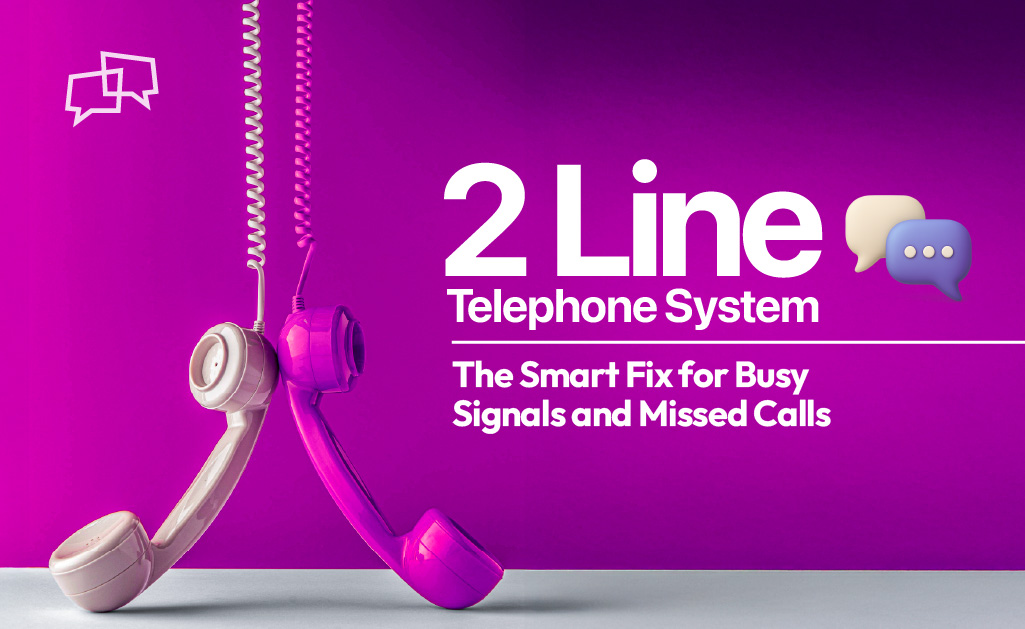
2-Line Telephone System:
A Smart Upgrade for Small Businesses
A 2-line telephone system lets small businesses handle two calls at once, eliminate busy signals, and improve professionalism with scalable VoIP options.
TL;DR — Quick Takeaways
- A 2-line telephone system allows your business to manage two simultaneous calls.
- It eliminates busy signals and improves customer experience instantly.
- Traditional analog systems work, but VoIP offers more flexibility and scalability.
- When call volume grows beyond two lines, a professional answering service ensures no opportunity is missed.
Is your single phone line constantly tied up, forcing potential customers to hear that frustrating busy signal? A 2-line telephone system is the classic fix, giving your business the power to handle two separate phone calls at the same time. Think of it as adding an express lane for your communications; while one conversation is happening on line one, a second call can be made or received on line two without missing a beat.
 Understanding the 2-Line Telephone System
Upgrading to a 2-line telephone system is often the first major step a growing business takes to appear more professional and stop losing valuable opportunities. It directly solves the “one-call-at-a-time” bottleneck by instantly doubling your communication capacity.
This simple upgrade can transform how you operate. For example, a small e-commerce shop can take a customer’s order on line one while simultaneously confirming a shipment with a supplier on line two. The customer on the first line receives a focused, professional experience, completely unaware another critical business call is happening.
How a 2-Line Telephone System Works
At its heart, a 2-line system is all about making sure you never miss a critical call. This is accomplished using one of two primary technologies, both of which achieve the same goal through different routes.
- Traditional Analog System: This is the old-school setup relying on physical copper wiring installed by a technician. You’ll need a special 2-line phone with buttons to switch between Line 1 and Line 2.
- VoIP (Voice over Internet Protocol) System: This modern approach uses your existing internet connection to create virtual phone lines. No extra physical wiring is needed, giving you far more flexibility and advanced features managed in the cloud.
The need for this kind of setup is nothing new. As businesses boomed in the early 20th century, the single phone line quickly became a major bottleneck. The incredible growth of telephone adoption—from around 600,000 phones in 1900 to 5.8 million by 1910—shines a light on how urgent the need was for multi-line systems to help businesses juggle calls more efficiently.
The key takeaway is that a 2-line system isn’t just about adding another line; it’s about creating operational efficiency and ensuring every customer can reach you.
Practical Applications of a 2-Line System
The ability to separate conversations is a genuine game-changer for many small operations. A freelance consultant can dedicate one line strictly for client work and use the second for personal calls, creating a clear professional boundary. Similarly, a doctor’s office can manage patient appointments on one line while handling insurance inquiries on the other.
This separation prevents calls from colliding and keeps business communications flowing smoothly. Of course, once your call volume outgrows what even two lines can handle, it’s time to consider a professional answering telephone service to ensure every single call gets captured.
Key Features and Benefits of a
2-Line Telephone System
A 2-line telephone system is about much more than just handling two calls at once. It’s the first real step up from a personal phone to a professional communication hub. These features aren’t just technical add-ons; they’re practical tools that create a more polished, productive, and customer-friendly operation.
The most immediate change is in your professional image. When a client calls and never gets a busy signal, it sends a powerful message: you’re organized, available, and ready for business. That small detail builds instant credibility.
Boosting Productivity with a 2-Line System
A 2-line system makes your team more effective by unlocking multitasking capabilities impossible with a single line.
Imagine a small consulting firm. A consultant is deep in a critical client call on line one when a vendor calls with time-sensitive information on line two. Instead of the call going to voicemail, they can professionally place the vendor on a brief hold, handle the client’s needs, and then seamlessly switch back.
This is all made possible by a few essential features of a 2-line telephone system:
- Call Waiting: Alerts you to an incoming call on the second line while you’re busy on the first, so no opportunity is ever missed.
- Call Transfer: Lets you seamlessly pass a call to another person or department, a game-changer for internal workflow. To learn more, see how to optimize call routing for faster service.
- Conferencing: Lets you merge both lines for a three-way conversation, perfect for on-the-fly collaborations with clients and teammates.
These features work in tandem to create a true communication command center, turning a simple phone into a business tool that prevents dropped calls and missed connections.
Ultimately, all of this funnels down to a dramatically better customer experience. Clients aren’t met with the frustration of a busy signal or left hanging. They’re greeted by a business that has its act together, which turns a one-time customer into a loyal advocate for your brand.
Comparing Single-Line vs.
2-Line vs. Modern VoIP Systems
Picking the right phone system is a critical decision that directly impacts how you communicate with customers and your ability to grow. Let’s compare the main options, from the most basic setup to a solution built for the future.
A single phone line is where most businesses start. It’s simple, but it’s a one-lane road with no room to maneuver. The second you’re on a call, your business is effectively closed to anyone else trying to reach you. That single limitation is what makes a 2-line telephone system such a vital upgrade.
From Limited to Limitless: How Phone Systems Scale
The jump from one line to two instantly doubles your call capacity, solving the immediate frustration of busy signals. However, both single and traditional 2-line analog systems share the same fundamental weakness: a hard physical ceiling. If you need a third line, you’re looking at another technician visit and another bill.
This is where modern VoIP systems change the game. Instead of being tied to physical wires, they create virtual phone lines over your internet connection. You can add or remove lines almost instantly from a simple online dashboard, giving you nearly endless room to scale.
While a 2-line telephone system is a vital step up for professionalism and efficiency, a modern VoIP system is the key to unlocking true, unrestricted growth for your communications.
This infographic sums up the core benefits you gain by upgrading your communication tools.

As you can see, a better system directly boosts professionalism, productivity, and the customer experience—the foundational pillars of any growing business.
Phone System Feature Comparison Table
This side-by-side comparison breaks down the key differences to help you choose the right solution.
| Feature | Single-Line System | 2-Line Telephone System | Modern VoIP/PBX System |
|---|---|---|---|
| Call Capacity | 1 active call at a time | 2 active calls at a time | Virtually unlimited; scalable on demand |
| Scalability | Very poor. Requires a new physical line. | Poor. Requires another technician visit for a 3rd line. | Excellent. Add or remove lines instantly online. |
| Professionalism | Low. Frequent busy signals for callers. | Good. Reduces busy signals, allows call holding/transfer. | High. Advanced features like auto-attendants. |
| Advanced Features | Basic. Voicemail and caller ID. | Moderate. Call waiting, transfer, 3-way calling. | Extensive. IVR, call recording, analytics, CRM integration. |
| Flexibility/Mobility | None. Tied to a physical desk phone. | None. Also tied to a physical location. | High. Take calls on desk phones, computers, or mobile apps. |
| Ideal For | Solopreneurs or very low-volume businesses. | Small businesses, clinics, or retail shops. | Any business planning to grow or needing advanced features. |
This table shows a clear progression. While a 2-line system is a fantastic step up, a modern VoIP solution is in another league entirely when it comes to features and future-proofing your business. For businesses looking to seriously ramp up their outreach, understanding how an automated calling system works shows what’s possible with modern tools.
And when your growth outpaces even the most flexible system? That’s a great problem to have, and it’s the perfect time to see how expert cloud call center solutions can manage that overflow professionally.

Who Needs a 2-Line System?
Industries and Use Cases
While the concept of a 2-line telephone system seems simple, its real power is in its practical application. This isn’t just office hardware; it’s a problem-solving tool that helps small businesses project professionalism and operate smoothly.
A two-line setup is a perfect fit for any business where multitasking is key to survival. The moment you find yourself juggling an appointment booking while trying to order supplies, you’ve hit the exact point where a single line becomes a liability.
Real-World Scenarios for a 2-Line System
Let’s look at how a 2-line phone system solves daily headaches in a few specific fields.
- Small Law Offices: A lawyer can keep line one strictly for confidential client conversations. Meanwhile, line two is free for calls with court clerks or opposing counsel. This separation is crucial for privacy and ensures a critical client call is never interrupted.
- Local Restaurants: The host can take reservations and takeout orders on the first line without missing an important call from a food supplier on the second. During the dinner rush, that simple split prevents missed orders and frustrated customers.
- Medical and Dental Clinics: The front desk can manage patient scheduling on line one while handling insurance verifications or calls from a pharmacy on line two. It’s a simple change that streamlines the entire operation and improves the patient experience.
This strategic separation of calls is more than a convenience—it’s the foundation of a structured, professional communication workflow that prevents costly errors and missed opportunities.
This technology has a surprisingly deep history. As telephone networks exploded in the early 20th century, two-line systems became essential for financial brokers who had to juggle client consultations and live transactions. When the Bell patents expired, this setup became a competitive advantage. You can dig into this pivotal era in the history of the telephone.
For businesses today, managing two conversations at once isn’t a luxury—it’s a core operational need. This is also where a professional phone call answering service can step in, ensuring that even when both your lines are busy, your customers are always greeted by a professional voice.
Knowing When to Upgrade
Beyond a 2-Line System
A 2-line phone system can be a fantastic workhorse for a growing business, but it isn’t a forever solution. Recognizing its limitations is key to keeping your growth smooth and your customers happy.
The most obvious red flag? Customers start complaining about getting a busy signal. That’s a direct sign that your call volume has officially outpaced what two lines can handle. If your team is constantly juggling calls and wishing for a third line, your phone system has become a roadblock.
Signs Your Business Has Outgrown a 2-Line System
Another tell-tale sign is when you need more advanced features. As your business gets more sophisticated, so do your needs for efficiency and data. A basic 2-line setup just can’t deliver the modern capabilities that help you scale properly.
Here are a few indicators it’s time to move on:
- You need data: You want to see call analytics—like peak hours, call duration, and missed call rates—but your current system is a black box.
- You need integration: Your team is wasting time manually keying caller info into your CRM when it could be automated.
- You need mobility: You want to support a remote or hybrid team with extensions that follow them anywhere, not just tied to a desk.
The moment your phone system creates more problems than it solves is the moment you’ve officially outgrown it. Busy signals, missed calls, and a lack of modern features are all shouting that it’s time to level up.
When you start thinking about an upgrade, it’s a good idea to explore the various essential customer service technologies for small businesses that go far beyond a simple dial tone. This is usually the point where scalable, cloud-based VoIP and PBX solutions become the logical next step.
And if your call volume grows even beyond what a new in-house system can manage, bringing in a BPO partner is a game-changer. CallZent’s virtual answer service with live agents can step in to handle that increased traffic, making sure every customer is greeted professionally as you continue to grow.
Where Do You Go From Here?
This guide has laid out how a 2-line telephone system can be a game-changer for professionalizing your business. It’s the smart, practical first step to stop missing calls, project a more polished image, and build momentum.
But a 2-line system is a stepping stone, not the final destination. As your hard work pays off and your business starts to take off, your needs will grow beyond what two lines can handle. The real market leaders are the ones planning for that success today.
Partnering for Smart, Scalable Growth
Think ahead to that moment when your 2-line system is ringing off the hook—a fantastic problem to have! That’s your signal. It means you’ve outgrown your starter setup and are ready for the next level of customer engagement.
Your goal should be to build a business so successful that your phone system just can’t keep up. When that day comes, you’ll need a partner ready to handle that growth without missing a single beat.
That’s where CallZent comes in. Once your phone system is bringing in more calls than your team can manage, our professional call center solutions are ready to step in. We provide the scalable, bilingual support you need to make sure every customer call is answered professionally. We’re here to help you capture every opportunity and keep your growth curve moving up and to the right.
Answering Your Questions About 2-Line Phone Systems
When considering a 2-line telephone system, a few common questions always pop up. Getting straight answers is the best way to figure out if it’s the right move for your business.
Can I Use My Existing Phone with a 2-Line System?
It depends. For a traditional analog system, no—you’ll need a special 2-line telephone that can physically handle two separate connections, with buttons to switch between Line 1 and Line 2. However, with a modern VoIP setup, you have more freedom. You can often use a standard IP phone or a “softphone” app on your computer or smartphone, since the lines are virtual.
How Much Does a 2-Line Telephone System Cost?
The price can vary. A traditional analog service usually involves a fixed monthly fee per line, plus the one-time cost of buying special 2-line phones. A VoIP-based system is generally more flexible, with pricing often based on the number of users rather than lines. For most businesses, VoIP ends up being more scalable and cost-effective over time.
Can I Have More Than One Phone Number on a 2-Line System?
Yes, absolutely. A 2-line system is about handling two simultaneous calls—it has nothing to do with how many phone numbers you have. It’s common to assign a different number to each line. For instance, a retail shop could use one number for customer service and a separate number for suppliers, all on the same 2-line phone.
Is a 2-Line System Difficult to Set Up?
Setup difficulty depends on the technology. A traditional analog system is more involved and will likely require a technician to physically install the second line. In contrast, a modern VoIP 2-line system is often a simple plug-and-play process where you connect IP phones to the internet and manage settings from an online dashboard.
🚀 Ready to Never Miss Another Call?
CallZent provides scalable call center and answering solutions that grow with your business — beyond what a 2-line telephone system can handle.
Schedule a CallAs your business grows, your communication needs get more complex. CallZent provides scalable, professional call center solutions to ensure every customer call is handled with expertise, letting you focus on what you do best. Explore our services at https://callzent.com.