Skip to content
Customer Support Strategy
24/7 Customer Service: The Ultimate Guide to Always-On Support
Is your business losing sales overnight? Learn how 24/7 customer service boosts revenue, improves retention, and scales efficiently with nearshore support.
TL;DR — Quick Takeaways
- 24/7 customer service is now a business necessity, not a luxury.
- Always-on support increases revenue, reduces churn, and boosts loyalty.
- Nearshore outsourcing offers the best balance of cost, quality, and alignment.
- A successful rollout requires strong KPIs, training, and the right partner.
Meta Title: 24/7 Customer Service: The Ultimate Guide to Always-On Support
Meta Description: Is your business losing sales overnight? This guide explores the ROI of 24/7 customer service and how nearshore outsourcing can provide a competitive edge.
Is your business truly open if your customer support isn’t? In today’s digital world, the 9-to-5 workday is a relic. Your customers live, shop, and seek help on their schedule—which often means long after your office has closed for the day. This shift has turned 24/7 customer service from a luxury perk into a fundamental requirement for competitive survival.
Meeting the Always-On Customer Demand
In a global, digital marketplace, your doors never really close. Someone might be ready to make a purchase at 2 AM, only to abandon their cart because of one simple, unanswered question. Another customer might need urgent help on a Saturday, far outside your typical Monday-to-Friday support hours. These aren’t just one-off situations; they’re the new standard.
Expecting people to wait for help is a surefire way to lose sales and frustrate your customer base. The truth is, every moment you’re unavailable is a potential sale lost and another crack in a customer’s loyalty. Research confirms that 83% of customers expect an immediate interaction when they reach out. When that doesn’t happen, they don’t just wait around—they leave.

The Real Cost of Being Unavailable
When you shut down your support lines at 5 PM, you’re creating blind spots that have a direct impact on your revenue. These missed opportunities pile up faster than most business owners realize, hitting the bottom line hard.
Think about these all-too-common scenarios where a lack of 24/7 customer service hurts your business:
- Abandoned Shopping Carts: A customer is about to buy a high-value item late at night but has a last-minute question on shipping. With no live chat or agent available, they simply close the tab. You just lost a sale.
- Negative Social Media Buzz: A user hits a frustrating bug on a Saturday morning. When they can’t reach support, they take their complaint to social media, where it quickly damages your brand’s reputation.
- Lost International Customers: A potential client in another time zone tries to get in touch during their workday—which happens to be the middle of your night. They can’t get the info they need and immediately pivot to a competitor who is available.
The critical takeaway is this: 24/7 availability isn’t just about service; it’s a powerful revenue-capture and brand-protection strategy.
Turning a Challenge into an Opportunity
The thought of staffing a team around the clock can feel overwhelming, especially for small and medium-sized businesses. The costs of hiring, training, and managing an in-house team to cover three different shifts can be a serious barrier. But if you approach it strategically, this challenge is actually a massive opportunity for growth.
Modern solutions have made constant availability more accessible than ever before. By partnering with a nearshore provider like CallZent, you can meet this customer demand without the overhead and complexity of trying to build it all yourself. A strategic partner can help you:
- Capture sales that would otherwise be lost overnight or on weekends.
- Improve first-contact resolution by providing immediate answers.
- Build unwavering customer loyalty by being there whenever they need you.
This isn’t about adding another cost center; it’s an investment in a real growth driver. Adopting an always-on model shows your customers that you value their time and their business, turning what was once a logistical headache into your new competitive edge.
Calculating the True ROI of Always-On Support
Thinking of 24/7 customer service as just another expense is a huge mistake. It’s a strategic investment that pays for itself, turning your support team from a cost center into a serious engine for revenue and retention.
When you break free from the old 9-to-5 model, the returns show up right where it counts—on your bottom line.
Picture this: it’s 11 PM, and a customer is on your website, credit card in hand. They have one last question about a product before they click “buy.” Without instant support, that sale disappears. With an agent ready to help, you not only secure the revenue but also create a customer who feels valued.
Boosting Key Performance Indicators Around the Clock
Round-the-clock availability isn’t just about plugging leaks in your sales funnel; it’s about actively building value at every stage of the customer journey.
Here are the specific metrics that get a major boost:
- Higher Customer Lifetime Value (CLV): When you’re always there to help, you build incredible trust and loyalty. Happy customers stick around, buy more often, and spend more over time.
- Improved Conversion Rates: A quick chat during checkout can be all it takes to answer a last-minute question and prevent cart abandonment. This simple touchpoint turns hesitant browsers into confident buyers.
- Reduced Customer Churn: If a customer has a problem on a Saturday, they don’t want to wait until Monday for a fix. Instant support stops frustration in its tracks and prevents them from jumping to a more responsive competitor.
This isn’t just a feeling; it’s a fact. Today, a staggering 74% of consumers expect customer service to be available 24/7. That expectation has completely reshaped the global market. Ignoring it means putting trillions of dollars in potential sales at risk.
The Financial Risk of Inaction
Figuring out the ROI for 24/7 support also means looking at the cost of doing nothing. The risks of sticking to limited hours are real, and they’re almost always bigger than you think. Every unanswered late-night email and unresolved weekend ticket chips away at both your revenue and your reputation.
A single negative experience can wipe out all the marketing dollars you spent to acquire that customer. Always-on support is the best insurance policy you can have against preventable customer loss.
Think about it. A high-value client runs into a technical glitch on a Friday night. If they can’t get help until Monday morning, they’re a major churn risk. The revenue lost from that one client could easily pay for an entire month of 24/7 support. Suddenly, it’s not an expense—it’s just smart risk management.
Partnering with a nearshore BPO offers a cost-effective way to get this incredible ROI. You get a skilled, bilingual team in your time zone without the sky-high costs of building an in-house 24/7 operation. To see exactly how the numbers break down, you can dig deeper into the ROI of outsourcing your call center and see how it saves you time and money.
Finding Your Ideal 24/7 Service Model
So, how do you actually deliver on the promise of 24/7 customer service without burning out your team or blowing your budget? This is where the rubber meets the road. Choosing the right operational model is one of the most critical decisions you’ll make, and it’s definitely not a one-size-fits-all solution.
The best approach hinges entirely on your business goals, who your customers are, and the financial realities you’re working with. Let’s walk through the main options, starting with the most traditional and moving toward more strategic, cost-effective alternatives.
The In-House Model
Keeping your support team in-house gives you absolute control. Your agents are your employees, steeped in your company culture, and you oversee everything from training to quality control. This direct management ensures every customer interaction perfectly mirrors your brand’s voice.
But that level of control comes at a premium. Providing true 24/7 coverage means hiring, training, and managing at least three separate shifts. You’re looking at complex scheduling, night-shift pay bumps, and major overhead for salaries, benefits, and office space. For most businesses, the logistical and financial weight is just too much to bear.
Understanding Outsourcing Options for 24/7 Customer Service
Outsourcing is the go-to strategy for achieving 24/7 support, but it’s crucial to understand that not all outsourcing partners are created equal. Where your partner is located is just as important as what they do, as geography directly affects cost, collaboration, and the quality of the customer experience.
To make an informed decision, you need to understand the differences between the primary staffing models. Each offers a unique blend of cost, control, and cultural alignment.
Comparing 24/7 Customer Service Staffing Models
| Model | Cost | Time Zone Alignment (for U.S.) | Cultural Proximity | Ideal For |
|---|---|---|---|---|
| In-House | Highest | Perfect | Perfect | Companies with large budgets and a need for absolute control over brand experience. |
| Offshore | Lowest | Poor | Low | Businesses focused purely on cost reduction, often for simple, non-voice tasks. |
| Nearshore | Balanced | Excellent | High | Businesses seeking a strategic balance of cost savings, quality, and seamless collaboration. |
This table shows a clear trade-off. While going offshore offers the biggest cost savings, it often comes at the expense of cultural and time zone alignment, which can frustrate customers and complicate operations. Nearshore, however, hits the sweet spot.
Here’s a quick breakdown of the main outsourcing paths:
- Offshore: This involves partnering with a center in a distant country, like India or the Philippines. The main appeal is a dramatic reduction in cost. The downside? You often run into significant time zone differences, language hurdles, and cultural disconnects that can leave American customers feeling misunderstood.
- Nearshore: This means outsourcing to a neighboring country, like Mexico. This model delivers the best of both worlds: substantial cost savings combined with close cultural and time zone alignment with the U.S.
The flowchart below cuts right to the heart of the matter, visualizing the fundamental choice businesses face when deciding whether to be available around the clock.
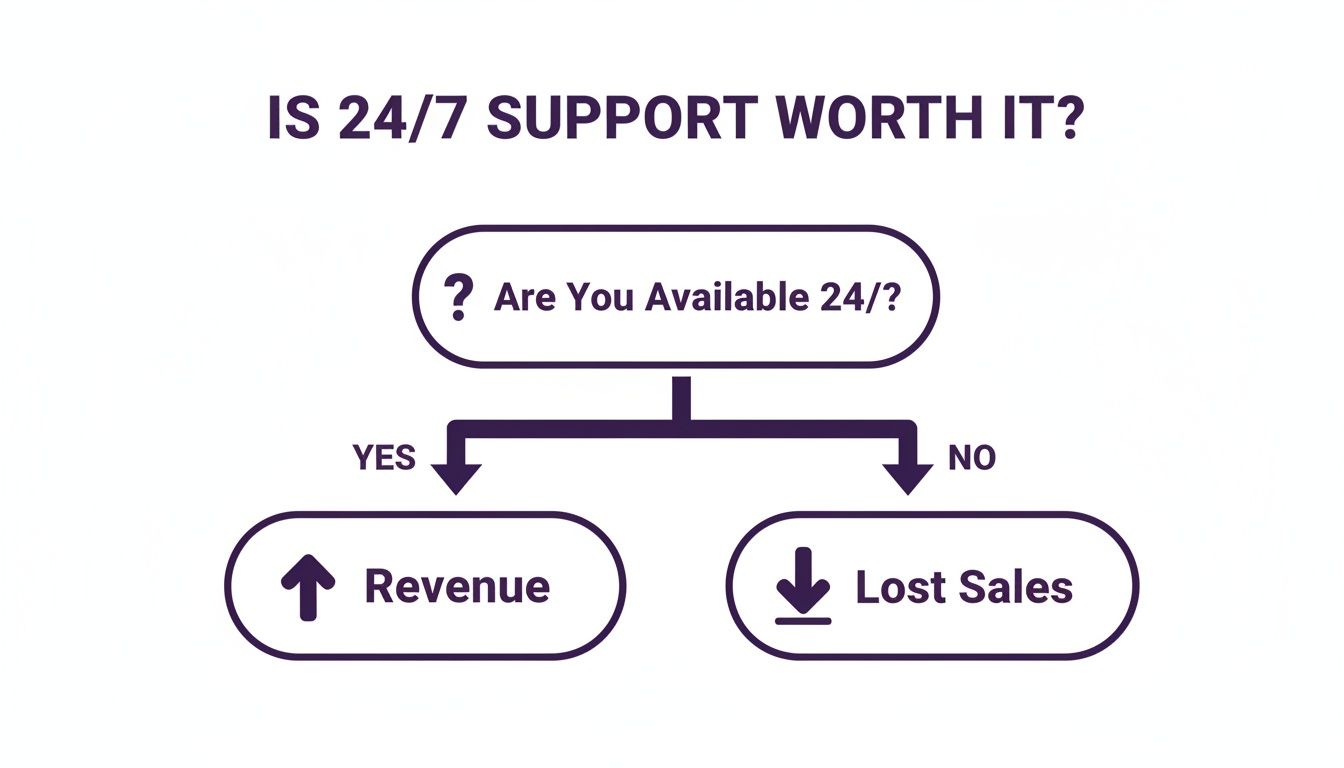
The takeaway is simple. Embracing 24/7 customer service is a direct investment in protecting and growing your revenue. Staying offline means you’re actively leaving money on the table.
The Nearshore Advantage For 24/7 Customer Service
For most North American businesses, the nearshore model has proven to be the smartest path forward. A partner in Tijuana, for example, operates in the same time zones as the U.S., which gets rid of the frustrating communication delays you see with offshore teams.
This proximity makes your outsourced team feel less like a vendor and more like a genuine extension of your own company.
Nearshore isn’t just about saving money; it’s about gaining a strategic advantage. You get a highly skilled, bilingual workforce that understands the nuances of your customer base without the extreme costs of an in-house team.
Agents in nearshore locations are also culturally in sync with American consumers, which leads to more natural, effective, and empathetic conversations. That cultural fluency is key to building real rapport and resolving problems quickly, giving your customer satisfaction scores a direct boost.
If you’re weighing the pros and cons, our guide on hiring vs. outsourcing bilingual agents breaks down the financial and operational details to help you make the right call.
The Rise Of Blended Models
Finally, a growing number of companies are using a blended or hybrid approach. This model combines skilled human agents with technology like AI-powered chatbots.
Bots can field simple, repetitive questions 24/7—things like “Where’s my order?” or “I need to reset my password.” This frees up your human agents to handle the more complex, high-stakes issues that require critical thinking and empathy.
This strategy can be incredibly powerful, but execution is everything. A clunky, poorly designed bot will create more frustration than it solves. The best hybrid models use AI to support a talented human team, always giving customers a clear and easy way to talk to a person when they need one.
Unlocking Superior Support with Nearshore BPO
Picking an outsourcing model is a huge strategic decision. For a lot of North American companies, though, the choice is becoming obvious. Nearshore BPO is the winning strategy for businesses that refuse to sacrifice quality just to save a few bucks. It’s the smart play for delivering exceptional 24/7 customer service.

A Tale of Two Outsourcing Models
Let’s look at a real-world example. A growing e-commerce company here in the U.S. first decided to partner with an offshore provider in Asia. The low price tag was tempting, but the hidden costs started piling up almost immediately. The 12-hour time difference alone created a massive communication lag, making real-time problem-solving impossible.
Worse, their customers were getting frustrated. The agents, while technically fluent in English, just didn’t get the cultural nuances and slang common in North America. This disconnect led to longer calls, terrible first-contact resolution (FCR) rates, and a nosedive in customer satisfaction (CSAT) scores. The brand they had built so carefully was starting to take a hit.
After nine months of this, they pulled the plug and switched to a nearshore partner in Tijuana, Mexico. The change was immediate and nothing short of dramatic.
The Power of Proximity and Cultural Fluency
Moving to a nearshore BPO model turned their support operations around almost overnight. Because their new team was in the same time zone, collaboration was finally seamless. Questions got answered in minutes, not days. The U.S. management team could work directly with their support leads just like they were in the next office over.
Here’s what made all the difference:
- A Bilingual and Bicultural Talent Pool: The agents in Tijuana weren’t just fluent in English and Spanish; they understood the cultural context. Conversations felt more natural and empathetic, leading to much faster resolutions.
- Drastically Improved CSAT: With agents who could actually connect with customers, CSAT scores shot up by over 20% in the first quarter alone.
- Higher First-Contact Resolution: Better training and a real understanding of the customer base meant agents could solve problems on the first try, sending FCR rates through the roof.
A nearshore BPO partner is more than just a vendor—they are a strategic extension of your team, fully dedicated to protecting and elevating your brand’s reputation around the clock.
This story isn’t a one-off. It proves a fundamental truth in modern customer service: you don’t have to choose between quality and cost-efficiency. Nearshore solutions strike the perfect balance, giving you access to a highly skilled workforce without the sky-high costs of an in-house team or the operational headaches of going offshore.
For any business serious about providing superior 24/7 customer service, the nearshore model just works.
Your Implementation Checklist for 24/7 Customer Service
So, you’ve decided to offer 24/7 customer service. Great move. Now for the hard part: actually making it happen. A smooth rollout needs a clear, step-by-step plan. This checklist will walk you through everything from planning to launch, making sure your new always-on support feels like a natural part of your brand.
Jumping into 24/7 support puts you right in line with a massive market trend. The global Contact Center as a Service (CCaaS) market is set to skyrocket from $8.33 billion in 2026 to $30.15 billion by 2034. This explosion proves just how vital uninterrupted support is for staying competitive. You can discover more insights into this growing market on CMSWire.
Phase 1: Define Your Foundation
Before you build anything, you need a blueprint. This phase is all about setting clear goals and expectations for your 24/7 operation. Get this right, and you’ll avoid confusion down the line.
-
Map Your Customer Journey: Pinpoint every touchpoint where a customer might need help, day or night. This includes everything from pre-sale questions and post-purchase support to technical glitches and billing issues. Understanding this map shows you where 24/7 support will make the biggest difference.
-
Establish Clear Service Level Agreements (SLAs): Don’t just aim for “fast.” Define what success looks like with specific, measurable targets. Realistic SLAs are the foundation of consistent service.
- Live Chat: Aim for an initial response in under 60 seconds.
- Email: Target a first response within 1-4 hours, even overnight.
- Phone Calls: The industry standard is to answer 80% of calls within 20 seconds.
-
Choose Your Key Performance Indicators (KPIs): Beyond SLAs, decide how you’ll measure success. Key metrics like First Contact Resolution (FCR), Customer Satisfaction (CSAT), and Average Handle Time (AHT) are essential. A true BPO partner will help you track and analyze these from day one.
Your SLAs and KPIs aren’t just internal metrics; they are a promise to your customer. Define them carefully and collaboratively with your service partner.
Phase 2: Build Your Tech and Training Stack
With your goals set, it’s time to get the right tools and knowledge in place. Technology and training have to work together to create a consistent, high-quality customer experience.
-
Select the Right Tech Stack: Your team needs the right gear. A modern CRM is non-negotiable for tracking customer history. A shared helpdesk platform like Zendesk or Freshdesk ensures every agent sees the same information, so customers never have to repeat themselves.
-
Develop Robust Training Materials: Your brand voice is its personality. Create a comprehensive training manual that covers company history, product details, and—most importantly—your specific tone. Use real-world examples and role-playing scenarios to show agents exactly how to sound like you.
-
Create Clear Escalation Paths: Not every problem can be solved by a frontline agent. You need a clear, tiered system for escalating complex or urgent issues. Who does an agent call at 3 AM for a server outage? The plan must be rock-solid to prevent delays and frustration. For more on this, check out our guide on implementing Service Level Agreement best practices, which is crucial for managing escalations.
Phase 3: Launch and Collaborate
The final step is going live, but the work doesn’t stop there. A successful launch is a partnership between your company and your BPO provider, focused on constant improvement. A partner like CallZent doesn’t just follow a script; we work with you.
This means a phased rollout, maybe starting with a small group of agents or a single channel to iron out any kinks. We’ll set up regular meetings to review performance, discuss agent feedback, and tweak the strategy. This partnership ensures your outsourced team acts as a perfectly integrated part of your organization, delivering exceptional 24/7 customer service that drives real growth.
Choosing the Right BPO Partner for Your Brand
Picking a partner for your 24/7 customer service is the single most important decision you’ll make in this entire process. This choice goes way beyond a sales pitch or a price sheet; it’s about finding a team that will become a true extension of your brand, protecting your reputation around the clock.
The right partner becomes part of your company’s DNA. The wrong one can cause damage to customer trust that’s nearly impossible to repair. You have to look past the marketing fluff and dig into the real operational and cultural guts of any potential provider.
Assessing Core Competencies and Security
Before you even get to pricing, you need to confirm a BPO’s core capabilities. Their experience and security measures are the non-negotiable foundation of any successful partnership.
- Industry-Specific Experience: Do they actually know your industry? A BPO that serves an e-commerce brand needs a totally different skill set than one supporting a healthcare company with strict HIPAA compliance rules. Ask for case studies and references from clients in your specific field.
- Robust Security Infrastructure: How do they protect your data and your customers’ private information? Dig into their data protection policies, network security, and even physical security. A data breach is a brand catastrophe, so don’t be shy about investigating this area thoroughly.
- Technological Proficiency: What tech are they running on? Make sure their platforms are modern and can integrate smoothly with your own systems, like your CRM or helpdesk software.
The Human Element: The Agent-Centric Difference
All the technology and security in the world mean nothing without the right people on the other end of the line. A happy, well-trained, and motivated agent delivers far superior service. This is where an agent-centric culture becomes a huge differentiator.
When you’re vetting a partner, ask direct questions about their people:
- How do you hire and train agents to truly capture a client’s brand voice?
- What’s your agent retention rate, and what specific steps do you take to keep it high?
- How do you empower agents to solve problems on their own?
A BPO that invests in its people is investing in your customers. Low agent turnover means more experienced, knowledgeable representatives handling your calls, which directly translates to higher customer satisfaction.
When selecting a BPO partner for your 24/7 customer service, exploring insights from top remote companies can also help inform your decision on operational models and best practices for managing distributed teams effectively.
Ultimately, look for a partner with a collaborative mindset. They should want you involved in strategy and performance reviews, ensuring you’re both perfectly aligned on your long-term goals. Making a confident choice means finding a provider who values both their process and their people.
Answering Your Top Questions About 24/7 Service
Thinking about making the leap to 24/7 customer service? It’s a big move, and we get that you probably have a few questions. We’ve heard them all, so here are the straight-up answers to the most common concerns from businesses just like yours.
Is 24/7 Service Affordable for a Small Business?
It absolutely can be, but the key is being smart about how you build it. Trying to hire an in-house, around-the-clock team will get expensive fast, especially for a small business.
This is where a nearshore model changes the game. By partnering with a team in a nearby location like Tijuana, you get skilled, bilingual agents for a fraction of what you’d pay at home. What looks like a massive expense becomes a surprisingly manageable investment with a serious ROI.
How Can I Ensure an Outsourced Team Represents My Brand?
This is a big one, and it all comes down to finding a true partner, not just a call-taker. A great partner lives and breathes your brand.
The process starts with deep-dive training on your products, company culture, and unique brand voice. They don’t just read from a script; they become a genuine extension of your team. With ongoing quality checks, you can be confident your brand is represented perfectly on every single call or chat.
What Are the First Steps to Transition from 9-to-5?
Your first step is simply to map it all out. Start by defining what success looks like—your service level agreements (SLAs). From there, you’ll choose your tech (like a CRM and helpdesk) and get your training materials ready.
We often recommend a phased rollout. Kicking things off with just one channel, like email or live chat, lets you iron out any wrinkles before you go all-in.
The most important decision is choosing a partner who guides you through this checklist, ensuring a smooth and successful transition.
Will AI Chatbots Replace Human Agents?
Nope, but AI is definitely changing the job for the better. The future of customer support is a smart blend of human and AI working together.
AI is fantastic for answering the simple, repetitive questions that come in 24/7. This frees up your human agents to handle the complex, emotional issues where a real conversation makes all the difference. To see how this can work, just look at how companies like Polychat use a mix of resources on their general Polychat’s customer support page to cover the basics.
🚀 Ready to Deliver 24/7 Customer Service?
CallZent helps businesses implement always-on support with nearshore, bilingual teams that drive results and improve customer experience.
Schedule a CallReady to provide exceptional 24/7 customer service without the complexity? CallZent offers custom-fit nearshore solutions that deliver quality and cost-efficiency. Contact us today to build your always-on support team.