Skip to content
Nearshore vs Offshore Outsourcing
Nearshore vs Offshore Outsourcing: What’s Really Best for Your Business?
Understand the real operational, financial, and compliance differences between nearshore and offshore outsourcing—and discover which model creates the best customer experience, collaboration, and long-term ROI.
TL;DR — Quick Takeaways
- Nearshore outsourcing (e.g., Mexico) delivers real-time collaboration, cultural alignment, high-quality customer interactions, and strong data security—saving 30–50% with minimal friction.
- Offshore outsourcing (e.g., Philippines, India) maximizes cost reduction (up to 70%) but introduces time zone gaps, cultural disconnects, and quality-control challenges.
- Strategic trade-off: nearshore prioritizes operational agility and quality, while offshore emphasizes low labor costs.
- Best for U.S. businesses: Nearshore offers the strongest balance of cost efficiency and operational excellence—especially in regulated or customer-facing industries.
Are you leaving money on the table or risking customer loyalty with your current outsourcing strategy? The choice between nearshore and offshore outsourcing isn’t just about geography; it’s a strategic decision that pits cost against control. Nearshore offers superior collaboration and quality control due to time zone and cultural alignment, while offshore provides more aggressive labor cost savings but often introduces operational friction. The right choice hinges on whether you prioritize seamless integration or pure cost reduction.
Defining the Outsourcing Battleground: Nearshore vs Offshore
Choosing an outsourcing partner is one of the most critical decisions a modern business can make, directly impacting everything from customer satisfaction to your bottom line. The “nearshore vs offshore” debate isn’t just about location; it’s a strategic choice between two fundamentally different operational models. Getting this right means taking a clear-eyed view of what each model truly offers beyond just the sticker price.
This infographic breaks down the core differences in time zone, culture, and operational control.
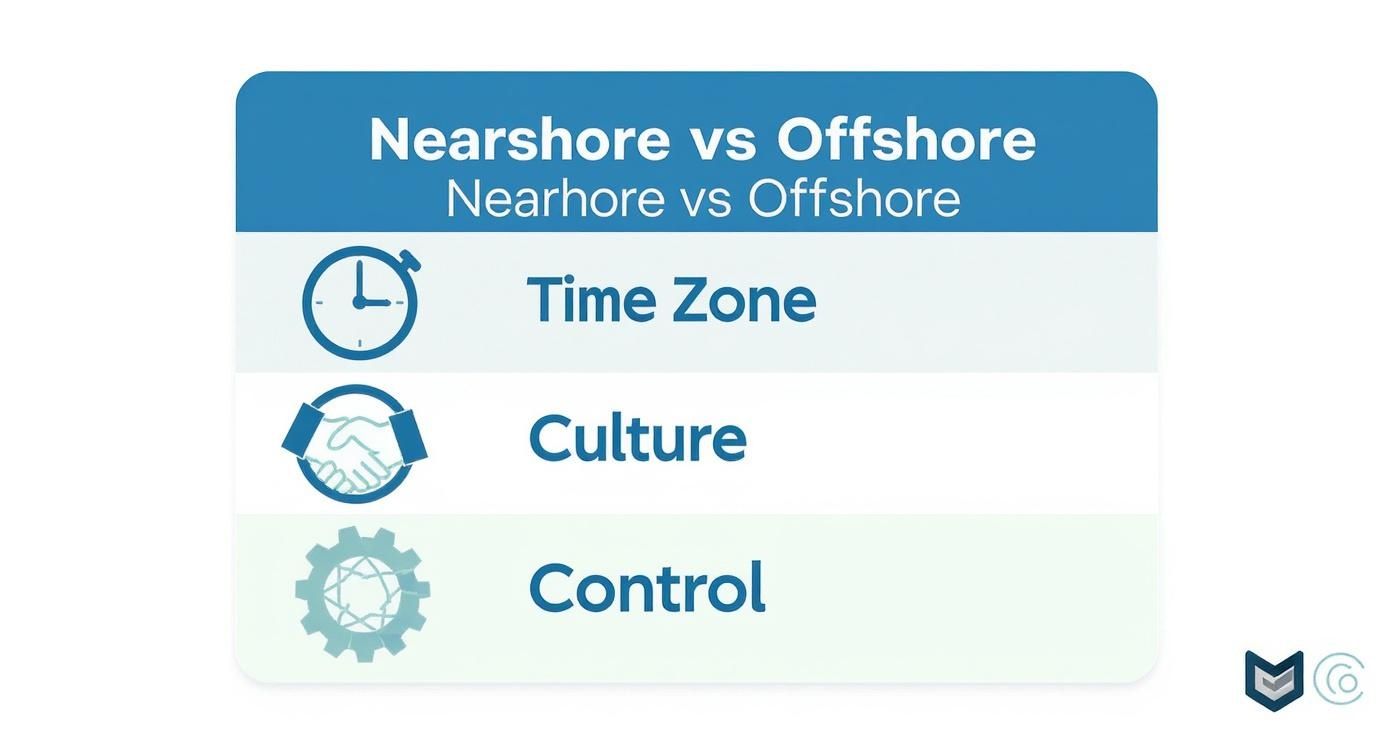
As you can see, the nearshore model shines in areas that demand high-touch collaboration. The offshore model’s main draw is its potential for significant cost reductions, though that usually comes with compromises.
What is Nearshore Outsourcing? A Closer Look
Nearshore outsourcing simply means partnering with a BPO or call center in a neighboring country or one that shares a similar time zone. For a U.S.-based company, that typically points to partners in countries like Mexico or Canada. The real value here is proximity, which fuels real-time collaboration, makes site visits easy, and creates a strong cultural connection.
Practical Example: A U.S. e-commerce brand working with a Tijuana-based call center like CallZent can have their teams collaborate on a new sales script in the morning and see it go live by the afternoon. That’s an agility that’s nearly impossible to achieve with a 12-hour time difference.
What is Offshore Outsourcing? Weighing the Distance
Offshore outsourcing, on the other hand, involves delegating business processes to a company much farther away—think the Philippines, India, or Eastern Europe. Historically, the primary driver for this model has been access to a massive talent pool at a much lower labor cost. While the financial appeal is undeniable, it often comes with hurdles like major time zone gaps, cultural disconnects, and potential communication barriers. For a more exhaustive breakdown, check out this definitive guide to Nearshore vs Offshore.
Side-by-Side Comparison: Nearshore vs Offshore At a Glance
Sometimes you just need a quick, side-by-side look to see how things stack up. This table provides a summary of the key strategic differences between nearshore and offshore BPO and call center services.
| Factor | Nearshore (e.g., Mexico) | Offshore (e.g., Philippines, India) |
|---|---|---|
| Time Zone | Overlapping or identical (0-3 hours difference) | Significant difference (8-12+ hours) |
| Cultural Affinity | High similarity, shared media, and consumer habits | Varies significantly, may require extensive training |
| Travel & Oversight | Easy, cost-effective (short flights, drivable) | Difficult, expensive, and time-consuming |
| Collaboration | Real-time, agile, and seamless | Asynchronous, requires overnight communication |
| Labor Cost | Moderate savings (30-50% less than onshore) | Highest savings (up to 70% less than onshore) |
| Data Security | Often aligned with U.S. legal/privacy standards | Varies by country, can pose compliance risks |
This at-a-glance view makes the core trade-offs crystal clear. Nearshore is your go-to for agility and alignment, while offshore remains the leader for deep cost-cutting, provided you can manage the distance and differences.
How Proximity and Culture Impact Your Operations
Geography is much more than just a pin on a map—it’s a critical driver of your business performance. When you’re weighing nearshore vs. offshore, proximity isn’t just about convenience; it’s about agility. The power to collaborate in real-time is a massive competitive advantage, and it’s often the first thing you lose when your team is halfway around the world.
Think about it this way: a critical customer issue flares up at 2 PM Pacific Time. With a nearshore partner in Tijuana, your in-house manager can jump on a video call instantly with the support team. They can troubleshoot, map out a plan, and roll out a solution before your business day is even over. That seamless, in-the-moment interaction is only possible because of shared or nearly identical time zones.

The Strategic Value of Shared Time Zones in Nearshore Models
Now, let’s replay that scenario with an offshore partner in Asia. That same 2 PM PT problem lands squarely in the middle of their night. Communication degrades into a frustrating cycle of overnight emails and delayed replies, dragging a one-hour problem into a 24-hour ordeal. This operational friction doesn’t just slow you down—it directly chips away at customer satisfaction.
The closer your outsourcing partner is in time, the faster your business can move. This isn’t just a “nice-to-have.” It’s fundamental to maintaining momentum and responsiveness. For a deeper look at this, you can explore the strategic advantages of time zone alignment in call center outsourcing.
This alignment also makes oversight and team integration far easier. Hopping on a flight to Tijuana for a quarterly review or a hands-on training session is a quick, inexpensive trip. That same visit to an offshore location balloons into a multi-day, high-cost event that disrupts workflows for everyone involved.
Cultural Affinity: The Engine of Customer Connection
Beyond time zones, cultural affinity is a crucial factor that too many businesses underestimate. When your agents intuitively grasp the cultural nuances, slang, and expectations of your customers, the quality of service skyrockets. Agents in Latin America share countless cultural touchstones with North American consumers, which leads to more natural, empathetic, and effective conversations.
An agent who understands a customer’s subtle joke about a recent holiday or a pop culture reference can build rapport instantly. They turn a standard support call into a positive brand experience. This intuitive connection is nearly impossible to replicate with teams from vastly different cultural backgrounds.
This cultural bridge delivers tangible business results. For instance:
- Higher Customer Satisfaction (CSAT) Scores: Customers feel genuinely understood, which translates to better feedback.
- Increased First-Call Resolution (FCR): Fewer misunderstandings mean problems get solved correctly the first time.
- Stronger Brand Loyalty: Positive, human-centric interactions build the kind of trust that keeps customers coming back.
Ultimately, choosing a nearshore partner is an investment in operational smoothness and a superior customer experience. The benefits of proximity and cultural alignment aren’t just buzzwords; they are real-world advantages that boost efficiency, reduce friction, and build a much stronger connection with your customer base.
Calculating the True Cost of Your BPO Partner
When comparing nearshore vs. offshore outsourcing, it’s easy to get fixated on the hourly rate. But if you’ve been in business for a while, you know the hard truth: the cheapest hourly rate rarely translates to the lowest total cost. Focusing only on that number is a rookie mistake, as it completely ignores the hidden expenses that pile up and wipe out those initial savings.
To make a smart decision, you have to look at the Total Cost of Ownership (TCO). This gives you the real financial picture, forcing you to look past the invoice and account for everything that hits your budget—from management headaches to the price of a simple miscommunication.

Uncovering the Hidden Costs of Offshore Models
For decades, offshore outsourcing has been a go-to strategy, promising dramatically lower labor costs with rates that can be 40% to 70% cheaper than onshore options. But this advantage often comes with serious trade-offs that quietly inflate your expenses.
Let’s pull back the curtain on where these extra costs really come from:
- Bloated Management Overhead: Managing a team 12 hours away is a different beast entirely. Your stateside managers will burn hours on late-night calls, writing painfully detailed emails to prevent misunderstandings, and clarifying things that would have been a five-minute chat with a nearshore team. That lost productivity is a very real, and very measurable, cost.
- Sky-High Travel and Training Expenses: Getting on-site is non-negotiable for building relationships and ensuring quality. A flight to Tijuana for a strategy session is an easy day trip. A similar visit to the Philippines or India? That’s a massive logistical headache involving pricey flights, hotels, and days of downtime for your most important people.
- The Sinking Cost of Rework: When you’re working across a 12-hour time difference, miscommunications are bound to happen. A slightly unclear instruction sent at the end of your day can lead to an entire day of wasted work by the offshore team, forcing expensive do-overs. These errors, born from cultural or language gaps, directly drive up project costs and throw timelines off track.
How Nearshore Slashes Your Total Cost of Ownership
This is where the nearshore model really starts to shine. While the hourly rate might be a bit higher than in far-flung offshore locations, the operational smoothness it creates results in a much lower TCO.
The real value of a nearshore partner isn’t just in the savings—it’s in what you avoid spending money on. You sidestep the high price of communication friction, rework, and excessive management.
Let’s put this in real-world terms. Imagine a U.S. e-commerce company using an offshore call center. A major website glitch hits at 3 PM EST. By the time the offshore team even starts their day, you’ve lost hours of sales. With a nearshore partner in Tijuana, that problem gets spotted and escalated in real-time, drastically cutting downtime and protecting revenue.
When you dig into the numbers, the savings become even clearer. If you’re ready to see every line item, our guide provides a complete call center outsourcing cost breakdown.
This is the point where the financial argument for nearshore becomes undeniable. By getting rid of the operational drag and communication hurdles that come with a distant team, a nearshore partnership lets your business run smoother, solve problems faster, and get a better return on your investment. That slightly higher rate more than pays for itself in pure efficiency and quality.
Navigating Security and Compliance Across Borders
For any company in a high-stakes industry like finance, healthcare, or e-commerce, data security isn’t just a nice-to-have; it’s the bedrock of your business. When you’re weighing a nearshore vs offshore partner, you’re not just hiring a vendor. You’re choosing a legal jurisdiction to entrust with your customers’ most sensitive information. A single compliance slip-up can unleash crippling fines, messy legal battles, and a permanent crater in customer trust.
The global legal and regulatory landscape is a minefield. Different countries have wildly different standards for data privacy, breach notifications, and consumer rights. This gap creates a massive risk factor that has to be front and center in your decision.
The Nearshore Advantage in a Regulated World
One of the strongest arguments for nearshoring, particularly to a partner in Mexico, comes down to legal and regulatory alignment. Countries like Mexico have built their data privacy standards and legal frameworks to mirror those in the U.S. and Canada. This isn’t a coincidence—it’s reinforced by powerful trade agreements like the United States-Mexico-Canada Agreement (USMCA), which helps create common ground rules for digital trade and data protection.
This alignment makes for a predictable and secure operational environment. If you’re a U.S. healthcare company, it means your nearshore partner is already wired to respect the intense privacy demands of regulations like HIPAA. For a financial services firm, it means they understand the seriousness of PCI DSS compliance. This shared legal DNA simplifies audits, smooths out compliance checks, and dramatically lowers the risk of an accidental violation.
The strategic benefit of nearshore compliance is predictability. When your partner operates under a familiar legal framework, you spend less time trying to become an expert on foreign regulations and more time growing your business, knowing your data is handled correctly.
The Compliance Risks of Offshore Outsourcing
On the other hand, going offshore often feels like stepping into a fragmented and confusing legal world. The data privacy laws in many popular offshore hubs can be dramatically different from—and sometimes in direct conflict with—U.S. regulations. This creates serious compliance headaches that can put your entire operation on the line.
Practical Example: A data breach occurs. A U.S. company is legally required to notify its affected customers within 30 days. But the laws in their offshore partner’s country might not have a mandatory timeline at all. This conflict puts you in an impossible bind, forcing you to choose between violating U.S. law or the local regulations your partner must follow.
Here are a few common risks that come with the offshore model:
- Conflicting Data Sovereignty Laws: Some countries legally require customer data to be stored on local servers, which can directly clash with your company’s data policies and U.S. rules.
- Varying Intellectual Property Protection: The enforcement of IP laws can be much looser in some offshore locations, leaving your proprietary software and business processes exposed.
- Inconsistent Security Standards: While many offshore providers hold certifications, the baseline national standards for cybersecurity might not be as rigorous, creating vulnerabilities.
In the end, the peace of mind that comes from a compliant and secure nearshore partnership is invaluable. To see what this looks like on the ground, you can learn more about security and compliance in Mexico BPOs.
Matching Your Industry to the Right Outsourcing Model
Deciding between a nearshore and an offshore partner isn’t just about crunching numbers. It’s a strategic choice that has to line up with the real-world demands of your industry. The ideal model for a high-growth e-commerce brand is worlds away from what a heavily regulated financial firm requires. Generic advice falls flat when compliance, customer trust, and operational security are on the line.
The things that matter most in your industry—whether it’s bulletproof data protection, instant customer engagement, or empathetic support—should drive your outsourcing strategy.
Healthcare: Why Patient Support Thrives with Nearshore BPO
In healthcare, the stakes couldn’t be higher. Every patient interaction demands a careful blend of empathy, accuracy, and absolute confidentiality. This is one area where the nearshore model isn’t just a good choice; it’s a clear winner.
The biggest hurdle is always compliance with the Health Insurance Portability and Accountability Act (HIPAA). Nearshore partners in Mexico operate within a legal framework that mirrors U.S. data privacy standards, which makes implementing and auditing HIPAA-compliant processes far more straightforward. This drastically lowers the risk of a breach that could cost millions and shatter patient trust for good.
Then there’s the human element. A patient calling about a confusing medical bill or a sensitive health issue needs to feel genuinely heard. Agents who share a close cultural and linguistic background can provide that nuanced, empathetic support.
Financial Services: Where Nearshore Security is Paramount
For any business in the financial sector, security is the entire foundation. Protecting sensitive financial data means strict compliance with standards like the Payment Card Industry Data Security Standard (PCI DSS) is non-negotiable.
Here, the proximity of a nearshore partner becomes a massive advantage. It’s so much easier to manage and audit security protocols when your partner is just a short flight away. You can conduct on-site security reviews and work on risk management face-to-face, ensuring your standards are met without compromise.
In finance, control is everything. The ability to closely monitor security practices and enforce compliance protocols in real-time is a non-negotiable advantage that strongly favors the nearshore model.
E-commerce and Retail: How Nearshore Improves the Customer Experience
For e-commerce and retail brands, customer experience is the brand. Your success depends on fast, helpful, and friendly support, especially during peak shopping hours. In the nearshore vs offshore debate, the need for real-time responsiveness settles the argument.
Having a nearshore call center in the same time zone as your customers is a game-changer. When a customer has a product question at 3 PM on a Friday, they need an answer right then and there—not the next morning. Nearshore agents are available during those critical business hours to solve problems, stop cart abandonment, and even secure upsells. That instant availability is something offshore models just can’t offer.
Plus, bilingual agents in a nearshore center can easily serve a wider customer base, which is critical in the diverse North American market. If you want to see how this model drives real results, you can learn about our e-commerce BPO services and get a deeper look.
An Industry-Specific Verdict: Nearshore vs Offshore Recommendations
For any business where sensitive data, regulatory alignment, and real-time collaboration are top priorities, the nearshore model isn’t just a better option—it’s the only one that makes strategic sense.
| Industry | Primary Concern | Recommended Model | Reasoning |
|---|---|---|---|
| Healthcare | HIPAA Compliance & Patient Empathy | Nearshore | Aligned data privacy laws and cultural affinity ensure secure, compassionate patient support. |
| Finance | PCI DSS Compliance & Data Security | Nearshore | Proximity allows for easier security audits and hands-on oversight of stringent protocols. |
| E-commerce | Real-Time Support & Sales Conversion | Nearshore | Shared time zones enable immediate customer service during peak hours, preventing lost sales. |
| General BPO | Aggressive Cost Reduction | Offshore | Best suited for non-customer-facing tasks where cost is the absolute top priority. |
Common Questions on Nearshore vs. Offshore Outsourcing
As you get closer to a decision, a few key questions always seem to pop up. Moving past the glossy brochures and into the real-world implications of each model is what separates a good choice from a great one. Let’s dig in.
What Is the Biggest Hidden Cost in Offshore Outsourcing?
The biggest hidden cost is almost always the massive management overhead required to operate across a 12-hour time difference and a significant cultural gap. This isn’t just an inconvenience; it eats into your bottom line in a few painful ways:
- Constant Rework: When a simple misunderstanding crops up due to language nuances or communication lag, you can lose an entire day’s work. The cost of redoing tasks and the resulting project delays can quickly wipe out any initial savings.
- Managerial Burnout: Your domestic managers end up on late-night calls and writing painstakingly detailed emails to prevent mistakes. That’s time and energy they should be spending on strategic work, not firefighting.
- Bloated Travel Expenses: Need to do some in-person training? A quick day trip to a nearshore location like Tijuana turns into an expensive, week-long international journey when your team is on the other side of the world.
How Does Nearshore BPO Improve Customer Satisfaction?
Nearshore outsourcing gives your Customer Satisfaction (CSAT) scores a direct lift by creating a much more natural, intuitive connection between agents and customers. It really boils down to two things: cultural familiarity and immediate responsiveness. At its core, great business process outsourcing is all about positive human interactions, and proximity gives you a huge advantage there.
Agents in a nearshore location like Mexico just get the North American consumer. They share cultural reference points, from holidays to buying habits. This shared context lets them build real rapport and show genuine empathy. Your customer feels heard, not just handled.
A customer doesn’t want to feel like they’re being managed by a script; they want to feel heard by a person. Nearshore agents, with their high cultural affinity, excel at turning standard support calls into memorable, positive brand experiences that build lasting loyalty.
Plus, with overlapping business hours, your customers get help when they actually need it. No more waiting overnight for an answer. That single factor dramatically boosts first-call resolution rates and leaves customers feeling cared for.
Is Nearshore a Good Fit for a Small Business?
Absolutely. In fact, nearshore BPO is often the perfect growth strategy for small and medium-sized businesses (SMBs). It hits the sweet spot, delivering serious cost savings without forcing you to sacrifice the quality and control that smaller companies live and die by. Most SMBs simply can’t afford the operational headaches or brand damage that can come from a poorly managed offshore relationship.
The nearshore model lets you tap into top-tier talent, modern technology, and scalable infrastructure without the massive capital investment of building it yourself. It’s a way to punch above your weight class.
Most importantly, nearshore partners like CallZent offer the kind of flexibility that a growing business needs. You can start with a small, dedicated team and scale up seamlessly as you win more customers. That scalability, combined with a high degree of collaboration and control, makes nearshore a powerful, low-risk tool for ambitious SMBs ready to compete with the big guys.
🚀 Ready to Scale with a Nearshore Partner You Can Trust?
CallZent helps businesses reduce costs, improve customer experience, and scale operations with elite nearshore teams in Mexico.
Ready to see how a nearshore partnership can drive your business forward? The team at CallZent has over two decades of experience helping companies scale efficiently while enhancing customer satisfaction. Contact us today to build your custom BPO solution.