Skip to content

Customer Experience
Why First Call Resolution Matters: Boost CX & Reduce Costs
Learn what First Call Resolution (FCR) is, why it’s a critical KPI for customer satisfaction and operational efficiency, and how to improve it.
TL;DR — Quick Takeaways
- First Call Resolution (FCR) measures how often customer issues are resolved on the first attempt.
- High FCR drastically boosts customer satisfaction and long-term loyalty.
- Improving FCR reduces repeat call volume and significantly lowers operational costs.
- Clear processes, empowered agents, and strong knowledge systems are essential to increasing FCR.
We’ve all been there. You call a company with a simple problem, only to get stuck in a maze of transfers, endless hold music, and repeating your story to five different people. It’s frustrating, inefficient, and a massive waste of time.
Now, imagine the opposite. You make one call, explain your issue once, and the agent on the other end provides a complete solution right then and there. That seamless experience is the power of First Call Resolution (FCR), and it’s not just good customer service—it’s the gold standard.
 The Power of a One-Call Solution
First Call Resolution is a key performance indicator (KPI) that tracks your team’s ability to completely resolve a customer’s problem during their first contact. No follow-up calls, no additional emails, no reopening a chat ticket. It’s the ultimate measure of an empowered team and a streamlined support process.
For customers, a one-call solution shows you respect their time and are equipped to solve their problems effectively. It can single-handedly turn a negative situation into a positive brand experience. For your business, a high FCR is a clear sign of operational excellence and a smart investment in customer loyalty.
What Does First Call Resolution Actually Measure?
At its core, FCR isn’t just about speed; it’s about the quality and completeness of the resolution from the customer’s perspective. It answers one critical question: “Did we fully solve the customer’s problem so they don’t have to contact us again?”
This metric is a cornerstone of great customer support because it directly impacts both customer loyalty and operational costs. The industry average FCR rate hovers around 70%, meaning nearly one-third of all customers need to make a second contact. For more complex issues, that rate can plummet to 47%. Getting it right the first time is a significant challenge, but mastering it separates great call centers from the rest. You can find more First Call Resolution benchmarks on medallia.com.
“Every follow-up call is a missed opportunity to build trust. FCR turns a potential problem into a definitive moment of brand loyalty.”
Achieving a high FCR rate requires more than skilled agents. It demands a culture of genuine empathy and a commitment to understanding the customer’s real issue, which starts with listening. To elevate your team’s skills, explore our guide on the power of active listening in call centers. Mastering this skill is a foundational step toward solving problems on the first attempt.
Why FCR Is a Game-Changer for Your Business
Treat First Call Resolution as more than just a number on a performance dashboard. It’s a direct reflection of your company’s efficiency and how much you value your customers’ time. A high FCR rate sends a clear message: “We are organized, capable, and here to solve your problem, not waste your day.”
When you solve an issue in a single interaction, you transform a moment of frustration into one of trust. That single positive experience can be the difference between a lifelong customer and one who switches to a competitor.
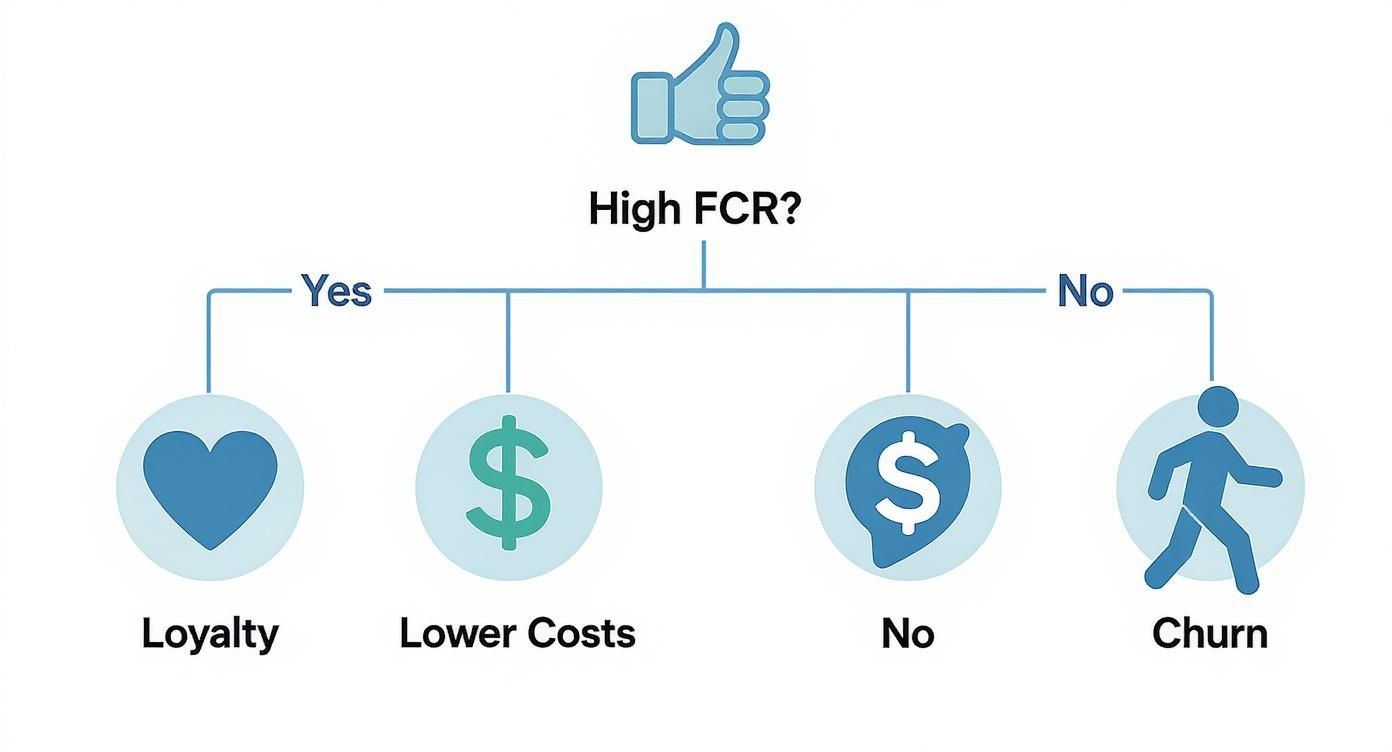
The Direct Link Between First Call Resolution and Customer Loyalty
A high FCR rate is one of the most powerful engines for customer retention. It’s simple: when customers know they can count on you for a fast, effective solution, they have no reason to look elsewhere. This reliability builds a level of brand loyalty that is difficult for competitors to penetrate.
Real-world example: A customer calls their internet provider because their Wi-Fi is down.
- Low FCR: The agent has them reboot the router, which doesn’t work. They promise a callback from a technician that never comes. The customer has to call back the next day, frustrated and ready to switch providers.
- High FCR: The agent quickly identifies a network outage in the area, provides an estimated time for restoration, and offers a credit on their next bill for the inconvenience. The customer hangs up informed and valued, their loyalty strengthened.
Slashing Operational Costs with Better FCR
The financial upside of strong FCR is significant. Every time a customer has to call back about the same unresolved issue, your operational costs multiply. You are essentially paying agents multiple times to handle the same problem—a massive and avoidable drain on resources.
Improving your First Call Resolution rate directly reduces repeat call volume, freeing up your agents to assist other customers. This boost in efficiency means you can handle more inquiries without increasing staff, leading to substantial cost savings. Since FCR is a major driver of customer satisfaction, learning how to effectively measure customer satisfaction provides a holistic view of your operational health.
Boosting Brand Reputation and Agent Morale
Your brand’s reputation is built one customer interaction at a time. Consistently delivering one-call solutions cements your image as a reliable, customer-centric company. Happy customers become powerful advocates, spreading positive word-of-mouth that marketing dollars can’t buy.
And let’s not forget your team. High FCR rates do wonders for agent morale. When agents are empowered and equipped to solve problems on the spot, they feel more successful, confident, and less stressed. This leads to higher job satisfaction and lower turnover, creating a more experienced and effective team. These metrics are vital, which is why it’s essential to understand all your key customer service performance indicators.
The industry has taken note. A recent report revealed that 80% of service professionals now track FCR, a huge jump from 51% in 2018. This isn’t a passing trend; it’s a clear signal that FCR is now a critical measure of success. You can dive deeper into these findings on First Call Resolution from Salesforce.com.
How to Measure First Call Resolution Accurately
You can’t improve what you don’t measure. While tracking your FCR rate is the first step, doing it correctly is what truly matters. It’s more than just a formula; it requires a clear and consistent strategy.
The basic calculation is straightforward:
FCR Rate = (Total Cases Resolved on First Contact / Total Number of First Contacts) x 100
For example, if your team handles 500 initial customer calls in a day and completely resolves 375 of them without needing any follow-up, your FCR rate is 75%. The real challenge isn’t the math—it’s defining what “resolved” actually means and what counts as a “first contact.”
Establishing Clear Rules for FCR Measurement
To get an accurate picture of your performance, you must set clear ground rules. Without them, your data will be inconsistent, making it impossible to track real progress.
- Define ‘Resolved’: Does an issue count as “resolved” when an agent closes the ticket? Or only when the customer confirms their problem is solved? Actionable insight: Always anchor your definition to the customer’s perspective. Their confirmation is the ultimate source of truth.
- Set a ‘No Repeat Contact’ Window: Decide on a realistic timeframe for what counts as a repeat contact. A 24-hour window is often too short, as a customer may not realize their issue persists until the next day. Most BPOs find that a 7-14 day period is the most effective window for accurate tracking.
- Clarify ‘First Contact’: Be clear about what qualifies as a first contact. For instance, if a customer calls and the call is dropped before they speak to an agent, that shouldn’t count against your FCR.
Locking down these definitions is crucial. It ensures everyone is measuring success the same way, which is fundamental for tracking improvements. This consistency is a cornerstone of effective call center management, a topic we explore in our guide on how to measure and improve call center KPIs.
Choosing Your FCR Measurement Method
There are several ways to collect FCR data, each with pros and cons. The most reliable approach is to combine methods for a complete view.
| Method | How It Works | Pros | Cons |
|---|---|---|---|
| Post-Call Surveys | Customers receive a short email, SMS, or IVR survey asking, “Was your issue fully resolved today?” | Captures the customer’s direct feedback, making it the most accurate source of truth. | Low response rates can skew the data and provide an incomplete picture. |
| CRM/Helpdesk Analysis | You track whether a ticket for the same customer and issue is reopened within your defined timeframe (e.g., 7-14 days). | Automated, data-driven, and provides a large sample size without manual effort. | Doesn’t capture customer sentiment. A ticket might stay closed, but the customer remains unhappy. |
| Quality Assurance (QA) Review | QA specialists listen to call recordings and review agent notes to determine if an issue was properly resolved. | Offers deep, qualitative insights into agent performance and identifies coaching opportunities. | Time-consuming and can be subjective, relying on the evaluator’s interpretation of “resolved.” |
The most trustworthy FCR data puts the customer’s voice at the center. While they require more effort to implement, post-call surveys provide the clearest answer to the ultimate question: “Did we actually solve the problem?” For best results, blend that direct customer feedback with internal data from your CRM analysis. This combination gives you both the quantitative scale and qualitative accuracy needed to truly understand and improve your First Call Resolution.
 Proven Strategies to Improve Your FCR Rate
Knowing your FCR rate is the start, but improving it is where the real value is created. Boosting your First Call Resolution performance isn’t about a single magic bullet; it’s about a deliberate approach focused on empowering your agents and optimizing the systems they use.
The goal is to implement strategic improvements that transform your call center from a reactive environment into a proactive, problem-solving machine.
Strategy 1: Empower Agents with Knowledge and Authority
The biggest obstacle to a high FCR rate is an agent who has to say, “Let me ask my manager.” When agents lack the authority to make decisions or the knowledge to tackle complex problems, repeat calls are almost guaranteed.
Empowering them is the most direct path to one-call solutions.
This means giving them the autonomy to handle common issues without needing a supervisor’s approval. For example, allowing an agent to process a refund up to a certain amount (e.g., $50) or offer a small service credit on the spot. This resolves the situation immediately and turns a frustrated customer into a satisfied one.
An empowered agent is a resolution machine. Giving them the trust and tools to make decisions on their own is the fastest way to turn a two-call problem into a one-call success story.
Investing in your team with proven strategies to increase employee retention is also key. Experienced, confident agents are far more capable of handling issues independently, which is the bedrock of a consistently high FCR.
Strategy 2: Optimize Your Internal Knowledge Base
An agent’s best friend is a well-organized, easily searchable knowledge base. If information is outdated, scattered, or hard to find, agents waste precious time searching for answers while the customer waits.
Your knowledge base should be the single source of truth, featuring:
- Intuitive Search: Agents should be able to find what they need in seconds.
- Step-by-Step Guides: Clear, concise instructions for common and complex processes reduce errors.
- Regular Updates: A dedicated team should keep all articles current with the latest product info and policies.
Strategy 3: Analyze the Root Causes of Repeat Calls
You can’t stop repeat calls until you understand why they happen. This means digging into your data to spot patterns. Are customers repeatedly calling about the same billing issue? Is a new product feature causing widespread confusion?
Actionable Insight:
- Tag all non-FCR calls in your CRM with a reason code (e.g., “needs escalation,” “policy restriction,” “training gap”).
- Run monthly reports to identify the top 3-5 reasons for repeat calls.
- Create a targeted action plan to address each root cause, whether it’s updating the knowledge base, adjusting a policy, or providing specific agent training.
This analysis shines a light on the systemic issues that are hurting your FCR rate. For a deeper look at this process, check out our guide on how to optimize First Call Resolution.
Common Questions About First Call Resolution
Getting serious about FCR often brings up a few common questions and debates. Addressing them head-on keeps your team aligned and focused on the right goals.
What Are the Biggest Barriers to a High FCR Rate?
A low FCR rate rarely points to a single agent’s failure. More often, it signals systemic issues holding the entire team back. The usual suspects include:
- Inadequate Agent Training: Agents who don’t deeply understand products or policies can’t solve problems confidently.
- Siloed Information: When an agent says, “I can’t see that information,” it’s a recipe for a callback.
- Overly Restrictive Policies: If agents can’t issue a small credit or process a simple refund without manager approval, you’re forcing escalations for easily solvable issues.
Should We Prioritize FCR Over Average Handle Time (AHT)?
This is the classic call center debate, but the answer is clear: effectiveness (FCR) almost always trumps raw speed (AHT). Rushing a customer off the phone only to have them call back an hour later creates more work and frustration.
A low Average Handle Time is meaningless if it leads to a second call. Focusing on FCR ensures you’re solving the root problem, not just closing a ticket quickly.
The goal isn’t to ignore AHT, but to find a balance where efficiency serves resolution—not the other way around. One call that truly solves the problem is far more cost-effective and better for customer loyalty than two or three rushed, unresolved ones.
How Can AI Technology Improve FCR?
AI is a practical tool that can make a real difference in your FCR rates. The goal isn’t to replace agents but to equip them with technology that makes them smarter and faster.
- AI-Powered Agent Assist: These tools can listen to a call in real-time and automatically surface the right knowledge base article or customer history, eliminating the need to put customers on hold.
- Predictive Routing: Smart systems can analyze a customer’s issue before the call connects, routing it to the agent with the precise skills and experience needed to solve that specific problem on the first try.
🚀 Ready to Improve Your First Call Resolution?
CallZent builds empowered nearshore teams trained to resolve issues on the first call. Improve CX, reduce costs, and scale smarter.
At CallZent, we build expert nearshore teams that are empowered to solve customer problems on the first try. Discover how our call center solutions can elevate your customer experience and boost your FCR. Learn more at https://callzent.com.