Skip to content

Outbound Productivity
Predictive Dialers: The Smarter
Way to Boost Outbound Productivity
Predictive dialers use smart algorithms to connect agents with more live callers, dramatically increasing talk time, efficiency, and outbound productivity.
TL;DR — Quick Takeaways
- Predictive dialers automate outbound calling and connect agents only with live humans.
- They boost agent talk time from ~20 minutes to 45–50 minutes per hour.
- Smart algorithms filter busy signals, voicemails, and invalid numbers.
- They dramatically increase productivity, morale, and ROI in outbound campaigns.
Tired of watching your agents waste precious time on calls that go nowhere? If your outbound team is manually dialing numbers, they’re likely spending more time listening to dial tones and voicemails than actually talking to prospects. There’s a smarter way to handle outbound campaigns, and it’s called predictive dialing.
Think of it as an intelligent automated calling system that’s laser-focused on one thing: connecting your agents with live humans, back-to-back, without the dead air.
How Does Predictive Dialing Work?
Imagine an expert traffic controller for your call center. Instead of your agents manually punching in numbers and waiting through endless ringing, a predictive dialer gets to work. It uses a smart algorithm to place multiple calls at once, perfectly timing them to predict the exact moment an agent will be free.
The system is always learning. It crunches data like your team’s average call duration, how long after-call work usually takes, and historical answer rates for your contact list. With that information, it adjusts its dialing pace on the fly. The goal is simple: have a live person on the line, ready to talk, the second one of your agents says “goodbye” to their last caller.
This process automatically weeds out all the time-sucking parts of outbound calling:
- Busy signals
- Voicemail boxes
- Disconnected numbers
- Calls that just ring and ring
By getting rid of these roadblocks, your agents get to do what they do best—talk to actual people. It’s a core piece of the efficiency puzzle, and you can explore more tools like it in our guide to the essential types of call center software. The result is a massive jump in talk time and a team that’s hitting its numbers without burning out.
From Manual Effort to Automated Efficiency
The leap from manual dialing to predictive dialing is night and day. Studies show that predictive dialers can boost agent productivity by as much as 300% compared to the old way of doing things. An agent who struggles to make 50-70 manual calls in a shift can suddenly handle 200-300 calls with a predictive dialer. Why? Because the machine handles all the dialing, waiting, and filtering for them. You can dive deeper into the market data with this report on predictive dialer software.
To really understand what predictive dialing is all about, it helps to see it side-by-side with the manual process. The difference isn’t just about technology; it’s a complete shift in how you run your operations.
Key Takeaway: Predictive dialing turns idle time into productive conversations. It’s not just about dialing faster; it’s about dialing smarter to maximize every minute of your agents’ workday.
Let’s break down the key differences between the two approaches.
Manual Dialing vs. Predictive Dialing At a Glance
The table below paints a clear picture of why so many call centers have moved away from manual methods. It highlights the stark contrast in efficiency, agent activity, and overall operational output.
| Feature | Manual Dialing | Predictive Dialing |
|---|---|---|
| Dialing Process | Agent manually enters each phone number. | System automatically dials multiple numbers simultaneously. |
| Agent Talk Time | Low; often less than 20 minutes per hour. | High; typically 45-50 minutes per hour. |
| Idle Time | High; agents wait during ringing, busy signals. | Minimal; agents are connected to live calls back-to-back. |
| Efficiency | Low; significant time wasted on unproductive calls. | High; filters out voicemails, no-answers, and busy tones. |
| Call Pacing | Dependent on individual agent speed. | Algorithm-driven; adjusts pacing based on real-time data. |
| Lead Penetration | Slow and inconsistent. | Fast and thorough, maximizing list coverage. |
Looking at this comparison, it’s easy to see how predictive dialing reshapes an agent’s entire day. The focus shifts from the tedious task of finding someone to talk to, to the high-value work of actually talking to them.
How the Predictive Dialing Engine Actually Works
So, how does this technology pull off what feels like a magic trick? It’s all about a powerful algorithm, but let’s break it down with a real-world example.
Imagine a savvy restaurant host managing a busy night. They don’t just wait for a table to become free before looking for the next group. They anticipate it, watch the diners, and have the next party ready to be seated the moment the table is cleared. A predictive dialer does the exact same thing for your agents.
At the heart of the system is its pacing algorithm. This isn’t some static, “set it and forget it” feature. It’s a dynamic engine that constantly learns from your team’s real-time performance to decide precisely how many calls to place at any given moment.
It continuously crunches the numbers on several key metrics:
- Average Talk Time: How long does a typical conversation last?
- Wrap-Up Time: How much time does an agent need for after-call work, like updating the CRM?
- Live Answer Rate: What percentage of dialed calls are actually picked up by a real person?
- Agent Availability: How many agents are on calls versus how many are free?
Using this data, the algorithm predicts when the next agent will be available and dials multiple numbers just ahead of that moment. The entire goal is to have a live prospect on the line at the exact second an agent wraps up their previous call. This intelligent approach is a perfect example of how you can use automation and artificial intelligence in call centers to supercharge performance.
Smart Filtering for Maximum Efficiency
A huge part of what makes predictive dialing so powerful is its ability to screen out all the dead-end calls before they ever reach an agent. The engine intelligently detects and filters out all the time-wasters that drain an agent’s day.
The Power of Prediction: A predictive dialing engine doesn’t just dial numbers; it orchestrates conversations. By learning from every call, it fine-tunes its timing to ensure agents spend their time speaking with prospects, not listening to dial tones.
For instance, the system instantly weeds out:
- Busy signals
- Voicemails and answering machines
- Disconnected or invalid numbers
- Fax machines
By handling this grunt work automatically, the dialer ensures that only live, answered calls are passed to your team. This one feature alone can skyrocket agent talk time from under 20 minutes per hour to over 45 minutes per hour.
The image below really drives home the difference between the old manual grind and the streamlined flow of predictive dialing.
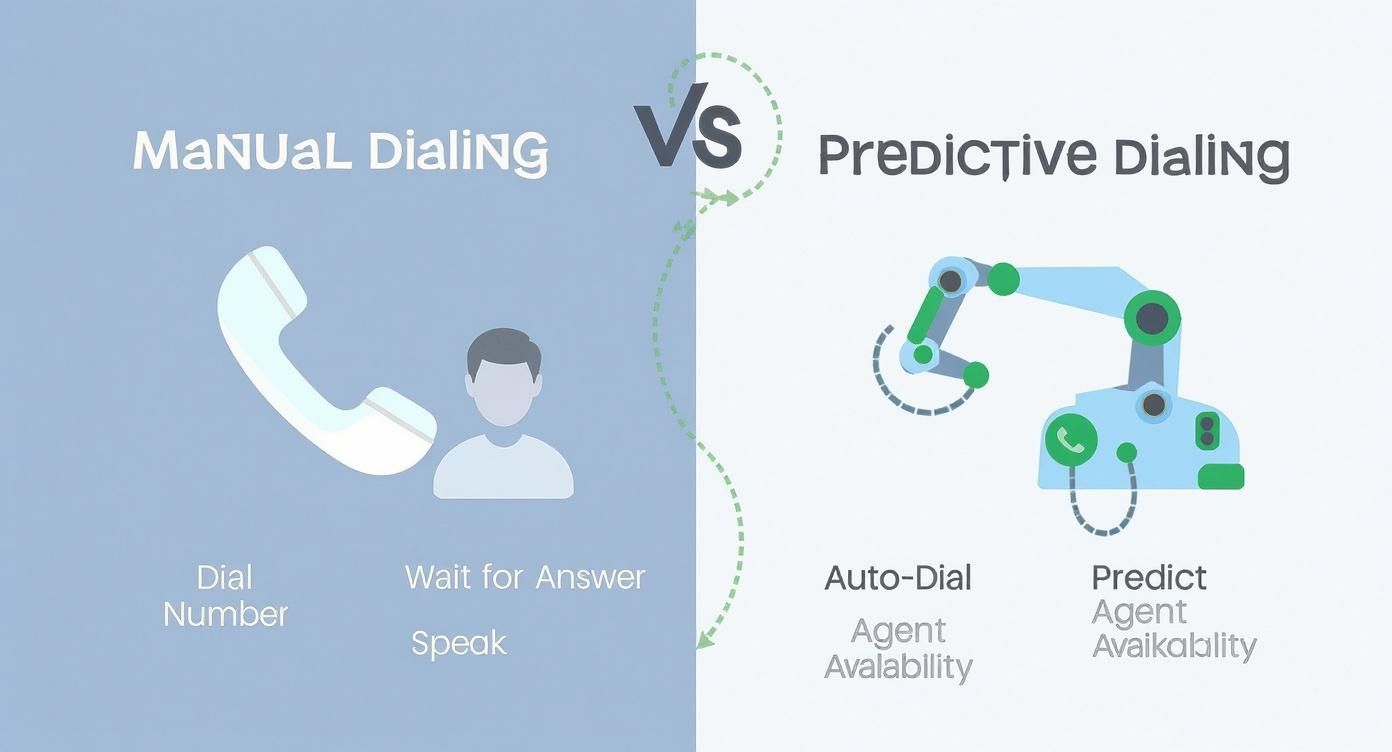
As you can see, predictive dialing takes the agent out of the repetitive, low-value tasks of dialing and waiting. It lets them do what they do best: engage with customers.
The Real-World Benefits of a Predictive Dialer
The technical side of a predictive dialer is impressive, sure, but what really matters is what it does for your bottom line. Let’s move from theory to practice. This technology translates directly into powerful, real-world advantages that any leader in the BPO space will immediately recognize. It’s about transforming operations from the ground up.

Benefit #1: A Massive Boost in Agent Productivity
The single biggest win from a predictive dialer is the dramatic spike in agent productivity. By automating the entire dialing process and filtering out all the junk calls, the system practically eliminates agent idle time. Instead of wasting 30-40% of their shift listening to dial tones and voicemails, agents are moved from one live conversation to the next.
This isn’t just a minor tweak; it’s a complete operational shift. More conversations per hour directly lead to bigger results.
- Increased Sales and Appointments: For a sales team, this means more opportunities to close deals. For an appointment setting campaign, it’s more qualified meetings on the books. Simple as that.
- Faster List Penetration: Your team can burn through large contact lists in a fraction of the time, making sure you reach leads while they’re still hot.
- Improved ROI on Campaigns: Maximizing every agent’s time on the clock ensures you get the most value out of your payroll and lead-gen spend.
Of course, handling a surge in connections is a good problem to have, but it’s still a problem. You’ll need a solid strategy to manage high call volumes in your call center without letting quality slip.
Benefit #2: Improved Agent Morale and Retention
Let’s be honest: manual dialing is a tedious, soul-crushing task. The constant rejection from unanswered calls, busy signals, and voicemails is a fast track to agent burnout and high turnover. A predictive dialer gets rid of the most frustrating parts of the job.
By serving up a steady stream of live connections, the system keeps agents engaged and focused on what they were hired to do—connect with people. This shift has a profound impact on the work environment, creating a more positive and motivated team. Agents feel more successful, which boosts morale and cuts down the high costs of recruiting and training replacements.
“A predictive dialer transforms an agent’s role from a number-puncher to a conversation specialist. When agents spend their day having meaningful interactions, their job satisfaction and performance skyrocket.”
Benefit #3: Enhanced Campaign Management and Analytics
Modern predictive dialers are more than just calling machines; they are powerful data hubs. Every single call attempt, connection, and outcome is tracked, giving you a goldmine of analytics to make smarter decisions.
This rich data allows you to:
- Monitor Performance in Real-Time: Track key metrics like connection rates, average call duration, and agent talk time to spot top performers and identify coaching opportunities on the fly.
- Optimize Call Lists: Analyze which lists are hitting and which are missing. You can then allocate resources to the winners and drop the duds.
- Forecast with Accuracy: Use historical data to predict campaign outcomes and staff your teams more effectively for what’s coming next.
Understanding the financial impact of every connection is vital. Each answered call is an opportunity, and missing them has a real price. You can learn more about the real cost of missing calls and see exactly why maximizing connections is so crucial for revenue.
Choosing the Right Outbound Dialing Mode
While a predictive dialer is a powerhouse for high-volume campaigns, it’s not the only tool in the shed. Understanding the difference between various dialing modes is key to picking the right one for your goals. If you choose wrong, you could end up with wasted effort or even compliance headaches.
Think of it like this: different jobs require different tools. You wouldn’t use a sledgehammer to hang a picture, and you wouldn’t use a tiny tack hammer to break up concrete. The same logic applies here.
Power Dialer: The Relentless Metronome
A power dialer is the most straightforward of the bunch. It works like a relentless metronome, dialing one number right after the next for a specific agent. The moment a call ends—whether it was a busy signal, voicemail, or a live chat—the system queues up the next number on the list.
There’s no fancy algorithm here; it’s a simple one-to-one system. This puts agents in the driver’s seat and completely eliminates the risk of abandoned calls, since a call is only ever placed for an agent who is definitely free. It’s a solid choice for follow-up calls or smaller campaigns where that personal touch still matters.
Progressive Dialer: The Cautious Approach
The progressive dialer is a step up from the power dialer but more cautious than a predictive one. Just like a power dialer, it dials one number at a time for each available agent. The key difference? It’s a bit smarter. The system actually waits until an agent has finished all their after-call work and is 100% ready before it even thinks about placing the next call.
This method guarantees zero “dead air” for the person on the other end and completely prevents abandoned calls. It strikes the perfect balance for campaigns needing efficiency but dealing with more complex sales or sensitive info. Think B2B outreach, where an agent needs a moment to scan a contact’s profile before the call connects. Your choice here can make or break your outbound lead generation strategies, so matching the tool to the task is everything.
Predictive Dialer: The High-Speed Optimizer
As we’ve covered, the predictive dialer is the most aggressive and efficient of the three. By dialing multiple numbers per agent at the same time, it’s laser-focused on keeping your entire team in back-to-back conversations. Its algorithm is constantly calculating and anticipating when agents will become free, making sure a live call is ready for them the second they hang up.
The right dialing mode isn’t about which one is ‘best’—it’s about which one is best for your specific campaign. Matching the technology to the objective is the foundation of an efficient and compliant outbound operation.
This high-speed approach is perfect for large-scale, straightforward campaigns like telemarketing, surveys, or political outreach, where the number one goal is maximizing live connections.
To make it even clearer, let’s break down how these three modes stack up against each other. The table below gives you a quick snapshot of where each one really shines.
Power vs. Progressive vs. Predictive Dialing
| Dialer Type | Dialing Method | Best For | Key Advantage |
|---|---|---|---|
| Power | Dials one number after another for each agent. | Small teams, follow-up calls, warm leads. | Simple, gives agents control, no risk of abandoned calls. |
| Progressive | Dials one number only when an agent is fully available. | B2B sales, high-value leads, complex customer interactions. | Balances efficiency and control, provides agent prep time. |
| Predictive | Dials multiple numbers per agent using an algorithm. | High-volume telemarketing, collections, surveys, large contact lists. | Maximum agent talk time and unparalleled efficiency for large campaigns. |
Ultimately, understanding these distinctions helps you move beyond a one-size-fits-all approach. By picking the dialer that aligns with your campaign’s pace, complexity, and compliance needs, you set your team up for maximum impact.
Putting Your Predictive Dialer to Work
Owning a powerful tool is one thing; using it to its full potential is something else entirely. Just flipping the switch on a predictive dialer won’t magically boost your numbers. A smart implementation strategy is what separates a chaotic, complaint-ridden operation from a smooth, revenue-generating machine.
It all starts with a solid foundation. To handle the sheer volume of calls a predictive dialer generates, you need a robust communication infrastructure. Before you do anything else, it’s worth digging into understanding modern telephony and data connectivity solutions to make sure your backend is up to the task.

Integrate for Intelligence
A dialer working in a silo is a huge missed opportunity. The real magic happens when you integrate it directly with your Customer Relationship Management (CRM) system. This connection is what turns your dialer from a simple calling machine into an intelligent sales and service tool.
With integration, the moment a call connects, your agent gets a “screen pop” with the customer’s entire history. This context transforms a generic, scripted pitch into a personalized, meaningful conversation. It’s the difference between a cold call and a warm, informed interaction—a change that can dramatically improve your conversion rates.
Fine-Tune Your Pacing and Perfect Your Lists
Think of your dialer’s pacing algorithm as its engine—it needs a skilled driver to get the most out of it. If you set the dialing ratio too aggressively, you’ll burn through your list with dropped calls and annoy potential customers. But if you set it too low, you defeat the whole purpose of having a predictive dialer in the first place.
The best approach? Start conservatively. Keep a close eye on your abandonment rate in real-time and gradually increase the pace as you gather data. You’re looking for that sweet spot that keeps your agents busy without exceeding the 3% abandonment rate mandated by regulations like the TCPA in the U.S.
Just as critical is the quality of your call lists. Garbage in, garbage out.
- Scrub Your Data: On a regular basis, clear out disconnected numbers, duplicates, and anyone on the Do Not Call (DNC) registry.
- Segment Your Lists: Group your contacts by time zone, campaign, or lead score. This helps you call the right people at the right time with the right message.
- Prioritize Fresh Leads: Clean, current lists always lead to higher connection rates and far fewer wasted dials.
A predictive dialer is only as good as the data you feed it. Prioritizing list hygiene is non-negotiable for both efficiency and compliance.
Train Your Team for the New Pace
Finally, you have to get your agents ready for the new reality. Moving from manual or even progressive dialing to a predictive system can be jarring. The pace is relentless, and the back-to-back nature of the calls requires a completely different mindset.
Invest in thorough training. Show your team how to manage the rapid flow of conversations and how to use the integrated CRM data on the fly. When your agents feel confident and prepared, they won’t just survive in this high-energy environment—they’ll thrive, turning that increased call volume into real, tangible results.
Common Questions About Predictive Dialing
Even after getting the hang of the technology, a few practical questions always pop up before teams decide to jump in. Leaders want straight answers on the important stuff—legality, efficiency, and making sense of the jargon. Let’s clear up those final hurdles.
Is Using a Predictive Dialer Legal?
Absolutely, as long as you play by the rules. In the United States, the big regulations to follow are the Telephone Consumer Protection Act (TCPA) and the FTC’s Telemarketing Sales Rule.
The most important rule of thumb is the call abandonment rate. A call is “abandoned” if a live person picks up, but no agent is free to talk to them within two seconds. To stay compliant, your dialer has to keep this rate below 3% of all answered calls over a 30-day period.
How Does the System Handle Answering Machines?
This is where modern dialers really shine. They come equipped with something called Answering Machine Detection (AMD). This tech is smart enough to analyze the audio in the first few moments of a call and tell the difference between a real person saying “hello” and a recorded voicemail greeting.
If it detects an answering machine, the system can be told to either hang up right away or leave a pre-recorded message. This keeps your agents from wasting time listening to voicemails and ensures they’re only connected to live prospects.
What Is the Difference Between Abandoned and Dropped Calls?
People use these terms interchangeably all the time, but in a call center, they mean very different things. Getting the distinction right is key for staying compliant and tracking performance accurately.
- Abandoned Call: This is what happens when the dialer connects to a live person, but every agent is busy. The system has no choice but to hang up. As we mentioned, there are strict legal limits on this. You can find more strategies on how to reduce call abandonment in your call center in our detailed guide.
- Dropped Call: This is purely a technical problem. A dropped call is any connection that fails because of a network issue, a system bug, or just bad reception. It’s a glitch, not an intentional part of the dialing process.
Clarity in terminology is key. An abandoned call is a direct result of dialer pacing, while a dropped call is a technical failure. Managing the former is a compliance necessity.
🚀 Ready to Maximize Your Outbound Efficiency?
CallZent’s nearshore teams in Tijuana combine expert agents with predictive dialing technology to help you scale faster and smarter.
Ready to transform your outbound campaigns and maximize every conversation? At CallZent, we leverage smart technology like predictive dialing to deliver exceptional results for our clients. Our nearshore solutions in Tijuana combine expert agents with intelligent automation to drive efficiency and growth.