Skip to content
Customer Experience
Omnichannel Customer Experience:
The Key to Seamless, Connected Support
An omnichannel customer experience unifies every communication channel into one continuous conversation, eliminating repetition and boosting satisfaction and loyalty.
TL;DR — What You Need to Know
- An omnichannel customer experience integrates phone, chat, email, social, and more into ONE continuous journey.
- Customer context follows them across channels—no more repeating information.
- Omnichannel reduces customer effort, increases CSAT, and boosts loyalty.
- Businesses see better engagement, retention, and operational efficiency with unified channels.
Ever spent ten minutes explaining a problem to a chatbot, only to be transferred to a live agent and have to start all over again? It’s frustrating, disjointed, and the exact problem an omnichannel customer experience is designed to solve. This strategy is all about creating connected and consistent interactions, no matter how a customer chooses to reach out.
What is an Omnichannel Customer Experience, Really?
An omnichannel strategy goes far beyond just being available on multiple channels (that’s multichannel). Instead, it focuses on weaving all those channels together into a single, continuous conversation with the customer at the center of it all.
Think of it this way: a multichannel setup is like having a bunch of separate, one-way streets. A customer can drive down the “email street” or the “phone street,” but those roads never connect. If they decide to switch, they have to go back to the beginning and start their journey all over again.
An omnichannel customer experience, on the other hand, is a smart, interconnected highway system. All the lanes (your channels) merge seamlessly. A customer can get on via the social media on-ramp, cruise over to the live chat lane, and then take the phone call exit ramp—and all their information and context travel right along with them.
Key Takeaway: The heart of an omnichannel experience isn’t about how many channels you offer. It’s about how deeply they’re integrated to create a single, uninterrupted customer journey.
This seamless flow is powered by a unified view of the customer, where data from every interaction is pulled into one central place. This gives your support agents the full picture of a customer’s history, no matter which channel they used to get in touch.
Omnichannel vs. Multichannel: A Fundamental Difference
To truly understand what an omnichannel customer experience is, you have to know the difference between omnichannel and multichannel—two terms that get confused all the time. Both involve using more than one channel, but how they work and the results they deliver are worlds apart. Nailing this difference is the first step in appreciating the evolution of customer communication channels.
Here’s a practical breakdown to make it crystal clear.
| Feature | Multichannel Experience | Omnichannel Experience |
|---|---|---|
| Primary Focus | Company-centric; focused on the channel. | Customer-centric; focused on the journey. |
| Channel Integration | Channels operate in silos with no data sharing. | Channels are fully integrated and share data in real-time. |
| Customer Journey | Fragmented and disconnected; customers must restart conversations. | Seamless and continuous; context follows the customer. |
| Agent Perspective | Agents have a limited view of past interactions on other channels. | Agents have a complete 360-degree view of the customer’s history. |
| Customer Effort | High; customers often have to repeat information. | Low; the experience feels effortless and intuitive. |
As you can see, one approach builds walls between conversations while the other builds bridges.
The Impact of a Unified Approach on Your Business
Making the switch from siloed channels to a truly integrated strategy has a massive impact on the bottom line. An omnichannel customer experience is a powerhouse for boosting customer engagement, retention, and loyalty.
The numbers don’t lie. Recent reports show that 45% of firms that implemented omnichannel strategies saw better customer engagement, and 35% reported improved customer loyalty. Even more telling, customer satisfaction scores (CSAT) for omnichannel support hit an impressive 67%—more than double the 28% seen with fragmented multichannel approaches. This data makes it clear: a connected experience isn’t just a nice-to-have. It’s a critical driver of customer happiness and long-term business success.
Why an Omnichannel Strategy Is a Business Imperative
Let’s be blunt: having an omnichannel strategy is no longer a forward-thinking luxury. It’s a fundamental requirement for survival and growth in today’s market. In a world where customers expect instant, seamless service, a disconnected approach creates friction, frustrates people, and directly hits your bottom line. An omnichannel framework is about more than just being on multiple channels; it’s about creating a single, fluid conversation that drives real business results.
This isn’t just about making things easier for your customers, either. It’s about building a more resilient and profitable business. When every interaction is connected, you eliminate that all-too-common frustration of customers having to re-explain their issues over and over. This simple fix directly leads to higher satisfaction, stronger brand affinity, and unshakable loyalty.
Driving Loyalty and Customer Lifetime Value
The link between a unified experience and customer retention is incredibly strong. Picture a modern retail journey: a customer spots a product on Instagram, clicks to your website to read reviews, adds it to their cart on a laptop, and later uses a mobile coupon to buy it in-store. After the purchase, they get a thank-you SMS with a tracking link.
If there’s an issue, they can reply directly to that SMS, and an agent instantly has their complete purchase history. This effortless flow is what turns a one-time buyer into a lifelong advocate. A study of 46,000 retail shoppers found that businesses with solid omnichannel engagement retain 89% of their customers, a stark contrast to the 33% retained by those with weak strategies. Even better, these loyal customers have a 30% higher lifetime value, proving that a seamless experience is a powerful revenue driver.
The Big Picture: An omnichannel strategy isn’t a cost center; it’s a revenue multiplier. By prioritizing a seamless customer journey, you’re investing directly in loyalty, retention, and long-term profitability.
Boosting Operational Efficiency
Beyond happy customers, a well-executed omnichannel strategy delivers huge operational gains. When agents have a complete, unified view of a customer’s history, they spend less time digging for information and more time actually solving problems. This is a core idea behind effective customer experience management.
Think about the impact on key call center metrics:
- Reduced Average Handle Time (AHT): With instant access to a customer’s entire interaction history—from their last website visit to a recent chat—agents can diagnose and resolve issues much faster.
- Improved First-Contact Resolution (FCR): When agents have the full context, they’re far more likely to solve a problem on the first try. That means no more costly and frustrating follow-up calls.
- Increased Agent Satisfaction: Giving your team the right tools and information reduces their own frustration, leading to less burnout and higher retention of your most valuable people.
The right metrics tell the story. A truly omnichannel approach makes a measurable difference.
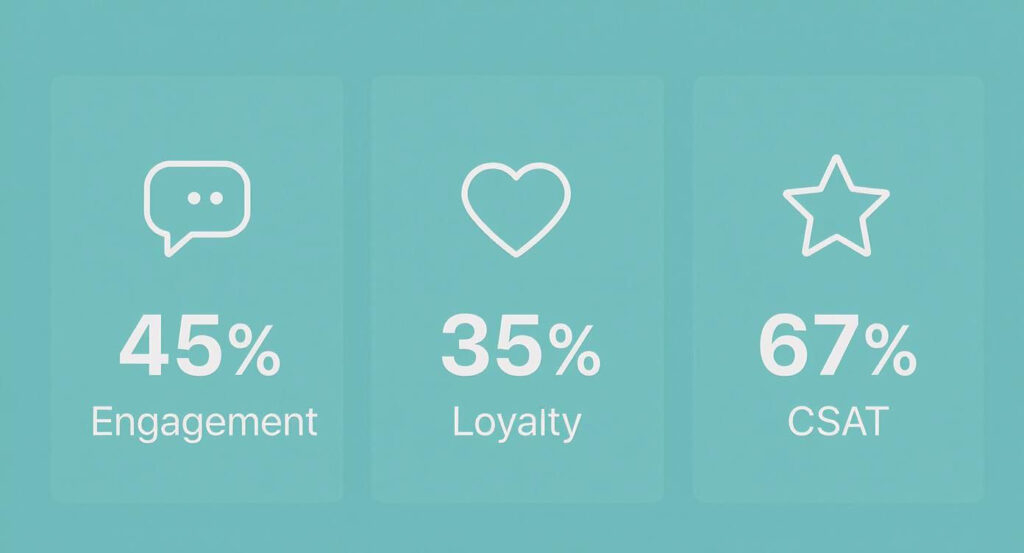
The data doesn’t lie. A unified strategy directly translates into more engaged, loyal, and satisfied customers.
Creating a Competitive Advantage
At the end of the day, a top-tier omnichannel experience is a powerful competitive differentiator. In a crowded market, people don’t just choose products; they choose experiences. A business that makes it easy, intuitive, and pleasant to get help will always win against competitors who force their customers to navigate clunky, siloed systems.
By investing in an omnichannel framework, you’re sending a clear message: you value your customer’s time and are committed to their success. This builds a level of trust that no marketing campaign can replicate, securing your market position and paving the way for sustainable growth. This is exactly where a strategic partnership with a nearshore call center can provide the expertise and technology to make this vision a reality.
The Pillars of a True Omnichannel Framework
Building a genuinely omnichannel experience isn’t about just piling on more channels. It’s about engineering a smart ecosystem where every piece works together perfectly. Think of it like conducting an orchestra. Each channel—voice, email, chat, social media—is an instrument. For the music to sound right, they all have to play from the same sheet, guided by one conductor: the unified customer profile. Without that, you don’t get a symphony; you get noise.
To shift from a jumble of siloed interactions to a seamless performance, you need to build your strategy on three core pillars. These aren’t optional—they’re the non-negotiables for creating the fluid, effortless experience that defines a modern omnichannel setup. As outlined in the core pillars of customer experience management, getting these right is everything.

A Unified Customer Data Platform
The absolute bedrock of any omnichannel strategy is a unified customer data platform (CDP) or a deeply integrated CRM. This is your single source of truth, the central hub where every piece of customer information lives and breathes. It’s the conductor’s score that keeps every instrument in tune.
Without it, your agents are flying blind. An agent on the phone has no clue the customer just spent 20 minutes wrestling with a web chat. This forces customers to repeat themselves—a major pain point that 60% of consumers say kills their experience.
A unified platform puts an end to this by pulling together data points like:
- Past purchase history: What did they buy, and when?
- Previous support tickets: What problems have they run into before, and did we fix them?
- Website browsing activity: What pages were they just looking at before they reached out?
- Interaction history across all channels: What was said in their last email, tweet, or chat session?
This 360-degree view empowers agents to deliver support that’s smart and context-aware, making them feel proactive instead of just reactive.
Seamless Channel Integration
Once you have that central data hub, the next pillar is wiring all your channels into it. This is the technical plumbing that lets information flow freely between your phone system, email platform, live chat software, and social media inboxes. True integration means a conversation can start on one channel and move flawlessly to another.
For instance, a customer starts a chat on your website to ask about a product’s warranty. The chat agent realizes they need more detailed technical help and offers to escalate to a phone call.
In a true omnichannel system, the agent transfers the call, and the phone support specialist instantly gets the entire chat transcript. They greet the customer by name and say, “I see you were just chatting with Maria about the warranty on your recent purchase. Let’s get that sorted out.”
That seamless handover means the customer never has to start over. It dramatically cuts down on their effort and boosts the odds of a first-contact resolution. Suddenly, separate interactions become one continuous conversation.
A Consistent Brand Journey
The final pillar is delivering a consistent brand journey, no matter the channel. This goes way beyond technology; it’s about maintaining a uniform tone, message, and quality of service at every single touchpoint. Your brand’s personality has to come through whether a customer is reading a knowledge base article, talking to a chatbot, or speaking with a live agent.
This consistency is what builds trust and reinforces your brand identity. It demands:
- Standardized Agent Training: All agents, no matter what channels they work on, need to be trained on the brand’s voice and service standards.
- Unified Knowledge Base: Every agent should pull answers from the same, up-to-date source of truth to avoid giving out conflicting information.
- Consistent Policies: Your return policies, promotions, and service level agreements (SLAs) must be identical everywhere. A customer shouldn’t get one answer on Twitter and a different one over the phone.
When these three pillars—unified data, integrated channels, and a consistent journey—are locked in place, you create an omnichannel experience that doesn’t just meet expectations. It builds real loyalty and drives growth.
How to Build Your Omnichannel Customer Experience Strategy
Knowing the “what” and “why” of an omnichannel experience is the easy part. Building it? That’s a different beast altogether. Moving from a messy, siloed multichannel setup to a truly connected system can feel like a massive undertaking, but it’s totally achievable with the right game plan. This isn’t theory; it’s a practical guide to getting it done.
Let’s follow a fictional e-commerce company, “Urban Bloom,” as they make this exact shift. Their support was a classic multichannel mess: email tickets lived in one system, phone calls in another, and social media DMs were a Wild West managed by the marketing team. Customers were annoyed, agents were spinning their wheels, and sales were dropping through the cracks. Their journey breaks down into four critical steps.

Step 1: Map the Complete Customer Journey
Before they even thought about new software, Urban Bloom’s first move was to map out every single way a customer could interact with their brand. They literally traced the entire path—from a customer seeing a social media ad to making a purchase and, weeks later, trying to process a return.
This exercise was eye-opening. It immediately flagged the biggest friction points. For instance, they realized customers who used live chat to ask about a sizing issue had to repeat their entire story from scratch when they called to finalize the exchange. The journey map made it painfully obvious where conversations were falling apart.
Key Insight: You can’t fix a broken journey you can’t see. Mapping customer touchpoints isn’t just busywork; it’s the diagnostic tool that shows you exactly where your siloed channels are failing people.
Step 2: Select the Right Technology Stack
With a clear map in hand, Urban Bloom knew what they needed. Their next step was picking the right tools, and the keyword was integration. They needed tech that could plug their CRM, contact center software, and analytics into one seamless system.
This meant investing in a platform that gave agents a unified desktop. Instead of juggling a dozen tabs for email, chat, and phone, agents would now have one screen showing a customer’s entire history. Choosing the right platform is the bedrock of creating powerful, integrated help desk solutions that actually empower your agents. For retail businesses, layering in innovative tech like virtual fitting rooms can also create a powerful, truly connected experience.
Step 3: Train Agents for a New Way of Working
Technology is only half the puzzle. Urban Bloom knew their agents needed a new mindset to handle conversations that drift from one channel to another. The training wasn’t about channel-specific rules but about holistic problem-solving.
Agents were trained to:
- Think contextually: Always review a customer’s history before responding. No more “Can you repeat that for me?”
- Manage concurrent conversations: Juggle a live chat and an email queue without letting quality slip.
- Maintain brand voice: Ensure the friendly, helpful Urban Bloom tone was consistent, whether in a 280-character tweet or a 10-minute phone call.
This shift turned agents from ticket-closers into genuine customer advocates who could handle complex, multi-stage issues with ease.
Step 4: Start with a Pilot Program
Instead of a high-stakes, big-bang launch, Urban Bloom played it smart and started with a pilot program. They chose to integrate just two of their busiest channels first: email and live chat. A small, dedicated team of their top agents was selected to test drive the new system.
This controlled rollout let them squash bugs, tweak workflows, and gather real-world feedback in a low-risk setting. After two months of fine-tuning, they had a proven model ready to be scaled across the entire support organization. By starting small, they ensured their company-wide launch was a smooth success, not a chaotic mess.
Omnichannel Customer Experience Examples in the Real World
Theory is one thing, but seeing omnichannel customer experience in action really brings its power to life. It’s not just some abstract concept for massive corporations; it’s a practical strategy that creates tangible results. Let’s break down a couple of real-world scenarios to see how a unified approach turns everyday interactions into memorable, loyalty-building moments.
These examples show how seamless transitions between channels aren’t just a nice-to-have—they are what modern customers now expect as the bare minimum for good service.
The Seamless Banking Experience
Imagine a customer, Sarah, who needs a small business loan. Her journey is a perfect example of omnichannel done right.
- Step 1: The Digital Start. Sarah kicks off her application on her bank’s mobile app during her lunch break. She gets the initial details in but needs to grab a few financial documents she doesn’t have on her.
- Step 2: The Effortless Handoff. Later that evening, she logs into the bank’s website on her laptop. The application is sitting there, right where she left off. She uploads the documents and hits submit.
- Step 3: The Proactive Follow-Up. The next day, a loan officer spots a minor discrepancy. Instead of a generic email that might get lost, he sends her a secure message through the banking app, letting her clarify the detail in seconds.
- Step 4: The In-Person Finish. To sign the final papers, Sarah books an in-person appointment. When she arrives, the bank representative greets her by name, pulls up her completed application, and has everything ready to go. Not once did she have to repeat a single piece of information.
From the bank’s side, every interaction was logged into a single customer profile, giving each employee the full context to provide fast, intelligent service. From Sarah’s side, the process was just… easy.
The Connected Travel Journey
Now, think about a travel company that has truly mastered omnichannel support for a family planning their vacation. The whole experience is woven together across multiple platforms, with each one playing a specific, logical role.
The family uses WhatsApp for quick questions and to get updates on flight deals. Once they book, a detailed itinerary lands in their email, which they can easily save or print. A week before their trip, an automated SMS reminds them to check in online.
Then, the unexpected happens—a flight delay. They call the 24/7 support line, and the agent who answers already sees their booking details, flight status, and recent interactions. The agent can then proactively rebook their connecting flight and hotel transfer, confirming the new details via both SMS and an updated email itinerary.
Key Takeaway: The magic in these examples is making the technology invisible. The customer doesn’t think about “channels”; they just experience one continuous, helpful conversation with the brand.
These fluid experiences aren’t just about making customers happy—they drive serious business results. The practical impact of a solid omnichannel strategy is huge. Research shows that omnichannel marketing drives a staggering 287% increase in purchase rates and boosts customer retention by 89%. Omnichannel shoppers are just plain more valuable, with a 250% higher rate of purchase on platforms that integrate multiple channels, and 54% of customers now prefer using messaging apps or social media for service.
You can discover more about these omnichannel stats and see for yourself how they impact business growth. This is exactly where a strategic nearshore BPO partner like CallZent comes in, providing the trained bilingual agents and integrated technology needed to bring this level of sophisticated service to your own customers.
Answering Your Questions About Omnichannel
Even with the benefits laid out, shifting to an omnichannel strategy brings up some real questions. Moving from the siloed channels you’re used to over to a completely connected customer experience is a big leap. Let’s tackle the most common hurdles and questions businesses face so you can move forward with confidence.
Getting these answers straight is the key to turning the idea of an omnichannel customer experience from a buzzword into something you can actually build.
What Is the Real Difference Between Omnichannel and Multichannel?
The biggest difference boils down to one word: integration.
Multichannel is simply offering support on different platforms. You’ve got phone, email, and live chat, but they all operate in their own little worlds. This creates a choppy experience where customers are forced to repeat themselves every time they switch from one channel to another.
Omnichannel, on the other hand, weaves all those platforms into a single, continuous conversation. The focus isn’t on your channels; it’s on the customer’s journey across them. All their history and context travel with them, making the entire experience feel effortless.
How Can a Small Business Start an Omnichannel Strategy?
You don’t need to try to connect a dozen channels at once—that’s a recipe for disaster. The smart move is to start small and be strategic.
First, map out your most common customer journeys. Where do people interact with you most? Pick the two or three channels that are most critical to your audience.
Focus on getting those right first. A fantastic starting point is linking your email support to your CRM. Suddenly, your agents have a customer’s entire purchase history right in front of them. Another easy win is using a unified inbox to pull social media DMs and web chats into one manageable queue.
The goal is progressive integration. Master the connection between two channels before adding a third. This step-by-step approach is far more manageable and won’t break the bank.
What Is the Role of a BPO Partner in an Omnichannel Experience?
Think of a strategic BPO partner as the engine that makes the whole omnichannel machine run. A partner like CallZent doesn’t just provide agents who can handle different channels; we bring the technology and integrated platforms needed to make it all work seamlessly.
Instead of you having to build a complex tech stack from the ground up, you can plug into an existing, proven infrastructure. You get a team that already knows how to create connected customer journeys from day one. This allows you to launch a high-quality, consistent brand experience much faster and without the massive upfront cost.
How Do You Measure the ROI of an Omnichannel Strategy?
Measuring the return on an omnichannel strategy is about looking at a mix of customer-focused and operational metrics. It’s not just about saving a few bucks; it’s about building long-term value and making your entire operation more efficient. Having the right technology is crucial for this, and understanding the different types of call center software will help you pick a platform that gives you the analytics you need.
To get a true picture of your ROI, keep a close eye on these KPIs:
- Customer Lifetime Value (CLV): A smooth experience creates loyal customers, and loyal customers spend more money with you over time. It’s that simple.
- Customer Retention Rate: When customers don’t have to fight to get help, they stick around. Track this number before and after you make the switch.
- Customer Satisfaction (CSAT) and Net Promoter Score (NPS): As the experience gets easier for the customer, you should see these scores climb across every channel.
- First Contact Resolution (FCR): When agents have the full story, they solve problems on the first try way more often. This cuts operational costs and makes customers incredibly happy.
- Average Handle Time (AHT): This might tick up a bit at the start as agents get used to the new system. But over time, it should drop as they no longer have to waste time hunting for information in different places.
By tracking these numbers, you’ll have hard data to prove the financial and experiential value your omnichannel strategy is delivering.
🚀 Build a Seamless, Unified Customer Journey
CallZent delivers bilingual omnichannel support with the technology and expertise you need to elevate every interaction.
Ready to transform your customer interactions from fragmented conversations into a seamless, unified experience? At CallZent, we provide the technology, strategy, and expert bilingual agents to build an omnichannel framework that drives loyalty and growth. Let us help you create the connected journey your customers deserve.