Skip to content

Outsourcing Strategy • 2026 Guide
Affordable Call Center Services: How to Cut Costs Without Cutting Quality
A practical guide to evaluating outsourcing options, understanding real cost drivers, and why nearshore models like Tijuana deliver the best balance.
- The cheapest call center is rarely the most cost-effective.
- True affordability = high resolution quality + low operational waste.
- Nearshore (especially Tijuana) offers the best mix of cost savings, quality, and collaboration.
- Focus on cost per resolution—not cost per minute.
Can you still deliver excellent customer support without building a cost structure that eats your margins?
A lot of companies answer that question the wrong way. They assume they have only two choices. Pay premium onshore rates for quality, or go as cheap as possible and deal with service issues later. That framing misses the middle ground where many of the best outsourcing decisions happen.
The question is not whether support should be cheap. It is whether your support operation creates value at a sustainable cost. That is what businesses should mean when they search for affordable call center services.
Is High-Quality Customer Support Becoming Unaffordable
The pressure is real. The U.S. call centre market is valued at USD 13.8 billion in 2025 and is projected to reach USD 27.2 billion by 2035, growing at a 7.0% CAGR according to Future Market Insights on the United States call centre market. Bigger market, more channels, higher customer expectations. None of that makes support cheaper.
What changes cost fastest is not only wage pressure. It is complexity. Customers now expect fast replies on phone, chat, and other digital channels. They expect bilingual service in many markets. They expect agents to know the account history. They expect problems solved on the first interaction, not bounced between teams.
That is why “affordable” has become a strategy question, not a budget line item.
A low rate that creates repeat contacts, poor transfers, weak customer experiences, or bad reporting is expensive. A well-run outsourced team that handles interactions cleanly, works in your time zone, and integrates with your tools can reduce waste even if it is not the absolute cheapest option on paper.
Many teams are also blending human support with automation. If you are evaluating that path, this piece on revolutionizing customer support with affordable AI is useful background because it shows how cost control and responsiveness can work together when the setup is practical.
Affordable support is not bargain-bin support. It is support designed to resolve issues well, with less operational drag.
That is where nearshore models deserve more attention. For North American companies, they often solve the problem that onshore pricing and distant offshore friction both create.
The Bottom Line on Affordable Call Center Services
If you only need the short version, use this:
-
Look past headline pricing: The cheapest quote is not always the lowest-cost operation. Review cost structure, staffing model, reporting, and escalation quality. This breakdown of call center outsourcing cost in 2026 is a useful starting point.
-
Nearshore usually gives the best balance: For North American businesses, affordable call center services often work best when cost savings come with time zone alignment, bilingual support, and easier collaboration.
-
Vet the operation, not just the proposal: Technology stack, training process, QA discipline, and account management determine whether outsourcing saves money or creates rework.
Decoding What Makes a Call Center Service Affordable
A service is not affordable because the rate card looks low. It is affordable when the provider can deliver stable service, solid resolution quality, and predictable costs over time.

Pricing model matters more than most buyers expect
Call center proposals usually fall into a few common models.
| Model | Best fit | Watch for |
|---|---|---|
| Per-minute | Low-volume or overflow support | Idle time may be hidden elsewhere |
| Per-hour or per-agent | Dedicated workflows and more control | You pay for staffing discipline, not just talk time |
| Shared team | Simpler tasks and variable volume | Brand knowledge can be thinner if onboarding is weak |
It’s like choosing a mobile plan. A plan that looks cheap can become expensive if usage patterns do not match the structure.
If your calls are short and predictable, one model may work well. If you need trained agents handling more nuanced conversations, another model will make more sense even if the sticker price looks higher.
Cost drivers sit behind the quote
Buyers often focus on agent wages first. That matters, but it is only one part of the picture.
The stronger questions are these:
- How much training is built in? Cheap service without process training usually leads to repeat contacts.
- What tech stack supports the team? Basic phone handling is one thing. Integrated CRM, ticket visibility, and analytics are another.
- Who manages quality? Supervisors, QA reviews, and coaching are operating costs, but they are also what prevent avoidable failures.
- How much admin work follows each call? That hidden labor changes economics fast.
Global labor differences are real. The average salary for a call center representative in the Philippines is $4,326.94 per year, compared with approximately $56,177.16 per year in Switzerland, as noted in LiveAgent’s call center statistics roundup. That spread shows why outsourcing remains attractive, but salary arbitrage alone does not tell you whether the operation will work for your customers.
A provider becomes more affordable when it removes inefficiency from the workflow. That can include cleaner routing, better training, fewer escalations, and smarter post-call processes. For teams looking at automation inside service operations, this overview of the modern AI call center model is relevant because it frames AI as an operational tool, not just a buzzword.
True affordability isn’t about the lowest price per minute; it’s about the highest value per resolution.
One practical filter is whether the provider can explain where savings come from. If the answer is only “lower labor cost,” keep asking questions. If the answer includes workflow design, cloud systems, and measurable operational discipline, you are getting closer to a real fit. You can also compare those savings drivers against this overview of call center cost savings.
The Nearshore Advantage Why Tijuana Is a Strategic Hub
For North American businesses, the strongest outsourcing setup is often not fully onshore and not far offshore. It is nearshore.
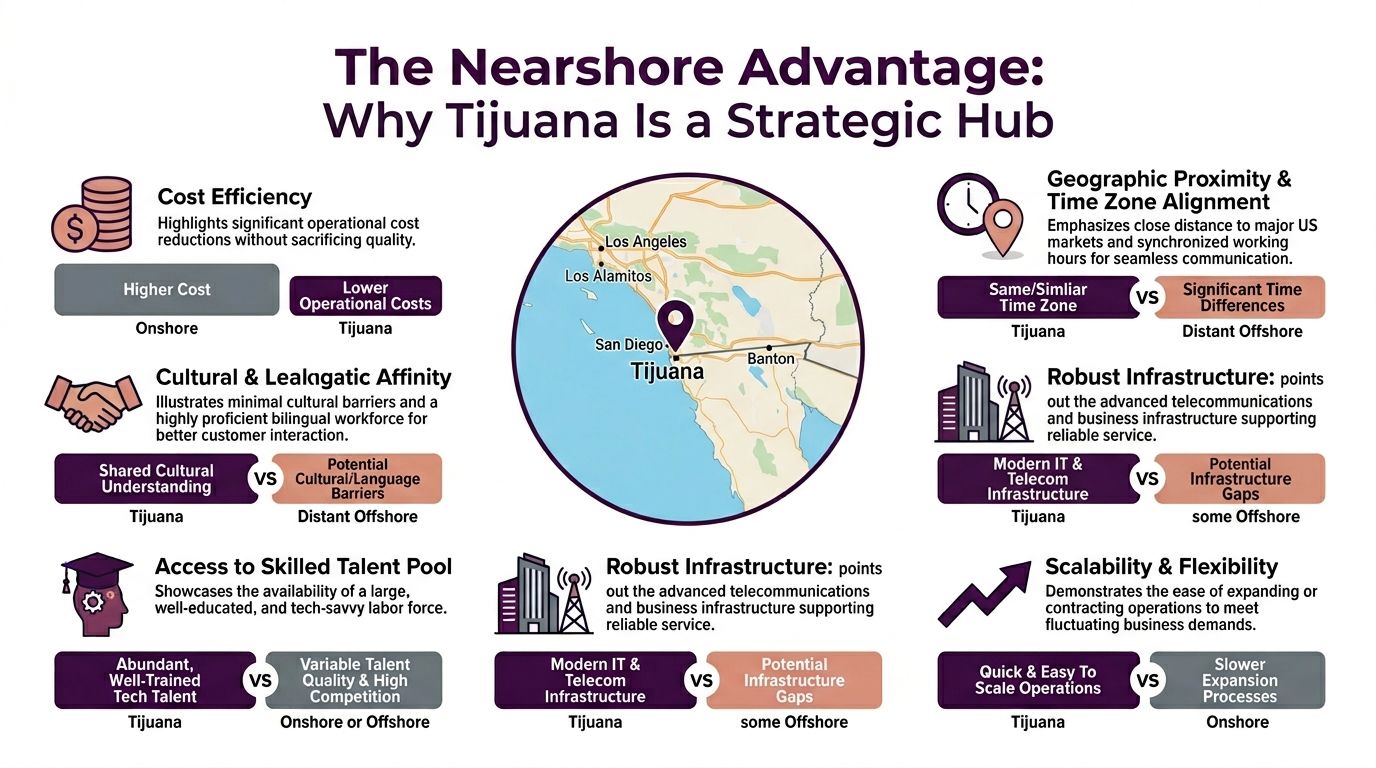
Onshore gives control. Offshore gives low labor cost. Nearshore balances both.
A U.S.-based team usually offers easy communication and market familiarity. The trade-off is obvious. Cost rises quickly, especially when coverage extends beyond standard business hours or requires bilingual support.
Traditional offshore providers can lower labor expense, but many buyers run into practical friction. Time zone gaps slow feedback loops. Coaching sessions become harder to schedule. Language quality can vary by campaign. Cultural mismatch shows up in call tone, escalation judgment, and customer trust.
Nearshore operations in Mexico sit in a better position for many companies because they cut cost without creating as much operational distance.
According to Crescendo’s review of call centers for small business, nearshore providers in Mexico can offer 50-70% cost savings over U.S. onshore operations while also achieving 20-30% higher CSAT scores for U.S. clients due to cultural proximity and bilingual fluency.
That combination matters more than buyers sometimes realize.
Why Tijuana works especially well
Tijuana is not just “close to the U.S.” in a geographic sense. It is close in day-to-day working reality.
A team in Tijuana can align schedules with U.S. business hours without forcing late-night management routines. Training sessions, QA reviews, and live calibrations are easier. Escalations can be handled in real time. Site visits are realistic. That changes the relationship from vendor management to operational collaboration.
For English-Spanish support, location also changes service quality. Bilingual capability is not enough by itself. The advantage comes when agents understand how North American customers speak, what they expect from support interactions, and when a script should bend to keep a conversation natural.
That is especially valuable for:
- E-commerce brands dealing with order issues, shipping questions, and returns
- Healthcare organizations serving diverse patient populations
- Financial services teams that need clear, precise conversations with low confusion
- Telecom and utilities where call intent can shift quickly from billing to troubleshooting
The strategic sweet spot
Nearshore is not the right fit for every use case. If you need ultra-specialized support tied tightly to internal teams, in-house can still be the better choice. If you only need basic overflow answering, a cheaper commodity provider may be enough.
But for companies that want an outsourced team to feel like an extension of the business, Tijuana often hits the sweet spot. Cost stays controlled. Communication stays direct. Customer interactions sound more natural.
That is why many buyers evaluating call center outsourcing in Tijuana Mexico are not looking for lower rates. They are looking for lower friction.
How Different Industries Win with Affordable Nearshore Support
Different sectors break support operations in different ways. The right nearshore setup solves the pressure point that is hurting the business, not just the phone queue.

E-commerce needs elasticity, not just coverage
A growing online store can handle normal order volume with a lean in-house team. Then a seasonal spike hits. Returns increase. “Where is my order?” calls pile up. Chat volume rises at the same time.
That is where affordable call center services help most when they can scale fast without forcing a permanent internal hiring decision.
A nearshore team can take overflow order-status calls, returns, exchanges, subscription updates, and basic product questions while your internal staff focuses on exceptions and VIP customers. If your business sells into English- and Spanish-speaking markets, bilingual coverage also removes a common support bottleneck. For brands exploring that model, this page on call center for e-commerce shows the kind of use cases that typically fit well.
Healthcare needs language sensitivity and process discipline
Healthcare support is rarely just “answer the phone.” It often includes appointment scheduling, intake support, reminder calls, and routing patient questions to the right next step.
In practice, the best nearshore healthcare teams do two things well. They speak clearly with patients who may already be stressed, and they follow process without improvising around sensitive information.
A bilingual nearshore team is especially useful for clinics and provider groups serving mixed-language communities. A patient calling to reschedule, confirm insurance details, or ask where to send paperwork should not have to struggle through language barriers before they get help.
In regulated or sensitive industries, consistency matters as much as friendliness.
Finance and insurance need precision
Financial services, lending, and insurance support break down when conversations become vague. Customers call with policy questions, payment issues, onboarding questions, or document follow-ups. Those calls require clean scripts, careful authentication, and good note-taking.
Nearshore teams work well here when they are trained for exact language and structured escalation. The benefit is not only lower support cost. It is the ability to keep queues manageable without sacrificing clarity in high-stakes conversations.
A practical example: a broker or lender may keep licensed or highly specialized conversations in-house, while outsourcing first-line inquiries, appointment setting, lead qualification, and document follow-up to a bilingual support team. That keeps experienced internal staff focused where their expertise matters most.
Your Actionable Checklist for Evaluating Call Center Partners
Most bad outsourcing decisions do not start with obvious red flags. They start with a polished proposal, vague promises, and a buyer who did not ask enough operational questions.

Ask how the operation runs on an ordinary Tuesday
Any provider can sound strong when talking about launch support and account setup. Ask what daily management looks like after month two.
Use questions like these:
- Who owns QA? Ask how calls are reviewed, how feedback is delivered, and how often scripts are updated.
- How are agents trained before launch and after launch? A one-time onboarding sprint is not enough for changing products and policies.
- What happens when call volume shifts suddenly? Good providers can explain overflow plans without hand-waving.
- Who handles escalations? You want named functions and clear paths, not general assurances.
If the answers feel generic, the service usually is.
Review the technology stack like an operator, not a shopper
Technology is not a nice extra. It determines how efficiently the team works.
According to Unity Connect’s overview of affordable call center services, advanced providers use predictive dialers, automatic call distributors, and real-time analytics, and 72% of companies agree that analytics improve customer experience.
That means your checklist should include:
- CRM integration: Agents should see the right customer context without switching between disconnected tools.
- Call routing logic: Ask how the provider handles language, skill-based routing, and overflow.
- Live dashboards: You should be able to review service levels, handle trends, and queue pressure without waiting for an end-of-month report.
- Interaction records: Notes, tags, and disposition standards need to be consistent enough to support coaching and process improvement.
A provider does not need the flashiest stack. It needs a stack that makes agents faster and managers smarter.
Watch for contract traps and soft red flags
This part gets overlooked because buyers rush to compare rates.
Look for:
- Minimums that do not match your volume
- Extra charges for reporting, QA, or bilingual support
- Vague setup language
- No service-level definitions
- No detail on staffing continuity
One practical benchmark is whether the provider is transparent enough to help you compare options side by side. CallZent is one example of a nearshore provider that focuses on bilingual support and operational fit for North American companies, but whichever partner you evaluate, use a structured process like this guide on how to find vet best call center outsourcing companies.
If a provider cannot explain its workflow clearly before signature, it will not become clearer after launch.
Smart Strategies to Maximize Your Outsourcing ROI
The contract does not create the ROI. The operating rhythm does.
A lot of companies outsource support and then manage the partner too loosely. They send a script, approve the launch, and only step in when service levels slip. That approach wastes the upside.
Start with clean scope and shared metrics
Define what belongs with the outsourced team and what stays in-house. Keep it practical. Which interactions should they own? Which require escalation? What does a successful resolution look like?
Then agree on a reporting cadence. Weekly reviews are often enough early on because they surface script gaps, routing problems, and customer pain points before they become chronic.
Optimize Cost Per Call, not just labor cost
Cost Per Call is a useful operating metric because it reflects the entire system, not just payroll.
According to Zoom’s guide to call center metrics, affordable providers can reduce Cost Per Call by 15-25% through cloud-based CRMs, remote work models, and AI tools that cut after-call work by up to 60%.
That points to a better way to work with your provider:
- Tighten call reasons and dispositions
- Fix repeat-contact drivers in your site, billing flow, or FAQs
- Use summaries and automation to reduce after-call admin
- Move simple contacts out of the live queue when self-service can handle them cleanly
Treat the partner like an operating team
The strongest outsourcing relationships are collaborative. Your provider should tell you what customers are struggling with, where scripts break down, and which issues are creating unnecessary volume.
That is where the savings compound. Not because labor got cheaper, but because the business removes avoidable demand from the queue.
Frequently Asked Questions
Can affordable call center services still support compliance requirements
Yes, but only if compliance is built into the workflow instead of added as a marketing claim. For smaller firms, that matters more now because Chatdesk’s review of affordable call center services for small businesses notes that PCI fines rose 25% in 2025, and many businesses are moving toward secure nearshore options with U.S.-adjacent data handling at $1.10-$1.50 per minute, compared with $2.50+ onshore.
For healthcare or finance, ask providers how they handle access controls, call recording rules, script restrictions, escalation paths, and auditability.
What should I look for in a contract to avoid hidden fees
Look for plain language around setup, minimum volumes, reporting, QA, bilingual support, after-hours coverage, and platform charges. If a proposal says “custom” in too many places, ask for every billable item in writing before signing.
How can a service scale as my business grows
Ask how the provider adds seats, cross-trains agents, and handles peak periods. Good partners can explain how they scale without forcing a full rebuild of scripts, routing, and reporting.
Is nearshore always better than offshore
Not always. It depends on your workflow. But if your business depends on fast collaboration, bilingual service, and smoother customer conversations, nearshore often gives you better day-to-day execution.
Looking for Affordable, High-Quality Support?
CallZent provides bilingual nearshore call center services from Tijuana—helping North American businesses reduce costs while improving customer experience.
Explore CallZentIf you are comparing affordable call center services and want a practical nearshore option, CallZent provides bilingual call center and BPO support from Tijuana for North American businesses that need cost control, quality, and easier collaboration in one operating model.