Skip to content
Ever wonder how much business you might be losing to voicemail? A professional answering service is the solution, providing a dedicated team of live agents to handle your incoming calls and act as a direct extension of your business. The goal is simple: ensure every customer call is answered by a real, helpful person—24 hours a day, 7 days a week—so you never miss an opportunity. This is far more than just taking messages; it’s a strategic tool for capturing leads, delighting customers, and building a brand that people trust.
TL;DR: What You Need to Know
An answering service provides live agents to handle your business’s incoming calls 24/7. Key functions include capturing leads, scheduling appointments, and offering basic customer support. By ensuring every call is answered professionally, these services help businesses increase revenue, improve customer satisfaction, and operate more efficiently, turning a potential operational cost into a profit center.
Never Miss a Customer Call Again
Picture this: you’re deep in a crucial client meeting when your phone buzzes with an incoming call from a new prospect. You can’t answer, so they hang up and immediately dial your competitor. Ouch.
That exact scenario is the problem a professional answering service solves. Instead of a simple message pad, think of it as a strategic part of your team—your ‘always-on’ front desk. It ensures every call is picked up quickly and handled with care, making every caller feel valued. In a world where customers expect an instant response, sending a potential lead to voicemail is like shutting the door in their face.
Modern answering services have evolved far beyond old-school switchboards. They are sophisticated communication hubs designed to help businesses grow by handling a variety of tasks that free up your internal team to focus on their core responsibilities.
What an Answering Service Can Do for Your Business
A top-notch service does much more than just say “hello.” Agents are trained to become a seamless part of your company, managing calls with the same professionalism and brand voice you’d expect from an in-house employee. This creates a powerful first impression and builds trust from the very first interaction.
Here’s a snapshot of what a professional answering service can handle:
- 24/7 Live Answering: Having round-the-clock availability means that no matter when a customer calls—day, night, or on a holiday—they reach a real person ready to assist. This is a key feature of a reliable answering service.
- Lead Capture and Qualification: Agents gather key information from new prospects, qualify them based on your criteria, and immediately forward the details to your sales team for follow-up.
- Appointment Scheduling: By syncing directly with your calendar, agents can book, confirm, or reschedule appointments, keeping your schedule packed and organized without you lifting a finger.
- Basic Customer Support: They can answer common questions, walk callers through basic troubleshooting steps, and even process orders, taking a significant workload off your staff.
For smaller businesses, this level of support can be a complete game-changer. We dive deeper into how these solutions help in our guide to the best call center services for small businesses.
The simple act of answering every call professionally can transform your business. Data shows 62% of potential clients choose the first business that responds to their inquiry, making immediate availability a critical competitive advantage.
Ultimately, an answering service isn’t just about managing calls; it’s about managing opportunities. It’s a proactive strategy to ensure every inquiry is captured, every customer feels heard, and your business continues to grow, one professional conversation at a time.
The Real Business Impact of an Answering Service

Let’s move past the theory. Partnering with a professional answering service isn’t just another operational cost—it’s a direct investment in your company’s growth and profitability. The real impact appears in captured leads, happier customers who stick around, and a much healthier bottom line.
Think about it: every unanswered call is a potential sale walking out the door and straight to your competition.
Boost Lead Capture and Stop Leaking Revenue
Every time your phone rings unanswered—whether it’s an after-hours inquiry, a call during a lunch rush, or an overflow call when your team is swamped—that’s leaked revenue. These are golden opportunities that simply vanish.
An answering service acts as your ultimate safety net, ensuring every one of those leads is captured and nurtured.
Real-world example: A successful law firm receives a call about a high-value personal injury case at 9 PM on a Friday. Without 24/7 coverage, that lead is lost. But with a professional answering service, trained agents can handle the initial intake, gather crucial details, and even schedule a consultation—securing a massive potential case while the firm’s partners are home for the weekend.
This proactive approach to lead capture keeps your sales pipeline full of qualified prospects ready to convert. By simply being available, you immediately gain a powerful competitive advantage.
Elevate Customer Satisfaction and Loyalty
Quick, professional responses do more than just capture new business; they build lasting customer loyalty. When customers know they can reach a helpful person anytime, it sends a clear message: you value their business and respect their time. That positive experience is the foundation of high retention rates.
Real-world example: A property management company gets an urgent call in the middle of the night about a burst pipe. This can’t wait until business hours. An answering service can dispatch an on-call plumber immediately, turning a potential disaster and an angry tenant into a situation handled with calm, professional efficiency.
This kind of responsiveness builds trust and turns customers into brand advocates. They’re far more likely to leave glowing reviews and refer new business your way. The investment in small business customer service outsourcing pays for itself repeatedly through a stronger reputation and repeat business.
By preventing missed revenue opportunities and improving client retention, the ROI of a quality answering service often far outweighs its modest monthly cost, effectively turning a potential expense into a powerful profit center.
How Different Industries Benefit from an Answering Service
The applications are incredibly diverse, making a difference for businesses in almost every sector. Here are a few practical examples:
- E-commerce Stores: During peak holiday seasons, an answering service can field order inquiries, track shipments, and process returns. This prevents cart abandonment and frees up your core team to focus on inventory and marketing.
- Healthcare Clinics: A medical answering service can schedule patient appointments, handle prescription refill requests, and manage non-urgent calls with HIPAA-compliant protocols, allowing medical staff to focus on in-person patient care.
- HVAC & Plumbing Companies: For trade services, emergencies don’t follow a 9-to-5 schedule. A 24/7 service guarantees every emergency call is answered and dispatched, securing profitable jobs that would otherwise go to the next company on the list.
In each scenario, the answering service does more than just answer the phone. It protects revenue, elevates the customer experience, and allows the business to operate more efficiently. It’s a strategic tool that drives real, measurable results.
How a Professional Answering Service Actually Works
Ever wondered what happens behind the scenes when you forward your calls? It’s not a simple hand-off. It’s a carefully coordinated system designed to be a seamless extension of your business, protecting your brand with every interaction.
Think of it as a perfectly executed relay race for your customer communications. The moment a customer dials your number, their call is instantly routed to your answering service partner. A live agent, fully prepped and trained on your business, immediately picks up.
The Agent’s Playbook: Your Custom Script
Before taking a single call, agents are trained on the specifics of your business. They work from a custom script and knowledge base that you help build and approve, ensuring they sound just like one of your own team members.
This playbook is packed with essential details:
- Brand Voice and Tone: Whether you prefer a friendly, casual vibe or a more formal, professional tone, the agents adopt it as their own.
- Frequently Asked Questions: They’re equipped with ready answers to common questions about your hours, location, services, or pricing.
- Call Handling Protocols: Agents receive specific instructions for different scenarios, like how to escalate an urgent support ticket or how to schedule a new client consultation.
With this preparation, the agent isn’t just answering a phone; they’re representing your brand with confidence and accuracy.
Technology: The Engine Behind the Service
Today’s answering services are powered by smart technology that keeps the process running smoothly. The second a call comes in, the agent’s screen instantly displays all your company’s information and the custom script.
A professional answering service combines highly trained people with powerful technology. It’s this blend of human skill and digital efficiency that ensures every customer interaction is handled flawlessly, building trust and protecting your brand.
These advanced systems often integrate directly with the tools you already use. For example, integration with your Customer Relationship Management (CRM) platform gives the agent a caller’s history, allowing for a more personal and informed conversation. This is a core part of our own inbound call center solutions.
Once the call concludes, the agent documents every key detail—messages, appointment times, new lead info—and delivers it straight to you via your preferred channel, whether that’s email, SMS, or a direct entry into your software. The entire journey is tracked and logged, leaving you with a perfect record.
From the first ring to the final message delivery, every step is designed for professionalism, security, and efficiency. It’s a system built to guarantee that no matter when your customers call, they receive the exceptional service they deserve.
Finding the Right Type of Answering Service for Your Business
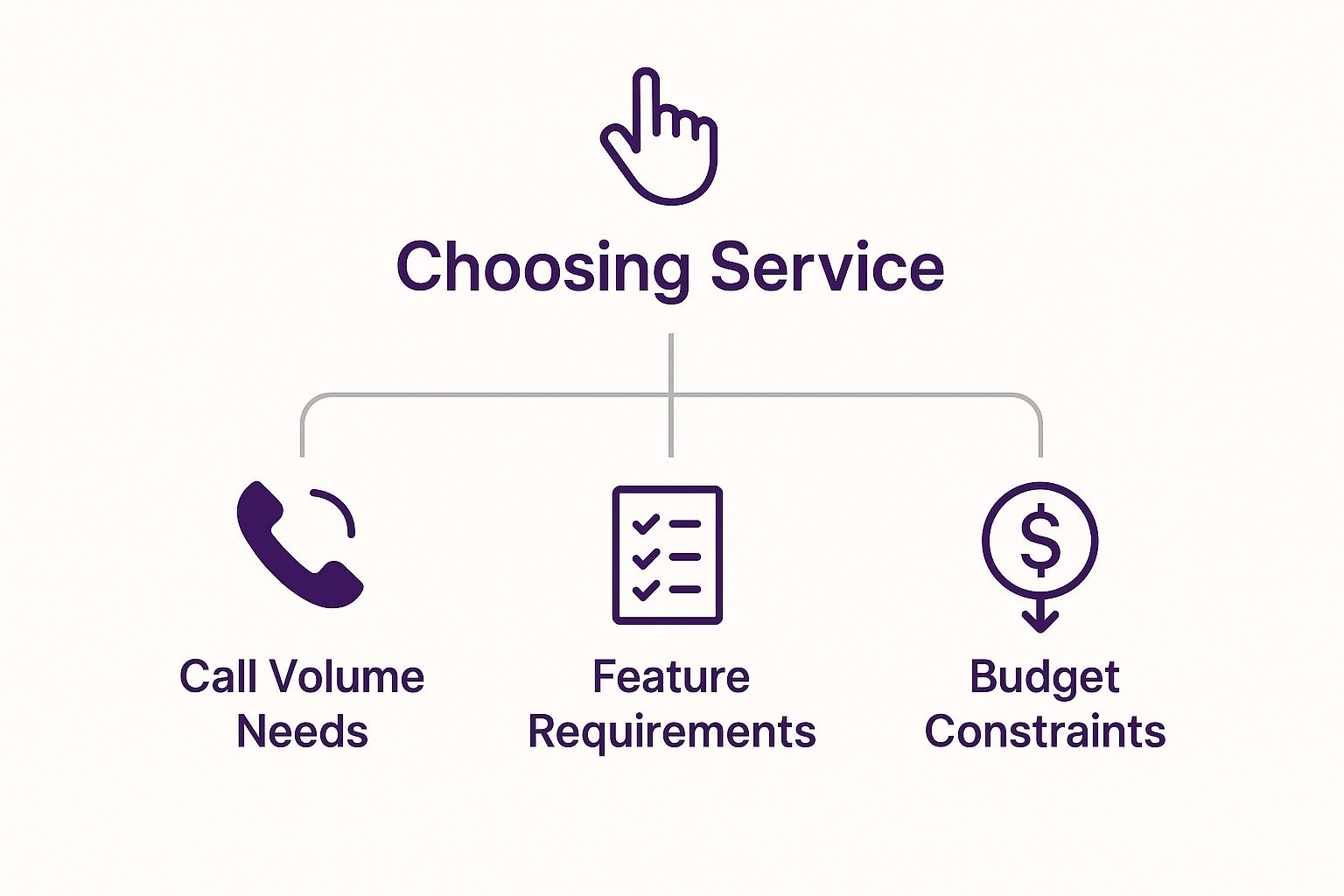
Choosing an answering service isn’t a one-size-fits-all decision. The best partner for a busy law firm will have different skills than one for a growing e-commerce brand. To find the perfect fit, you must match the service type to your specific business goals, call volume, and customer needs.
Not all answering services are created equal. They fall into distinct categories, each built to solve different business problems. Understanding these types is the first step toward making a smart choice.
Inbound Answering Services
Inbound services are the most common type, focusing entirely on managing calls coming into your business. Think of them as your dedicated front-line team, ensuring every caller gets a prompt, professional, and helpful response.
These services are a lifesaver for businesses that can’t afford to miss a single customer inquiry, support request, or sales opportunity. An inbound answering service typically handles:
- 24/7 Live Answering: Agents are on standby around the clock, so your business is always open to customers.
- Appointment Scheduling: They can sync with your calendar software to book, reschedule, and confirm appointments.
- Customer Support: They act as your first line of defense, handling common questions and freeing up your in-house team for more complex issues.
- Order Taking: For retail or e-commerce businesses, agents can process orders over the phone, capturing sales that might have otherwise slipped away.
Real-world example: A local HVAC company uses an inbound service to ensure an emergency call at 3 AM about a broken furnace is answered immediately. The agent dispatches an on-call technician, securing a high-value job that would have gone to a competitor.
Outbound Answering Services
While inbound services react to incoming calls, outbound services are proactive. They make calls on your behalf to achieve specific business targets, requiring a skill set focused on outreach and engagement.
Outbound services are a powerful tool for generating new business, gathering customer feedback, and moving leads through your sales pipeline. Common tasks include:
- Lead Follow-Up
- Customer Surveys
- Appointment Reminders
Real-world example: A software company might use an outbound service to follow up with users who signed up for a free trial, answer their initial questions, and encourage them to upgrade to a paid plan.
Specialized Answering Services
Some industries have unique needs due to complex regulations or the sensitive nature of their calls. Specialized answering services are built to meet these requirements, with agents who have industry-specific training.
Choosing a specialized service is absolutely critical in regulated fields. Untrained agents can create huge compliance risks, while industry experts protect your business and build trust with your clients.
This is where true expertise makes all the difference. Key examples include:
- Medical Answering Services: These providers are HIPAA-compliant, and their agents are trained to handle patient calls with the required privacy and empathy.
- Legal Intake Services: For law firms, specialized agents know how to conduct new client intake, gather case details compassionately, and screen calls so attorneys only spend time on qualified leads.
- Financial Services: In finance, agents are trained on strict security protocols and can handle tasks like lead qualification for mortgage brokers or initial intake for insurance claims.
By identifying your primary need—inbound support, outbound growth, or specialized compliance—you can find an answering service that aligns perfectly with your business.
How to Choose the Right Answering Service
To make things clearer, here’s a quick breakdown of how these service types stack up against different business needs.
| Service Type | Primary Function | Best For (Example Scenarios) | Key Features |
|---|---|---|---|
| Inbound Answering Service | Reactively managing incoming calls and customer interactions. | Businesses with high call volumes; service-based industries like HVAC or plumbing; companies needing after-hours support. | 24/7 live answering, appointment scheduling, basic customer support, order taking. |
| Outbound Answering Service | Proactively making calls on behalf of the business. | Sales-driven organizations; companies focused on lead generation; businesses needing to gather customer feedback. | Lead follow-up, customer surveys, appointment reminders, market research. |
| Specialized Answering Service | Handling calls that require specific industry knowledge or compliance. | Medical practices (HIPAA), law firms (legal intake), financial institutions (security protocols). | Industry-specific training, compliance adherence, high-level data security, expert terminology. |
Ultimately, the goal is to find a partner that feels like a true extension of your team. By understanding these core differences, you’re already on your way to finding the perfect one.
The Future of Call Answering: A Human and AI Partnership

The conversation around AI often paints a picture of robots replacing jobs. But in customer communication, the future isn’t about replacement—it’s about partnership. The best answering service today masterfully blends AI’s lightning-fast efficiency with the empathy and critical thinking that only a human can provide.
This powerful duo creates a service that’s both incredibly sharp and deeply personal. Technology handles repetitive tasks, freeing up human agents to focus on building relationships.
How AI Empowers Human Agents
Think of AI as the ultimate sidekick for a live agent, working behind the scenes to make every customer interaction faster, smarter, and more helpful. This hybrid model is a game-changer.
Here’s how this tag team works in the real world:
- Instant Triage and Routing: AI can instantly identify the reason for a call. It can answer simple questions like “What are your hours?” on its own or route a hot sales lead directly to the best available agent without wasting a second.
- Real-Time Agent Assistance: While an agent is on a call, AI can pull up the customer’s history, suggest answers from a knowledge base, and provide data on the fly, enabling faster, more accurate problem-solving.
- Automated Post-Call Work: After the call, AI can automatically summarize the conversation, log notes in your CRM, and schedule follow-up tasks. This frees the agent to move immediately to the next customer, boosting overall productivity.
This blend of high-tech and human touch is a practical strategy modern businesses are using right now. You can see exactly how we use automation and artificial intelligence in our call centers to put this into action.
The Best of Both Worlds for Your Customers
From the customer’s perspective, this hybrid approach feels seamless. They get the immediate response they expect without sacrificing the quality of the conversation.
Real-world example: A customer calls a plumbing company at midnight with a burst pipe. The last thing they want is a frustrating phone menu. An AI-assisted answering service can instantly capture key details like their name and address while a human agent is already connecting to the line, ready to provide a calm, empathetic voice and dispatch a technician.
The goal of a modern answering service isn’t just to answer calls. It’s to resolve issues on the first contact by giving skilled agents the best possible tools to succeed. That’s the power of the human-AI partnership.
By leaning into this forward-thinking model, your business doesn’t just keep up—it gets ahead, delivering service that is both remarkably efficient and genuinely human.
How to Select the Best Answering Service Partner
Choosing the right answering service is like hiring a strategic partner who becomes the voice of your brand. With every call, your reputation is on the line, so getting this decision right is crucial for long-term success.
This means looking closely at a provider’s capabilities, track record, and alignment with your business goals. A cheap service that makes your brand look unprofessional can cost you far more in lost customers than you save on the monthly invoice.
Evaluate Industry Experience and Specialization
First, look for a provider with proven experience in your industry. A team that already speaks your language and understands your unique challenges can deliver higher quality service from day one. An answering service for a medical clinic has entirely different needs than one for a law firm.
For instance, a healthcare provider must work with a partner that is fully HIPAA-compliant to protect patient privacy—no exceptions. Don’t hesitate to ask potential vendors for case studies or references from businesses like yours.
Key Questions for a Potential Answering Service
Before signing a contract, you need clear, specific answers to a few critical questions. Vague responses are a red flag.
Here’s a practical checklist to guide your conversations:
- What does your agent training process involve? Top-tier services invest heavily in training agents on your specific brand voice and business rules.
- How do you ensure brand consistency? Look for providers who collaborate with you to build custom scripts and a detailed knowledge base.
- Can your service scale with my business? A true partner should offer the flexibility to adjust your plan as your call volume changes.
- What are your security protocols and compliance standards? This is non-negotiable for industries handling sensitive data. Ensure they meet standards like HIPAA or PCI DSS if applicable.
Understanding these details is especially important when you’re looking for call center services for your small business that can grow with you.
Review Technology and Integration Capabilities
The best answering service providers use robust technology to create a seamless experience. Ask if their platform can integrate with the tools you already use, like your CRM or scheduling software. This is a game-changer, as it allows agents to see customer history or book appointments directly in your system, leading to more personalized and efficient interactions.
A true partnership is built on alignment. Your answering service should not only meet your current needs but also have the foresight and capability to support your future growth and evolving customer expectations.
The demand for integrated solutions is clear. The global Contact Center as a Service (CCaaS) market, a close cousin to the answering service industry, is projected to grow significantly, showing a massive shift toward cloud-based communication tools that simply work better.
Frequently Asked Questions About Answering Services
Even with a clear understanding of the benefits, you might still have a few questions. Let’s tackle the most common ones we hear from business owners to help you make an informed decision.
How Much Does an Answering Service Cost?
The honest answer is: it depends. The cost hinges on your call volume and the complexity of the tasks required, from basic message-taking to advanced appointment scheduling. Most providers offer tiered plans, such as per-minute rates or monthly packages with a set number of included minutes.
Think of it as an investment, not an expense. A quality answering service prevents you from losing valuable leads and helps retain current customers, delivering an ROI that almost always outweighs the monthly fee. We recommend getting a custom quote to find a plan that fits your budget and business goals.
Will Agents Sound Like They Are Part of My Company?
Absolutely. A top-tier answering service invests heavily in training agents to be a seamless extension of your brand. They learn your company’s tone, use customized scripts you approve, and handle calls just as an in-house employee would.
The whole point is to create a customer experience so smooth that your callers never guess they’re talking to a partner service. Your brand’s voice and professionalism are front and center on every single call.
This detailed preparation ensures your customers feel they’re speaking with a helpful, knowledgeable professional who works directly for you.
How Quickly Can an Answering Service Be Set Up?
You might be surprised at how fast the process can be. For most standard services, you can be up and running with live agents taking your calls within 24 to 48 hours.
The process typically involves:
- A brief consultation to understand your call-handling needs.
- Collaboration to create your custom call scripts and protocols.
- Simple instructions on how to forward your business lines.
More advanced setups, like CRM or scheduling software integrations, may take a little longer. A good provider will have a dedicated onboarding team to ensure a smooth transition from day one.
What Is the Difference Between an Answering Service and a Virtual Receptionist?
These terms are often used interchangeably, but there can be a slight distinction. A traditional answering service typically focuses on expertly managing incoming calls—taking messages, screening calls, and routing them appropriately.
A “virtual receptionist” service often includes a broader range of administrative tasks. This can encompass everything an answering service does, plus tasks like making outbound calls or managing your calendar. The best providers offer a blend of both, customizing their services to fit your business’s exact needs.
Ready to ensure every customer call gets a professional answer and every lead is captured? CallZent provides scalable, bilingual answering service solutions that act as a true extension of your team. Discover how our services can help your business grow today.
Setup a free consultation here. We can work together to grow your business and help you deliver outstanding customer experiences.