Skip to content

Back Office Outsourcing Guide
Back Office Outsourcing: Your Guide to Efficiency & Savings
Is administrative work slowing your growth? Discover how back office outsourcing can cut costs, improve efficiency, and free your team to focus on core business goals.
TL;DR — The Core Idea of Back Office Outsourcing
Back office outsourcing is the strategic decision to delegate non-customer-facing administrative tasks—like data entry, payroll, IT support, and accounting—to a specialized external partner. This isn’t just about offloading work; it’s a powerful move to reduce operational costs, increase efficiency, and refocus your internal team on revenue-generating activities. By partnering with experts, you gain access to superior technology and talent without hiring in-house.
Meta Title: Back Office Outsourcing: Your Guide to Efficiency & Savings
Meta Description: Is administrative work slowing your growth? Discover how back office outsourcing can cut costs, improve efficiency, and free your team to focus on core business goals.
Is your team drowning in administrative work instead of focusing on what really moves the needle? It’s a common problem that quietly drains resources and stalls growth. You hired brilliant people to innovate and serve customers, not to get lost in spreadsheets and paperwork.
This guide is your roadmap to reclaiming that lost potential. We’ll break down exactly what back office outsourcing is, how it drives real-world results, and how to implement it smartly.
TL;DR: The Core Idea of Back Office Outsourcing
Back office outsourcing is the strategic decision to delegate non-customer-facing administrative tasks—like data entry, payroll, IT support, and accounting—to a specialized external partner. This isn’t just about offloading work; it’s a powerful move to reduce operational costs, increase efficiency, and refocus your internal team on revenue-generating activities. By partnering with experts, you gain access to superior technology and talent without the high overhead of hiring in-house.
What Does Back Office Outsourcing Actually Mean?
Picture your business as a high-end restaurant. The chefs, servers, and hosts are your front office—they’re the visible stars creating the customer experience. But behind the scenes, a powerful engine is running to make their success possible. This is where ingredients are sourced, inventory is managed, supplier invoices are paid, and payroll is processed. These are your back office functions.
Back office outsourcing is like bringing in a world-class culinary logistics team to run that kitchen with absolute precision. You’re handing over those essential, non-client-facing duties to a partner who lives and breathes that kind of work. It’s more than just offloading tasks; it’s a strategic move to make your entire operation run smarter.
You can learn more about the broader concept in our detailed guide on what business process outsourcing is.

The Goal: Reclaim Your Most Valuable Resources
The real goal here is to reclaim your internal resources—your time, talent, and money—from the administrative grind that doesn’t directly bring in revenue. For example, instead of your marketing manager losing hours processing expense reports, they could be mapping out your next big campaign.
“Delegating back office tasks isn’t about giving up control; it’s about gaining focus. It allows you to perfect your customer-facing services by ensuring the engine running behind the scenes is perfectly tuned.”
This strategic shift is a major trend. The global market for business process outsourcing was valued at $273.5 billion in 2023 and is projected to nearly double, hitting an estimated $560 billion by 2032. This explosive growth signals that businesses everywhere are getting serious about working smarter, not harder.
Key Back Office Functions You Can Outsource
So, what kind of work are we talking about? Here are some of the most common back office functions that companies choose to outsource. These are the repetitive, time-consuming tasks that, while critical, can easily be handled by a specialized partner, freeing up your team for higher-value work.
| Function Category | Specific Tasks | Real-World Example |
|---|---|---|
| Finance & Accounting | Accounts payable/receivable, bookkeeping, payroll processing, financial reporting. | An e-commerce brand outsources its bookkeeping to ensure accurate financial records and timely tax filings without hiring a full-time CFO. |
| Human Resources | Payroll administration, benefits management, onboarding paperwork, HR data management. | A fast-growing tech startup offloads HR admin to streamline hiring and ensure compliance, letting its core team focus on talent acquisition. |
| Data Management | Data entry, database maintenance, data cleansing, document digitization, transcription services. | A marketing agency outsources lead list cleansing to ensure its sales team is working with accurate, high-quality data. |
| IT Support | Help desk services, network monitoring, software updates, data backup and recovery. | A small law firm uses an outsourced IT help desk to provide 24/7 tech support for its team without the cost of an in-house IT department. |
By handing these functions over to experts, you not only improve efficiency but also gain access to specialized skills and technologies you might not have in-house. A great example is finding reliable outsourcing bookkeeping services to keep your financials airtight without hiring a full-time accountant.
As a nearshore partner in Tijuana, CallZent offers a distinct advantage. Our proximity means we operate in the same time zones as our North American clients and share a strong cultural alignment, making collaboration feel natural and effortless.
The Strategic Benefits of Outsourcing Back Office Tasks
Let’s move beyond the definition and dig into why savvy companies see back office outsourcing as a genuine competitive advantage. This isn’t just about handing off tedious work—it’s a strategic move that fuels real growth and makes your business more resilient.

Slash Costs and Boost Your Bottom Line
For most businesses, the first win is financial. Outsourcing instantly turns fixed labor costs (salaries, benefits, office space) into flexible operational expenses. Think about it: you sidestep the hefty overhead of recruiting, training, and managing additional full-time staff. This directly improves your profitability and cash flow.
A real-world example is a mid-sized logistics company. By outsourcing its invoice processing, it saved over 30% on administrative costs annually, money it then reinvested into upgrading its delivery fleet.
Achieve Peak Operational Efficiency
Imagine your best people—the ones who drive your business forward—are spending a quarter of their week buried in administrative tasks like data entry or invoice processing. An expert outsourcing partner brings specialized processes and technology to execute these functions with speed and precision.
This focus delivers tangible results:
- Reduced Error Rates: A dedicated team handling financial reconciliation or data management uses refined processes that catch mistakes, leading to higher accuracy.
- Faster Turnaround Times: Experts simply work faster. Workflows like purchase order processing or document verification get done in a fraction of the time.
- Streamlined Processes: BPO partners have already perfected the most efficient ways to handle these tasks. You plug that expertise directly into your business.
Unlock Access to Global Talent and Technology
Trying to hire an in-house expert for every single role is not only expensive but often impossible, especially for small and medium-sized businesses. The same goes for investing in the latest enterprise-level accounting software or data security platforms.
Outsourcing is a powerful growth lever, not just a cost-cutting tool. It provides immediate access to a global talent pool and advanced technologies that level the playing field, allowing you to compete with much larger organizations.
A BPO partner has already made those massive investments. You get the benefit of their skilled people and top-tier technology without the huge upfront cost, paying only for what you use. This strategic access is a key reason the BPO market is projected to reach over $560 billion by 2032.
Sharpen Your Focus on Core Business Goals
Perhaps the most important benefit is the freedom it gives your team. When administrative headaches disappear, your internal staff can pour all their energy into the things that actually move the needle—innovation, product development, customer relationships, and strategic growth.
Take a fast-growing e-commerce brand gearing up for the holidays. Instead of frantically hiring and training temporary staff for order processing, they use back office outsourcing. This frees their core team to focus on killer marketing campaigns, letting them crush the seasonal rush without breaking a sweat.
This is just smart financial management. For more ideas, our guide on how to reduce operational costs offers practical advice. Ultimately, outsourcing helps your business scale smarter and focus its energy where it truly counts.
How to Choose the Right Back Office Outsourcing Partner
Your success with back office outsourcing comes down to one critical decision: picking the right partner. This isn’t like buying software. You’re bringing on a team that needs to function as a genuine extension of your own. Get it right, and they’ll be invested in your growth. Get it wrong, and you’re looking at headaches that defeat the purpose of outsourcing.
The biggest mistake is focusing only on the price tag. While cost savings are a huge plus, the cheapest option is rarely the best. Real value comes from a partner who brings industry know-how, tight security, and a collaborative spirit.
Core Evaluation Criteria for Your BPO Partner
Before you start looking at proposals, create a clear checklist. This helps you compare apples to apples.
Here are the absolute non-negotiables:
- Industry-Specific Expertise: Does the provider get your business? A partner with e-commerce experience will know how to handle seasonal returns, while a healthcare specialist will be an expert in HIPAA compliance.
- Rock-Solid Data Security: Ask direct questions about security protocols. Look for certifications like SOC 2 or ISO 27001 and confirm they comply with regulations like GDPR or HIPAA if relevant.
- Scalability and Flexibility: A great partner can easily scale their services up or down to match your needs, without trapping you in a rigid contract.
- Cultural and Time Zone Alignment: Smooth collaboration depends on easy communication. A partner in a similar time zone with a similar work culture makes every daily interaction easier.
Onshore vs Offshore vs Nearshore Outsourcing
Where your outsourcing partner is located has a massive impact on your day-to-day working relationship. Each model has pros and cons.
| Factor | Onshore (Same Country) | Offshore (Distant Country) | Nearshore (Neighboring Country) |
|---|---|---|---|
| Cost | Highest | Lowest | Moderate (Balanced) |
| Time Zone | Identical | Significant Difference | Aligned or Minimal Difference |
| Collaboration | Easiest | Most Challenging | Seamless and Easy |
| Cultural Fit | Highest | Varies Significantly | High Affinity and Understanding |
Offshore can offer the lowest labor costs, but massive time zone gaps and cultural disconnects often lead to hidden costs from miscommunication. Onshore offers perfect alignment but comes with a premium price tag.
For many North American businesses, nearshore outsourcing offers the perfect sweet spot. A partner like CallZent in Tijuana provides major cost savings while keeping time zones aligned and cultural parallels strong, creating a true partnership.
This strategic approach gives you the best of both worlds. You can learn more about it in our guide to smart sourcing for your business. And if you’re looking for a partner for specific tech needs, you can find tips on choosing the best outsourcing IT company.
Your Roadmap to a Smooth Implementation
Handing over part of your back office to an external partner can feel like a huge leap. But with a clear, structured plan, the process becomes predictable and far less daunting. Think of this roadmap as your blueprint for a successful back office outsourcing initiative.
Step 1: Conduct an Internal Assessment
Before looking at vendors, look inward. Map your current back office workflows to identify the real bottlenecks. Which tasks are repetitive and draining the most time from your skilled team? The goal is to pinpoint functions that are necessary but not core to your business. For example, a software company might realize its developers are bogged down with HR paperwork—a classic outsourcing opportunity.
Step 2: Build a Compelling Business Case
Once you know what to hand off, define why. A strong business case turns this idea into a strategic imperative. This document should spell out expected results with measurable Key Performance Indicators (KPIs).
Your business case should nail down:
- Clear Objectives: Get specific. Are you trying to cut operational costs by 25%? Reduce invoice processing time from three days to 24 hours?
- Projected ROI: Go beyond direct cost savings. What’s the value of freeing up your internal team to focus on revenue-generating work?
- Risk Assessment: Acknowledge potential hurdles—like data security or knowledge transfer—and outline how you’ll tackle them.
Step 3: Navigate Vendor Selection
With your game plan set, it’s time to find the right partner. This infographic breaks down the selection process into three core pillars: expertise, security, and operational model.
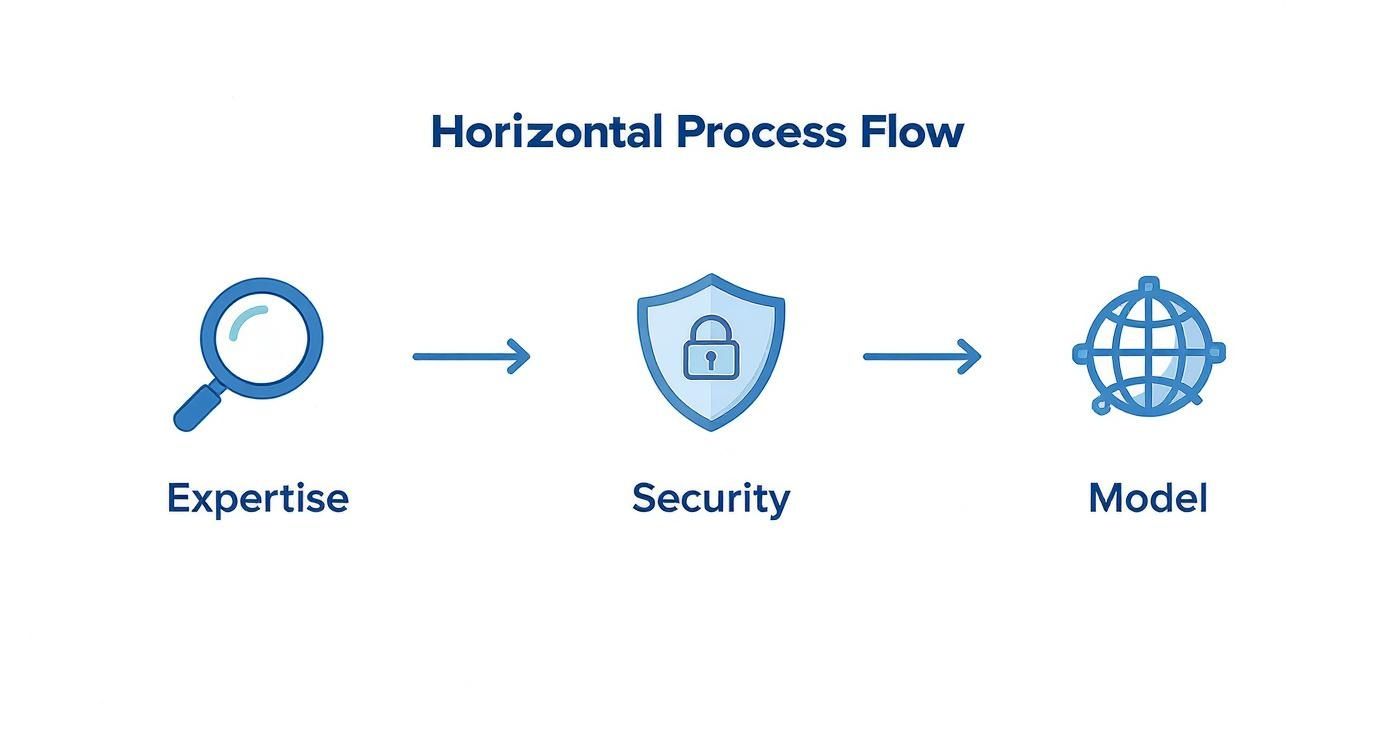
As you can see, a successful partnership is built on a balanced foundation of skill, safety, and strategic alignment.
Step 4: Craft a Comprehensive Service Level Agreement (SLA)
The SLA is the most important document in this relationship. It’s the contract that defines everything—from performance expectations and reporting to security protocols. A vague SLA is asking for trouble.
A well-crafted SLA isn’t just a legal document; it’s a communication tool that ensures both you and your partner have the exact same definition of success.
Your SLA needs to detail metrics, reporting frequency, and clear procedures for resolving issues. To make sure you’ve covered all your bases, check out our deep dive into service level agreement best practices.
Step 5: Manage the Transition and Onboarding
This is where the rubber meets the road. A smooth transition is crucial for minimizing disruption. This stage is all about detailed knowledge transfer—documenting your processes and training the outsourcing team until they know them inside and out. A solid plan includes clear communication channels, tech integrations, and running a pilot program to iron out any kinks before going all-in.
Step 6: Establish Ongoing Performance Management
Launching the partnership is just the beginning. Long-term success in back office outsourcing comes down to continuous performance management and open communication. Set up regular review meetings to go over performance against the KPIs in the SLA. These meetings are a chance to talk through challenges, find areas for improvement, and tweak processes together. A true partner will proactively suggest ways to make things even better.
Seeing Back Office Outsourcing in Action
Theory is one thing, but seeing how back office outsourcing works in the real world is where it all clicks. Let’s walk through a few practical examples to show how this move can truly reshape a business.
Example 1: The Healthcare Clinic Drowning in Paperwork
A busy local clinic delivered top-tier patient care, but its administrative team was swamped with scheduling, insurance verification, and billing. This paperwork mountain was stretching wait times and crushing staff morale.
- The Problem: The clinic’s focus on patient care was being undermined by administrative overload.
- The Solution: They outsourced two key functions to a BPO partner specializing in healthcare:
- Patient Scheduling: A remote team took over all appointment calls, freeing up in-clinic staff.
- Insurance Verification: The partner handled confirming patient coverage before each visit.
- The Results: Patient wait times dropped by 30%, billing errors plummeted, and the clinic staff could give their full attention to the patient experience.
Example 2: The SaaS Company Scaling Too Fast
A fast-growing SaaS company was scrambling to hire developers, but its small HR team was buried under payroll, benefits, and onboarding paperwork.
- The Problem: The HR department had become a bottleneck, slowing down hiring and causing them to lose top talent.
- The Solution: The company turned to back office outsourcing for its HR administration. A nearshore partner took over payroll, benefits management, and compliance paperwork.
- The Results: The time to hire for critical roles was cut in half. The company grew from 50 to 150 employees in one year, directly fueling a 40% revenue jump.
By handing off the transactional HR work, the company grew from 50 to 150 employees in just one year—without the growing pains that usually bring fast-growing businesses to their knees.
Example 3: The E-commerce Store Overwhelmed by Orders
An online retail store selling custom apparel was overwhelmed during peak seasons. The in-house team was stuck manually entering order details, processing returns, and updating inventory, leading to shipping mistakes and delays.
- The Problem: Repetitive data entry was causing shipping errors and long refund delays, tarnishing the store’s reputation.
- The Solution: They outsourced two specific back-office jobs:
- Order Data Entry: An outsourced team ensured every order was entered into the fulfillment system accurately and in real-time.
- Returns Processing: The partner took over the entire returns loop.
- The Results: Order accuracy shot up to 99.8%, and customer satisfaction scores jumped by 25% because the returns process became fast and transparent.
The Future of Back Office Technology and Services
The world of back office outsourcing is evolving. The future isn’t about finding someone cheap to do data entry. It’s about partnering with a provider who brings serious tech to the table—the kind that delivers insights to move your business forward.
At the heart of this shift are Artificial Intelligence (AI) and Robotic Process Automation (RPA). These are powerful tools automating the monotonous, rule-based work that used to eat up so much time.
The Rise of Automation in Outsourcing
The impact is huge. Instead of an agent just processing invoices, an AI-powered system can now analyze spending trends and flag anomalies. This flips the script, turning an outsourcing partner from a simple doer into a strategic advisor.
- AI-Powered Analytics: Modern BPO partners can analyze massive datasets to spot trends and predict customer behavior.
- RPA for Efficiency: Bots can handle tasks like data migration and report generation at lightning speed, cutting out human error.
- Cloud-Based Integration: The cloud allows for a seamless and secure connection between your systems and your partner’s, creating one unified workflow.
If you’re thinking about bringing some of this in-house, check out our guide on how to automate repetitive tasks.
From Task Execution to Strategic Partnership
A modern back office partner does more than just take work off your plate. They offer sophisticated data analysis that helps you make smarter, faster decisions. This evolution is reflected in the market’s health, with BPO revenues in the United States expected to hit $159.75 billion in 2025.
“The true value of modern back office outsourcing lies not in offloading work, but in gaining access to technological capabilities and strategic insights that you don’t have in-house. It’s about turning your administrative functions into a source of competitive advantage.”
Of course, with new technology comes a greater need for security. Top-notch cybersecurity isn’t an optional extra; it’s the price of entry. A forward-thinking partner like CallZent invests heavily in protecting your data, ensuring that as your operations get more connected, they also get more secure.
Common Outsourcing Questions, Answered
Jumping into back office outsourcing usually sparks a few key questions. Here are straightforward answers to what business leaders ask us most.
How Can I Be Sure My Company’s Data Is Secure?
This is the big one. Any outsourcing partner worth considering puts data security at the top of their list. They will have layers of protection like end-to-end encryption, secure network access, and regular audits for standards like SOC 2 or GDPR. Before signing, ask to see their security certifications. Your Service Level Agreement (SLA) should spell out exactly who is responsible for data protection. A real partner is an open book about their security.
Isn’t Outsourcing Just for Big Corporations?
Not anymore. That’s a common myth. Today’s BPO providers offer flexible, scalable models built specifically for small and medium-sized businesses (SMBs). Outsourcing gives you access to the kind of high-end tech and expert talent that used to be reserved for big players, all without the massive upfront cost. It’s a powerful way to level the playing field.
What’s the Real Difference Between Back Office and Front Office Outsourcing?
It all comes down to direct customer interaction.
- Front office outsourcing covers any role where your team is talking directly to customers—like inbound customer service, outbound sales, and technical support. They are the voice of your brand.
- Back office outsourcing is about the crucial work behind the scenes. These are internal tasks—like payroll, accounting, and data entry—that keep your business running smoothly but don’t involve interacting with a customer.
Elevate Your Back Office Efficiency
Free your team from repetitive administrative tasks. With CallZent’s nearshore back office solutions, you gain a reliable, efficient, and cost-effective extension of your operations.
Ready to see how a strategic partnership can transform your operations? The team at CallZent is here to build a custom back office solution that aligns perfectly with your business goals. Start the conversation with CallZent.