Skip to content

Business Operations & BPO
Back Office Support: The Operational Engine Behind Scalable Growth
Learn how nearshore back office support reduces costs, improves accuracy, and frees your team to scale faster without adding operational complexity.
TL;DR — Quick Takeaways
- Back office support covers essential non-customer-facing tasks like billing, data management, claims processing, and administration.
- Outsourcing these functions improves efficiency while reducing operational costs by up to 60%.
- Nearshore models provide real-time collaboration, stronger security, and cultural alignment.
- Strategic back office outsourcing turns administrative work into a scalable growth advantage.
Is your team drowning in administrative work instead of focusing on customers and growth? If that sounds familiar, it’s time to talk about back office support. These are the essential, non-customer-facing tasks—like data management, billing, and administrative duties—that quietly keep your business running smoothly.
The Hidden Engine Powering Your Business Growth
Think of your business as a high-performance car. Your front office—the sales, marketing, and customer service teams—is the sleek, polished exterior everyone sees. It’s the part of the car that engages with the world.
But what actually drives it forward? The engine, hidden right under the hood. That engine is your back office.
Without a well-oiled engine, the car sputters and stalls, no matter how great it looks. It’s the same in business. If your back office tasks are inefficient or piling up, your entire operation suffers. Sales reps get bogged down with paperwork, customer data becomes a mess, and leaders spend their days putting out administrative fires instead of steering the company forward.
This is the core problem that good back office support solves. It isn’t just about hiring someone to handle paperwork; it’s a strategic move to ensure your operational engine is powerful, efficient, and ready for growth.
What Is Strategic Back Office Support?
Strategic back office support simply means delegating these crucial background tasks to a specialized team. By doing this, you’re not just offloading work—you’re hitting key goals that are essential for scaling a modern business:
- Reclaiming Focus: Your best people can finally concentrate on their primary roles—innovating, selling, and building customer relationships—instead of getting sidetracked by repetitive admin work.
- Boosting Efficiency: Specialized teams bring proven processes and technology to the table, completing tasks faster and more accurately than an in-house employee trying to juggle too many things at once.
- Controlling Costs: Outsourcing cuts the overhead that comes with hiring, training, and equipping a full-time administrative team. For businesses looking to get smarter with their spending, learning how to reduce operational costs often leads directly to outsourcing these functions.
“Effective back office support isn’t an expense; it’s a strategic investment in efficiency, accuracy, and sustainable growth.”
For example, an e-commerce store gearing up for the holiday rush. Instead of the marketing team manually updating thousands of product listings, a dedicated back office team handles it all behind the scenes. This frees up the marketers to launch campaigns that drive record sales. That’s the power of a well-run operational engine.
By outsourcing back office support, you’re building a foundation for scalable, resilient, and more profitable growth.
Exploring the Core Back Office Support Services That Drive Efficiency
To really get a handle on back office support, you have to look past the buzzwords and see what’s actually happening behind the curtain. These aren’t just random administrative chores; they’re specialized functions that, when handled by pros, give you a serious operational leg up. Each service is like a gear in a well-oiled machine, making sure everything runs smoothly when no one is looking.
The diagram below shows how these core back office tasks directly fuel sustainable business growth.
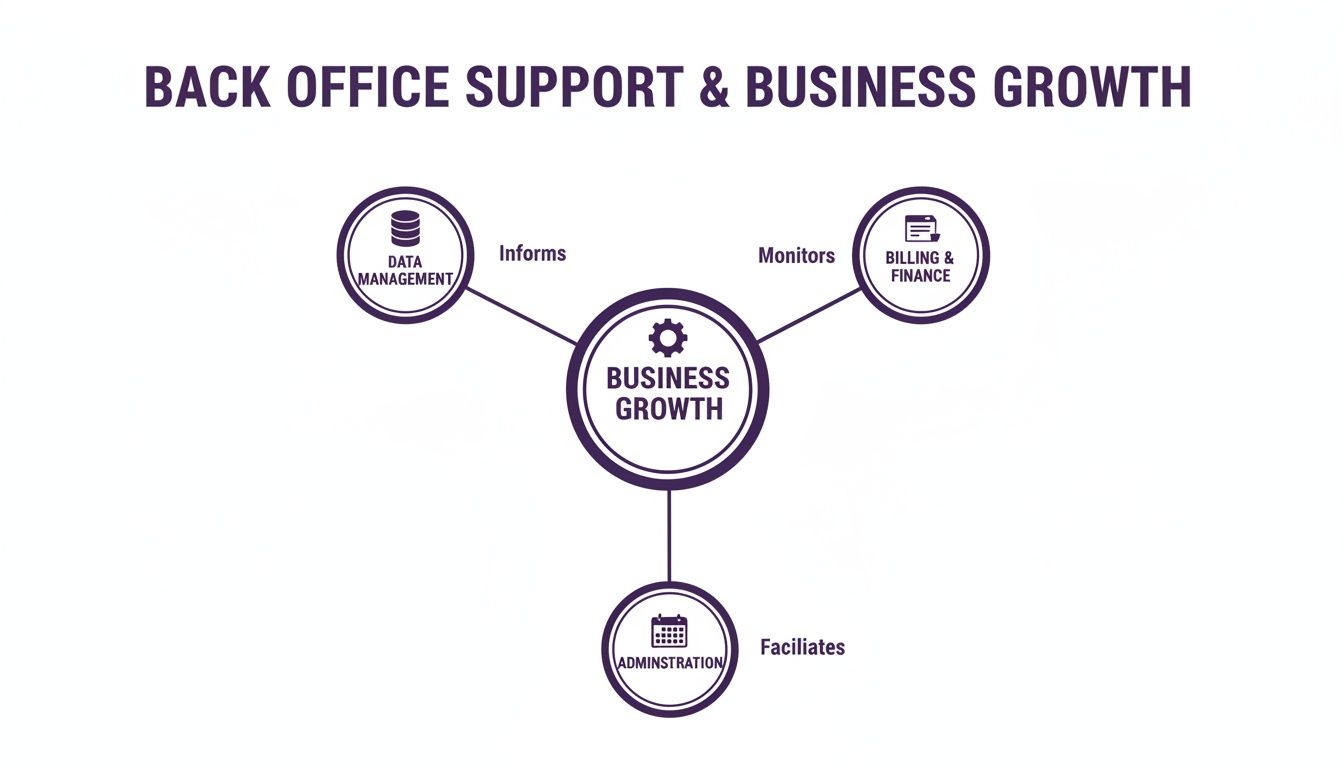
As you can see, things like data management, billing, and admin support aren’t just siloed tasks. They’re interconnected systems that push the entire business forward.
Data Entry and Management
In today’s world, data is everything. But managing it is a relentless, detail-heavy job that can suck up your team’s precious time and energy. This is precisely where outsourcing data management becomes a smart move.
Think about an e-commerce store. Outsourcing means handing off the mind-numbing task of updating thousands of product descriptions, prices, and inventory levels. A dedicated team makes sure every single detail is spot-on, preventing customer headaches and lost sales from bad info. That kind of precision is what keeps your online presence looking sharp and professional.
Billing and Invoicing Management
Steady cash flow is the lifeblood of any business, but let’s be honest—managing billing and invoicing can be a major bottleneck. One missed invoice or a simple billing mistake can stall payments and even strain client relationships.
Take a software-as-a-service (SaaS) company juggling thousands of monthly subscriptions. A specialized back office team can manage the whole cycle: creating accurate invoices, processing payments, and chasing down overdue accounts. This keeps revenue flowing in predictably, giving the company a stable financial foundation to stand on.
“Delegating routine financial tasks doesn’t just save time; it fortifies your cash flow and builds a foundation of financial discipline that enables confident, strategic decision-making.”
This frees up your internal finance experts to focus on the big picture stuff—like analysis, budgeting, and strategy—instead of tracking down payments. The result is a healthier and more predictable revenue cycle.
Claims Processing and Verification
For industries like healthcare and insurance, claims processing isn’t just an administrative task; it’s a core function that’s both incredibly complex and absolutely critical. Any error or delay here can directly hit your revenue and leave patients frustrated.
A healthcare provider, for example, could team up with a BPO to handle submitting, verifying, and following up on insurance claims. An expert team knows how to navigate the complicated rules of different insurance carriers, which means fewer rejections and faster reimbursements.
- Accuracy Check: They verify patient info and codes before submission to catch errors early.
- Carrier Follow-Up: The team stays on top of claim statuses and deals with any issues that pop up.
- Compliance: They ensure every claim follows strict industry rules like HIPAA.
By getting this process running smoothly, the provider boosts its cash flow and frees up medical staff to focus completely on patient care.
Administrative and Virtual Assistance
Every business leader knows how much administrative tasks can drag you down—scheduling meetings, managing a chaotic inbox, booking travel, and prepping documents. These things have to get done, but they pull focus from the strategic work that actually grows the business. This is where virtual assistants (VAs) are worth their weight in gold.
Imagine a startup founder who needs to be all-in on product development and talking to investors. A VA can take over their calendar, filter their emails, and get presentations ready. That support lets the founder pour their energy into high-impact work that moves the needle.
This isn’t just about basic scheduling, either. It can include technical tasks that require specific skills, blending administrative help with some real tech-savvy. For instance, some admin teams can even provide first-level technical help, similar to the specialized solutions you’d find with IT help desk support services. By offloading these responsibilities, leaders get back their most valuable asset: their time.
Why Outsource Your Back Office Support?
Knowing what back office support is helps, but the real question is why you should care. The truth is, outsourcing these day-to-day tasks solves some of the biggest headaches businesses run into, turning what feels like a necessary cost into a smart investment in your future.

Unlocking Serious Cost Savings
The first and most obvious win is the hit to your bottom line. Running an in-house admin team is way more expensive than just their salaries. You’re also paying for benefits, payroll taxes, office space, new laptops, and constant training. It adds up fast.
When you team up with a nearshore partner, you swap all those messy, unpredictable costs for one simple, predictable service fee. You get an entire team of specialists for what it might cost to hire just one or two people yourself. Curious how that math works? You can dig into the ROI of outsourcing and see how those savings start to snowball, freeing up cash for things that actually grow your business, like marketing or product R&D.
Gaining Effortless Scalability
Let’s be real—business is never a flat line. A retail brand might get swamped with orders over the holidays, or a startup could see a massive user spike after a big launch. Trying to hire and train staff to keep up with those peaks and valleys is slow, costly, and a logistical nightmare.
Outsourcing your back office support gives you the flexibility to scale up or down at a moment’s notice.
- Peak Seasons: Instantly add more hands on deck to crush that mountain of data entry or order processing.
- Market Expansion: As you grow, your support partner scales right alongside you to handle the new workload.
- Quiet Periods: When things slow down, you can scale back your services just as easily. You only pay for what you actually use.
This agility means your back-end operations move in perfect rhythm with your business, without the painful cycle of hiring and firing.
Improving Accuracy and Quality
Repetitive work like data entry or processing invoices is a breeding ground for human error, especially when your team is juggling a dozen other tasks. Small typos can cause huge problems—think messy financial reports, late payments, and seriously unhappy customers.
“A BPO partner’s core business is accuracy and efficiency. By tapping into that expertise, you’re not just delegating tasks—you’re upgrading your operational quality.”
By handing this work over to a dedicated BPO provider, you’re tapping into teams that do this stuff all day, every day. They have dialed-in processes and quality checks designed to catch mistakes and keep standards high. For a healthcare clinic, this could mean hitting 99% accuracy on billing and saving millions in denied claims.
Ensuring Stronger Compliance and Security
Keeping up with industry rules—whether it’s HIPAA in healthcare, PCI DSS for payments, or GDPR for data privacy—is a full-time job in itself. One slip-up can lead to massive fines and a serious blow to your reputation.
Expert BPO providers make it their business to stay on top of these complicated, ever-changing regulations. They invest heavily in tight security protocols and ongoing training to make sure your sensitive data is handled correctly and legally.
As remote work becomes the norm, U.S. companies are increasingly looking to experts to handle critical functions securely. One of the easiest ways to start is with specialized virtual receptionist solutions that take a huge administrative load off your plate. This lets you get back to focusing on your core business, knowing your operational backbone is both secure and compliant.
Why Proximity Matters: The Nearshore Advantage in Back Office Support
So you’ve decided to outsource your back office support. It’s easy to assume that geography doesn’t matter anymore—after all, isn’t the whole point to get work done remotely?
Not quite. The truth is, where your outsourcing partner is located plays a huge strategic role in your success. This is where the nearshore advantage really comes into its own.
Unlike offshore models that often get tangled up in massive time differences and cultural disconnects, a nearshore partner in a place like Tijuana offers something far more valuable: seamless collaboration. It shifts the entire dynamic from a simple vendor transaction to a true extension of your own team.
Time Zone Alignment Is a Game Changer
Let’s be honest, one of the biggest headaches with offshore outsourcing is the time lag. You ask a simple question at 5 PM your time, and you might not get an answer until you’re back in the office the next morning. That delay absolutely kills momentum and turns urgent fixes into a slow, painful grind.
A nearshore partner, on the other hand, operates on the same business clock as you.
- Real-Time Problem-Solving: An urgent billing issue pops up? You can jump on a call immediately and get it sorted out in minutes, not days.
- Integrated Workflows: Your in-house staff and nearshore support team can work together throughout the day, keeping projects moving without those frustrating overnight pauses.
- Immediate Accessibility: You can reach your team during your standard work hours. It feels as natural as walking over to a colleague’s desk.
This alignment cuts out the operational friction that plagues so many offshore partnerships. The result is faster turnarounds and a much more responsive, agile operation.
The Power of Cultural and Linguistic Affinity
Beyond just time zones, cultural familiarity is a powerful—and often overlooked—benefit. A nearshore team in Mexico just gets the nuances of North American business culture, communication styles, and customer expectations. This shared context cuts down on misunderstandings and helps build stronger, more intuitive working relationships.
“Proximity isn’t just about miles on a map; it’s about closing the gap in communication, culture, and collaboration. That’s the strategic advantage of nearshore.”
This cultural sync is especially powerful when you add a fully bilingual workforce into the mix. For a U.S. financial firm, this could mean their support team handles data entry from English documents one minute and then seamlessly communicates with Spanish-speaking clients the next. That dual capability makes the entire operation more versatile and effective.
A True Partnership, Not Just a Provider
At the end of the day, the nearshore model creates a much deeper level of integration. Thanks to easy travel, shared time zones, and cultural similarities, your provider feels less like a distant contractor and more like a genuine partner who’s invested in your success.
It’s a model built for collaboration, not just delegation. If you want to dig deeper into this approach, you can learn more about what nearshore outsourcing is and see how it stacks up against other models. For North American companies, this proximity makes nearshore a smarter, more integrated choice for powerful back office support.
How to Choose the Right Back Office Support Partner
Picking a provider for your back office support isn’t just about hiring a vendor—it’s about finding a partner who becomes a true extension of your team. This decision can feel huge, and it is. It directly impacts your efficiency, your data security, and your ability to grow. A structured approach, however, can cut through the noise and help you find a team that genuinely clicks with your business.
The best choice goes way beyond the price tag. You need to dig into what a potential partner can do and what makes them tick. You’re looking for someone who understands your world and can anticipate your needs, not just a team that works through a checklist.
Assess Industry-Specific Expertise
First things first: do they know your industry? A one-size-fits-all approach to back office support is a recipe for disaster. Every sector has its own language, compliance headaches, and unique ways of getting things done.
For instance, a healthcare practice needs a partner who lives and breathes HIPAA compliance and is an expert in medical billing codes. An e-commerce business, on the other hand, needs a team that gets the ins and outs of inventory management and order fulfillment logistics.
Ask potential partners for case studies or to connect you with clients in your industry. This is the quickest way to see if they have real-world experience and won’t be learning the ropes on your dime.
Evaluate Technology and Security Protocols
In a world where data is gold, security is non-negotiable. You’re handing over sensitive company and customer information, so their defenses need to be ironclad.
A true BPO partner doesn’t just manage tasks; they safeguard your data, align with your strategy, and provide the operational backbone that allows you to focus on growth.
Ask them about their tech stack, data encryption standards, and what happens if disaster strikes. Make sure they’re up to snuff on regulations like GDPR or PCI DSS. A provider who takes security seriously will be transparent about their protocols and welcome your questions. This is a critical step in building trust. As you vet potential partners, it’s helpful to browse lists of the top BPO companies in the USA to benchmark how established providers handle their security and expertise.
Review Training and Quality Assurance
How do you know the work will be consistently good? The answer is in their training and quality assurance (QA) processes. A great partner invests heavily in their team and has a rock-solid system for keeping standards high.
Get specific with your questions:
- Onboarding: How will they train their team on your specific processes and brand voice?
- Ongoing Training: What do they do to keep their team’s skills sharp and current with industry changes?
- Quality Checks: How is work actually reviewed? Do they use peer reviews, manager audits, or performance metrics to catch errors?
A partner with a clear QA framework is committed to getting it right, which ultimately protects your reputation and your bottom line. Making this kind of informed decision is at the heart of what we call “smart sourcing.” To really nail this strategic approach, take a look at our comprehensive guide to smart sourcing to help frame your evaluation.
Laying the Foundation for Growth
Think of back office support as much more than just admin work—it’s the operational bedrock of your entire business. When you hand off these critical, behind-the-scenes tasks to a dedicated nearshore partner, you’re not just clearing your team’s plate. You’re making a strategic move to free up your best people so they can focus on what truly matters: innovating and taking care of your customers.
This isn’t about simply offloading tasks. It’s a calculated decision to build a stronger, more resilient operational core. Doing so sharpens data accuracy, unlocks new efficiencies, and gives you the flexibility to scale without skipping a beat. You’re essentially transforming a cost center into a powerful asset that fuels real, forward momentum. With that solid foundation in place, your business is ready to handle growth, pivot with the market, and stay laser-focused on its mission.
The smartest companies don’t just work harder—they build smarter operational systems that let their best people do high-value work. That’s the true power of strategic back office support.
Ready to stop letting administrative burdens dictate your pace? It’s time to build a foundation for lasting success. Let’s explore how the right back office support can help you hit your most ambitious goals and create a more streamlined, profitable future.
Frequently Asked Questions About Back Office Support
Even when the benefits are clear, diving into back office support can kick up a few practical questions. Getting straight answers is the key to making a confident, smart decision for your business. Let’s walk through some of the most common things we hear from leaders just like you.
What’s the Real Difference Between Back Office and Front Office?
The easiest way to think about it is like a restaurant. The front office is everything your customers see and interact with—the friendly host, the attentive servers, the manager making rounds. They are the face of your business, creating the customer experience.
The back office support, on the other hand, is the bustling kitchen. It’s the chefs, the prep cooks, and the dishwashers. No one sees them, but without their work—ordering ingredients (procurement), managing inventory (data), and ensuring the kitchen runs smoothly (admin)—the entire restaurant would grind to a halt. The front office can’t succeed without a rock-solid team working behind the scenes.
Is Outsourcing Back Office Work Only for Big Companies?
Not at all. While huge corporations have outsourced for decades to handle their massive scale, it’s often the small and medium-sized businesses (SMBs) that feel the biggest positive impact. Outsourcing gives them immediate access to specialized talent and powerful tech they couldn’t justify hiring for or buying outright.
For a startup, it means having an expert manage your invoicing without the hefty salary and benefits of a full-time finance person. It completely levels the playing field, allowing smaller players to operate with the same efficiency as their bigger competitors and freeing up founders to focus on what really matters: growth.
It’s a common myth that outsourcing is a luxury reserved for enterprises. The reality? It’s a growth engine for SMBs, giving them instant expertise and the ability to scale without the overhead.
How Do I Figure Out Which Back Office Tasks to Outsource First?
Getting started can feel like a huge task, but the best approach is to go for the low-hanging fruit. Look for the jobs that are repetitive, suck up a ton of time, and aren’t directly tied to your core mission. These are almost always the biggest drags on your team’s energy and focus.
A quick audit of your team’s day-to-day work is a great starting point. Just watch where the administrative quicksand is. You’ll likely spot a few obvious candidates right away:
- High-Volume Data Entry: Think updating product catalogs, plugging in new customer info, or processing piles of forms.
- Routine Financial Tasks: Things like sending out standard invoices, chasing down late payments, or balancing daily transactions.
- Repetitive Admin Work: This could be anything from scheduling meetings and managing a general inbox to pulling the same reports week after week.
Handing these tasks off first gives your team immediate breathing room and delivers a fast return on investment. It’s the quickest way to prove the value of back office support from day one.
🚀 Ready to Strengthen Your Operations?
CallZent delivers secure, scalable nearshore back office support built for growing North American businesses.
Ready to build a more focused, scalable, and efficient business? CallZent provides expert nearshore back office support designed for your specific needs. Let us handle the operational grind so you can get back to driving real growth.