Skip to content

BPO Solutions
Expert Back Office Support Services: Scale Your Business Without the Overhead
Discover how back office support services can cut costs by 40–60% and free up your time. Learn key functions, benefits, and how to choose the right BPO partner.
TL;DR — Quick Takeaways
- Back office support services handle non-customer-facing work like accounting, data, HR, and admin.
- Nearshore outsourcing typically reduces operational costs by 40–60%.
- Outsourcing frees leadership time to focus on revenue, strategy, and growth.
- The right BPO partner operates as a true extension of your internal team.
What if you could plug a fully operational team into your business overnight, sidestepping the headaches of hiring, training, and overhead? That’s the strategic power of back office support services. These are the essential, non-customer-facing jobs—think accounting, data entry, and HR administration—that keep your entire operation running smoothly behind the scenes.
 The Engine Room Powering Your Business Growth
Picture your business as a ship. Your sales and customer service teams are on deck, interacting with the world and steering you toward new opportunities. But what’s happening below?
Down in the engine room, a skilled crew manages everything from navigation charts to fuel levels. Without them, the ship wouldn’t move an inch. That engine room is your back office. It’s the collection of critical administrative and operational tasks that are invisible to your customers but absolutely vital for success. These activities are the backbone of your company, ensuring everything is financially stable, running efficiently, and legally compliant.
What Are Back Office Support Services?
In a nutshell, back office support services is the practice of outsourcing these non-customer-facing tasks to a specialized third-party provider. This is a core component of what Business Process Outsourcing is, a strategy where companies delegate specific business functions to outside experts.
By doing this, you can focus on your core mission—whether that’s building amazing products, delivering top-tier customer care, or breaking into new markets.
Commonly outsourced back office support services include:
- Data Management: Tasks like data entry, database cleaning, and records management to ensure information is accurate and secure.
- Accounting and Finance: Handling bookkeeping, managing accounts payable/receivable, and processing payroll.
- Human Resources: Taking care of administrative HR work like onboarding paperwork and benefits administration.
- IT Support: Providing internal teams with help desk support, software maintenance, and system upgrades.
Why This Matters for Your Business
In today’s competitive market, efficiency is everything. Small business owners often spend nearly 40% of their time on administrative work, pulling them away from activities that generate revenue. This is where back office support becomes a game-changer.
A well-run back office isn’t a cost center; it’s a profit protector. Efficient financial and data management prevents costly errors and frees up capital for growth.
Partnering with a nearshore BPO provider like CallZent gives you instant access to a team of skilled professionals without the massive cost and time investment of hiring internally. This guide will walk you through what these services are, the direct benefits you’ll see, and how to pick the right partner to build a more agile and resilient business.
Defining Your Back Office Operations
To fully grasp the value of outsourcing, you first need to understand what’s happening behind the curtain in your own business. Think of a busy restaurant. The front office is the friendly staff taking orders and engaging with diners. The back office is the kitchen crew, the inventory manager, and the accounting team ensuring every meal is perfectly prepared and profitable.
Both are essential, but they handle completely different work. While customer-facing roles get the spotlight, the back office provides the foundation for a smooth, scalable operation. Getting this distinction right is the first step toward building a more efficient business. For a deeper analysis, our guide breaks down the key differences between front office vs back office roles.
Front Office vs. Back Office: A Clear Breakdown
This table illustrates the core differences between customer-facing (front office) and operational (back office) business functions, helping you identify outsourcing opportunities.
| Business Function | Front Office (Customer-Facing) | Back Office (Operational Support) |
|---|---|---|
| Primary Goal | Direct customer interaction, sales, and support. | Internal processes, efficiency, and operational stability. |
| Key Roles | Sales teams, customer service reps, receptionists. | Accountants, data analysts, HR administrators, IT support. |
| Visibility | Highly visible to customers and the public. | Works behind the scenes; invisible to customers. |
| Metrics | Customer Satisfaction (CSAT), sales conversion rates. | Data accuracy, processing times, cost efficiency. |
| Example Tasks | Answering support calls, closing a sale, greeting clients. | Processing invoices, updating databases, managing payroll. |
Understanding this split is crucial. While your front office wins customers, your back office ensures the business can deliver on its promises without falling apart.
Core Categories of Back Office Functions
Most back office work falls into four main categories. Pinpointing these in your company will highlight where you can gain the most efficiency and sharpen your focus.
1. Data Management
Modern businesses run on data, but keeping it organized is a massive, relentless job. This category covers all the tasks that ensure your information is accurate, secure, and ready to use.
- Data Entry: Manually inputting information from sources like customer forms or supplier invoices into digital systems.
- Data Processing: Transforming raw data into something useful, like creating sales reports or analyzing customer behavior.
- Database Maintenance: Regularly cleaning, updating, and validating your databases to remove errors and duplicates, keeping your data trustworthy.
For example, an e-commerce store might outsource its order processing. A dedicated team would enter new orders, update inventory in real-time, and verify shipping details, preventing stockouts and keeping customers happy.
2. Financial Services
Managing cash flow is non-negotiable. These functions keep your company financially healthy and compliant. As you map out your back office, mastering bookkeeping basics is a critical first step.
Key financial services often outsourced include:
- Bookkeeping: The day-to-day recording of all financial transactions.
- Accounts Payable/Receivable: Managing payments to vendors and chasing payments from customers.
- Payroll Processing: Ensuring everyone is paid correctly and on time, including handling taxes and benefits.
- Invoicing: Creating and sending invoices to clients and following up to ensure payment.
3. Administrative Support
These are the organizational tasks that keep the entire company humming. Without solid administrative support, workflows grind to a halt and productivity tanks.
Imagine a busy executive who offloads calendar management to a virtual assistant. That assistant schedules meetings, books travel, and handles emails, freeing up the executive to focus on high-level strategy instead of logistical details. Other common admin tasks include document preparation, email management, and general clerical work.
4. Human Resources Support
While strategic HR decisions should stay in-house, many administrative burdens can be effectively outsourced. Offloading these repetitive tasks allows your HR team to concentrate on culture, talent development, and employee engagement.
- Onboarding Paperwork: Managing the collection and processing of documents for new hires.
- Benefits Administration: Handling employee enrollment in health insurance, retirement plans, and other benefit programs.
- Recruitment Support: Sourcing candidates, screening resumes, and scheduling first-round interviews.
A fast-growing tech startup, for instance, could partner with a BPO to handle the administrative side of hiring. This lets their internal HR leaders focus on finding top-tier engineering talent instead of drowning in paperwork.
The Real-World Wins of Outsourcing Back Office Support Services
We’ve defined what back office support is. Now, let’s get to the “why.” What are the tangible, bottom-line advantages you gain by outsourcing? The most obvious win is a significant drop in costs.
When you partner with a nearshore provider, it’s not uncommon to see operational expenses fall by a stunning 40-60%. You immediately cut costs tied to in-house salaries, benefits, office rent, and expensive software licenses. But the ROI goes far beyond just saving money.
Freeing Up Your Most Valuable Asset: Time
Every hour your leadership team spends wrestling with administrative work is an hour they aren’t spending on innovation, strategy, or customer relationships. Outsourcing buys this critical time back.
Instead of getting bogged down managing payroll or double-checking data entries, your key players can zero in on the high-impact activities that move the needle. It’s a strategic pivot, allowing you to point your internal talent toward what they do best.
Great back office support isn’t just about saving money; it’s about buying back time to focus on what truly grows your business.
This infographic breaks down the core functions businesses typically delegate to achieve these results.
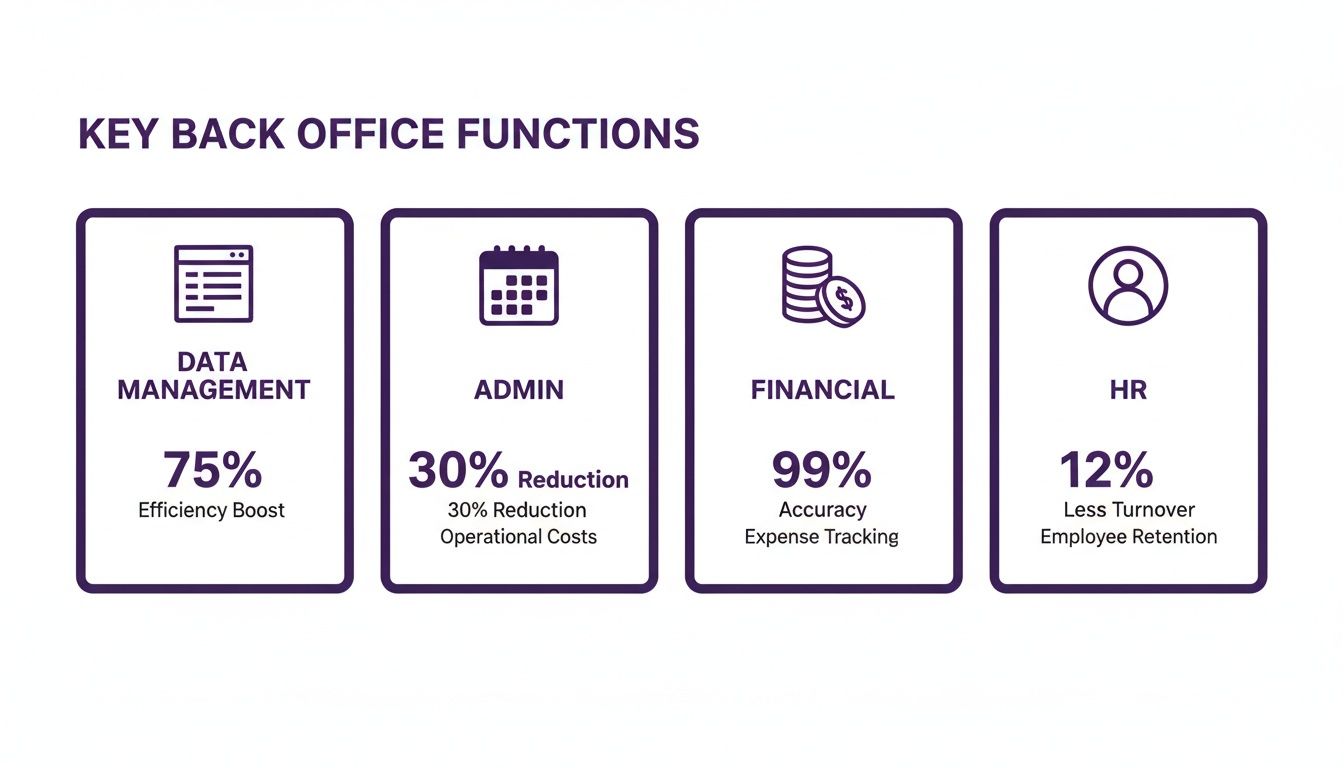
By offloading essentials like data management and day-to-day administrative tasks, companies unlock a new level of efficiency.
Gaining Unmatched Scalability and Agility
Business demand is never a flat line. You have seasonal rushes, unexpected growth spurts, and quieter periods. An in-house team is a fixed cost, which makes adapting to these swings difficult and expensive.
Outsourcing gives you incredible flexibility. Picture a retail business gearing up for the holidays. With a back office partner, they can instantly ramp up their order processing and data entry teams to handle the surge. Come January, they can scale back down without the headache of layoffs.
This agility is a massive competitive advantage, letting you pivot the moment the market shifts. To better understand this model, explore the benefits of nearshore outsourcing and see how it strikes the perfect balance between cost savings and responsiveness.
Accessing Specialized Expertise and Technology
Building a top-tier back office team from scratch requires specialized skills—in accounting, data security, and HR compliance. For most small and medium-sized businesses, hiring full-time experts in all these areas isn’t feasible.
A BPO partner instantly connects you with a deep bench of seasoned professionals trained on the latest tools and best practices. This is even more crucial in niche industries. For example, a specialized partner can supercharge a law firm by providing expert legal outsourcing services that eliminate inefficiencies and clear the way for growth.
When you bring on a partner, you also get the benefit of their technology stack. They’ve already invested in advanced software and automation that might be too expensive for you to acquire on your own, leading to better accuracy and faster turnaround times. This isn’t just about delegating tasks; it’s about upgrading your entire operational engine.
How to Choose the Right Back Office Partner
Selecting a BPO provider is a major decision that goes beyond a simple price comparison. The right partner becomes an extension of your team, helping you find efficiencies and unlock growth. The wrong one can create operational nightmares and drain resources.
It starts with understanding your geographical options. Outsourcing models generally fall into three categories, each with its own trade-offs.
Onshore vs. Offshore vs. Nearshore Models
Getting this first step right is fundamental to a successful partnership, as it impacts everything from daily communication to your bottom line.
- Onshore: Partnering with a provider in your own country. The main benefit is perfect cultural and time zone alignment, but it’s the most expensive option.
- Offshore: Working with a provider in a distant country, like India or the Philippines. It offers the biggest potential for cost savings but often comes with significant time zone differences and potential cultural barriers.
- Nearshore: This model, which includes partners in locations like Tijuana, Mexico, offers a strategic sweet spot. You get major cost savings compared to onshore, but with the huge advantages of aligned time zones and strong cultural affinity with North American businesses.
For most U.S. and Canadian companies, a nearshore solution delivers the ideal blend of cost-efficiency and operational harmony.
What to Look For in a BPO Partner
Once you’ve settled on a model, it’s time to vet potential partners. A cheap price is worthless if the provider can’t deliver on quality, security, and reliability. This is where your due diligence counts. A great approach is smart sourcing, which focuses on finding a partner that delivers strategic value, not just checking tasks off a list. You can explore this concept in our strategic guide to outsourcing.
The global back office outsourcing market was valued at USD 273.5 billion in 2023 and is projected to nearly double by 2032. This explosive growth shows how many businesses are turning to outsourcing to stay agile. To learn more, you can discover more insights about the back office outsourcing market. This trend makes one thing clear: choosing a secure, forward-thinking provider is more important than ever.
Key Questions to Ask Potential Providers
To cut through the sales pitches, you need to ask the right questions. Here’s a checklist to guide your conversations.
1. Industry Expertise and Compliance
- What is your experience working with companies in our industry (e.g., e-commerce, healthcare, finance)?
- How do you stay current with industry-specific regulations like HIPAA or PCI DSS?
- Can you provide case studies or references from clients with similar needs?
2. Technology and Security Protocols
- What does your technology stack look like? How do you manage workflows and ensure efficiency?
- How do you protect our sensitive data? Describe your protocols for data protection and disaster recovery.
- Can your systems integrate with our existing software?
3. Scalability and Flexibility
- What is your process for scaling services up or down as our needs change?
- What is the typical turnaround time for adding team members during our peak seasons?
- How flexible are your contract terms and Service Level Agreements (SLAs)?
4. Team and Culture
- How do you recruit, hire, and train your agents?
- What do you do to foster a positive company culture and minimize employee turnover?
- What does your communication structure look like? Who would be our main point of contact?
Getting detailed answers to these questions will empower you to choose a back office support services partner that is truly equipped to help you succeed.
 Weaving Your Outsourced Team into the Fold
You’ve vetted providers and selected a back office partner. Now comes the make-or-break phase: integration. A seamless transition doesn’t just happen; it’s the result of a deliberate plan to make your new provider an extension of your business.
The first few weeks of onboarding set the stage for the entire partnership. This is your chance to bring your outsourced team into your company’s world, ensuring they feel like a committed partner invested in your success.
Building a Strong Foundation from Day One
The first step is to arm your new team with the right tools and mindset. A great onboarding program goes beyond technical processes; it’s about immersing them in your culture.
- Cultural Immersion: Share your company’s mission, vision, and core values. Help them understand the why behind what you do.
- Process Deep Dives: Provide crystal-clear documentation, video tutorials, and live training on your specific workflows and software.
- Open Lines of Communication: Establish clear points of contact and set up shared channels in Slack or Microsoft Teams to keep the conversation flowing.
Don’t think of them as an outsourced team. Think of them as your new remote department. That single shift in mindset is the biggest factor in building a high-performing, collaborative partnership.
 Setting Clear Expectations and KPIs
Vague goals lead to disappointment. Define what a “win” looks like from the start by setting specific Key Performance Indicators (KPIs) that are measurable and meaningful.
For instance, instead of “process invoices faster,” a better KPI is “Reduce average invoice processing time from 3 days to 24 hours while maintaining a 99.5% accuracy rate.” This clarity removes guesswork and gives your outsourced team the ownership they need to hit their targets. Managing an external team is a unique skill, and our guide on how to manage remote teams is packed with practical tips to keep everyone aligned.
Keeping an Eye on Performance—Without Micromanaging
Trust is the fuel for a great partnership, but accountability is the map. Monitor outcomes, not activities. Focus on the results your team is delivering against their KPIs instead of clock-watching. This builds autonomy and shows you respect their expertise.
Set up a regular rhythm for check-ins, like a quick weekly sync and a more in-depth monthly performance review. Use this time to discuss progress, tackle challenges, and celebrate wins. A shared knowledge base—a central hub for process docs and FAQs—is another game-changer. It helps the team solve problems on their own, reinforcing their role as a capable, integrated part of your operations.
Ready to Take the Next Step?
We’ve seen how back office support services are more than a budget line item—they’re a strategic lever for building a stronger, more focused, and resilient business. When you delegate essential but repetitive tasks to a dedicated partner, you reclaim your two most valuable assets: time and your team’s energy.
That freedom allows you to zero in on what really matters: driving innovation, perfecting your products, and pursuing core activities that put you on the map. The conversation shifts from, “How will we get through this admin work?” to “What’s the next big opportunity we can seize?”
Time for an Honest Look
This is the perfect moment to take a hard look at your internal processes. Where are the bottlenecks? What time-consuming chores are pulling your best people away from high-impact projects? Pinpoint where your business could gain the most from specialized expertise.
Operational excellence isn’t about doing everything yourself. It’s about building a system where everything gets done exceptionally well.
Think about it: every hour someone spends on manual data entry is an hour they’re not spending on growing your customer base. A smart partnership helps you win that trade-off.
Transform Your Operations with a Nearshore Partner
If you’re ready to escape the administrative weeds and accelerate your growth, it’s time to see what a nearshore partnership can do for you. Taking that next step is about making a conscious choice to focus on what you and your team do best.
At CallZent, we don’t offer one-size-fits-all solutions. We build custom-fit BPO services designed to feel like a natural extension of your team, helping you hit your most ambitious goals. Let’s explore how our tailored back office support services can become the engine that powers your company’s next chapter.
Got Questions? We’ve Got Answers
Stepping into the world of back office support services can bring up a few questions. To help clear the air, we’ve tackled some of the most common queries we hear from business owners.
What Is the Difference Between Back Office and Front Office Support?
Think of your business like a restaurant. The front office is everything your customers see and interact with—the host, servers, and dining room. These are your sales and customer service teams.
The back office is the engine room—the kitchen. It’s where essential prep work, cooking, and coordination happen. This includes accounting, data entry, payroll, and HR. Customers never see the kitchen crew, but without them, there’s no food on the table. The back office ensures the entire operation runs smoothly so the front office can shine.
Are Back Office Services Only For Large Corporations?
Not at all. In fact, outsourcing back office tasks is a secret weapon for small and medium-sized businesses (SMEs). For a growing company, hiring full-time specialists for every operational role is a huge financial burden.
Outsourcing gives you instant access to that top-tier talent without the overhead. It allows smaller companies to build a rock-solid operational foundation and compete with larger players. For example, a small e-commerce shop can bring on an outsourced team to handle a flood of holiday orders without hiring permanent staff.
How Do I Ensure Quality From An Outsourced Team?
Ensuring top-notch quality isn’t about micromanaging. It’s about building a genuine partnership from day one. When you treat your outsourced team like an extension of your own, great things happen.
Here’s how to set yourself up for success:
- Pick the Right Partner: Do your homework. Look for a provider with a solid track record and experience in your industry.
- Define Clear KPIs for Your Back Office Support Services: Before starting, agree on specific Key Performance Indicators (KPIs). This removes confusion and gives everyone a clear target.
- Keep Communication Open: Regular check-ins and shared communication tools make the team feel integrated, not isolated.
- Invest in Onboarding: Take the time to train them on your company culture and processes. When they understand the “why” behind their tasks, the quality of their work soars.
A great partner won’t just take orders; they’ll work with you to define success and provide transparent reports on your progress.
🚀 Ready to Streamline Your Back Office?
CallZent builds nearshore back office support services that scale with your business — without the overhead.
Ready to build a more efficient, scalable business? The team at CallZent creates custom-fit back office solutions that act as a true extension of your team, freeing you to focus on growth. Explore our services and see how we can help.