Skip to content

Call Center Quality
A Practical Guide to Achieving the Best Call Center Quality
What does the best call center quality truly mean? Discover the KPIs, QA frameworks, and strategies to balance efficiency and customer experience for lasting success.
TL;DR — Quick Takeaways
- The Best Call center Quality is built on three pillars: operational efficiency, agent effectiveness, and customer experience.
- KPIs like FCR, CSAT, NPS, AHT, and adherence provide a measurable view of performance.
- A strong QA framework requires clear standards, balanced scorecards, consistent monitoring, and regular calibration.
- Technology and nearshore bilingual teams significantly elevate quality, scalability, and customer satisfaction.
What does the Best Call Center Quality really mean? It’s more than just a corporate buzzword. It’s the measurable heartbeat of your customer relationships—a strategic mix of operational speed, agent effectiveness, and the genuine connection you build with every single person who reaches out. Get it right, and your call center transforms from a cost center into a powerful engine for customer loyalty and growth.
TL;DR: The Core of Best Call Center Quality
Achieving true quality in a call center means balancing three pillars: Operational Efficiency (speed and resource management), Agent Effectiveness (solving problems correctly the first time), and the Customer Experience (making customers feel heard and valued). This is measured through a blend of Key Performance Indicators (KPIs) like First Call Resolution (FCR), Customer Satisfaction (CSAT), and Average Handle Time (AHT). A robust Quality Assurance (QA) framework, powered by technology and human coaching, is essential for turning these metrics into consistent, high-level performance.
Defining The Best Call Center Quality Beyond Buzzwords
If you strip away the jargon, defining quality in a call center boils down to balancing three core pillars. Think of it as a three-legged stool—if one leg is wobbly, the whole thing tips over. These pillars are what separate a service that just works from one that builds real, lasting customer loyalty.
Pillar 1: Operational Efficiency
This is about speed, precision, and smart resource management. How quickly are your agents answering calls? Are schedules optimized to handle peak hours without burning out your team? Efficiency is the foundation that ensures customers aren’t left waiting and your operation runs like a well-oiled machine. It’s the promise of a prompt response.
Pillar 2: Agent Effectiveness
An efficient agent who can’t actually solve a problem is just a fast way to frustrate a customer. This pillar measures an agent’s ability to accurately diagnose an issue, provide the right information, and—most importantly—resolve the customer’s need on the first try. This is the “what” and “how” of problem-solving. It’s the promise of a correct answer.
Pillar 3: The Customer Experience
This is where the magic happens. It’s the emotional side of the conversation. Did the customer feel heard, respected, and valued? A huge part of genuine quality comes from listening to your customers and showing empathy. This pillar is often what turns a satisfied customer into a loyal brand advocate. It’s the promise of a positive interaction.
The Balancing Act for Business Success
Here’s the trick: these three pillars can’t work in isolation. If you obsess over efficiency by enforcing strict call times, you’ll get rushed agents and unhappy customers. Focus only on a friendly experience without effective resolutions, and you’ll have pleasant chats that solve nothing.
“True call center quality is achieved not by excelling in one area, but by harmonizing efficiency, effectiveness, and empathy in every single interaction.”
This balance is what drives real business results. As customer expectations rise, industry benchmarks are shifting. The old goal of answering 80% of calls in 20 seconds is being replaced by a push for 90% in 15 seconds. Likewise, a strong First Call Resolution (FCR) rate, which should land between 70% and 79%, is a non-negotiable sign of both agent effectiveness and happy customers. If your numbers are dipping below that, it’s a red flag that a process is broken.
Getting your definition of quality right transforms your call center from a necessary expense into a powerful engine for customer retention and brand growth.
The KPIs That Actually Measure The Best Call Center Quality
Defining quality is one thing; measuring it is another. To get a real handle on quality in a call center, you have to look past gut feelings and dig into the hard data. Key Performance Indicators (KPIs) are your dashboard, showing you exactly what’s working, what’s broken, and where you need to steer the ship.
But not all metrics are created equal. Focusing on the wrong ones, like an overly aggressive Average Handle Time (AHT), can backfire, pushing agents to rush calls just to keep their times down. The right KPIs tell the full story by connecting operational efficiency with genuine customer satisfaction.
Measuring the Customer’s Voice
These KPIs come straight from the source—your customers. They give you a clear, unfiltered window into their experience.
- Customer Satisfaction (CSAT): This is the classic “How satisfied were you?” survey, usually on a 1-5 scale. It’s an instant pulse check on a specific interaction. For example, a customer giving a 5/5 after a tech support call means the agent delivered a great experience.
- Net Promoter Score (NPS): This looks at long-term loyalty by asking, “How likely are you to recommend us?” It sorts customers into Promoters, Passives, and Detractors. A rising NPS tells you your service is creating brand fans, not just putting out fires.
Measuring Operational Excellence
While customer perception is king, operational metrics reveal how effectively your team is performing. These numbers help you pinpoint friction in your processes.
- First Call Resolution (FCR): Did you solve the customer’s problem on the first try? A high FCR is one of the strongest indicators of quality service. It means customers aren’t stuck in a frustrating loop of calling back. A sudden FCR dip at a software company, for instance, might be a red flag that a recent update is causing a bug that agents need new training on.
- Average Handle Time (AHT): This is the total time an agent spends on an interaction, from start to finish, including hold times and after-call work. A low AHT is good, but it must be balanced with FCR and CSAT. A nearshore partner like CallZent uses AHT data to spot complex issues that need better processes, not to rush agents. If AHT suddenly spikes for a certain call type, it’s a signal that agents need better tools or training.
- Schedule Adherence: This tracks how well agents stick to their schedule—are they on time and taking breaks as planned? High adherence is crucial because it ensures you have enough people ready to take calls, preventing long, frustrating wait times for customers.
For a deeper dive into the numbers that drive performance, exploring different operational efficiency metrics can provide a clearer picture.
By blending customer-facing and operational KPIs, you get a 360-degree view of your operation. To learn more about making these metrics work together, check out our complete guide on key customer service performance indicators. This balanced approach is the only way to build a call center that’s truly high-quality.
How to Build a World-Class Quality Assurance Framework
Having the right KPIs is like having a map, but you still need a vehicle to get you to your destination. A Quality Assurance (QA) framework is that vehicle. It’s the structured process that turns raw data into consistent improvements, transforming the abstract idea of quality in a call center into a daily reality.
Think of a QA program like a professional sports team reviewing game tapes. The goal isn’t to punish players for mistakes but to identify weaknesses, refine strategy, and elevate the entire team’s performance. It’s a collaborative effort focused on growth. A well-designed framework ensures everyone—from agents to managers—is aligned on what “good” looks like.
Defining Your Quality Standards
Before you can monitor or score anything, you have to define what you’re measuring against. This is the bedrock of your QA program. If your standards are vague, you’ll get inconsistent evaluations and confused agents.
Your quality standards must be:
- Objective: Based on specific behaviors (“Did the agent confirm the customer’s identity?”) instead of subjective feelings (“Was the agent friendly enough?”).
- Customer-Centric: Aligned with what customers actually value. If customers prioritize quick solutions, your standards should reflect that.
- Actionable: Written so agents can understand and apply them directly to their work.
This is where you see how key metrics like First Call Resolution, Average Handle Time, and Customer Satisfaction all connect.
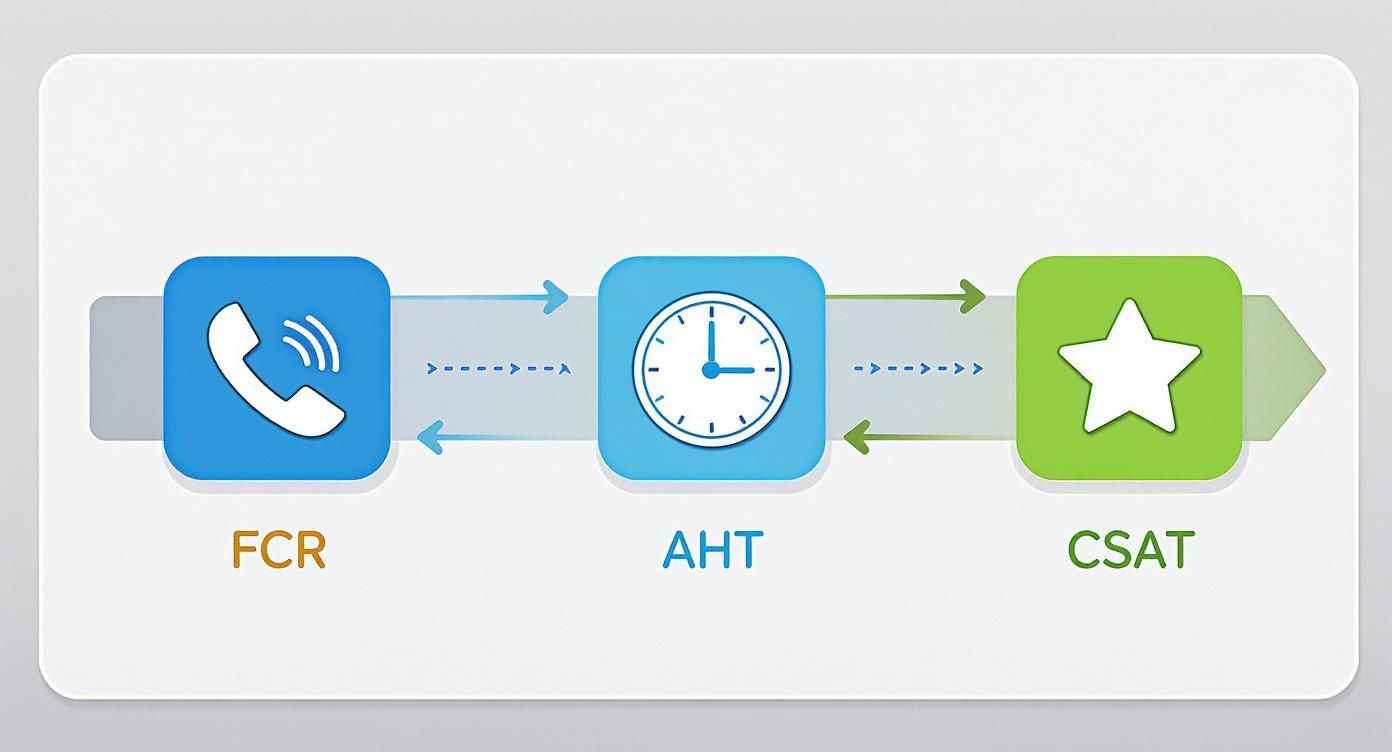
The flow is simple: achieving high FCR and CSAT often means taking a balanced approach to AHT, ensuring efficiency never comes at the cost of solving the problem.
Creating Balanced and Fair Scorecards
A scorecard is the tool you’ll use to evaluate interactions against your standards. A great scorecard is balanced, focusing on critical elements like compliance and process adherence alongside vital soft skills like empathy and problem-solving.
For instance, a retail company struggled after launching a new, complex returns policy. Their FCR rate plummeted because agents gave out inconsistent information. By adding a new scorecard section dedicated to that policy—with specific criteria for explaining the rules correctly—they quickly pinpointed which agents needed more training. The result was a 15% boost in FCR in just one month.
“A quality scorecard isn’t a checklist to catch errors; it’s a blueprint for success that shows agents exactly what they need to do to win.”
Implementing Consistent Call Monitoring
With standards and scorecards in place, the next step is monitoring. This is where you listen to and evaluate real customer interactions. Consistency is everything. Random, infrequent monitoring won’t give you enough data to spot meaningful trends.
Most operations aim to review 4-5 calls per agent per week, but this isn’t a rigid rule. New hires might need daily monitoring, while seasoned top performers could be fine with a couple of reviews weekly. This loop of listening, scoring, and providing feedback is the engine of any QA program. For a complete walkthrough, explore our guide on how to implement call monitoring that drives real results.
Driving Alignment Through Calibration Sessions
To keep everything fair and consistent, you need calibration sessions. In these meetings, QA specialists and team leaders listen to the same call and score it independently. Afterward, they compare scores and discuss any disagreements. This process ensures that “empathetic” or “professional” means the same thing to every evaluator, eliminating bias and building trust in the QA process. When agents know they are being scored fairly, they are far more receptive to coaching and feedback.
 Using Technology for Smarter Quality Monitoring
Manually reviewing a few calls each week is like trying to understand the ocean by looking at a bucket of water. You get a tiny snapshot, but you miss the powerful currents and hidden trends that truly define quality in a call center. Modern technology flips this script, transforming QA from a manual chore into a data-backed strategy.
Instead of sampling a tiny fraction of calls, you can now analyze 100% of your interactions. This is where tools like speech and text analytics come in, acting as your eyes and ears on every single conversation.
Uncovering Insights with Speech and Text Analytics
Imagine an insurance company wants to figure out why customers are leaving. With speech analytics, they can automatically scan every call for keywords like “cancel policy,” “confused,” or “frustrated.” This instantly flags the interactions that need a closer look, moving beyond random chance to focus on the calls that matter.
This approach brings systemic issues to the surface that manual reviews would almost certainly miss. For example, if dozens of flagged calls mention confusion around a specific policy rider, you’ve just found a major training gap or a piece of poorly written customer communication. That’s a real insight you can act on immediately.
The Power of AI and Sentiment Analysis
Technology can go even deeper than keywords. AI-powered sentiment analysis measures the emotional tone of a conversation, picking up on sighs, raised voices, or long pauses that signal customer friction.
This adds a layer of objective emotional intelligence to your QA process. It helps supervisors spot which agents are masters of de-escalation and which ones might need more coaching on handling tough conversations. It gives you a consistent way to measure the customer’s emotional journey—a vital part of true quality.
Real-Time Dashboards and Live Guidance
The best approach to quality in a call center doesn’t just look at past interactions—it improves them while they’re happening. Modern platforms offer real-time dashboards and live agent guidance.
- Real-Time Dashboards: Supervisors can monitor live calls and see key metrics update instantly. This allows them to jump in proactively, sending a quick message to an agent who seems stuck or even joining a call to prevent a bad situation from escalating.
- Live Call Guidance: AI can give agents on-screen prompts during a call. If a customer mentions a competitor, the system can automatically pull up a battle card with key selling points. If an agent is struggling to find information, it can suggest the right knowledge base article.
“Technology transforms quality assurance from a rearview mirror that only looks at past mistakes into a GPS that provides real-time guidance for the road ahead.”
This proactive approach is at the core of how we deliver exceptional service at CallZent. By integrating these tools, we ensure our QA program isn’t just about scoring calls but about constantly elevating performance. To get a better sense of how data drives our success, check out our deep dive into contact center analytics and the power of data. This commitment to smarter monitoring allows us to provide objective, actionable insights that translate directly into better outcomes for our clients and their customers.
 The Human Element: Coaching and Training for Sustained Quality
You can have all the data, analytics, and scorecards in the world, but they’re useless without the most important part of your operation: your agents. Technology is great at showing you where the problems are, but only your people can fix them. This is where the abstract concept of quality in a call center gets real—through effective, human-focused coaching and continuous training.
Data provides the map, but coaching is the conversation that helps an agent navigate the terrain. A great coaching program is built to foster growth, not fear. It flips the script on QA, turning it from a punitive “gotcha” system into a collaborative tool for professional development.
Adopting a Positive Coaching Model
Effective coaching isn’t about pointing out what an agent did wrong. It’s about sitting down with them to figure out how they can nail it next time. The goal is to focus on specific, coachable behaviors, giving them a clear path to improvement that builds confidence instead of tearing it down. This positive approach turns supervisors into mentors and strengthens the entire team.
Let’s walk through a real-world example. A supervisor notices an agent’s Average Handle Time (AHT) is creeping up. Instead of a formal, critical review, they set up a one-on-one session.
- Observe: They listen to a few calls together, not to find fault, but to understand the agent’s workflow.
- Discover: The supervisor sees that the agent keeps fumbling to find customer info in the CRM. The problem isn’t the agent’s conversation skills; it’s a clunky software interface.
- Action: Instead of just saying “be faster,” the supervisor offers targeted training on CRM shortcuts and advanced search functions.
The result? The agent’s AHT drops by 30 seconds per call, their frustration vanishes, and their confidence soars. That’s the power of constructive, targeted coaching.
The Role of Continuous Training
Coaching is perfect for addressing immediate performance gaps, but ongoing training is what prepares your team for what’s next. The customer service world never stands still—new products launch, policies change, and customer expectations rise. A one-and-done onboarding program doesn’t cut it if you want to maintain a high level of quality in a call center.
“Investing in your people is the most direct path to sustainable quality. Great agents aren’t just found; they’re developed through consistent support, coaching, and training.”
Continuous training needs to be a core part of your operational rhythm. This means regular refreshers, workshops on new skills like de-escalation, and deep dives into product updates. For our nearshore teams in Tijuana, this is especially important.
Training for Bilingual and Bicultural Excellence
In a nearshore environment, top-tier training goes beyond simple language fluency. Our agents must navigate complex cultural nuances to build genuine rapport. That’s why our training programs focus heavily on bicultural communication, ensuring agents understand regional idioms, different communication styles, and the specific expectations of North American consumers.
This is a huge part of CallZent’s commitment to quality. By investing heavily in talent acquisition and providing continuous development, we make sure our agents are not just bilingual, but truly bicultural. This deep cultural affinity lets them create connections that go far beyond a simple transaction, delivering the elite level of service our clients expect and their customers deserve.
Enhancing Quality with Nearshore and Bilingual Teams
A common myth is that a nearshore strategy is all about cutting costs. The truth is, when done right, it’s a direct route to elevating the very meaning of quality in a call center. This is especially true when serving a diverse customer base, where just speaking the language is only the beginning.
A real connection happens when an agent doesn’t just translate words but truly understands the culture behind them. A nearshore partnership opens the door to a bicultural talent pool that navigates these subtleties effortlessly. It’s the difference between simple translation and genuine communication—the kind that builds real trust.
Adapting QA for a Bilingual Environment
Quality in a bilingual setting demands a more sophisticated QA framework. A standard scorecard will likely miss the mark because it wasn’t designed to measure the critical elements of a top-tier bilingual conversation. The goal is to get past basic language checks and evaluate true communicative skill.
A QA scorecard for a bilingual agent needs to be built for these unique challenges. For example, a generic card might have a simple checkbox for “Professional Tone.” A specialized one digs deeper:
- Tonal Consistency: Did the agent maintain a professional tone while switching between English and Spanish in the same call?
- Appropriate Code-Switching: If the customer moved between languages, did the agent follow their lead naturally, without causing confusion?
- Understanding Regional Idioms: Did the agent catch and correctly respond to colloquialisms or regional phrases, showing deep cultural fluency?
These are the details that separate a robotic, script-reading agent from someone who can build an authentic connection.
The Bicultural Advantage of Tijuana
Our location in Tijuana gives us a powerful edge in delivering this level of quality. The talent pool here isn’t just bilingual; it’s inherently bicultural. Our agents grew up immersed in both American consumer culture and Latin American social norms. You can’t teach that dual perspective in a training manual.
“Elite quality in a bilingual call center isn’t just about speaking two languages. It’s about thinking in two cultures, ensuring every customer feels completely understood and valued.”
This bicultural fluency means our agents can instantly grasp what an American customer expects while delivering the warmth and personal touch valued in many Latin American cultures. They get the context behind the conversation, which leads to quicker resolutions and happier customers.
At CallZent, our QA process is built from the ground up to measure and strengthen this bicultural excellence. We ensure our agents don’t just pass along information but truly connect with customers on a cultural level—a critical piece of delivering superior quality in a call center.
Frequently Asked Questions About Call Center Quality
Even with the best strategy, running a quality program brings up questions. Let’s tackle some of the most common ones we hear from leaders trying to fine-tune their QA approach.
What is the single most important metric for call center quality?
If we had to pick just one, it would be First Call Resolution (FCR). Why? Because a strong FCR rate is a master key that unlocks improvements across the board. When you solve the problem on the first try, you are:
- Boosting CSAT: Happy customers who don’t have to call back are satisfied customers.
- Slashing Costs: You eliminate expensive, unnecessary follow-up calls.
- Proving Agent Effectiveness: It shows your agents are knowledgeable and empowered.
However, no single metric tells the whole story. FCR tells you if you solved the problem, while CSAT and NPS tell you how the customer felt about it. A truly comprehensive view of quality requires a balanced scorecard of KPIs.
How often should we monitor agent calls for quality assurance?
The standard starting point is 4-5 calls per agent per week, but a one-size-fits-all approach is a mistake. Your monitoring frequency should be flexible and data-driven.
- A new hire in their first 90 days may need daily check-ins.
- A seasoned top performer might only need a couple of reviews a week to stay sharp.
- During a new product launch or policy change, you should ramp up monitoring for everyone to catch issues early.
The goal is to be consistent and let data guide your focus. Good analytics will point you toward the call types or agents that need a closer look, helping you work smarter.
Can outsourcing to a nearshore partner actually improve quality?
Absolutely—if you choose the right partner. A strategic nearshore BPO like CallZent brings more to the table than just cost savings. We are specialists in QA frameworks and have access to technology and a bicultural talent pool that’s tough for most companies to build internally.
With a partner, you get agents with high cultural affinity and native language skills, which immediately smooths out customer interactions. A dedicated BPO is obsessed with operational excellence because it’s our entire business. That means we invest in specialized training and QA processes that an internal department, often stretched thin, simply doesn’t have the bandwidth to develop.
🚀 Elevate Your Call Center Quality with CallZent
Partner with a nearshore team trained in world-class QA frameworks, bilingual communication, and data-driven excellence.
Ready to see how a dedicated nearshore partner can elevate your customer experience? At CallZent, we build custom quality assurance programs that deliver measurable results. Learn more about our solutions.