Skip to content
Call Center Software
Best Call Center Software for Small Business: 2026 Guide
Discover the best call center software for small business, including key features, pricing, and how to scale customer support efficiently.
TL;DR — Quick Takeaways
- Cloud-based platforms are the best call center software for small business due to flexibility and cost savings.
- Must-have features include omnichannel support, CRM integration, IVR, and analytics.
- AI tools like chatbots and sentiment analysis improve efficiency and customer experience.
- Pairing software with a nearshore partner like CallZent maximizes ROI and scalability.
Are you still juggling customer service with a standard phone line and a messy inbox? If so, you know the chaos. It’s a constant struggle to track conversations, leading to missed calls, slow responses, and a customer experience that feels completely disjointed. You’re not just risking frustration; you’re actively capping your own growth.
The best call center software for small business isn’t just for massive corporations anymore. Modern cloud-based platforms deliver everything you need—omnichannel support, CRM integration, and powerful analytics—without the enterprise price tag. For a small business, making this leap is often the defining line between barely keeping up and building a loyal customer base that drives real expansion.

As you evaluate platforms, remember that the communication backbone is key. It’s worth exploring the best VoIP solutions for small business that will power your system. And for a deeper look at how different tools stack up, our detailed help desk software comparison is a great resource.
For a small business, the biggest leap forward is moving from a reactive, “firefighting” support model to a proactive, data-driven one. The right software is what makes this happen, turning every customer interaction into a piece of priceless business intelligence.
This guide will walk you through exactly how to choose the right call center software for your small business. We’ll cut through the jargon and give you practical, actionable steps—from pinpointing must-have features to understanding how a nearshore partner like CallZent provides the expertise and staff to turn your new software into a true growth engine.
Why Cloud-Based Platforms Are a Game Changer for Small Businesses
For a growing small business, the days of housing bulky, expensive server racks for your call center are long gone. The old on-premise model was a massive headache—it demanded huge upfront capital, a dedicated IT team just for maintenance, and was notoriously difficult to scale up or down.
Cloud-based call center software, also known as Contact Center as a Service (CCaaS), completely flips this script. It offers a smarter, more flexible path to growth.

Instead of a giant capital expense, you pay a predictable monthly subscription. This simple shift frees up vital cash flow that you can pour back into other areas of your business. More importantly, it gives you the operational agility you need to compete in a fast-moving market.
Real-World Agility in Action: A Practical Example
Let’s translate this into a real-world scenario. Imagine you run a small e-commerce brand that sells custom athletic wear. With an old-school on-premise system, getting ready for the Black Friday rush meant buying expensive hardware and licenses months in advance—and just hoping you guessed the right amount of traffic.
With a cloud platform, the process is a breeze:
- Instant Scaling: You can jump from 5 to 50 agent seats in minutes to handle the holiday madness.
- Zero Hardware Hassle: No new servers, no complex installations. Your agents just need a computer, a headset, and an internet connection.
- Scale Down Instantly: Once the peak season is over, you can scale right back down to your core team, making sure you only pay for what you actually use.
This kind of elasticity isn’t just for seasonal retail. Think about a telehealth startup where compliance is everything. A cloud platform lets you build a secure, remote workforce that can maintain HIPAA compliance from anywhere, all while delivering critical patient support. To see just how versatile this technology is, exploring some public cloud examples can highlight the benefits for all kinds of businesses.
The biggest advantage of the cloud isn’t just cost—it’s speed. It allows a small business to react to market opportunities and challenges with the quickness of a startup, no matter its size.
The Financial and Strategic Edge of Cloud Call Center Software
The market data doesn’t lie. This isn’t just a trend; it’s a fundamental change in how businesses operate. Cloud solutions grabbed a massive 61.70% market share in 2025, and projections show that dominance will only continue as the market swells from $49.64 billion to an incredible $400.19 billion by 2035.
For small businesses, the benefits are direct and measurable. Companies report cost reductions of 25-35% and a 15% lift in customer satisfaction after making the switch. You can read more about the contact center software market forecast to see the full scope of this growth.
This transition to the cloud also fuels a powerful partnership model. At CallZent, we use these exact cloud call center solutions to power our nearshore services. This synergy lets us deploy highly skilled, bilingual agent teams for our clients quickly and cost-effectively, without being tied down by physical infrastructure. Your business gets enterprise-level support that flexes with your needs, all built on technology that’s ready for whatever comes next.
Essential Features of the Best Call Center Software for Small Business
When you’re looking for call center software, it’s easy to get lost in a sea of features. The trick isn’t finding the platform with the most bells and whistles. It’s about zeroing in on the right tools that solve your specific problems and help you grow.
Let’s break down the must-haves based on the real-world impact they’ll have on your daily operations. This will help you build a checklist of what actually matters for your team and your customers.
Core Operational Features
These are the non-negotiables. Think of them as the foundation of any serious call center. They ensure your team can handle calls efficiently and professionally, turning chaos into a smooth, controlled process. Without them, you’re just answering phones.
- Automatic Call Distribution (ACD): At its heart, an ACD is your team’s traffic controller. It automatically sends incoming calls to the best available agent based on rules you set. For example, a call from a customer with a high lifetime value can be routed straight to your most senior agent, ensuring your VIPs always feel valued.
- Interactive Voice Response (IVR): Your IVR is your 24/7 digital receptionist. It greets callers and lets them route themselves (e.g., “Press 1 for Sales, Press 2 for Support”). This simple feature dramatically cuts down on misdirected calls and empowers customers to get help faster.
- Call Recording and Monitoring: This is a game-changer for quality control and agent training. Recording calls lets you review interactions to ensure compliance, settle disputes, or pinpoint coaching opportunities. Live monitoring allows supervisors to listen in and offer real-time feedback, which is crucial for getting new agents up to speed quickly.
Getting the mechanics right is key. For a deeper look at how ACD and other systems direct your customer traffic, our guide on what is call routing breaks down how it all works.
Growth-Focused Integrations
Software that doesn’t talk to your other tools creates data silos and headaches. The best call center software for a small business should be a central hub, connecting your most important platforms to give you a single, unified view of your customer.
When your integrations are done right, your call center stops being a cost center and starts driving growth. Every conversation becomes smarter.
The best software isn’t about having the most features; it’s about having the right features that solve your specific customer challenges.
Here are two integrations that can make a massive impact:
- Omnichannel Support: Customers don’t care about channels; they just want answers. The best call center software provides omnichannel support, bringing every communication—voice, email, chat, social media—into one dashboard. This means an agent can see a customer’s recent email while talking to them on the phone, creating a seamless, informed experience.
- CRM Syncing: This is arguably the most critical integration. When your call center software syncs with your Customer Relationship Management (CRM) platform, your agents are instantly supercharged. A customer calls, and their entire purchase history, past support tickets, and contact info pop up on the screen. It eliminates the dreaded, “Can you give me your order number again?” and turns a generic call into a personal, efficient interaction.
Performance-Boosting Tools
Once your core operations are running smoothly, the next move is to optimize for excellence. Performance-boosting tools give you the data you need to make smart decisions, improve agent performance, and level up your customer experience.
Real-time analytics dashboards are the heart of this. They give supervisors an at-a-glance view of key metrics like call volume, average wait times, first-call resolution rates, and agent status. If wait times suddenly spike, a manager sees it immediately and can shift agents to that queue, fixing a problem before it frustrates customers. These tools are what separate a reactive team from a proactive, high-performing one.
How AI in Call Center Software Is Revolutionizing Customer Service
Not that long ago, AI in customer service seemed like something only massive corporations with endless budgets could afford. That’s just not true anymore—powerful AI features are now affordable, accessible, and baked right into the best call center software for small business.
These tools aren’t here to replace your human agents. They’re here to give them superpowers, automating tedious tasks and uncovering insights that were once impossible to find. By taking care of routine work, AI frees up your team to do what they do best: solve complex problems and build genuine customer relationships.
AI Chatbots: Your 24/7 Frontline Support
One of the quickest and most effective ways to use AI is with a chatbot. Imagine a customer has a simple question at 11 PM, like, “What’s your return policy?” Instead of making them wait until morning, a chatbot gives them an accurate answer on the spot.
For a small team, this delivers two huge wins:
- Constant Availability: Your business can offer support 24/7 without the cost of staffing a round-the-clock team.
- Reduced Agent Workload: By handling all the common, repetitive questions, chatbots let your skilled agents focus on the more urgent or tricky issues that really need a human touch.
Today’s AI chatbots are also smart enough to know when they’re out of their depth. If a query gets too complex, they can seamlessly transfer the conversation—along with the full history—to a live agent. This handoff ensures the customer never gets trapped in a frustrating loop. You can see more on how we approach this in our guide to automation and artificial intelligence in call centers.
Flag Frustrated Customers with Sentiment Analysis
How do you know when a customer is about to lose their cool on a call before they hang up? AI-powered sentiment analysis gives you that sixth sense. The tool listens to conversations in real-time, analyzing word choice, tone of voice, and long pauses to determine the customer’s emotional state.
If the system detects rising frustration, it can instantly alert a supervisor. This allows a manager to quietly listen in, send the agent a private message with advice, or even jump in to de-escalate the situation and save the customer relationship.
Sentiment analysis acts like an early warning system. It turns a reactive ‘damage control’ situation into a proactive opportunity to save a customer relationship before it breaks.
This is a game-changer for maintaining high service quality and identifying agents who may need more coaching on navigating tough conversations. It’s a perfect example of how AI delivers actionable insights that directly improve the customer experience.
Identify Risks and Opportunities with Speech Analytics
For businesses in regulated fields like finance or healthcare, compliance is non-negotiable. Speech analytics is an AI tool that automatically scans 100% of your call recordings for specific keywords or phrases, giving you a level of oversight that manual spot-checks could never achieve.
For instance, a small financial services firm can use speech analytics to ensure agents are reading mandatory disclaimers on every call. If a disclaimer is missed, the system flags that recording immediately for review, allowing management to fix the compliance gap and provide focused training.
But it’s not just about dodging risks. Speech analytics can also pinpoint sales opportunities by flagging calls where customers mention a competitor or show interest in a new product. There’s a reason the market for these tools is booming—speech analytics alone is projected to top $7 billion by 2030. Small businesses are already seeing agent productivity jump by up to 30% after adopting AI-driven software. You can discover insights about call center statistics and other trends that show a clear, measurable return on investment.
A Practical Framework for Evaluating Call Center Software
Picking the right call center software isn’t about finding the one with the longest feature list. I’ve seen too many small businesses get dazzled by features they’ll never use, only to end up with a platform that’s a nightmare to deploy, impossible to get support for, or has a price tag full of surprises.
To make a smart decision that actually helps you grow, you need to look past the slick marketing and focus on what really counts: real-world performance, scalability, and the true cost of ownership. It’s about asking the tough questions now so you don’t face painful problems later.
Moving Beyond the Feature Checklist
The most common mistake is getting bogged down in a simple feature-for-feature comparison. A better approach is to group your evaluation criteria by their real-world business impact. This helps you see the complete picture of what each vendor truly offers.
Here are the critical areas I always tell businesses to investigate:
- Ease of Deployment and Use: How fast can you actually get up and running? For small teams without a dedicated IT department, a user-friendly interface is a must. Look for vendors that promise rapid onboarding and have intuitive dashboards to cut down on training time.
- Quality of Vendor Support: When things go wrong—and they will—you need help now. Prioritize vendors with a reputation for excellent, 24/7 support through phone, chat, and email. A great platform with lousy support is just a ticking time bomb.
- Real-World Scalability: Your software has to grow with you, not hold you back. Can you add or remove agent seats instantly to manage seasonal rushes? Does the platform have advanced features you can turn on later without a complicated migration?
- Pricing Transparency: Hunt for clear, predictable pricing. Be suspicious of hidden costs like per-minute charges for toll-free numbers, mandatory setup fees, or pricey add-ons for essential features like CRM integration. That “per user, per month” number is almost never the full story.
Choosing the right AI tools has become a key part of evaluating modern software. This decision tree shows how to map specific business goals to the right AI solution.
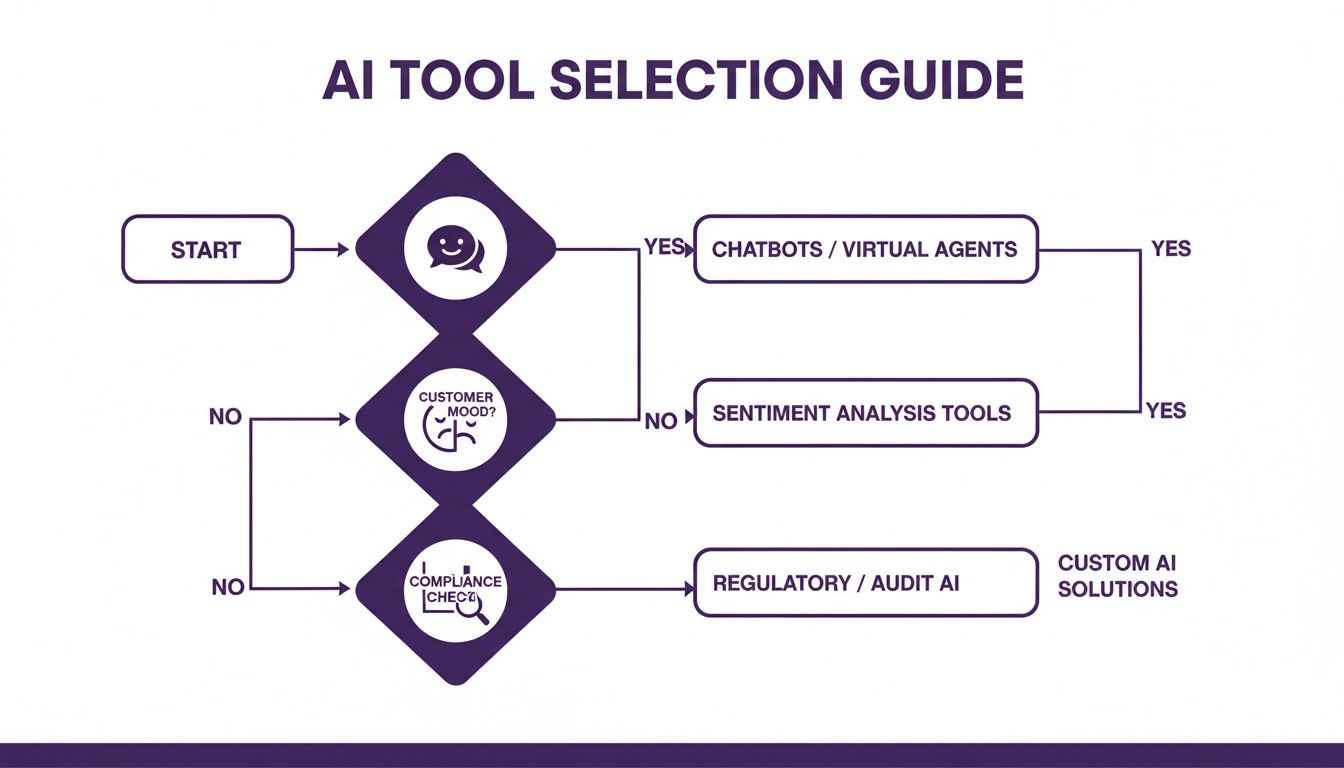
As you can see, the right tool—whether it’s a chatbot for simple questions, sentiment analysis to gauge customer mood, or analytics for compliance—depends entirely on what you’re trying to achieve.
Your Call Center Software Evaluation Checklist
To keep your evaluation organized, use a decision matrix like this one. It forces you to compare vendors apples-to-apples and keeps you focused on your specific requirements instead of getting sidetracked by flashy but irrelevant features.
| Evaluation Criteria | Vendor A | Vendor B | Your Requirements |
|---|---|---|---|
| Core Features | |||
| Omnichannel Support | ✓ | ||
| IVR/ACD | ✓ | ||
| Call Recording | ✓ | ||
| Scalability & Usability | |||
| Ease of Use | ✓ | ||
| Onboarding Process | < 1 week | ||
| Adding/Removing Seats | Instant | ||
| Integrations | |||
| CRM Integration | ✓ | ||
| Help Desk Integration | |||
| Support & Security | |||
| Support Availability (24/7?) | ✓ (Live) | ||
| Compliance (PCI/HIPAA) | |||
| Total Cost of Ownership | |||
| Per User/Month Price | |||
| Hidden Fees | No | ||
| Contract Terms | Monthly |
By filling this out for each potential provider, you’ll have a clear, at-a-glance comparison that makes the final decision much easier and more data-driven.
Situational Recommendations for Smart Decisions
The “best” software is never one-size-fits-all. Your business model, customers, and biggest headaches should be what guides your final choice. Forget generic advice; you need recommendations built for how businesses actually operate.
For small businesses, the smartest software choice isn’t the one with the most features—it’s the one that most elegantly solves your biggest operational headache at a price that makes sense for your bottom line.
Think about which of these common scenarios sounds most like your business:
- For E-commerce with High Seasonality: If your online store sees massive traffic spikes during the holidays, you need a vendor with flexible, usage-based pricing. This lets you scale up to 50 agents for Black Friday and then scale right back down to five in January without paying for seats you aren’t using.
- For Businesses Targeting US & Latin American Markets: If you serve a bilingual customer base, your platform must have strong multilingual IVR and omnichannel features. Even more important is how you’ll staff those channels. This is where partnering with a nearshore provider like CallZent becomes a game-changer, giving you instant access to native bilingual agents who get the cultural nuances of both markets.
- For Startups in Regulated Industries (Healthcare/Finance): Here, security and compliance are everything. You need to zero in on platforms that offer end-to-end encryption, PCI/HIPAA compliance, and detailed call recording with speech analytics to make sure every single interaction is up to standard.
When you apply this kind of structured thinking, you’re no longer just buying software. You’re making a strategic investment that will solve today’s problems and give your business a solid foundation to build on for years to come.
Pairing Great Software with a Strategic Nearshore Partner
Picking the right call center software is a huge win, but it’s only half the job. Technology is a powerful tool, but it doesn’t run itself. The real magic happens when you pair that platform with trained, motivated agents who know how to squeeze every drop of value out of its features.
This is where your strategy shifts from just buying software to building a real growth engine. Without the right people, even the most advanced platform is just an expensive monthly bill. True operational excellence comes from combining powerful tech with human expertise.

The Nearshore Advantage: Your Secret Weapon for Growth
For most small businesses, building a skilled, in-house call center team is just too expensive and time-consuming. This is where partnering with a nearshore BPO like CallZent, located right across the border in Tijuana, becomes a game-changer.
Our model delivers benefits that directly solve the biggest challenges small businesses face:
- Significant Cost Savings: Nearshore operations are dramatically more affordable than building a team in the United States. You get access to top-tier talent without the crushing overhead of domestic labor costs.
- Vast Bilingual Talent Pool: Tijuana has a deep pool of fluent, bilingual professionals who understand the nuances of both English and Spanish-speaking customers. This is non-negotiable for any business serving the diverse North American market.
- Deep Cultural Alignment: Our proximity to the U.S. ensures our agents share a strong cultural connection with your customers. This leads to more natural, effective, and relatable conversations.
The global contact center software market is set to hit $137.64 billion by 2030, and North America leads the pack with a 37% market share. This growth creates the perfect environment for small businesses to team up with nearshore BPOs in places like Tijuana for bilingual support. Smart businesses see a return on their investment in months, not years, especially when using outsourcing solutions that are 30-50% cheaper than U.S. onshore options. You can explore more data on the growth of the contact center software market.
From Theory to Reality: A Real-World Scenario
Let’s make this practical. A U.S.-based SaaS company wanted to launch 24/7 bilingual technical support to better serve its growing user base in Latin America. Building this team stateside would have been a massive project, requiring months of recruiting, training, and a budget that was simply out of reach.
Instead, they partnered with us at CallZent.
By tapping into our existing infrastructure and trained agent teams, they launched their full 24/7 bilingual operation in just a few weeks. They got the technology, the talent, and the strategic guidance all in one place.
This isn’t just outsourcing; it’s smart scaling. We work as an extension of your business, providing both the technology and the people you need to execute your customer service vision. To see how this works, you can learn more about our approach to nearshore outsourcing management services. We position ourselves as your growth partner, ensuring your investment in great software delivers the results you expect.
Common Questions About Call Center Software
Diving into call center software brings up a lot of the same questions for small business owners. You need straight answers to find the right fit for your team without breaking the bank. Let’s get into the most common ones.
What Does Call Center Software Typically Cost for a Small Team?
The good news is that most modern platforms use a per-user, per-month subscription model, which makes budgeting predictable. For a small team, you can find solid options starting around $20-$50 per agent per month for the core features.
If you’re looking for more advanced plans with full omnichannel support and AI tools, expect to pay anywhere from $75 to $150+ per user. The key is to watch out for hidden fees. Things like extra charges for phone numbers, usage minutes, or critical integrations can sneak up on you and inflate the total cost.
How Quickly Can We Get Started?
This is where cloud-based software really proves its worth. Forget the old on-premise systems that took months to set up. You can get a modern cloud solution running in days, and sometimes even hours.
There’s no physical hardware to install, so the whole process is incredibly fast. Your agents just need a computer, a good headset, and a stable internet connection to log in and start handling calls.
The deployment speed of cloud software is a massive competitive edge for small businesses. It means you can react to market demands and scale your support operations almost overnight.
Can It Integrate with My Existing CRM?
Yes, and honestly, this should be a deal-breaker. The best call center software for a small business is built to connect seamlessly with popular CRMs like Salesforce, HubSpot, and Zendesk.
This integration is what transforms your support from reactive to proactive. When a call comes in, the agent sees the customer’s entire history pop up on their screen. No more asking repetitive questions—just a personalized, efficient conversation.
Do I Need a Dedicated IT Team to Manage This?
Nope, and that’s one of the biggest wins of the Software-as-a-Service (SaaS) model. The vendor hosts and maintains the entire platform, which means they do all the heavy lifting on the backend.
- Automatic Updates: New features and security patches are rolled out automatically by the provider.
- Server Maintenance: You’ll never have to worry about buying, managing, or upgrading physical servers.
- Technical Support: If something goes wrong, their support team is on standby to fix it.
This low-maintenance reality frees up your time and money, so you can focus on growing your business, not managing software.
🚀 Upgrade Your Customer Support Today
Discover how CallZent combines the best call center software for small business with expert bilingual agents to drive growth.
Talk to an ExpertReady to pair the right software with an expert team? CallZent provides the skilled, bilingual agents and strategic oversight to turn your customer support into a growth engine.
Discover how our nearshore solutions can empower your business.