Skip to content
Healthcare Outsourcing
BPO Healthcare Services: Streamline Operations and Refocus on Patient Care
Learn how healthcare Business Process Outsourcing (BPO) helps medical practices reduce administrative burden, improve revenue cycle performance, and deliver a better patient experience—without compromising compliance.
Is your medical practice drowning in administrative tasks instead of focusing on patient care? It’s a common struggle: skilled clinical staff get bogged down by endless paperwork, complex billing codes, and constant phone calls—pulling them away from what they do best.
What if you could delegate those administrative headaches to a team of specialists? That’s the power of BPO healthcare services. By outsourcing non-clinical tasks like medical billing, claims processing, and patient support, providers reclaim time, reduce costs, and elevate the patient experience.
TL;DR — Why Healthcare BPO Is a Game-Changer
- What it is: Outsourcing non-clinical healthcare operations to specialized experts.
- Core services: Medical billing & coding, claims processing, RCM, and patient support.
- Key benefits: 40–50% cost savings, fewer errors, faster payments, happier staff.
- Compliance: HIPAA-secure workflows and enterprise-grade data protection.
- Best model: Nearshore BPO offers cost efficiency with real-time collaboration.
Is your medical practice drowning in administrative tasks instead of focusing on patient care? It’s a common struggle: skilled clinical staff get bogged down by endless paperwork, complex billing codes, and constant phone calls, pulling them away from what they do best.
What if you could delegate those administrative headaches to a team of specialists? That’s the power of BPO healthcare services. This guide breaks down how outsourcing non-clinical tasks like medical billing, claims processing, and patient support can free your team to focus on health outcomes while boosting your practice’s financial health. It’s a strategic move to reclaim time, reduce costs, and elevate the patient experience.
Reclaim Your Focus with BPO Healthcare Services
Feeling buried under administrative tasks is practically a universal experience in healthcare. The constant pressure of chasing insurance payments, managing patient records, and handling a never-ending stream of calls for appointments can quickly overshadow the real reason you got into this field: providing excellent medical care.
This operational strain doesn’t just tank staff morale. It can also lead to costly errors and slowdowns that directly hit your bottom line.

This is exactly where Business Process Outsourcing (BPO) comes in. Think of it not as just handing off tasks, but as integrating a team of specialists directly into your workflow—a team that lives and breathes the very administrative functions that often slow your practice down.
What Does Healthcare BPO Actually Mean?
At its core, healthcare BPO means hiring an outside company to manage specific, non-clinical business activities. It’s a strategic move that frees up your internal staff to concentrate on their patient-facing responsibilities.
For example, a busy dermatology clinic might partner with a BPO to handle all their insurance prior authorizations. Instead of a nurse spending hours on the phone with insurance companies, a specialist at the BPO manages the entire process, freeing the nurse to assist with patient procedures.
Key BPO Healthcare Services at a Glance
| Core Service | Primary Function | Key Benefit |
|---|---|---|
| Medical Billing & Coding | Accurately code services to ensure proper reimbursement and avoid denials. | Maximizes revenue and reduces compliance risks. |
| Claims Processing | Manage the full lifecycle of an insurance claim, from submission to payment. | Speeds up payments and cuts down on administrative follow-up. |
| Patient Support | Handle appointment scheduling, answer inquiries, and offer bilingual support. | Improves patient satisfaction and front-office efficiency. |
| Revenue Cycle Management (RCM) | Oversee the entire financial process from patient registration to final payment. | Optimizes cash flow and reduces bad debt. |
By bringing a BPO partner on board, you gain access to a dedicated, trained workforce and better technology without the massive overhead of hiring and managing another in-house team. You can dive deeper into how this works in our guide on outsourcing medical billing to boost revenue.
The primary goal of BPO healthcare services is to transform your administrative backend from a cost center into a streamlined engine for growth and improved patient care.
The Building Blocks of BPO Healthcare Services

When people talk about BPO healthcare services, it’s not a one-size-fits-all solution. Think of it as a specialized toolkit, with each tool designed to fix a specific administrative headache in your practice. Outsourcing these key functions helps you build a stronger, more efficient operational foundation.
These services cover the entire spectrum of non-clinical work, from the first time a patient calls to the final payment being posted. Each one is an opportunity to trade an internal administrative grind for focused, external expertise.
Why Medical Billing and Coding Accuracy is Critical
Medical billing is far more than sending an invoice. It’s a highly detailed process where one tiny coding mistake can trigger a denied claim, stall payments, and punch a hole in your revenue.
Real-World Example: Imagine a busy orthopedic practice that miscodes a complex knee surgery. The insurance company rejects the claim. Now, the office staff must drop everything, investigate the error, correct the code, and resubmit—a cycle that drains resources and clogs cash flow.
A skilled BPO partner eliminates this problem. They employ certified coders who are experts in CPT, ICD-10, and HCPCS codes. They ensure every service is coded correctly the first time, boosting your first-pass claim acceptance rate and getting you paid faster.
How BPO Streamlines Claims Processing
Once a claim is coded correctly, the next hurdle is getting it processed. This means submitting claims to dozens of different insurance payers, each with its own unique rules and submission quirks. Managing this in-house is a constant game of follow-up.
A dedicated BPO team takes over this entire workflow, handling:
- Claim Submission: Filing claims accurately and on schedule with each insurance company.
- Denial Management: Immediately investigating rejected claims to identify the issue and manage the appeals process.
- Payment Posting: Accurately recording payments and reconciling accounts so your financial picture is always clear.
This transforms a chaotic, manual task into a well-oiled machine, ensuring a predictable, steady stream of income.
Comprehensive Revenue Cycle Management with BPO
Revenue Cycle Management (RCM) is the big-picture financial process. It covers everything from the moment a patient schedules an appointment to the moment their account has a zero balance.
Effective RCM isn’t just about collecting payments; it’s about optimizing every single financial touchpoint to maximize efficiency and profitability.
Outsourcing RCM provides an expert, holistic view of your practice’s financial health. A BPO partner manages the entire cycle, identifying weak points and implementing strategies to improve cash flow. This comprehensive approach builds long-term financial stability. These tasks are typically considered back-office operations; learn more about the distinction in our guide to front-office and back-office services.
Patient-Facing BPO Support Services
Finally, BPO healthcare services extend beyond the back office to include crucial patient interactions. These front-line services are key to building patient loyalty. Understanding the unique challenges in the Health Care Services industry is critical for a BPO to be effective.
Key patient support services include:
- Appointment Scheduling: Managing inbound calls to book, confirm, or reschedule appointments, freeing your front desk for in-person needs.
- Prior Authorization Management: Navigating the complex process of getting pre-approval from insurance companies for procedures.
- Bilingual Patient Support: Offering fluent support in both English and Spanish to serve diverse communities effectively.
By outsourcing these functions, you ensure patients receive prompt, professional, and helpful service every time, strengthening your reputation.
Why Top Healthcare Providers Are Embracing Outsourcing
The shift toward BPO healthcare services isn’t just a trend; it’s a strategic response to the immense pressures modern providers face. The decision to outsource has moved beyond simple cost-cutting; it’s now about fundamentally redesigning operations to be more resilient, patient-focused, and financially healthy.
Leading healthcare organizations know that trying to be experts in everything—from complex medical procedures to the tangled web of insurance billing—is an inefficient model. They focus internal resources on world-class patient care and partner with specialists to handle the administrative load.
The Financial Case for BPO Healthcare Services
For any healthcare provider, every dollar matters. High overhead for administrative staff, office space, and technology can eat into a budget that should be going toward patient care. Outsourcing tackles this financial strain by converting fixed in-house costs into a more flexible, variable expense.
The proof is in the numbers. The global healthcare BPO market, valued at USD 200.2 billion in 2022, is projected to explode to USD 726.78 billion by 2031, according to Mordor Intelligence. This growth is fueled by providers realizing they can slash operational costs by up to 40-50%.
Actionable Insight: A mid-sized clinic could redirect the savings from outsourcing its billing department to finally purchase an upgraded EMR system, improving both data accuracy and patient safety. Another might use the freed-up capital to hire an additional nurse practitioner, expanding their capacity to see more patients.
Modern BPO isn’t just a line item for savings; it’s a strategic move for growth. It’s about converting administrative overhead into capital for innovation and better patient outcomes.
Regaining Focus on Core Patient Care
Administrative overload is one of the biggest threats to quality patient care. When your skilled clinical team is bogged down with paperwork, they have less time and mental energy for their patients. This leads to staff burnout and plummeting patient satisfaction.
Outsourcing non-clinical tasks acts as a powerful release valve. Imagine a busy primary care office where the front desk staff constantly juggles ringing phones and a line of patients checking in. By outsourcing appointment scheduling to a BPO, that in-house staff can now give their full attention to the patients right in front of them.
This creates a ripple effect of positive outcomes:
- Shorter Patient Wait Times: Check-in and checkout processes become smoother.
- Better Patient Interactions: Staff are less frazzled and can engage more meaningfully.
- Higher Staff Morale: Freeing clinical professionals from tedious administrative work lets them practice at the top of their license, improving job satisfaction and reducing turnover.
Accessing Specialized Talent and Ensuring Continuity
Hiring, training, and retaining expert medical coders, billers, and compliance specialists is a massive challenge. The healthcare industry is complex and constantly changing, requiring continuous education.
Partnering with a provider of BPO healthcare services gives you immediate access to a deep pool of trained, certified experts. Better yet, outsourcing provides critical business continuity. If your star in-house billing manager suddenly leaves, a BPO partner ensures your essential functions keep running without a single hiccup, safeguarding your revenue stream.
Mastering Compliance in Healthcare Outsourcing
In healthcare, compliance isn’t just a box to check—it’s the bedrock of trust between you and your patients. When you bring in a BPO partner, you’re entrusting them with highly sensitive Protected Health Information (PHI).
Choosing the right partner means finding one that treats data security with the same gravity you do. A single breach can trigger devastating financial penalties and permanent damage to your reputation. That’s why digging into a potential partner’s compliance framework is non-negotiable.
Understanding HIPAA and Its Role in BPO
The Health Insurance Portability and Accountability Act (HIPAA) sets the gold standard for patient data protection in the U.S. It establishes strict national rules for safeguarding PHI.
When you work with a BPO, that partner legally becomes a “Business Associate.” This means they are bound by the same confidentiality and security rules as your own practice. They are a direct extension of your organization and carry the same responsibility.
A truly compliant BPO partner doesn’t just meet the minimum requirements of HIPAA; they build their entire operational culture around data security, making it a central pillar of their service delivery.
This is where you can instantly tell the difference between a basic vendor and a genuine strategic partner. A partner serious about compliance invests heavily in the infrastructure, technology, and training needed to build a fortress around your data.
Essential Security Measures to Demand from a BPO Partner
Vetting a BPO’s security protocols can feel overwhelming, but you can zero in on a few critical areas to gauge their seriousness. These measures are the foundation of a secure outsourcing relationship.
Look for a multi-layered security strategy that includes:
- Rigorous Agent Training: Every agent handling PHI must undergo extensive, ongoing HIPAA training to understand the gravity of data privacy.
- End-to-End Data Encryption: All data, whether in transit or at rest on a server, must be encrypted. This scrambles the information, making it unreadable to unauthorized parties.
- Secure Physical Facilities: A compliant BPO operates from a secure, locked-down location with controlled access, keycard entry, constant surveillance, and strict clean-desk policies.
- Regular Security Audits: The best partners voluntarily bring in third-party auditors to test their systems, identify potential weak spots, and ensure their defenses are strong.
For a deeper dive, check out our guide on what makes a HIPAA-compliant call center. It’s also critical that any tech you use is secure; learn more about implementing HIPAA-compliant AI automation.
Choosing Your Outsourcing Model: Onshore vs. Nearshore vs. Offshore
You’ve decided outsourcing is the right move. Now comes the big question: where should your partner be located? The geography of your BPO partner is a huge factor in cost, communication, and day-to-day operations.
For most North American healthcare providers, the sweet spot is the nearshore model, which delivers the best of both worlds.
Breaking Down the BPO Models: Onshore, Offshore, and Nearshore
Let’s cut through the jargon. The “shore” simply refers to your country’s borders.
-
Onshore BPO: Your partner is in the same country as you. You get flawless cultural alignment and no time zone issues, but it’s by far the most expensive option.
-
Offshore BPO: Your partner is far away, often in a country like India or the Philippines. This model offers the biggest cost savings but can create friction with massive time zone gaps and cultural differences.
-
Nearshore BPO: This is the strategic middle ground. Your partner is in a neighboring country with a similar time zone, like Mexico. Nearshore offers significant cost savings over onshore while maintaining cultural alignment and enabling real-time collaboration.
For healthcare, real-time problem-solving is not a luxury—it’s a necessity. The nearshore advantage is the ability to pick up the phone and collaborate with your BPO team as if they were in the next office, not the next continent.
The Strategic Advantage of Nearshore BPO for Healthcare
There’s a good reason the nearshore model is making waves in the BPO healthcare services market. For providers in North America, partnering with a nearshore BPO in a location like Tijuana, Mexico, offers a unique mix of benefits perfectly tuned for the healthcare industry.
Nearshore hubs in Latin America are strengthening North America’s lead in the BPO market by offering better cultural alignment and tech access. For healthcare, this proximity is everything. It allows for immediate collaboration when dealing with sensitive patient data or tricky billing issues.
Another huge win is access to a highly skilled, bilingual workforce. A partner like CallZent provides agents fluent in both English and Spanish—essential for serving diverse patient communities and delivering equitable care.
Compliance is non-negotiable, regardless of the model you choose. This flowchart breaks down the must-haves.
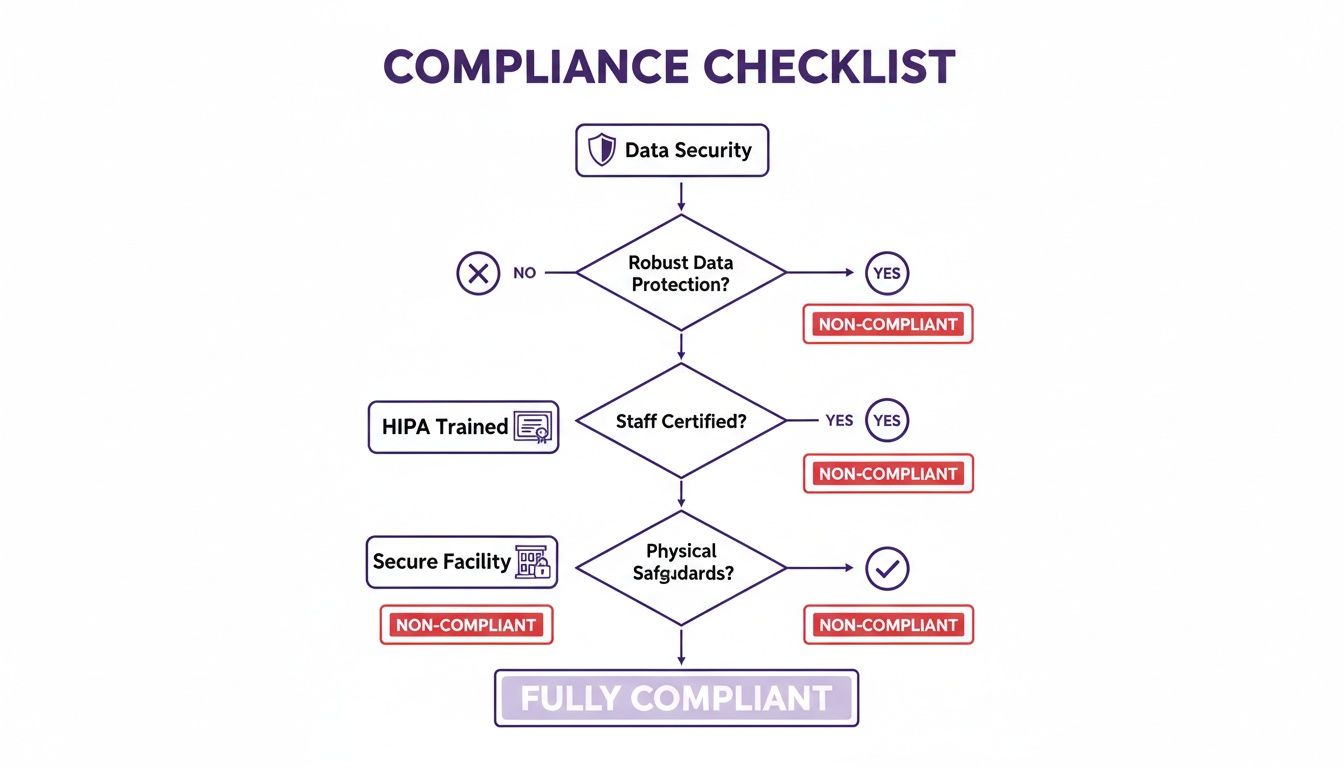
As you can see, it boils down to three pillars: ironclad data security, thorough HIPAA training, and a physically secure facility. A nearshore model makes it much easier to verify these critical compliance checks yourself.
Dive deeper into this topic in our complete nearshore vs. offshore outsourcing business guide.
Your Blueprint for a Smooth BPO Transition
Moving from thinking about BPO healthcare services to actually bringing a partner on board can feel like a huge leap. But with a clear plan, the switch can be smooth, predictable, and incredibly rewarding.
This blueprint breaks down the process into manageable, actionable steps to get your partnership started on the right foot.
Think of this not as handing over control, but as a strategic collaboration. The goal is to align your new partner with your practice’s specific workflows, needs, and patient care philosophy. A great transition is built on clarity, communication, and shared goals.
Step 1: Assess Your Current Operations
Before you can improve anything, you need an honest look at where things stand. Map out the administrative tasks you’re considering outsourcing. Pinpoint the biggest bottlenecks and the areas where your team is sinking the most time.
Is your claim denial rate stubbornly high? Are patients complaining about long hold times? Writing these down gives you a concrete baseline to measure success against. This internal audit is the bedrock for setting realistic goals and picking the right partner.
 Step 2: Define Clear Key Performance Indicators (KPIs)
Once you know what needs fixing, you must define what “fixed” looks like. Vague goals like “improve efficiency” are useless. You need specific, measurable Key Performance Indicators (KPIs) that both you and your BPO partner can track.
Here are a few practical examples:
- Reduce the claim denial rate from 15% to below 5% within the first six months.
- Cut the average accounts receivable (A/R) days to under 30. This directly measures how fast you’re getting paid.
- Achieve a patient satisfaction score of 95% or higher for all phone interactions handled by the BPO team.
These hard numbers eliminate ambiguity and create a shared understanding of success.
Think of your KPIs as the north star of your BPO partnership. They turn fuzzy goals into concrete targets, making sure everyone is rowing in the same direction toward the same definition of success.
Step 3: Plan for a Seamless Handover
The final piece is the transition itself. A well-planned handover minimizes disruption and sets your new team up for success from day one.
This involves more than sharing passwords; it requires a structured transfer of knowledge. If you’re weighing your options, our guide on the transition from offshore to nearshore providers offers key insights for logistical planning.
Create a detailed plan that includes everything from training sessions and system access to clear communication channels. Designate a single point of contact on your team to work directly with the BPO’s implementation manager. This hands-on approach ensures that when you flip the switch, your new partner is ready to perform like a true extension of your practice.
Healthcare BPO: Your Questions Answered
Diving into BPO healthcare services always brings up questions. Getting clear, straightforward answers is the only way to feel confident you’re making the right move. Let’s tackle the most common concerns.
How Is Patient Data Kept Secure with a BPO Partner?
This is the top question, and for good reason. For any reputable BPO partner, protecting patient data is the foundation of their entire operation. Security is a system of overlapping defenses:
- Strict Access Controls: Agents only see the specific information they need to do their job—nothing more.
- Comprehensive HIPAA Training: Every team member undergoes rigorous, continuous training on HIPAA rules and data privacy.
- Physical Security: Facilities are locked down with controlled access, surveillance, and clean-desk policies.
- Data Encryption: All patient data is encrypted, both in transit and at rest, making it unreadable to unauthorized parties.
What Does the BPO Transition Process Actually Look Like?
A well-planned transition should feel almost invisible to your team and patients. The process is a collaborative effort:
- Discovery: The BPO team learns your current workflows inside and out.
- Implementation Plan: A detailed plan is built covering system access, training, and communication protocols.
- Dedicated Management: A project manager from the BPO guides you every step of the way to ensure a successful launch.
How Do I Measure the Success of My BPO Partnership?
Success isn’t a vague feeling; it’s about tracking hard numbers against the goals you set from day one.
The effectiveness of any BPO healthcare services partnership is proven by the numbers. Clear Key Performance Indicators (KPIs) are essential for holding your partner accountable and quantifying the return on your investment.
Common KPIs to track include:
- First-Pass Claim Acceptance Rate: A direct measure of billing accuracy.
- Average Days in Accounts Receivable (A/R): How much faster you’re getting paid.
- Patient Satisfaction Scores: The real-world quality of every patient interaction.
- Cost Per Claim: A straightforward metric showing efficiency gains.
A quality BPO partner will provide regular performance reviews and transparent reports, so you always know how the partnership is performing against your goals.
Frequently Asked Questions About BPO Healthcare Services
1. What tasks can healthcare providers outsource?
Billing, coding, claims processing, RCM, appointment scheduling, prior authorizations, and patient support.
2. Is healthcare BPO HIPAA compliant?
Yes—when working with a certified provider that signs a Business Associate Agreement (BAA).
3. Will patients know we outsourced support?
No. BPO agents act as an extension of your practice, following your scripts and brand voice.
4. How quickly can we get started?
Most implementations launch within 2–4 weeks after discovery and onboarding.
5. Is nearshore outsourcing better than offshore?
For North American providers, nearshore offers better time-zone alignment, communication, and compliance oversight.
6. Can BPO help reduce claim denials?
Absolutely. Certified coders and denial management teams dramatically improve first-pass acceptance rates.
7. Will outsourcing reduce staff burnout?
Yes. Removing administrative overload improves morale and retention.
8. How do we measure BPO success?
KPIs like denial rate, A/R days, patient satisfaction, and cost per claim.
9. Is BPO suitable for small practices?
Yes—outsourcing scales to clinics of all sizes.
10. What makes CallZent different?
Nearshore expertise, bilingual agents, HIPAA-first security, and healthcare-focused workflows.
Ready to Streamline Your Healthcare Operations?
CallZent delivers secure, nearshore BPO healthcare services that reduce costs, improve revenue cycle performance, and let your team focus on patient care—not paperwork.
Ready to see how a nearshore BPO can transform your healthcare practice? At CallZent, we specialize in providing secure, compliant, and efficient solutions that let you focus on what matters most—your patients. https://callzent.com