Skip to content

Business Process Outsourcing in Healthcare: A Strategic Advantage
Discover how healthcare BPO can reduce administrative burdens, cut costs, and improve patient care. Learn the benefits, what to outsource, and how to choose the right partner.
TL;DR: Your Guide to Healthcare BPO
- What is it? Healthcare BPO involves outsourcing non-clinical tasks like billing, scheduling, and data entry to specialized partners.
- Why do it? Reduce admin burdens, lower costs, and let your staff focus fully on patient care.
- What can be outsourced? Patient engagement, revenue cycle management, and back-office support.
- How to choose a partner? Prioritize HIPAA compliance, healthcare expertise, and seamless tech integration.
- What are the benefits? Efficiency, scalability, cost savings, and access to specialized expertise.
TL;DR: Your Guide to Healthcare BPO
- What is it? Healthcare BPO involves delegating non-clinical tasks (like billing, scheduling, and data entry) to a specialized external partner.
- Why do it? The goal is to reduce administrative burdens, cut operational costs, and free up your clinical staff to focus entirely on patient care.
- What can be outsourced? Key areas include patient engagement (appointment scheduling), revenue cycle management (billing, coding, collections), and back-office support (data entry, transcription).
- How to choose a partner? Prioritize providers with deep healthcare experience, ironclad security (HIPAA compliance is non-negotiable), and technology that integrates with your systems.
- What are the benefits? Strategic BPO delivers immediate efficiency, on-demand scalability to match patient volume, and access to specialized expertise you can’t build overnight.
What Types of Healthcare Organizations Use BPO Services?
BPO isn’t just for big hospitals—healthcare organizations of every size and specialty tap into outsourcing to streamline their operations. Here’s a quick breakdown of who benefits:
- Hospitals: With a maze of departments and endless paperwork, hospitals routinely outsource everything from billing to administrative support to keep patient care running smoothly.
- Physician Groups & Doctor’s Offices: Smaller practices leverage BPO for back-office work—think scheduling, insurance verification, and medical billing—so doctors and staff can keep their focus where it matters most: patients.
- Clinics & Urgent Care Centers: Whether providing routine checkups or walk-in services, these facilities turn to BPO partners to handle non-clinical functions, freeing up staff for direct patient interactions.
- Imaging & Diagnostic Centers: Radiology labs and imaging centers, handling everything from MRIs to CT scans, often outsource specialized tasks like billing and claims processing.
- Ambulatory Surgical Centers (ASCs): Outpatient surgical facilities use BPO to manage paperwork, billing, and compliance, ensuring surgeons can operate without extra distractions.
- Birth Centers: Facilities focusing on labor and delivery streamline their administrative and billing processes by offloading them to BPO providers, making care more affordable and efficient for new families.
- Hospice & Palliative Care Providers: These organizations outsource administrative and financial operations to focus on compassionate, hands-on care for patients facing serious illness.
- Mental Health & Addiction Treatment Centers: To deliver comprehensive clinical support, these centers often farm out medical billing, appointment reminders, and other administrative essentials.
In short, if there’s a non-clinical task eating up valuable staff time, chances are there’s a healthcare provider—large or small—working with a BPO partner to take it off their plate.
A Brief History: From Factory Floors to Healthcare Halls
Outsourcing isn’t a new kid on the block—it’s been quietly shaping global business since the mid-20th century. Back then, companies first passed off manufacturing tasks to outside partners, streamlining operations long before “outsourcing” became a buzzword. The term itself didn’t land until the late 1980s, but by then, businesses were already deep into leveraging external support to stay nimble and competitive.
Fast-forward to the 1990s, and we saw the explosion of call centers across continents, with names like India and the Philippines becoming synonymous with BPO (Business Process Outsourcing). Originally, this wave focused on front-line customer service, but it wasn’t long before organizations realized that outsourcing could do more than just answer phones. Administrative duties, data entry, and other back-office essentials migrated into the hands of specialized teams around the globe.
Healthcare, ever on a mission to improve both efficiency and outcomes, soon followed. Early healthcare BPO focused squarely on non-clinical functions—think medical billing, claims processing, and transcription. Today, though, the landscape has broadened dramatically. Healthcare BPO partners now help manage not only the administrative load, but also patient engagement and certain clinical support tasks, continually widening the scope of what can be outsourced in pursuit of better patient care and organizational balance.
Why Top Healthcare Providers Embrace Business Process Outsourcing for Healthcare
In today’s healthcare world, the pressure is on. Providers are constantly caught in a tug-of-war between delivering world-class medical care and drowning in administrative paperwork. This balancing act stretches resources thin, often leading to staff burnout and operational headaches that can, unfortunately, ripple down to the patient experience.
The real problem is that these non-clinical tasks, while necessary, eat up time and energy that your clinical team should be dedicating to patients. This is exactly the problem that business process outsourcing for healthcare solves. It’s not just about cutting costs—it’s about making a strategic move to boost your overall quality and efficiency. When you partner with a BPO provider, you’re not just hiring help; you’re gaining a dedicated team that specializes in the very administrative functions that are bogging your team down.
Shifting Focus From Administration to Patient Care
Imagine your highly skilled nurses no longer tied to the phone for hours scheduling appointments. Picture your practice manager, freed from the frustrating chase of claim denials. Instead, they can focus on what really matters: patient education, care coordination, and making the in-clinic experience better for everyone. That shift is the true power of a smart BPO partnership.
The real value of business process outsourcing in healthcare isn’t just operational savings; it’s the strategic advantage of freeing your most valuable clinical assets to perform at the top of their licenses.
The industry is taking notice. The global market for business process outsourcing in healthcare is set to jump from $321.15 billion in 2024 to a massive $356.65 billion in 2025. This isn’t just a fleeting trend; it shows a widespread recognition that outsourcing is a key play for managing complexity and putting the patient first. You can dig into the full findings on the healthcare BPO market growth to see these trends for yourself.
Core Drivers for Adopting Healthcare BPO
So, what’s really pushing healthcare leaders to make the leap? The motivations go way beyond simply handing off a to-do list. It’s about building an organization that’s more resilient, efficient, and truly centered on the patient.
Take a look at the primary reasons driving healthcare organizations toward BPO partnerships.
| Driver | Impact on Your Healthcare Organization |
|---|---|
| Cost Reduction | Slashes expenses tied to hiring, training, and retaining admin staff. It also cuts overhead for things like office space and technology. |
| Improved Efficiency | BPO partners bring specialized tech and fine-tuned workflows to the table, handling tasks like billing and claims much faster and with fewer errors. |
| Enhanced Patient Focus | Gets your clinical staff out from under the paperwork, letting them pour their full attention and skills into patient care and satisfaction. |
| Access to Expertise | You get immediate access to pros in tricky areas like medical coding, compliance, and revenue cycle management without a long, drawn-out hiring process. |
| Scalability | You can easily scale your support team up or down based on patient volume or seasonal rushes, all without the headaches of managing full-time hires. |
Once you see these drivers laid out, it’s clear that business process outsourcing in healthcare is more than a buzzword—it’s a foundational strategy to future-proof your practice. To see how CallZent’s specialized solutions can help you tap into these benefits, check out our customer support services.
What You Can Outsource in Healthcare BPO

Okay, so you get why business process outsourcing in healthcare makes sense. The next logical question is, “What exactly can I hand off?” The good news is the scope is broad, allowing you to delegate the exact tasks that are draining your internal team and pulling focus away from patient care.
These services aren’t about replacing your core clinical staff. Think of them as a support system, working in the background to create a more efficient and patient-friendly operation. Let’s dig into the three critical pillars of tasks you can confidently delegate to a specialized BPO partner. Each one is designed to solve a specific operational headache.
Pinpointing Which Functions to Outsource
Before you dive into the world of healthcare BPO, it’s smart to map out exactly where your practice could benefit most from outside help. Start by taking a close look at your current workflows. Are your nurses fielding endless scheduling calls? Are billing errors slowing down reimbursements? Jot down every task that’s eating up time or causing repeated headaches.
Next, talk to your core team—the people living the day-to-day challenges. Their input will help spotlight processes that are ripe for improvement, be it patient intake, insurance verification, billing, or appointment reminders.
Once you’ve put your pain points under the microscope, prioritize tasks that:
- Consistently bog down staff productivity
- Require specialized expertise you don’t have in-house (think medical coding or claims denial management)
- Scale up or down seasonally, making full-time hires tricky
- Impact patient experience if mishandled
Don’t forget to factor in compliance and security. Functions involving patient data demand a partner with solid HIPAA credentials and a track record of protecting sensitive information.
With your shortlist in hand, you’ll be better equipped to zero in on a BPO partner who can best support your goals—and free up your staff to focus on what they do best: delivering outstanding patient care.
Clinical Operations You Can Outsource
Clinical operations outsourcing has expanded far beyond the front desk—and it’s all thanks to rapid digital transformation (and, let’s be honest, a little pandemic-fueled innovation pressure). Today, a good healthcare BPO partner can help you manage much more than admin headaches. Here are some prime examples of clinical functions you can confidently hand off:
- Diagnostic Services: Short on specialized staff or equipment? Outsourcing lets you tap into external laboratories or imaging centers for services like bloodwork and radiology, ensuring patients still get top-tier care without the logistical stress.
- Telehealth Solutions: Virtual care isn’t just a COVID-era bandage—it’s now an essential offering. BPO vendors help you roll out secure platforms for virtual consults, remote diagnosis, and even second opinions, making care more accessible for patients who can’t easily visit in person.
- Remote Patient Monitoring (RPM): BPO partners can streamline the tech and daily monitoring of patients outside your facility—think wearables and at-home health trackers. This means better continuity of care for patients with chronic illnesses or those in rural areas, without tying up your core clinical staff.
With these functions handled by skilled specialists, your team can focus on complex, in-person care—while your outsourced support keeps the wider patient experience running smoothly.
Clinical Operations That Can Be Outsourced
It’s not just front-desk paperwork and billing anymore—BPO in healthcare is moving steadily into the clinical arena, thanks largely to the digital leaps made since 2020. If you’re wondering what you can now confidently hand off, here’s how outsourcing is transforming core patient care functions:
- Diagnostic and Laboratory Services: Many organizations now partner with external labs and imaging centers—think Quest Diagnostics or LabCorp—to handle everything from blood work to advanced radiology. This frees your in-house staff to focus on direct patient care, while ensuring fast, accurate results for your patients.
- Telehealth Visits: With the rise of platforms like Teladoc and Amwell, it’s easier than ever to outsource remote consultations, virtual triage, and routine follow-up appointments. Patients love the convenience, and your clinicians can extend their reach without burning out on endless video calls.
- Remote Patient Monitoring (RPM): Devices and apps such as those from Philips or Fitbit allow specialists outside your walls to keep tabs on patients’ vitals, chronic conditions, and recovery progress—whether they’re down the street or several states away. These services enable proactive intervention and better chronic disease management, all without overloading your clinic’s team.
By handing off these specialized clinical tasks to the right partners, you gain flexibility, cutting-edge technology, and the ability to focus on what matters most—personalized care for every patient who walks through your door.
Patient Engagement and Support Services
The patient experience doesn’t start when someone walks through your doors. It begins with that very first phone call to schedule an appointment. A skilled BPO partner can manage this entire front-end communication process, becoming a seamless extension of your front office.
But this is much more than just answering phones. It’s about proactive engagement that genuinely improves patient satisfaction and health outcomes. These services often include:
- Appointment Scheduling and Rescheduling: Agents manage all inbound calls to book new appointments or adjust existing ones, making sure your calendar is always optimized.
- Automated and Live Reminders: A smart mix of automated messages and personal calls can drastically reduce costly no-shows.
- Post-Visit Follow-Ups: Agents can place follow-up calls to check on patients, gather valuable feedback, and make sure they understand their post-care instructions.
Here’s how it looks in the real world: Picture a busy multi-physician clinic struggling with a 20% no-show rate. That’s a huge hit to revenue and creates chaos in the schedule. By outsourcing appointment management, a dedicated team implements a new system: automated text reminders go out 48 hours before, and a friendly agent makes a personal confirmation call 24 hours prior. Within just three months, the no-show rate plummets to 5%. Patients even start mentioning how helpful the reminders are. This simple change boosts revenue and cements the clinic’s reputation for being organized and attentive.
Revenue Cycle Management
The financial health of any practice hinges on a complex, and often frustrating, process: Revenue Cycle Management (RCM). This covers every single step from the moment a patient is registered until their final bill is paid in full. Even small errors or delays along the way can choke your cash flow and create mountains of administrative work.
By outsourcing RCM, you’re not just delegating billing; you’re handing over a complex financial puzzle to experts who know how to solve it efficiently and accurately.
Specialized BPO providers bring a level of expertise to this area that’s notoriously difficult to staff and manage in-house. They live and breathe the constant changes in medical coding and insurance rules, so your team doesn’t have to.
Key RCM services include:
- Medical Billing and Coding: Certified coders are experts at translating physician notes into the correct ICD-10, CPT, and HCPCS codes. This accuracy is everything for getting clean claims submitted the first time.
- Claims Submission and Processing: The outsourced team manages the entire lifecycle of a claim—submitting it to payers, tracking its status, and handling any rejections or requests for more info.
- Denial Management and Collections: When a claim gets denied, BPO agents investigate the root cause, make the necessary corrections, and resubmit it. They can also handle the sensitive task of patient collections with professionalism and empathy, a service you can explore with CallZent’s debt collection solutions.
Administrative and Back-Office Support
Beyond patient calls and billing, every healthcare facility runs on a mountain of background administrative work. These tasks are absolutely essential, but they’re also highly repetitive and time-consuming. That makes them perfect candidates for outsourcing.
When you offload these duties, you directly empower your on-site staff. Instead of getting bogged down in paperwork and data entry, they can dedicate their time to high-value, patient-facing activities that require a real human touch and clinical knowledge.
Common back-office tasks to hand off include:
- Medical Data Entry: Accurately inputting patient demographics, insurance details, lab results, and other critical information into your EHR or practice management software.
- Claims Processing Support: Handling the initial data verification and preparation of insurance claims before they’re submitted, making sure every required field is complete and correct.
- Medical Transcription: Converting voice-recorded notes from physicians and clinicians into clean, written text for patient records.
By strategically delegating these three core functions, business process outsourcing in healthcare helps your organization run more smoothly, slashes administrative overhead, and, most importantly, allows you to re-center your mission around providing truly outstanding patient care.
The Strategic Edge of Business Process Outsourcing Healthcare Partnerships

While the initial cost savings are what get most healthcare leaders interested, the real power of business process outsourcing healthcare comes from the long-term strategic doors it opens. If you only see BPO as a way to cut costs, you’re missing the bigger picture. It’s like having a top-of-the-line smartphone and only using it to make calls—you’re leaving its best features untapped.
When you find the right BPO partner, they become a true extension of your team. They bring specialized skills, proven technology, and an agility you simply can’t build overnight. This isn’t just about offloading tasks; it’s about injecting new capabilities into your practice to make it more resilient and ready for whatever comes next.
Gain Instant Operational Efficiency
Imagine getting a fully trained, professional team and access to the latest contact center technology without the massive upfront investment. That’s what a BPO partnership delivers right out of the gate. You get to skip the long, expensive headache of recruiting, hiring, and training specialized staff for demanding roles like medical billing or patient support.
Instead, you plug directly into a system that’s already built for peak performance. Your partner has spent years refining their workflows, investing in the right software, and training agents to navigate the unique challenges of healthcare. This lets your practice see an immediate boost in performance, freeing up your core team to focus on what they do best: patient care.
Unlock True Scalability on Demand
Patient volume is never a straight line. It ebbs and flows with seasonal flu, open enrollment periods, or local health initiatives. For an in-house team, trying to keep up with these swings is a nightmare. Staff are either completely swamped or sitting idle with nothing to do.
Strategic outsourcing gives you an operational dial you can turn up or down as needed, ensuring your support capacity always matches real-time patient demand without the risks of overstaffing or understaffing.
This on-demand flexibility is a game-changer. Think about a hospital network gearing up for the annual open enrollment rush. They can instantly scale their patient support team to manage the flood of calls about insurance verification and plan changes. Once the peak passes, they can scale back down just as fast. You’re never paying for staff you don’t need, but you’re always ready for the busiest times.
Access to Specialized Expertise and Compliance
The healthcare world is wrapped in a thick layer of complex rules, from HIPAA privacy standards to the ever-changing ICD-10 coding systems. Keeping your own team perfectly trained on every update is a full-time job in itself. For a dedicated business process outsourcing healthcare provider, that expertise is their core business.
This specialization is more important than ever. The global Healthcare BPO market is expected to jump from $151.9 billion to $259.5 billion by 2028, a surge driven by the need for experts who can handle new coding requirements and rising operational costs. It’s clear that more organizations are relying on partners to manage this complexity. You can explore the full healthcare BPO market forecast for a deeper look at this trend.
What’s Fueling the Surge?
Several market trends are accelerating this shift:
- Pandemic-Driven Change: The COVID-19 pandemic pushed healthcare providers to rapidly outsource non-core functions to protect frontline staff. Digital tools made it easier than ever for third-party teams to deliver telehealth and remote patient monitoring (RPM) services.
- Relentless Cost Pressures: As medical organizations face mounting pressure to rein in costs, outsourcing non-essential tasks has become a proven strategy for reducing overhead and improving revenue cycle management.
- Data Security Demands: With nearly one-third of healthcare data breaches resulting in medical identity theft, providers are turning to BPO partners with advanced security protocols to safeguard sensitive patient information.
These trends aren’t just shaping the market—they’re redefining how healthcare organizations operate in a digital-first, cost-conscious world. You can explore the full healthcare BPO market forecast for a deeper look at this trend.
By teaming up with a firm like CallZent, you get a team whose entire job is to master these details. We bring specialized services that make sure every single patient interaction and back-office task is handled correctly.
- HIPAA-Trained Agents: Our teams go through tough training on protecting patient health information (PHI), which significantly lowers your practice’s risk.
- Medical Coding Professionals: We have certified coders who are experts in the latest standards, helping you get the maximum reimbursement and cut down on denied claims.
- Revenue Cycle Specialists: Our experts know the ins and outs of dealing with different insurance payers, which helps speed up your cash flow and keep your finances healthy.
In the end, a strategic partnership elevates business process outsourcing in healthcare from a simple line-item expense to a key part of your growth plan. It’s about getting the efficiency, flexibility, and deep expertise you need to not just compete, but to truly thrive.
How Digital Tools Are Transforming Clinical Outsourcing
It wasn’t so long ago that healthcare business process outsourcing (BPO) meant keeping clerical and administrative tasks off your plate. But now, digital technology is opening the doors for clinical operations to get the same strategic upgrade.
Three major tech-driven shifts are at the heart of this transformation:
- Seamless Patient Care Coordination: Modern platforms let BPO partners integrate directly with your existing systems, from EHRs to scheduling apps. With tools like Epic or Cerner, outsourced teams can access the data they need to support clinical workflows—without skipping a beat. Need help managing diagnostic services or handling routine patient intake? This can all happen behind the scenes, quickly and securely, so your in-house staff stays focused on hands-on patient care.
- Telehealth for Virtual Reach: Advances in telemedicine tools such as Zoom for Healthcare or Teladoc have enabled BPO providers to deliver clinical support remotely. Patients can connect with healthcare professionals via secure video calls, receive timely consultations, and get answers without ever setting foot in a clinic. This not only broadens your reach but makes care more accessible to patients in rural or underserved areas.
- Remote Patient Monitoring (RPM): Wearables like Fitbit, Apple Watch, and FDA-cleared devices from companies such as BioTelemetry have revolutionized how patient data is collected and managed. BPO vendors can now monitor patients’ vital signs and chronic conditions from afar, spotting issues early and alerting clinical staff when intervention is needed. This continuous flow of information helps improve outcomes while lightening the administrative load on your team.
With these technologies at your fingertips, outsourcing clinical functions isn’t just possible—it’s a smart strategy to enhance both efficiency and patient experience.
How to Select the Right Business Process Outsourcing Healthcare Partner
Deciding to bring in a business process outsourcing for healthcare partner is a big move, but the real make-or-break moment is picking the right one. Not all BPO providers are built the same, and when it comes to healthcare, the stakes couldn’t be higher. A bad choice can quickly spiral into compliance nightmares, frustrated patients, and operational chaos. The right one, however, becomes a genuine strategic asset.
It’s tempting to just compare price tags, but that’s a rookie mistake. You need to look deeper—at quality, specialized experience, and how well they’ll fit with your brand. Think of it like hiring a new department head. You wouldn’t just grab the cheapest resume off the pile. You’d hunt for someone with deep industry knowledge, a commitment to your values, and the chops to integrate with your team. The same logic applies here.
Start with a Self-Assessment
Before you even start reviewing potential partners, hit pause and take a close look at your own operations. Where are your teams bogged down? Are there processes that routinely frustrate staff or patients? Pinpoint the chronic bottlenecks—whether it’s billing headaches, appointment scheduling snafus, or slow claims follow-up.
Map out the specific pain points and inefficiencies holding your organization back. Talk to frontline staff, collect patient feedback, and pull some metrics on call volumes or denied claims. The goal is to create a clear list of priorities: what needs to change and which outcomes matter most, like faster response times or fewer errors.
By starting with this kind of honest self-inventory, you’ll know exactly which capabilities your future BPO partner must bring to the table. Not only does this give you a sharper lens for evaluating vendors, but it also arms you with the details you’ll need to set expectations and measure success down the line.
Prioritize Healthcare Specialization
The single biggest pitfall is falling for a generic, one-size-fits-all BPO provider. Healthcare isn’t e-commerce or retail; it has its own language, a thicket of regulations, and unique patient sensitivities. A partner who doesn’t live and breathe this world can do more harm than good.
Zero in on providers whose main business is healthcare. You want to know their agents are specifically trained in medical terminology, patient empathy, and the distinct rhythm of healthcare conversations.
Here’s a real-world example: A regional hospital outsourced its appointment scheduling to a huge, generic call center to cut costs. The agents, lost in a sea of medical terms, constantly misspelled physician names and misrouted calls for specialized departments. Patients got fed up, no-show rates shot up, and the hospital’s professional image took a serious knock. Meanwhile, a clinic of a similar size chose a specialized healthcare BPO. Their agents knew the difference between a cardiology follow-up and a new orthopedic consult, leading to smooth scheduling, happier patients, and a healthier bottom line.
Insist on a Proven Healthcare Track Record
Experience matters—especially in healthcare BPO. You want a partner who’s navigated the labyrinth of regulations and has a history of successfully supporting organizations just like yours. It’s not just about holding a few contracts in the industry; it’s about having a deep, verifiable background working with hospitals, clinics, and specialty practices.
A partner with a robust healthcare pedigree will already be fluent in managing complex medical workflows and anticipating regulatory curveballs. They’ll have referenceable case studies, glowing testimonials from healthcare clients, and a well-documented ability to adapt to changes like ICD-10 updates or new payer requirements. Think of it as hiring someone who’s “been there, done that”—they’re far less likely to stumble over avoidable pitfalls and will hit the ground running to support your practice’s unique needs.
Ask about their specialization, too. If you run a behavioral health clinic, for example, teaming up with a BPO that’s made its name supporting orthopedic centers might not be the best fit. Look for alignment in expertise, so you’re not stuck teaching someone the ABCs of your day-to-day operations.
Scrutinize Security and Compliance Protocols
In the healthcare world, data security isn’t just a “best practice”—it’s the law. Any partner you even consider must have an ironclad commitment to protecting patient health information (PHI). A compliance breach isn’t just a fine; it’s a catastrophic blow to the trust your patients have in you.
Your BPO partner is an extension of your practice. That means they become a guardian of your patients’ most private data. Their security has to be just as tough as yours, if not tougher.
You have to dig deep on this. Don’t just take their marketing slick for it; ask for proof. Key areas to probe include:
- HIPAA Certification: Are their agents and systems officially HIPAA-compliant? Ask to see current certifications and training logs.
- Data Encryption: Is all data—whether it’s sitting on a server or moving across the network—fully encrypted with modern standards?
- Secure Infrastructure: What do their physical and digital security measures look like? This covers everything from who can access the building to network monitoring and secure data centers.
Evaluate Technological Capabilities and Integration
The most effective business process outsourcing in healthcare happens when your partner’s technology and yours work in lockstep. A BPO provider that can’t plug into your existing Electronic Health Record (EHR) or Practice Management (PM) system is just creating more work and messy data silos.
Before you even think about a contract, map out the entire data flow. The provider should be able to walk you through exactly how their systems will securely link up with yours, whether it’s through APIs or another secure connection. A clean integration means information from patient calls, billing updates, and schedule changes flows right into your records in real time, keeping everything in one place.
At CallZent, we specialize in building these seamless connections. You can learn more about our bilingual nearshore solutions that put tech alignment first.
Ensure Cultural and Brand Alignment
Finally, never forget that your BPO partner’s agents are the voice of your practice. They’re on the front lines, talking to your patients every single day. If their communication style and professional values don’t mesh with yours, it can unravel the patient experience you’ve worked so hard to create.
When you’re vetting potential partners, ask to listen to call recordings from their other healthcare clients. What do you hear? Is the agent’s tone empathetic? Professional? Do they sound like someone who could be sitting at your own front desk? The right partner will take the time to learn your brand’s voice and train their agents to represent you with the same care and respect your own team would.
Choosing a BPO partner is a major decision, and doing your homework upfront is crucial. To help you stay organized during the evaluation process, we’ve put together a simple checklist.
Assess the Reputation of Your Prospective BPO Partner
A BPO provider’s reputation isn’t just about flashy marketing or a polished website—it’s earned through real-world performance and trust in the healthcare community. When you’re sizing up potential partners, don’t be shy about rolling up your sleeves and doing some due diligence. Here’s how you can cut through the noise:
- Verify Credentials: Confirm that the provider holds all required licenses, healthcare-specific certifications (like HIPAA or SOC 2), and up-to-date compliance documentation. Industry awards or recognitions from organizations like the Healthcare Information and Management Systems Society (HIMSS) can signal a provider’s credibility.
- Seek References and Case Studies: Ask for references from current healthcare clients, ideally in organizations similar to yours. Dig into published case studies or testimonials—does their track record show long-standing relationships and measurable results?
- Research Independent Reviews: Browse third-party review sites and industry forums to see what actual healthcare clients are saying. Are there repeated themes of reliability, data security, or agent professionalism?
- Check for Industry Involvement: Reputable BPOs often participate in healthcare conferences, contribute to thought leadership panels, or publish insights in authoritative outlets. Their visibility can indicate a genuine commitment to the field.
Building confidence in your partner’s reputation is non-negotiable—after all, you’re trusting them with your patients’ experience and your own professional name.
BPO Partner Evaluation Checklist
| Evaluation Criterion | Key Questions to Ask | Why It Matters |
|---|---|---|
| Healthcare Specialization | How many of your clients are in healthcare? Can you share examples? What specific training do your agents receive? | Generic partners don’t understand the nuances of medical terminology, patient empathy, or complex regulations, leading to errors and poor patient experiences. |
| Security & Compliance | Can you provide proof of HIPAA certification for your staff and systems? How is patient data encrypted and stored? | A breach is a legal and reputational disaster. Your partner must be a fortress when it comes to protecting PHI. |
| Technology Integration | How will your systems integrate with our EHR/PM software? Can you walk me through the data flow process? | Without seamless integration, you’ll create data silos, inefficiencies, and manual workarounds, defeating the purpose of outsourcing. |
| Cultural & Brand Fit | Can we listen to sample calls from your other healthcare clients? How do you train agents on a client’s specific brand voice? | Your outsourced team is the voice of your practice. A mismatch in tone or values can damage patient trust and your reputation. |
| Performance & Reporting | What key performance indicators (KPIs) do you track? How often will we receive reports? Can we see a sample report? | You need clear visibility into performance to ensure you’re getting the value you’re paying for and to identify areas for improvement. |
| Scalability & Flexibility | How do you handle sudden increases or decreases in call volume? What are the terms for scaling our service package up or down? | Your needs will change. A good partner can grow with you and adapt to fluctuating demands without a hitch. |
Use this checklist as a starting point to have detailed, meaningful conversations with potential partners. The more thorough you are now, the more successful and stress-free your partnership will be down the road.
A Roadmap for Successful BPO Implementation
You’ve vetted your potential partners and signed on the dotted line. Now, the real work begins. Moving to a business process outsourcing healthcare partnership isn’t like flipping a switch. It’s a carefully planned process to ensure a smooth, seamless handover with zero disruption to patient care. A truly great partner won’t just take your processes and run with them; they’ll work alongside you to map, refine, and integrate everything for peak performance.
This implementation roadmap pulls back the curtain on what happens next, breaking the journey into clear, manageable phases. It’s all about collaboration and transparency, making sure your new outsourced team acts as a genuine extension of your practice from day one.
Let’s walk through the critical steps.
Discovery and Process Mapping
The first step is always a deep dive into your current operations. You can’t improve what you don’t fully understand. During this discovery phase, we work side-by-side with your team to meticulously map out every single workflow you plan to outsource.
For instance, if we’re taking over appointment scheduling, we’ll look at everything—your call scripts, scheduling software, specific doctor preferences, and how you handle urgent requests. This isn’t just about copying your methods. It’s about finding the bottlenecks and seeing where we can make things better before we build the new workflow. The goal is a detailed playbook our agents will follow to the letter.
Technology Integration and Setup
With a clear process map in hand, we shift focus to the technology. A successful partnership hangs on the secure and efficient flow of information between our systems and yours. This is where we build the digital bridge that connects our team to your practice management software or EHR system.
Our IT specialists will work closely with your team to set up secure API connections or other integration methods. We test everything rigorously to make sure that when one of our agents books an appointment or updates a patient’s insurance info, it shows up instantly and accurately in your system. This gets rid of data silos and the headache of manual double-entry, which is a major win in any BPO strategy.
This visualization breaks down the core pillars of data security that are non-negotiable in any healthcare BPO partnership.
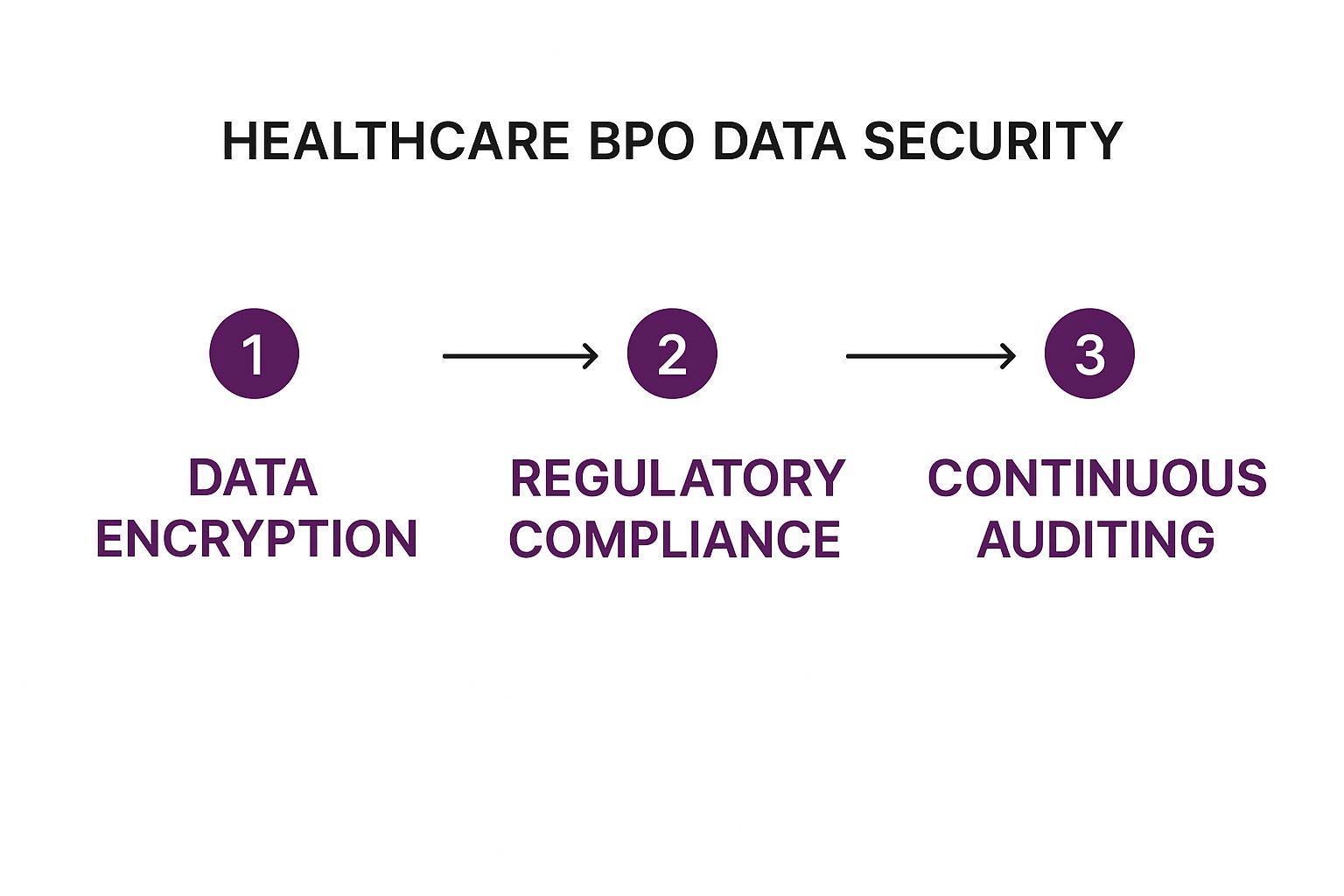
The flow from encryption to compliance and auditing shows a constant, cyclical commitment to protecting sensitive patient data.
Team Training and Onboarding
Now, the human element takes center stage. We hand-pick a team of agents and completely immerse them in your practice’s culture, brand voice, and specific way of doing things. They aren’t just trained on tasks; they’re trained to be representatives of your practice.
Our training covers:
- Brand Voice: We listen to recordings of your best in-house staff to teach our agents the perfect tone, phrasing, and level of empathy.
- System Proficiency: Agents become experts in navigating both our technology and any of your systems they need to access.
- Healthcare Compliance: Rigorous, ongoing HIPAA training isn’t optional—it’s mandatory. Every agent must understand their role in protecting patient privacy.
A successful go-live is not an accident. It’s the result of meticulous planning, deep collaboration, and a shared commitment to excellence from both sides of the partnership.
Go-Live and Performance Monitoring
Once the tech is connected and the team is fully trained, it’s launch time. But our work doesn’t stop there. The go-live date kicks off a continuous cycle of performance monitoring and fine-tuning. We track key performance indicators (KPIs) like call answer times, first-call resolution rates, and patient satisfaction scores.
This data-first approach lets us spot any issues quickly and make adjustments on the fly, ensuring the service not only meets but exceeds your expectations. Regular performance reviews keep you in the loop and prove our role as a proactive partner invested in your success.
The rapid growth of the healthcare IT outsourcing market, projected to hit $153 billion by 2034, shows just how vital these professionally managed services are becoming. As digital needs accelerate, having a partner who can manage EHRs, ensure compliance, and handle complex IT is no longer a luxury but a strategic necessity. You can find more insights on the expansion of healthcare IT outsourcing.
How the COVID-19 Pandemic Transformed Healthcare BPO
It’s impossible to talk about today’s healthcare BPO landscape without acknowledging the seismic shifts brought on by the COVID-19 pandemic. Practically overnight, the industry had to rethink how we deliver care, protect frontline workers, and keep operations running despite unprecedented constraints.
Here’s how the pandemic reshaped the world of healthcare business process outsourcing:
- Emphasis on Remote Services: With safety and social distancing top priorities, providers turned to third-party partners to enable telehealth visits and remote patient monitoring (RPM). This move wasn’t just about convenience—it became essential to maintain patient care while limiting in-person interactions.
- Outsourcing Non-Core Operations: In the thick of the pandemic, hospitals and practices needed to focus on core clinical responsibilities. To protect staff and ease administrative burdens, many organizations outsourced tasks like appointment scheduling, billing, and patient communications to BPO experts.
- Accelerated Digital Adoption: Tools like secure messaging platforms, video conferencing, and integrated EHR solutions saw rapid deployment. BPO partners played a key role in rolling out and supporting these technologies, ensuring continuity and compliance as care models shifted practically overnight.
- Resilience and Flexibility: The pandemic highlighted the need for agile, scalable solutions. Healthcare BPO services evolved to deliver flexibility—quickly scaling up or down based on unpredictable patient volumes and staffing needs.
In short, COVID-19 didn’t just accelerate digital transformation in healthcare—it cemented BPO as a strategic pillar for efficiency, safety, and uninterrupted care delivery.
Common Questions About Business Process Outsourcing in Healthcare

Making the jump to business process outsourcing in healthcare is a big step, and it’s completely normal to have a few questions. You need to be 100% confident before you hand over the keys to any part of your practice. Let’s walk through some of the biggest concerns on the minds of healthcare leaders, so you can get the clarity you need.
Most of these questions circle back to three core things: security, the patient experience, and how the whole thing actually works. Facing them head-on is the only way to really understand what a specialized BPO partnership can do for you.
How Secure Is My Patient Data with a BPO Partner?
This is always the first question, and it should be. Protecting patient health information (PHI) isn’t just a priority; it’s the entire foundation of trust in healthcare. Any BPO partner worth their salt doesn’t just follow security rules—they build their entire company culture around protecting your data.
A generic call center might see security as a box to tick. A true healthcare partner knows it’s the bedrock of the relationship. Here’s what that looks like in the real world:
- Ironclad HIPAA Compliance: Every single agent and system has to live and breathe the Health Insurance Portability and Accountability Act. This means tough initial training and ongoing education to keep up with every new rule.
- Advanced Data Encryption: All patient data—whether it’s sitting on a server or flying across a network—must be locked down with end-to-end encryption.
- Strict Access Controls: The principle of least privilege is key. Only people who absolutely need access to sensitive information get it, and that’s enforced with things like multi-factor authentication and role-based permissions.
- Constant Monitoring and Audits: The best partners are always watching their networks for threats and bringing in outside experts for regular security audits to find and patch any weak spots.
When you bring on a security-obsessed provider, you’re not adding risk. You’re actually upgrading your security by tapping into their specialized tech and expertise.
Will Outsourcing Hurt My Patient Experience?
It’s a common fear: passing patient calls to an outside team will feel cold and robotic. It’s a valid concern, but with the right partner, the opposite is true. A quality BPO actually improves the patient experience.
Think about your front-desk team right now. They’re probably heroes, but they’re juggling everything at once—checking in patients, answering ringing phones, wrangling paperwork, and putting out fires. It’s nearly impossible to give any one patient their full, undivided attention in that environment.
An outsourced team, on the other hand, has one mission: delivering professional, world-class support.
A specialized BPO partner doesn’t replace your compassionate care; they create the operational space for your in-house team to deliver it more effectively, while ensuring every call is handled with focused professionalism.
This single-minded focus means every patient call is answered quickly by a friendly, helpful agent who is trained on your practice’s specific protocols and brand voice. That kind of consistency and professionalism almost always pushes patient satisfaction scores up, not down.
What Is the Difference Between Onshore, Nearshore, and Offshore BPO?
Getting the lingo down is crucial for picking the right partner. Each BPO model offers a different mix of cost, convenience, and cultural connection.
- Onshore: The BPO is located in your own country. You get a shared culture and no language issues, but it’s easily the most expensive option.
- Offshore: The partner is far away, often on another continent like India or the Philippines. This route offers the biggest cost savings, but you might run into hurdles with huge time zone gaps, cultural differences, and strong accents.
- Nearshore: This is the “just right” model. The provider is in a nearby country with a similar time zone, like a U.S. practice working with a team in Mexico.
Nearshore gives you serious cost savings over an onshore partner but sidesteps the time zone and cultural headaches that can come with offshore. For U.S. healthcare providers, a bilingual nearshore partner is a game-changer, opening up seamless communication with a much wider patient community. You can see how CallZent’s nearshore call center services nail this perfect balance.
At the end of the day, the goal of business process outsourcing in healthcare is to build a stronger, more efficient practice. By getting straight answers to these key questions, you can make a smart decision that protects your data, elevates your patient care, and gives you a powerful competitive advantage.
Questions About Healthcare BPO
What is a Healthcare BPO?
A Healthcare BPO (Business Process Outsourcing) is the practice of outsourcing non-clinical tasks such as billing, appointment scheduling, and data entry to specialized providers. This reduces administrative burdens while improving efficiency and patient care.
By tapping into a trustworthy BPO partner, you get more than just help with paperwork. You gain three big advantages:
- Data Accuracy: A reputable BPO provider protects your patients’ health information and keeps your records precise.
- Service Efficiency: With dedicated agents and robust resources, your day-to-day operations run smoother and faster.
- Increased Productivity: Outsourcing frees up your in-house team to focus on what matters most—delivering quality care—leading to a boost in your organization’s overall productivity and profitability.
In short, a Healthcare BPO lets your staff spend less time buried in admin work and more time focused on your patients.
Is a Healthcare BPO HIPAA-compliant?
Yes, specialized Healthcare BPO providers ensure HIPAA compliance with trained agents, secure infrastructure, encryption protocols, and strict access controls. Compliance is non-negotiable when handling patient health information.
What are the benefits of outsourcing in healthcare?
Healthcare outsourcing reduces operational costs, increases efficiency, improves patient engagement, and provides instant access to specialized expertise in billing, coding, and revenue cycle management.
Why choose a nearshore Healthcare BPO partner?
Nearshore partners, like CallZent in Mexico, offer cost savings compared to U.S.-based providers, while providing cultural alignment, bilingual support, and real-time communication due to similar time zones.
Ready to Transform Your Healthcare Operations?
CallZent specializes in bilingual, HIPAA-compliant healthcare outsourcing that reduces costs, enhances patient engagement, and streamlines your operations.
Let us help you focus on what matters most: patient care.