Skip to content

Call Center Cost Reduction
10 Proven Call Center Cost Reduction Strategies for 2024
Are spiraling operational expenses silently eating away at your profit margins? Here’s a hard truth I’ve seen time and again: most call center cost reduction efforts fail because they only scratch the surface, never digging down to the root causes.
TL;DR: Key Cost Reduction Takeaways
- Optimize People & Processes: Master workforce management (WFM) to align staffing with call volume and invest in training to boost First Call Resolution (FCR).
- Leverage Technology: Use AI chatbots and intelligent IVR for routine tasks, and deploy speech analytics to uncover hidden inefficiencies.
- Choose the Right Sourcing Model: Evaluate nearshore partners, like CallZent in Tijuana, to balance significant cost savings with cultural alignment and operational efficiency.
- Implement a Phased Roadmap: Start with a cost audit to find quick wins, prioritize high-impact projects, pilot new initiatives, and then scale what works.
Are spiraling operational expenses silently eating away at your profit margins? Here’s a hard truth I’ve seen time and again: most call center cost reduction efforts fail because they only scratch the surface, never digging down to the root causes.
Effective cost management isn’t about making arbitrary cuts. It’s about a strategic pivot toward smarter, leaner, and more sustainable operations. This guide maps out a clear path forward, focusing on the four pillars of operational excellence: People, Processes, Technology, and Strategic Sourcing.
We’ll show you exactly how to transform your cost center into a value-driven hub of customer engagement. By understanding your complete call center outsourcing cost breakdown, you can start making informed decisions that drive real financial results and boost performance at the same time.
 Why Are My Call Center Costs So High?
It’s easy to get lost in a sea of operational expenses. But the first step toward making real, meaningful savings is understanding exactly where your budget is going. For most businesses, call center costs can feel abstract and uncontrollable, but they almost always boil down to a few predictable, high-impact areas.
The single biggest line item is almost always your people. In fact, labor typically accounts for 60-75% of total operational costs. That’s a massive figure, and it’s the primary reason so many organizations are laser-focused on finding smarter financial strategies and dialing in their call center cost reduction plans.
To give you a clearer picture, let’s break down the main culprits behind high costs and the initial strategies you can use to tackle them.
Top 4 Call Center Cost Drivers and Initial Solutions
| Cost Driver | Primary Impact | Initial Cost Reduction Strategy |
|---|---|---|
| People | High labor costs, training, and attrition. | Optimize hiring, training, and retention programs; explore nearshore or offshore sourcing. |
| Processes | Inefficient workflows, long handle times, and low first-contact resolution. | Map and refine agent workflows; implement best practices for call handling and resolution. |
| Technology | Outdated systems, high maintenance costs, and lack of automation. | Invest in modern, scalable tech like AI-powered IVR, chatbots, and integrated CRM systems. |
| Sourcing | High overhead from onshore operations. | Evaluate nearshore partners like CallZent for a balance of cost, quality, and cultural alignment. |
This table provides a high-level overview, but let’s dig a little deeper into the problems that often hide in plain sight.
The Primary Cost Drivers
Beyond salaries, a few other factors are notorious for bloating a budget. These core drivers often feed into each other, creating a cycle of inefficiency that’s incredibly expensive to maintain. Identifying them is the critical first move before you can even think about crafting a solution.
Here are the key areas that demand your immediate attention:
- Inefficient Processes: Every wasted minute an agent spends hunting for information or wrestling with a clunky CRM adds up. Fast. Poorly designed workflows directly inflate handle times and torpedo your team’s productivity.
- Outdated Technology: Sticking with legacy systems can be surprisingly expensive. The costs of constant maintenance, limited automation, and clunky integrations create hidden financial drains that bleed resources day after day.
- High Agent Attrition: The cost to recruit, hire, and train a new agent is steep. When your turnover rate is high, you’re in a constant state of spending money just to keep your headcount stable, let alone grow it.
“The goal isn’t just to spend less; it’s to get more value from every dollar you spend. True call center cost reduction comes from boosting efficiency, not just cutting line items.”
 Optimize Your People and Processes for Efficiency
Let’s be honest: your agents and workflows are the engine of your call center. When they run smoothly, everything just works. But when they’re clunky or inefficient, they quickly become your biggest cost centers, driving up expenses while frustrating customers and staff alike.
The real secret to smart cost reduction isn’t about cutting corners. It’s about eliminating waste by refining these two core components: your people and the processes they follow every single day.
Think of it like a finely tuned orchestra—each musician knows their part, the timing is perfect, and the result is seamless. When your team and processes are in sync, you create an operational harmony that directly translates into lower costs and happier customers.
So, where do you start? The first step is to stop guessing and start using data to manage your most valuable resource: your agents’ time.
Master Workforce Management for Peak Efficiency
One of the most common ways call centers bleed money is by having the wrong number of people on the clock. Too many agents sitting around means you’re burning through payroll. Too few, and you’re stuck with long wait times, angry customers, and burned-out employees.
The fix is precise Workforce Management (WFM). It’s all about matching your staffing levels to your actual call volume with pinpoint accuracy.
Here’s how to make it happen:
- Forecast Like a Pro: Use your historical data to predict call volumes not just for the day, but by the hour. This lets you schedule the exact number of agents you need for any given time slot.
- Get Flexible with Scheduling: The rigid 9-to-5 shift is a relic. Try implementing split shifts, part-time schedules, or even on-call models to cover your busiest hours without overpaying for the lulls.
- Adjust in Real-Time: Keep an eye on your call queues throughout the day and have a plan to react. This could mean bringing in standby agents during a surprise rush or reassigning staff from other tasks when things are quiet.
For example, a retail company noticed a massive spike in calls every Monday morning from customers following up on weekend orders. By shifting schedules to bring in more agents from 9 AM to 12 PM on Mondays and dialing back coverage on quiet Wednesday afternoons, they slashed overtime costs by 30% and saw their call abandonment rate plummet.
Empower Agents Through Superior Training
Investing in your team is one of the most powerful moves you can make. A well-trained agent solves problems faster and more effectively, which directly cuts down on handle times and repeat calls. The ultimate goal is to turn every agent into a one-stop problem-solver.
An empowered, well-trained agent is your most powerful cost-reduction tool.
Focus your training efforts on improving two critical metrics: First Call Resolution (FCR) and Average Handle Time (AHT). When your FCR is high, customers don’t need to call back, which lowers your overall call volume. When your AHT is low, it means your team is working efficiently.
Consider a software company that was struggling with long, drawn-out support calls. They dug into the data and discovered that 40% of their calls were about a single, complex installation issue. Instead of letting every agent struggle through it, they created a specialized training module focused solely on that problem.
The result? The AHT for those specific calls dropped by five minutes, saving them thousands of hours a year, and their FCR shot up by 25%.
Exploring different business process automation examples can also reveal new ways to streamline agent workflows and cut down on tedious manual tasks. To take a deeper dive into agent development, check out our guide on performance management best practices.
Ultimately, optimizing your people and processes creates a powerful feedback loop. Well-trained agents using efficient workflows are happier and more productive, leading to lower turnover, better service, and a much healthier bottom line.
Leverage Technology for Smarter Cost Reduction
Technology should be an investment in efficiency, not just another line item on your budget. For a modern call center, the right tech stack is the single most powerful lever you can pull to cut costs in a meaningful way. It shifts your entire operation from being a reactive expense center to a proactive, value-driving asset.
The real magic happens when you use technology to handle the predictable, high-volume tasks that eat up your agents’ time. This frees them up for the complex, high-value conversations that actually define a great customer experience. This isn’t about replacing people; it’s about making them smarter and more effective at their jobs.
Automate the Routine with AI and Modern IVR
Think about the top reasons customers call you. How many are simple, almost mindless inquiries like checking an order status, verifying an account balance, or asking for business hours? These calls are absolutely essential to answer, but they become incredibly costly when a human agent has to handle every single one.
This is where automation becomes a complete game-changer.
- AI-Powered Chatbots: These are not the clunky, frustrating bots from a few years ago. Modern chatbots can handle a massive percentage of routine questions instantly, 24/7, without any human oversight. They give customers immediate answers and drastically cut down your inbound call volume.
- Intelligent IVR Systems: An Interactive Voice Response (IVR) system can do so much more than just route calls. A well-designed IVR lets customers help themselves with tasks like paying a bill or tracking a package, resolving their issue before they ever need to speak to an agent.
By automating these straightforward interactions, you directly slash your cost per contact. More importantly, you let your skilled agents focus on solving genuine problems that require a human touch—empathy, critical thinking, and real connection. To see how this works in the real world, check out our guide on automation and artificial intelligence in call centers.
Uncover Hidden Savings with Speech Analytics
Beyond basic automation, one of the most powerful tools for digging up savings is speech analytics. This technology goes way beyond simple quality assurance checks. It listens to 100% of your call recordings to spot trends, keywords, and patterns that would be impossible for any human team to catch.
Speech analytics is a proven tool for cutting costs and boosting customer satisfaction at the same time. Research shows that call centers using speech analytics can slash operational costs by 20-30% while simultaneously bumping up customer satisfaction scores by as much as 10%.
Think about this real-world example: A utility company starts using speech analytics and discovers a 300% spike in calls where customers say “confusing bill.”
Instead of just training agents on how to explain the bill better, the company uses this insight to redesign the billing statement itself. The next month, calls about billing confusion dropped by 80%, deflecting thousands of future calls and saving a fortune in operational costs.
This is the true power of analytics—it helps you fix the root cause of a problem, not just patch up the symptom. It gives you a direct roadmap for process improvements and pinpoints specific coaching opportunities for agents, making every single interaction more efficient.
Embrace Agility with Cloud-Based Platforms
Finally, let’s talk about the foundation of a modern, cost-effective call center: its core platform. Old-school, on-premise hardware is a financial drain. It’s expensive to buy, a headache to maintain, and a nightmare to upgrade. You’re locked into a capital-intensive model with zero flexibility.
Moving to a cloud-based Contact Center as a Service (CCaaS) platform is a massive step toward financial and operational freedom.
A CCaaS model flips the script with several key benefits:
- Eliminates Infrastructure Costs: You can say goodbye to buying and maintaining physical servers and other pricey hardware.
- Pay-As-You-Go Flexibility: You only pay for the licenses and capacity you actually use, letting you scale up or down in an instant based on demand.
- Enables Remote Work: Cloud platforms allow your agents to work from anywhere, opening up a much wider talent pool and cutting the need for expensive physical office space.
By switching from a capital expenditure (CapEx) to an operational expenditure (OpEx) model, you gain incredible agility. Your call center can adapt on the fly to changing business needs without being dragged down by clunky, legacy technology, making it a cornerstone of any serious cost-reduction strategy.
Choose the Right Sourcing Model for
Call Center Cost Reduction Strategies
Once you’ve tuned up your processes, people, and tech, the final piece of the puzzle is deciding where your call center should live. This decision goes way beyond a simple cost-per-hour calculation; it’s about looking at the total cost of ownership and the massive impact location has on your budget, efficiency, and even how customers feel about your brand.
Think about it: cultural connection, time zone alignment, the available talent pool, and even how much it costs to fly your leadership team out for a visit all play a part. Get this choice wrong, and you’ll find yourself buried in hidden costs, frustrating communication gaps, and a drop in service quality that costs you far more than you ever hoped to save.
Onshore vs. Offshore vs. Nearshore: A Quick Comparison
There are three main paths you can take, and each has its own distinct flavor of pros and cons. Onshore keeps things in your home country, offshore sends operations to a faraway, lower-cost region, and nearshore finds a happy medium by outsourcing to a neighboring country.
- Onshore (e.g., USA/Canada): You get perfect cultural and language alignment, but it comes with the highest price tag for labor. No surprises there.
- Offshore (e.g., Philippines/India): This route offers the lowest labor costs, hands down. However, it often brings major headaches with clashing time zones, cultural disconnects, and long, expensive travel.
- Nearshore (e.g., Tijuana, Mexico): Here’s the balance. You get significant cost savings compared to keeping things at home, but you maintain fantastic cultural alignment, minimal time zone differences, and easy access for North American businesses.
For a growing number of companies, the nearshore model is the strategic sweet spot. It delivers the serious labor cost advantages of outsourcing without giving up the quality, easy collaboration, and cultural understanding that are essential for top-tier customer service. You can dive deeper into this balanced strategy in our strategic guide to outsourcing.
The infographic below shows a simple decision that helps reduce agent workload, a key factor in cutting costs no matter where your team is located.
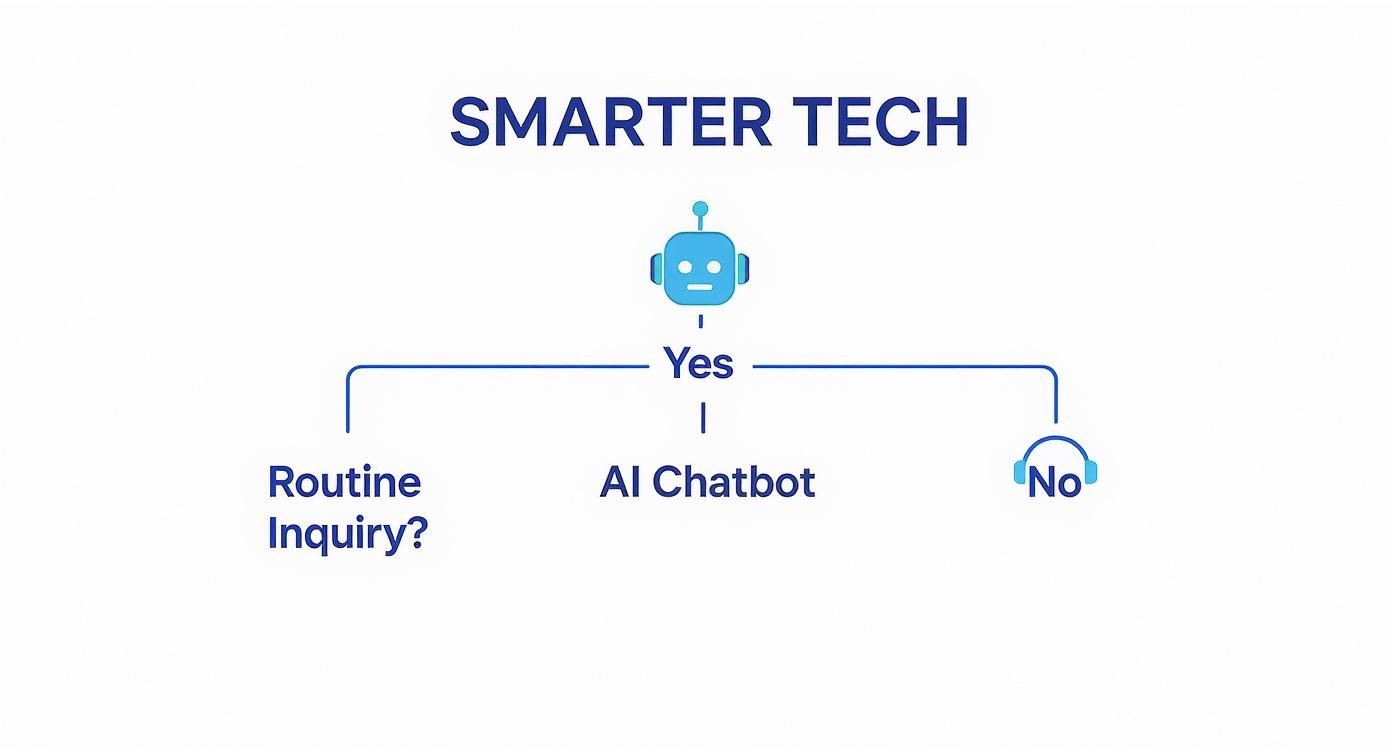
This is a great example of how technology can offload the simple stuff, freeing up your agents—onshore, offshore, or nearshore—to tackle the high-value interactions that truly matter.
Before we get into the nitty-gritty comparison, it’s helpful to see how these models stack up side-by-side. The table below breaks down the key differences you should be weighing.
| Factor | Onshore (e.g., USA) | Offshore (e.g., Philippines) | Nearshore (e.g., Tijuana, Mexico) |
|---|---|---|---|
| Labor Costs | Highest | Lowest | Moderate (Significant Savings) |
| Cultural Affinity | Perfect Match | Significant Differences | High Alignment |
| Time Zone | Same | 8-12 Hour Difference | Minimal to No Difference |
| Travel Accessibility | Easiest | Difficult & Costly | Easy & Affordable |
| Talent Pool | Skilled but Expensive | Large, Variable Skill Levels | Skilled, Bilingual, Cost-Effective |
| Agent Attrition | Moderate | Can be High | Typically Lower |
As you can see, the “cheapest” option isn’t always the most valuable. Now, let’s explore why that is.
The Total Cost of Ownership
Fixating only on an agent’s hourly rate is a rookie mistake. A real cost-benefit analysis demands you look at the entire financial picture, not just the number on the invoice.
“Effective sourcing isn’t about finding the cheapest option; it’s about finding the best value. That value is a blend of cost, quality, and operational synergy.”
When you’re weighing your options, you have to account for these often-ignored expenses that quietly bloat your total cost of ownership:
- Travel and Management: How quickly and cheaply can your leadership team get to the center for training, quality checks, or strategy sessions? A quick flight from San Diego to Tijuana is a world away from a draining 20-hour trip to Manila.
- Attrition and Training: High turnover rates, which can plague some offshore locations, lock you into an expensive, never-ending cycle of recruiting and training new agents. Nearshore centers often have much better agent retention thanks to a better work-life balance and stronger cultural ties.
- Communication and Collaboration: When your partner is working in the same time zone, collaboration is effortless. No more late-night conference calls or waiting a full day for an email response. This seamless communication drives efficiency and builds a much stronger, more effective partnership.
This deeper look is exactly why a slightly higher hourly rate in a nearshore location often leads to a lower total cost and a much better ROI in the long run. The practical benefits—easy travel, real-time collaboration, and access to a culturally-aligned, bilingual talent pool—create efficiencies that more than make up for the marginal difference in labor cost compared to far-flung offshore alternatives.
 Create Your Phased Implementation Roadmap
Real, sustainable call center cost reduction isn’t a one-and-done project; it’s a disciplined journey. Trying to overhaul your people, processes, and technology all at the same time is a classic recipe for chaos and burnout.
A much smarter approach is to break the process down into manageable phases. This ensures each step builds on the last and delivers tangible value, turning the abstract goal of “saving money” into a concrete action plan. It prevents you from overwhelming your team and creates momentum by delivering wins early and often.
Phase 1: Diagnosis and Quick Wins
You can’t fix a problem you don’t fully understand. The first phase is all about discovery—conducting a deep dive to pinpoint exactly where your money is going and identify the low-hanging fruit. These are the quick wins that can deliver immediate savings with minimal effort.
Here’s what to focus on first:
- Conduct a Full Cost Audit: Dig into every line item, from agent salaries and software licenses to utilities and overhead. The goal is to break it down to a granular Cost Per Call.
- Benchmark Your KPIs: How does your Average Handle Time (AHT), First Call Resolution (FCR), and agent attrition stack up against industry averages? This is where your biggest performance gaps will jump out at you.
- Identify Obvious Inefficiencies: Look for the simple stuff. Are agents wasting time on manual data entry? Are you consistently overstaffed during predictable lulls?
For instance, you might discover that 15% of all your inbound calls are simple password reset requests. A perfect quick win would be to add an automated reset option to your IVR, immediately deflecting thousands of calls and freeing up your agents for more complex issues.
Phase 2: Strategic Prioritization
With your data in hand, it’s time to get strategic. Not all cost-saving ideas are created equal. Some offer massive returns but require a huge investment, while others are easy to implement but have a smaller impact. This phase is about sorting your opportunities and building a realistic plan of attack.
Use a simple impact/effort matrix to categorize every potential project:
- High Impact, Low Effort: These are your top priorities. Implement the “quick wins” from Phase 1 immediately.
- High Impact, High Effort: These are your major strategic projects, like migrating to a new CCaaS platform or partnering with a nearshore provider. They need careful planning.
- Low Impact, Low Effort: Tackle these when you have spare resources, but don’t let them distract you from bigger goals.
- Low Impact, High Effort: Avoid these entirely. The return just isn’t worth the time and capital.
This process ensures you focus your limited resources where they’ll make the biggest difference, creating a clear, logical sequence for your entire roadmap.
“The smartest path to cost reduction isn’t doing everything at once. It’s about doing the right things in the right order.”
Phase 3: Pilot and Measure
When it comes to big changes—especially new technology or a major process shift—never go all-in from the start. A controlled pilot program is the perfect way to test your idea, work out the kinks, and gather real-world data without disrupting your entire operation.
Select a small, representative group of agents for the test. Before you begin, define what success looks like. For example, if you’re piloting new AI-powered coaching software, you might track changes in FCR and CSAT scores for the pilot group compared to everyone else. This controlled test proves the ROI and builds a powerful case for a full-scale rollout.
Phase 4: Scale and Optimize
Once a pilot has proven its worth, it’s time to scale. This final phase involves rolling out the successful initiative across the entire call center. But the work doesn’t stop there.
Continuous optimization is what separates good from great. As you scale, keep a close eye on your KPIs to ensure you’re still getting the results you expect. Gather feedback from agents and managers to identify any new challenges or opportunities for refinement. This is about embedding the changes into your operational DNA and building a culture that’s always looking for ways to improve.
If you want to dive deeper, our guide on how to scale your call center operations efficiently provides an excellent deep dive into managing growth.
Measure Success and Calculate Your ROI
Rolling out new call center cost reduction strategies is just the start. If you can’t prove they’re working, you’re just spinning your wheels. Vague feelings about “saving money” won’t cut it with leadership; you need to show them the hard numbers.
This means looking past obvious metrics like Cost Per Call and digging into the Key Performance Indicators (KPIs) that tell the real story. These are the numbers that connect your cost-saving efforts directly to the bottom line.
Key Performance Indicators to Track
Don’t drown in a sea of data. Zero in on the KPIs that have the biggest financial impact and clearly show how your cost-cutting efforts are paying off.
- First Call Resolution (FCR): This is the gold standard. It measures how many customer problems get solved on the very first try. A high FCR is a massive cost-saver because it stops expensive follow-up calls in their tracks, which shrinks your call volume and makes customers happier all at once.
- Agent Utilization Rate: This tracks how much time your agents are actively working on calls versus sitting idle. Nudging this rate up with smarter workforce management or automation means you’re squeezing more value out of every single payroll dollar.
- Employee Attrition: It costs a small fortune to replace an agent when you factor in recruiting, hiring, and training. A low turnover rate isn’t just a sign of a happy team; it’s a direct signal of a healthy, cost-efficient operation.
“You can’t manage what you don’t measure. Tracking the right KPIs transforms cost reduction from a hopeful goal into a data-driven strategy.”
Calculating a Clear Return on Investment
Once your new strategies are in place, it’s time to run the numbers and see what kind of financial punch they’re packing. This is where you prove your initiatives are actually contributing to the bottom line. The principles are similar to those used when measuring the ROI of internal communication initiatives, which often involves connecting actions to tangible business outcomes.
Let’s walk through a quick, realistic ROI calculation for bringing on a nearshore partner like CallZent.
ROI Formula: (Net Profit / Cost of Investment) x 100
Here’s what that looks like in the real world:
- Add Up Your Gains (Net Profit):
- Annual savings from lower agent salaries: $250,000
- Savings from reduced agent turnover (less hiring/training): $50,000
- Total Gain: $300,000
- Figure Out Your Investment Costs:
- One-time setup and transition fees: $25,000
- Annual management and partnership fees: $35,000
- Total Investment: $60,000
- Calculate the ROI:
- Net Profit = $300,000 (Gain) – $60,000 (Investment) = $240,000
- ROI = ($240,000 / $60,000) x 100 = 400%
A simple calculation like this builds a rock-solid business case. It proves that the upfront investment pays for itself several times over, giving you the clear, measurable data you need to justify your decisions to leadership.
Frequently Asked Questions
When you start digging into call center cost reduction, a lot of questions bubble up. We get it. Here are some straight answers to the most common things leaders ask, designed to give you clarity and confidence as you plan your next move.
What Is the First Step for Call Center Cost Reduction?
Before you can cut a single dollar, you need to know exactly where your money is going. The first step is always a top-to-bottom audit. Get granular with your expenses—map out everything from labor and technology licenses to overhead and training.
Once you have the full picture, pinpoint your top three cost drivers. See how metrics like your Cost Per Call stack up against industry benchmarks. This data-first approach is the only way to find your “quick wins” and make sure you’re focusing on changes that will actually move the needle.
Can I Reduce Costs Without Sacrificing Quality?
Absolutely. In fact, the smartest cost-reduction strategies almost always lead to better customer satisfaction. The goal isn’t to cut corners; it’s to cut out waste and inefficiency.
Think about it: when you automate simple, repetitive tasks, you free up your agents to handle complex issues where a human touch really matters. When you invest in agent training to boost First Call Resolution, you’re not just making customers happier—you’re also slashing the operational costs that come from repeat calls.
The best cost-saving initiatives are invisible to the customer but transformative for your bottom line. They focus on working smarter, not cheaper.
How Quickly Can I See ROI From a Nearshore Partner?
While every situation is different, most companies start seeing a positive return on their investment within the first 6-12 months of partnering with a nearshore call center. The most immediate savings come from labor arbitrage—the simple difference in salary costs.
But the real, long-term ROI builds over time. It’s driven by things like lower agent turnover, reduced training overhead, and access to a highly skilled, bilingual talent pool that improves customer outcomes. A great partner will work with you to set up clear KPIs from day one, so you can track the financial impact and watch the savings grow.
Ready to reduce costs without sacrificing CX?
At CallZent, we build cost-effective, high-performance nearshore solutions in Tijuana that help you save money while delighting your customers.
Ready to turn your cost center into a value-driven powerhouse? At CallZent, we build cost-effective, high-quality nearshore solutions that deliver results you can measure. See for yourself how our expert teams in Tijuana can help you lock in significant savings while delighting your customers. Explore CallZent’s services today.