Skip to content
Call Center Cost Optimization
Call Center Cost Savings: 10 Proven Strategies to Reduce Expenses
Discover 10 proven call center cost savings strategies to lower cost-per-contact, improve efficiency, and transform your support team into a growth driver.
TL;DR — Quick Takeaways
- Nearshoring can reduce operational costs by 30–50% while maintaining quality.
- Automation and AI significantly lower cost-per-contact and QA overhead.
- Workforce optimization eliminates overstaffing and idle time.
- Self-service and omnichannel tools deflect volume and improve efficiency.
Are rising operational costs turning your call center into an expensive liability rather than a value-driving asset? For many businesses, bloated headcounts, inefficient processes, and outdated technology are inflating customer support budgets without delivering the expected returns. The good news is that achieving significant call center cost savings is possible without sacrificing quality. Staying current with effective cost-reduction methods is essential, and keeping up with expert blogs and BPO industry insights provides a continuous stream of actionable ideas for optimization.
This article breaks down 10 proven strategies to cut expenses, boost efficiency, and transform your customer service operation into a lean, high-performing asset. From the strategic advantages of nearshoring to deploying intelligent automation, these are the actionable insights you need to reduce your cost-per-contact and maximize ROI. We’ll move beyond generic tips to give you a clear roadmap for building a more cost-effective and resilient customer support function.
1. Achieve Call Center Cost Savings by Nearshoring Your Operations
One of the most impactful strategies for significant call center cost savings is nearshoring your operations. This involves partnering with a BPO in a nearby country, like Mexico for U.S. businesses, which offers a powerful balance between cost-efficiency and operational control. Unlike offshoring to distant locations, nearshoring minimizes cultural disconnects and aligns time zones, leading to better collaboration and service quality.
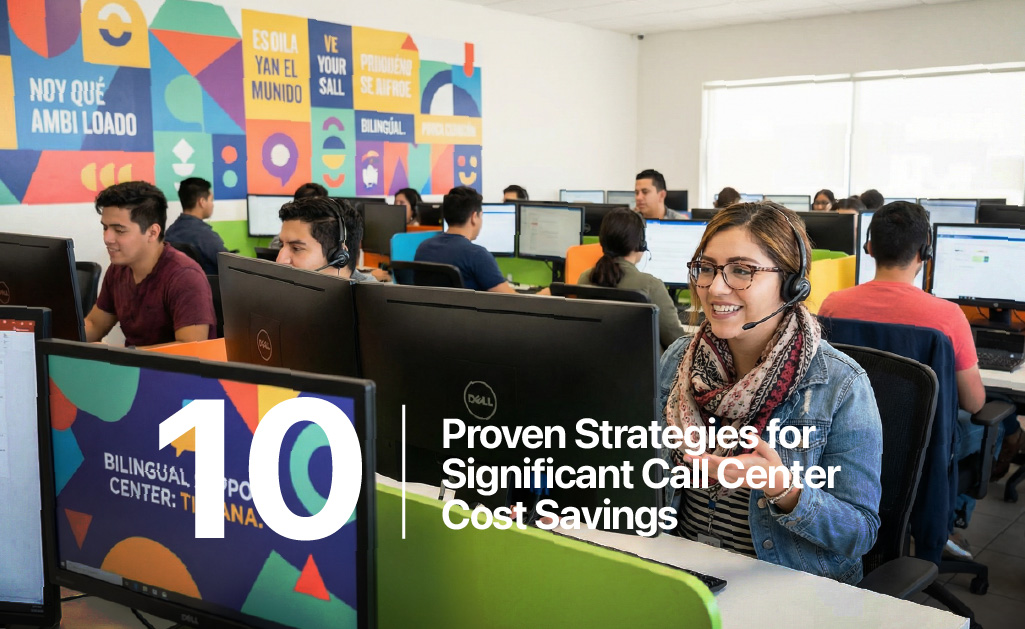
For example, a U.S. e-commerce brand can partner with a Tijuana-based call center to access a large, bilingual talent pool at a lower cost. Geographic proximity makes travel for management oversight, training, and relationship-building faster and more affordable, ensuring the partner truly acts as an extension of your brand.

How to Implement a Nearshoring Strategy
Many leading companies have successfully nearshored by setting up service centers in Tijuana to support their North American customer base. The key is finding a partner who aligns with your brand’s standards. For a deeper analysis, compare the costs, risks, and ROI of nearshore vs. offshore models to see which fits your business needs.
To ensure a smooth transition and maximize savings, follow these steps:
- Partner with Established Providers: Select a nearshore BPO like CallZent with a proven track record that understands your industry’s compliance and security needs.
- Verify Bilingual Capabilities: Ensure your partner offers genuinely bilingual agents who can fluently serve both English and Spanish-speaking customers.
- Establish Clear SLAs: Define key performance indicators (KPIs) and service level agreements (SLAs) to maintain high-quality service.
- Plan for On-Site Visits: The ease of travel is a primary benefit. Schedule regular visits to foster a strong partnership and ensure operational alignment.
2. Cut Costs with Intelligent
Call Routing and IVR
A powerful way to generate call center cost savings is by implementing an intelligent Interactive Voice Response (IVR) and advanced call routing system. This technology directs inquiries to the most qualified agent or self-service option based on the customer’s needs, language, or history. This approach significantly reduces handle times, minimizes transfers, and lowers your cost-per-call.
By getting customers to the right solution faster, you improve their experience while making your operations more efficient. For example, a bank can use its IVR to automate balance inquiries, while an e-commerce company can route callers with return questions directly to a specialized team, bypassing the general queue.

How to Implement Smart Routing and IVR
Successfully deploying this strategy requires more than just setting up an automated menu; it needs continuous analysis and refinement. The goal is to make the system a helpful tool, not a frustrating barrier. To better understand the strategic elements, you can explore how to optimize call routing for faster service and apply those principles.
Follow these steps to maximize your savings:
- Keep IVR Menus Concise: Limit your menu to four or five clear options to prevent user frustration.
- Offer a Callback Option: Allow callers to request a callback instead of waiting on hold to dramatically improve satisfaction.
- Analyze Routing Data: Regularly review call logs and abandonment rates to find bottlenecks and improve routing logic.
- Use Skills-Based Routing: Match callers to agents based on criteria like language fluency or product knowledge to boost first-call resolution.
3. Use Workforce Optimization
for Greater Cost Savings
A powerful method for achieving substantial call center cost savings is through strategic workforce optimization (WFM). This approach uses data analytics to accurately forecast call volumes and align agent schedules with demand. By precisely matching staffing levels to customer activity, you eliminate wasteful overstaffing during slow periods and prevent understaffing during peak times.
This data-driven strategy ensures your most valuable resource—your agents—are deployed effectively, minimizing idle time and maximizing productivity. For example, retail call centers can use WFM to prepare for Black Friday spikes, while financial services firms can scale teams for month-end reporting periods, all without overspending.
How to Implement Workforce Optimization
Effective WFM is a cornerstone of any high-performing contact center. The key is to analyze historical data to build predictive models that guide staffing decisions, reducing operational expenses and preventing agent burnout.
To integrate this strategy and unlock significant call center cost savings, follow these steps:
- Analyze Historical Data: Use 12–24 months of call volume data to create accurate forecasts for different times, days, and seasons.
- Account for External Factors: Incorporate marketing campaigns, holidays, and promotions into your forecasts to prepare for predictable volume changes.
- Build a Staffing Buffer: Maintain a 5-10% buffer in staffing capacity to handle unexpected spikes without compromising service.
- Monitor Schedule Adherence: Use real-time dashboards to track how closely agents follow their schedules and address deviations promptly.
4. Integrate Channels for Omnichannel Savings
A fragmented customer support system with separate tools for voice, email, and chat creates inefficiency and drives up costs. Consolidating these channels into a unified omnichannel platform is a critical strategy for significant call center cost savings. This approach eliminates redundant software licenses, streamlines agent workflows, and simplifies training.
By unifying communications, customers can switch channels—like from a web chat to a phone call—without repeating their issue. Agents gain a single view of the customer’s interaction history, enabling faster resolutions. This cohesion not only cuts costs but also massively improves the customer journey.
How to Implement Omnichannel Consolidation
Leading e-commerce and insurance companies achieve major savings by moving from siloed teams to a single, integrated platform. The goal is to create a seamless information flow that empowers agents. For a detailed guide on building this unified system, explore how to design a seamless omnichannel customer experience.
To effectively consolidate your channels and reduce expenses, follow these steps:
- Choose the Right Platform: Select a scalable platform that supports your most-used channels first and integrates with your existing CRM.
- Phase the Rollout: Implement the new system one channel at a time to minimize disruption, starting with your highest-volume channel like voice or email.
- Provide Comprehensive Training: Equip agents with in-depth training on the unified dashboard so they can confidently manage conversations from one interface.
- Monitor Channel Performance: Use analytics to track channel usage and reallocate resources from high-cost channels (voice) to low-cost channels (chat, SMS).
5. Implement Agent Performance
-Based Incentives
A powerful way to boost efficiency and achieve call center cost savings is by implementing performance-based incentive programs. This model connects a portion of agent compensation directly to key performance metrics like First-Contact Resolution (FCR) or Customer Satisfaction (CSAT). This approach motivates agents to improve their productivity and quality, as their efforts have a direct impact on their earnings.
When designed correctly, these programs encourage agents to work more efficiently without sacrificing service standards. For example, a technical support center could reward agents for high FCR scores. This alignment of agent goals with business objectives creates a win-win scenario.
How to Implement Performance-Based Incentives
The success of an incentive program depends on clear, achievable goals and transparent tracking. A common mistake is focusing on a single metric, like Average Handle Time, which can lead to agents rushing calls at the expense of customer satisfaction. A balanced approach is crucial.
To build an effective program that drives both performance and savings, consider these steps:
- Balance Key Metrics: Combine efficiency metrics (Average Handle Time) with quality metrics (CSAT or QA scores) to encourage well-rounded performance.
- Set Realistic Goals: Use historical data to establish achievable targets. Goals that seem impossible will demotivate agents rather than inspire them.
- Ensure Transparency: Make sure agents understand exactly how the incentive structure works and can track their progress in real time.
- Include Non-Financial Rewards: Recognize top performers with public praise, preferred scheduling, or professional development opportunities.
- Review and Adjust: Monitor the program for any signs of “gaming the system” and be prepared to adjust the metrics and rewards quarterly.
6. Promote Self-Service to Lower Inbound Volume
One of the most effective call center cost savings strategies is empowering customers to find their own answers. Implementing a detailed knowledge base and self-service portal allows customers to resolve common issues independently, reducing the need for agent assistance. This directly lowers inbound call volume and cost-per-contact while improving customer satisfaction by offering 24/7 support.
This strategy shifts simple, repetitive inquiries away from live agents, freeing them to handle more complex interactions. For example, tech companies use extensive knowledge bases to cut down on support tickets, while e-commerce platforms build self-service portals for returns and order tracking.
How to Implement Self-Service and Knowledge Management
Success depends on creating a user-friendly resource that directly addresses customer needs. For instance, telecommunications companies provide DIY troubleshooting guides with videos to help customers fix internet issues without calling support. The goal is to make finding information easier than contacting an agent.
To build an effective self-service ecosystem, follow these steps:
- Identify Common Questions: Use call data to pinpoint frequent customer issues and build your initial content around them.
- Organize Content Intuitively: Structure your knowledge base with clear categories and use customer-focused language, not internal jargon. An AI-powered search function can greatly improve usability.
- Incorporate Visual Aids: Use screenshots, diagrams, and video tutorials to explain complex steps.
- Provide a Clear Escalation Path: Always offer an easy way for customers to connect with a live agent if they can’t find a solution, preventing frustration.
7. Automate Repetitive Tasks with RPA for Cost Savings
A powerful strategy for generating substantial call center cost savings is adopting Robotic Process Automation (RPA). This technology deploys software “bots” to handle routine, rule-based tasks that consume significant agent time. By automating processes like data entry, order processing, and account lookups, you free your human agents to manage more complex and valuable customer interactions.
This shift not only boosts efficiency but also improves employee satisfaction by removing tedious work. For example, in financial services, RPA can process loan applications by automatically verifying data, reducing handling time from minutes to seconds. This minimizes errors and operational costs.
How to Implement RPA and Automation
The goal is to apply automation to high-volume, repetitive workflows where the potential for ROI is greatest. Success depends on careful planning. For an in-depth guide, explore how to automate repetitive tasks in your operations to build a more efficient system.
To deploy RPA effectively and achieve your cost-saving goals, follow these steps:
- Start with High-Volume Processes: Target tasks that are frequent and follow clear rules, such as insurance claim data entry or appointment confirmations.
- Map Processes Thoroughly: Before building bots, document every step of the workflow to ensure the automation is accurate.
- Design for Exception Handling: Build clear escalation paths. When a bot encounters an issue it can’t solve, it should seamlessly route the task to a human agent.
- Monitor Bot Performance: Continuously track metrics like processing time and error rates to measure ROI and identify areas for improvement.
8. Reduce Overhead with AI-Powered Quality Assurance
A significant path to call center cost savings is moving from manual QA to automated AI monitoring. This modern approach uses artificial intelligence to analyze 100% of customer interactions—calls, chats, and emails. It automatically identifies compliance deviations, agent performance trends, and customer sentiment without the labor-intensive costs of manual reviews.
Automated systems provide real-time feedback and can flag critical issues for immediate intervention. This not only cuts down on QA staff overhead but also improves consistency and reduces the risk of costly compliance breaches. For example, financial firms use AI to ensure agents follow strict FINRA regulations on every call, a task impossible with manual spot-checking.
How to Implement AI-Powered Quality Assurance
The goal is not to replace human oversight but to make it more strategic. AI handles the heavy lifting of data analysis, freeing QA managers to focus on high-value coaching and process improvements. For a detailed guide, explore best practices for call center quality assurance and see how automation fits in.
To integrate AI monitoring and maximize your returns, follow these steps:
- Define Clear Standards: Start by documenting explicit quality and compliance standards. The AI needs a clear “rulebook” to measure performance accurately.
- Train the AI Model: Use a set of your own recorded interactions—both good and bad—to train the AI model on your specific business context.
- Implement Real-Time Alerts: Set up automated alerts for critical failures, such as missed compliance disclosures in healthcare or financial calls.
- Create Agent Feedback Loops: Use the data to generate automated performance scorecards and identify coaching opportunities for agents.
9. Use Flexible Staffing Models to Control Labor Costs
Adopting a flexible or gig-based staffing model is a modern approach to managing call center cost savings by aligning labor expenses directly with demand. This strategy involves supplementing your core team with part-time or on-demand workers during peak periods, eliminating the high fixed costs of overstaffing during slower times.
This model is particularly effective for businesses with seasonal fluctuations. For instance, retailers can hire seasonal staff for holiday rushes, ensuring customer service levels remain high when they matter most, without paying for idle agents year-round.
How to Implement a Flexible Staffing Model
Success with a flexible workforce hinges on robust processes and technology. For example, e-commerce platforms scale their support teams for sales events by using on-demand agents who are trained and ready to go. This agility is a key driver of efficiency.
To build a high-performing blended team, follow these steps:
- Develop Rapid Onboarding: Create streamlined training modules that quickly get temporary agents up to speed on your products, systems, and brand voice.
- Use Centralized Management Tools: Implement a contact center platform to manage, monitor, and support a distributed team of permanent and gig workers.
- Set Clear Expectations: Clearly define performance metrics, communication protocols, and quality standards for all agents.
- Ensure Labor Law Compliance: Work with legal counsel to correctly classify contract workers and adhere to all regional labor laws to avoid legal risks.
10. Embrace Continuous Improvement with Lean Methodology
A powerful strategy for sustainable call center cost savings is adopting principles from Lean manufacturing. This approach centers on systematically identifying and eliminating waste and redundancies within your support operations. It is a data-driven method that produces incremental, ongoing improvements to both cost and quality.
By focusing on process refinement, you can shorten handle times, reduce errors, and increase first-call resolution rates without major capital investment. This disciplined practice turns your call center from a cost center into an efficient, value-driven operation.
How to Implement Continuous Improvement
An e-commerce business, for example, might map its returns process to find and remove bottlenecks, reducing calls about return status. The key is to make improvement an ongoing cultural commitment, not a one-time project. This mindset is central to delivering high-quality, cost-effective BPO services.
Follow these steps to integrate Lean principles into your operations:
- Start with Process Mapping: Document your current high-frequency workflows, like order inquiries, to create a clear picture.
- Empower Frontline Agents: Your agents are closest to the problems and often have the best solutions. Create a system for them to submit improvement ideas.
- Focus on Quick Wins: Identify and implement small, high-impact changes first to build momentum and demonstrate value.
- Measure Before and After: Establish baseline metrics for any process you plan to change. This allows you to quantify the impact and prove the ROI of your efforts.
10 Call Center Cost‑Saving Strategies Compared
| Strategy | Implementation Complexity 🔄 | Resource & Tech Requirements ⚡ | Expected Outcomes ⭐📊 | Ideal Use Cases | Key Advantages & Tips 💡 |
|---|---|---|---|---|---|
| Nearshoring Instead of Offshore Outsourcing | Low–Medium 🔄: vendor selection, legal setup, onboarding | Moderate ⚡: vendor management, bilingual staff, occasional travel | ⭐ Improved response times & oversight; 📊 ~30–50% operational cost reduction vs onshore | North American support, bilingual markets, time‑zone sensitive services | 💡 Better cultural alignment and oversight; choose proven providers, set clear SLAs |
| Intelligent Call Routing and IVR Optimization | Medium–High 🔄: design, AI tuning, integration with legacy systems | High ⚡: IVR/AI platforms, CRM integration, ongoing optimization | ⭐ Faster service & higher FCR; 📊 AHT ↓15–25%, transfers ↓ up to 40% | High call volumes, multi‑language centers, self‑service capable flows | 💡 Keep menus short; add callbacks and sentiment escalation; A/B test changes |
| Workforce Optimization and Scheduling | Medium 🔄: forecasting model setup and change management | Moderate ⚡: WFM software, historical data, real‑time adherence tools | ⭐ Better SLA compliance; 📊 labor cost ↓10–20%, SLA ↑15–25% | Retail seasonality, month‑end financial peaks, event‑driven demand | 💡 Use 12–24 months data, build 5–10% buffer, review forecasts regularly |
| Omnichannel Integration and Consolidation | High 🔄: data migration, phased rollouts, change management | High ⚡: unified platform, APIs, consolidated reporting | ⭐ Seamless CX and full customer view; 📊 tech costs ↓25–35%, efficiency ↑15–20% | Businesses with diverse channels (voice, chat, email, social) | 💡 Phase by channel, ensure robust APIs, train agents on unified UI |
| Agent Performance‑Based Incentive Programs | Medium–High 🔄: metric design, governance, payroll changes | Moderate ⚡: performance dashboards, analytics, payroll integration | ⭐ Higher productivity; 📊 productivity ↑15–30%, lower cost‑per‑contact | Sales, collections, measurable support environments | 💡 Balance quality and efficiency metrics, ensure transparency, review quarterly |
| Knowledge Management & Self‑Service Portals | Medium 🔄: content strategy, UX design, integration | Moderate ⚡: CMS/KB tools, search/AI, content creation resources | ⭐ 24/7 resolution and lower volumes; 📊 inbound volume ↓20–40%, cost per resolved issue ↓30–50% | Tech support, e‑commerce Returns, FAQs and repeatable issues | 💡 Use customer language, AI search/autocomplete, monitor analytics to update content |
| Automation of Repetitive Tasks (RPA) | High 🔄: process mapping, bot development, exception paths | High ⚡: RPA platforms, integration with legacy systems, bot maintenance | ⭐ Faster, more accurate processing; 📊 operational costs ↓25–40% for automated tasks; processing ↑30–50% | Claims, order processing, account lookups, high‑volume rule‑based tasks | 💡 Start with high‑volume rule‑based processes, map thoroughly, design exception handling |
| Quality Assurance Automation & AI Monitoring | High 🔄: model training, policy alignment, privacy considerations | High ⚡: speech/text analytics, storage, AI licensing, integration | ⭐ Consistent QA and realtime coaching; 📊 QA labor costs ↓40–60%, quality consistency ↑25–35% | Compliance‑sensitive sectors (finance, healthcare), large contact volumes | 💡 Train on internal data, combine AI with human review, define clear QA standards |
| Flexible & Gig‑Based Staffing Models | Medium 🔄: onboarding, distributed management, compliance | Moderate ⚡: remote management tech, rapid training systems | ⭐ Scalability and lower fixed costs; 📊 fixed labor ↓15–25%, rapid peak scaling | Seasonal retail, overflow support, gig/remote friendly roles | 💡 Build rapid onboarding, enforce quality standards, plan compliance/classification |
| Continuous Process Improvement & Lean Methodology | Medium–High 🔄: culture change, training, sustained effort | Moderate ⚡: training, facilitators, measurement systems | ⭐ Sustainable efficiency and quality gains; 📊 operational costs ↓15–30% over 12–24 months | Organizations seeking systemic, long‑term efficiency improvements | 💡 Start with process mapping, empower frontline agents, measure baselines and celebrate quick wins |
Transform Your Call Center into a Competitive Advantage
The journey to substantial call center cost savings is not a single leap but a series of deliberate, intelligent steps. The strategies that deliver the most impact go beyond simple budget cuts—they involve rethinking how your contact center operates, where it’s located, and the tools it uses. From the strategic choice of a nearshore partner to smart automation, each tactic contributes to a stronger, more resilient operational model.
The ultimate goal is to build an ecosystem where efficiency and customer satisfaction are two sides of the same coin. This is where true power lies. Instead of just reducing expenses, you begin creating a competitive advantage. Your call center stops being just a line item and starts driving customer loyalty and retention.
Your Action Plan for Lasting Savings
To move from theory to reality, focus on these immediate next steps:
- Conduct a Tech Audit: Are you fully using your IVR’s capabilities? Could Robotic Process Automation (RPA) handle repetitive agent tasks like post-call data entry? Identifying these opportunities is the first step toward significant gains.
- Analyze Agent Performance Data: Look beyond basic metrics like Average Handle Time (AHT). Dig into First Call Resolution (FCR) and customer satisfaction (CSAT) scores. High-performing agents are your most valuable asset; better tools can replicate their success.
- Evaluate Your Staffing Model: Is your scheduling rigid, leading to periods of over- and under-staffing? Exploring flexible models, even on a small scale, can directly impact your payroll expenses and reduce costly turnover.
- Explore Nearshore Solutions: The most impactful change often involves location. Compare the fully loaded costs of your current operation with a nearshore model. Consider not just salary but also the benefits of cultural alignment, time zone compatibility, and a large, bilingual talent pool.
Achieving call center cost savings is about being strategic. By combining the right people, processes, and technology, you can dramatically lower your overhead while improving service quality. This isn’t just about saving money; it’s about building a smarter, more effective business.
🚀 Ready to Unlock Real Call Center Cost Savings?
Partner with CallZent to reduce costs, improve performance, and build a high-performing nearshore support team.
Schedule a CallReady to see how a strategic nearshore partnership can unlock these savings for your business? At CallZent, we specialize in building high-performing, cost-effective bilingual teams in Tijuana that integrate seamlessly with your operations. Let us show you how our solutions can reduce your expenses and elevate your customer experience. Get in touch with a CallZent expert today.