Skip to content
Quality Assurance
Call Center Email Quality Monitoring Made Simple: A Practical, High-Impact Guide
Discover how call center email quality monitoring improves accuracy, reduces repeat contacts, and boosts customer satisfaction. A practical, high-impact guide for modern support teams.
TL;DR — Quick Takeaways
- Why It Matters: Poor email quality leads to repeat contacts, lower CSAT, and damaged brand trust—making QA essential.
- Scorecard Essentials: Evaluate solution accuracy, tone/empathy, compliance, and clarity; weight them based on business priorities.
- Smarter Sampling: Combine random, targeted, issue-based, and performance-based sampling for the most accurate insights.
- AI Advantage: AI enables 100% email review, automates compliance checks, and frees QA teams for impactful coaching.
Is your team’s email communication creating silent problems? For many call centers, it’s a massive blind spot. Inconsistent email quality can quietly lead to repeat customer contacts, chip away at brand trust, and ultimately hit your bottom line.
A formal call center email quality monitoring program isn’t just a best-practice; it’s essential for survival and growth in today’s competitive landscape.
Why Email Quality Monitoring is Non-Negotiable
In a busy call center, it’s easy to focus on what you can hear—the calls. But what about the conversations happening in writing? Emails are a critical touchpoint, and a single unclear, inaccurate, or poorly toned message can unravel a customer relationship without you ever knowing it happened.
This isn’t just about catching typos. It’s about stopping the expensive domino effect that poor written communication triggers.
The Hidden Costs of Inconsistent Emails
When email quality is an afterthought, the consequences ripple across your operation. From our own nearshore operations in Tijuana, we’ve seen firsthand how seemingly small email mistakes create big headaches for clients:
- More Repeat Inquiries: An ambiguous answer to a billing question doesn’t just frustrate a customer. It guarantees they’ll be calling or emailing again, driving up your contact volume and operational costs. For example, a customer asks, “Why was my bill higher?” and the agent replies, “It was due to overage charges.” A complete answer would specify which charges and how to monitor usage to prevent it next time.
- Damaged Brand Trust: Every email is a direct reflection of your company. Inconsistent formatting, grammatical errors, or an apathetic tone make your brand look careless and unprofessional.
- Higher Agent Burnout: Nothing frustrates an agent more than handling angry follow-up emails from customers who received a confusing response the first time. It adds unnecessary stress and complexity to their work.
A structured call center email quality monitoring program is the single most effective way to diagnose and fix these silent, costly problems.
Connecting Quality Directly to Your Bottom Line
Implementing a formal email QA process is a strategic investment with a clear, measurable return. We’ve seen organizations with established email QA processes make significant strides in key metrics.
Consistent enforcement of quality standards can reduce follow-up email exchanges by up to 35-40%, directly boosting your first-contact resolution (FCR).
Of course, great quality monitoring must also include the successful delivery of those emails. Following email deliverability best practices is critical. When you combine excellent content with a solid technical foundation, your messages don’t just read well—they get delivered.
Ultimately, a proactive approach transforms quality assurance from a cost center into a value driver. By raising your standards, you build customer loyalty that fuels revenue and sustainable growth. Our guide to call center quality assurance provides a deeper look into building this type of culture.
Designing a Scorecard That Actually Drives Quality
A generic checklist won’t cut it. Your entire call center email quality monitoring program is only as strong as the scorecard that powers it. Think of your scorecard not as a report card for agents, but as a blueprint for what a perfect customer interaction looks like in writing.
A well-designed scorecard aligns your team on a unified definition of “good.” It moves beyond simple pass/fail metrics and guides agents toward behaviors that genuinely improve the customer experience. This is where your company’s values are translated into concrete, measurable actions.
Core Categories for Your Email QA Scorecard
To build a scorecard that moves the needle, focus on categories that reflect what truly matters to your customers and your business. For a bilingual nearshore BPO like ours, this means covering both universal principles of good service and the specific nuances of language and culture.
Here are the essential building blocks for any effective email QA scorecard:
- Solution Accuracy and Completeness: Did the agent provide the right information? More importantly, did they answer all parts of the customer’s question—both stated and implied—to prevent a frustrating follow-up?
- Tone and Empathy: This is huge. Did the agent’s language match the customer’s emotional state? A response to a deeply frustrated customer should sound completely different from a simple info request. Getting this right is critical for de-escalation and building rapport.
- Procedural Adherence and Compliance: Did the agent follow all required steps? This covers everything from proper account verification to including necessary legal disclaimers. It’s the stuff that protects the business.
- Clarity, Grammar, and Formatting: Was the email easy to read and understand? Proper grammar, clear sentences, and simple formatting like bullet points or bold text can make a massive difference in comprehension.
For a bilingual team, that last point is non-negotiable. The scorecard must evaluate fluency and professionalism in both English and Spanish to ensure a consistent brand voice, no matter the language.
Assigning Weights for Maximum Impact
Not all quality criteria are created equal. A typo is a minor slip-up, but providing incorrect billing information is a critical failure that can destroy trust. This is why weighting each category in your scorecard is so important—it ensures your team focuses on the highest-impact behaviors.
For example, “Solution Accuracy” might be worth 40% of the total score because getting the answer right is non-negotiable. “Grammar and Spelling,” while important, might only be worth 10%. This system sends a clear message about your priorities and helps agents understand where to focus their efforts.
Strategically weighting your scorecard provides a framework for not just measuring performance, but also for understanding the crucial customer service performance indicators that signal a healthy customer relationship.
A weighted scorecard transforms quality monitoring from a simple checklist into a strategic tool that directly influences agent behavior and customer outcomes.
This is where you see the tangible benefits of a well-executed email QA program.
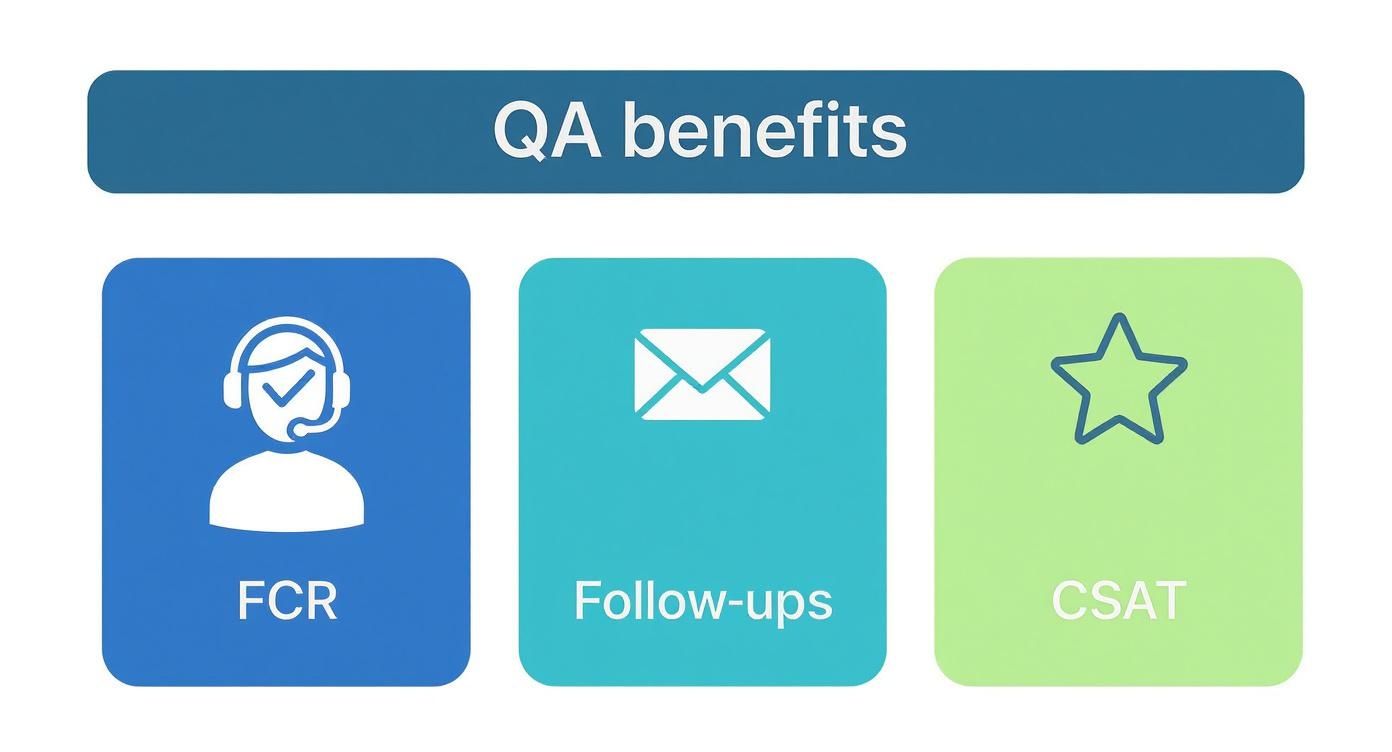
As you can see, a laser focus on quality directly increases First Contact Resolution (FCR), reduces the need for costly follow-ups, and boosts your overall Customer Satisfaction (CSAT).
Evolving Your Scorecard From Basic to Advanced
As your quality program matures, your scorecard must evolve with it. A basic, compliance-focused scorecard is a fine place to start, but an advanced, customer-centric one is where you’ll see the biggest gains in loyalty.
A mature scorecard moves beyond just checking boxes and starts evaluating the how and why behind an agent’s actions.
Email QA Scorecard Elements: Basic vs. Advanced
| Evaluation Category | Basic Scorecard Element | Advanced Scorecard Element |
|---|---|---|
| Greeting & Closing | Used approved template greeting/closing. | Personalized the greeting/closing based on customer history and tone. |
| Problem Resolution | Provided a technically correct answer. | Resolved the customer’s stated and unstated needs to prevent future contact. |
| Tone of Voice | Maintained a professional and neutral tone. | Demonstrated empathy and adapted the tone to match the customer’s sentiment. |
| Process Adherence | Followed the standard operating procedure (SOP). | Identified an opportunity to improve the SOP and provided proactive suggestions. |
| Formatting | Email was free of major formatting errors. | Used strategic formatting (bolding, lists) to make the solution easy to understand. |
Making the leap from the left column to the right is the secret to creating an email experience that feels genuinely helpful, not just procedurally correct. It empowers agents to become true problem-solvers, which should be the ultimate goal of any world-class call center email quality monitoring program.
Crafting a Fair and Insightful Email Sampling Strategy
Let’s be real: you can’t review every single email, and you don’t need to. A strong call center email quality monitoring program isn’t about playing Big Brother. It’s about getting a clear, representative snapshot of your team’s performance through a smart sampling strategy.
A good strategy ensures your insights are statistically sound and useful for coaching. Get it wrong, and you risk evaluating a skewed sample, leading to unfair agent assessments and training that misses the mark. This is how you build a system that agents trust.
Moving Beyond Purely Random Sampling
Random sampling is a classic approach for a reason—it’s a great starting point. Pulling a set number of emails per agent each week creates a solid, unbiased baseline of their performance. It provides a high-level view of how consistently your team is adhering to standards.
But if you only rely on random selection, you’ll miss critical trends and specific problem areas. The best QA programs blend different sampling methods to paint the full picture.
A fair sampling strategy isn’t just about picking emails at random; it’s about strategically selecting interactions that provide the most valuable insights for coaching and process improvement.
Incorporating Targeted and Systematic Sampling
To make your quality program truly insightful, you have to go deeper. Combining random sampling with more focused methods allows you to aim your QA efforts where they’ll have the biggest impact.
Here are a few powerful ways to layer your strategy for better email quality monitoring:
- Targeted Sampling for New Agents: Your newest team members are on the steepest learning curve. It makes sense to review a higher percentage of their emails during their first 90 days. This provides the intensive, early-stage feedback they need to build great habits.
- Issue-Specific Sampling: Did your company just launch a new product or change a major policy? Zero in on emails related to that topic. For example, after a billing system update, you might exclusively sample emails with keywords like “invoice,” “new charges,” or “payment error” to quickly spot and fix confusion.
- Performance-Based Sampling: If an agent’s metrics (like CSAT or FCR) suddenly drop, a targeted review of their recent emails can help you diagnose the issue. Conversely, sampling emails from top performers is a goldmine for finding best practices you can share with the entire team.
This multi-faceted approach mirrors what you see in broader quality programs. You can dive deeper into how to implement call monitoring to see how these principles apply across different channels.
Calculating Sample Size and Maintaining Transparency
So, what’s the magic number of emails to review? A common industry benchmark is 3-5 emails per agent, per week. For many teams, this is the sweet spot—enough to provide meaningful feedback without overwhelming your QA specialists. The right number ultimately depends on your team size, contact volume, and program goals.
More important than the exact number is transparency. Your agents need to understand exactly how emails are selected for review.
Discuss the process openly and often. Make it clear that the goal isn’t to “catch” people making mistakes but to find coaching opportunities and celebrate wins. When agents see the sampling process as fair and logical, they’re much more likely to buy into QA as a tool for their own growth.
Using AI to Enhance Your Email Monitoring
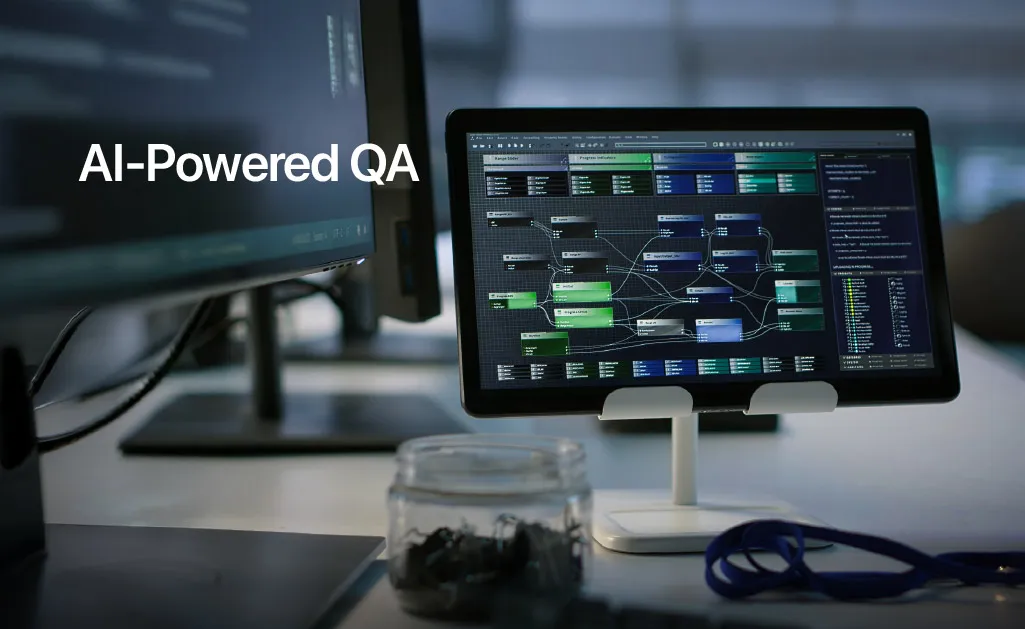
Manual reviews are slow, expensive, and can only ever scratch the surface. This old-school approach means you’re operating with massive blind spots. It’s time to bring in backup. Artificial intelligence is completely changing the game for call center email quality monitoring, giving you the power to analyze 100% of conversations, not just a tiny, random sample.
This is a fundamental shift that turns your QA process from a reactive audit into a proactive strategy. Forget hoping your random sample catches a critical issue. AI systems scan every single email for specific keywords, sentiment shifts, and compliance risks, flagging problems for you in near real-time.
From Manual Audits to Strategic Insights
The true power of AI in email monitoring isn’t just speed—it’s depth. An AI-powered system can pick up on nuances that a human reviewer, slogging through dozens of emails, would likely miss. It delivers an analytical power that completely reshapes your QA team’s function.
Here are a few practical examples of AI-powered email quality monitoring:
- Automatic Compliance Flagging: The system can instantly spot emails missing required legal disclaimers, those that mention sensitive data improperly, or ones that use non-compliant language.
- Customer Sentiment Analysis: AI can read between the lines to gauge customer emotions. It detects rising frustration, confusion, or satisfaction, giving you a real-time pulse on the customer experience.
- Pinpointing Agent Knowledge Gaps: If multiple agents are incorrectly answering questions about a new product, the system spots this trend immediately. This lets you deploy targeted training right where it’s needed most.
AI doesn’t replace your QA analysts—it elevates them. By automating the repetitive task of finding high-impact interactions, AI frees your experts to focus on what they do best: coaching, developing talent, and improving processes.
The ROI of AI-Powered Email Monitoring
Bringing in AI is an investment with a clear and measurable return. By offloading the heavy lifting of analysis to an automated system, you unlock major efficiency gains. Top-tier contact centers have found that implementing automated email quality monitoring slashes manual review time by a staggering 75-80%.
This frees up your QA team to focus on coaching and strategic improvements. These advanced systems can identify subtle communication patterns, detect sentiment, and flag potential compliance issues with accuracy rates often exceeding 92%.
It’s critical to understand how this technology is evolving. For example, recent developments like Zendesk’s AWS AI Engine for Customer Service Automation provide insights into the engines driving these changes.
Turning QA Analysts into Strategic Coaches
When AI handles the initial sorting and flagging, your QA team’s role gets a major promotion. They’re no longer auditors searching for a needle in a haystack. Now, they’re strategic coaches who start their day with a curated list of the most important interactions—both good and bad—that need a human touch.
The new workflow is much smarter:
- AI Scans 100% of Emails: The system analyzes every interaction against your scorecard criteria, compliance rules, and sentiment models.
- It Flags Key Interactions: It automatically surfaces emails that showcase excellent performance, highlight critical coaching opportunities, or contain compliance risks.
- Analysts Focus on High-Value Coaching: Your QA specialists can then spend their time diving into these specific examples with agents, delivering precise, data-backed feedback that helps them improve faster.
This approach ensures your most experienced people are using their expertise where it has the greatest impact. To see how these tools fit into a bigger picture, our guide on automation and artificial intelligence in call centers offers a comprehensive look. By embracing AI, you build a smarter, faster, and more effective call center email quality monitoring program.
From Scores to Skills: Turning Data into Great Coaching
A quality score is just a number. On its own, it doesn’t solve a customer’s problem or sharpen an agent’s skills. The real impact of a solid call center email quality monitoring program happens in the coaching session, where data transforms into meaningful, career-building feedback.
This is where you shift from auditing performance to actively building it. A successful coaching framework isn’t about listing mistakes; it’s a collaborative process for making things right. It’s a structured way to deliver feedback that motivates agents and drives lasting change.

The Power of Immediate, Focused Feedback
Imagine a golf coach trying to correct your swing a month after you played a round. The advice would be useless, right? The same logic applies in a call center. The longer you wait to coach, the less impact your feedback will have.
Data shows that agents who receive evaluation scores and personalized coaching within 24 hours of an interaction show better retention of quality standards and develop skills faster. A quick, informal chat the next day is infinitely more powerful than a formal review weeks later.
This commitment to speed turns coaching from a dreaded event into a continuous part of your culture.
Your goal isn’t to create a perfect score; it’s to build a confident, competent agent. Timely and specific coaching is the only way to get there.
Structuring a Coaching Session for Growth
A great coaching session is a conversation, not a lecture. It needs to feel supportive and aimed at helping the agent win. Running through a long list of errors is a surefire way to make an agent feel defensive and overwhelmed.
A much better approach is to zero in on just one or two key behaviors per session. This targeted method allows the agent to absorb the feedback and focus on mastering one skill before tackling the next.
Here’s a simple but effective framework for these conversations:
- Start with a Win: Always begin by highlighting something the agent did well. For example, “I really liked how you personalized the greeting here; it set a great tone.” This builds trust and makes them more receptive to constructive feedback.
- Focus on Behavior, Not Personality: Frame feedback around specific, observable actions. Don’t say, “You sounded impatient.” Instead, try, “Using short sentences without a closing pleasantry can come across as abrupt to the customer.”
- Let Them Co-Create the Action Plan: After identifying an area for improvement, ask, “What’s one thing you could do differently next time to handle this kind of situation?” Involving them in the solution gives them ownership over their development.
This approach is the bedrock of a high-performing team. To dig deeper into creating these growth opportunities, check out our guide on how to enhance agent training and development.
From Difficult Conversations to Incremental Wins
Not every coaching session is easy. You will have to address critical errors or patterns of poor performance. The key is to stay objective and let the data from your scorecard do the talking.
For instance, if an agent consistently forgets to verify customer information, the conversation isn’t about their carelessness. It’s about the procedural breakdown and the security risk it poses. By tying the feedback directly to scorecard criteria and its real-world impact, you depersonalize the issue and keep the focus on professional standards.
Ultimately, the goal is to foster a culture of continuous improvement. When an agent successfully applies feedback from a previous session, celebrate it. That positive reinforcement is what turns coaching from a chore into a motivator, creating a cycle where agents actively want to get better.
Got Questions About Email Quality Monitoring? We’ve Got Answers.
Even the most well-planned call center email quality monitoring program will stir up questions. As you roll it out, managers and team leads will naturally encounter challenges and “what-if” scenarios.
Let’s walk through the most common questions we hear, built from years of experience launching and scaling quality programs in fast-paced, bilingual BPO environments.
How Often Should We Calibrate Our Email QA Scorecards?
Calibration is the bedrock of a fair and consistent quality program.
When a program is new, we recommend calibrating weekly for the first month. This intense ramp-up period is critical for getting your entire QA team on the same page and establishing a solid scoring baseline.
Once everyone is aligned and scoring consistently, you can shift to a rhythm of bi-weekly or monthly calibration sessions.
The process is simple: have all evaluators score the exact same set of emails independently. Then, bring everyone together to discuss any differences in their scores. This ensures that “quality” means the same thing to every evaluator, which is essential for maintaining the integrity of your performance data.
What’s the Biggest Mistake to Avoid When Starting Email QA?
The single most destructive mistake is positioning QA as a “gotcha” tool designed to catch agents doing something wrong. This approach instantly breeds fear and mistrust, which will torpedo agent morale and engagement.
A quality program built on trust will always outperform one built on fear. Frame QA as a supportive, developmental resource from day one, and your agents will see it as a tool for their own success.
Be radically transparent. Show agents the scorecards, explain how emails are selected, and clearly define the program’s goals. Most importantly, ensure every coaching session is constructive, balanced, and focused on growth, not punishment.
Can We Use the Same Scorecard for Emails and Calls?
It’s tempting, but using the same scorecard for emails and calls is a mistake. The channels are fundamentally different, and a one-size-fits-all scorecard will miss the unique skills required for each.
While high-level goals like accuracy and process adherence are similar, how an agent achieves them is worlds apart. An effective email scorecard must evaluate specific written communication skills that are irrelevant on a phone call:
- Grammar and Punctuation: Essential for clarity and professionalism in writing.
- Formatting and Readability: Is the agent using lists, bolding, and white space to make complex information easy to scan?
- Clarity and Conciseness: Can they get the point across clearly without verbal cues or tone of voice?
To maintain a unified vision, you can align core categories (like ‘Customer Focus’ or ‘Process Adherence’) across scorecards, but the specific line items must be tailored to the medium.
How Do We Measure the ROI of Our Email QA Program?
This is the question that gets executives to listen. To prove the ROI of your email QA program, you must connect quality scores to hard business metrics. A rising quality score is nice, but a falling operational cost demonstrates true value.
Before you launch, benchmark your current email-related KPIs to get a clear “before” picture:
- First Contact Resolution (FCR): What percentage of emails are resolved in a single reply?
- Customer Satisfaction (CSAT): What are your current CSAT scores for the email channel?
- Escalation Rate: How often are emails being escalated to a senior agent or manager?
As your team’s quality scores climb, track the changes in these core metrics. You can calculate direct cost savings by quantifying the reduction in follow-up emails and escalations. When you show that higher quality directly lowers your cost-to-serve, you’ve made your business case.
🚀 Elevate Your Email Quality with CallZent
Build a high-performing support team with expert QA, coaching, and bilingual nearshore talent. Your customers deserve clarity, accuracy, and world-class service.
At CallZent, we build high-performing teams that understand the nuances of quality communication. Our bilingual agents in Tijuana are experts at creating exceptional customer experiences that build trust and drive loyalty.
Ready to see how a strategic nearshore partner can elevate your customer support? Discover our tailored call center solutions today.