Skip to content
Ecommerce Customer Support
Call Center for E-commerce: Stop Revenue Leaks and Boost Sales
Discover how a call center for e-commerce captures lost sales, improves customer satisfaction, and transforms support into a powerful growth engine.
TL;DR — Quick Takeaways
- Slow or inconsistent support leads directly to lost sales, high cart abandonment, and damaged brand reputation.
- A dedicated call center for e-commerce provides real-time human support that converts questions into completed purchases.
- Professional e-commerce support increases customer lifetime value, improves loyalty, and reduces operational friction.
- Nearshore call center partners deliver bilingual talent, cost efficiency, and real-time collaboration for North American brands.
Is your customer service leaking revenue? For most growing ecommerce stores, every missed call, slow email reply, or unanswered chat is a sale you just handed to a competitor. A specialized call center for e-commerce isn’t just an operational expense—it’s a powerful growth engine that builds trust, captures sales, and secures the repeat business that defines a successful brand.
Why Your Online Store Is Leaking Money Without Human Support
Ever feel like you’re pouring money into ads just to watch potential customers vanish at checkout? That’s not bad luck; it’s a classic revenue leak, and it’s almost always caused by a gap in real-time, human support.
Imagine this practical, real-world scenario: a customer is ready to spend $300 on your site but has a quick question about product compatibility. They try calling, but it goes to a generic voicemail. They send an email and get an auto-reply promising a response within 24-48 hours. By then, they’ve already found a similar product on Amazon, checked out, and forgotten your store ever existed. That sale is gone for good.
Key Takeaway: In ecommerce, speed and a real human connection aren’t just perks—they are the foundation of a customer’s decision to buy from you instead of someone else.
The Hidden Costs of Poor E-Commerce Customer Service
The financial damage from poor service goes far beyond a single lost sale. It creates a ripple effect that quietly drains your profitability. These hidden costs often manifest as:
- Sky-High Cart Abandonment: A staggering 70% of online shopping carts are abandoned. Many of these are from shoppers who had an unanswered question and simply gave up. A quick chat or call from a call center for ecommerce agent could have saved that sale.
- Damaging Negative Reviews: One frustrated customer is far more likely to post a negative review than a happy one is to post a positive one. Those bad reviews can scare away countless future buyers.
- Plummeting Customer Lifetime Value: When getting support is a headache, even customers who like the product won’t return. This forces you to spend more on acquiring new customers just to stay afloat.
This isn’t just a small problem. With 2.77 billion people shopping online globally, customer expectations are at an all-time high. A professional team ensures every customer feels heard and valued. For example, a dedicated phone call answering service can be the difference-maker, plugging the leaks in your sales funnel and turning your support from a necessary evil into a powerful growth driver.
What is an E-commerce Call Center? (It’s More Than Phones)
When you hear “call center,” do you picture rows of agents in headsets reading from a script? It’s time to update that image. A modern call center for e-commerce is the mission control for your entire customer experience, not just a phone bank.
Think of it as the central nervous system for all customer communications. It’s a hub that expertly manages every inbound and outbound interaction, ensuring a smooth, consistent brand experience, no matter the channel—from a pre-purchase question on live chat to a post-purchase return request via email.
This diagram shows a simple but powerful truth: when communication channels are unmanned, you get preventable revenue leaks.
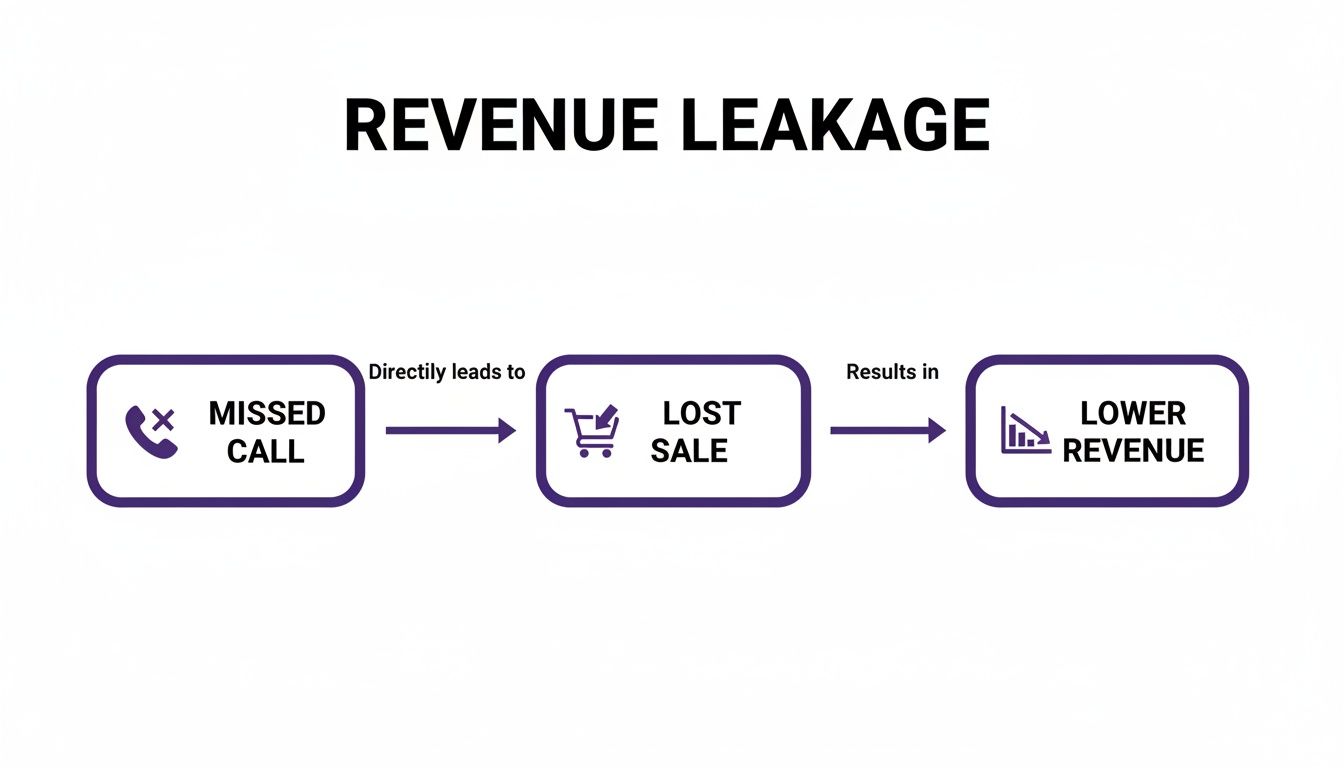
The image draws a straight line from a missed customer interaction to a tangible loss in revenue. It’s a pattern that slowly erodes profitability for many growing online businesses.
More Than Just Answering Calls: An Omnichannel Approach
A true e-commerce support partner operates on a simple principle: be where your customers are. Your shoppers don’t limit themselves to one channel, so your support can’t either. This is what separates a basic answering service from a genuine growth partner.
While an AI chatbot for e-commerce can handle simple, repetitive queries, it can’t replace the nuance and problem-solving ability of a trained human agent. The best strategies blend automation for efficiency with human expertise for the moments that matter.
A specialized ecommerce call center seamlessly blends technology and human agents to create a cohesive support system that adapts to customer behavior.
This means that whether a customer reaches out via phone, email, live chat, or a social media DM, they receive the same high-quality, on-brand service. To learn more about unifying your channels, check out our guide on creating an omnichannel customer experience.
The Strategic Role of a Call Center for E-commerce in Modern Retail
The function of a dedicated support center has evolved from a reactive, problem-solving unit to a proactive business driver. It’s about creating positive experiences that build loyalty and directly increase customer lifetime value.
Here are a few real-world examples:
- Guiding an Unsure Shopper: An agent on live chat sees a customer comparing two similar products. They proactively engage, explaining the key differences and offering a recommendation based on the customer’s stated needs. This confident guidance turns a potential bounce into a completed sale.
- Resolving a Shipping Inquiry: A customer emails, “Where is my order?” Instead of a generic reply, the agent provides a direct tracking link, confirms the estimated delivery date, and offers to send a delivery notification. A moment of customer anxiety is transformed into one of reassurance.
- Preventing a Costly Return: A customer calls, frustrated while trying to assemble a new product. A knowledgeable agent calmly walks them through the setup process, step-by-step. The sale is saved, the costs of processing a return are avoided, and the customer ends the call feeling successful.
In each scenario, the agent is doing more than just answering a question. They are actively shaping the customer’s perception of the brand, building trust, and directly contributing to the company’s bottom line. This is the true value of an expert call center for ecommerce partner.
Core Services That Drive E-commerce Growth
A specialized call center for e-commerce does far more than just field questions. It actively manages the critical moments that define a customer’s experience, turning potential frustrations into real opportunities to build loyalty and drive sales. These core services are the engine that powers your store’s growth and keeps things running smoothly.
Let’s dig into the specific functions that solve daily headaches for e-commerce managers and provide a serious boost to the bottom line.

Proactive Customer Service and Sales Support
Modern customer service isn’t about waiting for problems; it’s about anticipating needs and engaging customers at the right moment. A skilled agent can use live chat to assist a shopper who has been lingering on a product page, offering help before they even have to ask.
For example, if a customer is comparing two high-end blenders, an agent can jump in to highlight the differences in motor power and warranty, guiding them to the best choice. This level of service transforms a passive browsing session into an active, assisted sale. Find out more in our guide to live chat support outsourcing.
Seamless Order Management
The moment a customer clicks “buy” is just the beginning. The journey from order placement to unboxing is full of potential issues, from incorrect addresses to payment processing errors. A dedicated ecommerce call center acts as your first line of defense.
Imagine an agent reviewing a new order and spotting a typo in the street name. Instead of letting the package ship to a non-existent address, they proactively contact the customer, verify the correct details, and update the order in your system.
That single action prevents a costly shipping error, avoids a frustrating customer complaint, and saves a sale that would have otherwise ended in a chargeback.
This careful oversight is critical. The best e-commerce call centers resolve most issues on the first contact, which is vital for retaining customers in a competitive market.
Efficient Returns and Exchanges (RMA)
No matter how great your products are, returns are a part of e-commerce. How you handle them can be the difference between a one-star review and a customer for life. An expert team turns a potentially negative experience into a positive one with a smooth Return Merchandise Authorization (RMA) process.
Consider this real-world scenario:
- A customer calls, disappointed that the shirt they ordered is the wrong size.
- Instead of a complex, frustrating process, the agent immediately issues an RMA and emails a pre-paid shipping label.
- While still on the call, the agent helps the customer find the correct size and places the new order, ensuring it ships out the same day.
The customer hangs up not with a problem, but with a solution. This smooth, empathetic handling builds immense trust.
Expert Technical Support
For stores selling electronics, software, or products requiring assembly, technical support isn’t optional—it’s essential. A well-trained agent can save a customer from the brink of frustration.
Think about a customer struggling to set up their new smart home device. They call support, expecting a long wait. Instead, they connect with a knowledgeable agent who calmly walks them through the setup step-by-step. The customer’s frustration melts away, replaced by relief and gratitude. This is the tangible impact a call center for e-commerce provides—turning complex problems into simple, positive resolutions that protect your brand’s reputation.
Connecting Support Services to Real Business Results
Investing in expert support isn’t just about making customers happy; it’s about making a measurable impact on your bottom line. But what’s the real ROI? Let’s break down how a call center for e-commerce translates directly into tangible business outcomes.
A great support partner isn’t a cost center—it’s a profit engine. This happens by focusing on three key pillars: driving sales, building loyalty, and delivering serious operational savings.
Driving Sales and Higher Conversions
Every customer interaction is a sales opportunity. A skilled support team understands this and actively works to grow revenue during every call and chat.
24/7 support, for instance, is a powerful sales tool. It captures late-night shoppers with urgent questions right before they click “buy.” An agent available at 10 PM can clarify a product feature or confirm shipping times, preventing cart abandonment.
Furthermore, agents can be trained to identify upsell and cross-sell opportunities that feel natural and helpful.
- Upselling in action: A customer asks about a mid-range coffee maker. The agent answers their questions and also points out that the next model up has a built-in grinder for a richer flavor—a feature the customer values.
- Cross-selling in action: While processing an order for a new tent, an agent might ask, “Have you considered a durable, all-weather tarp to go with that? It will help protect your investment.”
This consultative approach boosts your Average Order Value (AOV).
Building Lasting Customer Loyalty
Positive support experiences are the bedrock of customer retention. When a shopper knows they can count on fast, helpful, and human service, they’re far more likely to come back.
A customer who has a problem resolved efficiently is often more loyal than a customer who never had a problem at all. Great support turns a potential brand detractor into a powerful brand advocate.
Think about the long-term value. A single positive interaction—like an agent patiently walking a customer through a return—can secure years of future purchases. That same customer is also more likely to leave a glowing review. To see how support drives these results, it’s crucial to measure customer engagement and connect it to repeat business.
Achieving Significant Operational Savings
Partnering with a specialized call center for e-commerce delivers significant savings, especially when compared to building an in-house team. A nearshore partner absorbs all the hidden expenses. You can dive into our guide on essential KPIs in customer service to see how these savings are measured.
To put it in perspective, here’s a look at the reality of managing support in-house versus working with a nearshore partner like CallZent.
In-House vs. Nearshore Call Center ROI Comparison
| Factor | In-House Team | Nearshore Partner (e.g., CallZent) |
|---|---|---|
| Hiring & Training | You carry the full burden of recruiting, onboarding, and continuous training costs. | The partner handles all hiring and training, giving you instant access to a skilled talent pool. |
| Technology & Tools | Requires a huge upfront investment in CRM software, phone systems, and other tech. | You leverage their existing, state-of-the-art technology with zero capital outlay. |
| Overhead Costs | Includes office space, utilities, benefits, and HR management for your staff. | These costs are all bundled into a predictable service fee, slashing your operational overhead. |
| Scalability | Scaling for seasonal peaks like Black Friday is slow, expensive, and a huge headache. | You get flexible, on-demand scalability, letting you adjust team size to match demand instantly. |
By offloading these heavy lifts to a nearshore partner, you free up your internal team to focus on core business functions: marketing, product development, and strategic growth.
How to Choose the Right Call Center for Your E-commerce Business
Choosing a partner for your call center for e-commerce isn’t just another vendor contract—it’s a critical decision that will shape your brand’s future. The right partner becomes a seamless extension of your team; the wrong one creates customer frustration and operational chaos.
Use this practical checklist to ask the right questions and find a partner who understands the demands of e-commerce.
Omnichannel Technology Integration
Your customers switch between channels effortlessly, and your support partner must do the same. A top-tier provider needs the technology to create a unified customer view across phone, email, live chat, and social media. Their systems must integrate cleanly with your e-commerce platform, like Shopify, BigCommerce, or Magento.
Key Questions to Ask:
- How do you integrate with our e-commerce platform?
- Can you demo your omnichannel dashboard so I can see how an agent views a customer’s full history?
- What is your process for adding a new support channel, like Instagram DMs?
Bilingual Language Capabilities
For any brand selling in the North American market, bilingual support (English and Spanish) is a requirement, not a bonus. It opens your brand to a much larger customer base.
Providing support in a customer’s native language isn’t just polite—it shows respect, removes friction from the buying journey, and dramatically boosts trust and conversions.
True bilingual operations are about deep cultural understanding. Conversations should feel authentic and natural, not scripted.
Robust Security and Compliance
When you outsource support, you’re entrusting a partner with sensitive customer data. Your chosen provider must demonstrate an ironclad commitment to security. The gold standard is PCI DSS (Payment Card Industry Data Security Standard) compliance, which is non-negotiable for handling credit card data.
Key Questions to Ask:
- Are you PCI DSS compliant? Can I see your Attestation of Compliance?
- What other security certifications, like SOC 2 or ISO 27001, do you hold?
- How do you ensure agent-level security, especially with a remote or hybrid workforce?
Flexible Scalability for Seasonal Peaks
E-commerce is a business of extremes. Your call center partner must be able to scale their team up and down to match your demand, especially during Black Friday or other holidays. This agility is a primary advantage of outsourcing. A good partner will work with you to forecast demand and have trained agents ready to deploy.
Key Questions to Ask:
- What is your process for scaling our team for Black Friday? What lead time do you need?
- How do you train seasonal staff to ensure they represent our brand correctly?
- How does your pricing model accommodate these seasonal fluctuations?
Choosing a call center for e-commerce is about finding a strategic ally. By asking these direct questions, you can cut through the sales pitches and find a provider with the tech, talent, and flexibility to help your brand succeed.
The Nearshore Advantage for North American Brands
When choosing a call center for e-commerce, location matters. For North American brands, the nearshore model offers a strategic edge that offshore or onshore options often can’t match.

While offshore solutions in distant time zones may seem cheaper initially, they often come with hidden costs like communication gaps and cultural disconnects. A nearshore partner, located in a hub like Tijuana, Mexico, strikes the perfect balance between cost-effectiveness and seamless collaboration.
Why Proximity Is a Superpower for Your Call Center
A nearshore partner offers powerful operational advantages that directly boost performance and customer satisfaction.
Here’s what makes the nearshore difference:
- Time Zone Alignment: Your nearshore team works the same hours as you and your customers. This means real-time collaboration and immediate answers, with no more waiting overnight for a response.
- Cultural Affinity: Agents have an intuitive grasp of North American consumer culture and buying habits. Conversations feel natural and empathetic, building a stronger connection with your customers.
- Effortless Collaboration: Need to hold a strategy session or conduct in-person training? A quick trip to a nearshore location like Tijuana is far easier and more cost-effective than a transcontinental flight.
A nearshore partner isn’t just outsourcing; it’s extending your team with skilled, culturally-aligned talent right next door, delivering onshore quality without the onshore price tag.
The Nearshore Advantage in Action: A Real-World Example
A fast-growing US apparel brand was struggling with an overwhelmed in-house support team and declining customer satisfaction. They were nervous about the communication barriers of offshore centers but knew they had to scale.
By partnering with a Tijuana-based nearshore team, they achieved incredible results. The new agents, fluent in English and Spanish and perfectly aligned with US time zones, integrated seamlessly.
Within six months, the brand cut its customer support costs by 40% while simultaneously boosting their Customer Satisfaction (CSAT) score by 15%. This powerful combination of savings and improved quality is a direct result of the nearshore model. Explore our detailed breakdown of the nearshore advantage to learn more.
Your Questions About E-commerce Call Centers Answered
Deciding to partner with a call center for e-commerce is a big step. Here are straight answers to the most common questions we hear from growing ecommerce brands.
How Long Does The Onboarding Process Take?
A typical launch takes between two to four weeks. This timeframe allows for a deep dive into your brand voice, intensive agent training on your products, and full integration with your systems. We use this time to build custom workflows to ensure your new team is a true extension of your brand from day one. A thorough setup prevents future headaches and ensures a seamless transition.
What Kind of Reports Will I Get to Measure ROI?
We provide a clear view of performance and your return on investment through live dashboards and regular reports. We track the key metrics that matter for a call center for e-commerce, including:
- First Call Resolution (FCR): What percentage of issues are we solving on the first contact?
- Average Handle Time (AHT): How efficiently are agents resolving customer issues?
- Customer Satisfaction (CSAT): What are your customers actually saying about their experience?
- Sales Conversion Rates: How effectively are agents converting inquiries into revenue?
This data ties our work directly to your bottom line, proving the value we deliver daily.
Can You Handle Sudden Sales Spikes During Holidays?
Absolutely. Handling unpredictable volume is a core strength of a nearshore partner. We work with you to forecast demand for peak seasons like Black Friday and have a bench of cross-trained agents ready to deploy. This flexible scaling ensures your service quality remains high even when order volume triples overnight, so you’re never caught off guard.
Ready to see how a dedicated team can transform your customer support and drive real growth for your ecommerce brand? At CallZent, we build partnerships that deliver results.
Explore our custom-fit solutions and get a free consultation today!