Skip to content

CALL CENTER OUTSOURCING COSTS
Call Center Outsourcing Costs: How Much Does It Really Cost?
Learn how much it really costs to outsource a call center, compare pricing models, uncover hidden costs, and see why nearshore delivers the best ROI.
TL;DR — Outsourcing Call Center Costs
- Nearshore call center outsourcing can reduce costs by 40–60% compared to in-house teams.
- Typical rates range from $12–$35/hour depending on location and service complexity.
- Nearshore offers the best balance of cost, quality, and time-zone alignment.
- Outsourcing converts unpredictable overhead into a single, scalable operating cost.
- The cheapest rate rarely delivers the best long-term ROI.
So, how much does it really cost to outsource a call center?
Let’s cut to the chase: a high-quality nearshore partner can slash your customer support expenses by a staggering 40-60% compared to keeping everything in-house. For many, that translates to rates starting around $15 per hour.
But this isn’t just a cost-cutting move. It’s about gaining efficiency, instant scalability, and specialized talent without the endless headaches of recruiting and managing infrastructure.

The Hidden Costs of an In-House Team
The decision to outsource often gets stuck on one simple question: cost versus value. Too many leaders make the mistake of comparing an outsourced agent’s hourly rate directly to an in-house employee’s salary. That’s a dangerously incomplete picture.
The true cost of an in-house team is a financial iceberg—the salary is just the tip. Below the surface, you’re on the hook for a mountain of expenses that are often scattered, hidden, and hard to track.
When you manage your team internally, you’re paying for:
- Recruitment & Hiring: The time and money poured into job ads, interviews, and background checks. A real-world example: A US-based tech company spent over $6,000 and two months to hire a single specialized support agent, only to have them leave within a year.
- Training & Onboarding: Paying new agents while they’re still learning the ropes and not yet productive.
- Benefits & Overhead: Health insurance, paid time off, office space, utilities—it all adds up.
- Tech & Software: Recurring license fees for CRMs, phone systems, and IT support.
- Management & Supervision: The salaries for the team leads and managers needed to keep things running.
A partnership with a nearshore call center like CallZent bundles all these unpredictable expenses into one clear, manageable operational cost.
In-House vs. Outsourced: A Practical Cost Comparison
Let’s put some real numbers to this. An outsourced agent can start as low as $15 per hour, a figure that’s a game-changer for any business trying to scale efficiently.
Now, compare that to an in-house team. The average agent’s salary alone is around $31,000 annually. But that’s before you tack on thousands more for recruiting and training each new hire. Industry benchmarks show that typical outsourced pricing falls between $15 to $45 per hour—a stark contrast to the sprawling, unpredictable costs of an internal operation.
We’ve seen it time and again: this shift transforms your customer service from a complex, resource-draining cost center into a predictable, scalable investment. You get immediate access to a trained, professional team without the financial drag of building one from the ground up.
Before we go deeper, here’s a quick side-by-side look at where the money goes.
Cost Comparison At a Glance: In-House vs Outsourced Call Centers
This table breaks down the major cost categories for running an in-house team versus what’s typically included when you partner with an outsourced provider.
| Cost Category | Typical In-House Cost (Per Agent Annually) | Typical Outsourced Cost (Included in Rate) |
|---|---|---|
| Agent Salary & Benefits | $35,000 – $55,000+ | Included |
| Recruitment & Training | $4,000 – $7,500 | Included |
| Management & Supervision | $8,000 – $12,000 | Included |
| Technology & Software | $2,500 – $5,000 | Included |
| Office Space & Utilities | $5,000 – $10,000 | Included |
| IT & Administrative Support | $2,000 – $4,000 | Included |
As you can see, the all-inclusive nature of outsourcing simplifies your budget dramatically, turning half a dozen variable expenses into one predictable line item.
The real value of outsourcing isn’t just in what you pay; it’s in the extensive costs and operational burdens you no longer have to worry about.
When you see the full picture, it’s clear why so many smart companies are making the switch. For a more detailed breakdown of these expenses, explore our complete guide on the hidden call center costs that can quietly drain your budget.
Outsourcing offers a clear path to world-class customer support that is both financially intelligent and operationally superior.
Decoding Common Call Center Pricing Models
Before you can answer “how much does it cost to outsource a call center,” you have to get a handle on how providers structure their fees. Think of it like picking a cell phone plan—the right one is all about your usage patterns. Nailing this first step ensures your partnership is built on a financial model that actually fits your business goals and budget.
Each model has its own rhythm, and the right choice can be the difference between a predictable operational cost and a frustratingly chaotic one. Let’s break down the most common structures you’ll run into.
The Per Hour Model
This is as straightforward as it gets, a lot like hiring a freelancer. You pay a flat rate for every single hour an agent is actively working on your account, whether they’re on calls, firing off emails, or handling back-office tasks.
The per-hour model is a perfect fit for businesses with a steady, predictable flow of customer interactions. If you know you need consistent coverage during specific hours, this approach gives you crystal-clear budget predictability.
- Best For: Companies needing dedicated support during set hours, like B2B technical support or appointment setting.
- Example: Imagine a SaaS company that needs expert support online from 9 AM to 5 PM, Monday through Friday. They can budget for a team of agents with precision, knowing their costs won’t suddenly spiral.
The Per Call or Per Minute Model
Here’s your true pay-as-you-go option. Instead of paying for an agent’s time, you’re paying for each interaction they handle, either per call or per minute. This model offers incredible flexibility, especially for businesses that see huge seasonal spikes or have wildly unpredictable call volumes.
You only pay for what you use, which is a lifesaver for keeping costs down during the slow months. The only catch? It can get pricey if your call volume shoots up and stays there.
- Best For: E-commerce brands during the holidays, companies launching a new product, or anyone with fluctuating customer demand.
- Example: A retail brand gets slammed with calls during its Black Friday sale. With a per-call model, they can instantly scale up their support without getting locked into year-round staffing they just don’t need.
Choosing the right pricing model is less about finding the cheapest option and more about matching the cost structure to your business’s natural rhythm.
The Dedicated Agent Model
Think of this as hiring a full-time employee who just happens to work at your partner’s facility. With the dedicated model, you get one or more agents assigned exclusively to your account. They become true experts on your products, services, and culture, acting as a genuine extension of your in-house team.
This is the premium choice for businesses that need specialized knowledge, a consistent brand voice, and complex problem-solving. While the upfront cost is higher, the ROI in customer satisfaction and loyalty can be massive. For a deeper dive into the numbers, our call center outsourcing cost breakdown gives you a closer look.
Performance-Based and Hybrid Models
Some of the more forward-thinking providers are also offering performance-based or hybrid models. In this setup, the provider’s pay is tied directly to specific results, like sales closed, leads converted, or customer satisfaction scores.
- Sales Campaigns: You might pay a lower base rate plus a commission for every sale an agent lands.
- Lead Generation: Costs could be structured on a per-qualified-lead basis.
- Customer Retention: A bonus could be tied to improving customer retention rates.
These models create a true partnership where your provider has skin in the game—they’re financially invested in seeing you succeed. To get a better feel for how the underlying technology costs influence these models, it’s helpful to explore examples like Pebb’s communication software pricing models. Understanding these components helps you see the full picture of what you’re paying for.
Key Factors That Drive the Cost to Outsource a Call Center
Ever wonder why one outsourcing quote is double the price of another, even when it looks like you’re asking for the same thing? The answer isn’t some secret formula. It comes down to a handful of critical variables that directly shape the final number on your proposal.
Figuring out “how much does it cost to outsource a call center” means looking at a few moving parts. The final price is always a blend of geography, complexity, and your day-to-day operational needs. Get a handle on these factors, and you’ll be able to make a smart, informed decision instead of just chasing the lowest bid.
Geographic Location: Your Biggest Cost Lever
Without a doubt, the single biggest factor determining your cost is where the provider is located. Labor costs are wildly different around the globe, and that difference is passed directly to you. This is where the whole onshore, nearshore, and offshore conversation gets real.
- Onshore (US/Canada): This gives you maximum cultural and linguistic alignment but comes at the highest price. For many businesses, it’s just not financially practical.
- Offshore (Asia/Eastern Europe): Here you’ll find the lowest hourly rates. The trade-off can be tricky time zones, cultural gaps, and potential communication hurdles.
- Nearshore (Latin America): This is the sweet spot. You get significant cost savings over US-based teams while keeping strong cultural ties, aligned time zones, and access to a massive bilingual talent pool. A nearshore partner in Tijuana, for example, operates in the same time zones as the US West Coast.
To give you a better sense of how rates shake out globally, here’s a quick comparison.
Average Hourly Call Center Rates by Global Region
The table below offers a bird’s-eye view of what you can expect to pay for outsourced agents in different parts of the world. It really highlights the cost-efficiency that nearshoring brings to the table for North American companies.
| Region | Average Hourly Rate (USD) | Key Advantages |
|---|---|---|
| Onshore (US/Canada) | $25 – $40+ | Perfect cultural/time zone alignment, but highest cost. |
| Nearshore (Mexico/Latin America) | $12 – $20 | Excellent cost savings, bilingual talent, cultural affinity. |
| Offshore (Philippines/India) | $8 – $14 | Lowest labor costs, large talent pool, 24/7 potential. |
| Offshore (Eastern Europe) | $15 – $25 | Strong technical skills, multilingual capabilities. |
As you can see, the financial argument for nearshoring is compelling. It provides a strategic middle ground, blending affordability with the high-quality communication that’s essential for great customer experiences.
This visual guide breaks down how these regional cost differences influence the core pricing models you’ll encounter.
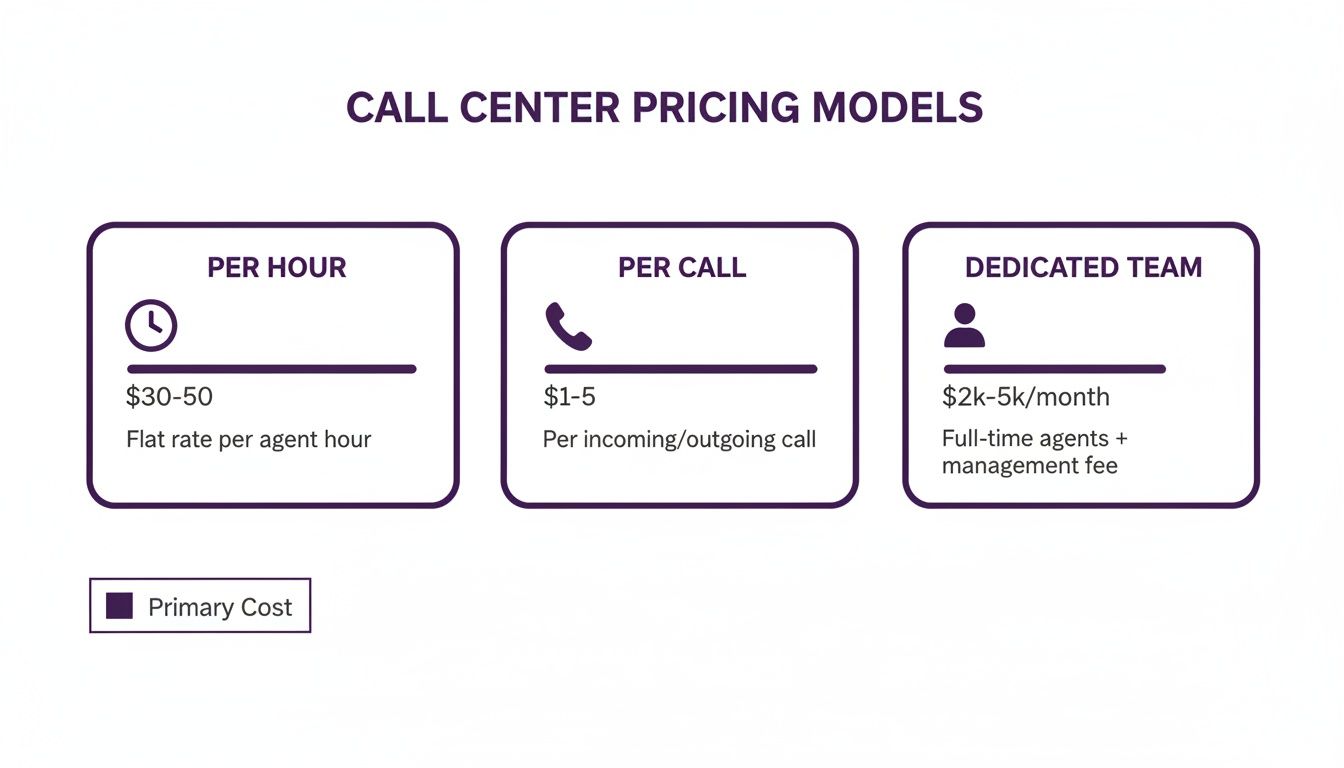
Whether it’s a per-hour, per-call, or dedicated team model, the price is fundamentally tied to the cost of labor and operations in that specific region.
Nearshore locations like Mexico, for instance, offer some of the best all-around value. With hourly rates for standard customer service typically landing between $12.50 and $35, companies can lock in 30-60% in payroll savings compared to keeping the team in-house. Proximity also means fewer latency issues and much better cultural sync-up, which is huge for customer satisfaction.
Service Complexity and Agent Expertise
Let’s be honest: not all customer interactions are created equal. The complexity of the work is a major cost driver because it dictates the skill level, training, and raw talent you need from your agents.
A straightforward order-taking or appointment-setting service will always cost less than specialized technical support where agents need certifications or deep product knowledge.
Think of it like this: hiring a general handyman is cheaper than hiring a licensed electrician. The same principle applies to call center agents—specialized skills command a higher price.
Here’s a quick breakdown:
- Tier 1 Customer Service: This covers the basics—simple inquiries, password resets, and general information. It’s the most cost-effective level.
- Tier 2/3 Technical Support: This is for in-depth troubleshooting, handling complex software problems, or work requiring licensed professionals (like in insurance or finance).
- Sales & Lead Generation: These roles often involve a base rate plus commission, as agents need sharp, persuasive communication skills to succeed.
Operational Requirements
Finally, your specific operational needs will shape the final quote. These are the details that influence staffing levels, scheduling, and the tech needed to deliver on your promises.
- Hours of Operation: Providing 24/7/365 support is more expensive than standard business hours (e.g., 9 AM to 5 PM, Monday-Friday). It simply requires more agents to cover those overnight and weekend shifts.
- Channel Support: An omnichannel strategy that includes phone, email, chat, and social media is more involved. It requires agents trained across multiple platforms and more sophisticated tech, which adds to the cost.
- Technology Stack: The need to integrate with your existing CRM (like Salesforce or Zendesk) or other specialized software can impact the price, though a good partner will make this feel seamless.
By understanding how these three pillars—location, complexity, and operations—work together, you can refine your requirements and have much more productive conversations with potential partners. For a deeper dive into how these elements come together, check out our guide to efficient call center operations.
Don’t Get Blindsided by Hidden Call Center Costs
The sticker price you see on a quote is almost never the full story. Whether you’re running a team in-house or sizing up an outsourcing partner, a flood of hidden costs can sink a perfectly good budget. Getting a handle on these often-ignored expenses is the only way to calculate your true Total Cost of Ownership (TCO).
Too many leaders fall into the trap of comparing an outsourced agent’s hourly rate directly against an in-house employee’s salary. That’s a huge mistake. The real cost of an internal team is like a financial iceberg—the salary is just the tiny piece you see above the water.
The Real Financial Drain of an In-House Team
When you run your own call center, you’re on the hook for a lot more than just wages. These costs are often unpredictable, always recurring, and add up fast, creating a serious drag on your business.
Let’s pull back the curtain on where the money really goes:
- Recruitment and Hiring: This is way more than a job post. Think about the countless hours your HR team and managers burn sourcing, screening, interviewing, and running background checks. For any kind of specialized role, that process can drag on for months.
- Onboarding and Training: You start paying new agents on day one, but they won’t be anywhere near full productivity for weeks, sometimes even months. Every new hire comes with this built-in period of paid learning where they aren’t generating value—a massive sunk cost.
- The Revolving Door of Agent Turnover: The call center world is famous for its high turnover, which often tops 30-45% a year. Every time an agent walks out the door, you’re not just losing a team member; you’re hitting the reset button on that entire, expensive recruitment and training cycle.
This constant cycle of hiring, training, and losing agents is one of the biggest—and most frustrating—hidden costs of running an in-house operation. It creates a never-ending loop of unpredictable expenses and shaky service quality.
But the staffing headaches are only half the battle. You also have a mountain of infrastructure and operational costs that are dangerously easy to underestimate. These are the expenses that keep the lights on and the phones ringing.
Infrastructure and Overhead You Can’t Ignore
The physical and digital backbone needed to run a professional call center is another area where costs love to spiral out of control. These aren’t just one-time buys; they are forever costs.
- Software and Licensing Fees: Every single agent needs a whole suite of tools—from a CRM and communication software to QA and workforce management systems. Those per-user, per-month fees multiply in a hurry as your team expands.
- IT Support and Maintenance: Your tech stack doesn’t run itself. It needs constant attention. Whether you’re dealing with system crashes, managing software updates, or locking down data security, you need a dedicated IT team ready to jump in at a moment’s notice.
- Facility Overhead: This covers everything from the rent and utilities on your office space to the nitty-gritty costs of headsets, computers, and decent chairs for every single agent.
When you partner with a top-tier nearshore provider like CallZent, all these chaotic, unpredictable variables just… disappear. Instead of trying to wrangle dozens of separate bills, you get one clear, predictable operational cost. We take on the risks of turnover, infrastructure headaches, and recruiting, so you can get back to focusing on what your business does best.
Why Nearshore Outsourcing Delivers Superior ROI
It’s a classic mistake to chase the lowest possible hourly rate when looking for a call center partner. The real goal isn’t just to find the cheapest option—it’s to lock in the highest possible return on investment (ROI). This is where nearshore outsourcing really shines, offering a powerful mix of cost, quality, and strategic value that other models just can’t replicate.
For businesses in North America, the question of “how much does it cost to outsource a call center” shifts from a simple price-per-hour calculation to one about total value gained. Nearshore isn’t just a cost-cutting play; it’s a genuine strategic advantage that pairs big financial benefits with the kind of operational excellence that builds real customer loyalty.

The Strategic Edge of Proximity
The biggest advantage of a nearshore partner is right in the name: proximity. Being geographically close to the US creates a seamless operational flow that offshore alternatives simply can’t match.
- Time Zone Alignment: Your nearshore team works when you work. This simple fact eliminates the frustrating communication delays so common with offshore partners, making real-time collaboration a breeze. Need to hop on a quick call to handle an urgent issue? No problem.
- Cultural Affinity: Nearshore agents in places like Tijuana have a deep, natural understanding of North American culture, slang, and consumer expectations. This leads to more authentic, empathetic conversations that build rapport and solve problems faster.
This alignment transforms your outsourced team from a distant vendor into a true extension of your company, plugged directly into your daily workflow.
The Perfect Balance of Cost and Quality
Sure, offshore locations might dangle rock-bottom hourly rates, but those savings often come with a hidden price tag: a drop in quality. Nearshore strikes the perfect balance, delivering substantial savings without making you sacrifice the customer experience.
Globally, outsourcing can slash operating expenses by 20-60% compared to keeping teams in-house. A nearshore partner in Mexico, with typical rates around $19.50-$30/hour, makes a compelling financial case while ensuring top-tier service and compliance with standards like HIPAA or PCI—a non-negotiable for many industries.
This strategic middle ground means you aren’t forced to choose between saving money and keeping your customers happy. You get both.
Tapping into a Bilingual Talent Pool
Another massive ROI driver is the immediate access to a large, highly skilled bilingual workforce. Finding fluent English and Spanish speakers in the US is both incredibly difficult and expensive.
A nearshore partner like CallZent taps into a rich talent pool where bilingualism is the norm, not a rare exception. This instantly allows you to serve a broader customer base without blowing up your budget.
The ROI of nearshore outsourcing is measured not just in dollars saved, but in higher customer satisfaction, seamless collaboration, and the strategic advantage of a culturally aligned, bilingual team.
A Real-World Nearshore Success Story
Let’s make this real. Imagine a mid-sized e-commerce brand in the US struggling with rising support costs and wildly inconsistent service from its in-house team. After partnering with CallZent in Tijuana, the results were dramatic and immediate.
- Immediate Cost Reduction: They cut their overall customer support budget by a staggering 50% within the first six months.
- Improved Customer Satisfaction: With a dedicated team of culturally aligned agents, their Customer Satisfaction (CSAT) scores jumped by 18%.
- Effortless Scalability: During their peak holiday season, they scaled their support team by 40% in just two weeks—something that would have been impossible to do in-house.
This example proves that the right nearshore partnership delivers more than just savings. It boosts quality, offers incredible flexibility, and ultimately drives real business growth. To see how this model can work for you, dive into the core benefits of nearshore outsourcing in our detailed guide.
How to Choose the Right Outsourcing Partner for Your Business
Picking an outsourcing provider is the single biggest decision you’ll make in this entire process. A great partnership can completely reshape your customer experience and light a fire under your growth. The wrong one? It’s just an endless source of headaches. The final piece of the puzzle in figuring out “how much does it cost to outsource a call center” is learning to see past the price tag and evaluate true, long-term value.
A cheap hourly rate is worthless if the service is shoddy, agents are constantly quitting, and your data isn’t secure. The goal is to find a partner who feels like a genuine extension of your team—someone as invested in your success as you are. That requires digging deeper, focusing on their processes, their people, and their performance.
Key Questions to Ask Potential Partners
Before you even think about signing a contract, you need to get into the weeds of how they operate. This is what separates the premier providers from the rest. Arm yourself with these questions to really understand a partner’s capabilities and commitment.
- Agent Training and Development: “Walk me through your initial training and what you do for ongoing development.” A solid partner invests heavily in their people. You want brand ambassadors, not just script-readers.
- Quality Assurance (QA) Process: “How do you actually monitor performance and give agents feedback?” Look for a structured, data-driven QA system that includes regular call monitoring, clear performance scorecards, and consistent coaching sessions.
- Employee Retention Strategy: “What are your agent turnover rates, and what are you doing to keep them low?” High turnover is a massive red flag. It points to a bad work environment that will absolutely spill over and affect your customer service.
- Data Security and Compliance: “Which certifications do you hold (PCI, HIPAA, SOC 2, etc.), and how are you protecting our customer data?” This is non-negotiable. Rock-solid security protocols are essential to protect your business and your customers.
Look Beyond the Quote
The best partnerships are built on more than a solid Service Level Agreement (SLA). They’re built on cultural alignment and transparent communication. Does this provider seem to share your company’s core values? Do they offer clear, real-time reporting dashboards that give you a full picture of what’s happening?
A true partner doesn’t just meet the terms of an SLA; they proactively seek opportunities to improve your processes, boost efficiency, and enhance your customer’s journey.
Their tech stack is also critical. A forward-thinking partner should be able to integrate with your existing CRM and other tools without a hitch, ensuring a seamless flow of information. They also need to prove they can scale with you, whether you’re bracing for a seasonal rush or planning for major expansion down the road. For more on this, our detailed article on how to find and vet the best call center outsourcing companies offers an even deeper framework.
At CallZent, we build our partnerships on a foundation of transparency, collaboration, and a relentless focus on our clients’ success. We invite you to see how our client-focused, nearshore approach is setting a new standard for what a BPO partnership can achieve.
We Get These Questions A Lot
When you start digging into the details of outsourcing, a few key questions always pop up. Here are the straight-up answers to the most common things we hear from businesses just like yours, so you can move forward with total confidence.
What’s the Smallest Team I Can Start With?
This really depends on the provider, but a flexible partner like CallZent can get you started with a team as small as 3-5 dedicated agents. This makes outsourcing a real possibility for startups or businesses that want to dip their toes in the water first. The trick is to find a partner who builds solutions that scale with you, so you aren’t locked into a massive, rigid contract from day one.
Do Bilingual Agents Cost More?
Yep, they usually do. Specialized skills command a higher price. But this is exactly where nearshoring to a place like Tijuana gives you a massive strategic edge. You’re tapping into a deep, naturally bilingual talent pool, which makes that extra cost way more manageable than trying to find the same skills in the US. You end up getting incredible value for your money.
Top-tier partners employ a robust quality assurance framework that includes consistent call monitoring, data-driven agent coaching, and tracking key metrics like First Call Resolution (FCR) and Customer Satisfaction (CSAT).
How Do You Guarantee Good Service?
A reputable outsourcing partner doesn’t just hope for quality—they engineer it with a structured quality assurance (QA) framework. Before you sign anything, ask a potential partner to walk you through their exact QA process. It should be a transparent system designed to make sure your brand standards are met every single time and that your customers stay happy. If you’re looking for more general industry perspectives and answers to common questions, you can always explore further insights on the Parakeet-AI blog for different viewpoints.
Can I Use My Own CRM Software?
Of course. Any modern, tech-savvy outsourcing partner should be able to plug right into popular platforms like Salesforce, Zendesk, HubSpot, or Shopify. Make sure to bring up your current tech stack early in the conversation to guarantee a painless integration. This is a non-negotiable for keeping a single, clear view of your customer and making sure your outsourced team truly feels like a part of your own.
🚀 Want a Transparent Cost Breakdown?
Discover how much you can save with a nearshore call center built for performance.
Ready to see how a transparent, high-performance nearshore partnership can transform your customer support and your budget? At CallZent, we provide custom-fit solutions that deliver world-class quality at a fraction of the cost of in-house or onshore alternatives.