Skip to content

Call Center Quality & Performance
A Guide to Achieving World-Class
Quality in a Call Center
Learn how to define, measure, and improve quality in your call center using proven KPIs, modern QA frameworks, AI-powered tools, and nearshore strategies that drive customer loyalty and sustainable growth.
TL;DR: How to Elevate Call Center Quality Assurance
World-class quality in a call center is built on four pillars: Agent Proficiency, Process Efficiency,
Technology & Tools, and Customer-Centricity. High-performing teams track KPIs like FCR, CSAT, and CES while using QA
as a coaching system—not a punishment model. AI-driven analytics and culturally aligned nearshore partners accelerate
results, helping call centers become growth engines instead of cost centers.
Is your call center just another operational cost, or is it your most powerful engine for growth? The answer hinges on one crucial element: quality. True quality isn’t about just answering calls faster; it’s a strategic system where skilled agents, smart processes, and supportive technology work together to create exceptional customer experiences that build lasting loyalty.
 Redefining What Quality in a Call Center
Truly Means
Let’s be direct: is your call center a cost center or a value generator? The answer almost always boils down to its level of quality.
Too many business leaders view quality as just another metric on a dashboard—a box to check. But genuine quality is the critical difference between a customer who hangs up frustrated and one who becomes a vocal advocate for your brand. That transformation is no accident. It’s built on a carefully designed ecosystem where talented agents, efficient processes, and smart technology work in perfect sync.
Prioritizing this comprehensive view of quality isn’t just a “nice-to-have.” It’s a non-negotiable strategy for any business serious about sustainable growth. When you invest in quality, you’re investing directly in customer retention, brand reputation, and your bottom line.
The Four Pillars of Call Center Quality
Achieving a high standard of quality requires balancing multiple elements. A breakdown in any single area can compromise the entire customer experience. True excellence happens at the intersection of operational efficiency and genuine human connection.
To build a world-class operation, your strategy for quality in a call center must rest on four core pillars.
The Four Pillars of Call Center Quality Assurance
| Pillar | Description | Key Metric Example |
|---|---|---|
| Agent Proficiency | This covers everything from deep product knowledge to soft skills like empathy and active listening. A great agent doesn’t just provide answers; they build trust. | Agent Satisfaction (ASAT) |
| Process Efficiency | Are your internal workflows helping or hindering your team? Efficient processes mean customers aren’t bounced between departments or forced to repeat information. | Average Handle Time (AHT) |
| Technology & Tools | The right tools empower agents to perform at their best. This includes a robust CRM, a user-friendly knowledge base, and analytics that provide actionable insights. | First Call Resolution (FCR) |
| Customer-Centricity | Success must be measured through the customer’s eyes. This means tracking metrics that directly reflect the experience you delivered, not just internal efficiency. | Customer Satisfaction (CSAT) |
When you get these four pillars right, you’re on the path to excellence. You can learn more about balancing these elements in our comprehensive BPO guide for business leaders.
“Quality is not an act, it is a habit. In the call center, this habit is formed by consistently aligning people, processes, and technology with the single goal of exceeding customer expectations.”
Ultimately, a quality-driven call center operates with a clear purpose. Every interaction is an opportunity to strengthen a customer relationship, resolve an issue correctly the first time, and prove your company’s commitment to excellence. This mindset transforms your contact center from a reactive support line into a powerful strategic asset.
The Essential KPIs for Measuring
Call Center Quality Assurance
You can’t improve what you don’t measure. While “quality” can feel abstract, Key Performance Indicators (KPIs) transform it into tangible data you can act on. Think of them as the gauges on a dashboard—each one gives you critical information to ensure your customer’s journey is a smooth one.
Tracking the right metrics is the first step toward building a high-performance operation. It allows you to stop guessing and start making strategic decisions, pinpointing where your team excels and where they need support. These numbers tell the true story of your service.
Efficiency and Effectiveness Metrics
First, let’s look at the nuts and bolts of your operation. Efficiency metrics measure how well your team uses its time, while effectiveness metrics show how successful they are at actually solving problems. A world-class call center strikes the perfect balance, ensuring interactions are handled both quickly and correctly.
Here are the operational KPIs that should be on every leader’s radar:
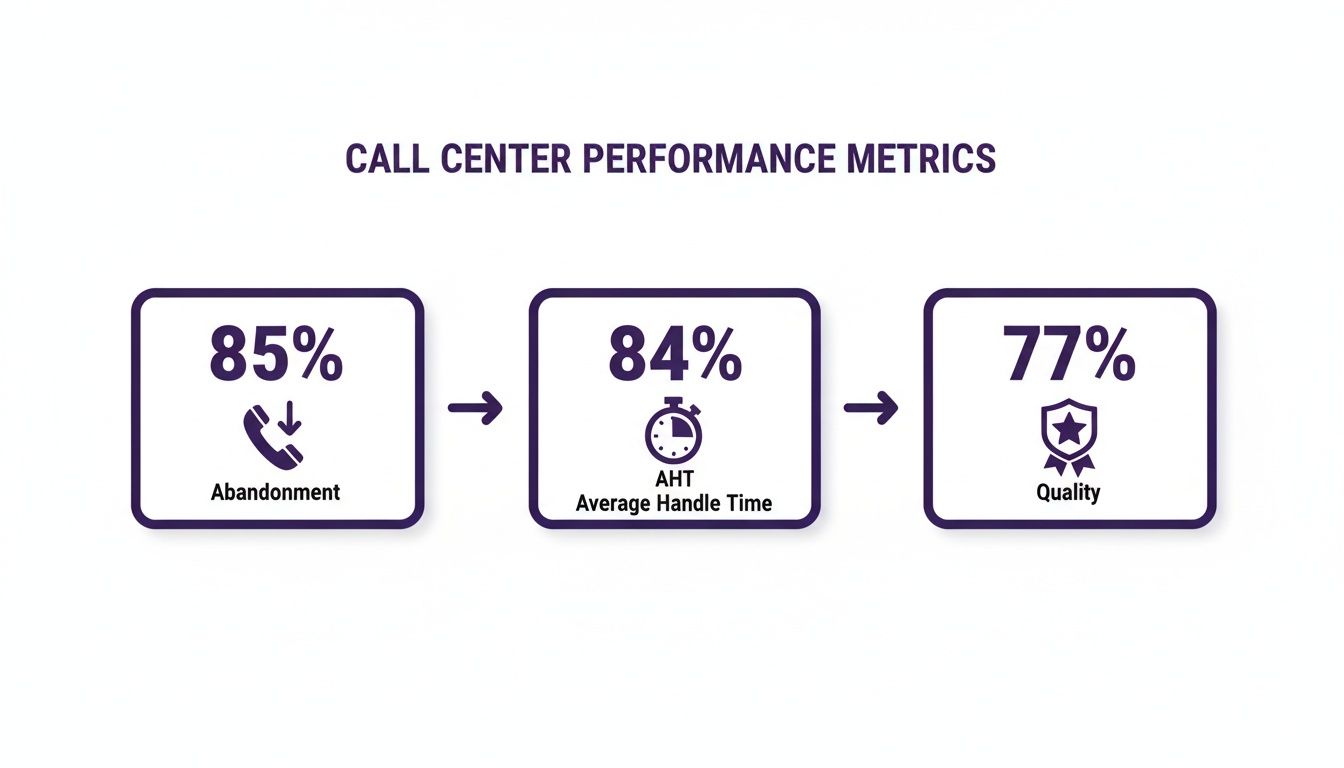
- Average Handle Time (AHT): The total time an agent spends on an interaction, from start to finish, including any after-call work. Real-World Example: If an agent’s AHT is consistently high on a specific issue, it may signal a gap in training or a confusing process that needs to be streamlined.
- First Call Resolution (FCR): This is the holy grail. It measures the percentage of calls where the customer’s issue is fully resolved on the first attempt. A high FCR is a powerful indicator of skilled agents and efficient processes.
- Abandonment Rate: This KPI tracks the percentage of callers who hang up before reaching an agent. A high rate is a major red flag, pointing to problems like understaffing, poor call routing, or excessive wait times.
Customer-Centric Quality Metrics
Speed is only half the story. The ultimate measure of quality in a call center comes directly from your customers. These metrics capture how they feel about the service they received, which is what truly drives loyalty.
A customer’s perception is your reality. If they don’t feel they received quality service, then all the internal efficiency metrics in the world won’t matter.
These are the leading KPIs that put the customer first:
- Customer Satisfaction (CSAT): Typically measured with a simple post-interaction survey like, “How satisfied were you with your service today?” on a 1-5 scale. It provides an immediate snapshot of a single experience.
- Net Promoter Score (NPS): This metric assesses long-term loyalty by asking how likely a customer is to recommend your company on a 0-10 scale. It’s less about one call and more about the overall brand relationship.
- Customer Effort Score (CES): This asks a simple question: “How easy was it to get your issue resolved?” A low-effort experience is a massive driver of loyalty. Real-World Example: If your CES is low, it might be because customers have to switch from chat to phone to email to solve one problem. Simplifying that journey is a direct path to higher quality.
Combining hard operational data with direct customer feedback gives you a 360-degree view of your performance. To take a deeper dive, check out our guide on creating effective call center reporting and metrics dashboards.
Building Your Quality Assurance (QA) Framework
Exceptional quality doesn’t just happen; it’s built by design. Moving from simply tracking KPIs to actively improving them requires a structured system. This is where a robust Quality Assurance (QA) framework comes in—it’s the blueprint for weaving excellence into every customer conversation.
A common pitfall is treating QA as a punitive system designed to catch agents making mistakes. That approach only fosters fear and defensiveness. The most effective frameworks turn this idea on its head.
A QA program should be a coaching tool, not a disciplinary one.
When your agents see QA as a source of support, constructive feedback, and professional growth, their performance naturally improves. This positive feedback loop is what creates a high-achieving, quality-obsessed culture.
How to Design a Modern QA Scorecard
The scorecard is the heart of your QA program. A great scorecard moves beyond rigid compliance checks (like whether an agent used the customer’s name three times) and measures the behaviors that actually create positive experiences.
Your scorecard should reflect what quality in your call center truly means, balancing both process adherence and the human touch.
Key elements for an effective QA scorecard:
- Empathy and Rapport: Did the agent acknowledge the customer’s emotional state? Did they build a genuine human connection?
- Active Listening: Did the agent accurately grasp the core issue without making the customer repeat themselves?
- Proactive Problem-Solving: Did the agent just answer the question asked, or did they anticipate a follow-up need and address it preemptively?
- Brand Voice Adherence: Did the agent’s language and tone align with your company’s personality?
- Process and Accuracy: Was the correct information provided? Were all necessary steps completed in the right order?
Ensuring Consistency with Calibrations and Reviews
Once you have a scorecard, you must ensure everyone uses it consistently. If one QA specialist scores a call a 95% and another gives the same call an 80%, the feedback becomes meaningless and erodes agent trust. This is why calibration is non-negotiable.
Calibration sessions are meetings where all evaluators score the same interaction independently and then discuss their reasoning. The goal isn’t to force agreement but to align on what “good” looks like, ensuring fairness and consistency.
The rhythm of reviews is also key. A practical approach is:
- New Agents: Review 3-5 interactions per week for the first 90 days.
- Tenured Agents: Review 3-5 interactions per month.
- Performance-Based: Increase review frequency for agents who are struggling with specific metrics.
For a deeper dive, see our expert guide on how to implement call monitoring.
How to Surpass Industry Quality Benchmarks
Are you just meeting the standard, or are you setting it? Knowing how your performance stacks up against industry benchmarks is the first step in moving from good to great. It provides the context needed to set ambitious yet realistic goals that can transform your call center into a strategic asset.
Without external reference points, you might be celebrating an internal win that’s actually below average. Benchmarking is about understanding the bigger picture of quality in a call center and using that knowledge to drive meaningful improvement.
Key Quality Benchmarks for Call Centers
Several KPIs are universally recognized as markers of quality. Consistently exceeding the industry standard for these metrics is directly tied to better business outcomes, like stronger customer loyalty and a healthier bottom line.
Here are a few critical benchmarks from in-depth contact center statistics you should be aiming for:
- First Call Resolution (FCR): Often seen as the ultimate effectiveness metric. The industry standard is 70-79%. World-class centers consistently achieve over 80%.
- Service Level: The classic “80/20 rule” (answering 80% of calls within 20 seconds) is the standard. Top performers often aim for 90/15.
- Call Abandonment Rate: The industry average hovers around 5-8%. Elite centers keep this number below 3%.
Pushing beyond these numbers requires a deliberate strategy. For example, achieving an FCR above 80% means your customers consistently get their problems solved quickly and without hassle, building powerful brand trust with every call.
Aspirational Targets for Call Center Quality Assurance
| Metric | Industry Standard | World-Class Target |
|---|---|---|
| First Call Resolution (FCR) | 70% – 79% | > 80% |
| Service Level | 80% of calls in 20 sec | 90% of calls in 15 sec |
| Call Abandonment Rate | 5% – 8% | < 3% |
| Customer Satisfaction (CSAT) | 75% – 85% | > 90% |
Translating Benchmarks into Business Value
Hitting elite performance levels has a direct, measurable impact on your business. When you consistently surpass industry benchmarks, you create a ripple effect that strengthens your entire organization.
Consider these tangible outcomes:
- Increased Customer Lifetime Value: Customers whose issues are resolved on the first call are far more likely to remain loyal, translating directly into repeat business.
- Enhanced Brand Reputation: World-class service generates positive word-of-mouth. Happy customers become your most effective marketers.
- Improved Operational Efficiency: To hit aggressive FCR and abandonment rate targets, your processes must be streamlined, your agents well-trained, and your technology optimized. This efficiency reduces waste and lowers operational costs.
Setting your sights on world-class performance isn’t just about the numbers. It’s a strategic decision to invest in the quality of your customer interactions, creating a foundation for sustainable growth.
 Using Technology and AI to Enhance Quality
While a well-trained, motivated team is the heart of any high-performing call center, technology is the powerful nervous system connecting everything. Modern tools and AI are no longer futuristic concepts; they are practical solutions that amplify your team’s skills and redefine what’s possible for achieving outstanding quality in a call center.
The goal isn’t to replace human agents but to empower them. Think of technology as a co-pilot that handles repetitive, data-heavy tasks, freeing up your agents to focus on what they do best: building rapport, solving complex problems, and delivering essential human-to-human service.
Leveraging AI and Automation to Improve Quality
- Speech and Text Analytics: Imagine analyzing 100% of customer interactions instead of a random 2% sample. AI-powered analytics tools transcribe and analyze every call, email, and chat. Practical Example: This technology can automatically detect rising customer frustration by analyzing tone of voice and keywords, allowing a supervisor to intervene in real-time to save the interaction.
- Real-Time Agent Assist: AI can support agents during a live call. When a customer asks a complex question, the system can automatically pull the relevant knowledge base article onto the agent’s screen. This reduces hold times and improves accuracy.
- Automated Quality Assurance (Auto-QA): Instead of having managers manually score calls, AI can evaluate 100% of interactions against your predefined scorecard criteria. This frees up your leaders to focus on high-impact coaching rather than tedious evaluation.
Using robust tools is key to modern quality assurance. For instance, a specialized customer service software solution can make a huge difference in agent efficiency and customer happiness.
Technology gives you the ‘what’—the data and the trends. Human leaders provide the ‘why’—the context, empathy, and personalized coaching that inspires real growth.
By integrating these tools, you create a more efficient, insightful, and supportive environment. To see how CallZent puts these ideas into practice, explore our guide on automation and artificial intelligence in call centers.
Why a Nearshore Partner Is Your Quality Advantage
Trying to build a world-class quality program in-house can be an uphill battle against high operational costs, agent turnover, and the challenge of providing 24/7 service. But what if the solution wasn’t pushing your internal team harder, but working smarter with the right partner?
This is where a nearshore BPO becomes a game-changer. It’s not just a cost-cutting measure; it’s a strategic investment in raising the bar for what quality in your call center truly means.
The Power of Proximity and Talent
A key advantage of a nearshore partner is immediate access to a deep, bilingual talent pool. A nearshore hub like Tijuana offers a highly educated workforce that is not only fluent in English but also culturally aligned with the US market. This eliminates the language and cultural gaps that often create friction in customer interactions.
Time zone alignment is another massive benefit. When your partner operates on the same schedule, collaboration is seamless. They act as a true extension of your team, available for real-time strategy sessions and problem-solving during your business hours.
“Choosing a nearshore partner isn’t outsourcing a problem; it’s insourcing expertise. You gain a dedicated team that is culturally aligned, highly skilled, and strategically positioned to deliver the quality your customers deserve.”
A Real-World Example of Quality Transformation
Consider a mid-sized e-commerce company struggling with declining CSAT scores and rising support costs. By partnering with a nearshore call center in Tijuana, they achieved a dramatic turnaround:
- CSAT scores jumped by 18% in six months as customers connected with empathetic, well-trained agents.
- First Call Resolution (FCR) improved by 22% because the new team was supported by a robust training and quality framework.
- Operational costs were reduced by nearly 40%, freeing up capital to reinvest in product development.
This happened because their nearshore partner delivered a complete quality framework, not just agents.
Your Strategic Path to Better Quality
Partnering with a nearshore BPO like CallZent transforms customer service from a cost center into a growth engine. You gain cost efficiencies without sacrificing the quality your customers expect, all while tapping into a skilled, culturally-aligned workforce.
You’re not just putting out operational fires; you’re building a sustainable, high-quality customer experience machine. To see how this model can work for your business, explore the CallZent nearshore advantage.
Common Questions About Call Center
Quality Assurance, Answered
When diving into call center quality, a few key questions always come up. Here are straight-to-the-point answers based on our industry experience.
What Is the Single Most Important Metric for Quality?
While metrics like CSAT are vital, if we had to pick just one, it would be First Call Resolution (FCR). A high FCR is a powerful indicator that your entire system—agents, processes, and technology—is working in harmony. It means you respect your customers’ time, which is the foundation of a great experience.
How Long Until I See Results from a QA Program?
You can expect to see early wins—like better script adherence or lower handle times—within the first 30 to 90 days. However, the more significant shifts in customer-facing metrics like CSAT and FCR typically take 3 to 6 months as agents internalize feedback and coaching takes full effect.
Are AI Quality Tools Affordable for Small Centers?
Absolutely. A few years ago, these tools were exclusive to large enterprises. Today, the market is filled with scalable, subscription-based AI platforms perfect for smaller call centers. Many offer entry-level tiers that provide significant automation without a massive upfront investment, delivering a clear ROI even for lean teams.
How Do I Measure Agent Empathy on a Scorecard?
Measuring empathy feels abstract, but it can be broken down into observable behaviors on your QA scorecard. Instead of a vague “Was the agent empathetic?” checkbox, look for specific markers:
- Active Listening: Did the agent paraphrase the customer’s issue to confirm understanding? (e.g., “So, if I’m understanding correctly…”)
- Validating Feelings: Did they use phrases that acknowledged the customer’s frustration or excitement? (e.g., “I can certainly understand why that would be frustrating.”)
- Personalized Responses: Did the agent go beyond the script to offer a genuine, human touch tailored to the specific conversation?
Turn Call Center Quality Into a Competitive Advantage
CallZent helps organizations achieve world-class call center quality through nearshore teams,
robust QA frameworks, and performance-driven leadership. Reduce costs, boost CSAT, and resolve
more issues on the first call—without sacrificing customer experience.
Frequently Asked Questions About Call Center Quality
What does “quality in a call center” actually mean?
It refers to consistently delivering accurate, efficient, and empathetic customer interactions.
Quality combines agent skill, process efficiency, technology support, and customer perception.
What is the most important KPI for call center quality?
First Call Resolution (FCR) is often the strongest indicator of quality because it reflects
agent capability, process design, and customer effort all at once.
How often should calls be reviewed for QA?
New agents should be reviewed weekly during onboarding, while tenured agents are typically
reviewed monthly. High-risk or underperforming agents may require more frequent reviews.
How long does it take to improve call center quality?
Operational improvements can appear within 30–90 days. Customer perception metrics like CSAT
and NPS usually improve within 3–6 months when coaching is consistent.
Can small call centers afford quality assurance tools?
Yes. Many modern QA and AI analytics platforms offer scalable pricing models designed for
small and mid-sized operations.
How is empathy measured in call center QA?
Empathy is measured through observable behaviors such as active listening, validating customer
emotions, and providing personalized responses rather than scripted language.
What role does AI play in call center quality?
AI enables 100% interaction analysis, real-time agent assistance, automated QA scoring,
and faster identification of coaching opportunities.
What are good CSAT benchmarks?
Industry averages range from 75–85%. World-class call centers consistently exceed 90%.
Why do nearshore call centers deliver higher quality?
Nearshore teams offer cultural alignment, language fluency, and time-zone overlap,
enabling better communication, training, and collaboration.
How does CallZent improve call center quality?
CallZent combines nearshore talent, performance-based QA frameworks, real-time analytics,
and hands-on leadership to deliver measurable quality improvements.
Ready to transform your customer service with a partner dedicated to world-class quality? CallZent provides expert nearshore solutions that deliver measurable results. Discover how we can elevate your customer experience today.