Skip to content
Call Center Quality Management
Quality Assurance Call Center: The Complete Guide to Metrics, AI, and Nearshore Excellence
TL;DR
A quality assurance (QA) call center program systematically monitors, evaluates, and improves customer interactions.
Its purpose is to standardize service, identify training needs, boost agent performance, and ensure regulatory compliance.
Core metrics include CSAT, NPS, and First Call Resolution (FCR).
Modern QA leverages AI to analyze 100% of interactions, allowing human experts to focus on high-impact coaching.
Partnering with a nearshore BPO like CallZent provides immediate access to experienced QA teams,
proven frameworks, and cost-efficient scalability.
A quality assurance (QA) program systematically monitors, evaluates, and improves customer interactions. Its purpose is to standardize service, identify training needs, boost agent performance, and ensure regulatory compliance. Core metrics include CSAT, NPS, and FCR. Modern QA uses AI to analyze 100% of interactions, allowing human experts to focus on high-impact coaching. Partnering with a nearshore BPO like CallZent provides immediate access to experienced QA teams, proven frameworks, and cost-efficient scalability.
Ever wonder what separates a merely functional call center from one that actively builds brand loyalty with every single interaction? The secret isn’t just friendly agents or quick answer times—it’s a robust quality assurance call center program working tirelessly behind the scenes.
Think of it as the conductor of an orchestra. A skilled conductor ensures every musician plays their part in perfect harmony, creating a masterpiece. In the same way, a QA program makes sure every agent delivers a consistent, high-quality customer experience that perfectly reflects your brand.
Why Quality Assurance Is the Heart of Your Call Center
Imagine a high-end manufacturing plant. Before any product ships, it goes through rigorous quality control to meet exacting standards. A quality assurance (QA) program in a call center does the exact same thing, but for a much more delicate product: your customer conversations.
It’s a systematic process for monitoring, evaluating, and—most importantly—improving every interaction between your agents and your customers. This isn’t about policing agents or catching them making mistakes. Far from it. QA is a proactive framework for building a culture of continuous improvement. A well-designed program ensures that every call, email, or chat reflects your brand’s unique voice, values, and commitment to excellence.
At its core, quality assurance is about implementing effective strategies to increase customer satisfaction and cementing the call center’s role as a driver of positive customer experiences. It turns abstract goals like “better service” into a concrete, measurable, and coachable reality.
Beyond Just Checking Boxes
A truly effective QA program goes far beyond simply scoring calls against a checklist. It becomes the central nervous system of your customer service operation, feeding you critical insights that drive real business results. The main goals are pretty straightforward:
- Standardizing Service Delivery: Ensure every customer gets the same high level of care, no matter which agent they speak to. Consistency builds trust.
- Identifying Training Opportunities: Pinpoint specific skill gaps that can be fixed with targeted coaching, instead of wasting time on generic, one-size-fits-all training.
- Boosting Agent Performance: Give agents clear, objective feedback that helps them grow, improve, and take real ownership of their performance.
- Ensuring Compliance: Verify that every interaction follows industry regulations and internal policies, which helps you avoid significant business risks.
“Quality assurance transforms agent interactions from mere transactions into experiences that build your brand. It’s the engine of consistency and the blueprint for excellence.”
By embedding these principles into all our partnerships, we make sure our teams function as a true extension of your brand. Understanding the fundamentals of a great BPO quality service is the first step. It shifts the entire operation from a reactive, problem-solving center to a proactive, value-creation engine that actively drives business growth.
The Real Business Impact of a Strong QA Program
So, beyond the theory and the scorecards, what does a solid quality assurance program actually do for your bottom line? A strong QA framework isn’t just a cost center—it’s a powerful revenue driver. It all boils down to three core pillars: boosting customer loyalty, tightening up operational efficiency, and locking down compliance. Think of it as the engine that turns good service into measurable financial returns.
When QA is really clicking, its effects ripple across the entire business. It stops being a background task and becomes a strategic asset that both protects and grows your revenue.
Elevating Customer Loyalty and Retention
Happy customers stick around, spend more, and tell their friends. But that loyalty has to be earned through consistently great experiences, and a quality assurance call center program is your number one tool for building that consistency. By digging into agent interactions, you can ensure they aren’t just closing tickets—they’re actually building relationships.
For example, a QA review might find that while agents are solving technical issues correctly, they aren’t showing enough empathy. Coaching them to say, “I understand how frustrating that must be,” can transform the customer’s entire experience and turn a negative situation into a positive one.
Every interaction becomes a chance to reinforce brand trust, cut down on churn, and increase Customer Lifetime Value (CLV). Customer satisfaction metrics are the proof. The average U.S. CSAT score for call centers hovers around 73%, but top-tier industries like financial services hit 79% because their standards are just plain higher. Hitting those upper benchmarks is a direct result of meticulous QA. If you want to dive deeper, check out these key call center statistics and their impact.
Streamlining Operational Efficiency
Inefficiency is a silent budget killer, draining cash through wasted time and duplicated effort. A great QA program is like a diagnostic tool, shining a light on those hidden process gaps that inflate your operational costs.
Take First Call Resolution (FCR). When an agent can’t solve an issue on the first try, the customer calls back. That instantly doubles the cost of handling that one problem, not to mention it torpedoes their satisfaction. QA helps you pinpoint why FCR is low—is it a knowledge gap? A broken workflow?—and gives you the hard data for targeted coaching.
This focus on efficiency has a domino effect on other key metrics:
- Reduced Average Handle Time (AHT): QA identifies what your top agents are doing right, allowing you to standardize those best practices across the whole team. Everyone starts resolving issues faster without sacrificing quality.
- Lower Repeat Call Volume: Getting it right the first time is the ultimate efficiency hack. It directly lowers your cost-per-interaction.
- Optimized Workflows: Often, QA insights reveal the problem isn’t the agent—it’s the process. Fixing these root-cause issues creates benefits that scale across your entire operation.
An investment in quality assurance is an investment in revenue. It protects your brand, grows your customer base, and turns your call center into a profit center.
Fortifying Compliance and Reducing Risk
In many industries—finance, healthcare, you name it—compliance isn’t just a good idea. It’s a legal requirement with seriously steep penalties for getting it wrong. Your QA program is your first line of defense, systematically checking interactions to make sure agents stick to every legal and regulatory script.
This proactive monitoring catches potential violations before they blow up into costly fines, lawsuits, or a PR nightmare. It’s a core part of any good risk management strategy. When you see how these benefits connect to a skilled nearshore team, you’ll understand why CallZent delivers a superior partnership.
Essential Metrics for Measuring Call Center Quality
You can’t fix what you can’t see. In any call center quality assurance program, your Key Performance Indicators (KPIs) are the gauges that tell you whether your customer service engine is running smoothly or about to stall out. These metrics aren’t just numbers on a dashboard; they’re the story of your customer experience and your operational health.
Focusing on the right metrics is what elevates your QA process from a simple box-checking exercise into a strategic powerhouse. Instead of just asking, “Did the agent follow the script?” you start asking, “Did we solve the customer’s problem on the first try and make them feel heard?” That shift is what separates a basic call center from one that genuinely drives customer loyalty.
Unpacking Customer-Centric Metrics
While you could track dozens of different numbers, a few stand out as the most honest indicators of quality. These are the KPIs that get right to the heart of the matter by focusing on the customer’s point of view. They answer the most important question of all: are your customers actually happy?
- Customer Satisfaction (CSAT): This is the classic “How did we do?” metric, usually captured in a quick survey after an interaction. A high CSAT score is a direct thumbs-up, signaling that your agents are hitting the mark and meeting customer expectations.
- Net Promoter Score (NPS): Going a step beyond immediate satisfaction, NPS asks how likely a customer is to recommend your company to others. It’s a powerful gauge of overall brand loyalty and a strong predictor of whether your customers will stick around for the long haul.
- First Call Resolution (FCR): This might be the single most important metric for both customer happiness and operational efficiency. When a customer has to call back, it’s a lose-lose. They’re frustrated, and your costs go up. A low FCR score is a massive red flag pointing to deeper issues.
Measuring Operational Excellence
Of course, it’s not all about the customer’s direct feedback. You also need to keep an eye on the KPIs that tell you what’s happening under the hood. These metrics shine a light on the internal health and efficiency of your call center, helping you spot process bottlenecks, identify coaching opportunities, and find ways to be more efficient without cutting corners on quality.
“A low First Call Resolution score is the canary in the coal mine for your customer experience. It signals deeper issues with agent training, knowledge access, or process breakdowns that demand immediate attention.”
Some of the most critical operational metrics include:
- Average Handle Time (AHT): This is the total time an agent spends on an interaction, from start to finish. While a lower AHT often looks good for efficiency, you have to balance it with FCR and CSAT. Rushing customers off the phone without solving their problem is a recipe for disaster.
- Compliance Adherence: This tracks whether agents are following required internal policies and industry regulations. In sectors like finance or healthcare, 100% compliance isn’t just a goal—it’s non-negotiable. This metric is your first line of defense against risk.
- Quality Assurance (QA) Score: This is the score that comes directly from your QA scorecard. It’s a composite number that evaluates an agent’s performance against a checklist of ideal behaviors, like demonstrating empathy, following procedures correctly, and providing an accurate solution.
The table below breaks down these essential metrics, what they measure, and the real story they tell about your business. For a deeper dive into the full spectrum of performance tracking, feel free to explore our guide to call center reporting and metrics dashboards.
Your Guide to Critical Call Center QA Metrics
Understand the most important KPIs for measuring call center quality, what they mean, and why they are vital for your business success.
| KPI | What It Measures | The Story It Tells |
|---|---|---|
| CSAT | Immediate customer happiness with a specific interaction. | Are your agents effectively solving problems and creating positive experiences in the moment? |
| NPS | Overall customer loyalty and willingness to advocate for your brand. | Is your service strong enough to build long-term relationships and drive referral business? |
| FCR | The percentage of issues resolved in the first interaction. | Are your agents empowered and knowledgeable enough to solve problems efficiently? |
| AHT | The average time spent on each interaction. | How efficient are your agents and processes? (Must be viewed with quality metrics). |
| QA Score | Agent performance against your brand’s specific quality standards. | Are your agents consistently meeting the specific behaviors that define excellent service? |
Ultimately, a strong QA program isn’t about any single metric. It’s about how they work together to give you a complete, 360-degree view of your customer experience. When you see the full picture, you can make smarter decisions that benefit everyone—your customers, your agents, and your bottom line.
How to Build a High-Impact QA Scorecard
The QA scorecard is the absolute bedrock of any quality assurance call center program. A generic, off-the-shelf scorecard might let you check a box, but it won’t move the needle on performance. A high-impact scorecard, on the other hand, is a custom-built tool that’s a direct reflection of your brand’s unique voice and customer journey, turning abstract goals into concrete actions your agents can learn from.
Think of it like a recipe for a five-star dish. You can’t create something amazing by just throwing ingredients in a bowl and hoping for the best. You need a precise, carefully balanced recipe that details every single component. Your scorecard does the exact same thing for a perfect customer interaction, breaking it down into measurable parts that agents can nail, time and time again.

Core Components of an Effective Scorecard
A strong scorecard is built on a foundation of clear, well-defined categories that cover the full spectrum of an agent’s performance. While you should always tailor the specifics to your business, most effective scorecards include sections covering procedural adherence, problem-solving, and communication skills.
These sections should have weighted scores that mirror your business priorities. For instance, if you’re in a highly regulated industry like finance, compliance might be a pass/fail section that carries the most weight. But if you’re focused on customer retention, empathy and connection might be worth more points.
“A scorecard shouldn’t just be a tool for grading agents—it should be a roadmap for their development. Every point and every category should guide them toward delivering the exact experience your customers expect and deserve.”
Ultimately, a well-structured scorecard gives you the hard data needed to make smart decisions while providing a fair, objective framework for coaching your team.
Sample Scorecard Template Breakdown
To make this crystal clear, let’s walk through a sample scorecard structure. You can use this template as a solid starting point, ready for you to tweak based on your specific operational needs and brand identity.
1. Procedural Adherence & Compliance (25 Points)
This section is all about the non-negotiables. It ensures consistency and keeps your business safe.
- Greeting: Did the agent use the approved opening script? (5 points)
- Verification: Was the customer’s identity verified correctly? (10 points – critical)
- Compliance: Did the agent provide all legally required disclosures? (10 points – critical)
2. Problem Resolution & Accuracy (40 Points)
This is where the rubber meets the road. It measures if the agent actually solved the customer’s problem efficiently and correctly.
- Active Listening: Did the agent truly understand the customer’s core issue? (10 points)
- Information Accuracy: Was the information given to the customer 100% correct? (20 points – critical)
- First Call Resolution: Was the issue completely resolved on the first try? (10 points)
3. Customer Experience & Communication (35 Points)
This focuses on the “how”—the soft skills that turn a routine transaction into a memorable, positive interaction.
- Empathy: Did the agent acknowledge the customer’s feelings and show genuine understanding? (15 points)
- Tone & Professionalism: Was the agent’s tone patient, confident, and professional throughout the call? (10 points)
- Closing: Did the agent summarize the resolution and use the approved closing? (10 points)
This structured approach is fundamental to how we operate, tying directly into our training and monitoring processes. You can learn more about this in our guide on how to implement call monitoring effectively.
Tailoring Scorecards for Bilingual and Nearshore Teams
When you’re working with a nearshore partner like CallZent, evaluating bilingual agents demands a more nuanced scorecard. It’s not enough for an agent to simply speak both English and Spanish; they need to navigate cultural subtleties and use precise, professional language in both.
When we design a scorecard for our bilingual teams, we add specific criteria:
- Linguistic Precision: Did the agent use the correct terminology and grammar in the customer’s chosen language without stumbling?
- Cultural Nuance: Did the agent adapt their communication style to fit the customer’s cultural context? For example, using a more formal tone where appropriate.
- Code-Switching: If the conversation required it, did the agent switch between languages smoothly and naturally?
This level of detail is a huge advantage of our nearshore model. It guarantees your brand voice stays strong and consistent, no matter which language your customer speaks. Building a QA program that truly works for you starts with a conversation, and we’re here to help you design it from the ground up.
How AI and Technology Are Reshaping Modern QA
The days of a manager spot-checking a handful of calls each week are officially over. Modern quality assurance call center programs have gone through a massive shift, and the driving force is technology that gives us a level of insight we once could only dream of. This isn’t just a small upgrade; it’s a completely new way of thinking about performance.
The biggest leap forward is the move from random sampling to analyzing everything. Imagine trying to judge an entire orchard by tasting just two or three apples. That was the old way. Today, technology—especially artificial intelligence—lets us analyze 100% of all customer interactions. Every call, every email, every chat.
The Power of 100 Percent Coverage
When you can see everything, you miss nothing. AI-powered tools like speech and text analytics are like a super-powered QA team that never sleeps, instantly sifting through thousands of interactions to pinpoint critical moments with surgical precision.
This kind of tech gives QA teams the ability to:
- Gauge Customer Sentiment: Automatically flag calls where a customer is frustrated or delighted, offering an unfiltered look into their real experience.
- Spot Churn Risks: Catch keywords or phrases that hint a customer might be ready to leave, which allows for proactive steps to save the relationship.
- Ensure Total Compliance: Instantly identify any time a required disclosure was missed or a policy wasn’t followed, dramatically reducing business risk.
This shift delivers real, measurable results. According to industry data, contact centers using AI see a 14% increase in issues resolved per hour and a 9% reduction in average handling time. Better tech leads to better outcomes, period.
Supercharging Human Experts, Not Replacing Them
There’s a common myth that technology is here to get rid of human QA experts. Nothing could be further from the truth. In reality, it supercharges them. By automating the tedious, time-consuming work of manual reviews, AI frees up your quality team to focus on what they do best: strategic coaching and improving processes.
Instead of spending hours just finding coachable moments, they can spend their time acting on them. One of the most powerful applications is real-time agent assistance, which feeds agents immediate feedback and guidance during live calls. This allows for instant self-correction and builds confidence on the fly.
“Technology doesn’t replace great QA professionals; it liberates them. It turns their focus from manual inspection to strategic improvement, which is where the real value lies.”
For any business looking to get a leg up on the competition, embracing these tools isn’t optional anymore. At CallZent, we build advanced technology right into our QA framework because we know it’s the key to delivering superior results. To see how this fits into a broader strategy, check out our insights on automation and artificial intelligence in call centers. This commitment to forward-thinking solutions ensures our partners get a QA program that is not only thorough but also incredibly efficient and insightful.
Partnering for Success with a Nearshore QA Program
Ramping up your quality assurance isn’t a solo mission—it’s about finding the right partner. When you work with a specialized nearshore provider, you’re not just outsourcing a task; you’re plugging a dedicated quality engine directly into your operations. It’s a partnership built on a shared obsession with excellence, turning your QA program from an internal audit into a real strategic asset.
The whole thing kicks off with collaboration. We sit down with you to build QA scorecards that actually sound like your brand and hit your business goals. We’ll get aligned on the KPIs that really move the needle and lock in a regular schedule for calibration sessions. These meetings are non-negotiable—they keep our QA analysts and your team on the exact same page, ensuring every single evaluation is consistent.
The Strategic Advantages of a Nearshore Model
Choosing a nearshore partner for your quality assurance call center program brings some powerful, distinct advantages to the table. It’s all about hitting that sweet spot between expertise, cost, and cultural alignment. The goal is for it to feel like an extension of your own team, just located across the border.
Here’s what that looks like in practice:
- Cultural and Time Zone Alignment: Our proximity to the U.S. makes collaboration a breeze. We’re on similar schedules and have a genuine understanding of the North American market, which leads to more natural, effective customer interactions.
- Access to a Skilled Talent Pool: Tijuana is a hotbed for highly skilled, bilingual professionals who are genuinely passionate about customer service. You get access to this top-tier talent without the steep costs of hiring domestically.
- Cost-Effective Excellence: A nearshore partnership gives you an enterprise-level quality framework without the enterprise-level price tag. You can get world-class results while keeping a close eye on your budget.
This infographic breaks down how a QA program evolves from basic manual checks to a sophisticated, AI-powered process that’s all about strategic coaching.
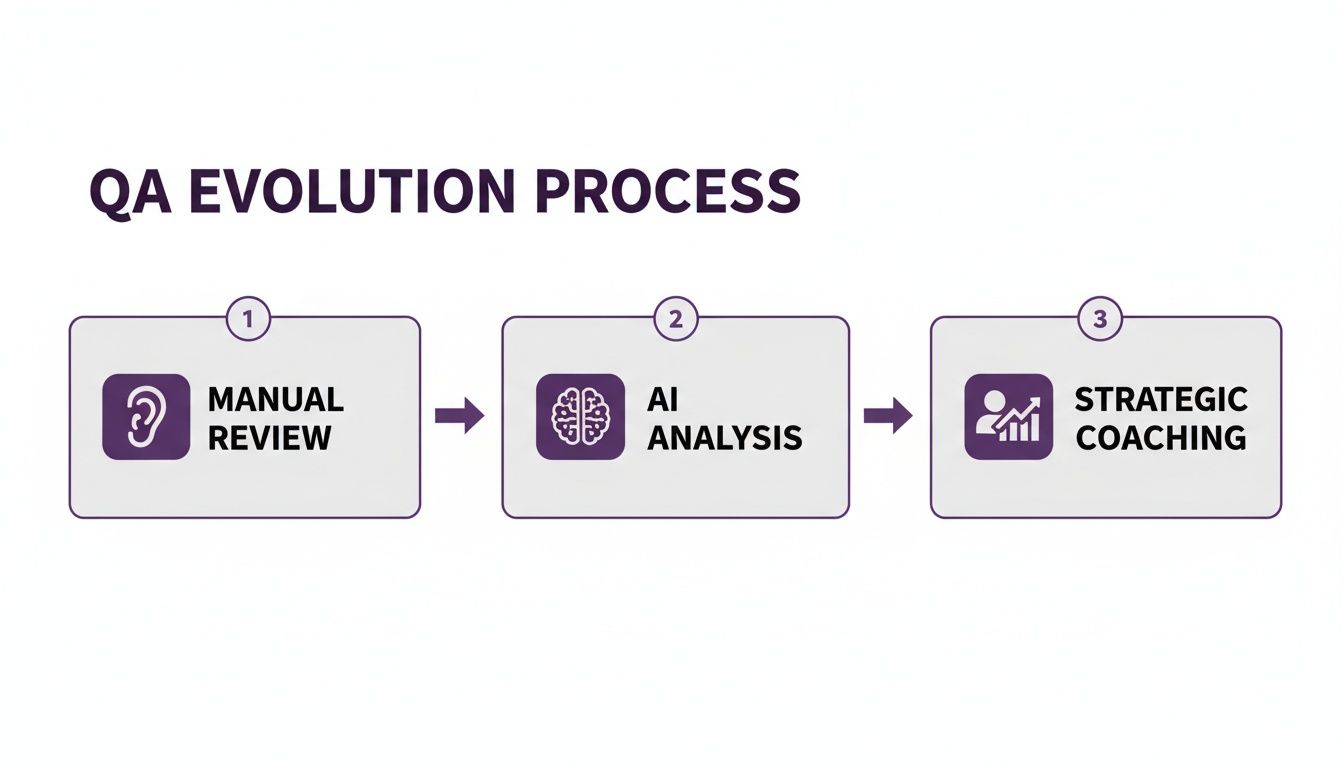
This visual roadmap shows how technology empowers QA, taking it from simple box-ticking to deep analysis that truly fuels agent growth.
Outsourcing QA as a Growth Strategy
More and more businesses are outsourcing their quality assurance, and for good reason. They’re realizing that QA is a specialized discipline that shines when you give it dedicated focus and the right tools. When you hand over your QA to an expert, you get immediate access to proven methods and modern tech that start driving improvement from day one.
The numbers back this up. Industry data shows that around 75% of organizations now use external providers to evaluate their customer interactions. This trend is being supercharged by massive investments in tech like conversational AI, a market expected to jump from $17.05 billion in 2024 to $49.8 billion by 2031. It’s clear the future of quality is powered by technology and driven by smart partnerships.
View quality assurance not as a cost, but as an integral part of your customer success engine. It’s an investment that pays dividends in loyalty, efficiency, and brand reputation.
At the end of the day, partnering with a nearshore BPO provider like CallZent is a strategic move to build a more resilient, effective, and customer-obsessed operation. By understanding the nearshore advantage, you can see how this model provides the perfect foundation for a world-class QA program that will support your growth for the long haul.
Common Questions About Call Center QA
Even with the best game plan, a few questions always come up when you’re building out or fine-tuning a quality assurance program. Let’s tackle some of the most common ones we hear from business leaders to give you the clarity you need to move forward.
How Often Should Call Center Agents Be Evaluated for Quality?
This is a great question, and the honest answer is: it depends on the agent. But a solid baseline for any quality assurance call center program is to review 3-5 interactions per agent, per week. This gives you a steady stream of data and provides consistent feedback without completely overwhelming your team.
Of course, that’s not a hard-and-fast rule. New hires or agents sharpening a specific skill might need a quick daily check-in. On the flip side, your seasoned top performers probably don’t need that same level of formal review. The modern approach, which we’re big fans of, uses AI to monitor 100% of interactions. The system then flags specific calls that need a human touch, making the whole process smarter and far more efficient.
What Is the Difference Between Quality Assurance and Quality Management?
Think of it like this: QA is inspecting the car, while QM is running the whole factory.
- Quality Assurance (QA) is the hands-on process. It’s about diving into individual customer interactions—scoring calls, listening to recordings, and giving agents direct, actionable feedback to make sure every conversation hits the mark.
- Quality Management (QM) is the big-picture strategy, the entire factory system. It takes all the rich data and insights from your QA efforts and uses them to drive systemic improvements across the board, from training programs and workflows to the tech your team uses every day.
Basically, QA is a vital part of the machine that feeds crucial intel into the broader Quality Management system.
Can My Business Afford a Comprehensive QA Program?
For most businesses, the answer is a resounding yes—especially when you partner with a nearshore BPO provider. Trying to build an enterprise-level QA program from the ground up is a massive undertaking. You’re looking at serious investments in specialized software, hiring and training expert personnel, and building the infrastructure to support it all. The upfront cost can be a real showstopper.
But partnering with a nearshore expert like CallZent lets you sidestep that entire financial hurdle. You get instant access to a mature, world-class quality framework—complete with the best tech and seasoned QA teams—all baked into your service package. It’s an approach that delivers a powerful ROI by boosting customer loyalty and making your operation more efficient, all without the massive capital outlay.
Frequently Asked Questions About Quality Assurance Call Centers
1. What is a quality assurance call center?
A quality assurance call center uses structured monitoring, evaluation, and coaching processes
to ensure customer interactions meet service, compliance, and brand standards.
2. Why is quality assurance important in a call center?
Quality assurance ensures consistent customer experiences, improves agent performance,
increases customer satisfaction, and reduces compliance and operational risk.
3. What metrics are used in call center quality assurance?
The most common QA metrics include Customer Satisfaction (CSAT),
Net Promoter Score (NPS), First Call Resolution (FCR),
Average Handle Time (AHT), and internal QA scores.
4. How often should call center agents be evaluated?
Most best-practice QA programs evaluate 3–5 interactions per agent per week,
supplemented by AI tools that monitor 100% of interactions for risk and coaching opportunities.
5. What is a QA scorecard in a call center?
A QA scorecard is a structured evaluation tool that measures agent performance
across areas like compliance, accuracy, problem resolution, and customer experience.
6. How does AI improve call center quality assurance?
AI enables full interaction coverage, sentiment analysis, automated compliance checks,
and real-time agent assistance, allowing human QA experts to focus on strategic coaching.
7. What is the difference between quality assurance and quality management?
Quality assurance focuses on evaluating individual interactions,
while quality management uses QA insights to improve training,
processes, technology, and overall customer experience strategy.
8. Can quality assurance reduce call center costs?
Yes. Strong QA programs improve first call resolution, reduce repeat contacts,
shorten handling times, and prevent costly compliance violations.
9. Is outsourcing call center QA a good idea?
Outsourcing QA provides immediate access to experienced analysts,
proven frameworks, and advanced technology without the cost of building in-house.
10. Why choose a nearshore partner for QA services?
Nearshore QA partners offer time-zone alignment, cultural compatibility,
bilingual expertise, and cost efficiency while maintaining high service quality.
Ready to Elevate Your Call Center Quality?
CallZent delivers enterprise-grade quality assurance with AI-powered monitoring,
expert nearshore QA teams, and proven frameworks that scale with your business.
Turn every customer interaction into a competitive advantage.
A world-class quality assurance program is within your reach. At CallZent, we build QA into the core of our partnership, ensuring every customer interaction strengthens your brand. Learn more about our approach.