Skip to content

Reporting & Metrics
Call Center Reporting:
Essential Metrics, Dashboards & KPIs That Drive Growth
Learn how call center reporting and metrics turn raw data into strategy. Discover essential KPIs, dashboards, and insights that drive measurable growth.
TL;DR — Quick Takeaways
- Call center reporting is strategic — the goal isn’t more metrics, but the right ones.
- Core KPIs like CSAT, FCR, NPS, and Service Level show true customer and operational health.
- Dashboards must be role-specific and designed for clarity, not complexity.
- Reporting drives growth when paired with consistent review rhythms and action plans.
Are your call center reports just a pile of numbers, or are they a strategic roadmap pointing you toward success? For many businesses, mastering effective reporting and metrics is the tipping point that turns a call center from a cost center into a powerful engine for growth. This guide cuts through the noise, shifting your focus from just tracking data to measuring what actually matters for your business goals and customer satisfaction.
Beyond Numbers: How to Use Reporting
and Metrics for Real Growth
It’s easy to fall into the trap of collecting data just for the sake of it. You end up with reports crammed with charts and figures that look impressive but leave you asking the most important question: “So what?” A strategic approach to reporting and metrics flips that script, turning raw data from your nearshore call center into a clear, actionable game plan.
Success isn’t about having the most metrics; it’s about tracking the right ones. Every data point should tie back to a larger business goal, whether that’s building customer loyalty, improving operational efficiency, or driving sales. For instance, tracking Average Handle Time is useful, but its true power is unlocked when you analyze it alongside Customer Satisfaction (CSAT) scores. This ensures that a push for speed isn’t accidentally damaging the quality of your service.
From Reactive to Proactive
A well-designed reporting framework helps you move from a reactive headspace—where you’re just fixing problems after they’ve already happened—and into a proactive one. By spotting trends early, you can anticipate challenges and address them before they escalate. This is where advanced tools shine; understanding the role of predictive analytics in customer retention is a huge step in this direction. This forward-thinking mindset turns your BPO partner from a simple service provider into a true strategic ally. To really get beyond the numbers and drive growth, you need to use your data effectively, a process that can be supercharged with expert business intelligence consulting.
The goal of great reporting isn’t just to tell you what happened yesterday; it’s to give you the insight you need to make smarter decisions about tomorrow.
Ultimately, your reports should tell a story. They should celebrate wins, highlight areas for improvement, and guide your strategy. By the end of this guide, you’ll have a clear framework for building a reporting system that does exactly that, ensuring your partnership with a BPO like CallZent drives real, measurable results.
Building Your Reporting Foundation: From Data to Decisions
Solid reporting doesn’t just appear out of thin air. It’s built on a fundamental understanding of how raw information is turned into a strategic asset. A common mistake is confusing metrics with Key Performance Indicators (KPIs), but understanding the difference is crucial for creating reports that actually mean something.
Think of it like building a house. All that raw data—every call log, chat transcript, and customer survey—is the foundation. It’s essential, but you can’t live in a foundation.
From Raw Data to Actionable Metrics
A metric is a single, quantifiable data point that gives your raw data some shape. It’s a specific measurement, like the walls going up on your foundation. Here are a few practical examples:
- Average Handle Time (AHT): How long, on average, a single customer conversation lasts from start to finish.
- Number of Calls Answered: A straightforward count of calls handled by an agent or team over a specific period.
- Wait Time: The time a customer spends in the queue before an agent picks up.
These numbers are crucial for day-to-day operations. However, focusing only on individual metrics can be misleading. Forcing agents to slash their AHT might just rush conversations and hurt customer satisfaction. This is why a smart call monitoring implementation is so important—it helps balance efficiency with quality.
This flowchart maps out the journey from raw data all the way to high-level strategy.
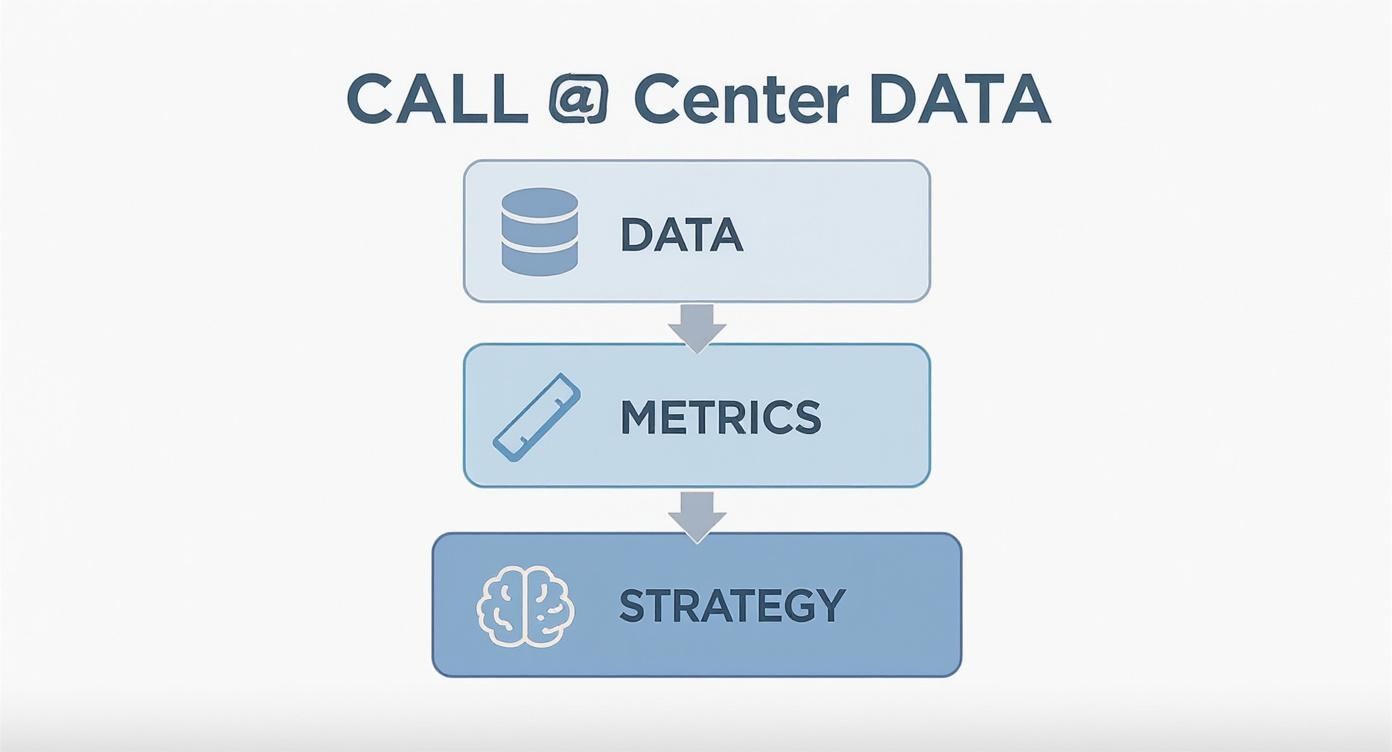
As you can see, metrics are the critical bridge that transforms unprocessed data into insights that can actually guide your business forward.
Connecting Metrics to Strategic KPIs
While a metric measures a process, a Key Performance Indicator (KPI) tells you whether that process is succeeding against a larger business goal. If metrics are the walls, KPIs are the roof protecting your entire business strategy. They tell you if you’re winning, not just if you’re busy.
A valuable KPI is always tied to a specific business objective.
If a metric doesn’t help you make a decision or doesn’t tie back to a larger business goal, it’s just noise. A true KPI always answers the question, ‘Are we succeeding?’
For example, a low Wait Time (a metric) is good, but it’s really just one component of a much more powerful KPI like Customer Satisfaction (CSAT). A high CSAT score tells you that your operational efforts are paying off by creating happy, loyal customers—which is the ultimate goal.
Different Reports for Different Audiences
Just as metrics and KPIs have different jobs, reports need to be tailored to different people. The data a frontline agent needs is worlds away from what your CEO needs to see.
- Operational Reports (Daily): For agents and team leads, these reports are often real-time and focus on immediate performance metrics like call volumes, adherence, and current wait times.
- Tactical Reports (Weekly/Monthly): Aimed at managers, these reports spot trends and connect operational metrics to department goals, like identifying training needs based on recurring customer issues.
- Strategic Reports (Monthly/Quarterly): Built for executives and clients, these reports zoom out to focus on high-level KPIs like NPS and customer retention, showing the ROI of your BPO partnership and its alignment with big-picture business goals.
The Most Important Call Center KPIs for Reporting and Metrics
While every business is unique, a core set of Key Performance Indicators (KPIs) forms the backbone of any solid call center reporting and metrics strategy. Trying to track everything at once leads to confusion. The secret is to focus on a balanced mix of KPIs that paint a complete picture of your performance.
We can group these must-have KPIs into three buckets: Customer Experience, Agent Productivity, and Operational Efficiency. A healthy call center excels in all three areas because they’re deeply connected. For example, when you improve operational efficiency with better tools, agent productivity increases, which in turn leads to happier customers.
Customer Experience KPIs: Measuring Customer Happiness
These KPIs measure how your customers feel after interacting with your brand. In a world where 86% of buyers will pay more for a great customer experience, this isn’t just a “nice-to-have”—it’s a business imperative.
- Customer Satisfaction (CSAT): The classic “How did we do?” survey, usually on a 1-5 scale. It’s a direct pulse check on a specific interaction. To get your score, divide the number of happy customers (those who gave a 4 or 5) by the total number of responses. A CSAT score between 75% and 85% is generally considered strong.
- Net Promoter Score (NPS): While CSAT is a snapshot, NPS measures long-term loyalty by asking: “How likely are you to recommend us?” on a 0-10 scale. Customers scoring 9-10 are Promoters, 7-8 are Passives, and 0-6 are Detractors. Your final score is the percentage of Promoters minus the percentage of Detractors. A score over 50 is excellent.
- Customer Effort Score (CES): This KPI measures how easy it was for a customer to get their issue resolved. A low-effort experience is one of the strongest predictors of customer loyalty.
Agent Productivity KPIs: Tracking Agent Performance
These metrics focus on how effectively agents use their time. A word of caution: you must balance these with quality and customer experience KPIs. Pushing for high productivity without monitoring service quality can seriously backfire.
A truly productive agent isn’t just the one who handles the most calls. It’s the one who resolves issues efficiently, effectively, and leaves the customer feeling heard and helped.
- Average Handle Time (AHT): The total time an agent spends on an interaction, including talk time, hold time, and after-call work. The formula is
(Total Talk Time + Total Hold Time + Total Wrap-up Time) / Total Number of Calls. A lower AHT can be good, but not at the expense of First Call Resolution or CSAT. - Agent Utilization: This metric shows the percentage of an agent’s logged-in time that is spent on call-related work. A high utilization rate (often around 80-85%) indicates efficient staffing, but if it gets too high, you risk agent burnout.
Operational Efficiency KPIs: The Health of Your Call Center
This final group provides a high-level view of your call center’s overall health, showing how well your people, processes, and technology work together.
- First Call Resolution (FCR): Often called the holy grail of call center metrics, FCR measures the percentage of calls where the customer’s issue is solved on the first try. A high FCR is a win-win: customers are happier, and operational costs go down. A good target is between 70% and 79%.
- Service Level: A real-time metric tracking how quickly calls are answered. The industry standard is “80/20”: answer 80% of calls within 20 seconds. Meeting this goal is your first line of defense against customer frustration. For a deeper look, check out our guide on key customer service performance indicators.
- Call Abandonment Rate: This KPI shows how many callers hang up before reaching an agent. A high rate (over 5-8%) is a red flag, often pointing to long wait times, a confusing IVR, or understaffing.
Designing Dashboards That Spark Action, Not Confusion
A dashboard crammed with every metric under the sun doesn’t create clarity—it creates noise. The best reporting and metrics dashboards are not data dumps; they are carefully crafted stories that guide attention, highlight what’s important, and make the next step obvious.
Think of a great dashboard like an airplane cockpit. The pilot sees the most critical information—altitude, speed, heading—at a glance, with the ability to drill down into specifics only when needed. Your call center dashboards should work the same way.
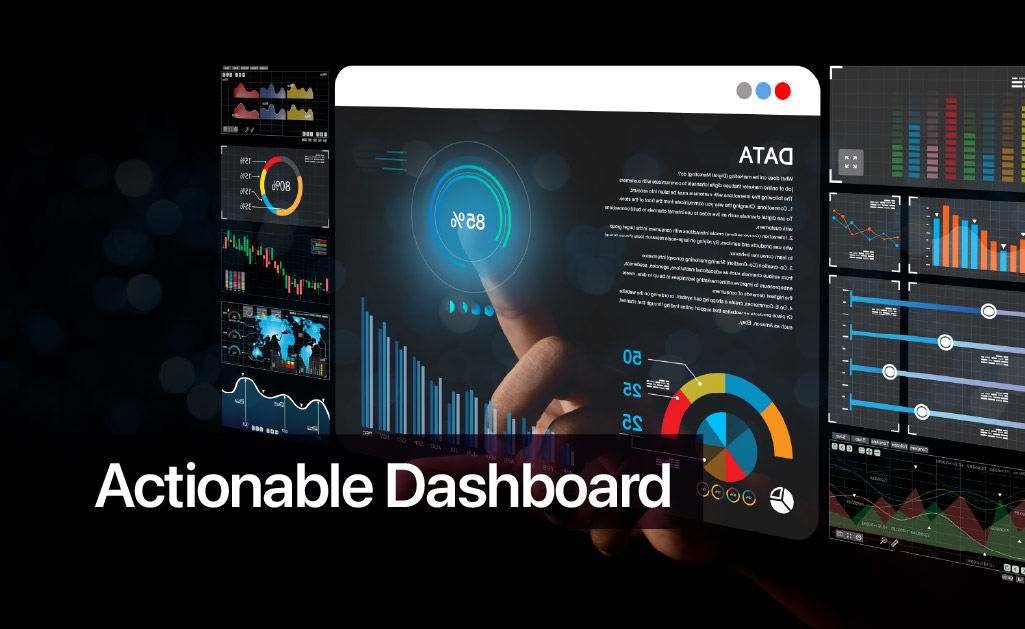
This means designing with the end-user in mind. After all, what a frontline agent needs to see is completely different from what a manager or executive requires.
Customizing Dashboards for Reporting and Metrics
Customization is what makes data actionable. If you drown a team member in irrelevant numbers, they’ll ignore the report. A much smarter approach is to build views specific to each role.
- For the Agent: Dashboards should focus on personal performance and customer feedback. Think key metrics like their own CSAT scores, First Call Resolution rate, and schedule adherence. The goal is empowerment.
- For the Team Manager: A manager’s view should blend team performance with operational health. This dashboard would show team-wide Service Levels, Average Handle Time trends, and agent leaderboards, with the ability to drill down into individual performance.
- For the Executive: The executive dashboard is all about the big picture. It should answer strategic questions about ROI and customer health, focusing on KPIs like Net Promoter Score, customer retention, and cost per resolution.
A great dashboard answers questions, not creates them. If someone has to ask, “What am I supposed to be looking at?” the design has already failed.
This focus on structured, transparent reporting is fast becoming a global standard. We’re seeing it everywhere, with frameworks like the Global Reporting Initiative (GRI) Standards being used by over 14,000 organizations. And this push for clarity is only picking up steam—regulations like Europe’s CSRD will bring another 50,000 companies into mandatory reporting by 2028.
Setting a Rhythm for Your Reporting Cadence
Just as important as what you report is when you report it. A solid reporting cadence creates a rhythm of accountability and continuous improvement.
Here’s a practical cadence:
- Daily Huddles: A quick, 15-minute meeting for team leads to review real-time dashboards and spot immediate issues, like a spike in call volume.
- Weekly Performance Reviews: Managers and agents review weekly reports to discuss trends, celebrate wins, and identify coaching opportunities based on metrics like CSAT and FCR.
- Monthly Strategic Meetings: You and your BPO partner analyze monthly and quarterly trend reports, connecting performance to business goals and planning future strategy.
The right technology makes all of this possible. Modern platforms that deliver customizable, real-time data are essential. You can explore the top benefits of contact center analytics to see how the right tools unlock this capability. And for fresh ideas on presenting data, it’s helpful to check out inspiring HR dashboard examples to see what’s possible.
Tailoring Reporting and Metrics to Your Industry
Generic reporting and metrics are like a blunt instrument—they get the job done, but without precision. To turn your reports into a powerful tool for growth, you have to measure what matters most in your industry. A custom-tailored reporting strategy isn’t a luxury; it’s a necessity for any BPO partnership to deliver tangible value.
E-commerce and Retail: Reporting and Metrics for Sales
In e-commerce, every customer interaction is tied to revenue. The goal is to measure how effectively your support team converts inquiries into sales and builds loyalty.
- Conversion Rate from Support: Track how many customer service interactions (like a live chat about a product) lead to a completed purchase.
- Cart Abandonment Follow-up Success: Measure the percentage of abandoned cart outreach calls or emails that successfully recover a sale.
- Spotlight Metric: Average Order Value (AOV) Impact: Does an interaction with a support agent lead to a higher AOV? This metric shows whether agents are successfully upselling or cross-selling, proving your BPO partner is a profit center.
Healthcare Support: Reporting for Trust and Accuracy
In healthcare, reporting must prioritize patient trust, data security, and accuracy. Speed is important, but never at the expense of privacy or correct information.
- Patient Data Verification Accuracy: This measures the percentage of calls where agents correctly verify patient identity according to HIPAA protocols. A 100% accuracy rate is the only acceptable standard.
- Compliance Adherence Score: Based on call monitoring, this score reflects how well agents follow required scripts related to patient privacy.
- Spotlight Metric: First Contact Resolution (FCR): FCR is critical in healthcare. A patient calling about a confusing bill or an appointment needs their issue resolved on the first try to avoid additional stress. High FCR is a direct indicator of patient trust.
Finance and Insurance: Metrics for Security and Compliance
The finance and insurance industries are built on security, trust, and regulatory compliance. The reporting and metrics here must reflect an intense focus on preventing fraud and protecting sensitive customer information.
- Fraud Detection Rate: Track the number of fraudulent activities successfully identified and stopped by agents during customer interactions.
- Time to Escalation for Security Events: Measure how quickly a potential security threat is identified and escalated to a specialized team. Every second counts.
- Spotlight Metric: Adherence to Compliance Scripts: This is a non-negotiable KPI. It measures how often agents follow legally mandated scripts for loan applications or insurance claims. A single slip-up can result in massive fines, making this a top-tier metric.
Turning Reports Into Your Continuous Improvement Playbook
The true power of reporting and metrics isn’t found in a spreadsheet; it’s in the actions you take because of them. Data that just sits there is useless. But when you use that data to ask “Why?” and “What’s next?”, it becomes your greatest tool for driving real, lasting improvements.

Think of your reports as the start of a conversation. A dip in your Net Promoter Score (NPS) isn’t a failure—it’s a signal. It’s an opportunity to collaborate with your BPO partner and dig into the root cause. This is where a true partnership shines, turning data points into a playbook for action.
From Identification to Action: A Practical Framework for Using Reports
Great reporting doesn’t just tell you what happened; it shows you what to do next. The process is a simple, repeatable loop that turns insights into results.
Here’s a practical example of putting your data to work:
- Identify the Anomaly: A metric suddenly changes. Your Average Handle Time (AHT) jumps by 25% this week.
- Diagnose the Root Cause: By listening to call recordings, you discover the AHT spike is isolated to calls about a new product feature. Agents are struggling to explain it, causing calls to drag on.
- Implement a Targeted Solution: Instead of a generic “work faster” memo, you roll out a training session focused specifically on the new feature and update the knowledge base with clearer talking points.
- Measure the Impact: Over the next two weeks, you watch the AHT for those specific call types. You see it return to normal, and as a bonus, First Call Resolution (FCR) for these issues improves.
This closed-loop process is fundamental to getting better. It ensures every action is driven by data and its effectiveness is measured.
The Power of Collaborative Improvement
This cycle works best when it’s a joint effort between you and your BPO partner. A low Customer Satisfaction (CSAT) score might not be an agent issue at all. It could point to a confusing return policy on your website or a broken checkout process that agents have no control over.
Your BPO partner is your first line of defense. They hear from your customers every single day and can provide invaluable ground-level intelligence that no report can fully capture.
By treating your reporting review sessions as strategic workshops, you combine hard data with human insights. This is how you build a powerful engine for growth. The data tells you where to look, and the human expertise from both sides tells you what to fix. You can learn more about using customer feedback for continuous improvement in our detailed guide.
Your Top Questions About Call Center Reporting, Answered
Jumping into the world of call center reporting can feel like learning a new language. You have the data, but what does it all mean? Here are straightforward answers to the most common questions we hear.
How often should we be looking at reports?
The right cadence depends on the metric. A “one-size-fits-all” review schedule doesn’t work.
- Real-time or Daily: For operational metrics like Service Level and Call Abandonment Rate. You need to watch these constantly to react to sudden changes in call volume or staffing.
- Weekly: This is ideal for agent coaching. Reviewing individual numbers like AHT or CSAT scores weekly helps you pinpoint where team members are excelling and where they might need support.
- Monthly or Quarterly: For strategic KPIs like Net Promoter Score (NPS) and long-term customer satisfaction trends. Looking at this data over a longer period shows whether your high-level strategies are working.
What’s the real difference between reporting and analytics?
People often use these terms interchangeably, but they play two different roles.
Think of it this way: Reporting tells you what happened. It’s the scoreboard. A report might say, “We handled 10,000 calls last week.”
Analytics tells you why it happened and what to do next. It’s the post-game analysis. Analytics dives into that report and finds that “call volume spiked because of a marketing promo, and handle times went up because agents weren’t fully trained on the offer.” One gives you facts; the other gives you a game plan.
How can we make sure our data is actually accurate?
Trustworthy data comes from two things: modern technology and clear, consistent rules. Partnering with a BPO that uses integrated platforms is the first step, as this minimizes the human error that comes from manual data entry.
Equally important is defining every single metric in plain English and documenting it. When your team and your BPO partner are tracking everything the exact same way, you create a single source of truth you can rely on.
If you had to pick just one KPI, what’s the most important?
While a balanced scorecard always provides the truest picture, if we had to pick just one, it would be First Call Resolution (FCR).
Why? Because it’s one of the few metrics that tells a powerful story about both efficiency and customer happiness.
A high FCR rate is a win-win. It makes your operation more efficient by eliminating the need for expensive, frustrating repeat calls. At the same time, it makes customers happier because you solved their problem on the first try. It’s a fantastic health check for your entire service operation.
🚀 Turn Your Data Into a Growth Engine
CallZent builds custom call center reporting frameworks, dashboards, and KPI strategies that help you make smarter, faster decisions.
Ready to stop guessing and start knowing? CallZent builds custom reporting and analytics dashboards that turn your data into a clear roadmap for growth.