Skip to content
Is your voicemail the black hole where customer opportunities go to die? For many small businesses, a missed call isn’t just a minor inconvenience—it’s a direct path to lost revenue.
In a world where instant answers are the new standard, relying on an answering machine is no longer a viable strategy. It’s a competitive disadvantage that actively sends your potential customers straight to the competition. This guide offers actionable insights to help you choose the right call center solution, turning your customer service from a cost center into a powerful growth engine.
TL;DR: Choosing the right call center solution isn’t just about answering phones. It’s about capturing every opportunity, reducing costs, and providing 24/7 professional coverage. The best solutions combine people and technology to deliver seamless, personalized customer experiences — and with CallZent, you gain a nearshore partner aligned with your culture and growth goals.
- The Problem: Missed calls equal missed revenue. Voicemail is not a customer service strategy.
- The Solution: Implementing a call center solution (outsourced, in-house software, or hybrid) ensures every customer is professionally handled, 24/7.
- Key Benefits: Drastically reduce costs compared to in-house staff, provide 24/7 coverage, scale services on demand, and access enterprise-level technology without the high price tag.
- Must-Have Features: Demand omnichannel support, CRM integration, intelligent IVR, and robust analytics to create a seamless and personalized customer experience.
- Why Partner with CallZent? We provide a professional, nearshore team that acts as a true extension of your brand, combining cost-effectiveness with cultural alignment to help you grow.

Why Customer Service Is Your Secret Weapon
Let’s be honest: Small businesses have something big companies can’t always match—authentic, attentive customer service. Think about The Office and the perpetual rivalry between Dunder Mifflin and Staples. Jim Halpert and Dwight Schrute weren’t just selling paper—they were selling service, building loyalty with every interaction. And in the real world, that can be the difference between your business thriving or just staying afloat.
There’s real data to back this up: Studies show that improving your customer experience can increase sales revenue by 2–7% and boost profitability by 1–2%. When you offer that “Dunder Mifflin touch,” customers come back—and they tell their friends.
But here’s the challenge: With limited staff and tight budgets, how do you deliver the same level of service as the big guys? It’s not just about keeping up—it’s about standing out.
Why Your Voicemail Is Costing You Customers
Think about it. How many times has your phone rung while you were busy with another customer, driving to a job site, or just trying to focus on running your business? Each unanswered call is a potential sale slipping through your fingers or a critical support issue left unresolved.
This isn’t just an annoyance; it’s a direct threat to your bottom line. Today’s customers lack the patience to wait for a callback. When they don’t get an immediate answer, they simply move on to the next option on their list.
This is where implementing call center solutions for small business becomes a true game-changer. You shift from a reactive, “hope-they-call-back” approach to a proactive system designed to capture every single opportunity. It’s about smartly outsourcing your communications to ensure a professional, live person is always available to represent your brand and secure your revenue.
By leveraging solutions built for small businesses, you’re not just answering calls—you’re building relationships and growing your bottom line.
The Growing Demand for Outsourced Call Center Support
The shift toward outsourced support is a fundamental change in how small and medium-sized businesses operate. The global call center outsourcing market is projected to climb to nearly $500 billion by 2027, driven by businesses just like yours. A recent study revealed that 47% of small businesses now use outsourced customer service—a figure that has doubled in just a few years.
This guide provides actionable insights to turn your customer service into a growth driver. We’ll cover:
- The different types of call center solutions available.
- The tangible benefits that impact your revenue and reputation.
- Key features to look for when choosing a partner.
- How to find the right team to be the voice of your brand.
A professional call center solution isn’t an expense; it’s a revenue multiplier that captures the opportunities you’re currently missing.
When you partner with a dedicated service like CallZent, you get more than just an answering service. You get a forward-thinking team committed to your success, ensuring every customer feels heard, valued, and professionally handled, 24/7.
What Are Call Center Solutions, Really?
Forget the outdated image of endless cubicle farms. For a small business, a modern call center solution is a powerful, flexible system for managing all your customer interactions.
Think of it as a strategic blend of skilled people and smart technology designed to handle every conversation professionally, so you don’t have to. It ensures that every customer inquiry, sales lead, or support ticket—whether it comes via phone call, email, or live chat—is captured and managed efficiently. This allows you to focus on your core business while your customer communication runs like a well-oiled machine.
There are three main models small businesses can leverage, each solving a different set of challenges.
What Are the Best Call Center Solutions for Small Businesses?
Navigating the world of call center platforms can feel overwhelming—especially with so many options promising to be the silver bullet for your communications challenges. The truth is, small businesses need solutions that balance robust capabilities with affordability, ease of use, and seamless integration into daily operations.
Here are some leading contenders that consistently stand out for small and growing teams:
Flexible, Cloud-Based Platforms: Solutions like Five9 and Talkdesk offer powerful cloud-based platforms equipped with advanced call routing, AI features, and omnichannel engagement. These make it possible to prioritize urgent calls, streamline workflows, and connect with customers via phone, email, SMS, or chat—all from one dashboard.
Integrations That Enhance Productivity: A top-tier solution should work with your existing systems, not against them. Platforms such as Aircall are tailor-made for seamless integration with popular CRMs and help desks. This puts customer information at your agents’ fingertips, enabling faster, more personalized service every time someone connects.
Intuitive Tools for Growing Teams: User-friendly platforms with simple onboarding, intelligent analytics, and smart automations let your team hit the ground running—no steep learning curve required. Tools that offer visual call flows, customizable reporting, and real-time monitoring will supercharge your team’s efficiency from day one.
Cost-Effective, Scalable Options: The best call center solutions provide transparent pricing, flexibility to start small, and easy scalability as your needs grow. They don’t require an IT department to deploy or maintain, making them ideal for businesses looking to maximize every dollar spent.
Support and Reliability: Exceptional customer service and minimal downtime should be non-negotiable. Look for providers with live support, regular updates, and a proven track record for reliability.
Ultimately, your goal is to find a partner that empowers you to level up your customer experience—whether you’re answering a dozen calls a day or managing high-volume demand during peak seasons. Choose a solution that fits your team today and scales with your ambitions tomorrow.
The Three Models of Call Center Solutions for Small Business
The right path depends on your specific needs, budget, and desired level of involvement. You can outsource everything, empower your team with better tools, or find a balance between the two. Each approach provides a clear path to stop missing calls and start building stronger customer relationships.
Let’s look at some real-world examples:
- Fully Outsourced Call Center Teams: This is the “done-for-you” model. You partner with a company like CallZent, and our professional agents become an extension of your brand. We handle everything from answering calls and booking appointments to providing tech support. For example, a local HVAC company can use our team to field emergency calls 24/7, ensuring they never miss a high-value job that comes in at 2 a.m.
- In-House Call Center Software: If you have an existing team, this model equips them with powerful tools. Cloud-based platforms provide features like smart call routing, recording for quality control, and deep analytics. For example, an e-commerce store can use this software to manage the holiday rush, automatically routing calls about order status to one agent while sending complex product questions to a specialist.
- Hybrid Call Center Models: This approach offers the best of both worlds. You might keep your in-house experts for complex technical issues during business hours but outsource all after-hours and weekend calls to a partner. This provides seamless, around-the-clock coverage without the massive expense of staffing an internal 24/7 team.
Related reading:
- How Customer Experience Management Drives Loyalty
- Nearshore vs Offshore Call Centers: Which Is Right for You?
- Why Bilingual Support Improves Customer Satisfaction
- Call Center Services for Small Business
Comparing Leading Call Center Solutions: Usability, Integration, Scalability, and Cost
Not all call center solutions are created equal—especially when it comes to balancing user experience, integration capabilities, growth potential, and budget-friendliness. Here’s how several industry favorites stack up in areas small businesses care about most:
Usability: Some platforms focus on an intuitive, user-friendly interface, making onboarding your team a breeze—even if they aren’t tech wizards. Solutions like Five9 and Dialpad shine here, offering dashboards that agents can pick up quickly, so you don’t lose days (or tempers) to confusing setups.
Integration: Being able to plug your call center into tools you already use (think: your CRM, helpdesk, or sales platform) is non-negotiable for most modern teams. Talkdesk and Aircall lead the charge with seamless integration to a wide array of business apps—meaning fewer data silos, more personalized service, and significantly less toggling between tabs.
Scalability: Your needs today may not reflect where you’ll be in a year, and the best call center solutions grow right along with you. Cloud-based platforms allow you to add (or remove) agents, activate new features, and handle increased call volume—all without shelling out for costly infrastructure changes. Whether you’re expanding to new locations or scaling up for a seasonal rush, options like these are built to flex as your business grows.
Cost: Budget transparency is a biggie. While many platforms tout low barriers to entry, be sure to look past the headline price. Some vendors offer clear, pay-as-you-go models; others bundle must-have features into pricier tiers or require custom quotes. Dialpad and Aircall tend to offer more straightforward pricing, but always double-check for hidden fees or feature restrictions that could sting later.
At the end of the day, the best solution is the one that fits both your workflow and your wallet—without sacrificing the quality of your customer interactions. Making the right call here sets the stage for better support, happier customers, and a more agile business.
A Closer Look at Leading Solutions: Key Features, Pros, and Cons
With so many options on the market, it’s important to separate the wheat from the chaff. Here’s a quick overview of what you can expect from some of the top call center platforms tailored for small businesses, focusing on key features, real-world advantages, and a few watch-outs worth knowing before you dive in.
Five9
A favorite among growing teams, Five9 packs a suite of advanced features—think intelligent call routing, predictive dialing, and analytics that help you refine customer interactions for better outcomes. The system is known for its scalability and user-friendly interface, making onboarding relatively pain-free.
What to watch for: While Five9 covers most bases in capability, small businesses might be put off by the lack of upfront pricing. This can make budgeting tricky if transparency is a priority for you.
Talkdesk
Talkdesk brings enterprise-grade tools down to a level accessible for smaller firms. It excels in omnichannel support, letting you communicate with customers via phone, email, chat, and more—all from a unified dashboard. Their platform offers intuitive agent workspaces and powerful reporting features to keep your team connected and productive.
Keep in mind: The platform frequently pushes updates, which occasionally leads to unexpected hiccups or slowdowns. It’s modern, but not always seamless.
Aircall
If integrating with your existing help desk or CRM is top priority, Aircall shines. The platform offers smooth syncing, plus features like interactive voice response (IVR), SMS messaging, custom call queues, and helpful collaboration tools such as warm transfer and real-time call commenting.
Potential drawback: Some users find the mobile and desktop app less intuitive, which can complicate daily use until your team gets the hang of it.
Dialpad
Fan of AI and deep analytics? Dialpad leverages smart tech to simplify team communication and offer actionable insights. It supports omnichannel engagement and is known for a clean interface and smart call routing.
Heads up: The learning curve can be a bit steeper due to the breadth of features, and you might find a few gaps in options like comprehensive call recording compared to other tools.
Each solution balances flexibility, scalability, and customer experience in different ways. Understanding these trade-offs helps you choose a partner that truly fits your business’s needs.
Making Smart Choices with Limited Resources
For most small businesses, getting the most value without a huge upfront investment is critical. Modern call center solutions are designed to be cost-effective and accessible. You can often pay only for what you use and scale up as your business grows, which is a game-changer for financial flexibility.
This diagram illustrates how these solutions break down into practical models.
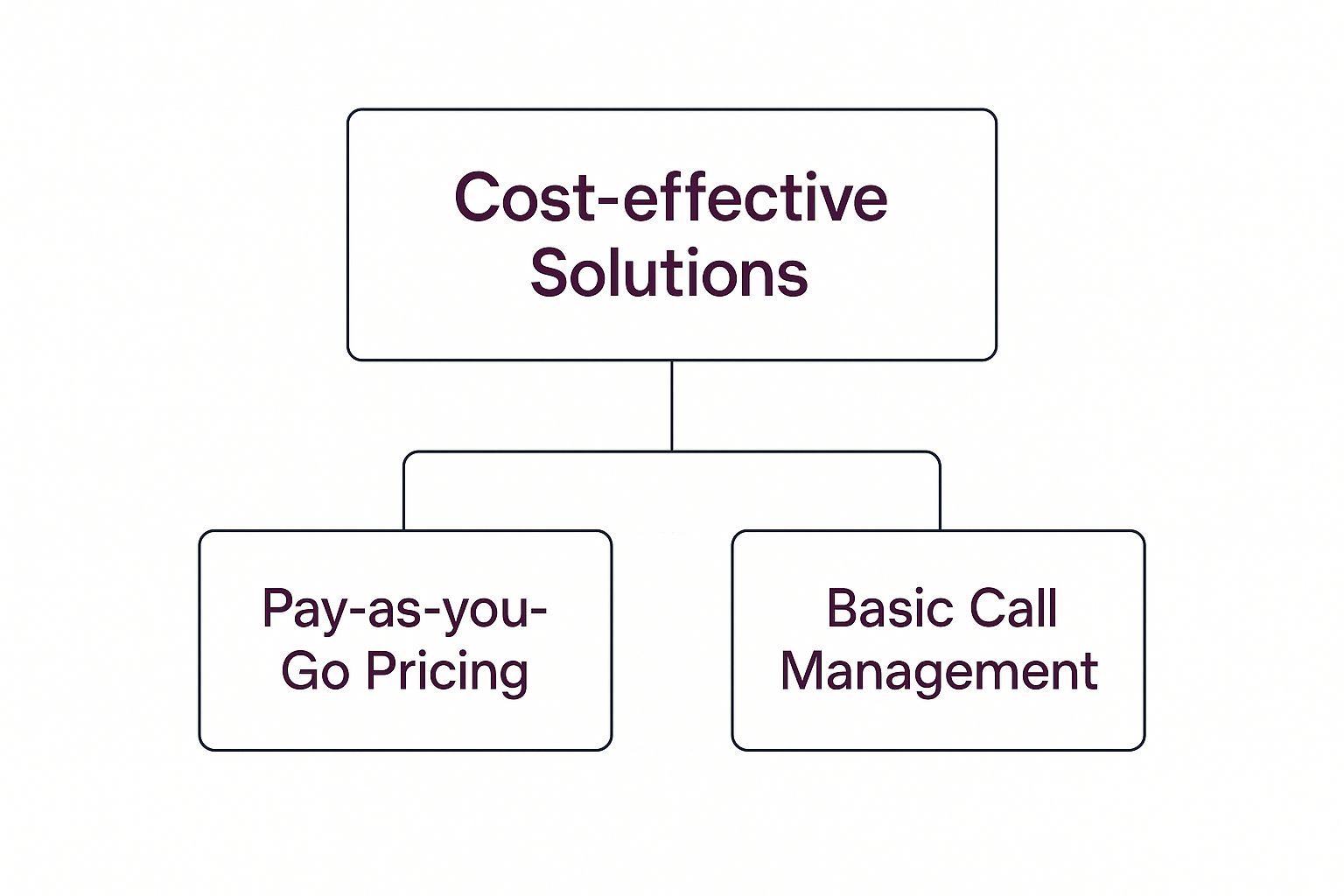
The key takeaway is that you don’t need a massive budget to implement a professional call management system.
Choosing the right model is a strategic decision. A fully outsourced team offers instant expertise and 24/7 coverage, solving the problem of missed opportunities overnight. Alternatively, software solutions empower your existing staff, boosting their efficiency and providing data to track performance. By understanding these core models, you can select a call center solution for your small business that perfectly fits your operations and growth plans.
Real-World Benefits for Your Business
Implementing the right call center solution for your small business is about more than just answering the phone. It’s about unlocking tangible, bottom-line benefits that fuel growth, enhance your reputation, and free you to focus on what you do best.
Each of these benefits directly solves a common small business headache, turning challenges into major advantages.
Significant Cost Savings
Hiring a full-time, in-house receptionist involves far more than just a salary. When you add benefits, payroll taxes, vacation time, training, and equipment, the true cost can be 30-40% higher than their base pay. For a small business, that’s a significant financial burden.
An outsourced call center solution flips this model entirely. Instead of a fixed salary, it becomes a flexible operational expense. You pay only for what you use, whether that’s a block of hours or a simple pay-per-call structure.
This approach eliminates:
- Recruitment and Training Costs: You gain a team of trained professionals from day one.
- Equipment and Overhead: No need to purchase desks, computers, or expensive phone systems.
- Benefits and Payroll Taxes: These loaded costs are handled by your partner.
24/7 Professional Coverage
Let’s be blunt: missed calls are missed revenue. When a potential customer calls after 5 p.m. and gets your voicemail, 80% of them will not leave a message. They just hang up and call your competitor. A professional call center ensures that never happens.
With 24/7 coverage, you project the image of a larger, more established company. A sales lead at 10 p.m.? A support question at 6 a.m.? A live, professional agent is there to represent your brand perfectly. This doesn’t just capture lost leads; it builds incredible trust and shows customers you are serious about their needs.
Effortless Scalability
Imagine launching a marketing campaign that triples your call volume overnight. An in-house team would be overwhelmed, forcing you to scramble to hire and train temporary staff.
Outsourced call center solutions for small business provide instant scalability. You can adjust your support levels on demand to handle seasonal rushes, promotional spikes, or sudden growth without HR headaches.
- Holiday Season: A retail shop can double its agent support for November and December, then scale back in January.
- Marketing Campaign: A home services company can add extra agents for the week a big promotion launches.
- Rapid Growth: A startup can scale its support team weekly as its customer base expands.
This flexibility ensures you’re never paying for idle staff or leaving money on the table during peak times.
Access to Enterprise-Grade Technology
Top-tier call center technology—like advanced analytics dashboards, powerful Customer Relationship Management (CRM) software, and intelligent call routing systems—is often prohibitively expensive for small businesses.
When you partner with a provider like CallZent, you get access to this entire toolkit as part of the service. We’ve made the investment so you don’t have to. Suddenly, you have deep insights into your call volume, peak hours, and common customer issues, enabling you to make smarter, data-driven decisions. Our approach to customer interactions shows how we integrate these tools to become a true extension of your team, leveling the playing field with your largest competitors.
Key Features Every Small Business Should Demand
Choosing a call center solution can feel overwhelming. Let’s cut through the technical jargon and focus on the core features that will actually make a difference for your business.
Think of this as your non-negotiable list of tools that separate a basic answering service from a true growth partner.
Omnichannel Support: Unify Your Customer Conversations
Customers today reach out through various channels—phone, email, live chat, and social media. An omnichannel support platform brings all these conversations into a single, unified inbox, giving your agents a 360-degree view of each customer’s journey.
For example, a customer starts a live chat to ask about a product, then calls an hour later to place an order. With omnichannel support, the agent on the phone instantly sees the chat history. The customer never has to repeat themselves, creating a seamless, professional experience that builds trust.
CRM Integration: Personalize Every Interaction
A call center solution that doesn’t sync with your Customer Relationship Management (CRM) system is inefficient. CRM integration automatically pulls up a customer’s entire history—past purchases, support tickets, and notes—the moment they contact you.
For example, when a repeat customer of a local home services company calls, the agent’s screen immediately shows their address and service history. This allows for a personal touch: “Hi Mrs. Johnson, good to hear from you! I see we fixed your water heater last spring. Are you calling about the faucet in the kitchen today?”
True customer loyalty isn’t built on transactions; it’s built on a foundation of seamless, personalized experiences that show you understand and value your customer’s time.
This simple moment turns a routine service call into a powerful relationship-building opportunity. You can see how we map out these integrated workflows by looking at our client collaboration process.
Intelligent IVR: Route Calls Efficiently
Modern intelligent IVR (Interactive Voice Response) systems do more than just direct calls. They can solve simple problems on their own, freeing up your human agents for more complex issues.
For example, a small e-commerce shop can use its IVR to let customers check an order status or track a package by entering their order number. This provides instant answers 24/7 and ensures that when a call reaches a live agent, it’s for a high-value reason.
Robust Call Analytics: Improve Performance
You can’t improve what you don’t measure. Call analytics and reporting tools are essential for quality control and strategic decision-making. They provide hard data on what’s happening on your front lines.
The table below outlines essential features to look for in a call center solution for your small business.
Multi-Location Support: Scale Without Hassle
Even if your business is based in a single city today, it’s wise to think like a company poised to expand. Multi-location support means your call center solution is ready to grow right alongside you.
Why does this matter? As you add new offices—or maybe even a remote team or two—you’ll be able to keep everyone on the same page. Your customers get the same excellent service wherever they call from, and your agents can easily collaborate across sites. There’s no need to juggle separate systems, power through confusing handoffs, or risk dropping the ball as you expand into new markets.
Imagine opening a new branch in another state: with true multi-location support, setting up your call center workflow is as simple as adding a new user, not overhauling your entire setup. Everyone taps into the same tools and customer data—no silos, no extra headaches.
So, whether you’re dreaming of a second location or just want to future-proof your business, make sure your call center solution sets you up for seamless growth down the road.
Essential Features Checklist for Your Call Center Solution
| Feature | Why Your Business Needs It | Key Question for Providers |
|---|---|---|
| Omnichannel Support | To provide a seamless customer experience across all communication channels like email, chat, and social media. | “Can you show me how a single agent manages conversations from chat, email, and phone in one interface?” |
| CRM Integration | To personalize interactions by giving agents instant access to a customer’s full history and context. | “Which CRM platforms do you integrate with, and how deep is the integration?” |
| Intelligent IVR | To automate simple requests and route complex calls to the right agent, saving time for both customers and staff. | “Can your IVR handle common requests like ‘order status’ without needing a live agent?” |
| Call Analytics | To track key metrics like wait times and first-call resolution, enabling you to improve agent performance and staffing. | “What kind of standard and custom reports can I generate to monitor my team’s performance?” |
| Call Recording & QA | To review conversations for training purposes and ensure your team consistently meets quality standards. | “How are call recordings stored, and what tools do you provide for quality assurance scoring?” |
With this data, you can move beyond guesswork. If analytics show wait times spiking between 3-5 p.m., you can adjust staffing to meet that demand—a simple fix that directly improves customer satisfaction.
Modern call center solutions for small business often package these tools effectively. For more options, you can discover more insights about call center solutions.
How AI Is Transforming Customer Service for Small Business
Artificial intelligence is no longer a futuristic concept; it’s a practical tool making top-tier customer service affordable for small businesses. AI is transforming the industry by automating repetitive tasks and turning manual processes into smart, efficient operations.
Think of AI not as a replacement for your team, but as its most valuable player. It handles predictable inquiries, freeing your skilled agents to focus on the complex, human-to-human conversations that build customer loyalty.
Practical AI Call Center Tools for Small Business Growth
Any modern call center solution for small business should incorporate these AI features to solve everyday challenges and deliver a superior customer experience without breaking the budget.
Here’s how AI is making a real-world impact:
- 24/7 AI Chatbots: An AI chatbot acts as a virtual team member who never sleeps. It can instantly answer common questions like “What are your hours?” or “Where’s my package?” providing immediate, round-the-clock support so customers never have to wait.
- Intelligent Call Routing: AI can analyze a customer’s initial words, understand their issue, and instantly route them to the correct agent. This eliminates frustrating transfers and long hold times, leading to quick and effective resolutions.
- Generative AI for Agents: Think of this as a co-pilot for your support team. These tools suggest optimal responses, summarize long customer emails in seconds, and ensure a consistent, professional brand voice. It helps new hires get up to speed quickly and maintains high quality across the board.
The goal of AI in customer service isn’t to replace the human touch; it’s to augment it, making every human interaction smarter, faster, and more impactful.
The Measurable Impact of AI on Efficiency
The rapid adoption of AI is driven by proven results. By 2025, an estimated 80% of companies will use AI-powered chatbots for customer interactions.
Companies that have integrated generative AI into their customer service have seen a 14% increase in issues resolved per hour and a 9% reduction in handling time per issue. For small businesses where every minute counts, this is a massive boost in efficiency. By automating routine work, AI gives your team back its most valuable asset: time to build relationships and solve complex problems.
Finding the Right Call Center Partner for Your Brand
Choosing a call center partner is a critical decision. You are entrusting them with the voice of your brand. They will shape customer experiences and protect your reputation. The right choice goes beyond cost—you need a true extension of your team.
A cheap service with poorly trained agents can do more harm than no service at all. To make the right decision, look beyond the sales pitch and focus on the criteria that truly matter.
How to Evaluate Industry Expertise in Call Center Solutions
Does the call center understand your business? A partner with experience in your field—whether it’s e-commerce, healthcare, or home services—will be effective from day one. They already know the terminology, common pain points, and customer expectations in your industry.
When vetting potential partners, ask for specific case studies or references from businesses like yours. Their ability to discuss successful outcomes for clients in your niche is a strong positive indicator. You can’t afford to be their learning curve.
Insist on Transparent and Scalable Pricing
For a small business, a predictable budget is crucial. Hidden fees and rigid contracts can be disastrous. The best call center solutions for small business offer clear, transparent pricing.
Look for partners who offer:
- Flexible Terms: You should be able to scale services up or down based on seasonal demand without penalties.
- Clear Billing: Your invoice should be easy to understand. If a provider can’t explain every line item, walk away.
- No Hidden Fees: Ask directly about any charges for setup, training, or reports.
Scrutinize the Agent Training Process
The quality of your customer service ultimately depends on the agent. A top-tier call center invests heavily in its training programs. This is the single most important factor in ensuring your brand’s voice and values are reflected in every conversation.
Your call center partner’s training program is a direct reflection of the customer experience they will deliver. A weak process guarantees inconsistent service.
Dig into their training process. Do they customize modules for your brand? How do they handle ongoing coaching and quality assurance? At CallZent, our process is built on intensive onboarding and continuous development to ensure every agent feels like a seamless part of your team.
Choosing the right partner is a strategic move that will define your customer relationships. By focusing on expertise, transparent pricing, and robust agent training, you can find a team that helps your business thrive.
Ready to find a partner who truly understands your brand? Schedule a no-obligation consultation with CallZent and let’s discuss your needs.
Have Questions? We Have Answers.
Exploring call center solutions can feel overwhelming. Here are answers to some of the most common questions from small business owners.
What Does a Call Center Solution Cost?
With an outsourced team, pricing is usage-based. It might be a flat monthly fee for a set number of calls or a pay-per-minute plan, which can be highly cost-effective. A small business might spend a few hundred dollars a month for after-hours coverage or more for full 24/7 support.
How Can I Trust an Outsourced Team With My Brand?
This is the most critical question. A quality provider doesn’t just hand agents a script; they immerse their team in your brand through a structured onboarding process.
Here’s what to look for in a call center solutions partner:
- Deep-Dive Discovery Sessions: They should want to understand your company’s voice, values, and customer profiles.
- Customized Training: Agents should be trained specifically on your products, services, and processes.
- Ongoing Quality Assurance: Reputable partners constantly monitor calls and provide feedback to ensure agents perfectly represent your brand.
Learn more by reading our guide on what to expect from a call center partner.
What’s the Difference Between Nearshore and Offshore Call Centers?
These terms refer to the geographical location of the call center, which impacts cost, culture, and communication.
- Offshore means outsourcing to a distant country (e.g., the Philippines or India). This often offers the lowest cost but can involve significant time zone and cultural differences.
- Nearshore involves partnering with a provider in a nearby country with a similar time zone (e.g., a U.S. company working with a team in Mexico). This model, which is our specialty at CallZent, balances significant cost savings with strong cultural alignment.
How Fast Can a Call Center Solution Be Implemented?
The timeline depends on the complexity. A simple software setup can be live in a few hours.
For small businesses, ease of deployment and a straightforward user interface are key. The right call center solution should allow your agents to get up to speed quickly, minimizing the learning curve and reducing downtime. Easy deployment translates to faster implementation—meaning you can start improving customer service almost immediately, even with limited resources.
For a fully outsourced team, plan for an implementation period of one to four weeks. This allows sufficient time for discovery, scriptwriting, agent training, and system testing. Rushing this process can lead to a rocky launch, so a smooth, error-free start is always the priority.
What is the best call center solution for small businesses?
The best solution depends on your needs. Fully outsourced teams offer 24/7 coverage, while hybrid models balance in-house expertise with outsourced efficiency. CallZent specializes in nearshore outsourcing that combines cost savings with cultural alignment.
How much does it cost to outsource customer service?
Pricing can range from a few hundred dollars per month for after-hours coverage to more for full 24/7 support. Most providers charge per call, per minute, or per agent hour. Explore CallZent’s flexible options.
What are the benefits of using a nearshore call center?
Nearshore solutions deliver cost savings, time-zone alignment, and cultural affinity. With CallZent in Mexico, U.S. businesses gain bilingual agents who feel like an extension of their own team.
How fast can a call center solution be implemented?
Simple software setups can be live in hours. Fully outsourced teams usually require 1–4 weeks for onboarding, script development, and training to ensure a smooth launch.
Is voicemail hurting my business growth?
Yes. Studies show that up to 80% of customers won’t leave a voicemail — they’ll just call your competitor. A professional call center ensures no opportunity is lost.