Skip to content
BPO & CUSTOMER OPERATIONS
Understanding Call Centers and BPO:
A Comprehensive Guide for Business Leaders
Learn how call centers and BPO work together to reduce costs, improve CX, and scale operations. A strategic guide for modern business leaders.
TL;DR — Quick Takeaways
- Call centers and BPO are not the same — call centers are a function, BPO is a broader operational strategy.
- BPO enables companies to outsource entire business processes, not just customer calls.
- Nearshore BPO models balance cost savings, cultural alignment, and time-zone compatibility.
- Strategic leaders use call centers and BPO to scale faster, improve CX, and stay competitive.
Trying to nail down the difference between a call center and BPO? It’s a common point of confusion, but when you break it down, the distinction is simple and crucial for making smart business decisions. A call center is a specialized team focused entirely on customer conversations. Business Process Outsourcing (BPO), on the other hand, is the broader strategy of delegating an entire business function—like accounting, HR, or data management—to an external partner.
Defining The Meaning Of Call Center And BPO

Have you ever wondered if outsourcing your customer service is the same as outsourcing your payroll? While both involve bringing in a third party, they solve fundamentally different problems. Getting this distinction right is the first step toward making a smarter, more cost-effective decision for your business.
A call center is a specialized service built to handle a company’s voice and digital communications. Its main job is to be the primary point of contact for customers, whether for support, sales, or inquiries. Think of it as your company’s front-line communications department, operated by an expert external team.
On the other hand, Business Process Outsourcing (BPO) covers a much wider field. It’s the practice of contracting out any non-core business operation to a third-party specialist. While a call center is technically a type of BPO service, the BPO umbrella is massive and includes many other functions.
Call Center vs BPO At a Glance
To make this crystal clear, here’s a quick side-by-side comparison that breaks down the core differences.
| Attribute | Call Center | BPO (Business Process Outsourcing) |
|---|---|---|
| Primary Focus | Managing customer communications (phone, chat, email). | Managing entire business functions or processes. |
| Scope of Work | Narrow and specific (e.g., tech support, inbound sales). | Broad and comprehensive (e.g., HR, accounting, IT). |
| Core Function | Voice and non-voice customer interactions. | Back-office and front-office process management. |
| Example Services | Answering service, technical helpdesk, order taking. | Payroll processing, data entry, supply chain management. |
This table shows how a call center is a specialized tool, while a BPO is the entire toolbox.
What Does This Distinction Mean For You?
Knowing the difference helps you zero in on exactly what your business needs. Are you drowning in customer calls and emails? A dedicated call center is the perfect fix. Or do you need help with an entire operational area, like data entry, billing, and customer support combined? That’s when a comprehensive BPO partnership is what you’re really looking for. For a deeper dive, check out our guide on [**what is Business Process Outsourcing**](https://callzent.com/what-is-business-process- outsourcing/).
Getting this right is crucial because it matches your problem with the right solution. Choosing a BPO when you only need call handling is like buying a whole toolkit when all you needed was a hammer. On the flip side, hiring just a call center when your back-office is in chaos won’t solve your deeper operational challenges.
The key takeaway is this: A call center manages your customer conversations, while a BPO manages entire business functions. All call centers are a form of BPO, but not all BPOs are call centers.
The industry’s growth tells the same story. The global call center market was valued at around USD 352.4 billion in 2024 and is expected to hit nearly USD 500.1 billion by 2030. That massive jump is fueled by the move into digital channels and smarter automation, showing just how vital these communication hubs have become for any modern business.
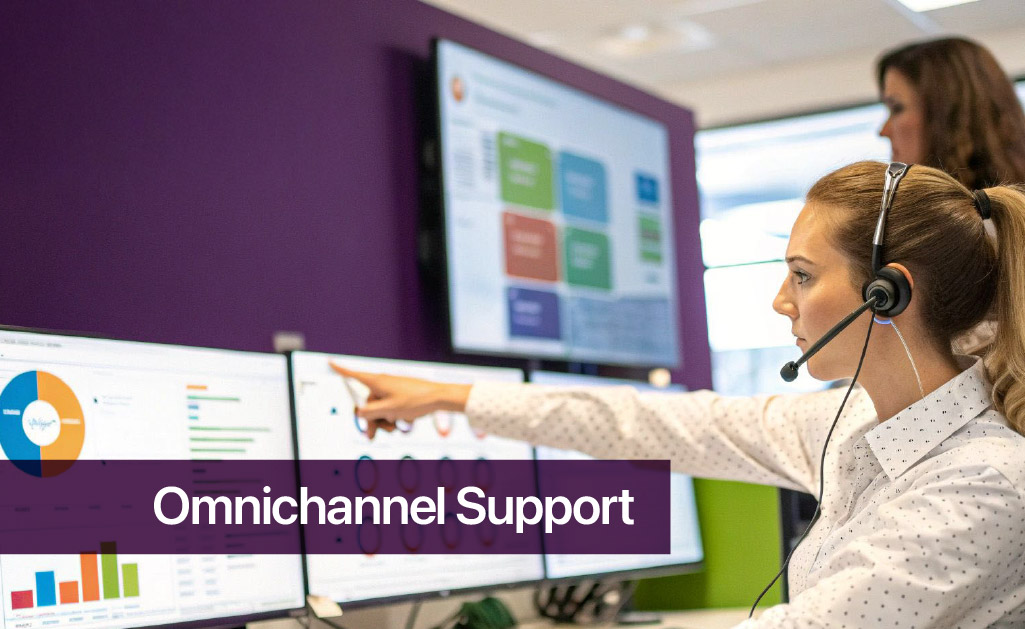 From Call Center to Contact Hub: The Omnichannel Evolution
The old picture of a “call center”—endless rows of agents chained to their phones—is dead and gone. Today’s customers hop between channels without a second thought, and your support needs to keep up. This shift has pushed the industry beyond basic phone calls and into the world of the modern omnichannel contact center.
It’s no longer about just answering the phone. It’s about creating a single, seamless conversation that follows the customer wherever they go. This idea is central to the modern meaning of call center and bpo services today.
What Does Omnichannel Support Actually Look Like?
Think about it from your customer’s perspective. Maybe they start a live chat on your website to ask a quick question. A few hours later, they reply to a follow-up email with extra details. The next day, they call in to finalize their purchase.
In a true omnichannel setup, the agent answering that call sees everything—the chat transcript, the email thread, all of it. The customer never has to repeat their story. It’s a small detail that makes them feel seen and understood, which is huge for building loyalty.
“The goal of an omnichannel experience is to create a single, continuous conversation with the customer, no matter how many times they switch between your website, social media, and phone support.”
Building a Team for Omnichannel Excellence
Pulling off a great omnichannel experience takes more than fancy software. You need agents who are true communication experts, comfortable and effective on any platform. At CallZent, we build our nearshore teams for this new reality from day one.
Our bilingual agents are masters of more than just voice support. They’re trained to excel in:
- Live Chat: Delivering fast, accurate answers in real-time.
- Email Support: Writing clear, professional responses to complex questions.
- Social Media Management: Engaging customers on platforms like Facebook and Twitter.
- SMS Communication: Sending quick updates and alerts right to a customer’s phone.
By ensuring our agents handle every channel with the same level of skill, we guarantee your brand delivers a consistent, top-tier experience every single time. Understanding how to build a seamless omnichannel customer experience is what separates good support from great support.
What Kinds of Services Do BPOs Actually Offer?
When you hear “Business Process Outsourcing,” your mind probably jumps straight to customer service calls. That’s a huge part of it, but the BPO world is so much bigger. A great BPO partner can handle tasks from nearly every corner of your business.
To understand the full scope, it helps to think of your business in two parts:
- Back-Office Functions: This is all the behind-the-scenes work that keeps the company running but that customers never see. Think of it as the engine room of a ship—absolutely essential, but out of sight.
- Front-Office Functions: This is everything your customers do see. Every interaction, touchpoint, and conversation. This is the face of your brand.
The Engine Room: Back-Office BPO
Back-office services are the operational backbone of your company. Outsourcing these often repetitive, time-consuming administrative jobs frees up your core team to focus on what really matters—like building better products or landing bigger deals.
Real-World Example: Imagine a fast-growing e-commerce brand. Instead of hiring a full-time finance team, they outsource data entry for new product listings and payroll processing to a BPO. Everything stays accurate and compliant, without the overhead, allowing their internal team to focus on marketing and growth. We dig deeper into this in our back-office outsourcing efficiency guide.
Common back-office services include:
- Data Entry and Management
- Accounting and Bookkeeping
- Payroll Processing
- IT Helpdesk Support
- Human Resources Administration
The Face of Your Brand: Front-Office BPO
Front-office functions are all about customer engagement. These are the make-or-break moments that define how people feel about your brand. A BPO specializing in the front office acts as a seamless extension of your own team, representing you professionally in every interaction.
Real-World Example: A software company could outsource its technical support and initial lead qualification calls. This frees up their in-house sales experts to focus only on the hottest, most promising leads, dramatically boosting their closing rate. The BPO warms up the prospects, making the entire sales cycle more efficient.
A true BPO partner doesn’t just check tasks off a list. They weave themselves into your operations, bringing specialized skills and the ability to scale up or down as you need.
The value here isn’t just theoretical; the numbers prove it. The global BPO market is on track to blow past USD 250 billion by 2025, with a steady annual growth rate of 7-8%. This isn’t just a trend—it’s a clear signal that businesses are seeing real results from the cost savings and specialized skills that outsourcing offers. You can dig into more of these trends and opportunities in the global BPO market to see where things are headed.
How To Choose The Right Outsourcing Solution
Deciding between a specialized call center and a full BPO partnership can feel like a make-or-break moment. Get it right, and you unlock efficiency and growth. Get it wrong, and you’re stuck with operational headaches and wasted money.
The good news? The choice becomes much clearer when you ask one simple question: Am I trying to fix a specific communication problem, or do I need to hand off an entire business function? Your answer is the key.
Pinpointing Your Primary Need
If your team is drowning in calls, letting sales opportunities slip through the cracks, or delivering inconsistent support, a dedicated call center is your best bet. Think of it like calling in a specialist. You’re hiring a focused team with a single mission: to manage your customer interactions with expert precision.
But what if your challenges are bigger? Maybe your back-office processes are a mess, you’re struggling with data entry, or you need to manage the entire customer journey—from lead generation to billing. That’s when a comprehensive BPO partnership makes sense. A BPO acts as a true extension of your business, taking ownership of multiple interconnected functions to drive improvements across the board.
This decision tree can help you visualize where your needs fall.
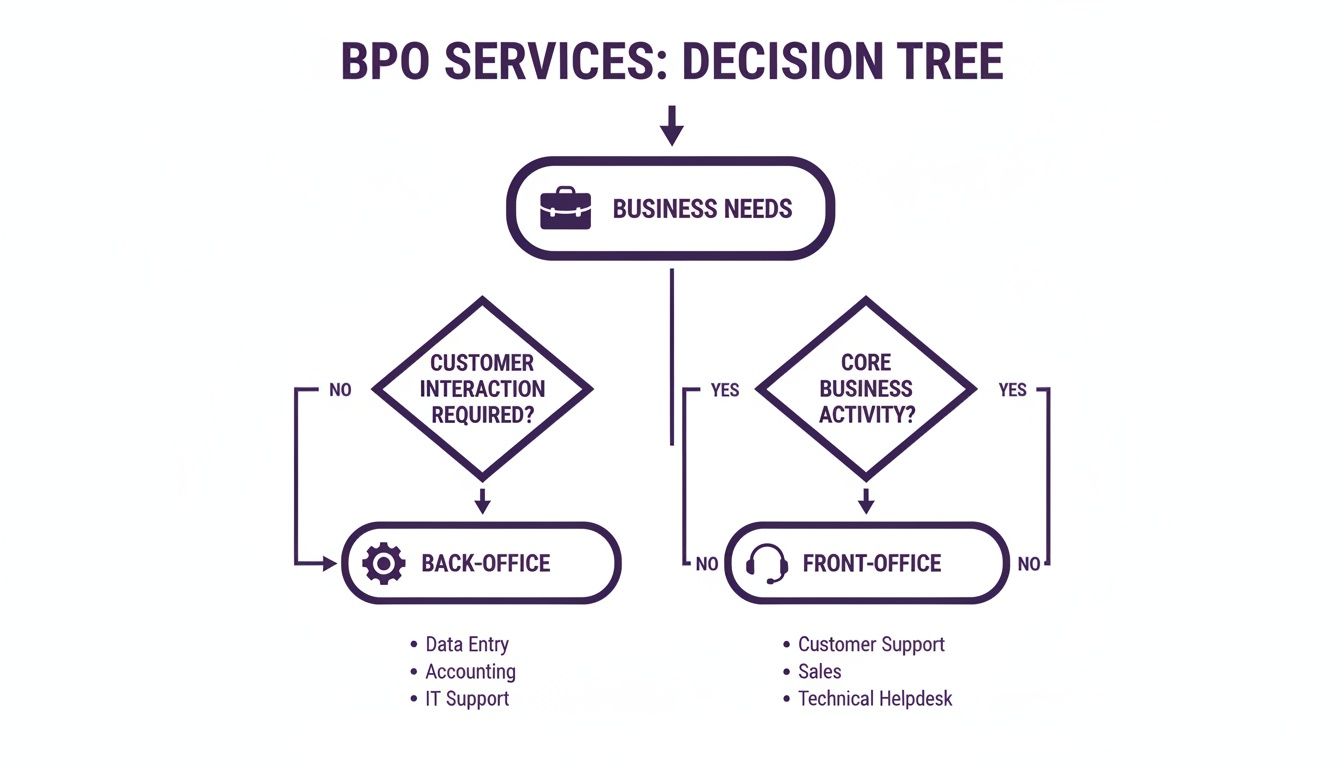
As the flowchart shows, it all starts with defining your core challenge. Once you know if you’re solving for front-office or back-office issues, you can zero in on the right set of outsourced services.
A Practical Checklist For Your Decision
To get you started, here’s a quick sanity check to help you find the right path.
- Business Size & Stage: Are you a startup that needs to scale support without the overhead of hiring? Or an established enterprise trying to optimize a specific department?
- Operational Complexity: Is your main headache just managing calls and emails? Or are you wrestling with complex workflows that cross multiple departments, like finance, HR, and IT?
- Growth Goals: Is your immediate focus on boosting customer satisfaction scores? Or are you laying the groundwork to scale your entire operation in the next 12 months?
Choosing the right partner is less about finding a vendor and more about finding a strategic ally. A call center solves an immediate communication need, while a BPO partner re-engineers a part of your business for long-term growth.
This decision is just one piece of a much larger strategy. To dig deeper into building a modern, resilient operational model, check out our strategic guide to outsourcing. It’s packed with insights to help you make smarter choices.
The Strategic Advantage of Nearshore BPO Solutions

Knowing the “what” behind the meaning of call center and bpo is only half the battle. The “where” is just as critical. The location of your outsourcing partner shapes everything from daily teamwork and cultural fit to your bottom line. This is where a nearshore solution becomes a powerful strategic move.
Nearshoring means partnering with a company in a neighboring country—like a U.S. business working with our team here in Tijuana, Mexico. It hits the sweet spot between offshoring (partnering with a distant country like India) and onshoring (outsourcing within your own country).
More Than Just Cost Savings
While affordability is a huge plus, the real magic of nearshoring is in the operational harmony it creates. Because we operate in a similar time zone to our U.S. clients, collaboration happens in real-time. No more waiting overnight for an email response or scheduling calls at odd hours.
That proximity also translates to stronger cultural alignment. Our agents understand the nuances of North American customer expectations, leading to conversations that feel natural and effective. When vetting partners, it’s also smart to look into local resources for sharpening language skills, like those offered by language training providers, which can be a game-changer for agent quality.
Real-World Example: Consider a U.S. e-commerce company tired of the communication gaps from their offshore provider. After switching to our nearshore team in Tijuana, they didn’t just cut costs—they saw their customer satisfaction scores jump by 25% in three months. Their new team felt like a real extension of their staff, not a disconnected group halfway across the world.
Nearshoring isn’t just about saving money; it’s about gaining a strategic operational advantage.
This approach gives you the cost-effectiveness of global outsourcing combined with the collaborative feel of an in-house team. You get the best of both worlds: lower operational costs without sacrificing the quality and control that come from having your partners just a short flight away.
Measuring the Success of Your Partnership
Outsourcing is a serious investment. So how do you know if it’s paying off? Moving beyond a gut feeling means focusing on the right data—the key performance indicators (KPIs) that connect your partner’s daily work to your bottom line.
Getting a handle on these metrics turns a simple service agreement into a real, performance-driven partnership. You’ll be able to have productive, data-backed conversations and clearly show the return on your investment.
Core Metrics for Your Call Center or BPO Partner
While every business has unique goals, a handful of universal metrics define success in this space. For call centers, it’s about efficiency and customer satisfaction. For broader BPO services, the focus is on hitting agreed-upon standards and driving operational improvements.
Here are key metrics you should track:
- First Call Resolution (FCR): The percentage of customer issues solved on the very first try. A high FCR means happier customers and lower costs, as agents aren’t bogged down with repeat calls.
- Customer Satisfaction (CSAT): Measured with a quick survey after an interaction, this gives you a direct pulse on customer happiness. It’s a powerful indicator of agent quality.
- Service Level Agreement (SLA) Adherence: This is non-negotiable for BPO functions. It measures whether your partner is hitting specific targets, like processing 99% of invoices within 24 hours.
These aren’t just numbers on a dashboard; they’re direct signals of your operational health. To learn more about building dashboards that tell a story, our guide on call center reporting and metrics is the perfect next step.
A high First Call Resolution rate doesn’t just create happy customers; it directly lowers your operational costs by eliminating the need for follow-up interactions.
The entire industry is shifting toward data-driven operations. In some sectors, using analytics is improving decision-making by up to 36%. This is part of a huge market evolution, with contact center outsourcing valued at nearly USD 97.3 billion in 2024 and only expected to grow. You can discover more insights about these industry shifts and what they mean for businesses like yours.
Frequently Asked Questions
Still have questions about call centers and BPOs? We get it. Here are quick, no-fluff answers to the questions we hear most often.
Is BPO Only for Large Corporations?
Not at all. While large companies use BPO to run massive operations, it’s a game-changer for small and medium-sized businesses (SMBs). Outsourcing gives smaller players access to professional-grade tools and specialized talent without the crippling upfront investment, effectively leveling the playing field. For example, a startup can partner with a BPO to handle customer emails and data entry, freeing up the core team to focus on product development and growth.
Can a BPO Handle More Than Just Customer Service Calls?
Absolutely. This is one of the biggest distinctions when looking at the meaning of call center and bpo. A call center is laser-focused on customer conversations, but a full-service BPO can take on an incredible range of tasks.
They can manage both front-office and back-office functions, such as:
- Data entry and database management
- Payroll and accounting support
- IT helpdesk services
- Lead generation and sales qualification
- Technical support and troubleshooting
A BPO is a versatile operational partner, not just a team that answers phones.
How Do I Ensure Quality When I Outsource My Call Center?
It all boils down to finding a true partner, not just a vendor. A reliable partner will be transparent, working with you to set clear Key Performance Indicators (KPIs) and delivering regular, easy-to-understand reports.
To guarantee high-quality service, focus on partners who are transparent with metrics like First Call Resolution (FCR) and Customer Satisfaction (CSAT). These numbers directly reflect the effectiveness of their agent training and operational standards.
Look for a provider with a robust agent training program and one that invites you to be part of the quality assurance process. That kind of collaboration is what makes an outsourced team feel like a genuine extension of your own.
🚀 Ready to Optimize Your Call Centers and BPO Strategy?
Discover how CallZent’s nearshore BPO solutions help business leaders reduce costs, improve CX, and scale with confidence.
Ready to see how a dedicated nearshore partner can elevate your operations and customer experience? CallZent offers custom-fit BPO and call center solutions designed to help you scale efficiently and achieve your goals. Explore our services today!