Skip to content

Call Center Outsourcing Strategy
Why Smart Companies Outsource
Call Centers to Drive Growth
Learn why companies outsource call centers to reduce costs, scale faster, and transform customer support into a strategic growth engine.
TL;DR — Quick Takeaways
- Outsourcing call centers is a growth strategy, not just a cost-saving tactic.
- E-commerce, healthcare, and fintech companies reduce costs by 40–60% while improving CX.
- Outsourcing delivers instant access to specialized talent, advanced technology, and 24/7 coverage.
- Nearshore partners like CallZent offer the best balance of cost savings, quality, and cultural alignment.
Struggling to keep up with customer demands while trying to grow your business? From fast-moving e-commerce startups to major healthcare networks, companies are discovering that outsourcing their call centers isn’t just about cutting costs—it’s a powerful strategy for unlocking growth.
The Strategic Shift To Outsourced Call Centers
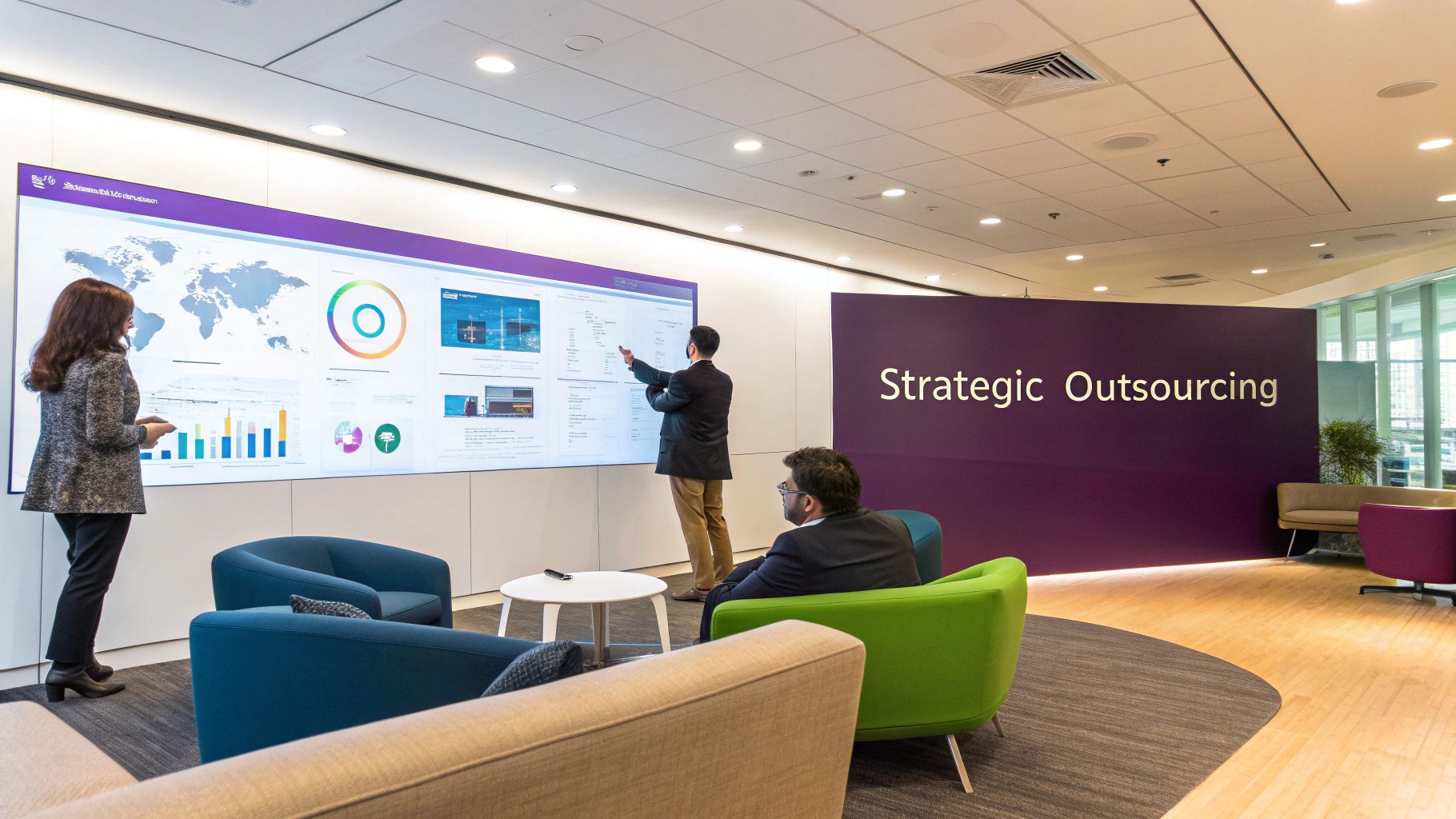
Handing off your call center operations has evolved far beyond a simple cost-saving trick. Today, it’s a core growth strategy for some of the world’s most competitive businesses. This shift happened because forward-thinking leaders stopped focusing on managing internal tasks and started focusing on achieving strategic outcomes.
The global call center outsourcing market is booming, expected to hit over $100 billion in 2025 and showing no signs of slowing down. This growth is fueled by companies in e-commerce, fintech, and healthcare who are achieving significant cost savings—often 40-60% lower than in-house operations—while gaining the ability to scale for busy seasons and offer 24/7 multilingual support.
Why the Smartest Companies That Outsource Call Centers Are Making the Switch
The decision to outsource is never about a single benefit. The real advantage comes from a combination of capabilities that are incredibly difficult and expensive to build on your own. Top companies know that partnering with a specialized BPO provides instant access to expertise that would otherwise take years and significant capital to develop.
Let’s break down the primary drivers with some real-world examples:
- Access to Specialized Talent: Imagine an e-commerce brand that can instantly tap into a team of agents who are already experts in handling complex returns and pre-sales questions, skipping a lengthy and expensive recruitment process.
- Cutting-Edge Technology: A fintech startup can leverage a BPO’s advanced CRM platforms and AI-powered fraud detection tools from day one, without the massive upfront investment.
- 24/7 Operational Power: A travel company can effortlessly offer round-the-clock support to its global customer base, ensuring travelers in any time zone get immediate assistance. It’s a game-changer for customer loyalty.
- Reduced Overhead: You can wave goodbye to the heavy costs of facility management, HR, ongoing training, and maintaining a complex tech infrastructure.
“The modern way to think about outsourcing is to see customer service not as a cost center, but as a powerful engine for generating value, sparking innovation, and expanding your market reach.”
The table below offers a quick look at why so many businesses are turning to call center outsourcing, connecting the strategic reason with the direct business impact.
Top Reasons Why Companies Outsource Call Center Operations
| Strategic Driver | Core Business Benefit | Example Industry |
|---|---|---|
| Cost Reduction | Lower operational and labor costs by 40-60%, freeing up capital for core business functions. | E-commerce: Manages seasonal peaks without hiring permanent staff. |
| Focus on Core Business | Allows internal teams to concentrate on product development, innovation, and strategic growth. | Tech/SaaS: Frees up engineers from basic support to focus on coding. |
| Access to Expertise | Instantly gains a skilled workforce and advanced customer service technologies. | Fintech: Leverages specialized agents for fraud detection and compliance. |
| Improved Scalability | Quickly scales customer support up or down to match demand without infrastructure changes. | Retail: Handles massive call volumes during Black Friday and holiday sales. |
| 24/7 Customer Support | Provides round-the-clock service to a global audience, improving customer satisfaction and loyalty. | Travel & Hospitality: Assists customers across different time zones for bookings. |
This isn’t just about saving a few dollars; it’s a fundamental move to build a more resilient and competitive business.
It’s All About Strategic Outcomes
At the end of the day, the most successful companies that outsource call centers aren’t just offloading tasks—they are delegating outcomes. They bring in experts to master customer interactions so their own teams can pour all their energy into what they do best: building great products and planning for the future.
This approach turns customer support from a necessary evil into a strategic asset. For example, a fintech company can guarantee 24/7 fraud monitoring, while an e-commerce brand can flawlessly handle the holiday rush. Once you understand the core reasons companies choose to outsource, you see how it becomes an essential tool for sustainable growth.
Which Industries Get the Most Out of Outsourcing?
While nearly any business can benefit from outsourcing, some industries have turned it into a decisive competitive advantage. These sectors face unique challenges—from dramatic seasonal demand and complex regulations to the need for highly specialized, around-the-clock support. For these companies that outsource call centers, partnering with a BPO isn’t a luxury; it’s a core part of their business strategy.
Outsourcing is already delivering huge wins for companies all over the world. Take healthcare, for example. It’s leading the pack in vertical growth with a +120% spike in related searches. By outsourcing tasks like appointment scheduling and insurance verification, providers are slashing patient wait times in half.
E-commerce is another major player, with a 15% jump in customer contacts annually. For them, the ROI from outsourcing is crystal clear, especially when it means lower agent turnover and the ability to scale instantly.
Let’s dig into the specific industries that are leading the way.
E-commerce And Retail
E-commerce businesses live and die by their ability to manage massive swings in customer demand. An in-house team that’s perfect for a quiet Tuesday in July will be completely overwhelmed by the Black Friday rush. This is where outsourcing changes the game.
Instead of scrambling to hire and train temporary staff every holiday season, e-commerce brands partner with call centers that can scale their agent count up or down as needed.
- Seasonal Surge Management: A clothing retailer partners with a BPO that can instantly add 100 trained agents to handle Black Friday and Cyber Monday inquiries, ensuring no sales are lost to long wait times.
- Complex Returns and Exchanges: An online electronics store outsources its returns process. Agents become experts on the company’s policy, efficiently processing RMAs (Return Merchandise Authorizations) and guiding customers, which frees up the internal team to focus on marketing.
- 24/7 Shopping Support: A furniture brand uses an outsourced team to provide constant chat and phone support, answering pre-sale questions about dimensions and materials at any hour, directly boosting conversion rates.
Healthcare Providers And Services
The healthcare world is governed by a mountain of regulations, especially HIPAA, which mandates the protection of patient data. Managing patient communications requires a level of security and specialized training that is incredibly expensive and difficult to maintain in-house. It’s no surprise that so many clinics, hospitals, and insurance providers are companies that outsource call centers.
A HIPAA-compliant BPO partner provides a secure environment from day one, with agents specifically trained to handle sensitive patient information. This blend of security and expertise is crucial for maintaining patient trust.
“For healthcare, outsourcing isn’t just about answering calls; it’s about providing a secure, empathetic, and efficient extension of the patient care journey.”
These partnerships manage critical, non-clinical tasks that define the patient experience. The strategic value of a medical call center is its ability to handle these functions with precision, allowing clinical staff to focus on patient health. Common outsourced tasks include:
- HIPAA-Compliant Patient Scheduling: A network of dental clinics uses an outsourced team to book appointments, send reminders, and manage cancellations, dramatically reducing no-show rates.
- Insurance Verification: A surgical center’s partner team confirms each patient’s insurance coverage before an appointment, preventing billing surprises and streamlining the check-in process.
- Patient Follow-Up: After a hospital stay, an outsourced agent makes a follow-up call to check on the patient and remind them about their follow-up appointment, improving patient satisfaction and adherence to treatment plans.
Fintech And Banking
In the fast-paced world of finance, there’s zero room for error. Security, accuracy, and availability are non-negotiable. Customers expect immediate help, especially when their money is on the line. Both agile fintech startups and large, established banks outsource to deliver this top-tier service without building massive internal support departments.
A specialized financial BPO brings agents to the table who are already trained in security protocols and financial products, ensuring every interaction builds customer confidence.
- Secure Customer Onboarding: A new investment app relies on an outsourced team to guide users through the essential Know Your Customer (KYC) and Anti-Money Laundering (AML) checks, ensuring a smooth and compliant sign-up process.
- 24/7 Fraud Monitoring and Support: A credit union’s partner agents are the first line of defense, monitoring for suspicious activity and providing instant support to customers who believe their account has been compromised.
- Tier 1 Technical and Account Support: Agents handle common issues like password resets, transaction inquiries, or app navigation, freeing up in-house experts to manage complex escalations.
Choosing Your Outsourcing Model: Onshore, Nearshore, Or Offshore?
Once you’ve decided to join the growing number of companies that outsource call centers, the next big question is: where? This isn’t just a geographic choice. It’s a strategic decision that impacts your budget, customer satisfaction, and daily operations.
You have three main options: onshore, nearshore, and offshore. Each has its own trade-offs, and understanding them is key to building a partnership that feels like a true extension of your team—not one that creates more problems than it solves. Let’s break down what each model means for your business.
Onshore Outsourcing: The Premium Domestic Solution
Onshore outsourcing means partnering with a call center within your own country. For a US-based company, this could mean working with a center in Phoenix or Orlando. The primary advantage is the complete absence of cultural or language barriers. For businesses in highly regulated fields like finance or healthcare, where data laws and compliance are paramount, this is often the preferred choice. However, this premium service comes at the highest cost.
Offshore Outsourcing: The Classic Cost Leader
When most people hear “outsourcing,” they picture the offshore model. This involves partnering with a provider in a distant country, such as the Philippines or India. The main driver here is aggressive cost reduction. The significant difference in labor costs allows companies to scale operations at a fraction of the price of an in-house or onshore team. The trade-offs? You may face significant time zone differences, potential cultural disconnects, and language accent barriers that can impact the customer experience.
Nearshore Outsourcing: The Strategic Sweet Spot
This is where the smart money is going. Nearshore outsourcing strikes a powerful balance between quality and cost. For businesses in North America, this means partnering with centers in neighboring countries like Mexico. It has quickly become the preferred strategy for companies that refuse to compromise on either customer experience or financial efficiency.
As the decision tree below shows, different industries weigh factors like cost and compliance differently when picking a model.
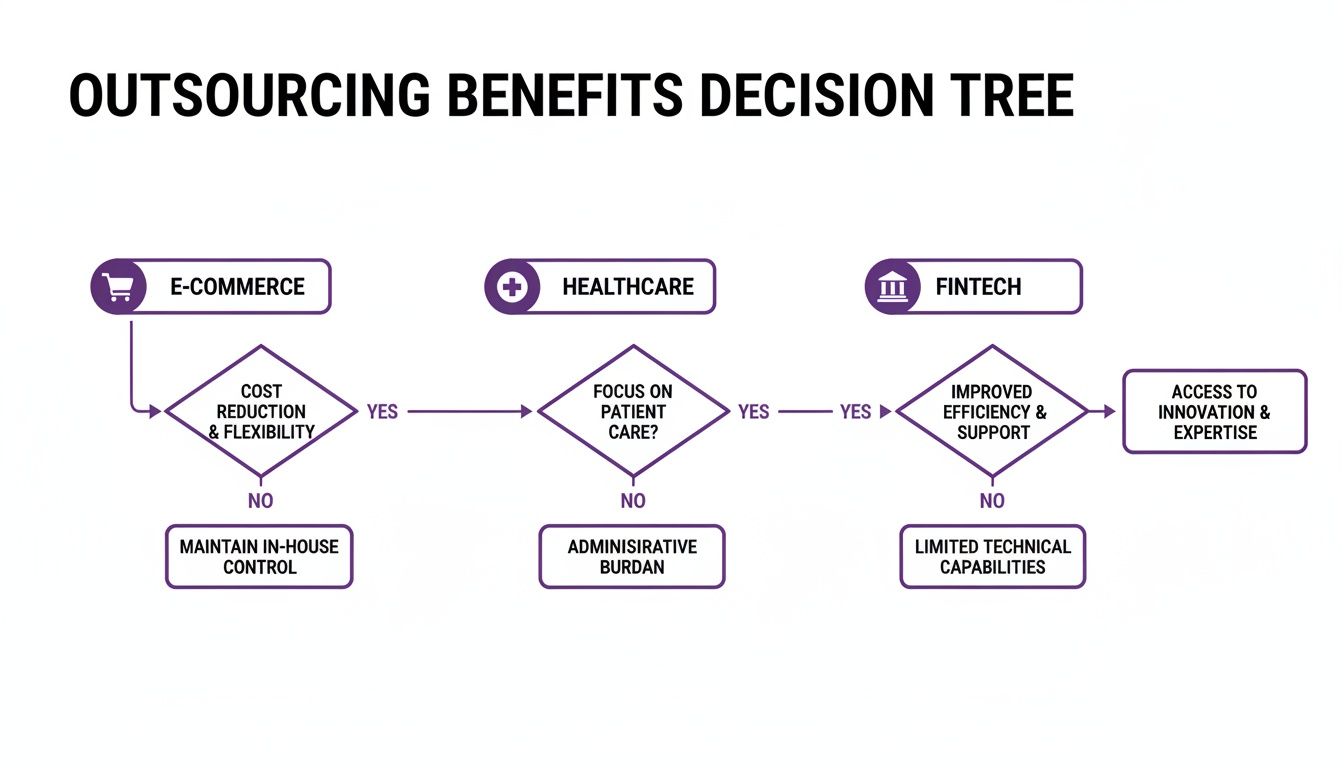
This visual highlights how industries like healthcare and fintech lean toward models with stricter compliance, while e-commerce might prioritize the scalability and cost-efficiency found in nearshore or offshore solutions.
With a nearshore partner, you get major cost advantages over an onshore team but without the communication gaps that can arise with offshore providers. Agents are typically bilingual, and the close cultural alignment with the US market makes customer interactions feel natural and effective.
“Nearshore outsourcing is designed for companies that refuse to compromise. It delivers the cost-efficiency of a global model with the cultural fluency and time-zone alignment of a domestic partner.”
The global demand for outsourcing is complex. While North America drives over 32% of the demand, the Asia-Pacific region handles over 23% of the work because of its low costs. Still, onshore holds a 59% share because it’s seen as the most reliable. The rise of nearshore, however, signals a clear shift toward a smarter balance of cost, quality, and cultural fit.
A Side-by-Side Comparison of Outsourcing Models
To see the difference clearly, it helps to put the models head-to-head. The table below breaks down how each one stacks up on the factors that matter most.
Onshore vs. Nearshore vs. Offshore Models for Companies That Outsource Call Centers
| Key Factor | Onshore (USA) | Nearshore (Tijuana) | Offshore (Philippines) |
|---|---|---|---|
| Cost Savings | Low (Highest Cost) | High (Significant Savings) | Highest (Lowest Cost) |
| Cultural Alignment | Perfect | Very High | Moderate to Low |
| Time Zone | Identical | Aligned (e.g., PST/CST) | Opposite (12-15 Hour Difference) |
| Travel & Collaboration | Easy (Domestic Flight) | Very Easy (Short Flight/Drive) | Difficult (Long-Haul Flight) |
| Bilingual Talent Pool | Available but costly | Abundant and accessible | Limited availability |
| Best For | High-compliance, sensitive data, premium brand experiences. | Businesses seeking a balance of cost, quality, and cultural synergy. | High-volume, cost-driven, 24/7 “follow-the-sun” support models. |
Ultimately, the right choice comes down to your company’s priorities. If you’re ready to dig deeper, our complete nearshore vs. offshore business guide has all the details you need to make a confident decision.
For many forward-thinking companies that outsource call centers, nearshore has become the strategic choice, delivering a powerful return on investment without ever sacrificing the quality of the customer experience.
The Financial Case For Outsourcing Your Call Center
Everyone knows outsourcing can “save money,” but what does that actually mean for your bottom line? Partnering with a BPO isn’t just about trimming payroll; it’s a complete overhaul of your cost structure, shifting from rigid capital expenses to a flexible, efficient operational model.
The immediate savings on salaries are just the tip of the iceberg. What most companies that outsource call centers quickly discover is that the real financial win comes from eliminating the massive, often hidden, overhead of an in-house team. These are the costs that quietly drain your budget year after year.
Direct Vs. Indirect Cost Savings
To see the full picture, you have to look beyond the obvious line items. The direct savings are easy to spot, but the indirect savings are where the game truly changes.
- Direct Savings: This is what you see on paper right away. We’re talking lower agent salaries, plus reduced spending on employee benefits, payroll taxes, and paid time off.
- Indirect Savings: This is all the operational baggage you get to drop. Think about recruitment agency fees, HR’s time spent on hiring, ongoing training programs, and pricey software licenses for every agent.
“Outsourcing transforms customer support from a heavy fixed cost into a flexible operational expense. This shift protects your cash flow and gives you the agility to scale on demand without financial penalty.”
On top of that, you sidestep huge capital investments. You’re no longer responsible for buying and maintaining all the physical infrastructure, from servers and IT equipment down to things like specialized call center cubicles.
A Practical Cost Comparison
Let’s put some numbers to this. Here’s a side-by-side look at the estimated annual cost of a 20-agent in-house team in a typical U.S. city versus outsourcing to a nearshore partner like CallZent in Tijuana.
| Cost Component | In-House Team (USA) | Nearshore Team (Tijuana) | Estimated Annual Savings |
|---|---|---|---|
| Agent Salaries & Benefits | ~$960,000 | ~$480,000 | $480,000 |
| Management & HR | ~$150,000 | Included in Service | $150,000 |
| Recruitment & Training | ~$80,000 | Included in Service | $80,000 |
| Office Space & Utilities | ~$120,000 | Included in Service | $120,000 |
| Technology & Licenses | ~$60,000 | Included in Service | $60,000 |
| Total Estimated Annual Cost | $1,370,000 | $480,000 | $890,000 |
Note: Figures are estimates for illustrative purposes.
The difference is staggering—often a 50-60% reduction in total costs. This isn’t a minor budget tweak; it’s a strategic move that can free up nearly a million dollars in capital. That’s money you can reinvest into product development, marketing, or other core initiatives that drive real growth.
The Strategic Value Of Financial Flexibility
Beyond the raw numbers, outsourcing gives you something incredibly valuable: financial agility. With an in-house team, your labor costs are fixed. You’re paying the same salaries whether call volumes are through the roof or dead quiet.
Outsourcing flips that script, turning a fixed expense into a variable one. You only pay for the coverage you need, when you need it. This model allows you to instantly scale up for a seasonal rush or a new product launch without the long-term financial burden of hiring permanent staff. In today’s market, that kind of flexibility is priceless.
For a more detailed breakdown, our guide explains how much it costs to outsource a call center based on different models and needs.
 Your Checklist For Selecting The Right Outsourcing Partner
You’ve analyzed the strategy and crunched the numbers. Now comes the most critical step: choosing the right partner. This is a big decision. The BPO you select becomes the voice of your brand.
A great partner feels like a seamless extension of your own team. The wrong one can create frustrating bottlenecks and damage your reputation. This checklist is designed to help you look past the sales pitch and truly vet potential partners. For companies that outsource call centers, a thorough vetting process is the best way to guarantee success.
Cultural And Linguistic Alignment
Your partner’s agents must sound like they’re part of your company, not a disconnected third party. This goes beyond just speaking the language—it’s about understanding cultural nuances and customer expectations.
- How do you train agents on our brand voice and values? Look for a detailed, custom onboarding process. A generic program is a red flag.
- Can we listen to sample calls from agents who would work on our account? This is non-negotiable. It’s the only way to get a real feel for their communication style.
- What is your agent turnover rate? Happy, well-supported agents stick around. A low turnover rate (under 25% annually) indicates a positive work environment, which translates to better service for your customers.
Technological Infrastructure And Integration
A modern call center runs on technology. Your partner must have a robust tech stack that integrates smoothly with your existing systems to avoid a disjointed customer experience.
As you build your checklist, ask about their specific technology, including their top VoIP providers for call centers, to ensure every call is crystal clear.
“A partner’s technology isn’t just about making their job easier; it’s about making your customer’s experience seamless. If their systems can’t talk to yours, your customers will feel the disconnect.”
- Which CRM platforms do you have experience with? They must demonstrate easy integration with major platforms like Salesforce, HubSpot, or Zendesk.
- What are your omnichannel capabilities? Ask how they unify phone, email, live chat, and social media interactions into a single conversation. Customers hate repeating themselves.
- What are your business continuity and disaster recovery plans? You need confirmation of backup power and redundant internet. An outage on their end shouldn’t halt your customer support.
Security And Compliance Certifications
In an era of constant data breaches, you can’t be lax on security. A reputable partner will prove their security with internationally recognized certifications. Ask to see the paperwork.
- PCI DSS: Mandatory for any company handling credit card information.
- HIPAA: Non-negotiable for healthcare organizations or anyone handling protected health information (PHI).
- SOC 2: This certification verifies they have strict controls in place for securing and managing customer data.
Scalability And Performance Reporting
Your business is dynamic, and your partner must be too. They need the flexibility to scale with you, whether you’re hitting a seasonal peak or launching in a new market. This must be backed by transparent, easy-to-understand reporting so you always know how things are going.
- How do you handle sudden spikes in call volume? They should have a clear, proven process for adding or reassigning agents without a drop in service quality.
- What Key Performance Indicators (KPIs) do you track? Look for essentials like Average Handle Time (AHT), First Call Resolution (FCR), and Customer Satisfaction (CSAT).
- Can we see a sample of your performance reports? The dashboards should provide actionable insights at a glance, not just a wall of numbers.
Choosing the right BPO is a major strategic move. To go even deeper, check out our guide on how to find and vet the best call center outsourcing companies.
Got Questions About Outsourcing Your Call Center?
Thinking about outsourcing your customer support is a big move. It’s smart, strategic, and naturally, it comes with a lot of questions. We’ve been there, and we’ve heard them all. Here are the most common concerns we hear from businesses just like yours, answered straight up.
Is My Company Big Enough (Or Too Small) To Outsource?
This is a common misconception. Outsourcing isn’t just a game for the Fortune 500 anymore. We see startups and growing mid-sized companies using it all the time to punch above their weight and scale way faster than they could alone.
The real question isn’t about your company’s size—it’s about your needs. Are you growing so fast you can’t keep up with customer calls? Are support costs eating into your budget? Do you need to offer 24/7 service to stay in the game? If you answered yes to any of these, outsourcing is a serious option. Modern partners offer flexible setups that can grow with you, from a small, dedicated team of 5-10 agents to several hundred. You only pay for what you actually need.
Will I Lose Control Of My Brand’s Customer Experience?
This is probably the number one fear we hear, and it’s completely valid. But here’s the thing: a high-quality partner acts as a true extension of your team, not some disconnected vendor. The fear of losing control is exactly why choosing the right partner is everything.
A top-tier provider doesn’t just answer calls; they live and breathe your brand. They invest serious time in brand immersion, cultural alignment, and have airtight quality assurance.
- They’ll work side-by-side with you to build out detailed scripts, protocols, and KPIs that sound exactly like you and reflect your core values.
- You get total visibility through transparent reporting, live call monitoring, and your own dedicated account manager. No surprises.
- You are always in the driver’s seat when it comes to how your customers are treated. This ensures a consistent, high-quality experience every single time someone reaches out.
“Think of it this way: a strategic partnership isn’t about giving up control. It’s about gaining an expert crew while you steer the ship. You set the course, and your partner executes with precision.”
How Do I Know My Company’s Data Will Be Secure?
In a world full of cyber threats, data security isn’t just a feature; it’s the foundation. When you’re vetting potential partners, their security and compliance credentials should be at the absolute top of your checklist.
Don’t settle for anything less than providers who can show you proof of internationally recognized certifications. These aren’t just fancy badges; they’re your assurance of a secure and professional operation.
- PCI DSS: If they’re handling any payment card information, this is non-negotiable. Mandatory.
- HIPAA: An absolute must for any healthcare organization or company dealing with protected health information. No exceptions.
- SOC 2: This one’s huge. It verifies that the provider has strict, audited controls for data security, availability, and privacy.
A reputable BPO will have a rock-solid security framework that includes encrypted networks, secure data centers, tight access controls, and regular third-party security audits. Always ask to see the documentation.
What’s The Difference Between A Call Center And A BPO?
People tend to use these terms interchangeably, but there’s a real difference. A traditional call center is pretty focused—it handles inbound and outbound calls. Voice is its main game.
Business Process Outsourcing (BPO), on the other hand, is a much bigger umbrella. It means outsourcing any business function. So, a call center is just one specific type of service that a BPO can offer.
Many modern partners, including CallZent, are full-service BPOs. We go way beyond just phone calls. Our services include:
- Email and live chat support
- Social media community management
- Technical support tiers
- Data entry and other back-office work
When you work with a BPO, you’re not just outsourcing a phone line; you’re outsourcing an entire process. This integrated approach leads to a much more seamless and effective customer experience.
🚀 Ready to Turn Customer Support Into a Growth Engine?
CallZent helps smart companies scale faster with nearshore call center outsourcing solutions built for performance and CX.
Ready to turn your customer support from a cost center into a growth engine? The team at CallZent is here to build a custom nearshore solution that aligns perfectly with your business goals. Contact us today for a personalized consultation and discover how our expert team can help you scale efficiently and delight your customers.