Skip to content

Contact Center Outsourcing
Contact Center Outsourcing Solution:
The Ultimate Strategic Guide
Explore how a contact center outsourcing solution helps reduce costs, scale support, and improve customer experience through strategic nearshore partnerships.
TL;DR — Quick Takeaways
- A contact center outsourcing solution offloads customer interactions to expert teams using proven processes and modern technology.
- Businesses benefit from lower operating costs, faster scalability, and access to specialized (often bilingual) talent.
- Nearshore outsourcing delivers stronger cultural alignment and real-time collaboration for U.S. companies.
- Success depends on choosing a partner with industry expertise, secure infrastructure, and transparent KPIs.
Are you struggling to keep up with customer demands while trying to keep costs in check? A contact center outsourcing solution isn’t just about hiring remote agents; it’s a strategic partnership designed to elevate your customer experience, unlock operational efficiency, and give you access to specialized talent and technology you couldn’t build overnight.
Think of it as instantly installing a fully-equipped, professionally-run customer service department that’s 100% dedicated to your brand’s success.
What Exactly is a Contact Center Outsourcing Solution?
At its core, a contact center outsourcing solution is the practice of entrusting your customer interactions—calls, emails, live chat, social media—to a third-party specialist. Instead of building and managing a customer service team from the ground up, you partner with an expert firm that handles everything: agent recruitment, training, technology infrastructure, and quality assurance.
This move frees you up to focus on your core business while a dedicated partner works to make your customers happier and your operations smoother.
For example, imagine an e-commerce company facing a massive surge in inquiries during the holiday season. By partnering with an outsourcer, they can instantly scale their support team. They sidestep the long and expensive process of hiring and training temporary staff, ensuring every customer gets a prompt response without derailing their internal teams. What could have been a bottleneck becomes a genuine competitive advantage.
 This is a Strategic Partnership for Growth
The global contact center outsourcing market isn’t just growing; it’s exploding. Valued at around USD 97.31 billion, it’s projected to hit USD 163.86 billion by 2030. This boom reflects a massive shift where businesses realize they can cut costs and deliver a better customer experience by letting the experts handle it.
Ultimately, this model is about gaining access to capabilities you don’t currently have in-house. A good partner brings a lot to the table:
- Specialized Talent on Tap: You get professionally trained agents, including bilingual support, without the HR headaches.
- An Advanced Tech Stack: They bring modern platforms for omnichannel communication, analytics, and reporting, saving you a huge capital investment.
- Operational Excellence: You benefit from their proven, battle-tested processes for workforce management, quality monitoring, and performance optimization.
To get a better feel for this kind of partnership, it’s helpful to look at a related concept by understanding what a Managed Service Provider is. The core idea is identical: you entrust key operations to an expert so you can get back to what you do best. You can also dive deeper into the basics in our guide on what contact centers are and see how they serve as the central hub for all customer communication.
Key Takeaway: Outsourcing your contact center isn’t just a cost-cutting measure. It’s a strategic decision to bring in outside expertise, technology, and scalability to build a more resilient and customer-obsessed business.
What Services Can You Outsource with a Contact Center Solution?
When you think about outsourcing a contact center, you might just picture someone answering phones. But that’s a seriously outdated view. A modern outsourcing partner offers a suite of services designed to manage the entire customer journey, freeing up your team to focus on growing the business.
Imagine an e-commerce brand getting slammed during the holiday rush. Instead of collapsing under a 300% surge in order inquiries, they use an expert inbound team to handle everything seamlessly. That’s the kind of power a real partnership brings to the table.
Inbound and Outbound Support
This is the bread and butter of any contact center, but the ways they can be used are incredibly diverse.
- Inbound Services: This is your customer-facing frontline. Agents handle all incoming communications—calls, emails, live chats—for things like customer service questions, processing new orders, or scheduling appointments. For example, a healthcare provider would use inbound services to manage patient bookings and field insurance questions.
- Outbound Services: This is all about proactively reaching out. A B2B software company might use an outbound team to run targeted lead generation campaigns, warming up prospects and setting appointments for their in-house sales reps.
Together, these two functions are the engine of customer communication, handling everything from reactive problem-solving to proactive engagement.
Specialized Support: Technical and Bilingual Solutions
Beyond the basics, specialized support is where a top-tier partner really proves its worth.
Technical Support isn’t a one-size-fits-all service. It’s typically tiered to get customers the right help, fast. For a fintech company, this could mean Level 1 agents guiding users through app features, while Level 2 agents dive deep to troubleshoot complex transaction errors.
Bilingual Support is non-negotiable if you want to reach a wider audience. As a nearshore partner in Tijuana, this is where CallZent really shines. We can effortlessly serve both your English and Spanish-speaking customers, ensuring language is never a barrier to great service—a massive advantage in the diverse North American market. If you’re curious, check out our guide on the top services provided by call centers in Tijuana.
The real magic of outsourcing is getting specialized skills on demand—from technical wizards to multilingual communicators—without the headache and overhead of building those teams yourself.
Back Office and Administrative Functions
A great outsourcing partner doesn’t just clock out when the call ends. They also handle the crucial back-office functions that keep your business humming. These tasks are often repetitive but are absolutely vital for keeping things running smoothly.
Just think about the mountain of administrative work a logistics company deals with. Their outsourced team might handle:
- Data Entry: Accurately keying in shipping manifests and tracking information.
- Order Processing: Verifying and pushing through new orders from different sales channels.
- Transaction Verification: Double-checking financial details to ensure accuracy and prevent fraud.
When you bundle these tasks with your customer-facing services, you create an incredibly efficient, seamless operation. It’s no wonder the contact center outsourcing market is expected to hit US$231.01 billion by 2032. Companies are increasingly turning to expert partners to cut costs and boost productivity.
Ultimately, a partner’s value is defined by its commitment to quality across every single service. A deep expertise in mastering customer support training ensures agents deliver consistently excellent service. This dedication—from the front lines to the back office—is what separates a simple vendor from a true partner that drives measurable results for your business.
The Real Business Benefits of a Contact Center Outsourcing Solution
Moving past the specific services, let’s get to the real business outcomes. Choosing to outsource your contact center isn’t just an operational tweak; it’s a strategic move that delivers tangible results across your entire company. We can boil these benefits down to four key pillars that directly impact your bottom line, your ability to adapt, and ultimately, how happy your customers are.
For many businesses, this decision becomes a powerful lever for growth, not just another line item on a budget. It’s about redirecting your internal team’s focus toward innovation while letting specialists perfect your customer interactions. The market reflects this shift—contact center outsourcing is expected to swell to USD 162.01 billion by 2029, driven by the nonstop demand for scalable, 24/7 support.
Unlock Significant Cost Savings
The most obvious win is a major drop in operational expenses. But this goes way beyond just lower agent salaries. A true partner wipes out a whole host of hidden costs that bleed your budget when you manage an in-house team.
Think about everything you get to sidestep:
- Recruitment and Training: The endless, costly cycle of hiring, onboarding, and training new agents? That’s no longer your problem. Your outsourcing partner handles it all.
- Infrastructure and Technology: You can forget about the massive upfront investment in office space, workstations, and pricey software licenses for your CRM and phone systems.
- Employee Benefits and Overhead: This covers everything from healthcare and paid time off to the administrative headaches that come with full-time staff.
By partnering with a provider, you turn all those unpredictable capital expenses into one predictable operational cost. If you want to dig into the numbers, you can learn more about the ROI of outsourcing call centers and see how it saves both time and money.
Achieve Effortless Scalability
Business needs are never static. Demand swings with the seasons, new product launches, or unexpected market shifts. Outsourcing your contact center gives you the flexibility to scale your support team up or down almost instantly—without the usual HR nightmare.
Picture a retail company gearing up for Black Friday. Instead of a frantic, months-long hiring blitz for temporary staff, they just give their outsourcing partner a heads-up. Within days, a fully trained team is ready to handle the 400% surge in calls and chats. When the rush is over, they scale back down just as easily. This kind of agility means you never miss a customer inquiry or waste money on idle staff.
Enhance Service Quality and Customer Satisfaction
Outsourcing gives you instant access to a pool of highly trained, career-focused customer service professionals. These aren’t just temporary hires; they are specialists in communication, problem-solving, and de-escalation.
“Outsourcing is more than a cost-saving tactic; it’s a direct investment in customer experience. It provides access to specialized talent and advanced technology that directly translates to higher satisfaction and loyalty.”
Top-tier partners also invest heavily in the kind of tech that many companies can’t afford on their own, from AI-powered analytics to true omnichannel communication platforms. This powerful combination of skilled people and superior tools leads to faster resolutions, more consistent service, and a real, measurable bump in key metrics like Customer Satisfaction (CSAT) and First Call Resolution (FCR).
Leverage the Nearshore Advantage for Your Solution
For businesses in the U.S., partnering with a nearshore provider like CallZent in Tijuana brings unique strategic advantages to the table that offshore alternatives often can’t match. This isn’t just about geography; it’s about genuine alignment.
Here are the key benefits of going nearshore:
- Time Zone Compatibility: Working in the same or similar time zones means your partner is online when you are. This makes real-time collaboration and troubleshooting completely seamless.
- Cultural Alignment: A shared cultural context with North American customers leads to more natural, empathetic conversations and far fewer misunderstandings.
- Simplified Collaboration: Proximity makes site visits for training, strategy sessions, and quality reviews easy and affordable, which helps foster a true partnership.
How to Choose the Right Contact Center Outsourcing Solution
Picking a partner for your contact center is easily the most critical decision you’ll make. Get it right, and you’ll supercharge your business. Get it wrong, and you’re in for brand damage and operational headaches. This isn’t just about finding a “vendor”—it’s about finding a true partner who will feel like a genuine extension of your team.
To do that, you need to look past the slick sales pitch. A solid evaluation means digging into their industry knowledge, their tech stack, their security chops, and whether they’re a good cultural fit.
Evaluate Their Industry and Domain Expertise
Does the potential partner really get your business? A provider that’s a rockstar in e-commerce might completely miss the mark on the compliance and empathy needed in healthcare. Real expertise means they can speak your customers’ language from day one, no hand-holding required.
When you’re digging into their experience, get specific:
- Do you have active clients in our industry? Don’t settle for vague answers. Ask for relevant case studies and testimonials.
- Can we speak with current client references? A partner who is confident in their work will be happy to connect you with satisfied customers.
- How do you train agents on our specific jargon and processes? You’re looking for a structured, customized training program, not some cookie-cutter, one-size-fits-all approach.
A partner with deep roots in your sector already knows your pain points and what your customers expect. That kind of specialized knowledge is invaluable and dramatically cuts down the ramp-up time, leading to better customer conversations, faster.
Assess Their Technological Capabilities
Let’s be clear: your outsourcing partner’s tech stack is your tech stack. If their systems are clunky, outdated, or inflexible, it’s your customer service that will suffer. You need a partner whose technology isn’t just current but is built for what’s next.
A great outsourcing partner doesn’t just provide agents; they provide access to a technology and innovation roadmap that most companies could never build on their own.
Probe their technical infrastructure with these questions:
- What CRM and contact center platforms are you running? Find out about their omnichannel capabilities—voice, email, chat, social—and, crucially, whether they can integrate with the systems you already use.
- What do your data analytics and reporting tools look like? They should offer transparent, real-time dashboards that give you a clear view of the KPIs that matter most to your business.
- What’s your uptime guarantee and disaster recovery plan? You need to know they have redundant systems in place to keep the lights on, no matter what.
A forward-thinking partner invests heavily in their tech. This gives you access to tools that make agents more efficient and customers happier. For a deeper look at vetting potential partners, our guide on how to [find and vet the best call center outsourcing companies](https://callzent.com/find-vet-best-call-center- outsourcing-companies/) offers an even more detailed checklist.
Scrutinize Security and Compliance Protocols
Handing over customer data is a huge deal. A security breach that happens on your partner’s watch is still a breach that tarnishes your brand. Their security and compliance can’t be an afterthought—it has to be airtight and non-negotiable.
This is especially true in regulated industries like finance and healthcare. A potential partner has to prove they have a robust security posture.
- What security certifications do you hold? Look for the big ones: ISO 27001, PCI-DSS for handling payments, and HIPAA compliance if you’re in healthcare.
- How do you ensure data privacy and protection? Ask them to walk you through their data encryption, access control policies, and the physical security of their facilities.
- How do you train agents on security best practices? Regular, mandatory training on threats like phishing and social engineering is an absolute must.
Don’t just take their word for it. Ask to see the paperwork and proof of certifications. A transparent partner will have this information ready, showing they’re as serious about protecting your customer data as you are. Choosing the right contact center outsourcing solution means finding someone who treats your security with the gravity it deserves.
To help you organize your evaluation, here’s a practical checklist to systematically compare potential providers.
Vendor Evaluation Checklist for Your Outsourcing Solution
This checklist is designed to help you move beyond surface-level conversations and dig into the details that truly matter. Use it to structure your calls with potential partners and create a clear, side-by-side comparison.
| Evaluation Criteria | Key Questions to Ask | What to Look For (Green Flags) |
|---|---|---|
| Industry Expertise | Do you have active clients in our industry? Can we see relevant case studies or speak to references? | Proven track record with brands similar to yours. They speak your industry’s language fluently. |
| Technology & Integration | What CRM/contact center platforms do you use? Can they integrate with our existing systems (e.g., Salesforce, Zendesk)? | Modern, omnichannel-ready platforms. A clear and simple integration process. |
| Agent Training & Quality | What does your agent onboarding and ongoing training process look like? How do you measure agent performance and quality? | Customized training programs specific to your brand. A robust Quality Assurance (QA) framework with regular feedback loops. |
| Security & Compliance | What certifications do you hold (ISO 27001, PCI, HIPAA)? Can you provide documentation? | Verifiable certifications relevant to your industry. Transparent policies on data handling and agent training. |
| Reporting & Analytics | Can we see a demo of your client dashboard? What KPIs do you track by default? Are reports customizable? | Real-time, transparent dashboards. The ability to track metrics that align with your business goals. |
| Scalability & Flexibility | How do you handle seasonal spikes or unexpected volume increases? What is the process for scaling our team up or down? | Agile staffing models. A clear process for adjusting resources without long-term lock-in. |
| Cultural Fit & Partnership | Who will be our main point of contact? What is your communication and governance model? | A dedicated account manager. A collaborative approach that feels like a partnership, not a transaction. |
| Pricing & Contract Terms | Can you provide a detailed pricing breakdown? What are the contract length and termination clauses? | Transparent, all-inclusive pricing with no hidden fees. Flexible contract terms that don’t lock you in unfairly. |
By systematically working through these points, you can build a comprehensive picture of each potential partner. This data-driven approach ensures your final decision is based on a solid foundation of facts, not just a feeling, setting you up for a successful and lasting partnership.
Implementing Your Solution and Measuring Success
You’ve done the tough part—vetting partners and finally making a choice. So, what happens now? A top-notch contact center outsourcing solution isn’t just switched on overnight. It’s built through a clear, collaborative setup process that moves your partnership from paper to practice. This is where you lay the groundwork for a smooth transition and long-term success.
The journey starts with a structured roadmap. Your partner should walk you through every stage, ensuring everyone is on the same page. The goal is to get your new team up and running without missing a beat, so there are no surprises when you finally go live.
This visual guide breaks down the essential criteria—expertise, technology, and security—that are the bedrock of any solid partnership.
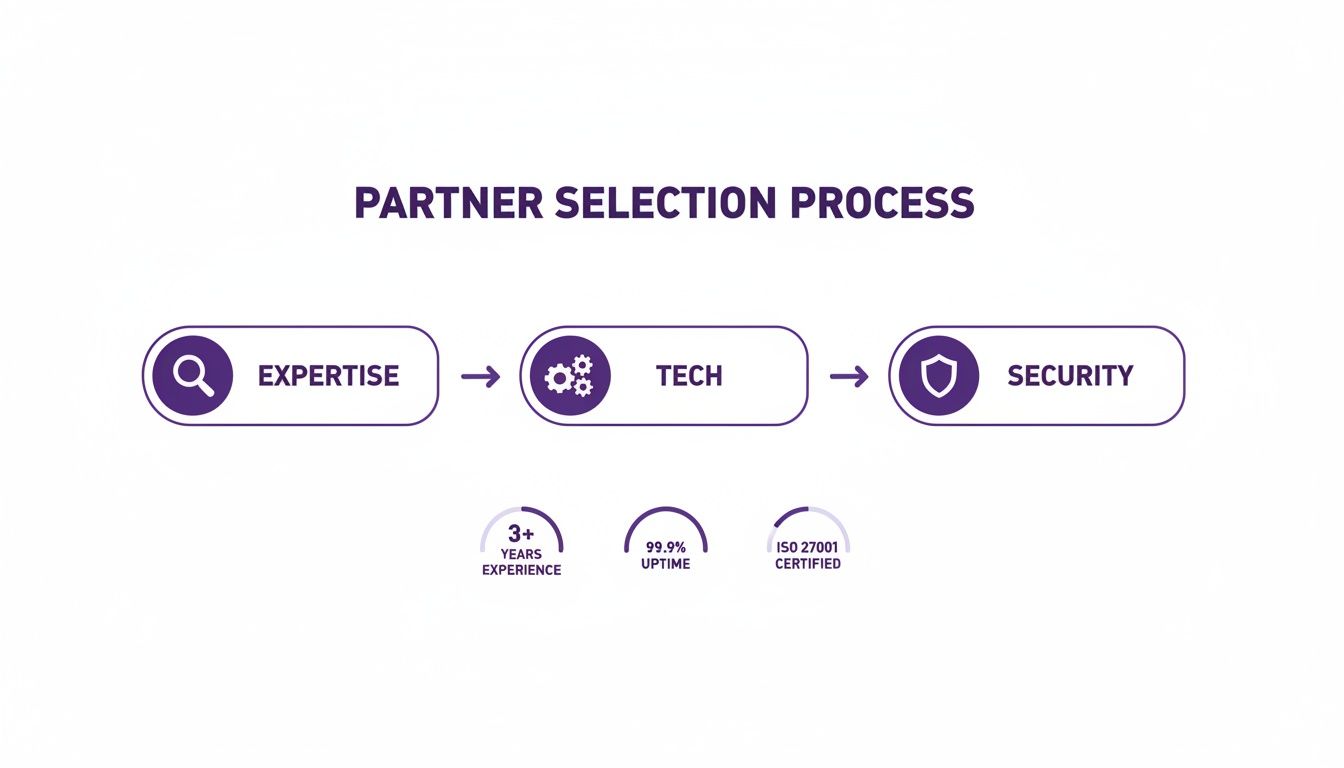
As the flow shows, a successful launch really begins with picking a partner who nails all three of these areas. It ensures everything is secure and technically sound before the first call is ever answered.
The Implementation Roadmap Unpacked
While every business is a little different, the rollout usually follows a proven path. Think of it like building a house: you need a solid foundation before you start putting up the walls.
- Discovery and Goal Setting: This first phase is all about getting in sync. Your partner will dive deep to understand your business goals, current workflows, and what your customers really expect. You’ll work together to define what a “win” looks like in clear, measurable terms.
- Technology Integration: This is where the tech teams get to work connecting the systems. It might involve linking their contact center platform with your CRM to make sure customer data flows securely and seamlessly between both sides.
- Agent Onboarding and Training: Your partner hand-picks and trains a dedicated team on your brand’s voice, products, and specific procedures. This is way more than a one-day workshop; it’s an immersive program designed to mold them into true ambassadors for your brand.
- Go-Live and Hypercare: The big day arrives, and the new team starts handling live customer interactions. This initial “hypercare” period is critical. Both teams will monitor performance like hawks, making real-time tweaks to iron out any kinks and ensure a fantastic customer experience from day one.
KPIs for Your Contact Center Solution: Defining and Measuring Success
How do you actually prove this new partnership is paying off? The answer is in the data. Tracking the right Key Performance Indicators (KPIs) is essential for managing your outsourced team and showing a clear return on your investment. These metrics tell the real story of your customer experience.
Key Takeaway: You can’t improve what you don’t measure. A transparent partner provides real-time access to performance data, turning metrics into actionable insights for continuous improvement.
While you could track dozens of metrics, a few stand out as mission-critical for gauging customer happiness and operational efficiency.
- First Call Resolution (FCR): This tracks the percentage of customer issues solved on the very first try, with no need for a follow-up call or email. A high FCR is a powerful sign that your agents are knowledgeable and your processes are dialed in.
- Customer Satisfaction (CSAT): Usually measured with a quick post-interaction survey like, “How satisfied were you today?” CSAT gives you an immediate pulse on customer sentiment. It helps you pinpoint what’s working and what’s not, one interaction at a time.
- Net Promoter Score (NPS): This metric looks at the bigger picture of customer loyalty by asking how likely a customer is to recommend your brand to a friend. NPS gives you a high-level view of your overall brand health and the strength of your customer relationships.
Getting a handle on these core metrics is fundamental. To go deeper, check out our guide on call center reporting and metrics dashboards. A great partner will make this a collaborative process, helping you set realistic benchmarks and constantly refining strategies to blow past them.
Frequently Asked Questions About Contact Center Outsourcing Solutions
Navigating the world of outsourcing often brings up a few critical questions. Getting clear, straightforward answers is key to making a confident decision. Let’s tackle the most common concerns businesses have when considering a contact center outsourcing solution.
What does a contact center outsourcing solution typically cost?
There’s no single price tag, as the right model is always tailored to your specific needs. However, pricing generally falls into one of three common structures, each built for different business scenarios.
- Per-Hour Model: You pay a set hourly rate for each agent’s time. This is a great fit for businesses with stable, predictable call volumes that need a consistently available team.
- Per-Interaction Model: You pay a fixed fee for each call, email, or chat handled. This works wonders for companies with fluctuating or unpredictable volume, since you only pay for the work that gets done.
- Dedicated Agent Model: You pay a flat monthly fee for a dedicated agent or team that works exclusively for you. This model offers the deepest brand immersion and is perfect for complex support needs requiring extensive product knowledge.
How do you maintain brand voice and quality?
This is a huge—and completely valid—concern. Handing over customer interactions can feel like a leap of faith, but a true partner has a robust system to become a seamless extension of your brand. It’s a collaborative effort built on three core pillars.
First is immersive training, where agents don’t just learn your products—they learn your culture and the specific nuances of your brand voice. Next comes relentless quality assurance (QA), where dedicated teams monitor interactions against a shared scorecard to guarantee consistency.
Finally, we establish collaborative feedback loops. Through weekly and monthly performance reviews, we ensure we’re always aligned with your goals and making data-driven improvements together.
What’s the real difference between nearshore and offshore outsourcing?
While both involve outsourcing to another country, the practical differences for U.S. businesses are night and day. Offshore typically means partnering with a provider somewhere distant, like the Philippines or India. This can lead to significant time zone gaps and, at times, cultural disconnects that your customers can feel.
Nearshore, like our operations in Tijuana, offers a massive advantage.
The nearshore model eliminates the friction of distance. With aligned time zones and strong cultural affinity, collaboration becomes effortless, making your outsourced team feel like they’re just in the next office over, not halfway around the world.
This proximity makes communication a breeze, simplifies site visits, and fosters a much more integrated partnership that delivers a natural, intuitive customer experience.
How quickly can an outsourced team be up and running?
The timeline really depends on the complexity of your operation, but a typical implementation follows a clear, well-worn path. A standard launch can often be completed in just four to six weeks.
This window covers everything from the initial discovery and goal-setting phase to technology integration, agent hiring, comprehensive training, and the final go-live day.
Ready to Explore Your Contact Center Outsourcing Solution?
We’ve covered a lot of ground, and hopefully, it’s clear that contact center outsourcing is much more than just an operational shortcut—it’s a real strategic investment in your brand’s future. It’s a proven way to ramp up efficiency, elevate the quality of your service, and drive sustainable growth.
The right partnership frees you up to do what you do best: focus on your core business. You can leave the customer interactions to dedicated experts who live and breathe this stuff.
Chart Your Path Forward
Now is the perfect time to take a hard look at your current customer service strategy. Get real about your operational costs, the headaches of scaling, and what your customer satisfaction scores are truly telling you. Pinpointing those areas for improvement is the first move.
Think about what a dedicated nearshore team could unlock for your business. Imagine having the power to scale up (or down) on a dime, tapping into bilingual agents to open up new markets, and enjoying the peace of mind that comes with predictable costs. That’s the advantage a strategic partner brings to the table.
Key Takeaway: The journey to an exceptional customer experience starts with a single step—assessing where you stand today and exploring how a dedicated partner can fill the gaps to accelerate your growth.
Exploring what’s possible is your logical next step. When you’re ready to build a more resilient, customer-first operation, our team is here to help. We can walk through your unique needs and design a solution that fits your goals and budget perfectly.
🚀 Ready to Elevate Your Customer Experience?
Discover how CallZent’s nearshore contact center outsourcing solutions help you reduce costs, scale fast, and deliver exceptional CX.
Ready to transform your customer experience and unlock new levels of efficiency? Contact CallZent today to Get a Free Quote and discover how our nearshore solutions can help your business thrive.