Skip to content
Customer Experience BPO
Breaking Barriers: Essential Cross-Cultural Communication for BPO Success
Master Cross-Cultural Communication for BPO success. Learn how cultural fluency boosts CSAT, improves FCR, and strengthens customer relationships in every market you serve.
TL;DR — Quick Takeaways
- Cross-cultural communication for BPO teams directly improves CSAT, FCR, and customer loyalty by reducing friction caused by cultural misunderstandings.
- Cultural missteps are costly: too much directness, the wrong tone, or incorrect formality can damage trust and increase churn.
- Agents need four core skills: Cultural Self-Awareness, Empathy, Communication Adaptation, and Ambiguity Handling.
- Build mastery by hiring for empathy, using immersive training, and creating a living cultural knowledge base.
- The nearshore advantage: Bicultural teams naturally excel at Cross-Cultural Communication for BPO operations.
Have you ever noticed how two customers, asking the same question, can require completely different approaches to feel satisfied? The answer isn’t just about what they say; it’s about the cultural lens through which they see the world. Mastering cross-cultural communication skills is no longer a soft skill—it’s the critical factor that separates an average BPO from an exceptional one.
This guide provides actionable insights for building a support team that doesn’t just speak the language, but understands the culture behind the conversation, turning every interaction into a positive brand experience.
Why Cross-Cultural Communication Skills Are a BPO Superpower
In a globalized market, simply speaking the same language isn’t enough. The real magic for a nearshore BPO happens when agents understand the person on the other end of the line—their expectations, their communication style, and their cultural norms.
Think of this real-world example:
- A customer from New York might appreciate a direct, no-nonsense agent who resolves their issue in under two minutes. They see it as efficient and respectful of their time.
- A customer from the Southern U.S., however, might prefer an agent who starts with a bit of friendly small talk (“How’s your day going so far?”) before diving into the problem. To them, this builds rapport and trust.
An agent who uses the same script for both customers will succeed with one and fail with the other. The New Yorker might find the small talk unprofessional, while the Southerner could perceive the direct approach as rude. Getting this wrong is a fast track to accidental friction.
Mastering cross-cultural communication skills transforms agents from simple problem-solvers into genuine brand ambassadors who can build authentic connections. This isn’t just a “soft skill”; it’s a hard-hitting business driver that directly boosts:
- Customer Satisfaction (CSAT): When customers feel truly heard and respected on a cultural level, satisfaction scores climb.
- First-Call Resolution (FCR): Clearer communication means fewer misunderstandings, leading to more issues being solved on the first try.
- Client Retention: Service that is culturally attuned builds powerful loyalty and makes your brand reputation shine.
Ultimately, this is about moving beyond just translating words to interpreting intent. It’s about making sure your message isn’t just heard, but is actually felt the way you intended. Investing in this area provides a massive competitive edge and is a cornerstone of the nearshore advantage that top-tier partners bring to the table.
The Hidden Costs of Cultural Missteps in Customer Support
A single cultural misunderstanding can unravel a customer relationship in seconds. While language fluency is a great start, it’s the subtle, unwritten rules of communication that often determine whether an interaction ends with a happy customer or a damaging one-star review.
Ignoring the nuances of cross cultural communication skills isn’t just a minor oversight—it’s a direct threat to your bottom line.
Consider an agent trained for maximum efficiency. They get straight to the point and use direct language to resolve issues quickly. This works perfectly with a customer from a similar, task-oriented culture, where it’s perceived as professional and effective.
But when that same agent interacts with a customer from a more relationship-focused culture (common in many parts of Latin America and Asia), that directness can feel abrupt, cold, or even rude. The customer might feel disrespected, leading to frustration and a negative perception of your entire brand.
When Good Intentions Go Wrong: Real-World Examples
Misunderstandings like these pop up when cultural expectations clash. These friction points can quickly escalate, creating very real financial and reputational damage.
Here are a few common scenarios in a call center:
- Varying Politeness Cues: An agent might use a customer’s first name to build rapport, as is common in the U.S. But in a more formal culture like Germany or Japan, this can be seen as overly familiar and disrespectful.
- Perceptions of Silence: In some cultures, a pause signifies thoughtful consideration. In others, it can be interpreted as confusion or incompetence, causing the customer to lose confidence.
- Direct vs. Indirect Feedback: A customer from a high-context culture might hint at their dissatisfaction indirectly to avoid confrontation (“Well, it’s not quite what I was hoping for”). An agent trained only to listen for direct complaints (“I am unhappy with this”) may miss these cues entirely, failing to solve the actual problem.
“A cultural misstep is more than just an awkward moment. It’s a breach of trust that can instantly sour a customer’s loyalty, turning a simple support call into a reason to leave for a competitor.”
These seemingly small misinterpretations pile up. They tank first-call resolution rates because agents and customers are speaking different emotional languages. They fuel negative word-of-mouth and tarnish your brand’s reputation in key markets. Most critically, they drive customers away. Every person who leaves due to a poor, culturally-unaware experience represents lost revenue and higher acquisition costs. This is why knowing how to reduce customer churn is directly linked to getting this right.
The Core Pillars of a Culturally Fluent Agent
Mastering cross-cultural communication isn’t about memorizing stereotypes. It’s about building a flexible, empathetic mindset that can adapt to any customer, anywhere. This complex ability rests on four teachable pillars that transform a good agent into a truly great brand ambassador.
Breaking these skills down provides a clear blueprint for what excellence looks like in action. It moves your team from simply knowing about cultural differences to actively using that knowledge to build stronger connections and solve problems more effectively.
Pillar 1: Cultural Self-Awareness
The journey to understanding others begins with understanding yourself. Cultural self-awareness is the ability to recognize how your own cultural background—your values, biases, and communication style—shapes your perceptions and actions. Without this foundation, it’s easy to assume your way is the “normal” way.
For a call center agent, this means acknowledging that their direct, fast-paced approach might be rooted in a culture that values efficiency over relationship-building. Recognizing this bias is the first step toward adapting to a customer who needs a more personal, unhurried conversation to feel heard.
Pillar 2: Empathy and Perspective-Taking
While self-awareness is internal, empathy is external. It’s the skill of genuinely trying to see a situation from the customer’s cultural viewpoint. This goes beyond simple sympathy; it’s an active attempt to understand the why behind their communication style, expectations, and emotional responses.
For example, a customer from a hierarchical culture may be hesitant to contradict an agent they see as an authority figure. An empathetic agent will notice this deference, use more open-ended questions (“How does that solution sound to you?”), and create a safe space for the customer to share the real issue without feeling disrespectful. This is a cornerstone of emotional intelligence in customer service.
This simple flowchart shows how quickly a minor misunderstanding can escalate, leading directly to a lost customer.
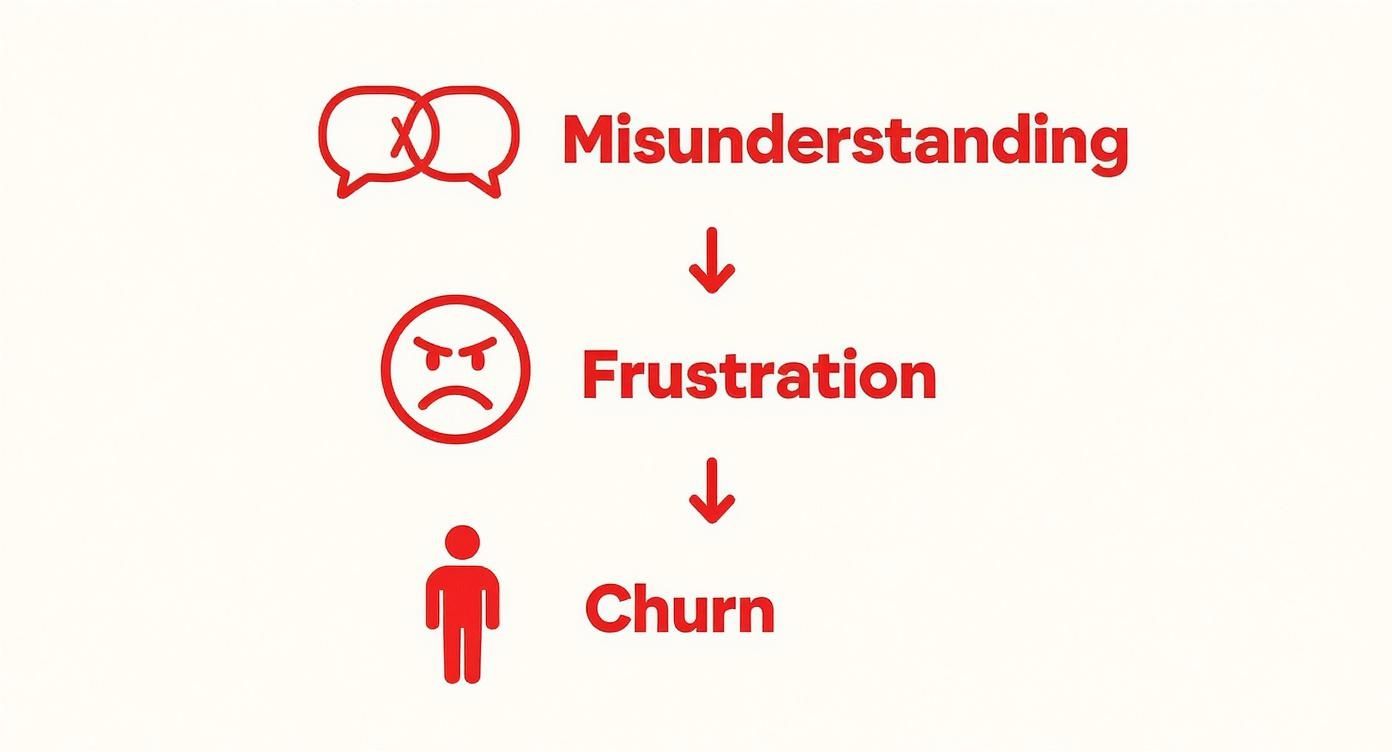
As you can see, churn isn’t a sudden event. It’s often the final stage of a communication breakdown that started with a completely preventable cultural misstep.
Pillar 3: Communication Adaptation
This is where theory becomes practice. Communication adaptation is the ability to consciously adjust your tone, pace, and vocabulary to better match the customer’s cultural preferences. It’s about meeting them where they are.
- Adjusting Formality: Using titles like “Mr.” or “Ms.” for a customer from a formal culture, versus using a first name for one from a more egalitarian background.
- Pacing the Conversation: Slowing down your speech and allowing for longer pauses when speaking with someone whose culture values thoughtful silence.
- Modifying Directness: Phrasing suggestions more softly (e.g., “Perhaps we could try…”) for an indirect communicator, instead of giving a direct command (“You need to do this”).
Pillar 4: Handling Ambiguity
Cross-cultural interactions are often filled with unclear signals. The ability to handle ambiguity means staying calm, patient, and resourceful when communication isn’t straightforward. Instead of getting frustrated by a vague response, a skilled agent sees it as a cue to ask clarifying questions and listen more carefully. This resilience prevents misunderstandings from escalating and shows the customer that the agent is committed to understanding them.
 Applying Cross-Cultural Communication Skills in Your BPO
Here is a quick summary of these core competencies and how they apply in a real-world call center setting.
| Key Competency | Definition | Real-World Call Center Example |
|---|---|---|
| Cultural Self-Awareness | Recognizing how your own cultural background influences your behavior. | An agent from a direct culture realizes their straightforward feedback might sound rude and adjusts to be more diplomatic. |
| Empathy & Perspective-Taking | Understanding the situation from the customer’s cultural viewpoint. | An agent recognizes a customer’s hesitation isn’t indecisiveness but a cultural norm and gives them more time to speak. |
| Communication Adaptation | Modifying your communication style to meet the cultural needs of the other person. | An agent slows their speech and avoids using complex idioms when speaking with a non-native English speaker. |
| Handling Ambiguity | Staying patient and resourceful when faced with unclear communication cues. | When a customer gives a vague “yes,” the agent asks clarifying questions like, “Just to be sure, does that mean you’re ready?” |
By developing these four skills, your agents move beyond just speaking the same language—they start speaking the same cultural language, building the kind of trust and rapport that creates customers for life.
 How to Build a Culturally Competent Support Team
Building a support team with sharp cross-cultural communication skills isn’t a one-time workshop; it’s a continuous, strategic effort woven into your operational fabric. To do it right, you must move beyond theory and implement practical processes that empower agents to handle diverse customer interactions with confidence.
This isn’t just about making customers feel good—it’s about driving business performance. The connection between cultural competence and the bottom line is clear. Companies with diverse leadership teams are more likely to outperform their peers financially, and that same principle applies to the customer-facing teams who are the voice of your brand.
Start with Hiring: Integrating Cultural Competency from Day One
It all starts with hiring. Look for cultural intelligence from the get-go. A candidate’s ability to show empathy, self-awareness, and adaptability is just as critical as their technical skills.
Embed cultural competency questions directly into your interview process. Ditch generic questions and use situational prompts instead:
- “Tell me about a time you had a misunderstanding with someone from a different background. How did you resolve it?”
- “Imagine a customer seems frustrated but is being very indirect. What steps would you take to understand their real issue?”
Their answers reveal their capacity for empathy and their ability to solve problems in ambiguous situations—key indicators of their potential to develop the advanced cross-cultural communication skills your team needs.
Foster Continuous Learning and Practical Application
One-off training sessions have a short shelf life. To build a truly competent team, create an environment where learning is constant and collaborative.
“Your best training resource is your team’s collective experience. Creating a system for agents to share, discuss, and learn from their cross-cultural challenges turns every difficult call into a teachable moment for everyone.”
Here are three actionable ways to put this into practice:
- Immersive Role-Playing: Go beyond standard scripts. Create detailed customer personas from your key markets, complete with cultural backstories, communication styles, and common frustrations. This gives agents a safe space to practice adapting their approach without real-world pressure.
- Create a Cultural Knowledge Base: Build a shared internal resource—like a wiki or a Teams channel—where agents can share notes on cultural norms, communication tips, and strategies that worked well for different customer groups. This “living document” becomes more valuable with every new insight.
- Peer-to-Peer Learning Sessions: Set up regular, informal meetings where agents can openly discuss tough cross-cultural interactions. Collaborative problem-solving builds team unity and helps everyone learn from each other’s wins and stumbles.
At CallZent, this commitment to ongoing development is a core advantage. We focus on practical application and shared learning, building teams that are not just bilingual, but truly bicultural. It’s a proactive approach that is a key part of how CallZent trains bilingual agents to deliver service that is a cut above the rest.
Navigating Cultural Nuances in Digital Communication
When you shift a conversation from a phone call to email or live chat, you lose crucial context. Tone of voice and body language disappear, creating a minefield for potential misunderstandings. That’s why excellent cross-cultural communication skills must extend to every typed word, emoji, and punctuation mark.
In text-only conversations, the risk of a cultural misstep skyrockets. A friendly exclamation point in one culture might come off as aggressive in another. The same goes for emojis and acronyms—”LOL” or “ASAP” can cause confusion, or even offense, if the person on the other end isn’t familiar with the cultural shorthand.
Actionable Tips for Adapting Written Style for a Global Audience
To avoid sounding abrupt or overly casual, agents must master the art of conveying the right tone and formality in writing. This is a core competency for any team providing true omnichannel support.
- Default to Formal Salutations: It’s always safer to start with “Dear Mr./Ms. [Last Name]” unless the customer sets a more casual tone first. It shows respect across most cultures.
- Be Mindful of Punctuation: Use exclamation points sparingly. In many cultures, overusing them can feel like you’re shouting or being impatient.
- Clarify Acronyms and Jargon: Spell out terms before using abbreviations. For example, write “as soon as possible” before using “ASAP.”
- Use Emojis with Extreme Caution: A thumbs-up emoji is positive in most Western countries but is a deeply offensive insult in others. When in doubt, leave it out.
The Growing Importance of Digital Cultural Fluency
The need for these skills is becoming more critical as interactions move online. One study found that while 79.2% of people feel digitalization has made cross-cultural interaction simpler, a massive 90.4% agree that cross-cultural communication is an essential skill. You can read the full research on digital age communication to see just how vital this has become.
“In digital channels, every word carries extra weight. Mastering written tone isn’t just about good grammar; it’s about showing cultural respect and building trust through a screen.”
To bridge these digital divides, teams need the right tools and strategies. This means understanding how SaaS help desk solutions can manage multilingual queries and even leaning on resources for auto translate devices and localization tips. It’s all proof that cultural fluency must be woven into every communication format.
Your Partner for Globally-Minded Customer Support
Going global successfully takes more than just a bilingual call center. It demands a partner who understands that great service is about genuine connection, not just conversation.
We’ve walked through why advanced cross-cultural communication skills are non-negotiable for any modern BPO, directly shaping the trust and loyalty your customers feel. The magic happens when you move from language fluency to cultural fluency—that’s what turns an adequate support experience into an exceptional one.
This is where a strategic nearshore partnership with CallZent makes all the difference. Our unique position in Tijuana gives clients access to a truly bicultural and bilingual workforce. Our agents don’t just speak the language; they live the culture, making them inherently attuned to North American consumer expectations. They seamlessly bridge the cultural gaps that other BPOs often don’t even see. This isn’t just a feature; it’s a built-in strategic edge for your brand.
Choosing the right BPO means choosing a team that can represent your brand with the cultural intelligence and empathy your global customers deserve.
Don’t let preventable cultural missteps weaken your customer relationships. Partner with a team of experts ready to build stronger connections that drive real worldwide growth. At CallZent, we have the experience, the talent, and the deep-seated cultural insight to transform your customer support from a cost center into a powerful competitive advantage.
Ready to see how a culturally-aware team can elevate your customer experience? Discover CallZent’s custom-fit BPO solutions and let’s start building a more connected future for your brand.
Frequently Asked Questions (FAQ)
How can we effectively train agents on cross-cultural communication skills?
Effective training must be practical and active, not theoretical.
- Run Interactive Scenarios: Use role-playing exercises based on culturally diverse customer personas your team actually encounters.
- Create a Shared Knowledge Base: Set up an internal wiki or channel where agents can share insights and strategies that worked for specific cultural situations.
- Offer Continuous Coaching: Use real call evaluations to provide ongoing feedback and reinforce good habits, moving beyond one-off workshops.
Are bilingual skills enough for excellent customer service?
No. Being bilingual is the starting line, not the finish line. Speaking the same language doesn’t guarantee understanding. A customer’s idea of politeness, their comfort with direct questions, and how they describe a problem are all shaped by culture. Fluency gets you in the door, but cross-cultural communication skills are what make the conversation successful, turning a transaction into a connection.
What is the best first step to improve our team’s cross-cultural skills?
The most powerful first step is to build self-awareness. Help your team understand their own cultural communication styles and how others might perceive them. From there, identify the primary cultures within your customer base and focus initial training on understanding those specific communication patterns. This targeted approach will deliver the biggest and fastest improvements for your team and your customers.
🚀 Elevate Your Customer Experience With Cultural Fluency
Partner with a bicultural, bilingual BPO team trained for world-class Cross-Cultural Communication for BPO success.
Ready to partner with a team that has cultural intelligence baked right in? CallZent delivers globally-minded customer support that turns every conversation into a connection. Discover our custom-fit BPO solutions today.