Skip to content
CUSTOMER EXPERIENCE STRATEGY
Customer Care Orientation: Building a Customer-First Culture That Drives Growth
Customer care orientation turns support into a growth engine. Learn how customer-first companies reduce churn, increase loyalty, and boost customer lifetime value.
TL;DR — Quick Takeaways
- Customer care orientation means every department prioritizes customer success, not just the support team.
- Companies with strong customer-first cultures see higher customer retention, loyalty, and revenue growth.
- Key drivers include empowered agents, data-driven empathy, and proactive problem-solving.
- Nearshore BPO partners like CallZent help scale customer-first support with bilingual agents and cost-efficient operations.
- What it is: A company-wide philosophy that prioritizes customer needs in every decision and process.
- Why it matters: Businesses with strong customer orientation reduce churn, increase loyalty, and boost Customer Lifetime Value (CLV).
- The shift: Moving from reactive problem-solving to proactive customer experience design.
- How to implement it: Empower agents, use customer data for empathy, and adopt proactive problem-solving across departments.
- How CallZent helps: Nearshore BPO teams can scale customer-first support while delivering cost efficiency and cultural alignment.
Are you sure your “customer-first” strategy is actually putting customers first? Many companies talk about being customer-centric, but in reality, they just have a highly-trained cleanup crew for when things go wrong.
True customer care orientation is a completely different approach. It’s not just a handbook for your support agents; it’s a core business philosophy that places the customer at the absolute center of every single decision, from product development to billing.
 What is Customer Care Orientation (And What It’s Not)?
Think of it like a ship’s compass. The needle always points to “true north,” guiding every turn to ensure the vessel reaches its destination. For a business, customer care orientation is that compass. It’s the unwavering true north that guides the entire organization—product, marketing, billing, and agent training—toward one goal: customer success.
This isn’t about getting better at handling complaints. It’s about building a business so attuned to its customers that most complaints never happen in the first place. It’s a proactive, company-wide promise to understand, anticipate, and consistently deliver on customer needs.
Key Takeaway: Customer care orientation isn’t a department; it’s a cultural mindset. It transforms customer interactions from a cost center focused on speed into a value engine focused on loyalty and growth.
A Fundamental Shift in Perspective
Getting this right requires a huge shift away from the old, siloed way of handling customer service. The traditional model treats support as a reactive team, jumping in only after a problem has surfaced. A business with a genuine customer care orientation, however, sees every employee as part of the customer experience.
Here’s what that shift looks like in practice:
- Reactive vs. Proactive: Instead of waiting for a customer to complain about a clunky checkout process, a customer-oriented team is proactively hunting for that friction and fixing it.
- Transactional vs. Relational: A traditional interaction ends when a ticket is closed. A relational approach means following up to ensure satisfaction and using that feedback to improve the experience for the next person.
- Departmental vs. Organizational: Instead of tossing “customer issues” to the support team, the whole company—from engineering to finance—is accountable for the experience. This is a key difference between customer service and customer experience and how both fuel growth.
This is more than a feel-good strategy; it’s a direct line to financial success. According to research, companies that lead in customer experience outperform laggards by nearly 80%, proving that a powerful customer care orientation slashes churn and significantly boosts revenue.
How a Strong Customer Care Orientation Compares to Traditional Service
To really nail down the difference, it helps to see the two approaches side-by-side. The table below breaks down the fundamental shift in mindset, metrics, and goals when a company graduates from a reactive service model to a proactive, all-in customer care orientation.
| Aspect | Traditional Customer Service (Reactive) | Customer Care Orientation (Proactive) |
|---|---|---|
| Primary Goal | Resolve tickets and close cases quickly. | Build long-term loyalty and maximize customer lifetime value. |
| Core Metric | Average Handle Time (AHT), Number of Tickets Closed. | Customer Satisfaction (CSAT), Net Promoter Score (NPS), Customer Effort Score (CES). |
| Team Focus | A dedicated support department that handles complaints. | A company-wide culture where every employee owns the customer experience. |
| Approach | Responds to problems after they have already occurred. | Anticipates needs and designs systems to prevent problems from happening. |
| Agent Role | Follow scripts and resolve issues within strict guidelines. | Empowered to make decisions and find creative solutions for the customer. |
As you can see, it’s not just a minor tweak—it’s a complete reimagining of what it means to serve a customer. One model is about damage control; the other is about value creation.
 The True Business Value of a Customer-First Culture
Let’s get one thing straight: a customer care orientation isn’t about warm feelings or a new mission statement. It’s a direct investment in your bottom line.
While the old-school view pegs customer service as a cost center, a true customer-first culture is a powerful profit driver. The focus shifts from just closing tickets to building long-term relationships that pay serious dividends. This mindset directly impacts metrics like customer churn, revenue, and, most importantly, Customer Lifetime Value (CLV). When every interaction is helpful, proactive, and empathetic, customers don’t just stick around; they spend more and become your best salespeople. Thinking about how to increase customer lifetime value starts with weaving this philosophy into your daily operations.
From Cost Center to Profit Driver
Imagine an e-commerce company ships the wrong item. The reactive, cost-center approach is a bland, apologetic email and a return label. A company with a real customer care orientation, however, sees a golden opportunity.
Their empowered agent not only rushes the correct item with overnight shipping but also tells the customer to keep the wrong one as a gift. That small gesture turns a frustrating mistake into a loyalty-defining moment. You’ve just turned a potential one-star complaint into a five-star story they’ll tell their friends. The act costs pennies but generates immense goodwill and future sales.
It’s the same in other industries. A healthcare provider can do more than just book appointments. By proactively sending reminders, offering clear directions, and making the check-in process ridiculously simple, they reduce patient anxiety and costly no-shows. This isn’t just “good service”—it’s a strategic move that makes the clinic more efficient and boosts patient satisfaction scores.
86% of buyers are willing to pay more for a great customer experience, proving that a strong customer care orientation is a direct revenue driver.
The data is crystal clear: customers will reward you for good service and punish you for bad experiences. Studies show that 53% of consumers will cut spending after just one bad interaction, yet they are 3x more likely to recommend a brand after a positive one. These numbers prove a customer care orientation isn’t an expense—it’s an investment with a very real, measurable return. You can dig into more of these critical customer service statistics and their impact.
How a Nearshore BPO Partner Amplifies Your ROI
Building this kind of culture from the ground up is a massive undertaking. This is where a strategic nearshore partner like CallZent provides immediate, tangible value. We don’t just answer calls; we become a seamless extension of your brand’s commitment to its customers.
Our bilingual agents in Tijuana are trained on your company’s values, not just scripts. This empowers them to deliver the kind of empathetic, effective support that forges lasting relationships. By partnering with us, you get:
- Scalable Expertise: Instantly plug into a team of professional agents who already live and breathe your customer-first goals.
- Cost-Effective Operations: Get superior service at a fraction of the cost of building an in-house team, thanks to our strategic nearshore location.
- Actionable Insights: We feed you data and feedback directly from the front lines, helping you continuously fine-tune your customer journey.
By integrating our expert teams, you can transform your customer support from a necessary cost into a scalable engine for revenue growth and brand loyalty.
The 3 Pillars of a Strong Customer Care Orientation
Building a company that truly lives and breathes customer care is about more than just a new motto. It requires a cultural shift grounded in principles your team can actually use. A real customer care orientation is built on three foundational pillars: empowering your frontline, using data to drive empathy, and proactively solving problems before they start.
When you get these three pillars right, they support every single interaction, turning routine service calls into memorable, loyalty-building experiences.
Pillar 1: Empowering Your Frontline Agents
A genuine customer-oriented culture gives agents the autonomy to solve problems on the spot. This means trusting your team to make smart decisions without getting bogged down in red tape or waiting for layers of approval. This kind of empowerment transforms your agents from script-readers into true customer advocates.
Picture this: a customer calls your BPO partner because their subscription auto-renewed by mistake. They’re frustrated and worried about the unexpected charge.
- A Non-Empowered Agent: Sticks to a rigid script, offers a flat apology, and tells the customer they have to fill out a refund form that will take 5-7 business days to review. The customer’s frustration boils over, and they hang up feeling ignored.
- An Empowered CallZent Agent: Listens, understands the concern, quickly verifies the situation, and immediately processes a full refund. Because they are authorized to make things right, they also offer a free month of service for the trouble, turning a negative moment into one of unexpected delight.
This is what frontline empowerment is all about: giving agents the authority to deliver a solution, not just an apology. It proves to the customer that you see their problem as your own.
This approach does more than just boost satisfaction scores; it builds deep, lasting trust. The customer walks away feeling heard and valued, which strengthens their bond with your brand.
Pillar 2: Using Data for Human-Centric Empathy
Empathy without context can feel generic. A great customer care orientation uses data not to automate replies, but to make them more human. Your CRM is a goldmine of information that can turn a standard interaction into a genuinely personal one.
When an agent can see a customer’s full history—past orders, previous support tickets, and even their preferred communication channel—they can deliver support that feels both personal and incredibly effective.
Let’s say a long-time customer of an e-commerce brand calls because a product they just bought isn’t working right. An agent with access to their history sees they’ve been a loyal buyer for over five years and rarely contact support.
Instead of launching into a generic script, the agent says, “I see you’ve been with us since 2019, Mr. Smith. I’m so sorry you’re having trouble with your new gadget. Let’s get this sorted out for you right away.” That simple acknowledgment completely changes the conversation. The agent is using data to show informed empathy, making the customer feel like a valued person, not just another ticket number. This is key to learning how to humanize your brand in every single interaction.
Pillar 3: Adopting a Proactive Problem-Solving Mindset
The final pillar moves your team’s focus from just reacting to issues to actively preventing them. A customer-oriented culture is constantly digging for the “why” behind every problem. Your support team, especially a dedicated BPO partner like CallZent, is perfectly positioned to spot recurring issues and alert you to systemic problems before they escalate.
Think about a scenario where dozens of customers are calling about confusion over a new billing statement.
- A Reactive Approach: Agents answer each call one by one, explain the new statement layout, and close the tickets. The root problem never gets fixed.
- A Proactive Approach: After the third call about the same issue, a team lead at your BPO partner flags it as a trend. They analyze the calls, realize one specific section of the invoice is causing confusion, and put together a quick report with call examples and a suggested fix.
This feedback loop allows the company to redesign the invoice, add a helpful explainer to the customer portal, and send out a clarifying email. The result? Call volume plummets, saving everyone time and preventing future customer frustration. Proactive problem-solving turns your support center from a firefighting unit into a strategic intelligence hub.
A Practical Framework for Implementation
Turning a philosophy like customer care orientation into day-to-day operations can feel daunting. The good news? You don’t have to rebuild your entire company overnight. By breaking the process into manageable phases, you can build a strong, customer-first culture one step at a time.
Think of this framework as your roadmap for turning big ideas into concrete actions. Each phase builds on the last, creating a smooth and sustainable shift that gets everyone on board, including key partners like CallZent.
Secure Executive Buy-In and Set the Vision
Before any real change can happen, your leadership team has to be all in. A customer care orientation isn’t just a department project; it’s a strategic business decision. To get that buy-in, you need to frame the initiative in terms of clear, tangible business outcomes—like higher revenue, lower churn, and a better Customer Lifetime Value (CLV).
Present a vision that’s about more than just “happier customers.” Show exactly how a proactive, empathetic approach to service hits the bottom line. For instance, a mid-sized insurance broker could calculate the revenue saved by cutting policyholder churn by just 5% through smarter, more compassionate claims support provided by a BPO partner.
Once leadership is aligned, create a clear, shared vision. This vision acts as the North Star for every effort that follows, defining what success looks like for your specific business.
Audit Your Current Customer Journey
You can’t improve what you don’t fully understand. The next step is a deep, honest audit of every single touchpoint a customer has with your brand. This means mapping out their entire experience, from the first time they land on your website to the moment they get their product and any support calls they make afterward.
During this phase, hunt for friction points:
- Where are customers getting stuck or frustrated?
- Which processes demand too much effort from them?
- Are there communication gaps between departments that create a clunky, disjointed experience?
Use tools like journey mapping software, customer feedback surveys, and call transcript analysis. Your BPO partner is a goldmine of information here—they have direct access to thousands of customer conversations packed with raw insights.
A thorough journey audit isn’t about placing blame; it’s about finding opportunities. Every point of friction you uncover is a chance to redesign a better, more thoughtful experience.
Train and Empower Your Teams
With a clear vision and a map of your customer journey, it’s time to get your teams ready. This phase is critical and involves everyone, from your internal staff to your nearshore BPO partners. Training for a customer care orientation goes way beyond product knowledge and reading from a script.
It has to focus on soft skills like active listening, genuine empathy, and creative problem-solving. This is a huge part of building a truly customer-centric culture where agents feel confident and capable. Empower your agents with the authority to actually resolve issues on their own, turning them from ticket-closers into brand heroes.
This infographic breaks down the three core pillars of great customer care: empowering agents, showing empathy in every conversation, and solving problems proactively.
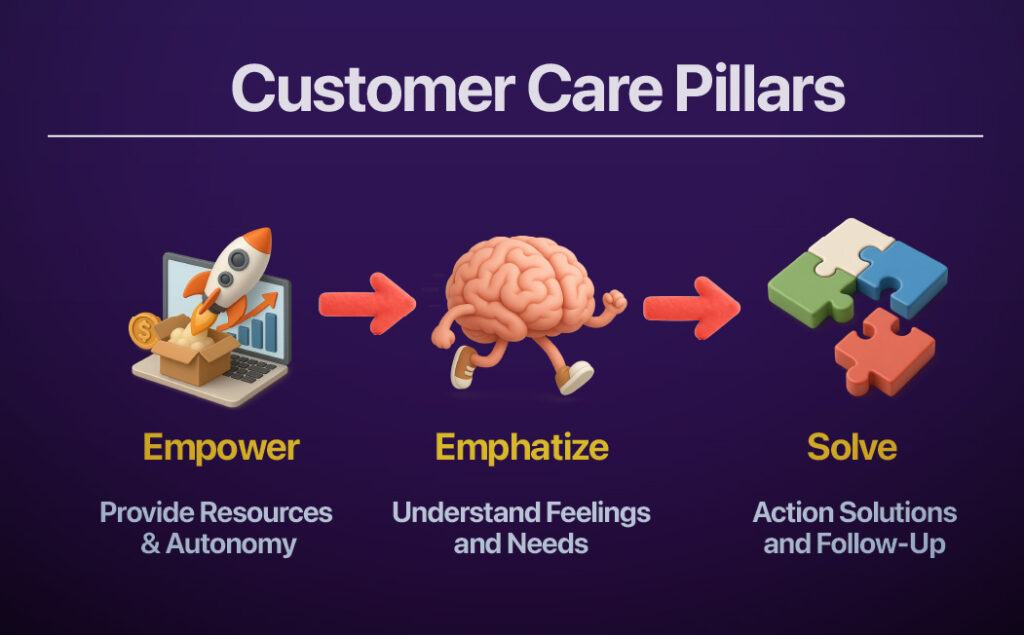
These pillars are designed to work together, creating an environment where your team is fully equipped to deliver the kind of exceptional experiences that build loyalty for the long haul.
Integrate Technology and Feedback Loops
The final phase is all about creating a system for continuous improvement. This means integrating technology that supports your agents, not replaces them. A unified CRM, for instance, gives agents a 360-degree view of the customer, enabling the kind of data-driven empathy that makes every interaction feel personal and effective.
At the same time, you need to establish strong feedback loops. Create clear channels for your BPO team to report recurring issues and customer sentiment back to your product, marketing, and operations teams. This transforms your contact center from a cost center into a strategic intelligence hub that drives proactive improvements across the business.
To keep that loyalty going strong, many businesses are incorporating loyalty gamification to turn repeat business into a fun, rewarding experience. These kinds of technology-driven initiatives are perfect for reinforcing the positive behaviors you’ve worked so hard to build.
Measuring Your Customer Care Orientation: Are You Tracking What Matters?
You’ve probably heard the old saying: “If you can’t measure it, you can’t improve it.” It’s a business classic for a reason. But when we talk about a customer care orientation, we have to ask a tough question: are we actually measuring the things that matter?
For too long, the focus has been on efficiency at all costs. It’s time to stop obsessing over how quickly you can get a customer off the phone and start measuring how happy you made them. This is how you prove the ROI of great customer care—not with speed, but with loyalty.
Moving Beyond Traditional Call Center Metrics
For decades, call centers were judged by metrics like Average Handle Time (AHT) and Calls Per Hour. While they might tell you something about operational efficiency, they say absolutely nothing about the quality of the conversation or how the customer actually feels.
Let’s be honest, these metrics can even backfire. When agents are pressured to end calls quickly, they’re incentivized to rush, not to resolve. A business with a genuine customer care focus understands this. It measures the outcome from the customer’s point of view. Did we solve their problem on the first try? Did we make it easy for them? Would they tell a friend about us? Those are the questions that lead to growth.
Key Takeaway: Measuring what matters means shifting focus from agent efficiency to customer loyalty. The goal isn’t to close tickets faster, but to build relationships that last longer.
Key KPIs for a Customer Care Orientation
So, what should you be tracking? To get a real sense of how your customer-first strategy is performing, you need a balanced set of metrics. Each one gives you a different piece of the puzzle, and together, they paint a complete picture of your customer experience.
Here are the four essential KPIs you need to start tracking. For an even deeper dive, check out our guide on the top KPIs in customer service that drive real business results.
-
First Contact Resolution (FCR): This metric measures the percentage of customer issues you solve on the very first try—no transfers, no callbacks, no follow-up emails needed. A high FCR is a direct sign that you respect your customer’s time and that your agents are empowered to solve problems.
-
Customer Effort Score (CES): CES asks a simple but powerful question: “How easy was it to get your issue resolved?” Reducing customer effort is one of the single biggest drivers of loyalty. This metric helps you find and eliminate friction points that frustrate customers.
-
Net Promoter Score (NPS): A classic for a reason, NPS measures customer loyalty by asking how likely they are to recommend your brand to friends or colleagues. It helps you sort customers into Promoters, Passives, and Detractors, giving you a clear, high-level view of brand health.
-
Customer Lifetime Value (CLV): This is the ultimate bottom-line metric. CLV tracks the total revenue you can expect from a single customer account throughout their entire relationship with your company. When your CLV is on the rise, it’s proof positive that your investments in building loyalty are paying off.
Building Your Customer-Oriented Dashboard
Tracking these KPIs is just the first step. The real magic happens when you see them all together on a single dashboard. This is where you can connect the dots and see how improvements in one area directly impact another. For example, you might find that a 10% jump in your FCR leads to a 5-point increase in NPS, which in turn boosts your overall CLV.
The table below breaks down these core metrics, what they measure, and why they’re so critical for any business that’s serious about growth.
Essential KPIs for a Customer Care Orientation
This table outlines the essential metrics for measuring the success of a customer-oriented strategy, moving beyond traditional call center stats.
| Metric | What It Measures | Why It Matters for Growth |
|---|---|---|
| First Contact Resolution (FCR) | The percentage of issues solved in a single interaction. | High FCR reduces customer frustration and operational costs, directly boosting satisfaction. |
| Customer Effort Score (CES) | How much effort a customer had to exert to get their issue handled. | Low effort is a powerful predictor of repeat business and loyalty. It shows you value their time. |
| Net Promoter Score (NPS) | Customer loyalty and their willingness to recommend your brand. | NPS is a leading indicator of future growth, as promoters drive word-of-mouth marketing. |
| Customer Lifetime Value (CLV) | The total profit a customer is expected to generate over time. | This is the ultimate proof of ROI, showing that happy, loyal customers are more profitable. |
By building your measurement strategy around these customer-centric KPIs, you’ll finally be able to show what you’ve known all along: investing in customer care isn’t a cost. It’s a direct driver of long-term, profitable growth.
Answering Your Top Questions About Customer Care Orientation
When leaders think about making a real shift toward a more proactive, meaningful customer approach, a lot of practical questions pop up. Moving to a true customer care orientation is a big deal that affects every corner of the business. Here, we tackle some of the most common questions decision-makers have about the budget, logistics, and partnerships involved.
This FAQ is designed to give you quick, straight answers so you can move forward with building a more resilient, customer-focused business.
How can a small business implement this on a budget?
A customer care orientation is a mindset first, a budget item second. Small businesses can kick off this shift with high-impact, low-cost changes. The trick is to focus on strategy and culture before you even think about expensive tech.
Start by mapping your customer journey to spot and smooth out any friction points. Make a real effort to ask for and listen to feedback, even if it’s just through simple surveys or direct conversations. Most importantly, empower your team to make customer-first decisions on the spot, without jumping through hoops for approval.
Partnering with a nearshore BPO like CallZent is also a surprisingly scalable and budget-friendly move. It gives you instant access to expert agents and top-tier technology without the massive upfront investment, letting you deliver enterprise-level care on a small business budget.
Isn’t this just a new buzzword for good customer service?
While they’re related, they are worlds apart. Good customer service is usually reactive—it’s about efficiently fixing problems as they happen. It’s absolutely essential, but it’s just one piece of the puzzle.
A customer care orientation, on the other hand, is a proactive, company-wide culture. It’s about making sure every department, from engineering to marketing, puts the customer’s best interests at the heart of their decisions. The focus is on anticipating needs and designing smooth, frictionless experiences to stop problems from ever happening.
Think of it like this: a great pit crew (customer service) is crucial for a race. But a customer care orientation is about designing the entire car from the ground up for reliability and driver delight. One is about fixing; the other is about creating.
How does a BPO partner help build a customer care orientation?
A true BPO partner does way more than just answer calls. They become an extension of your brand, living out your commitment to the customer in every single conversation. They are your eyes and ears on the front lines.
At CallZent, we make this happen in three key ways:
- Cultural Alignment: We dive deep to align our team with your brand values. Our agents don’t just work for you; they become passionate advocates who represent you with integrity.
- Actionable Data: We don’t just handle calls; we analyze them. We provide detailed reports on customer pain points, sentiment, and trends, giving you the hard data needed to make proactive improvements.
- Scalable Expertise: You instantly tap into a team of trained, bilingual agents and omnichannel technology. This means you can offer consistent, high-quality care across every channel, no matter how fast you grow.
We work right alongside you to weave your customer care philosophy into every agent interaction, turning your support team into a powerful strategic asset.
What’s the role of AI in a human-centric culture?
In a strong customer care culture, AI and technology are there to serve your people, not replace them. Their job is to supercharge your team’s abilities and free them up to do what humans do best: build real relationships.
AI is perfect for knocking out the routine, high-volume stuff—like checking an order status or answering basic FAQs. This efficiency lets your human agents pour their energy into the complex, high-empathy situations where they truly shine. AI can also arm agents with real-time customer context, helping them deliver smarter, more personal support.
The end goal is a seamless partnership where tech boosts efficiency and empowers your team to forge stronger, more meaningful connections with your customers.
🚀 Build a Customer-First Support Operation
CallZent helps companies scale customer-centric support with bilingual nearshore agents, advanced contact center technology, and data-driven performance management.
Talk to an ExpertReady to build a customer care orientation that drives real growth? CallZent offers scalable, expert BPO solutions that put your customers first. Discover how our nearshore services can transform your customer experience.