Skip to content
Customer Experience in Banking
Customer Experience Management in Banking: Closing the Loyalty Gap
Customer experience management in banking helps institutions reduce friction, improve retention, and deliver personalized, omnichannel service that drives long-term loyalty.
TL;DR — Quick Takeaways
- Customer experience management in banking requires a shift from internal processes to a fully customer-centric strategy.
- The biggest challenge is the gap between how banks perceive their service and how customers actually experience it.
- Winning banks focus on journey mapping, data-driven personalization, and seamless omnichannel experiences.
- Nearshore BPO partners like CallZent help banks scale high-quality, bilingual, and personalized customer support.
Let’s be honest: does your bank truly know how its customers feel? Many financial institutions are confident they deliver excellent service, but the on-the-ground reality for customers often tells a completely different story. This disconnect is one of the biggest challenges in modern banking, and closing it is the key to winning customer loyalty.
Why Your Customer Experience Strategy Might Be Failing
Here’s the thing about customer experience management in banking—it’s not just about polite tellers or a decent mobile app. It’s about deeply understanding and acting on what your customers are thinking and feeling at every single interaction. Far too many banks operate from an inside-out perspective. They get bogged down by internal processes and metrics that don’t line up with the real-world frustrations customers are dealing with.
This creates a dangerous blind spot. Recent industry findings paint a stark picture: while senior banking leaders rate their satisfaction with CX at 80%, actual customers put that number at a dismal 24%. That massive gap isn’t just a number; it’s a critical failure. For banks in the U.S. and EU, closing this chasm is non-negotiable. You can get a full breakdown of this strategic challenge and find out why bridging the customer experience gap is a key move for 2026.
The Source of Customer Frustration
This gap isn’t an accident. It’s born from siloed operations. The digital team doesn’t talk to the call center. The call center has no idea what happened at the branch. Each department hits its own targets, but in doing so, they inadvertently create a clunky, disjointed, and frustrating journey for the one person who matters most: the customer.
A real-world example? Imagine a customer applies for a credit card online but gets an error message. They call the support line, wait 20 minutes, and the agent has no record of the application. That’s a broken experience. It’s crucial to understand that a single positive transaction doesn’t equal a good overall experience. We explore the critical differences between customer service vs. customer experience in more detail in our guide. This fragmented approach is what leads to the common pain points that chip away at trust and loyalty.
Common Banking Channels and Customer Pain Points
This table highlights just a few of the frequent issues customers run into across different banking touchpoints. It underscores why a cohesive, omnichannel strategy isn’t a luxury—it’s a necessity for effective customer experience management in banking.
| Channel | Common Customer Frustration | Impact of Poor Experience |
|---|---|---|
| Mobile App | Complex navigation or frequent crashes when trying to complete a simple task, like transferring funds. | Customer abandons the task and loses trust in the bank’s digital competence. |
| Call Center | Long wait times followed by the need to repeat information to multiple agents who lack context. | High customer effort, increased frustration, and a feeling of being undervalued. |
| In-Branch | Tellers are unable to resolve issues that originated online, forcing the customer to start over. | A broken journey that makes the customer feel their time is not respected. |
| Website | Confusing product information or non-functional forms for loan applications or account opening. | High drop-off rates and potential customers turning to more user-friendly competitors. |
When experiences are broken at this level, it doesn’t matter how great your products are. Customers will remember the friction and look for a bank that makes their life easier, not harder.
The Four Pillars of Modern Banking CX
Building an exceptional customer experience management in banking strategy isn’t a one-off project. It’s a solid framework resting on four crucial pillars that work together. Think of it like building a house. You wouldn’t start with the paint and decorations; you need a solid foundation and a clear blueprint. These pillars are that essential structure.
Pillar 1: Customer Journey Mapping
First things first: you have to see the world through your customer’s eyes. Customer journey mapping is the process of visually plotting out every single interaction a customer has with your bank—from opening their first account to applying for a mortgage or disputing a charge.
This is where you ask the tough questions. Where do they get stuck? What makes them frustrated? And where are the moments you can create real delight? A good journey map isn’t based on what you think happens. It’s built from real customer feedback, support call transcripts, and hard behavioral data.
For example, a regional bank used journey mapping to dig into its mortgage application process. They found that customers were most annoyed by confusing paperwork and the long, silent wait between submission and approval. By pinpointing these friction points, the bank was able to redesign its entire communication flow. They added automated updates and a simple document checklist, which cut application times by 20% and sent satisfaction scores way up.
Pillar 2: Data and Analytics
If journey mapping is your blueprint, then data and analytics are the tools you use to measure, cut, and shape everything. Every click, app login, call, and branch visit generates a mountain of data. The goal is to turn that raw information into intelligence you can actually use.
This isn’t about intimidating data science. It’s about getting clear answers to practical questions:
- Which customers are most likely to leave in the next 90 days?
- What’s the number one reason people are calling our support center?
- Are customers who use our mobile app more profitable than those who only visit branches?
This is where the massive disconnect between a bank’s internal view and the customer’s real experience often becomes crystal clear.
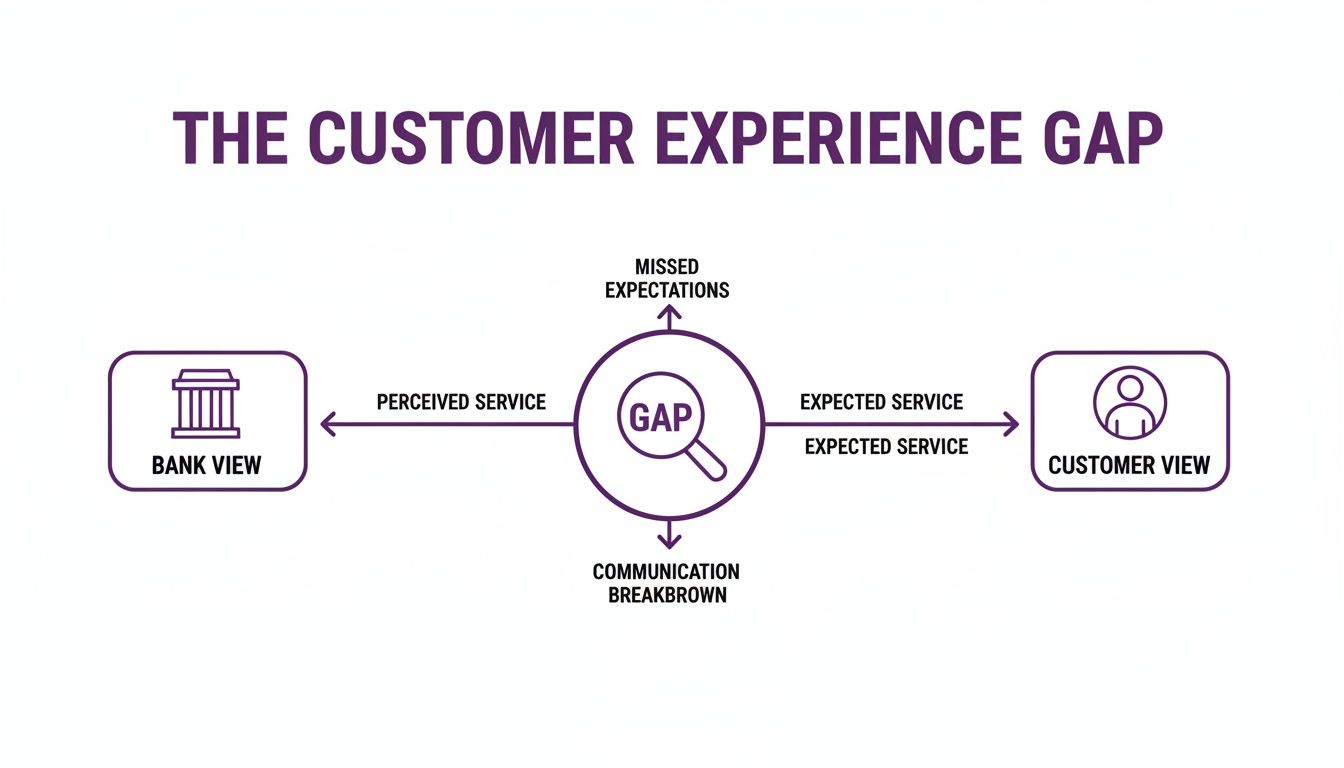
This “experience gap” shows just how different a bank’s perception of its service can be from what a customer actually feels. Data is the bridge that closes that chasm by giving you an unbiased look at customer behavior and feelings.
Pillar 3: Personalization
Once you understand the customer’s journey and have the data to back it up, the next step is personalization. This means ditching the one-size-fits-all messages and creating experiences that feel unique to each person.
It’s the difference between a generic “Check out our new savings account!” email and a proactive alert that says, “We noticed you have extra cash in your checking. Moving it to your high-yield savings could earn you an extra $50 this year.”
Personalization is no longer just a nice-to-have; it’s a core expectation. Customers want to feel recognized and valued, not like just another account number in a database.
This is how you build an emotional connection and real loyalty, turning a simple transactional relationship into a trusted advisory one.
Pillar 4: Omnichannel Orchestration
The final pillar is what ties it all together. Omnichannel orchestration makes sure the customer’s experience is smooth and consistent, no matter how they interact with you. A customer might start a loan application online, call support with a question, and then pop into a branch to sign the final papers.
A truly orchestrated experience means the agent on the phone already knows about the online application. The banker at the branch can pull up all the relevant details without making the customer repeat themselves for the third time. It’s all about breaking down the internal silos that cause so much frustration.
You can dive deeper into the concepts behind a strong CX framework by reading about the core pillars of customer experience management. When these four pillars work in sync, they create a powerful foundation for a customer experience strategy that doesn’t just solve problems but builds loyalty that lasts.
Using Hyper-Personalization in Banking CX Management
In a market flooded with near-identical banking products, generic service is a dead end. The new battleground for customer loyalty isn’t just about interest rates anymore; it’s won with hyper-personalization. This is where smart customer experience management in banking shifts from just solving problems to creating proactive, intelligent relationships.

Think of it as giving every single customer their own personal financial concierge. Instead of blasting out mass emails, you deliver “intelligent nudges”—like proactive savings tips, customized loan offers, or timely alerts about unusual spending. It’s all about understanding what your customer wants to achieve and helping them get there, sometimes before they even ask.
From Data to Actionable Insight
Hyper-personalization runs on data, but it comes alive with action. It means digging into spending habits, transaction histories, and major life events to anticipate what a customer needs next and delivering real value at just the right moment. This approach turns the bank-customer relationship from a series of transactions into a genuine partnership built on trust.
Here’s what that looks like in the real world:
- Proactive Savings: A fintech app notices a customer has forgotten about a few recurring subscriptions. It sends a friendly alert asking if they’d like to cancel, saving them money with zero effort on their part.
- Anticipatory Credit: A bank’s analytics model sees a small business customer’s cash flow patterns and predicts they might need a line of credit soon. It then proactively sends a pre-approved offer, giving them access to capital exactly when they need it most.
Hyper-personalization is the ultimate defense against agile fintech challengers. It builds a moat of loyalty around your customers that competitors simply can’t cross with generic offers.
This kind of tailored service makes customers feel seen and valued, forging a powerful emotional connection that creates unshakable loyalty. For more strategies on this, check out our guide on how to personalize customer interactions.
The Competitive Imperative of Personalization in Banking
Make no mistake, this isn’t just a fleeting trend; it’s a strategic must-do. Hyper-personalization has become a core pillar of modern customer experience management in banking. In fact, a whopping 68% of bank leaders plan to prioritize it by 2026, specifically to fend off fintech rivals.
The results are hard to argue with—top-performing banks are boosting retention rates by as much as 30%. Customers don’t just appreciate these ‘intelligent nudges’; they expect them. A solid 75% say they are more likely to engage when an experience feels like it was made just for them. To get a deeper look at this industry shift, you can explore the latest banking trends from KPMG.
The Role of Technology and Human Expertise
Pulling off hyper-personalization at scale often involves advanced AI technologies. These systems can crunch enormous amounts of data in real time, spotting patterns and triggering personalized actions automatically. For those curious about the mechanics behind it all, exploring courses on AI technologies can provide a solid foundation.
But technology is only half the story. It needs to be paired with skilled human agents who can navigate complex situations and add a dose of empathy when it counts. This is where a strategic partnership with a nearshore BPO like CallZent gives you a serious advantage. Our bilingual agents in Tijuana are equipped with powerful tools to deliver context-aware, personalized support that feels both high-tech and high-touch. This hybrid model allows banks to scale up sophisticated personalization efforts without breaking the bank, ensuring that as you grow, your customer experience only gets better.
Building Emotional Connection with Human-Centric Service
As banking goes digital, it’s easy to think the human touch is a thing of the past. It’s not. In fact, it’s become the single most valuable way to stand out. Winning at customer experience management in banking isn’t about shaving seconds off transactions anymore—it’s about building real emotional connections.
When a customer feels heard and genuinely cared for, especially during a tough time, it creates a bond no app feature can ever hope to match.

Think about the moments that really define a customer’s relationship with their bank: dealing with a fraudulent charge, applying for that first mortgage, or figuring out finances after a job loss. In those moments, “feeling understood” matters more than any interest rate or account fee. This is where human-centric service becomes your secret weapon.
The Power of Empathy Over Scripts
For way too long, contact centers have chained their agents to rigid scripts, basically turning them into robots. That approach might look efficient on a spreadsheet, but it kills any chance of building a real relationship. The key to creating unforgettable, positive experiences is empowering agents to go off-script and lead with genuine empathy.
When you train agents to truly listen and give them the freedom to solve problems, they stop being just “reps” and become trusted advocates for your bank.
- Active Listening: This isn’t just hearing the words. It’s picking up on the emotion behind them. Is the customer anxious, frustrated, confused?
- Empathetic Responses: Instead of a robotic, “I understand your frustration,” an empowered agent can say, “That sounds incredibly stressful. Let’s tackle this together and get it sorted out.”
- Problem Ownership: Giving an agent the authority to fix an issue without a dozen escalations sends a powerful message: your bank respects the customer’s time and is serious about helping.
This human-first focus isn’t a “soft skill”—it’s a core business strategy. The data is clear: emotional connection is now the biggest driver of loyalty in banking. Banks that build trust are on track to see 40% higher retention rates by 2026. On top of that, 67% of customers globally now say ‘feeling understood’ is more important than anything else, including price. You can read more about what’s ahead for banking customer experience.
Striking the Perfect Hybrid Balance
This isn’t a call to ditch technology. Quite the opposite—technology and empathy are the ultimate power couple. The best service models today are hybrids, where AI and automation handle the simple, repetitive stuff. This frees up your skilled human agents to focus on what they do best: navigating the complex, emotional situations that forge rock-solid loyalty.
Technology should serve the human connection, not replace it. Use AI to answer ‘What’s my balance?’ so your agents can focus on answering ‘What should I do?’
For example, an AI chatbot can instantly handle basic questions about account balances or transaction histories 24/7. But the moment a customer hints at a serious problem, like a suspected scam, the system needs to seamlessly hand them off to a highly trained human agent who can provide the expert guidance and reassurance they need. For more on this, check out our guide on how to humanize your brand.
This hybrid approach proves you don’t have to choose between efficiency and empathy. By partnering with a strategic BPO like CallZent, banks can roll out this model cost-effectively. Our agent-first culture ensures our teams aren’t just technically skilled—they’re emotionally intelligent, ready to build the genuine connections that define truly great customer experience management in banking.
Your Roadmap to a Winning CEM Strategy
Understanding the “what” and “why” behind customer experience management in banking is the easy part. The real challenge? Turning that knowledge into an effective, bank-wide program that actually delivers results. This isn’t something you can achieve with good intentions alone. It takes a clear, practical roadmap to guide you from concept to execution.
Think of it like building a house. You wouldn’t just show up with a hammer and start putting up walls. You’d start with a detailed blueprint (your strategy), pour a solid foundation (technology and buy-in), frame the structure (a pilot program), and then add the finishing touches (scaling and personalization). Following these steps ensures your CEM initiative is built to last.
Phase 1: Secure Leadership Buy-In
Before you can even think about breaking ground, you need everyone from the board members to department heads fully on board. A CEM overhaul is a massive undertaking that affects every corner of the bank. Without solid support from the top, it’s dead in the water. This means you need to do more than just ask for a budget—you need to build a rock-solid business case.
Show them the numbers. Present the hard data on your “customer experience gap,” point to the ROI of even a small boost in retention, and draw a direct line between a better experience and higher profitability. This isn’t about fluffy feelings; it’s about securing the bank’s financial future.
Phase 2: Map Journeys and Select Your Tech Stack
With your leadership team convinced, it’s time to draw up the blueprint. This phase is all about two parallel tracks: mapping your customer journeys and picking the right technology to support them. Use those journey maps to pinpoint the biggest friction points and the “moments of truth” where the experience consistently falls apart.
These pain points will tell you exactly what you need from your tech. Do your journey maps show customers repeating themselves every time they switch from the app to a phone call? You need a CRM that gives every agent a unified view of the customer. Are people bailing on the online mortgage application halfway through? A better digital platform should be at the top of your list.
Your tech stack is the foundation of your CEM house. It has to be strong enough to hold up everything you build. Key components typically include:
- Customer Relationship Management (CRM): The single source of truth for all customer data.
- Customer Data Platform (CDP): To pull data from different systems into one cohesive customer profile.
- Analytics Tools: To measure what’s working, what isn’t, and why.
For a deeper dive into elevating your bank’s service, this guide to Mastering the Customer Experience in the Banking Industry is a fantastic resource.
Phase 3: Launch a Pilot Program
You wouldn’t build a whole subdivision without a model home, right? A pilot program is your model home. It’s your chance to test your strategy, tech, and new processes on a small, manageable scale before you bet the farm on a full rollout.
Pick a specific journey to focus on, like new customer onboarding or resolving credit card disputes. This lets you work out the kinks, gather early feedback, and prove that the concept works. The lessons you learn here are pure gold, helping you sidestep costly mistakes when you go big. And remember, consistently gathering customer feedback for continuous improvement is absolutely essential during this stage.
A successful pilot program is your best tool for building momentum. It turns skeptics into believers by providing tangible proof that your CEM strategy delivers real results.
Phase 4: Scale Across the Organization
Once your pilot has proven its worth, it’s go-time. This is where your CEM initiative stops being a “project” and starts becoming the new way of doing business across the entire bank. This phase is just as much about managing change as it is about deploying new software.
Communication is everything. Keep the entire organization in the loop, celebrate the wins, and provide plenty of training to get employees comfortable with new tools and workflows. As you scale, your support needs are going to grow—fast. This is where a strategic partnership with a nearshore expert like CallZent can be a game-changer.
We can help you seamlessly scale your support teams with highly trained, bilingual agents from our Tijuana call center, ensuring your service quality never takes a hit during the transition. This allows you to maintain an exceptional customer experience even while you’re undergoing major internal changes, guaranteeing a smooth and successful rollout.
Frequently Asked Questions About Banking CXM
Getting into customer experience management in banking always kicks up a few questions. It’s a big topic, and it can be tough to know where to begin or how to sell the investment to your leadership team. We’ve got you covered with some straight-to-the-point answers to the questions we hear most from banking leaders.
What Is the First Step to Improve Customer Experience?
The absolute first thing you have to do is map your customer journey from their perspective, not yours. Ditch the internal process charts and what you think happens. You need to see your bank through your customers’ eyes using real surveys, feedback, and behavioral data.
This map is your new blueprint. It will shine a light on the “moments of truth”—those make-or-break interactions where things go wrong and where a little improvement can make a huge difference. You might find out your app is a breeze to use, but trying to dispute a charge is where customers get fed up and leave.
Before you spend a dime on new tech, you have to diagnose the problem. This makes sure you’re fixing what actually matters to your customers, not just what you think matters.
Once you’ve pinpointed those real pain points, you can start building a strategy that actually works. This early work stops you from throwing money away and makes sure your efforts hit home.
How Can We Measure the ROI of Improving Customer Experience?
To measure the ROI of customer experience management in banking, you have to draw a straight line from your experience metrics to your bottom line. It’s all about proving that a happier customer is a more valuable one.
Start by tracking Key Performance Indicators (KPIs) like Net Promoter Score (NPS), Customer Satisfaction (CSAT), and Customer Effort Score (CES). The real magic, though, is linking those scores to cold, hard financial numbers.
- Connect NPS to Churn: Does a 10-point jump in NPS for a certain customer group lead to a drop in churn over the next year?
- Link CES to Operational Costs: Does making it easier to open an account (a lower Customer Effort Score) lead to fewer support calls and a lower cost-to-serve?
- Tie Satisfaction to Lifetime Value: Do your most satisfied customers end up having a higher Customer Lifetime Value (CLV) because they add more products or upgrade services?
For instance, if you notice that the customers most likely to renew are the same ones adding new services, you’ve found your financial link. This builds an undeniable business case by showing that every dollar you invest in the customer experience comes back as better retention and profit.
How Can Smaller Banks Compete with Large Institutions?
Smaller banks and credit unions can’t outspend the big national players, so they have to out-service them. The trick is to use your size as your biggest weapon by being more agile, more personal, and more strategic with your partnerships.
Don’t try to be everything to everybody. Instead, own a niche. Become the go-to bank for local small businesses by giving them incredible, personalized service that the giants can’t match at scale. Lean into human connection as your key differentiator—after all, 67% of customers say “feeling understood” is more important than price.
A killer strategy is partnering with a nearshore BPO provider like CallZent. This move gives you instant access to elite talent and cutting-edge tech without the massive upfront cost.
Benefits of a Nearshore Partnership for Smaller Banks:
-
- Cost-Effective Scaling: Quickly add to your support team for 24/7 coverage or to handle busy periods without the overhead of hiring.
- Access to Bilingual Talent: Effortlessly serve a wider audience by offering fluent support in both English and Spanish from our Tijuana call center.
- Technological Advantage: Get your hands on sophisticated contact center tools and analytics that would otherwise be out of your budget.
🚀 Elevate Your Banking Customer Experience
CallZent helps financial institutions deliver scalable, personalized, and bilingual customer experience solutions through nearshore BPO services designed for modern banking.
Schedule a CallThis approach lets you deliver a top-shelf experience that’s both high-tech and high-touch. It levels the playing field, allowing you to compete on amazing service, not just a bigger budget, and build a loyal customer base that larger, impersonal banks can only dream of.
Ready to deliver a world-class customer experience without breaking the bank? CallZent offers scalable, bilingual, and cost-effective nearshore BPO solutions that empower you to build lasting customer relationships. Learn how we can tailor a strategy for your financial institution today.