Skip to content
Customer Retention Strategy
Customer Retention Management: Turn Customers Into Lifelong Revenue
Customer retention management helps businesses reduce churn, increase lifetime value, and build loyalty through proactive support, personalization, and scalable CX strategies.
TL;DR — Quick Takeaways
- Customer retention management focuses on keeping customers engaged, satisfied, and loyal over time.
- Retaining customers is significantly more profitable than acquiring new ones, with small improvements driving major ROI.
- Key drivers include proactive support, personalization, and seamless customer experience across channels.
- Nearshore BPO partners like CallZent help scale retention strategies with expert agents and advanced technology.
Is your business a leaky bucket? You can spend a fortune pouring new customers in, but if your existing ones are slipping away, you’re fighting a losing battle. This is where customer retention management comes in—it’s the strategic process of keeping your hard-won customers happy, engaged, and loyal for the long haul.
It’s more than just good service; it’s a proactive strategy to plug the leaks, nurture relationships, and turn your customer base into your most valuable asset.
Why Is Customer Retention Management a Financial Superpower?
Too many businesses get caught on the hamster wheel of chasing new leads, completely overlooking the goldmine they’re already sitting on. But smart companies know that real growth isn’t just about getting new customers; it’s about keeping the ones you have. Effective customer retention management is a powerful financial strategy that builds sustainable, long-term success.
Simply put, every customer you keep is one less you have to pay to acquire. As a BPO partner, we see this firsthand with our clients: when they shift focus to retention, their profitability soars. This approach shares its DNA with client relationship management, which is all about building and nurturing those strong connections.
Retention by the Numbers: Why It Outperforms Acquisition
Focusing on retention isn’t just a feel-good tactic—it’s one of the most powerful financial levers you can pull. The data is clear: investing in your current customers consistently delivers a much higher return than spending to attract new ones.
The proof is impossible to ignore. A small 5% increase in customer retention can boost profits by 25% to 95%. Why? Because loyal customers spend more—about 67% more on average than new buyers. In fact, a staggering 65% of a company’s business often comes from its existing customer base.
Key Takeaway: Customer retention management isn’t a cost center; it’s a profit multiplier. Shifting focus from “always new” to “nurture and grow” turns your customer base into your most reliable asset.
This strategic approach boils down to a few core activities:
- Proactive Communication: Don’t just wait for problems. As a practical example, a BPO agent can monitor shipping for an e-commerce client and reach out to a customer about a delay before they even notice, turning a negative into a positive.
- Personalized Experiences: Use data to understand individual customer needs. Our guide on what customer experience management is dives deeper into how to orchestrate these valuable touchpoints.
- Closing the Feedback Loop: Actively ask for customer feedback and—more importantly—act on it to improve your service.
- Building a Community: Create a sense of belonging that connects customers to your brand on a level deeper than just a transaction.
Ultimately, effective customer retention management creates a virtuous cycle. Happy, loyal customers don’t just keep buying; they become your best salespeople, driving powerful word-of-mouth referrals that bring your acquisition costs down even further.
Measuring What Matters: Key Metrics for Customer Retention Management
You can’t manage what you don’t measure. A smart retention strategy moves beyond guesswork and into clear, actionable data. The good news? You don’t need a degree in data science. A few core metrics are all it takes to get a real-time pulse on your customer base and start making smarter business decisions.
These numbers aren’t just entries on a spreadsheet; they’re the vital signs of your business. By tracking them, you can spot risks before they become problems, uncover hidden opportunities, and prove the ROI of your retention efforts.
The Core Metrics of Retention
To get a clear picture of how you’re doing, you need to zero in on three foundational metrics. Each one reveals a different piece of the puzzle, from how many customers are sticking around to how much they’re worth to you over the long haul.
Key Customer Retention Metrics at a Glance
This table breaks down the essential metrics you need to track. Think of it as your quick-reference guide for measuring the strength of your customer relationships.
| Metric | What It Measures | Simple Formula | Why It Matters |
|---|---|---|---|
| Customer Retention Rate (CRR) | The percentage of existing customers who remain with you over a specific period. | (Ending Customers – New Customers) / Starting Customers x 100 | Directly shows how well your loyalty and satisfaction efforts are working. |
| Customer Churn Rate | The percentage of customers you lose during a specific period; the opposite of CRR. | (Lost Customers / Starting Customers) x 100 | Pinpoints “leaks” in your business and acts as an early warning for potential problems. |
| Customer Lifetime Value (CLV) | A prediction of the total revenue a business can expect from a single customer account. | (Average Purchase Value) x (Average Purchase Frequency) x (Average Customer Lifespan) | Helps justify spending on retention by showing the long-term payoff of a happy customer. |
Let’s dig a little deeper into what these numbers really mean for your business.
-
Customer Retention Rate (CRR): This is your most direct measure of success. For example, if an e-commerce shop starts the quarter with 1,000 customers and ends with 950 of those same people, its CRR is 95%. This metric is perfect for seeing the immediate impact of a new loyalty program or improved support model.
-
Customer Churn Rate: This is the flip side of CRR, measuring the percentage of customers who walk away. A rising churn rate is an alarm bell—maybe a competitor launched a new offer, or a recent product update is causing headaches. This is a critical KPI in our call center, as it signals a need to investigate and act.
-
Customer Lifetime Value (CLV): This is where things get really interesting. CLV forecasts the total revenue you can expect from a single customer. A SaaS company with a high CLV knows that investing in a dedicated BPO success team to keep a client for one more year will yield a massive return.
This infographic hammers home the powerful financial impact of dialing in your customer retention strategy.
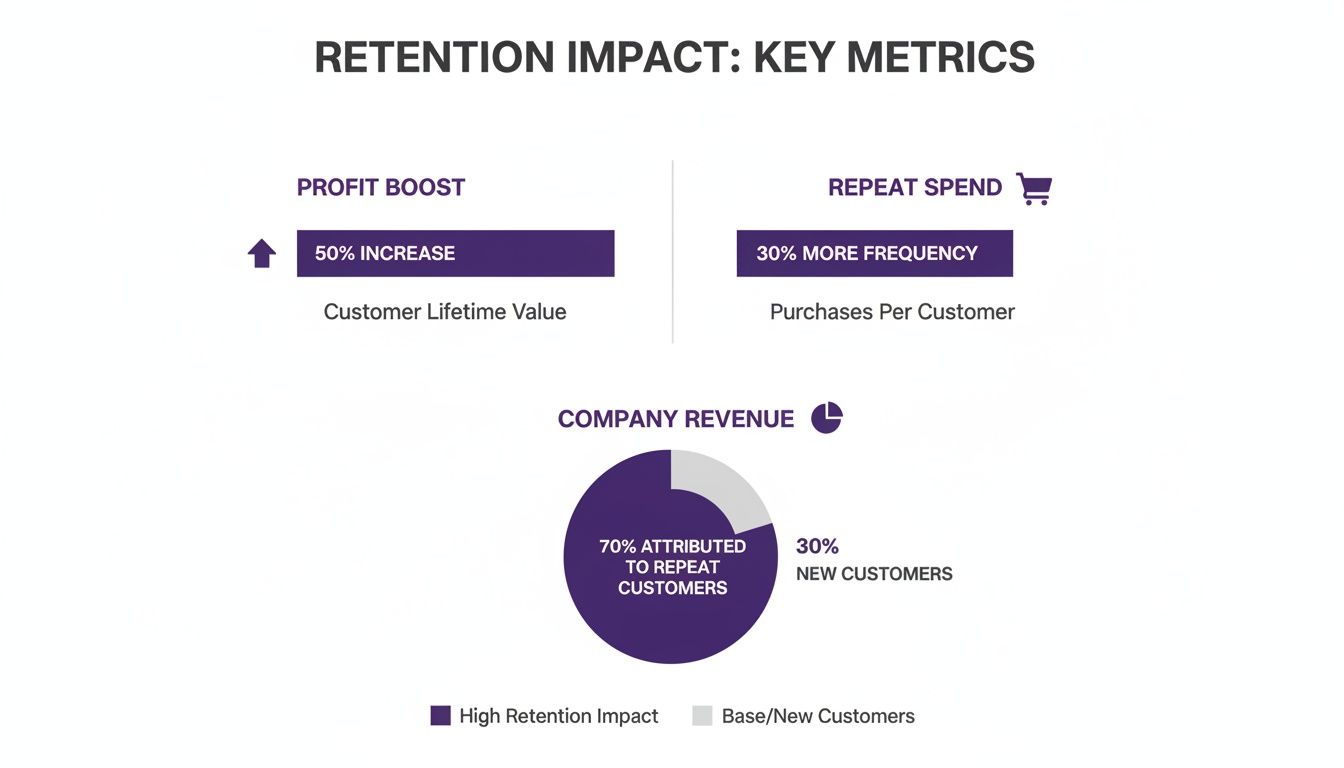
As you can see, even small improvements in retention directly fuel profitability, increase how much your loyal customers spend, and drive overall company revenue growth.
Turning Data into Actionable Insights
Knowing your numbers is only half the battle. The real magic happens when you use that data to make informed decisions. To get an even more granular view, you can explore the many different KPIs in customer service that ultimately feed into these high-level retention metrics.
A rising churn rate is not a failure—it’s feedback. It’s a clear signal from your customers that it’s time to listen, analyze, and act before small issues become big problems.
By keeping a close eye on these key figures, you can get ahead of churn risks. For example, if you notice a dip in repeat purchases from a specific customer segment, you can trigger a targeted outreach campaign with your call center team to gather feedback and offer a “we miss you” incentive. That’s how you stop churn in its tracks.
The Real Drivers of Customer Loyalty
Why do some customers stay loyal for years, while others bolt after just one purchase? Sure, a good product at a fair price is the price of admission. But in a crowded market, that’s not what builds real, lasting loyalty.
The true drivers are the human elements—the emotional connection and standout service moments that turn a simple transaction into a genuine partnership.

In today’s market, effective customer retention management isn’t just about what you sell; it’s about how you make people feel.
Beyond Price: Building Loyalty with Human Connection
Let’s be clear: customers expect a quality product that’s priced fairly. That’s table stakes. But building your loyalty strategy on these factors alone is a losing game—competitors can copy them in a heartbeat. Deep, unshakable loyalty is built on trust and positive emotional experiences.
These are the moments that stick with a customer:
- Proactive Support: A BPO agent for a SaaS client notices a user is struggling with a new feature and proactively reaches out with a tutorial link.
- Trust Through Consistency: The sense of security a customer feels when they get clear, honest, and reliable communication at every single touchpoint.
- Empathetic Problem-Solving: A support rep who truly listens to a frustrated customer, validates their feelings, and takes full ownership of making things right.
These are the stories customers tell their friends. And they’re nearly impossible for your competitors to replicate.
The Power of an Empathetic Call Center Agent
In a world of chatbots, a real human connection is a premium asset. Technology is great for simple tasks, but it can’t fake the empathy and creative problem-solving of a well-trained agent. This is where your support team—or a BPO partner like CallZent—becomes your single most powerful retention tool.
Imagine a customer receives a damaged item from an e-commerce store.
- An automated response is just a transactional email with return instructions. It’s cold.
- A loyalty-building response involves a live agent who offers a sincere apology, immediately ships a replacement, and maybe even adds a small discount for the trouble.
The second scenario doesn’t just fix the problem. It proves the company cares, turning a negative experience into a reason for the customer to come back.
“Today’s B2B buyers want to do business with companies whose values align with their own… This approach creates emotional loyalty that transcends transactional relationships and gives customers a reason to stay even when competitors offer similar products.”
This is why investing in high-quality, empathetic support is a direct investment in your bottom line. Research shows that 78% of people are more likely to recommend a brand that provides frictionless experiences.
Building Trust Through Brand Integrity
Brand integrity is simple: it’s the alignment between your promises and your actions. Customers can sense when a brand is being dishonest, and it demolishes trust faster than anything else.
Maintaining brand integrity comes down to a few key things:
- Honest Communication: Admit when you’ve made a mistake. Be upfront about how you’re going to fix it.
- Consistent Policies: Ensure your return, support, and billing policies are fair and applied consistently to everyone.
- Valuing Feedback: Actively listen to what customers are saying—the good and the bad. Then, show them you’re using that feedback to get better.
When a customer trusts your brand, they’re more forgiving of the occasional hiccup and far less likely to be tempted by a competitor’s discount. That trust, earned one interaction at a time, is the bedrock of sustainable growth.
How Technology Powers Modern Customer Retention Management
Let’s be honest: modern retention isn’t just about having good intentions. It’s about having the right tools to make your strategy work at scale. While a genuine human connection builds loyalty, technology is the framework that makes those consistent, personalized interactions possible.
Think of the right tech stack as the engine for your customer retention management program.
This technology is what helps you shift from just putting out fires to actively building relationships. It gives your team a 360-degree view of every customer, empowering them to make smarter, more empathetic decisions. The goal is a seamless experience where every customer feels known and valued.
Core Components of a Retention-Focused Tech Stack
A solid retention tech stack isn’t just one piece of software; it’s several key platforms working in harmony. As a BPO provider, we rely on this integration to deliver seamless service for our clients.
Here are the non-negotiables:
- Customer Relationship Management (CRM) Platform: This is the brain of your operation. It’s where all customer data lives—contact info, purchase history, and every support interaction. A well-organized CRM gives agents immediate context to personalize every conversation.
- Omnichannel Support System: Customers expect to move between channels—phone, email, chat—without starting over. An omnichannel platform weaves these conversations into a single thread, heading off customer frustration before it starts.
- AI-Powered Analytics: These tools are your early warning system. They analyze customer behavior to predict churn, flagging at-risk customers so your team can intervene before it’s too late.
Integrating communication systems is a game-changer. For example, using a CRM with VoIP integration lets our agents dial customers directly from their profile and automatically log the call, streamlining the entire workflow.
Putting the Technology into Action
So, how does this all work in the real world? Imagine a SaaS company using a BPO for support.
- A customer calls the support line with a technical snag. The agent uses the CRM to see the customer’s entire history and recognizes they are a high-value, long-term user.
- The agent solves the problem and logs the call details in the omnichannel support platform.
- Minutes later, an automated workflow sends a one-question SMS survey: “On a scale of 1-10, how satisfied were you with today’s support?”
- The response is automatically fed back into the CRM. Over time, AI-powered analytics pool this data, highlighting top-performing agents and flagging recurring issues that might signal a deeper product bug.
This closed-loop system creates a powerful feedback cycle. And the numbers don’t lie. Companies with strong omnichannel strategies retain an incredible 89% of their customers—a massive jump from the 33% retained by businesses with weak implementations.
Technology is the engine, but your agents are the drivers. The best tools are only effective in the hands of skilled people who can use data to deliver the empathy and creative problem-solving that technology alone cannot.
The SaaS industry is a perfect example of this tech-driven approach. Many are now using help desk solutions to automate onboarding and provide proactive support. If you’re in this space, it’s worth exploring how a SaaS help desk solution can shape your support strategy. By blending automation with a human touch, these companies are building incredibly loyal customers.
Customizing Retention Strategies for Your Industry
A powerful customer retention strategy is never one-size-fits-all. What delights a customer in e-commerce might be irrelevant to a patient in healthcare. To get it right, you have to tailor your approach to your industry’s unique dynamics and customer expectations.
Different sectors face completely different retention landscapes. Recent data shows high-performing industries like Commercial Insurance can see retention rates of 86%, while many e-commerce businesses struggle with rates as low as 31-38%. Sectors like Banking (75%) and Retail (63%) each have their own benchmarks.
Knowing where your industry stands helps you set realistic goals. You can dive deeper into customer retention rates across various industries to see how you stack up.
Here are some tailored retention playbooks we use at CallZent for key industries.
E-commerce: Proactive Support & Loyalty Management
In the hyper-competitive world of e-commerce, exceptional service is the real differentiator.
- Proactive Post-Purchase Support: Our bilingual agents can monitor shipping statuses and proactively contact customers if a delay is spotted, turning a potential complaint into a trust-building moment.
- Frictionless Returns: We make returns easy. Our agents can quickly process returns, offer store credit, or help find a replacement item, saving the sale and reinforcing customer confidence.
- Loyalty Program Management: Our agents act as ambassadors for your loyalty program, explaining benefits, helping customers redeem points, and gathering feedback.
Healthcare: Patient Empathy and Follow-Up
In healthcare, retention is about patient well-being and trust. Every communication must be empathetic, confidential, and clear.
Key Takeaway: For healthcare providers, every interaction is a chance to build trust. Empathetic communication and consistent follow-up show a commitment to patient care that goes beyond the clinic walls.
A specialized call center is invaluable. For example, our agents make post-discharge follow-up calls to ensure patients understand care instructions and have scheduled their next appointment. This simple act can significantly reduce readmission rates. Our bilingual agents also ensure language is never a barrier to clear, compassionate care.
Finance and Banking: Building Trust and Security
Trust is the absolute currency of the financial services industry. Retention here is built on reliability and expert guidance.
- Knowledgeable Advisory Services: Our agents are trained to explain the features of different savings accounts, guide someone through a loan application, or connect them with a financial advisor.
- Secure Authentication and Fraud Prevention: As a BPO partner with robust security protocols (PCI compliance), we ensure customer data is protected and handle sensitive situations with professionalism.
- High-Touch Onboarding: A personal welcome call to a new banking customer sets a positive tone. Our agents can walk them through online banking features and answer initial questions, making them feel valued from day one.
Telecom: Proactive Issue Resolution
The telecom industry is notorious for high churn. The key to retention is proactive outreach and first-call resolution. This starts before they even become a customer; it’s vital to implement lead generation best practices that attract subscribers who are more likely to stick around.
Imagine a localized network outage. A proactive telecom provider can use its call center to:
- Identify Affected Customers: Pinpoint exactly who is in the outage area.
- Send Proactive Alerts: Push out SMS or email notifications that acknowledge the problem and provide an ETA for resolution.
- Offer Human Support: Empower agents with real-time information so when customers do call, they get accurate updates.
This proactive approach to customer retention transforms a frustrating experience into one where the customer feels informed and looked after.
Why a BPO Partner is Your Secret Weapon for Customer Retention Management
Building an in-house team for customer retention management is a huge commitment—high costs, a constant search for talent, and expensive tech overhead. For many businesses, it’s just not sustainable.
This is where bringing in a strategic partner like a nearshore BPO completely changes the game.

A nearshore BPO provider is a smart, scalable way to level up your retention strategy without the painful internal investment. You get instant access to a suite of benefits designed to build loyalty and protect your revenue.
Gain Instant Expertise and Scalability
Instead of building from the ground up, a BPO partner gives you a world-class retention operation from day one. You immediately tap into a deep pool of skilled, bilingual talent ready to connect with your customers. For any business focused on growth, exploring the business process outsourcing benefits shows just how this model supports rapid, cost-effective expansion.
This approach brings major wins:
- Significant Cost Savings: Dramatically cut overhead tied to hiring, training, and technology.
- 24/7 Operational Capacity: Provide around-the-clock support to engage customers whenever they need you.
- Advanced Technology Integration: Plug directly into sophisticated retention tools without the massive upfront cost.
A BPO partner becomes an extension of your own team. They work with you to design and run custom retention campaigns—from proactive satisfaction calls to loyalty program management—all centered on making your customer relationships stronger.
Ultimately, partnering with a BPO for customer retention is a strategic move. It lets you focus on what you do best while leaving your customer relationships in the hands of specialists. This teamwork transforms retention from a costly internal department into a high-ROI, growth-driving partnership.
Common Questions About Customer Retention Management
As you start weaving customer retention management into your business, you’re bound to have questions. We’ve got you covered with clear, straightforward answers to the most common ones.
What Is The Difference Between Customer Retention and Customer Loyalty?
Think of it this way: customer retention is the outcome—keeping a customer around. It’s a number you can track. Customer loyalty, on the other hand, is the feeling—the positive connection and trust a customer has for your brand.
Loyalty is what drives retention. You don’t just get retention; you earn it by building loyalty. Retention is the “what,” and loyalty is the “why.”
Which Department Is Responsible for Customer Retention Management?
While customer service teams are on the front lines, true customer retention management is a team sport. It’s a company-wide effort where every department plays a part.
- Marketing: Shapes the messaging and sets the tone.
- Product/Operations: Delivers the core experience.
- Sales: Sets the right expectations from the start.
When all departments are in sync, the customer gets a cohesive, trustworthy experience. That’s the bedrock of long-term loyalty.
Key Insight: Real ownership of retention isn’t about dumping it on one department. It’s about building a culture where every employee understands their role in keeping customers happy.
How Soon Should a New Business Focus On Customer Retention?
From day one. Seriously. While getting new customers is make-or-break for a new business, it’s far easier to build good retention habits from the start than it is to patch a “leaky bucket” down the road.
Even small actions make a huge difference. Send a personalized thank-you email. Actively ask for feedback. Make it ridiculously easy for customers to get help. These early moves build a loyal base that will grow right alongside you.
🚀 Build a Stronger Customer Retention Strategy
CallZent helps businesses improve customer retention management with scalable, bilingual support and nearshore BPO solutions designed to increase loyalty and reduce churn.
Talk to an ExpertReady to build a world-class retention strategy without the high overhead? CallZent provides the expert agents, advanced technology, and scalable solutions to turn your customers into lifelong fans. Discover how our nearshore BPO services can amplify your customer retention management by visiting https://callzent.com.