Skip to content

Customer Experience
Customer Service Communication
Skills: The Playbook for Loyalty
Master customer service communication skills with active listening, empathy, clarity, and positivity to boost CSAT, NPS, and First Contact Resolution.
TL;DR — Quick Takeaways
- Active listening reduces repeat contacts by confirming the real issue the first time.
- Empathy + validation de-escalate tension and increase customer trust, even when outcomes aren’t ideal.
- Clarity lowers Average Handle Time (AHT) and improves First Contact Resolution (FCR).
- Positive language reframes limits into options and keeps conversations collaborative.
- Adaptability (style-matching) builds rapport fast across different customer personalities.
Ever wonder why one customer interaction can build a lifelong fan, while another sends them running to a competitor? The secret is in mastering customer service communication skills. These are the tools your team uses to make people feel heard, valued, and respected—transforming a routine service call into a genuine connection.
The Real Cost of Poor Customer Communication
Exceptional customer service isn’t just about fixing a problem; it’s about the experience of getting it fixed.
Picture this: two customers call with the exact same issue. One hangs up frustrated and dismissed. The other feels completely understood and appreciated. The solution was the same, but the communication made all the difference.
Poor communication is more than just a bad moment for a customer. It creates tangible, far-reaching consequences that can quietly eat away at a business. Research shows U.S. companies lose over $62 billion annually from poor customer service alone, and most of that damage traces back to a communication breakdown.
The Financial and Reputational Damage of Bad Communication Skills
When communication stumbles, the fallout is swift and expensive. A single conversation handled badly can trigger a painful chain reaction:
- Skyrocketing Customer Churn: Studies show a staggering 86% of customers will ditch a brand after a bad service experience. Ineffective communication is almost always the culprit, leaving customers feeling like their business just doesn’t matter.
- A Tarnished Brand Reputation: In the age of instant online reviews, one negative interaction can be broadcast to thousands. Angry customers are far more likely to share their stories, damaging your reputation and scaring off new clients.
- Bloated Operational Costs: Miscommunication leads to longer call times, callbacks for the same issue, and more escalations to senior staff. All that inefficiency drives up operational costs and burns out your team.
This reality reframes customer service communication skills from a “soft skill” to a core business strategy. Investing in how your team speaks, listens, and shows empathy is a direct investment in your bottom line. It’s one of the surest ways to build a loyal customer base, and our guide on how to reduce customer churn dives deeper into this connection.
Here’s the bottom line: Every interaction is a moment of truth. It’s an opportunity to either strengthen a customer relationship or break it for good.
At CallZent, we’ve built our nearshore call center services around this very principle. We get that for businesses in cutthroat industries like e-commerce, healthcare, and finance, every single conversation counts. Nailing these skills is the first step in turning your customer service from a cost center into a powerful engine for growth. This guide will give you the practical framework to make it happen.
Key Customer Service Communication
Skills You Cannot Ignore
Exceptional customer service isn’t about flashy scripts or complicated tech; it boils down to a handful of foundational skills that can turn a potential disaster into a moment of true customer loyalty. These are the absolute non-negotiables—the core abilities every single agent needs to represent your brand well.
For any leader building a team, understanding these skills is the first step toward creating a world-class service operation. This flowchart says it all, drawing a straight line from one bad call to lost revenue and a damaged reputation. It really highlights how much is riding on every single conversation.
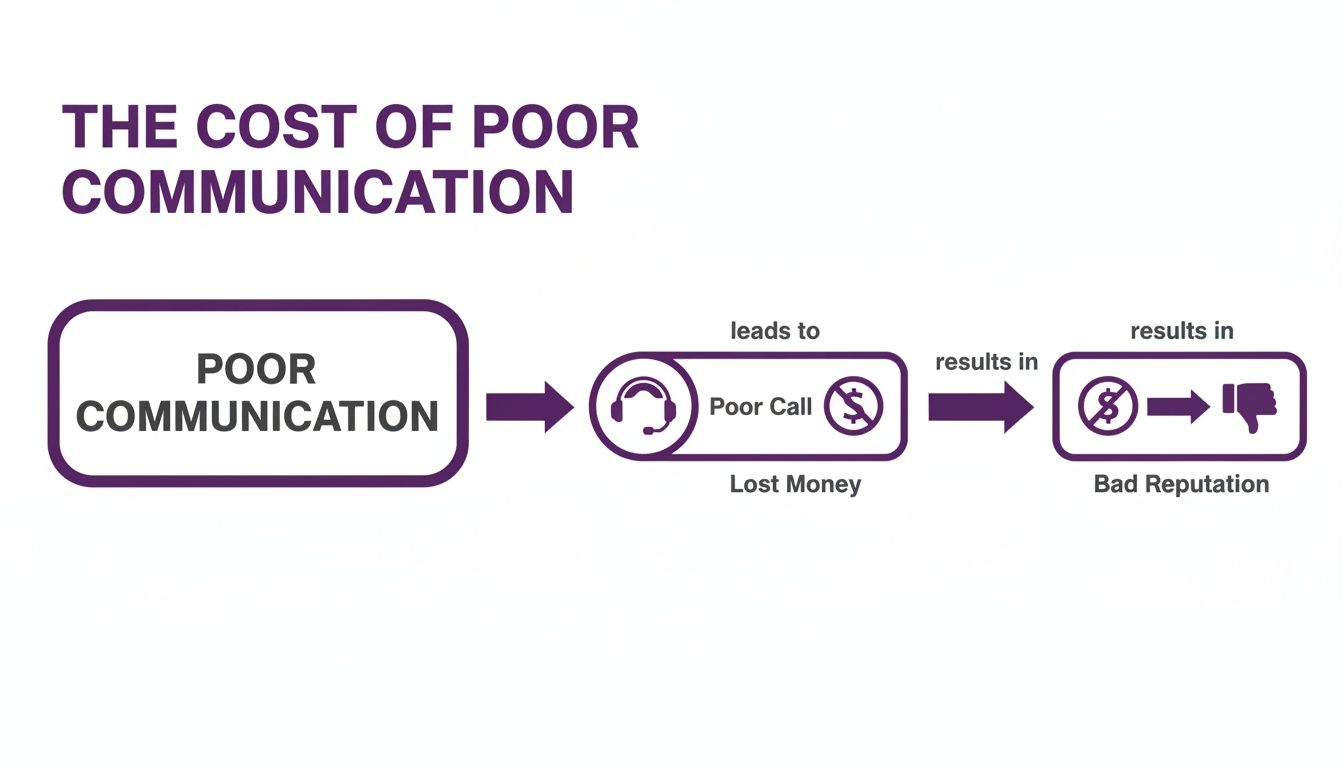
As you can see, a single communication breakdown isn’t just an isolated hiccup. It’s a trigger for real, measurable financial and brand damage.
To help you build a solid foundation, here’s a quick-reference table that breaks down these essential skills and shows what they look like in action.
Core Communication Skills and Their Impact
| Skill | Primary Benefit | Real-World Scenario |
|---|---|---|
| Active Listening | Reduces misunderstandings and makes the customer feel genuinely heard. | An agent paraphrases a customer’s complex billing issue to confirm understanding before offering a solution. |
| Empathy | De-escalates tension and builds a strong emotional connection. | An agent validates a customer’s frustration over a delayed shipment, saying, “I understand how disappointing that must be.” |
| Clarity | Prevents confusion and ensures solutions are easy to follow. | Instead of using jargon, a tech support agent explains a fix in simple, step-by-step terms a non-expert can follow. |
| Positive Language | Shapes a constructive and optimistic customer perception. | An agent says, “That feature will be available next month,” instead of, “You can’t get that right now.” |
| Adaptability | Tailors the interaction to the customer’s unique personality and mood. | An agent matches the quick, direct pace of a busy executive but offers calm reassurance to an anxious caller. |
These abilities are truly the bedrock of great service. Empathy, for instance, is a huge one. It’s not just about being nice; it’s about an agent’s ability to genuinely connect with a customer on a human level. You can explore this more by understanding the role of emotional intelligence in customer service.
To really get interactions right, it helps to look at the bigger picture and explore comprehensive customer support best practices where effective communication is always a central theme. Getting these core skills down provides the perfect framework for everything we’ll cover next.
The Foundation of Great Service: Active Listening and Empathy
If customer communication were a building, active listening and empathy would be its unshakeable foundation. Everything else—clarity, problem-solving, and positivity—rests on top. Without them, even the most technically correct solutions feel hollow and transactional, failing to build the trust that creates loyal customers.
These skills are especially vital in complex fields like healthcare, finance, and e-commerce, where misunderstandings can have serious consequences. Get them right, and you turn a simple service exchange into a powerful relationship-building opportunity.
Decoding the Message with Active Listening Skills
Active listening is so much more than just staying quiet while the customer talks. It’s an engaged, focused process of understanding not just the words, but the tone and the underlying emotions, too. Think of a skilled agent as a detective gathering clues to solve a case on the first try, preventing those frustrating repeat calls.
It’s a cornerstone of effective service, directly impacting customer satisfaction. In fact, active listening can reduce repeat contacts by up to 30% by ensuring issues are fully understood and resolved the first time around. For businesses, that efficiency translates into major operational savings.
True active listening involves a few key moves:
- Paraphrasing: Restating the customer’s issue in your own words to confirm you’ve got it right.
- Asking Clarifying Questions: Probing for more detail to fill in any gaps in your understanding.
- Summarizing: Briefly recapping the entire situation before you jump into proposing a solution.
Let’s see how this plays out.
Real-World Example: A Complex Billing Inquiry
Imagine a customer calls, audibly frustrated, about an unexpected charge on their telecom bill.
A Poor Response (Passive Listening):
Customer: “I don’t understand this $50 charge on my bill! I never signed up for this.”
Agent: “Okay, let me check the system for you.”
This agent heard the words but missed the emotion entirely. They failed to build any confidence, leaving the customer feeling unheard and anxious while they wait.
A Great Response (Active Listening):
Customer: “I don’t understand this $50 charge on my bill! I never signed up for this.”
Agent: “I can definitely see why a surprise $50 charge would be frustrating. So I can be sure we’re looking at the same thing, you’re referring to the ‘Premium Data Package’ fee on your latest statement, is that correct?”
See the difference? This response immediately de-escalates the situation. By paraphrasing the issue and asking a clarifying question, the agent proves they are paying attention and are already working with the customer, not against them. This simple shift is fundamental, and we explore it further in our article on the power of active listening in call centers.
Connecting Through Empathy in Customer Service
Once you’ve accurately understood the customer’s problem through active listening, empathy is the next critical step. Empathy isn’t about agreeing with the customer or taking the blame; it’s about acknowledging their emotional state and validating their feelings. It’s the skill of saying, “I see you, and I understand why you feel that way.”
Empathy is the bridge that connects a customer’s frustration to your willingness to help. It turns an adversarial dynamic into a partnership.
When customers are upset, their first need is simply to feel heard. Empathetic statements act as a pressure release valve, lowering the tension and making them far more receptive to a solution.
Practical Phrases for Showing Empathy
Building empathy into your customer service communication skills doesn’t require complex scripts. It just relies on simple, validating phrases that show you’re on their side.
Here are a few powerful phrases your agents can use that don’t admit fault:
- “I can certainly understand how frustrating that would be.”
- “It sounds like this has been a really difficult experience for you.”
- “Thank you for bringing this to my attention. I can see why you’re concerned.”
- “That’s not the experience we want for our customers, and I’m sorry you had to deal with that.”
Notice how none of these phrases make promises or admit the company was wrong. They simply acknowledge the customer’s emotional reality. When an agent combines active listening to diagnose the problem with empathy to connect with the person, they create an environment of trust and collaboration. That powerful one-two punch is what drives first-contact resolution and turns disgruntled customers into your brand’s biggest fans.
Mastering Clarity, Positivity, and Adaptability in Service
Once your team has a solid handle on active listening and empathy, it’s time to build on that foundation. The next layer involves the action-oriented skills that actually get problems solved: clarity, positivity, and adaptability. These are the tools agents use to steer a customer from a place of frustration to one of relief and satisfaction.
These skills are what make a solution stick. They ensure the fix is actually understood, the conversation feels helpful, and the customer feels like they were treated as an individual, not just another ticket number.

Without them, even the most well-intentioned support can miss the mark. A technically perfect fix is worthless if the customer can’t follow the instructions. And a friendly tone doesn’t mean much if an agent can’t pivot their style to match the customer’s personality.
The Power of Crystal-Clear Communication
Clarity is the absolute bedrock of efficient problem-solving. In tech support, finance, or healthcare, throwing around confusing jargon is the fastest way to make a customer feel small and frustrated. The best agents are expert translators who can distill complex internal language into simple, actionable steps anyone can follow.
When communication is clear, you see a direct drop in Average Handle Time (AHT) and fewer repeat calls. It’s simple: when a customer understands the “why” behind a solution and the “how” of what to do next, they feel empowered, not overwhelmed. This is one of the most vital customer service communication skills, especially when the stakes are high.
Let’s look at a quick before-and-after to see what a difference it makes.
Before (Loaded with Jargon):
“To resolve the API authentication failure, you’ll need to purge the cache and then re-provision the token from the primary server node. After that, check the logs for a 200 OK status.”
While technically correct, this is gibberish to most customers. It creates more questions than it answers.
After (Simple and Clear):
“It looks like your system just needs to refresh its connection to our server. We can fix this in two quick steps. First, I’ll have you click the ‘Clear History’ button in your settings. Once that’s done, I’ll guide you to click ‘Reconnect,’ which will give your account a fresh, secure link. It should only take a minute.”
The second script gets to the same result but does so with total respect for the customer’s perspective. It builds their confidence and solves the problem without adding more stress to their day. To see more of these principles in action, check out our guide on how to deliver outstanding customer support.
Shaping Perceptions with Positive Language
The words an agent chooses can completely reframe an entire interaction. Positive language isn’t about being fake or overly cheerful; it’s a strategic shift that focuses on what can be done, steering the conversation toward solutions instead of dead ends.
This subtle change transforms a negative situation into a constructive partnership. It moves the dynamic from “us vs. you” to “us working together.”
Positive language doesn’t change the facts of a situation, but it fundamentally changes how the customer feels about those facts.
Here’s how to reframe common negative phrases:
- Instead of: “I can’t get you that product until next month; it’s back-ordered.”
- Try: “That product will be available next month. I can place the order for you right now to ensure it ships out the moment it arrives.”
- Instead of: “We don’t have that feature.”
- Try: “While that specific feature isn’t available, many of our customers have found this alternative method works really well. Let me walk you through it.”
This proactive, solution-first approach reassures the customer that even if they hit a wall, their agent is an ally who is committed to finding the best possible path forward.
Adapting to Every Customer with Style-Matching
Finally, we arrive at one of the most advanced customer service communication skills: adaptability. This is the art of quickly reading a customer’s personality and adjusting your own communication style to match theirs. This “style-matching” builds an immediate, almost subconscious rapport that makes the customer feel comfortable and truly heard.
An agent who sticks to the same script and tone for every single caller is bound to clash with some personalities. Great communicators are chameleons.
Think about these common customer types and how an agent might adapt:
- The Busy Executive: They speak quickly, get straight to the point, and just want the bottom line.
- Agent’s Approach: Be concise and mirror their efficiency. Skip the small talk and focus on delivering the solution immediately.
- The Anxious Novice: They might sound uncertain, ask a lot of questions, and need plenty of reassurance.
- Agent’s Approach: Slow down. Speak calmly, offer clear step-by-step guidance, and use validating phrases like, “That’s a great question,” to build their confidence.
- The Frustrated Ventor: This person is upset and needs to feel heard before they’re ready to solve anything.
- Agent’s Approach: Let them talk. Use active listening and empathy first, allowing them to voice their frustration without interruption before gently pivoting toward a solution.
By mastering clarity, positivity, and adaptability, your agents evolve beyond simply answering questions. They become expert communicators who can de-escalate tension, build genuine trust, and turn even the most difficult interactions into memorable, positive experiences for your brand.
How to Build a World-Class Communication Team
Exceptional customer service communication isn’t something people are just born with. It’s built, piece by piece, through smart strategy and consistent effort. For any manager, investing in these skills is one of the highest-impact moves you can make. It all starts with a clear blueprint for hiring the right people, training them effectively, and creating a culture where they can actually succeed.

This process is about turning a group of individuals into a tight-knit unit of expert communicators, ready to step into any customer interaction with total confidence.
Identifying Strong Communicators During Hiring
You can’t build a great team without the right people on the bus. While you can always teach someone technical skills, some personality traits are dead giveaways of a natural communicator.
During interviews, you need to go beyond the cookie-cutter questions and dig for the core qualities you can’t see on a resume.
- Look for Empathy and Patience: Ask candidates to walk you through a time they handled a frustrated person. What you’re listening for isn’t just the story, but their ability to stay cool and actually connect with someone’s emotional state.
- Assess Problem-Solving Instincts: Toss them a tricky, hypothetical customer scenario. The goal isn’t to see if they get the “perfect” answer. It’s to see who starts asking smart, clarifying questions and thinks logically, even when the pressure is on.
- Evaluate Clarity: Listen closely to how they talk about their own work history. If they can make their past jobs sound straightforward and easy to understand, they can do the same for your customers.
Designing a Comprehensive Training Program for Better Communication
Once you’ve got the right talent, a solid training program is what sharpens their customer service communication skills. Think of it as an ongoing gym membership for their skills, not a one-and-done onboarding class.
A truly effective training routine needs a few key elements:
- Role-Playing Difficult Conversations: Run simulations of real-world scenarios, like dealing with an angry customer or having to deliver bad news. This builds muscle memory in a safe space, so agents can practice de-escalation and positive phrasing without real-world consequences.
- Peer Coaching and Feedback Sessions: Pair up your new hires with seasoned pros. This kind of mentorship creates a collaborative vibe and lets newbies learn in real-time from people who have already mastered the art.
- Constructive Call Recording Reviews: Call recordings should be teaching tools, not gotcha moments. Sit down with agents to review calls, pointing out what they nailed and identifying specific areas for improvement in a supportive, helpful way.
This hands-on approach ensures agents can pull from a deep well of practiced skills the moment they’re live with a customer.
The Power of a Centralized Knowledge Base
Great communication is fueled by confidence, and confidence comes from knowing you have the right answers. That’s why a centralized, easy-to-search knowledge base isn’t a nice-to-have; it’s a non-negotiable.
This internal library should be packed with:
- Approved scripts for the most common questions.
- Real examples of positive phrasing and empathetic statements.
- Clear, jargon-free breakdowns of complex products or policies.
When agents know they can find the right answer in seconds, they can stop worrying about the what and focus their energy on the how—listening, empathizing, and building a real connection.
An agent-centric culture is the secret to world-class service. When you invest in your team’s growth, provide them with the right tools, and trust them to succeed, they will consistently deliver exceptional experiences for your customers.
The Unique Value of Bilingual Agents
In today’s market, speaking a customer’s language is a massive advantage. But bilingual agents, especially those with true cultural fluency, do more than just translate. They bridge cultural gaps. They understand the subtle cues and unspoken nuances that a non-native speaker might miss, which creates a much deeper and more authentic connection with the customer.
This is a cornerstone of our philosophy at CallZent. Our nearshore location in Tijuana gives us access to an incredible pool of bilingual talent that is perfectly positioned to serve North American clients. We believe that when you invest in your people, you build teams that deliver excellence. It’s a model we’ve poured into our BPO solutions, because building a world-class team is the only way to get world-class results.
Measuring the Impact of Strong Communication Skills
You can’t improve what you don’t measure. That old saying is especially true in customer service. Customer service communication skills aren’t just about making people feel good; they’re a direct line to tangible business results. To really prove their value, you have to look past basic stats like handle time and focus on the key performance indicators (KPIs) that tell you about the quality of the interaction.
This data-driven approach is what connects an agent’s actions to the company’s bottom line. It paints a clear picture of how skills like empathy, clarity, and active listening are impacting customer loyalty and your revenue. To truly nail this, it’s essential to learn how to measure customer service effectiveness with the right KPIs.
Key Metrics That Reflect Communication Quality
When you get your team’s skills dialed in, the proof shows up in the numbers. Certain metrics are a direct reflection of high-quality communication, and they should be the bedrock of how you track performance.
These KPIs tell the real story of your customer experience:
- First Contact Resolution (FCR): This tracks the percentage of customer issues you solve in a single conversation. A high FCR is a direct result of active listening and clarity. When agents truly understand the problem and provide a straightforward solution, there’s no need for that dreaded follow-up call.
- Customer Satisfaction (CSAT): Usually measured with a quick post-interaction survey, CSAT scores are hugely influenced by an agent’s empathy and positive language. Customers who feel heard and respected are much more likely to report a satisfying experience, even if the outcome wasn’t exactly what they hoped for.
- Net Promoter Score (NPS): This metric gets at long-term loyalty by asking one simple question: how likely is a customer to recommend your brand? Strong, genuine communication builds the trust it takes to turn a regular customer into an enthusiastic fan.
Beyond these core three, it’s also smart to keep an eye on the Customer Effort Score (CES). After all, effective communication makes it much easier for customers to get the help they need. You can dive deeper into this with our guide on how to measure Customer Effort Score.
Using Technology to Uncover Deeper Insights
While metrics like CSAT and FCR are essential, they only give you part of the picture. Today’s technology can give you a much more objective and detailed view of how your agents are performing.
AI-powered sentiment analysis is a game-changer for quality assurance. It moves beyond subjective listening to provide objective, data-backed insights into the emotional tone of every single call.
This tech automatically scans conversations, flagging keywords and tracking the emotional tone of both the agent and the customer. It can pinpoint moments of frustration, highlight the use of positive language, and even spot successful de-escalation tactics. This gives managers specific, concrete examples to use for praise or to identify clear opportunities for targeted coaching, driving continuous improvement across the entire team.
Your Top Questions About Customer Service Communication Skills, Answered
Even with the best strategy in place, questions pop up when you’re focused on team development. Here are some of the most common questions we hear from business leaders about leveling up their team’s customer service communication skills.
What Is the Single Most Important Communication Skill?
They’re all connected, but if you had to pick just one, active listening is the undeniable foundation. Without truly hearing what a customer is saying—and what they aren’t saying—everything else falls flat. You can’t apply empathy or solve a problem you don’t fully understand.
Great listening cuts through the noise, prevents misunderstandings, and makes customers feel genuinely heard. It’s the cornerstone of any positive service interaction and drastically reduces the need for follow-up calls.
How Can You Measure the ROI of Communication Skills Training?
It’s easier than you might think. You can tie the ROI directly to key business metrics that move when communication quality improves. Keep an eye on these four areas for tangible proof:
- First Contact Resolution (FCR): When communication is clear and effective, issues get solved on the first try. Your FCR rate should climb.
- Customer Satisfaction (CSAT) and Net Promoter Score (NPS): Check your post-interaction surveys. You should see a direct lift in satisfaction and loyalty scores.
- Customer Churn: Happy, understood customers stick around. Monitor for a drop in churn, which naturally boosts customer lifetime value.
- Agent Turnover: This one’s internal but just as important. Agents who feel skilled and confident are more engaged and less likely to leave. Better skills lead to better morale.
Are Communication Skills Different for Chat and Email?
The core principles—empathy, clarity, positivity—are the same, but how you apply them changes completely. In text-based channels like chat and email, you lose the nuance of tone of voice, so word choice and conciseness become absolutely critical.
Written communication has to be crystal clear and efficient to get the point across professionally. Plus, response time suddenly becomes a huge part of the communication experience itself. Your training should always be tailored to the specific channels your agents live in every day.
Can You Actually Train Someone to Be More Empathetic?
Absolutely. While some people are naturally more attuned to it, empathy is a skill that can be developed and strengthened just like any other. It’s not a fixed personality trait.
The best training programs don’t just talk about empathy; they build it. We use perspective-taking exercises, drills on identifying emotional cues, and practice with validating language. Role-playing, especially with emotionally charged scenarios, is one of the most powerful ways to build and reinforce empathetic habits until they become second nature.
Communication is measurable: when it improves, FCR rises and effort drops.
FAQ: Customer Service Communication Skills
1) What are customer service communication skills?
They are the behaviors agents use to understand customers, explain solutions clearly, and build trust—especially active listening, empathy, clarity, positive language, and adaptability.
2) Why are customer service communication skills important?
They directly impact loyalty metrics like CSAT, NPS, FCR, and CES. Customers remember how you made them feel, not just what you did.
3) What is the most important communication skill for agents?
Active listening. If agents don’t fully understand the issue and emotion, everything else—empathy, clarity, resolution—falls apart.
4) How do you train customer service communication skills?
Use role-play, real call reviews, targeted weekly coaching, and a strong knowledge base so agents can communicate confidently in real time.
5) How does empathy help in customer service?
Empathy lowers tension and makes customers more receptive to solutions. It signals “I understand,” which reduces escalation and improves CSAT.
6) What is positive language in customer service?
It’s phrasing that focuses on what can be done next instead of what can’t. It keeps the conversation collaborative and solution-oriented.
7) How do communication skills improve First Contact Resolution (FCR)?
When agents listen well and explain clearly, customers understand the fix and don’t need to call back—raising FCR and lowering costs.
8) Are communication skills different for chat and email?
The principles are the same, but execution changes. Written channels require extra clarity and conciseness because tone is harder to convey.
9) What metrics should track communication quality?
Track FCR, CSAT, NPS, and CES. These show whether customers felt heard, supported, and able to resolve issues without extra effort.
10) Can outsourcing improve customer service communication skills?
Yes—if the partner hires for soft skills, trains consistently, and maintains QA. Nearshore teams with cultural alignment often deliver stronger rapport and clarity.
🚀 Ready to Upgrade Your Customer Conversations?
CallZent builds nearshore customer support teams trained in active listening, empathy, clarity, and positive language—so your metrics move and your customers stay.
At CallZent, we build our teams around these principles, ensuring every agent has the training, tools, and cultural support to deliver exceptional service. Discover how our nearshore BPO solutions can elevate your customer experience by visiting us at https://callzent.com.