Skip to content
Customer Experience Training
Customer Service De-Escalation Training Strategies: How to Turn Conflict Into Customer Loyalty
Learn how structured customer service de-escalation training strategies helps BPOs and call centers reduce escalations, retain agents, and protect client brands through high-pressure customer interactions.
TL;DR: Key De-Escalation Strategies
- Why It Matters: Escalated calls damage brand reputation, increase costs, and drive agent burnout.
- Training Framework: Focus on psychology, empathy, strategic language, and emotional regulation.
- Actionable Techniques: Real-world role-playing builds confidence and muscle memory.
- Measure Everything: Track Escalation Rate, FCR, CSAT, and AHT to prove ROI.
- Make It Culture: Continuous coaching turns de-escalation into instinct.
Has this ever happened to you? A routine customer call suddenly goes sideways, and you can hear the tension escalating with every word. That single moment isn’t just a challenge for your agent; it’s a critical crossroads for your business. How they handle it can either salvage the customer relationship or shatter it for good.
In today’s competitive landscape, customer service de escalation training is no longer a “soft skill”—it’s a core strategic necessity for any BPO or call center serious about protecting its clients’ brands and retaining customers.
Why Customer Service De-Escalation Training Strategies Is a Core Business Skill
When a customer interaction gets heated, your agent’s response is a direct reflection of your brand. True de-escalation isn’t about “winning” an argument or shutting a customer down. It’s about expertly navigating a tense situation toward a positive resolution, protecting your brand’s reputation, and actually strengthening loyalty when it matters most.
This guide is your practical blueprint for building a customer service de-escalation training program that delivers real results. We’ll break down how to protect your brand, reduce agent burnout, and turn those high-stakes moments into lasting customer relationships.
The True Cost of Escalated Calls
Let’s be direct: escalated calls are a drain on your resources. They consume the valuable time of higher-paid supervisors, disrupt workflows, and often end in costly concessions like refunds or credits just to pacify an angry customer. Research shows that a staggering 35% of customers feel angry during service interactions, making this a frequent and expensive problem for any call center.
Think of this guide as the playbook for empowering your frontline agents. The goal is to give them the confidence and tools to resolve these situations themselves, saving time, money, and customer relationships.
Building Resilience and Retaining Your Best Talent
Placing agents on the front lines without the right conflict management tools is a direct path to burnout and high turnover. This isn’t just a theory; it’s a daily reality in the BPO world. Investing in customer service de escalation training is a direct investment in your team’s well-being and job satisfaction.
When agents feel equipped and supported, they’re more confident, less stressed, and far more likely to stay with your company.
“An agent who can confidently turn a negative interaction into a positive one is not just solving a problem—they are building a stronger, more resilient customer relationship for your brand.”
This resilience begins with empathy. Understanding the customer’s emotional state is the first step toward defusing tension. It’s why the role of empathy in building long-term relations is a cornerstone of any elite customer service strategy. By focusing on these skills, you’re not just training agents—you’re building a more stable, experienced, and effective workforce.
A Practical Framework for Customer Service De-Escalation Training
Building an effective customer service de-escalation training program can feel daunting. The key is to approach it not as one massive project, but as a series of connected, manageable modules. A solid framework provides a clear roadmap, ensuring every agent builds skills logically and systematically.
This modular approach allows you to tailor the training to your team’s specific needs, whether you’re onboarding new hires or refreshing the skills of seasoned veterans. By breaking it down, you create a flexible and powerful system that strengthens your entire customer service operation.
Core Modules for Your De-Escalation Training Program
A robust de-escalation framework is built on four essential pillars. Each module must have clear learning objectives and hands-on activities that transform theory into practical, real-world skills. This structure ensures agents don’t just learn what to do—they know how to do it when the pressure is on.
- Understanding Customer Frustration: Before agents can de-escalate, they need to understand the psychology behind customer anger. This module covers common triggers and teaches agents how to recognize emotional cues before a situation spirals out of control.
- Mastering Active Listening and Empathy: This goes far beyond just hearing words. Here, agents learn techniques to listen for the emotion behind the words, validate a customer’s feelings (without necessarily agreeing with them), and use genuine empathy to build rapport.
- Using Strategic Language to Defuse Tension: The right words can calm a volatile situation, while the wrong ones can ignite it. This module focuses on replacing trigger words—like “can’t,” “won’t,” or “policy”—with calming, solution-oriented language that keeps the conversation productive.
- Maintaining Composure Under Pressure: Agents must manage their own emotional responses. This part of the training covers techniques for staying calm, detaching personally from criticism, and setting firm, professional boundaries when a customer becomes abusive.
This structured approach creates a repeatable process for turning a negative interaction into a positive outcome.
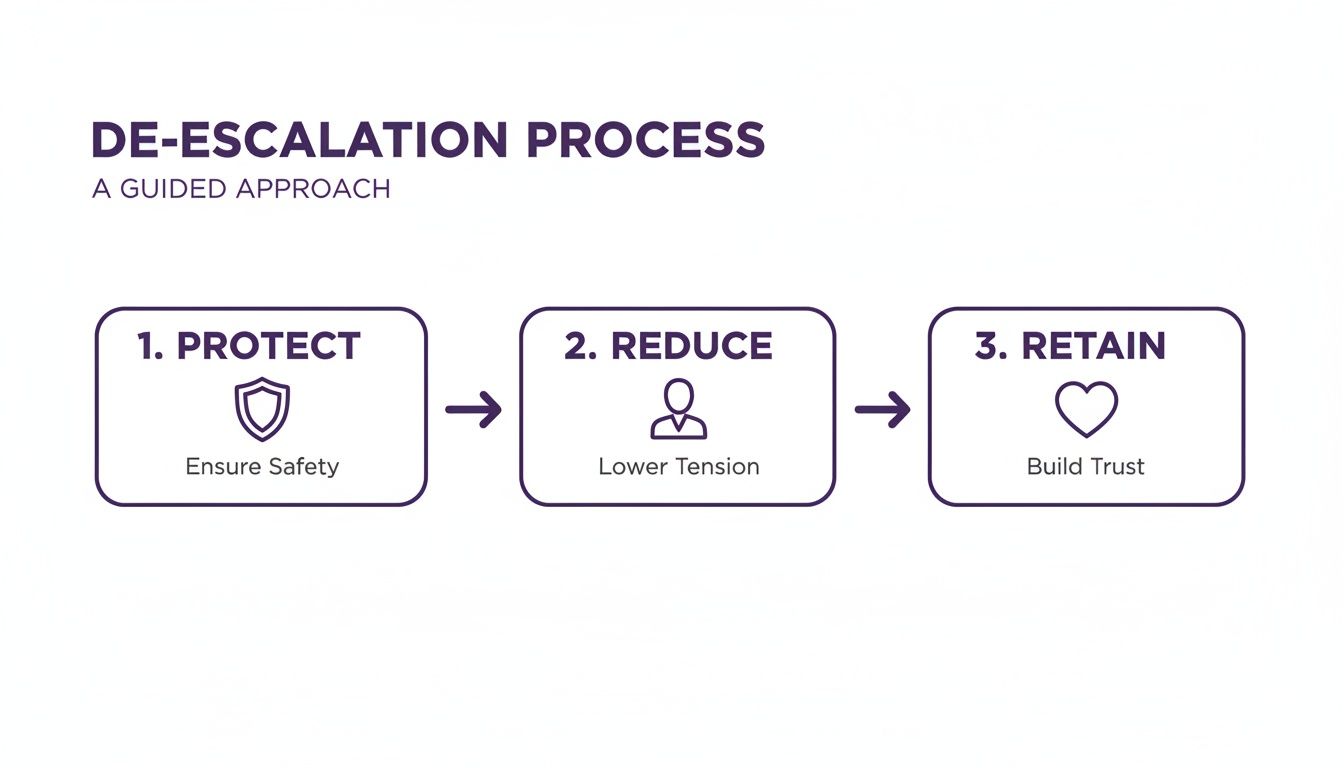
This flowchart highlights that de-escalation isn’t a single action but a strategic process aimed at retaining the customer for the long term.
Actionable Training Activities and Scenarios
Theory alone doesn’t build confidence. Each module must be paired with practical, hands-on activities that simulate real-world pressure. These concepts should fit into your broader training curriculum. For more ideas on structuring your program, our guide on how to develop a successful call center training is an excellent resource.
“The best training frameworks don’t just teach techniques; they build muscle memory. Agents should be able to execute these skills instinctively when a call turns difficult.”
Here’s a practical example of how to structure activities for the “Strategic Language” module:
| Learning Goal | Practical Activity |
|---|---|
| Identify and eliminate common trigger words from agent vocabulary. | “Trigger Word Swap” Exercise: Provide agents with scripts full of negative language (“You have to…”, “Our policy is…”). Their task is to rewrite them using positive, collaborative alternatives (“Let’s try…”, “Here’s what we can do…”). |
| Master at least five proven de-escalating phrases for common scenarios. | Scenario Role-Playing: Run role-plays where agents must use specific phrases like “Let’s work on this together” or “I understand why you’re upset” in a simulated tough call. |
| Learn to shift conversations from the problem to the solution using language. | “Future Focus” Drills: Agents practice redirecting a customer fixated on a past issue by using forward-looking statements like “Here’s what we can do to resolve this for you moving forward…” |
Modern AI tools can create incredibly realistic simulations for this kind of practice. For instance, mastering Mindreader’s roleplaying feature to sharpen client interaction skills offers a safe environment for agents to build confidence without risk.
Adapting De-Escalation Training for Bilingual and Nearshore Teams
For a bilingual nearshore BPO like CallZent, adapting this framework is non-negotiable. This process goes far beyond direct translation; it requires deep cultural nuance. A phrase that sounds perfectly reassuring in English might come across as dismissive or robotic in Spanish.
Your training must account for these subtleties. Role-playing scenarios should be conducted in both languages, with feedback focused not just on word choice but on tone, cultural context, and non-verbal cues. This cultural attunement is what enables agents to connect with customers through genuine empathy, regardless of language, transforming a good training program into an exceptional one.
Real-World De-escalation Techniques in Action
Theory is one thing; facing an irate customer on a live call is another. This is where excellent customer service de-escalation training proves its value—by equipping agents with practical, pressure-tested techniques that actually work.
Let’s move beyond the abstract and look at real-world examples from high-stakes industries. You’ll see how a well-trained agent can use validation, empathy, and solution-focused language to completely turn a negative call around. Remember, the goal isn’t to win an argument; it’s to save the customer relationship.

Scenario One: The Frustrated E-commerce Shopper
The Situation: An online shopper’s package is marked “delivered,” but it’s nowhere to be found. They are angry, convinced their order is lost forever, and their trust in your client’s brand is plummeting.
Untrained Response:
“I’m sorry, but our system says it was delivered. You’ll have to file a claim with the shipping company. We can’t do anything until their investigation is finished, which could take weeks.”
Why it Fails: While factually correct, this response is an emotional dead end. It sounds dismissive, unhelpful, and pushes all the work back onto the already frustrated customer. You’ve just poured gasoline on the fire.
Trained Response:
“I can absolutely see why you’re so upset—it’s incredibly frustrating when a package goes missing, especially one you were looking forward to. Let’s get this figured out together. I’m opening an immediate trace with the carrier on our end right now. While that’s processing, could you help me confirm the shipping address we have on file? My only priority is to find out what happened and make this right for you.”
The Difference: The trained agent immediately validates the customer’s feelings (“I can see why you’re upset”), uses collaborative language (“let’s get this figured out together”), and takes ownership of the next steps. The dynamic instantly shifts from a confrontation to a partnership.
Scenario Two: The Confusing Healthcare Bill
The Situation: A patient calls, completely baffled and angry about a medical bill. They believe they’ve been overcharged but are lost in a sea of complex codes and industry jargon. This is a high-stress situation that combines financial anxiety with health concerns.
Untrained Response:
“Well, the CPT code 99214 is for a detailed office visit, which is what was billed. If you disagree, you need to file an appeal with your insurance.”
Why it Fails: This agent just threw a wall of jargon at an overwhelmed patient and passed the buck. The customer feels ignored, confused, and powerless.
Trained Response:
“I understand this bill is confusing, and it’s completely valid to feel frustrated when you see unexpected charges. I’m pulling up the details right now, and I’m going to walk through each line item with you, explaining it all in plain language. Let’s look at this together so we can get you a clear answer. My goal is to make sure you understand exactly what you’re being billed for and confirm its accuracy.”
The Difference: The trained agent leads with empathy, offers to simplify the complexity, and frames the goal as a shared one. This empowers the patient and builds trust, even if the bill itself is correct. The key is active listening, a skill we explore in-depth in The Power of Active Listening in Call Centers.
Scenario Three: The Panicked Financial Services Client
The Situation: A banking client calls in a panic. They’ve spotted a large, fraudulent charge on their credit card and are terrified their account has been compromised. Their anxiety is sky-high, and they need immediate reassurance.
Untrained Response:
“Okay, I see the charge. I have to read you a fraud disclosure first. Please hold.”
Why it Fails: While the disclosure may be required, this response is cold and robotic. It prioritizes a script over the person, making a panicked customer feel like just another number in the queue.
“The moment a customer feels heard and understood is the moment de-escalation truly begins. It’s not about what you say first; it’s about how you make them feel first.”
Trained Response:
“I can hear how concerning this is, and you absolutely did the right thing by calling us immediately. We’re going to tackle this right now. First, I’m securing your account to prevent any other activity. Now, let’s walk through this charge together so I can get it disputed for you. You will not be held responsible for this fraudulent transaction.”
The Difference: This is a masterclass in taking control and providing reassurance. The agent immediately takes command, explains the protective actions they’re taking, and—most importantly—delivers the key message upfront: “You will not be held responsible.” This directly addresses the customer’s biggest fear, allowing them to calm down and assist with the resolution process.
The need for this practical training is growing. In 2023, the NRF Foundation launched a major Customer Conflict De-escalation training program, with over 58,000 credentials earned in its first year alone. You can read more about the NRF program’s findings. These scenarios prove that customer service de-escalation training is a critical investment that pays dividends in customer loyalty and brand trust.
How to Measure the Success of Your De-Escalation Training
Investing in customer service de-escalation training is a strategic business decision, not just an operational expense. Like any smart investment, its success must be measured. If you can’t quantify the results, you can’t manage the process or justify the cost. Tracking the right key performance indicators (KPIs) is the only way to prove the ROI and understand the tangible impact on your bottom line.
This isn’t about collecting vanity metrics. It’s about focusing on data that demonstrates clear improvements in efficiency, customer loyalty, and agent morale. By setting up a simple dashboard, you can move from guessing to making data-driven decisions that validate your program’s value.
Key Metrics That Prove De-escalation Success
To see the real-world effects of your training, monitor a specific set of KPIs directly linked to conflict resolution. These numbers tell a clear story about how well your team is navigating tough conversations and preventing them from spiraling.
- Escalation Rate: This is your most direct measure of success. A significant drop in the percentage of calls transferred to a supervisor means your frontline team is resolving more issues independently. That’s a huge operational win.
- Average Handle Time (AHT) on Difficult Calls: While a lower AHT is often the goal, in de-escalation, you’re looking for stability or a slight decrease. Effective techniques reduce time wasted in unproductive arguments, even if the call itself requires a more careful, deliberate approach.
- Post-Conflict Customer Satisfaction (CSAT): Surveying customers after a tense interaction provides invaluable insight. An increase in CSAT scores for these specific encounters proves your agents are not just closing tickets—they are actively repairing customer relationships.
- First Call Resolution (FCR): When an agent can de-escalate a situation and solve the problem in a single interaction, it’s a massive win for efficiency and customer experience. An improved FCR on emotionally charged calls is one of the strongest indicators that your training is working.
 The Overlooked Metric: Agent Retention
One of the most powerful—and often forgotten—benefits of robust de-escalation training is its impact on your team. Facing angry customers daily without the right tools is a primary driver of agent burnout and turnover.
When your team feels equipped and confident, job satisfaction rises and stress levels fall. By tracking your Agent Retention Rate before and after implementing the training, you’ll likely see a compelling positive correlation. Higher retention means lower recruiting and onboarding costs, leading to a more experienced, skilled, and effective team.
“Lower escalation rates are not just an operational win; they are a direct reflection of a more empowered, confident, and resilient team. This is how you build a sustainable, high-performing call center culture.”
The data supports this. Studies show that practical de-escalation training leads to dramatic reductions in conflict. One study in a high-stress environment saw severe aggressive incidents plummet from 74% to 40% post-training, with total aggressive incidents falling by an incredible 73%. You can learn more about these de-escalation findings and see how these principles apply directly to the high-pressure world of customer service.
Building Your De-escalation Dashboard
Keep it simple. A dashboard for tracking these KPIs should provide a clear, at-a-glance view of your progress.
First, establish your baseline. Collect at least three months of data for these key metrics before the training begins. This gives you a solid benchmark to measure against.
Once training is underway, update the dashboard weekly or monthly. Watching the trends will not only help you demonstrate ROI but also identify specific areas where your team may need additional coaching. For a deeper dive into setting up effective tracking, check out our guide on call center reporting and metrics dashboards. A well-designed dashboard transforms abstract training goals into concrete business results, proving that investing in your team is one of the smartest financial decisions a BPO can make.
Fostering a Culture of Continuous Improvement
A one-time workshop on customer service de-escalation training is a great start, but it’s not a long-term solution. The real, lasting impact comes from embedding these skills into the fabric of your daily operations. True success isn’t about a single event; it’s about creating a system of ongoing support and reinforcement that makes de-escalation an instinct, not an afterthought.
This shift from a training session to a cultural pillar is what separates good call centers from great ones. It ensures your investment pays dividends for years to come.
Actionable Coaching Strategies for Team Leads
Your managers and team leads are the champions who make this culture stick. Their daily interactions are the perfect opportunity to coach and reinforce the lessons from formal training, moving them from theory to consistent, real-world application.
A powerful tool for this is the de-escalation scorecard. When reviewing call recordings, don’t just focus on the outcome. Use a scorecard that measures specific behaviors. Ask questions like:
- Did the agent actively listen without interrupting?
- Did they use validating language like, “I can see why that’s so frustrating”?
- Did they successfully pivot from the problem to a solution?
- Was their tone calm and professional throughout the call?
This approach turns a standard QA review into a targeted coaching session, giving agents concrete, actionable feedback.
Keeping Skills Sharp with Refresher Training
De-escalation is a perishable skill. Regular, engaging refresher exercises are essential for keeping your team’s abilities sharp.
Short, monthly role-playing sessions are incredibly effective. Ditch the generic scenarios and use real (anonymized) examples of tough calls your team has recently handled. This makes the practice immediately relevant. Have agents take turns playing the frustrated customer and the responding agent, followed by a group debrief on what worked well and what could be improved. It’s a collaborative way to build both skills and team cohesion.
“The best coaching doesn’t just correct mistakes; it builds an environment where agents feel safe to practice, fail, and ultimately master the skills that protect both them and the brand.”
This continuous practice is what transforms training from a memory into a reflex.
The Power of Positive Reinforcement and Support
Recognizing and rewarding excellent de-escalation is just as important as coaching for improvement. When you hear an agent masterfully handle a difficult call, celebrate it. Acknowledge their skill in a team meeting or with a small bonus. Positive reinforcement shows the entire team what success looks like and motivates everyone to strive for that standard.
Equally crucial is creating a psychologically safe environment. Handling an intensely angry customer is emotionally draining. Agents need to know they have support after a stressful call. Encourage them to take a short break to reset and debrief with a manager without fear of judgment. This support system is critical for preventing the burnout that leads to high turnover.
This focus on agent well-being has a direct financial benefit. Effective de-escalation training has been shown to dramatically reduce employee turnover. Some studies show companies that prioritize conflict management can see up to 4 times higher talent retention by fostering better communication and reducing burnout.
Ultimately, continuous improvement relies on a solid feedback loop. This involves coaching your agents and listening to what they—and your customers—have to say. Our guide on using customer feedback for continuous improvement offers practical strategies to complete this circle. This ongoing process of coaching, support, and feedback is what turns training into a true cultural cornerstone.
Common Questions About Customer Service De Escalation Training
Even with a clear plan, it’s natural to have questions before you commit. Implementing a comprehensive customer service de-escalation training program is a significant step, and getting the details right is key to success.
Here are answers to some of the most common questions we hear from BPO and call center managers.
How long should our de-escalation training be?
There’s no single magic number, but a powerful foundational program typically starts with an 8-to-16-hour workshop. The key is to break this up into smaller, digestible sessions spread across several days to prevent information overload and allow for better absorption.
However, the initial workshop is just the beginning.
Think of that first workshop as boot camp. It’s intense and necessary. But ongoing coaching? That’s the regular drilling that keeps soldiers sharp and battle-ready. You can’t have one without the other.
For skills to stick, you must pair the workshop with consistent reinforcement. We see the best results with monthly one-hour coaching sessions focused on real-world call reviews, supplemented by a two-hour skill refresher each quarter. This transforms training from a one-time lesson into a lasting instinct.
What is the biggest mistake to avoid in de-escalation training?
The single biggest mistake is treating training as a one-and-done event. De-escalation is not a skill you learn once and possess forever; it’s a perishable skill that requires constant practice to stay sharp.
Any program that consists only of a workshop without a plan for follow-up coaching is a wasted investment.
If you don’t weave these de-escalation principles into your daily operations—from team huddles and QA scorecards to one-on-one reviews—agents will revert to old habits under pressure. You must make it part of your culture; otherwise, the initial investment will evaporate.
How do we adapt this training for a bilingual team?
This is a critical question, especially for nearshore call centers like CallZent. Adapting customer service de-escalation training for a bilingual team is about much more than just translating scripts. It requires cultural attunement. A phrase that feels warm and reassuring in English might sound cold or insincere in Spanish, and vice versa.
To get it right, your training must include:
- Cultural Nuance Workshops: Discuss differences in communication styles, tone, common expressions, and what genuine empathy sounds like in each language and culture.
- Bilingual Role-Playing: Scenarios must be practiced in both English and Spanish, with feedback from native speakers who can identify subtle cultural missteps.
- Culturally-Aware Language: Instead of literal translations, develop cultural equivalents—phrases and approaches designed to build trust and rapport authentically in both languages.
This ensures your agents can connect with every customer on a human level, showing genuine empathy that respects their unique background.
Frequently Asked Questions About Customer Service De-Escalation Training
1. What is customer service de-escalation training?
Customer service de-escalation training teaches agents how to calm angry or frustrated customers, manage emotional conversations, and guide interactions toward positive resolution—without escalating the issue to supervisors.
2. Why is de-escalation training important for call centers?
Escalated calls increase costs, harm brand reputation, and contribute to agent burnout. De-escalation training reduces escalations, improves customer satisfaction, and helps retain skilled agents.
3. How long does effective de-escalation training take?
A strong foundation typically requires 8–16 hours of initial training, followed by ongoing coaching, call reviews, and refresher sessions to ensure skills remain sharp under pressure.
4. Can de-escalation training really improve customer satisfaction?
Yes. Customers who feel heard and respected—even during difficult interactions—are far more likely to remain loyal. Many organizations see higher post-conflict CSAT and Net Promoter Scores after training.
5. What industries benefit most from de-escalation training?
While all industries benefit, it is especially critical in e-commerce, healthcare, financial services, utilities, and SaaS—anywhere emotions, money, or urgency are involved.
6. How do you measure the success of de-escalation training?
Key metrics include Escalation Rate, First Call Resolution (FCR), Average Handle Time on difficult calls, post-conflict CSAT, and agent retention rates.
7. Is de-escalation training different for bilingual or nearshore teams?
Absolutely. Effective training must account for cultural nuance and communication style—not just language translation. Role-playing in both languages is essential for success.
8. What is the biggest mistake companies make with de-escalation training?
Treating it as a one-time workshop. De-escalation is a perishable skill that requires continuous reinforcement, coaching, and feedback to remain effective.
9. Can de-escalation training reduce agent burnout?
Yes. When agents feel confident handling difficult calls, stress decreases and job satisfaction improves—leading to lower turnover and a more experienced support team.
10. Should de-escalation skills be part of quality assurance reviews?
Definitely. Including empathy, tone control, validation, and solution-focused language in QA scorecards ensures de-escalation becomes part of everyday performance standards.
Turn Customer Conflict Into Brand Loyalty
At CallZent, customer service de-escalation training isn’t an afterthought—it’s built into how we recruit, train, and manage our nearshore teams.
Our bilingual agents are trained to protect your brand, calm high-stress interactions, and retain customers when it matters most.
If you’re ready to reduce escalations, improve CSAT, and build a calmer, more resilient customer support operation, let’s talk.
At CallZent, we build our nearshore teams with these principles at their core, ensuring your customers receive culturally-aware, empathetic, and effective support. Discover how our BPO solutions in Tijuana can elevate your customer experience.
Learn more at https://callzent.com.