Skip to content
Customer Strategy & CX
Customer Service vs Customer Experience:
What Drives Growth?
Customer service solves moments. Customer experience shapes the entire journey. Learn the key differences, metrics, and strategies that drive sustainable growth.
TL;DR — Quick Takeaways
- Customer Service is reactive and transactional, focused on resolving a single issue.
- Customer Experience (CX) is proactive and holistic, covering every touchpoint in the customer journey.
- Great service is essential—but it cannot fix a broken customer experience on its own.
- Businesses that master both outperform competitors in loyalty, retention, and growth.
Is there really a difference between customer service and customer experience? Absolutely, and understanding it is the secret to sustainable growth.
Think of it this way: Customer service is a single, often reactive, interaction. Customer experience (CX) is the entire journey—the sum of every touchpoint a person has with your brand, from the first ad they see to the support call they make a year later.
A single, perfectly executed play is your customer service. The entire winning season is the customer experience. Getting this right isn’t just theory; it’s the foundation of a modern, resilient business.
TL;DR: The Core Difference in 30 Seconds
- Customer Service is reactive and transactional. It’s a single moment focused on solving a specific problem (e.g., a support call, a live chat).
- Customer Experience (CX) is proactive and relational. It’s the customer’s total perception of your brand, shaped by every interaction across their entire journey.
- Key Insight: Great customer service is a critical part of a great customer experience, but it can’t fix a broken journey on its own. To win, you need both.
Is It Service or Experience? Settling the Great Debate
If you’ve ever used “customer service” and “customer experience” interchangeably, you’re not alone. Many business leaders do, but it creates a dangerous blind spot in your strategy. While top-notch customer service is a massive part of a great customer experience, it’s still just one piece of a much bigger puzzle.
Let’s break it down with a practical, real-world example. A customer buys a new laptop from your online store. The website was a breeze to use, checkout was frictionless, and the shipping was lightning-fast. All of that is part of their customer experience.
A month later, a software bug pops up. They call your support line, and a friendly, sharp agent walks them through a fix in under five minutes. That single, effective problem-solving moment? That’s customer service.
The first part was proactive, shaping their overall feeling about your brand. The second was reactive, putting out a specific fire. You need both to win, but they operate on completely different levels. Understanding how these holistic interactions build loyalty is key, especially in complex industries that are mastering bank customer experience by looking beyond just the transaction.
Customer Service vs. Customer Experience At a Glance
Getting this distinction right is the first step toward building a business that people genuinely love. You can’t patch up a clunky website, confusing marketing, or a mediocre product with a great support team alone. It all has to work together. This is the core idea behind effective customer experience management.
Sometimes, seeing it side-by-side makes all the difference. Here’s a quick look at how the two stack up.
| Attribute | Customer Service | Customer Experience (CX) |
|---|---|---|
| Scope | A single interaction or touchpoint. | The entire customer journey and lifecycle. |
| Focus | Reactive; solving an immediate problem. | Proactive; shaping perceptions and feelings. |
| Ownership | Primarily the customer support department. | The entire organization, from marketing to product. |
| Goal | Resolve issues and provide assistance efficiently. | Build a long-term, loyal relationship with the customer. |
| Timeline | Short-term, transactional. | Long-term, relational. |
The key takeaway is that customer experience is the sum of all parts, while customer service is just one of those parts. A customer’s feeling about your brand is formed by every interaction, big and small, and service is a critical moment of truth within that broader journey.
 Core Strategic Differences: Service vs. Experience
Knowing the definitions is a start, but the real lightbulb moment happens when you see how customer service and customer experience actually function in the wild. The difference between customer service and experience becomes painfully obvious once you put their core functions side-by-side. Honestly, they require completely different mindsets, investments, and organizational charts to get right.
Let’s dig into the critical areas that show why you can’t just apply your service playbook to your experience strategy and expect it to work.
Scope: A Single Moment vs. The Entire Journey
The most fundamental split between the two is scope. Think of customer service as a close-up shot—it’s focused on one specific, isolated interaction. We’re talking about a single phone call, a quick email exchange, or a live chat session.
Customer experience (CX), in contrast, is the panoramic view. It’s the sum of every single touchpoint a person has with your brand, starting from the first time they see an ad all the way through their purchase, using the product, and any follow-up contact.
- Service in Action: A customer calls your support line because a promo code isn’t working on your website. The agent’s job is clear: fix that one problem, right now.
- Experience in Action: That same customer’s journey actually includes seeing your ad on Instagram, how easy (or hard) it was to find the product on your site, the checkout friction (promo code included), the “unboxing” moment, and the feedback survey you sent a week later. The broken code is just one scene in a much bigger movie.
Ownership: One Department vs. The Whole Company
Who “owns” it? That’s another massive differentiator. Customer service traditionally lives in a specific department. It’s the team with the headsets and the specialized training to handle incoming problems.
Customer experience, however, belongs to everyone. It’s a company-wide philosophy. Marketing, sales, product development, even the finance team—they all have a hand in shaping the customer’s journey. A confusing invoice from accounting or a misleading ad from marketing can sour the experience just as quickly as a fumbled support call. A great service team can be an island of excellence, but a truly great customer experience demands that every employee understands how their work impacts the customer.
Approach: Reactive vs. Proactive
By its very nature, customer service is reactive. It springs into action after a customer has a problem or a question. The team is on standby, ready to respond when someone reaches out.
A smart CX strategy is the polar opposite: it’s proactive. It’s all about getting ahead of issues before they happen. This means anticipating customer needs, finding and smoothing out rough patches in the journey, and designing a process that’s as effortless as possible from day one. It’s a core principle when you’re figuring out how to improve your customer service strategy, because it forces you to think beyond just putting out fires.
Goals: Problem Resolution vs. Relationship Building
The endgames for service and experience are miles apart. Customer service has a very direct, immediate goal: solve the problem. Success is all about resolving the issue quickly and efficiently, making the customer happy in that specific moment.
CX is playing the long game. Its goal is to build a strong, loyal relationship. It’s about creating positive feelings and a genuine connection that makes people want to come back and, even better, tell their friends about you.
Research shows 73% of consumers say experience is a major factor in their buying decisions, proving that CX has a massive role in growth that goes far beyond simple transactional support.
Key Metrics and Technology
How you measure success and the tools you use are completely different.
- For Customer Service: You’re tracking tactical KPIs. Think First Call Resolution (FCR), Average Handle Time (AHT), and Customer Satisfaction (CSAT) scores that are tied directly to one interaction.
- For Customer Experience: The metrics are strategic and relational. Here, you’re looking at Net Promoter Score (NPS), Customer Lifetime Value (CLV), and Customer Effort Score (CES).
The tech stacks are just as distinct. Service teams lean on ticketing systems like Zendesk, call center software, and internal knowledge bases. A full-blown CX strategy requires a much broader arsenal, including CRM platforms like Salesforce, journey mapping software, and heavy-duty analytics tools to see the big picture.
How to Measure the Difference Between Service and Experience
You can’t fix what you don’t measure. And when you’re trying to pin down the difference between customer service and customer experience, the clearest distinction is often in the data you track. How you define success reveals your true focus: are you just putting out fires, or are you building a loyal following?
Customer service metrics are all about the here and now. They’re tactical, giving you a high-resolution snapshot of how an agent or team performed in a single interaction. In contrast, customer experience metrics are about the long game. They’re strategic, offering a panoramic view of the entire customer relationship.
Key Performance Indicators for Customer Service
For customer service, the name of the game is efficiency and resolution. Success is all about how quickly and effectively you can solve a customer’s immediate problem.
- First Call Resolution (FCR): This is the gold standard, measuring the percentage of calls resolved on the first try. A high FCR is a sign of an empowered, knowledgeable team.
- Average Handle Time (AHT): AHT clocks the average duration of a customer interaction. While efficiency is good, chasing a low AHT can lead to rushed, unresolved issues.
- Customer Satisfaction (CSAT): This is the classic post-interaction survey, asking, “How satisfied were you with this interaction?” CSAT gives you direct, immediate feedback on a specific touchpoint.
Getting a handle on these foundational metrics is the first step toward operational excellence. If you want to dive deeper into what to track, check out our detailed guide on key customer service performance indicators.
A high CSAT score on a single call is valuable, but it’s a dangerous blind spot if you assume it guarantees a positive overall customer experience. A customer can be happy with an agent’s help but still be frustrated with the journey that led them to make the call in the first place.
Key Performance Indicators for Customer Experience
When you zoom out to measure the entire customer experience, the focus shifts from quick wins to long-term relationship health. These KPIs are about loyalty, not just momentary satisfaction.
- Net Promoter Score (NPS): This one gauges loyalty with a single, powerful question: “On a scale of 0-10, how likely are you to recommend our company to a friend or colleague?” It sorts your customers into Promoters, Passives, and Detractors, giving you a straightforward look at brand advocacy.
- Customer Lifetime Value (CLV): CLV is a predictive financial metric. It forecasts the total revenue you can expect from a single customer over their entire relationship with your business. It’s the clearest way to tie your CX efforts directly to long-term profitability.
- Customer Effort Score (CES): CES asks a simple question: How easy was it to get your issue resolved? A low-effort experience is one of the strongest predictors of future loyalty and repeat business.
Relying only on service metrics is like judging a movie by a single scene. You need both tactical service KPIs to ensure every interaction is flawless and strategic experience KPIs to ensure the entire story keeps customers coming back.
The Financial Impact: How Service and Experience Affect Your Bottom Line
For any business leader, the real difference between customer service and customer experience hits home on the balance sheet. Getting either one wrong has serious financial consequences, but they impact your business in vastly different ways.
One is an immediate, visible cost. The other is a slow poison that erodes your foundation from the inside out.
A single bad customer service interaction has a direct, calculable price tag. It might be an abandoned cart, a product return, or a cancelled subscription. The damage is tangible and easily measured. Think of it as a single leaky faucet—it’s annoying and costs you money, but you can fix it in isolation.
The High Cost of a Poor Experience
A poor customer experience, on the other hand, is a much bigger problem. It’s not just a leaky faucet; it’s a fundamental flaw in your company’s entire plumbing system. A weak CX doesn’t just cost you one transaction. It quietly drains your well of customer loyalty, diminishes brand trust, and systematically drives down your long-term revenue.
This slow erosion is what makes a bad CX so dangerous. A frustrating service call might lead to an angry tweet. But a consistently frustrating experience—from your website to your product to your support channels—creates widespread negative word-of-mouth that can cripple your growth for years. This is where the difference between customer service and customer experience becomes crystal clear.
- A service failure might cost you one customer.
- A systemic experience failure puts your entire market position at risk.
In fact, one report found that businesses globally have $3.8 trillion in sales at risk due to bad customer experiences. That staggering figure shows that CX is a primary driver of sales, dwarfing the isolated costs of individual service blunders. You can read more about these customer experience findings to see just how massive the financial risk is.
Investing in CX Isn’t an Expense—It’s an Imperative
This data completely reframes the conversation. Pouring money into a positive, holistic customer experience isn’t just another operational expense to be minimized. It’s a strategic imperative for sustainable growth. A proactive CX strategy—mapping the customer journey, simplifying processes, and personalizing interactions—is an offensive play that generates major returns.
Managing these functions efficiently is critical, and understanding the ROI of outsourcing call centers can reveal how the right partnership lets you focus on high-level CX strategy while ensuring your service remains excellent.
While poor service might cost you a customer, a poor experience can cost you a market.
At the end of the day, the financial picture is clear. Fixing service issues protects today’s revenue. Building a superior customer experience secures your company’s future.
How a BPO Partner Elevates Both Service and Experience
Knowing the difference between customer service and experience is one thing, but executing both flawlessly is another. Most businesses find their internal teams are stretched thin, forced to choose between putting out daily service fires and building a long-term, proactive experience strategy. This is where a specialized partner can completely change your trajectory.
Partnering with a nearshore Business Process Outsourcing (BPO) provider like CallZent lets your company master both disciplines at the same time. It creates a powerful division of labor: the BPO handles the tactical, high-volume world of customer service, freeing up your in-house team to focus on the high-level, strategic work of crafting an unforgettable customer experience.
Freeing Your Team for Strategic CX Work
When you delegate your front-line service, you’re not just offloading tasks—you’re reclaiming your most valuable asset: your team’s time and strategic brainpower. Instead of getting buried in support tickets and call queues, they can finally zoom out and see the bigger picture.
This strategic shift empowers them to:
- Deeply analyze customer feedback gathered by your BPO partner to identify systemic issues.
- Map the end-to-end customer journey to pinpoint and eliminate friction points.
- Develop proactive communication strategies that anticipate customer needs before they have to ask.
- Collaborate across departments with marketing, product, and sales to ensure a consistent brand message at every single touchpoint.
This flowchart shows the critical path a customer travels, illustrating how failures in either service or experience can lead to significant business losses.
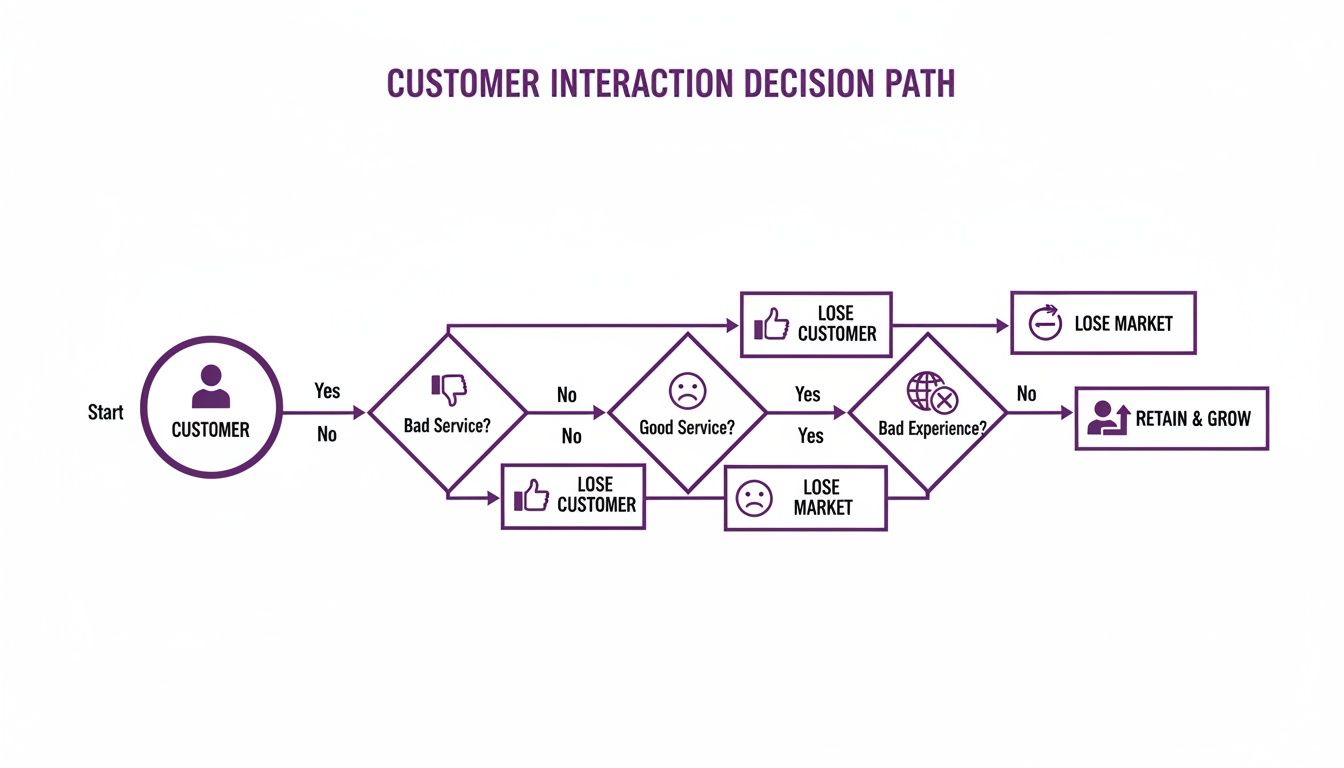
As you can see, even with decent service, a poor overall experience can still cost you your market. It really drives home the need for a dual focus.
A Real-World Example of a BPO Partnership
Picture an e-commerce company swamped by customer service inquiries during its peak season. Its small in-house team was overwhelmed, leading to long wait times and plummeting CSAT scores. They couldn’t even think about improving the website or checkout process because they were constantly putting out fires.
They decided to partner with a nearshore call center to manage all their front-line service tickets via phone, email, and chat.
The results were immediate and transformative. With the BPO partner delivering exceptional, 24/7 service, the in-house team was able to shift its focus entirely to the broader customer experience. They used the detailed reports from the BPO to analyze the root causes of common inquiries.
This analysis revealed that a confusing return policy and a clunky checkout page were driving a majority of the support volume. Armed with this data, they redesigned the policy page and streamlined the checkout flow. Within three months, they reduced their overall call volume by 20% and saw a marked improvement in their Net Promoter Score.
This case study is a perfect illustration of what a strategic partnership can do. The company didn’t just outsource a problem; it invested in a solution that elevated both its service delivery and its long-term experience strategy. To see how this model works, you can explore the full range of BPO call center definitions, services, and benefits and discover how it can be applied to your business.
Building Your Integrated Customer Strategy
Knowing the difference between customer service and experience is one thing. Turning that knowledge into a powerful, unified strategy is where real growth happens. A great strategy doesn’t just patch holes; it builds a seamless framework that puts the customer at the center of every decision.
The goal is to move from theory to practice, taking clear, actionable steps that get your entire organization on the same page.

This shift requires a deliberate, step-by-step approach. It’s all about designing an ecosystem where exceptional service moments happen naturally within a flawlessly architected customer experience.
Four Actionable Steps to a Unified Approach
Creating a truly integrated strategy means looking at your operations from the customer’s perspective and giving your teams the tools to deliver excellence. Here are four essential steps to get you started.
- Map the Complete Customer Journey
First things first: walk in your customer’s shoes. You need to document every single touchpoint, from the first ad they see to the follow-up email after a purchase. Pinpoint where the experience is smooth and, more importantly, where the friction is. This map becomes your blueprint for improvement. - Gather and Analyze All Feedback
Your customers are already telling you what’s working and what isn’t. Listen to call recordings, read through support emails, analyze survey results, and keep an eye on social media comments. By consolidating feedback from both direct service interactions and broader experience surveys, you can spot the recurring themes and fix the root causes, not just the symptoms. - Empower Your Frontline Teams
Your customer service agents—whether they’re in-house or outsourced—are your eyes and ears on the ground. Give them the right tools, ongoing training, and the autonomy to solve problems without being handcuffed by rigid scripts. An empowered agent can turn a negative service moment into a loyalty-building experience. - Align the Entire Organization
Customer experience isn’t just one department’s job; it’s a company-wide commitment. Ensure every team, from marketing and product development to finance, understands its role in the customer journey. Set shared, customer-centric goals and KPIs that hold everyone accountable for their piece of the puzzle.
Mastering both service and experience—and integrating them seamlessly—is the definitive key to building a resilient, modern, and customer-focused brand.
This strategic alignment is what separates the good companies from the truly great ones. The real challenge—and the real opportunity—is in the execution. By mapping the journey, listening intently, empowering your people, and aligning your goals, you can build a strategy that doesn’t just satisfy customers but turns them into lifelong advocates.
Ready to build a strategy that elevates both your service and experience? Let’s talk about how CallZent can help you achieve operational excellence. Contact us today for a consultation and let’s get started.
Common Questions About Customer Service vs. Experience
When you start digging into customer interactions, a few questions always seem to pop up. Let’s clear the air on some of the most common ones to help you sharpen your strategy.
Can You Have Good Service but a Bad Experience?
Absolutely. It happens all the time, and this scenario is the best way to understand the difference between customer service and experience.
Imagine this: a customer struggles to find what they need on your confusing website, fights with a clunky checkout process, and then their order shows up two weeks late. Every one of those touchpoints created a frustrating, negative customer experience.
When they finally call to complain, they get a fantastic agent—someone who is friendly, empathetic, and fixes their problem in minutes. That single moment was excellent customer service. But that one great interaction probably won’t be enough to undo all the friction that came before it. The customer might like the agent, but they’ll likely walk away thinking their overall experience with your brand was a mess.
A great service interaction is like a first-aid kit for a bad experience. It can patch up a specific wound, but it can’t fix the underlying issues that caused the injury in the first place.
Who Is Responsible for Customer Experience in an Organization?
This is a big one. While customer service usually lives in a specific department, customer experience (CX) is everyone’s job.
Real ownership of CX isn’t about assigning it to one person; it’s a company-wide philosophy that has to come from the top down. Every single department has a hand in it:
- Marketing creates the first impression and sets customer expectations.
- Sales guides the purchase and kicks off the relationship.
- Product Development builds the thing the customer is actually using.
- Logistics is in charge of getting the product to the customer’s door.
- Finance handles billing—a process that can be a major source of frustration if not handled smoothly.
When every team gets how their role fits into the bigger customer journey, you can start delivering an experience that feels seamless and positive from start to finish.
How Can Small Businesses Improve CX Without a Large Budget?
You don’t need a huge tech budget or a dedicated CX team to make a real difference. Small businesses can get a lot of mileage out of high-impact, low-cost strategies.
First, just listen to your customers. Actively ask for feedback with simple surveys or follow-up emails. They will give you a roadmap telling you exactly what needs fixing.
Next, walk through your customer’s journey yourself. Go through every step—from finding your brand online to buying something and asking for help. You’ll be surprised at the friction points you uncover. From there, empowering your team to solve problems on the spot without jumping through hoops is a simple way to create a much smoother, more positive experience.
🚀 Ready to Elevate Service and CX?
CallZent helps fast-growing companies deliver exceptional customer service while building scalable, long-term customer experiences through nearshore BPO solutions.
At CallZent, we help you deliver flawless customer service so your team can focus on building an unbeatable customer experience. Discover our flexible and scalable nearshore solutions designed for growth. Learn more at CallZent.com.