Skip to content
E-Commerce BPO
E-Commerce Call Center Guide: Turn Support Into a Revenue Driver
Learn how to transform your customer support in e-commerce call center into a revenue driver with the right outsourcing model, tech stack integration, and performance KPIs.
TL;DR — Quick Takeaways
- Shift your mindset: Your e-commerce call center should drive revenue, not just resolve tickets.
- Choose the right model: Nearshore outsourcing balances cost savings with cultural alignment.
- Integrate your systems: CRM, e-commerce platform, and omnichannel tools must work seamlessly.
- Track impact KPIs: Focus on FCR, CSAT, and NPS—not just call volume.
For any e-commerce brand, your support center is the human connection that turns a simple online transaction into a lasting customer relationship. It’s where you handle everything from order tracking and returns to technical support and sales questions, directly shaping brand loyalty and, ultimately, your revenue. But are you treating it as an expense or an asset?
Your E-commerce Call Center Is a Revenue Engine, Not a Cost Center
Imagine this: a customer calls, frustrated about a delayed shipment. A standard support agent apologizes and gives them a tracking update. But a revenue-focused agent resolves the issue, empathizes with their frustration, and then offers a discount on their next purchase for a related product, securing a future sale before hanging up.
That’s the power you unlock when you stop seeing customer support as a cost center. For too long, business owners have treated their call centers as a necessary evil—an operational expense to be slashed at every turn. But that old-school thinking misses a massive opportunity for growth.
A strategic e-commerce call center isn’t just a defensive line for fixing problems; it’s a proactive engine for driving your business forward. Every single interaction is a chance to build trust, gather priceless feedback, and guide customers toward more value.
This shift in mindset is more critical than ever. As e-commerce sales continue to explode, the demand for high-quality support operations that don’t just keep up but actually lead the way has never been higher. If you need help refining your approach, CallZent offers expert customer service consultancy to align your support operations with your real growth goals.
Beyond Problem-Solving to Profit-Driving
When you treat support as a revenue driver, a well-trained team can do so much more than just look up tracking numbers. They can actively:
- Save Abandoned Carts: Proactively connect with customers who left items in their cart, answering last-minute questions and overcoming objections to close the sale.
- Upsell and Cross-sell: Recommend complementary products or premium upgrades based on a customer’s purchase history and stated needs. For example, an agent helping a customer with a new camera can suggest a compatible lens or a protective case.
- Gather Product Insights: Collect direct, unfiltered feedback during support calls to inform your product development and marketing strategies.
- Boost Customer Lifetime Value (LTV): A single positive, memorable support experience can turn a one-time buyer into a lifelong brand advocate.
Your customer support team hears directly from your audience every single day. Treating their insights as a cost center means you’re ignoring your most valuable source of market research.
This guide is your roadmap to building or optimizing an e-commerce call center that contributes directly to your bottom line. We’ll walk through everything from assessing your needs and picking the right partner to integrating systems and measuring what truly matters.
Charting Your E-Commerce Support Blueprint
Before you even think about searching for a call center partner, you need a crystal-clear picture of what you actually need. Rushing this step is like building a house without a blueprint; you’ll end up with a structure that doesn’t fit and costs a fortune to fix. The first move is a thorough audit of your current support operations.
Audit Your Current Support Workload
Start by pulling your support ticket data from the last six to twelve months. Look for patterns. What are your peak hours, days, and seasons? For a fashion retailer, the week after a new collection drops or the chaos of a Black Friday sale will look completely different from a quiet Tuesday in April.
Having this data helps a potential partner understand your baseline needs and, more importantly, how to staff for those inevitable surges. An essential part of this is actionable customer support training, which frames how agents should be prepared for these exact scenarios.
Next, categorize your most common customer issues. Don’t just lump everything under a generic “support” tag. Break it down into clear segments:
- Order Status Inquiries: Simple “Where is my order?” questions.
- Returns and Exchanges: How many requests are you getting, and why?
- Pre-Sale Product Questions: Inquiries about sizing, materials, or features.
- Technical Glitches: Issues with the website, promo codes, or payment errors.
- Billing Issues: Questions about charges, refunds, or payment methods.
This detail is crucial. If 60% of your tickets are simple order tracking questions, your strategy might lean heavily on automation and a smaller team of live agents. But if 40% are complex technical issues for a high-tech gadget, you need a partner with specialized, in-depth training. It’s also vital to create a seamless omnichannel customer experience where all your channels work together.
Forecast Your Future Growth
A support blueprint shouldn’t just reflect where you are today—it has to anticipate where you’re headed. Are you planning a massive holiday promotion? Expanding into a new international market? Launching a highly anticipated product line next quarter?
A great e-commerce call center partner doesn’t just handle your current ticket volume; they provide the flexible scalability to support your most ambitious growth plans.
Think about it: a subscription box company aiming to double its subscriber base in the next year must be confident its BPO partner can scale agent support seamlessly, without any drop in quality. That means planning for hiring, training, and new technology well in advance.
How to Select the Right E-Commerce Call Center Partner
Choosing a call center partner is one of the biggest decisions you’ll make. This isn’t just about finding the cheapest hourly rate; it’s about finding a true partner who will operate as a seamless extension of your team, safeguarding your brand’s reputation.
The vetting process has to be thorough. You need a partner whose tech stack mirrors your own, with proven skill in the platforms you already use. For example, if your store is on Shopify and you manage customer data in Salesforce, your potential partner must have flawless integration experience with both.
This decision tree can help you map out whether keeping support in-house or outsourcing is the right first step.
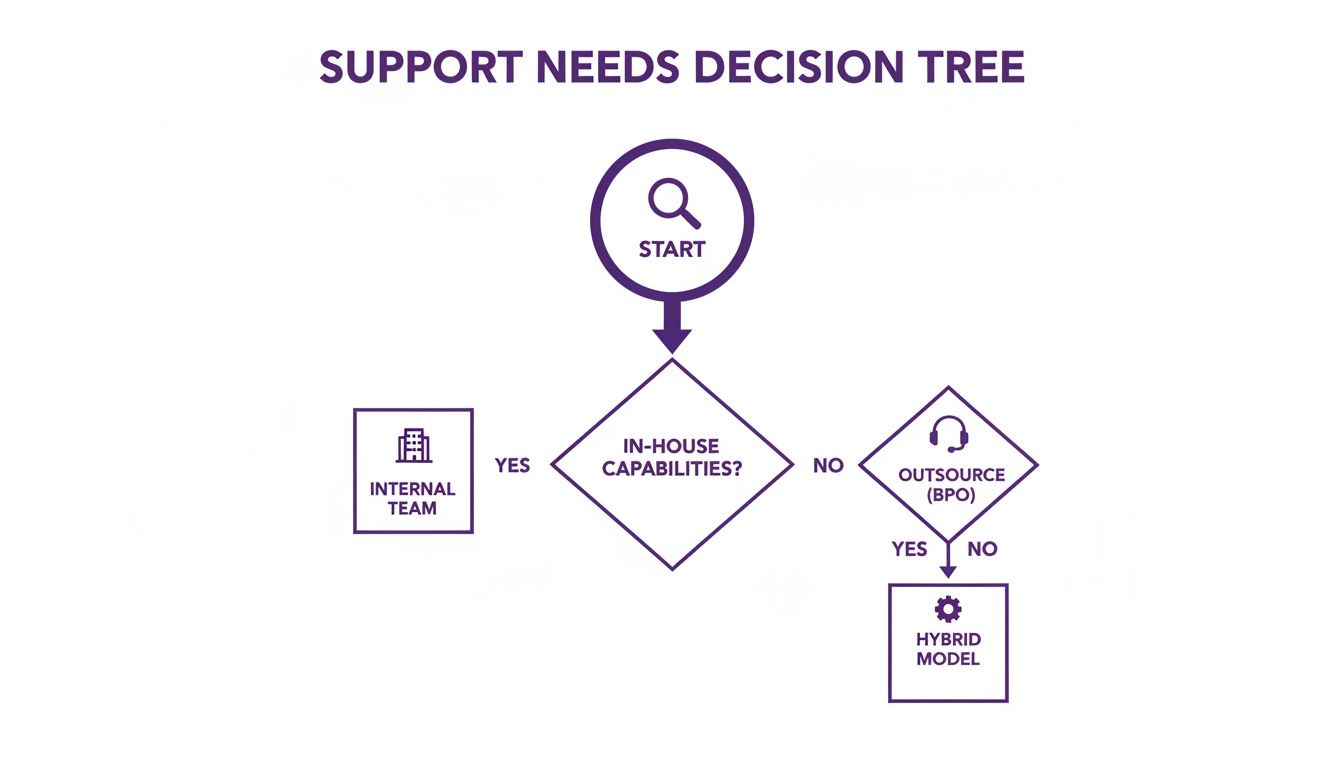
Running this self-audit lays the groundwork for figuring out if an in-house, hybrid, or fully outsourced BPO model fits your operational bandwidth and growth plans.
Key Criteria for Evaluating Your BPO Partner
When evaluating potential partners, there are a few non-negotiables. First up: security protocols. You’re handling sensitive customer data, which means PCI DSS (Payment Card Industry Data Security Standard) compliance is mandatory.
Beyond tech and security, cultural alignment is everything. Your partner’s agents are the voice of your brand. They must understand the nuances of your customer base and communicate with the right tone and empathy. This is where nearshore partners, especially in hubs like Tijuana, give North American companies a serious edge.
Your BPO partner should operate as a dedicated extension of your brand, not a disconnected third-party vendor.
The shared cultural affinity and minimal time zone differences create more natural, effective conversations. Agents are better equipped to build genuine rapport with customers, which directly impacts satisfaction and resolution rates. A top-tier e-commerce call center should have a first call resolution rate of 75% or higher, solving most issues in a single touchpoint.
E-Commerce Call Center Models: In-House vs. Offshore vs. Nearshore
To make the right choice, you have to understand the different outsourcing models. Each comes with its own set of pros and cons. Our guide on how to find and vet the best call center outsourcing companies offers a detailed framework.
Here’s a quick comparison:
| Factor | In-House Team | Offshore Partner (e.g., Asia) | Nearshore Partner (e.g., Tijuana) |
|---|---|---|---|
| Cost | Highest (salaries, benefits, overhead) | Lowest labor costs | Significant savings over in-house |
| Control | Maximum control over branding & quality | Less direct control over daily ops | High level of collaboration & oversight |
| Talent Pool | Limited to local talent market | Access to a massive, diverse workforce | Large, bilingual talent pool with cultural alignment |
| Cultural Affinity | Perfect alignment with brand culture | Potential for cultural disconnects | Strong cultural alignment with North America |
| Time Zone | Same time zone | Significant time zone differences | Minimal to no time zone difference |
| Communication | Seamless internal communication | Potential for language barriers | Fluent bilingual communication |
While offshore offers the lowest price point, the nearshore model often provides the best overall value by blending cost savings with the cultural and operational alignment necessary for a premium customer experience.
 Integrating and Onboarding Your New Team for Success
You’ve picked the right partner—great. But the real work starts now. The success of this venture hinges on how well you integrate and onboard your new team. This isn’t just about handing over a script; it’s about making them a true extension of your brand.
First, the technical integration. Your new agents need the same real-time information your in-house team relies on. This means plugging your e-commerce platform—whether it’s Shopify, Magento, or WooCommerce—directly into your partner’s CRM and contact center software. The goal is a single, unified customer view where agents can see order history, past conversations, and shipping status instantly.
The Human Side of Integration
While tech is the backbone, it’s the people who create the customer experience. Your onboarding needs to be an immersive experience, not just a lecture. Here are a few practical examples:
- Product Deep Dives: Agents can’t support what they don’t understand. If you sell apparel, send them product samples. If you sell software, give them full-access accounts to explore. At a minimum, run live video demos where they can ask questions.
- Brand Voice Workshops: Don’t just email a style guide. Conduct role-playing exercises focused on tone. Is your brand quirky and fun or professional and reassuring? Agents need to feel the difference.
- Systems Training: Let them practice in a sandbox environment of your software. This builds muscle memory and confidence before they talk to a real customer.
Onboarding isn’t just about transferring knowledge; it’s about instilling confidence. An agent who feels fully prepared and supported from day one is far more likely to resolve issues on the first call.
For instance, an online retailer selling high-end home goods flew a product manager to their new nearshore call center for a two-day training. Agents assembled furniture and felt the quality of the fabrics. The result? Their first-call resolution rate was 15% higher than projected in the first week. This simple investment in deep, collaborative training paid for itself almost immediately. To build your own effective program, check out our guide on how to develop a successful call center training program.
Measuring Performance with the Right KPIs
If you can’t measure it, you can’t improve it. Once your new team is live, your focus must shift to data-driven optimization.
For a modern e-commerce call center, this means looking past outdated metrics like raw call volume. Simply tracking how many calls an agent takes is a recipe for rushed, low-quality interactions. Instead, the goal is to measure impact. Did we solve the customer’s problem? Are they happy? Will they buy from us again?
The Core Three KPIs for an E-Commerce Call Center
To get a true picture of performance, zero in on these critical metrics:
- First Call Resolution (FCR): This is the gold standard. FCR measures the percentage of issues resolved in a single interaction. A high FCR (aim for 75% or more) is a powerful sign of knowledgeable agents and efficient processes.
- Customer Satisfaction (CSAT): Usually measured with a quick post-interaction survey (“How satisfied were you?”), CSAT gives you immediate feedback on a specific experience. It’s your real-time pulse check.
- Net Promoter Score (NPS): This metric gauges long-term loyalty by asking customers how likely they are to recommend your brand. While CSAT measures a single moment, NPS reflects the overall relationship.
Turning Data into Actionable Strategy
Tracking these numbers is just the start. The real magic happens when you interpret them. For example, if you notice CSAT scores consistently dip for “product return” inquiries, the problem might not be the agent. It could be a signal that your return policy is confusing or your website’s return portal is broken. The data points you to the root cause.
Great reporting doesn’t just tell you what happened; it tells you why it happened. It transforms raw data into a roadmap for improving your entire customer journey.
This is where regular Quality Assurance (QA) reviews become non-negotiable. Listening to call recordings and reviewing chat transcripts alongside your KPIs provides the context you need. To truly understand the long-term impact of your support, tracking various customer retention metrics is also a must.
Transparent, shared dashboards are a game-changer. When your BPO partner sees the same performance data you do, it creates a culture of shared ownership. You can learn more about this approach in our guide to call center reporting and metrics dashboards.
Your Top E-Commerce Call Center Questions, Answered
If you’re considering outsourcing your customer support, you probably have questions. Here are some straight answers to what we hear most often.
How much does an e-commerce call center service cost?
The honest answer is: it depends. The cost varies based on the pricing model (per agent vs. per minute), support complexity, and location. While offshore partners may have the lowest hourly rates, nearshore partners provide the best overall value. You get significant cost savings compared to a US-based team but retain the high-quality service and cultural familiarity that customers appreciate. Stop focusing on just the hourly rate and think about the total value.
How can I make sure outsourced agents sound like my brand?
This is a valid concern. The secret is a deep, hands-on onboarding process. A true partner will immerse their agents in your brand’s story, values, and specific communication style.
The success of outsourcing hinges on a deep, collaborative onboarding process. A strong partner will immerse their agents in your brand story, values, and communication style.
For example, we rely heavily on role-playing real customer scenarios and holding regular calibration sessions to ensure our agents are true brand ambassadors. Your involvement is crucial to making the experience seamless for your customers.
What is the must-have technology for a modern e-commerce call center?
Running a modern support operation is all about the tech stack. The essentials are:
- A solid CRM (like Zendesk or Gorgias) to see a customer’s full history.
- An omnichannel platform that unifies phone, email, live chat, and social media.
- Direct integration with your e-commerce platform (like Shopify or BigCommerce) to access live order data.
The best providers also use AI analytics to spot trends and deploy chatbots for simple, repetitive questions, freeing up human agents to tackle complex issues where they can really make a difference.
Can a call center do more than just answer support questions?
Absolutely. A strategic e-commerce call center is one of your most powerful sales and retention tools. Agents can be trained to upsell and cross-sell during a support chat. They can process orders over the phone for less tech-savvy customers. They can even make outbound calls to follow up on abandoned carts. This transforms your support team from a cost center into a proactive, revenue-generating engine.
blockquote>Confidence drives performance. Well-trained agents resolve faster and sell smarter.Frequently Asked Questions
How much does an e-commerce call center cost?
Costs vary by model and complexity, but nearshore outsourcing offers significant savings compared to in-house operations while maintaining service quality.
Can an e-commerce call center increase sales?
Yes. With proper training, agents can upsell, cross-sell, and recover abandoned carts during support interactions.
What industries benefit most from e-commerce call centers?
Retail, fashion, electronics, subscription services, health & wellness, and DTC brands see strong ROI from optimized support operations.
How quickly can outsourcing scale?
A nearshore partner can typically ramp new teams within weeks, depending on volume and training requirements.
Is nearshore better than offshore?
For North American brands, nearshore often provides better cultural alignment, real-time collaboration, and higher CSAT.
What compliance standards matter?
PCI DSS compliance and data security protocols are essential for protecting customer payment information.
Do agents require product knowledge?
Absolutely. Deep product immersion improves FCR and customer confidence.
What channels should be supported?
Phone, email, live chat, SMS, and social media should all integrate into one omnichannel platform.
How do I measure ROI?
Track FCR, CSAT, NPS, conversion rates, and customer lifetime value improvements.
Can CallZent support high-growth brands?
Yes. CallZent specializes in scalable, bilingual nearshore teams built for fast-growing e-commerce companies.
🚀 Ready to Transform Your E-Commerce Call Center?
CallZent builds high-performing nearshore e-commerce call center teams that increase retention, improve CSAT, and drive revenue growth.
Talk to an ExpertReady to transform your customer support from a necessary expense into a growth engine? The team at CallZent has spent over two decades building high-performing, bilingual support teams for e-commerce brands just like yours. As a leading nearshore BPO in Tijuana, we offer the perfect blend of cost-effectiveness, cultural alignment, and expertise to help you scale.
Explore our tailored e-commerce services at https://callzent.com.