Skip to content
Call Center Training
De-Escalation Techniques: Turn Difficult Calls Into Loyal Customers
Master de-escalation techniques for call centers. Learn how to handle difficult customers, reduce escalations, and turn negative interactions into loyalty-building moments.
TL;DR — Quick Takeaways
- Listen first: Active listening is the foundation of all effective de-escalation techniques.
- Lead with empathy: Acknowledging emotions builds trust and diffuses tension.
- Stay calm: Your tone directly influences the customer’s emotional state.
- Focus on solutions: Shift from what you can’t do to what you can control and resolve.
Ever had that one tough call derail an agent’s entire day and chip away at your brand’s reputation? You’re not alone. The reality is, every customer interaction is a moment of truth, and how your team handles a frustrated customer can define their entire perception of your company.
De-escalation is a strategic process, but at its heart, it’s about turning conflict into connection through listening, empathy, and collaborative problem-solving. It’s about giving your team a proven playbook to guide frustrated customers toward a genuinely positive outcome.

The Foundation of Effective
De-Escalation Techniques for Call Centers
When an agent is on the line with an angry customer, the conversation is about so much more than the immediate problem. It’s a make-or-break moment that can either forge customer loyalty for life or send them straight to a competitor.
Thinking of de-escalation as just “calming people down” misses the point. It’s a set of structured, teachable skills that turn volatile situations into opportunities to rebuild trust.
For any call center or BPO, mastering these skills isn’t a “nice-to-have”—it’s a core business function. By equipping agents with the right techniques, you empower them to take control, handle tension like a pro, and resolve issues on the first try.
Why De-Escalation Is a Business Imperative
The link between solid conflict resolution and your bottom line is direct. When customers feel heard and respected—even when they’re upset—they are far more likely to stick around. When an agent can successfully de-escalate a situation, they’re not just solving a problem; they’re saving a customer relationship.
The benefits go far beyond just keeping customers happy. An agent who feels confident and prepared to handle difficult calls is a happier, more engaged employee. This is a core belief here at CallZent; our agent-first culture is built on the idea that supported agents deliver world-class service.
Investing in de-escalation techniques pays dividends across the board:
- Boosts Customer Loyalty: Turning a negative experience into a positive one builds powerful, lasting relationships.
- Improves Agent Retention: Empowered agents feel less burnout and more job satisfaction, which cuts down on costly turnover.
- Protects Brand Reputation: Every successfully de-escalated call reinforces your image as a company that genuinely cares.
- Increases Operational Efficiency: Solving issues on the first call keeps them from bubbling up to management, saving everyone time and resources.
Key Takeaway: De-escalation isn’t a soft skill; it’s a strategic function that directly drives customer loyalty, improves agent retention, and protects your bottom line.
Moving Beyond Scripts to Real Skills
While scripts can be a helpful guide, real de-escalation hinges on authentic human connection. It demands that agents listen actively, validate how the customer is feeling, and then pivot the conversation toward a solution they can build together.
These aren’t just personality traits people are born with—they are competencies that can be trained and perfected.
This guide provides the same practical framework our own agents use every day. It’s about building a playbook that gives your team the confidence to handle anything that comes their way with professionalism and empathy. The foundation of excellent service lies in critical customer service communication skills, which are essential for every agent. The following sections will break down exactly how to put these principles into action.
The Psychology of a Frustrated Customer
To master de-escalation, you first need to get inside the head of an angry customer. It’s almost never just about the late package or the billing error. The real fuel for the fire is a deeper feeling—of being ignored, dismissed, or completely powerless.

When a customer feels like you’re not listening, they get stuck in what we call the validation-frustration cycle. Every time they hit a wall—a long hold time, a robotic script, an unhelpful answer—another layer of frustration builds. They get louder and more demanding because, in their mind, it’s the only way to finally get a reaction.
The secret to breaking this cycle isn’t solving the problem in ten seconds. It’s validating their emotion first. Your immediate goal is to prove you’re an ally, not just another obstacle.
The Power of Empathy and Active Listening
Genuine empathy is your single most powerful de-escalation tool. When a customer is venting, they’re not just talking; they’re testing you. They’re subconsciously asking, Are you actually listening, or are you just waiting for your turn to talk?
Active listening is how you prove you’re engaged. And it’s more than just being quiet. It’s about taking specific actions to show you’re onboard.
- Give Verbal Nods: Simple affirmations like “I see,” “I understand,” or “Okay” show you’re following along without interrupting. They’re small but mighty signals that you’re paying attention.
- Summarize Their Problem: After they’ve explained, paraphrase it back. “So, if I’m understanding correctly, the main issue is that you were charged twice and haven’t received a refund yet?” This confirms you heard them right and gets you both focused on the core issue.
- Ask Open-Ended Questions: Use questions that invite more detail, like “Can you tell me more about what happened next?” This makes them feel like a partner in solving the problem, not a suspect under interrogation.
This approach flips the script from a confrontation to a collaboration. Suddenly, it’s not you versus them. It’s both of you working together to find a solution.
How Your Calm Influences Theirs
Here’s where it gets really interesting—there’s a biochemical element to de-escalation. A person’s nervous system is hardwired to respond to the vocal cues of others. When an agent keeps their voice calm, steady, and low-pitched, it can have a direct, physical effect on an agitated customer.
It’s a phenomenon called vocal contagion. Your controlled tone sends a non-verbal signal of safety and control, which can actually encourage the customer’s own nervous system to calm down from its high-alert state.
A calm agent creates a calm customer. Your ability to manage your own emotions isn’t just about being professional—it’s a core de-escalation technique that can biochemically change the entire direction of a conversation.
To truly master this, it’s worth understanding challenging behaviors and what drives them. This deeper comprehension is what separates a good agent from a great one. It’s also a cornerstone of developing emotional intelligence in customer service, a skill we drill down on in our own agent training. Once you understand the ‘why’ behind the anger, you can respond with authentic empathy and steer the conversation toward a positive outcome.
Actionable De-Escalation Techniques for Call Centers
Alright, let’s get practical. Theory is great, but what do you actually do when a customer is furious on the other end of the line?
We’ve boiled it down to a four-action framework our own agents at CallZent use every single day. This isn’t a rigid script to be memorized. Think of it as a conversational roadmap to steer any tense interaction back toward a productive outcome.
When you master these four core actions—Listen, Empathize, Acknowledge, and Propose a Solution—you stop reacting to confrontation and start guiding a collaborative process. It gives you a clear path forward, even when a customer is at their most frustrated.
First, Listen to Understand—Not Just to Reply
Real listening isn’t about waiting for your turn to talk. It’s about actively showing you’re engaged. The second a customer feels truly heard, you’ll often feel the tension drop almost immediately.
Use these active listening techniques to build that instant connection:
- Verbal Nods: Simple, well-timed phrases like “I see,” “Okay,” or “I’m with you” work wonders. They show the customer you’re following their story without interrupting their flow.
- Summarize and Confirm: Once they’ve laid it all out, repeat the core issue back to them. For example: “So, just to make sure I’m following, the technician missed the appointment window, and you haven’t had a single update since this morning. Is that right?” This proves you were paying attention and gets you both on the same page.
Empathize to Build a Bridge
Empathy is the bridge you build to connect with the customer’s frustration. It’s not about agreeing with them or making promises you can’t keep. It’s simply about validating their feelings and showing you get their perspective.
A single, genuine statement can completely flip the tone of a call.
Key Quote: “The moment you say ‘I can see how frustrating this must be,’ you stop being an obstacle and start being an ally. You’re no longer part of the problem; you’re the beginning of the solution.”
Here are a few powerful phrases our bilingual agents use every day:
- English: “I can definitely understand why you’re upset about this.”
- Español: “Puedo entender perfectamente por qué está molesto/a por esto.”
- English: “That sounds like a really difficult situation. I’m sorry you’ve had to deal with it.”
- Español: “Suena como una situación muy difícil. Lamento que haya tenido que pasar por eso.”
Acknowledge to Validate Their Position
Acknowledging the customer’s point is a separate, critical step. This is where you verbally validate their emotion without necessarily admitting company fault. It’s a subtle but powerful distinction.
For instance, if someone is angry about a company policy, you can say, “You’re right to be frustrated. I’d feel the same way if I were in your shoes and couldn’t get a clear answer.” You’re agreeing with the feeling of frustration, not that the policy is wrong.
This is incredibly disarming. Most people brace for a fight. When you meet them with agreement, it diffuses their anger and opens the door to actually solving the problem. Of course, preventing that frustration from boiling over in the first place is even better. Strategies like optimizing call queues can drastically reduce wait times and cool tensions before an agent even says hello.
Propose a Collaborative Solution
Once you’ve listened, empathized, and acknowledged, you’ve earned the right to pivot to a solution. The key here is using collaborative language. You want the customer to feel like they’re part of the process, not just being told what will happen.
Instead of dictating terms, present options and invite them in.
- “Here is what I can do for you right now…”
- “Let’s work together to figure out the next best step.”
- “I have two possible options we can explore. Which one sounds better to you?”
This simple shift gives the customer back a sense of control—something they likely felt they lost. We dive much deeper into how to frame these conversations in our guide to effective customer service scripts and examples.
By framing the fix as a partnership, you completely transform the dynamic and set the stage for a positive resolution.
Adapting Your Approach for Different Industries
A de-escalation script that works for a banking customer will fall flat with a worried patient. The truth is, there’s no such thing as a one-size-fits-all approach to calming an upset customer.
Mastering de-escalation means going deeper than a generic script. You have to understand the specific industry context and the unique emotional triggers at play. A frustrated patient calling a medical call center has completely different anxieties than a customer worried about a fraudulent charge on their credit card.
At CallZent, we train our agents to be specialists in the industries they serve. It’s about understanding what’s truly at stake for the customer—whether it’s their health, their finances, or a critical online order.
While the specifics change, the core process always starts from the same place. This flow serves as the foundation for every de-escalation conversation, no matter the industry.
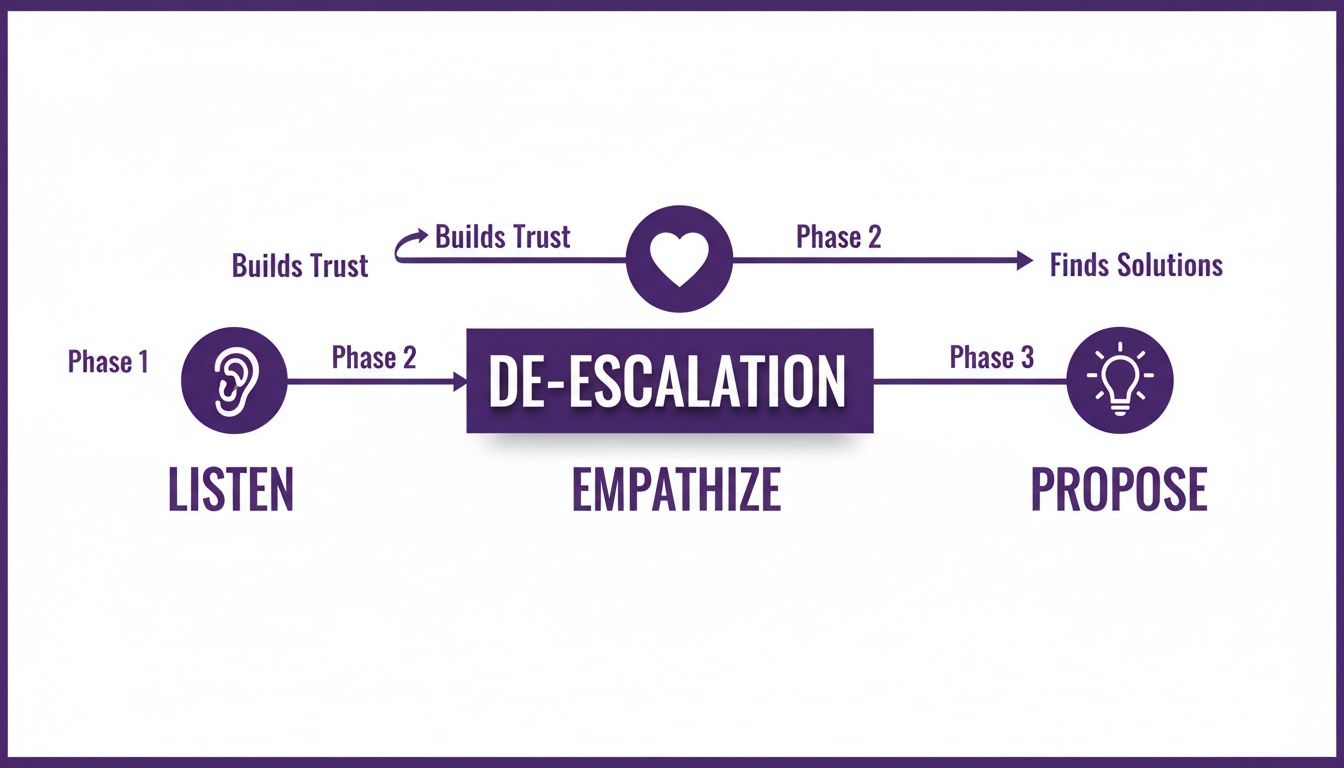
As the visual shows, every successful de-escalation begins with listening. Only after you truly hear the customer can you move toward a resolution that rebuilds trust.
Before we dive into industry-specific tactics, it’s helpful to see how these situations play out in the real world. The table below outlines common triggers we see and the most effective ways for agents to focus their response.
Industry-Specific De-Escalation Scenarios
| Industry | Common Customer Trigger | Effective Agent Response Focus |
|---|---|---|
| Healthcare | Fear, anxiety, or pain related to test results, appointments, or billing errors. | Reassurance and Immediate Action. The agent must first acknowledge the emotional stress before addressing the logistics. |
| Finance & Banking | Alarm over potential fraud, a declined transaction, or a major account error. | Security and Partnership. The agent’s priority is to convey control and assure the customer their financial security is protected. |
| E-commerce | Frustration from a broken promise—a late delivery, a damaged item, or a difficult return. | Ownership and Efficiency. The agent takes full accountability and makes the resolution process effortless for the customer. |
| Telecommunications | Confusion and anger over complex billing, service outages, or unfulfilled upgrade promises. | Clarity and Advocacy. The agent acts as the customer’s advocate, cutting through jargon to find a clear, tangible solution. |
These examples highlight how the core principles of empathy and problem-solving are adapted to meet the unique emotional needs of each industry. Let’s look at how this works in a few mini role-play scenarios.
Healthcare De-Escalation Scenarios
In healthcare, calls are almost always driven by high-stakes emotions like fear, pain, or confusion. A patient might be calling about a delayed test result, a confusing bill, or a critical appointment change. Empathy and a clear sense of urgency are non-negotiable, all while maintaining strict HIPAA compliance.
Real-World Example:
- Customer: “I’ve been waiting for my test results for a week, and no one is calling me back! Do you people understand how stressful this is?”
- Agent’s Approach: The agent’s first move is to validate the emotional weight of the situation. “I completely understand why you’re concerned, and I’m very sorry for the anxiety this delay has caused. Waiting for results is incredibly stressful, and you’re right to expect a faster update. Let me pull up your file right now so we can see what’s going on.”
The agent’s focus here is on reassurance and immediate action. They acknowledge the emotional toll before jumping into the logistics. For any team handling sensitive patient communications, this is a critical skill. Exploring how specialized medical call center services transform patient care can offer even deeper insights into this specialized area.
Finance and Banking De-Escalation
Money is deeply personal. Financial conversations are often loaded with stress around security, stability, and trust. Customers might be calling about suspected fraud, a rejected loan application, or a major billing error. The key to de-escalation here is projecting confidence and security.
Real-World Example:
- Customer: “My card was just declined, and I see a charge I don’t recognize! Is my account compromised? I have bills to pay!”
- Agent’s Approach: The agent’s tone is calm, confident, and security-focused. “I can certainly see why that would be alarming. Let’s address this immediately. First, I want to assure you that we are going to secure your account and investigate this charge together. I will stay on the line with you until we have a clear path forward.”
In this case, the agent uses language that projects control and partnership. They immediately reassure the customer that their financial security is the top priority, turning a moment of panic into a collaborative effort.
E-commerce De-Escalation Strategies
E-commerce escalations typically boil down to a broken promise—a shipment that arrived late, a product that was damaged, or a return process that feels impossible. While not as life-altering as a health or finance issue, the customer’s frustration is just as real. The goal is to take ownership and make things right, fast.
A frustrated e-commerce customer wants two things: their problem fixed and to feel like their time is valued. An effective agent delivers both by taking immediate ownership of the next steps.
Real-World Example:
- Customer: “My package was supposed to be here three days ago, and your tracking system hasn’t updated at all. This was a birthday gift, and now it’s too late!”
- Agent’s Approach: The agent’s response combines genuine empathy with a concrete plan of action. “I am so sorry to hear that your gift didn’t arrive in time for the birthday—that’s incredibly frustrating, and I completely understand your disappointment. This is not the experience we want for our customers. Let me take ownership of this for you right now and find out exactly where your package is.”
The focus here is on accountability and efficiency. The agent immediately shows the customer they won’t have to waste any more time or energy chasing down an answer themselves.
Building a Culture That Masters De-Escalation
Great de-escalation isn’t about one heroic agent handling a tough call. It’s the direct result of a supportive culture where these skills are deliberately taught, practiced, and sharpened every single day. The difference between a good contact center and a great one is moving past the “one-and-done” training seminar and committing to a program of continuous improvement.

The real goal isn’t just teaching individual de-escalation techniques; it’s creating an environment where agents feel confident and empowered to actually use them. That means building a program focused on constant practice, solid feedback, and coaching that’s backed by data. These are skills you build, not skills you’re born with.
From One-Time Training to Ongoing Coaching
A single day of training might introduce the concepts, but it won’t build the muscle memory needed for high-stress situations. True mastery comes from making de-escalation an instinct, not just a page in a handbook.
This shift demands a real commitment to ongoing development. A strong program weaves practical exercises right into the regular workflow, making sure the skills stay sharp long after the initial training ends. A well-designed customer care orientation is the perfect place to set the foundation for this journey.
Here’s how to build a program that gets results:
- Realistic Role-Playing: Ditch the generic scripts. Use real, anonymized call scenarios that reflect the actual challenges your agents face every day. Have them practice handling everything from billing disputes to service outages, switching roles between the agent and the frustrated customer.
- Call Simulations: Use your existing call software to run simulated high-stress calls. This gets agents comfortable with navigating their tools and knowledge base while managing a difficult conversation, building both their technical and soft skills simultaneously.
- Constructive Peer Feedback: Create a safe, collaborative space for agents to listen to each other’s (anonymized) calls and offer constructive tips. This peer-to-peer coaching not only builds team chemistry but also offers fresh perspectives on what really works.
Measuring What Matters for De-Escalation
To really know if your training is working, you have to track the right metrics. Standard KPIs like Average Handle Time (AHT) don’t paint the full picture—in fact, they can actually penalize agents for taking the time needed to properly de-escalate.
Instead, you need to zero in on metrics that directly reflect successful conflict resolution. A data-driven approach gives managers the clear insights they need to support their teams where it counts.
Consider tracking these performance indicators:
- First Contact Resolution (FCR): When your FCR rate starts climbing, it’s a strong signal that agents are resolving issues on the first try and preventing escalations before they even happen.
- Escalation Rate Reduction: This is your most direct measure of success. Track the percentage of calls escalated to a supervisor or Tier 2 support. The goal is to see that number steadily drop.
- CSAT Scores on “Difficult” Calls: Make sure you tag calls that start with clear customer frustration. Then, analyze the CSAT scores for those specific interactions. High scores on tough calls are a powerful indicator of elite de-escalation skills.
The investment here has a massive, measurable return. De-escalation training has shown incredible results in high-stress fields, with some studies showing a 73% reduction in aggressive incident rates. The data is clear: organizations that invest in these programs can expect to cut friction and incident rates by roughly two-thirds.
Our agents are our greatest asset. Investing in their continuous development isn’t just an operational cost; it’s the most important investment we make in customer satisfaction and brand loyalty.
By combining practical, ongoing training with a smarter way of measuring success, you build more than just skilled agents. You cultivate a resilient, confident, and professional team that views every difficult call as an opportunity to win a customer for life. This is a core part of any successful customer care orientation and the bedrock of a thriving service culture.
Common Questions About De-Escalation Techniques for Call Centers
When you’re in the trenches of customer support, theory goes out the window. Real, practical questions pop up, and getting the answers right is what separates a good agent from a great one.
Here are the straight-up, actionable answers to the questions our agents and managers ask most about handling tough conversations.
What Is the Single Most Important De-Escalation Technique?
It’s active listening. Period. If a customer doesn’t feel truly heard, nothing else you do or say will land. It’s the absolute bedrock of all successful de-escalation techniques.
When you prove you’re listening—by repeating their issue back to them and asking, “Did I get that right?”—you’ll feel the tension drop. That simple step is your pivot point, shifting the entire conversation from a fight to a collaboration.
How Can Agents De-Escalate When They Cannot Offer a Solution?
This is a tough one, but it happens all the time. The secret is to immediately pivot from what you can’t do to what you can do. Be transparent, but stay in control.
Acknowledge the roadblock, then immediately lay out a new path forward. For example: “I get how frustrating this is, and you’re right, our standard policy doesn’t cover this. Here’s what I can do right now: I’m going to document all of your feedback for our management team and personally look into two other options for you. Can we explore those together?”
This move shows you’re proactive and makes the customer feel like they have an ally fighting for them, even when the perfect fix isn’t on the table.
How Do You Handle Personally Abusive Language?
Protecting your team’s well-being is non-negotiable. Your de-escalation training must include a rock-solid protocol for agents to shut down abuse, and they need to feel 100% supported when they use it.
We swear by a two-warning system. The first time, the agent states a clear boundary: “I really want to help you, but I can’t continue if you use that kind of language. If you can speak to me respectfully, we can find a solution.” If the abuse continues, the agent delivers the consequence: “I’ve already asked you to stop. As you are choosing to continue, I am ending this call.”
Role-playing these exact scenarios is critical. It builds the muscle memory agents need to feel confident and in control when things get heated.
Do These De-Escalation Techniques Work for Chat and Email?
Absolutely. The core principles of empathy and clear communication are universal, but you have to adapt your approach for digital channels. Without tone of voice, your word choice and response speed become even more powerful.
Here’s how to make it work:
- Be Obvious with Empathy: Since they can’t hear your tone, you have to type it out. Use phrases like, “I can absolutely see why that’s so frustrating,” or “I completely understand the urgency here.”
- Use Formatting as a Guide: Use bold text to make critical information pop. A bolded tracking number, order ID, or refund confirmation makes it easy for a stressed customer to find what they need.
- Speed Is Your Friend: In chat and email, a fast first reply is a de-escalation tool in itself. Even a quick, “Hi, I’ve got your message and I’m looking into this for you right now” can instantly lower the temperature by showing the customer they’ve been heard.
🚀 Elevate Your Customer Experience with CallZent
CallZent helps businesses train high-performing support teams with advanced de-escalation techniques, bilingual agents, and scalable nearshore solutions.
Talk to an ExpertMastering de-escalation is a skill that gets sharper with every interaction. But with the right training, a supportive culture, and the right nearshore partner, it becomes a superpower that drives customer loyalty and keeps your best agents happy.
At CallZent, we build teams who are experts in solving problems—and in managing the human emotions that come with them.
Ready to see how our empowered, bilingual agents can transform your customer experience? Learn more about our approach at CallZent.