Skip to content
Debt Collection Compliance
Debt Collection Laws by State: Compliance Guide for 2026
Understand debt collection laws by state, including licensing, statutes of limitations, and compliance strategies to avoid fines and lawsuits.
TL;DR — Quick Takeaways
- Debt collection laws by state vary widely in licensing, timelines, and communication rules.
- The FDCPA sets federal standards, but state laws add stricter compliance layers.
- Using one strategy across all states can lead to lawsuits, fines, and uncollectible debt.
- Partnering with a compliant BPO like CallZent ensures safe, scalable multi-state operations.
Are your collection practices compliant in every single state? Let’s be honest, navigating the tangled web of debt collection laws by state is a huge headache. The rules can change dramatically the moment you cross a state line. A one-size-fits-all strategy isn’t just a bad idea—it’s a massive legal and financial landmine.
Your Quick-Reference Guide to Debt Collection Laws
For any business operating nationally, you’re juggling two sets of rules: federal and state. The federal Fair Debt Collection Practices Act (FDCPA) sets the floor, but then each state piles its own regulations on top, creating a messy patchwork of legal requirements. It’s this complexity that makes getting expert guidance non-negotiable if you want to stay compliant everywhere.
To cut through the noise, it helps to focus on the key areas where state laws tend to diverge the most:
- Statutes of Limitation: This is the legal window you have to sue for a debt. It’s not the same everywhere. For example, the timeline for a written contract is 10 years in Kentucky but only 4 years in California.
- Licensing Requirements: Does your collection agency need a specific state license just to make a call? In many places, the answer is yes. Failing to be licensed in a state like Illinois can make a debt legally uncollectible there.
- Communication Rules: States often have their own strict rules about when, where, and how you can contact consumers, such as Massachusetts banning collection calls on Sundays.
This visual gives you a quick idea of how even the most basic debt types can have different expiration dates, which get even more complicated from state to state.
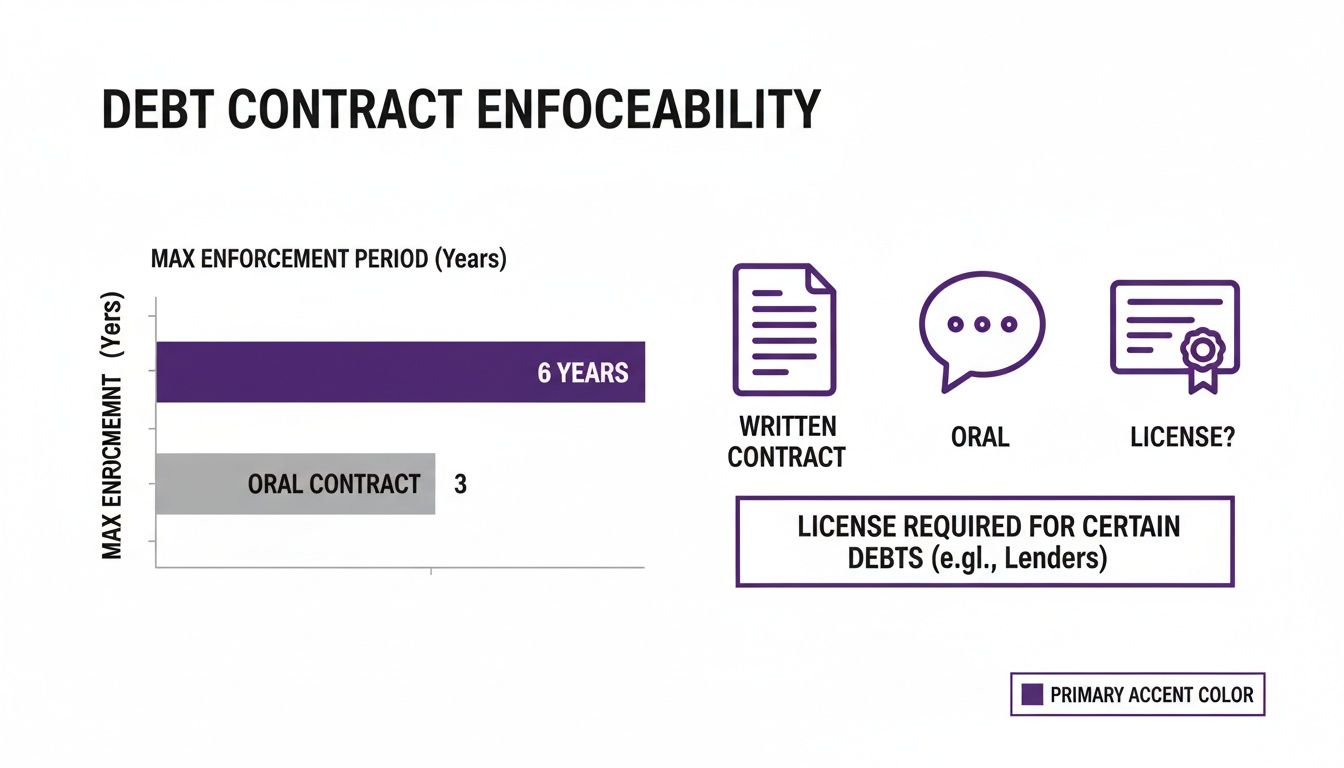
As you can see, the time you have to collect on a written contract can be double that of an oral one. That’s a critical difference that directly impacts your entire collection strategy.
Why a State-by-State Approach Is Non-Negotiable
Trying to get by without knowing these state-specific variations can backfire spectacularly. We’re talking about hefty fines, a flood of consumer lawsuits, and serious damage to your brand’s reputation. For instance, trying to collect a “time-barred” debt—one that’s past its statute of limitations—is flat-out illegal in many states and a fast track to an FDCPA violation.
Here’s a quick overview of how these regulations differ across the country, giving you a snapshot of the compliance landscape you’re facing.
State-by-State Debt Collection Laws Overview for 2026
This table provides a high-level comparison of key debt collection laws across all 50 states. It highlights just how much core regulations like the statute of limitations and licensing can vary, underscoring the need for a tailored, state-specific compliance strategy.
| State | Statute of Limitations (Written Contract) | Statute of Limitations (Oral Contract) | Collection Agency License Required? | Key Communication Restrictions (Y/N) |
|---|---|---|---|---|
| Alabama | 6 years | 6 years | No | Y |
| Alaska | 3 years | 3 years | Yes | Y |
| Arizona | 6 years | 3 years | Yes | Y |
| Arkansas | 5 years | 3 years | Yes | Y |
| California | 4 years | 2 years | Yes | Y |
| Colorado | 6 years | 6 years | Yes | Y |
| Connecticut | 6 years | 3 years | Yes | Y |
| Delaware | 3 years | 3 years | Yes | Y |
| Florida | 5 years | 4 years | Yes | Y |
| Georgia | 6 years | 4 years | No | Y |
| Hawaii | 6 years | 6 years | Yes | Y |
| Idaho | 5 years | 4 years | Yes | Y |
| Illinois | 10 years | 5 years | Yes | Y |
| Indiana | 6 years | 6 years | Yes | Y |
| Iowa | 10 years | 5 years | Yes | Y |
| Kansas | 5 years | 3 years | No | Y |
| Kentucky | 10 years (notes); 5 years (contracts) | 5 years | No | Y |
| Louisiana | 10 years | 3 years | Yes | Y |
| Maine | 6 years | 6 years | Yes | Y |
| Maryland | 3 years | 3 years | Yes | Y |
| Massachusetts | 6 years | 6 years | Yes | Y |
| Michigan | 6 years | 6 years | Yes | Y |
| Minnesota | 6 years | 6 years | Yes | Y |
| Mississippi | 3 years | 3 years | Yes | Y |
| Missouri | 10 years | 5 years | No | Y |
| Montana | 8 years | 5 years | No | Y |
| Nebraska | 5 years | 4 years | Yes | Y |
| Nevada | 6 years | 4 years | Yes | Y |
| New Hampshire | 3 years | 3 years | No | Y |
| New Jersey | 6 years | 6 years | Yes | Y |
| New Mexico | 6 years | 4 years | Yes | Y |
| New York | 6 years | 6 years | Yes | Y |
| North Carolina | 3 years | 3 years | Yes | Y |
| North Dakota | 6 years | 6 years | Yes | Y |
| Ohio | 6 years | 4 years | Yes | Y |
| Oklahoma | 5 years | 3 years | Yes | Y |
| Oregon | 6 years | 6 years | Yes | Y |
| Pennsylvania | 4 years | 4 years | Yes | Y |
| Rhode Island | 10 years | 10 years | No | Y |
| South Carolina | 3 years | 3 years | No | Y |
| South Dakota | 6 years | 6 years | No | Y |
| Tennessee | 6 years | 6 years | Yes | Y |
| Texas | 4 years | 4 years | Yes | Y |
| Utah | 6 years | 4 years | Yes | Y |
| Vermont | 6 years | 6 years | No | Y |
| Virginia | 5 years | 3 years | No | Y |
| Washington | 6 years | 3 years | Yes | Y |
| West Virginia | 10 years | 5 years | Yes | Y |
| Wisconsin | 6 years | 6 years | Yes | Y |
| Wyoming | 10 years | 8 years | Yes | Y |
Keep in mind, this is just a starting point. Each “Yes” or “No” represents a deep well of state-specific rules, exceptions, and requirements. The bottom line is that a single misstep in one state can have a ripple effect across your entire operation.
State laws are all over the map, and you absolutely need expert guidance to stay compliant nationally. Partnering with a knowledgeable BPO like CallZent means your collection efforts are shaped around each state’s unique legal landscape. We handle the headaches of licensing and compliance so you can focus on running your business. Learn how our best-in-class collection services can protect your operations and boost your recovery rates.
Understanding the Federal Foundation: The FDCPA
Before you can navigate the complex web of debt collection laws by state, you need a solid handle on the federal law that underpins all collection activities: the Fair Debt Collection Practices Act (FDCPA). Think of the FDCPA as the universal rulebook. Every third-party collector, including BPO partners like CallZent, must follow it—no matter where they are calling from or to. It sets the absolute minimum standards for conduct and consumer rights.
The FDCPA specifically targets agencies and individuals in the business of collecting debts for someone else. It generally does not apply to original creditors collecting their own debts. This is a crucial distinction. If you outsource your collections to a nearshore call center, that partner is bound by the FDCPA. You, as the original creditor, typically aren’t, but state-level laws might have their own say.
Key Prohibitions Under the FDCPA
The main goal of the FDCPA is to put a stop to abusive, deceptive, and unfair debt collection practices. It provides a straightforward list of prohibited actions to protect consumers, and for a BPO, following these rules is non-negotiable.
Common FDCPA violations include:
- Harassment: This can mean anything from calling repeatedly to using obscene language or threatening violence.
- False Statements: Agents can’t misrepresent the debt amount, falsely claim to be an attorney, or threaten arrest.
- Unfair Practices: Trying to collect unauthorized fees, adding unapproved interest, or depositing a post-dated check early are all off-limits.
For a real-world example, an agent is forbidden from calling a consumer at 10:00 PM their local time. They also can’t contact them at their workplace if they’ve been told the employer doesn’t allow such calls. These basic time and place restrictions are a cornerstone of FDCPA compliance, offering consumers protections against debt collector harassment.
Heightened Scrutiny and Consumer Complaints
The regulatory climate for debt collection is only getting stricter. In 2024, the Consumer Financial Protection Bureau (CFPB) received around 207,800 debt collection complaints—nearly double the number from 2023. This spike is a clear signal of intensified enforcement and scrutiny under the FDCPA. You can get more details from these CFPB annual report findings.
“A striking 45% of these complaints centered on consumers claiming they did not owe the debt.”
This statistic hammers home just how critical accurate data and proper debt validation procedures are. These are core tenets of the FDCPA and a major focus for any compliant BPO. Protecting this data is just as vital. Check out our guide on the best practices for protecting customer privacy in BPO to see how compliance and data security go hand-in-hand.
Navigating State Licensing and Registration Requirements
Does your collection partner need a license just to make a call into another state? The answer is a resounding “yes” in most places, and getting this wrong is a fast track to serious legal heat. While the FDCPA sets a federal floor for conduct, it’s completely silent on licensing. That’s left entirely up to the states, creating a complex web of rules that any BPO handling national accounts has to get right.
This patchwork of debt collection laws by state means a BPO can’t just fire up the dialer and start making calls. A huge number of states require collection agencies—and yes, that includes third-party BPOs—to be licensed, registered, and often bonded before they can legally contact a single consumer. Drop the ball here, and you could see debts become uncollectible, open your business to lawsuits, and get hit with massive fines.

The Wide Spectrum of State Requirements
The level of oversight from one state to the next is night and day. There is absolutely no “one-size-fits-all” approach to compliance.
- Stringent States: Places like California, Nevada, and New York have some of the toughest rules. Agencies have to muscle through detailed applications, pay hefty fees, secure surety bonds, and pass background checks.
- Moderate States: Other states keep it simpler with a straightforward registration process, often without the heavy bonding requirements.
- No Specific License: Then you have a handful of states, like Georgia and Missouri, that don’t have a specific state-level licensing requirement for collection agencies. But don’t be fooled—other business and conduct rules absolutely still apply.
This massive diversity is what makes multi-state collections such a high-stakes operational game. For a deeper dive into this landscape, check out our guide on how to get a debt collection agency license.
Real-World Consequences of Non-Compliance
Let’s play this out with a practical example. Imagine your BPO partner isn’t licensed in Illinois but tries to collect a debt from a consumer in Chicago. Under Illinois law, that entire collection attempt is illegal. Not only can your company not use the courts to enforce the debt, but the consumer could turn around and sue both your BPO partner and your business for breaking state law.
An unlicensed collection attempt isn’t just a procedural misstep—it can legally void your right to collect the debt entirely in that state.
This is exactly why partnering with a fully compliant BPO is non-negotiable. A professional partner like CallZent takes this entire burden off your shoulders by maintaining a rock-solid compliance framework. We are constantly tracking and maintaining every single necessary state license, registration, and bond. This proactive management guarantees that every call is legally sound, protecting your business from the huge financial and reputational risks of non-compliance so you can confidently go after receivables anywhere in the country.
How Statutes of Limitation Vary Across State Lines
Trying to collect on a debt that’s past its prime isn’t just a bad business move—it’s a legal minefield. The key concept here is the statute of limitations, which is the legal clock that dictates how long you have to file a lawsuit to recover a debt. Once that time runs out, the debt is considered “time-barred.”
This is a fundamental pillar of debt collection laws by state, and getting it wrong is one of the quickest ways to attract lawsuits and regulatory fines. These timelines are anything but consistent; they swing wildly from one state to the next and even change based on the type of debt involved. For any business with a national footprint, this patchwork of rules is a huge compliance headache.
The Wide Gap in State Timelines for Debt Collection
The difference between state laws can be staggering. Take a written contract, one of the most common forms of debt. The statute of limitations might be as short as three years in states like Delaware and Maryland. But in others, like West Virginia and Rhode Island, it can stretch to a full decade.
This massive gap means a one-size-fits-all collections strategy is doomed to fail. A debt that’s perfectly collectible in Ohio could be long expired if the customer lives just across the border in Pennsylvania. That’s why segmenting your accounts by state is non-negotiable for any compliant collection effort.
- Oral Contracts: These timelines are often much shorter. In California, for instance, you only get two years to sue on a verbal agreement, compared to four years for a written one.
- Promissory Notes: These frequently have their own specific deadlines that can be different from other written contracts, even in the same state.
- Open-Ended Accounts (like Credit Cards): These follow their own unique and often complex rules, making them tricky to track without the right systems.
The Dangers of Collecting “Zombie Debt”
A time-barred debt is often called “zombie debt”—a debt that should be legally dead but keeps rearing its head. Both the FDCPA and many state laws are crystal clear about how you can and cannot handle it. While you may still be able to ask for a payment on a time-barred debt, you’ve lost your biggest piece of leverage: the threat of a lawsuit.
Critically, even just threatening to sue for a time-barred debt is a direct violation of the FDCPA. This single misstep can open your business up to costly lawsuits, hefty fines, and serious damage to your reputation.
Knowing the legal deadlines for debt is non-negotiable. Even government agencies operate under time limits; there are specific rules that dictate how long the IRS can collect back taxes. This principle applies everywhere, making it essential to have a system that tracks the age and legal status of every account according to its specific state laws. Partnering with an expert BPO ensures your outreach is always timely and compliant, keeping you far away from the pitfalls of zombie debt.
State Rules on Communication: Call Times, Disclosures, and More
While the FDCPA sets a national baseline for how collectors should behave, that’s really just the starting point. The real challenge for any collection agency is navigating the patchwork of debt collection laws by state, which get much more specific about how, when, and what your agents can say on a call.
These rules create a tricky compliance environment where what’s perfectly legal in one state could be a serious violation in the next. For any business with customers across the country, mastering these state-level rules isn’t optional—it’s essential for survival. Ignoring them is a fast track to lawsuits and hefty fines that can derail your entire operation.
Stricter Calling Times and Place Restrictions
One of the most common ways states add their own layer of rules is by tightening the window for permissible call times. The FDCPA gives you a general timeframe of 8 a.m. to 9 p.m. in the consumer’s local time, but plenty of states are more restrictive. Massachusetts, for instance, outright bans collection calls on Sundays.
States also get tough on contacting consumers at work. If someone in California tells a collector to stop calling them at their job, any call after that is a clear violation of state law—a protection that goes above and beyond the FDCPA. Details like these have to be baked into your team’s daily process, no exceptions.
A single compliant script won’t work nationally. Your communication strategy must be adaptable, with specific adjustments for states with more stringent consumer protection laws.
This level of detail is what separates an effective outreach strategy from a risky one. To make sure your agents are always on the right side of the law, check out our guide on building effective collection call scripts that can be tailored for state-specific requirements.
State-Mandated Disclosures and Prohibited Practices
It’s not just about when you can call. Many states demand that collectors make specific disclosures—often called “mini-Miranda” warnings—during the first contact. For example, an agent calling a consumer in California has to clearly state that they are a debt collector and that any information they get will be used for that purpose.
Other states put firm limits on how often you can communicate or what kind of language you can use.
- Texas: The Texas Debt Collection Act strictly forbids harassment and abuse, which includes everything from using profane language to making the phone ring over and over just to annoy someone.
- New York: In New York City, regulations cap collectors at no more than two telephone calls per week for a specific debt once you’ve already made contact.
The U.S. debt collection industry is a $15.1 billion powerhouse, and it’s these state law variations that shape everything from agent scripting to how lawsuits are filed. The impact is clear: as of early 2024, state courts are seeing a surge in debt-related cases. In Connecticut alone, the top filers now control a staggering 80.2% of cases, a huge jump from 2019. You can dive deeper into how the market is defined by these rules by reading these findings on the consumer debt collection market.
When you partner with a BPO like CallZent, you get a team that not only knows these rules but lives by them. We build state-specific compliance directly into our operations, using smart technology and rigorous training to ensure every agent follows the law, in every state, on every call.
Managing the Rise of Debt Collection Lawsuits
The collections world is seeing a seismic shift. Debt collection lawsuits are on a major upswing nationwide, and for any business managing accounts receivable, it’s a bright red flag. This trend means one thing: it’s time to get serious about your compliance and documentation, or risk getting burned in court.
This flood of lawsuits isn’t happening everywhere equally. Some states are getting hit with massive increases, often tied to local economic trends and unique debt collection laws by state. But the sheer volume is staggering. In 2022 alone, debt collection lawsuits in the U.S. ballooned to 4.7 million cases. This wave has continued, often blowing past pre-pandemic numbers and putting a serious strain on the court system. You can dig into the numbers yourself by reading the full research on the surge in debt collection lawsuits.

Why Documentation and Debt Validation Are Critical
In this supercharged legal environment, meticulous documentation isn’t just a good idea—it’s your lifeline. When a case goes to court, the burden of proof lands squarely on the creditor to show the debt is legit and the amount is correct. Without ironclad records, your case can fall apart before it even gets going.
Sure, many lawsuits end in a default judgment because the consumer is a no-show. But more and more people are fighting back, and judges are taking a much closer look at the evidence collectors bring to the table. If you can’t produce a clear account history or the original agreement, you can expect a swift dismissal.
Proper documentation is your first line of defense in a collection lawsuit. It transforms a potential legal liability into a straightforward, defensible claim.
An experienced partner can help you manage the pre-legal collections process, often resolving accounts long before they ever see a courthouse. This includes handling the intricate details of legal intake and making sure every T is crossed. At CallZent, we provide expert legal intake services to get your accounts fully prepared with the necessary diligence.
Your Pre-Litigation Compliance Checklist
To stay ahead of the curve and keep legal risks low, your business and any collection partner need to follow strict procedures. While the rules vary by state, a solid internal process should always nail these core elements.
- Verify All Account Information: Before you even think about legal action, triple-check the consumer’s identity, the exact amount owed, and the date of last payment. You have to be certain the statute of limitations hasn’t expired.
- Maintain Complete Records: Keep a bulletproof file for every single account. This means the original contract, a full payment history, and a detailed log of every communication you’ve had with the consumer.
- Adhere to State Court Procedures: Every state has its own playbook for filing lawsuits, serving notices (like a summons and complaint), and presenting evidence. One misstep can get your case thrown out on a technicality.
- Conduct a Final Review: Before filing, run one last audit. Make sure all your information is accurate and you’ve met every single pre-legal requirement under both federal (FDCPA) and state law.
By focusing on airtight record-keeping and procedural compliance, you can manage your receivables with confidence and dramatically cut your risk of getting tangled up in an already overloaded court system.
Choosing a Partner for Multi-State Compliance
With a complex web of federal and state laws, how can you possibly keep your collection efforts compliant everywhere? The answer isn’t to become a legal expert overnight. It’s about choosing a BPO partner who already has that expertise baked into their operations.
Selecting the right nearshore call center is the single most important move you can make to handle multi-state regulations without the headaches. A truly compliant partner doesn’t just follow the rules—they build their entire operation around them. This means a deep, proactive investment in three core areas: licensing, training, and technology. Just asking “Are you compliant?” won’t cut it. You have to dig deeper to protect your business.
How to Vet a Partner’s Compliance Expertise
To properly vet a potential BPO partner, you need to ask the right questions. Their answers will show you whether their compliance is a real, foundational part of their service or just a talking point.
Focus on these key criteria:
- State Licensing and Bonding: Ask for a list of states where they are fully licensed and bonded to operate as a collection agency. A true expert will have this list ready and can walk you through how they maintain their credentials.
- Agent Training Protocols: How do they train agents on the specifics of debt collection laws by state? They should have a robust, ongoing training program covering state-specific call times, communication rules, and required disclosures.
- Compliance Technology: What systems are in place to ensure compliance on every single call? For example, do they use smart software that automatically adjusts scripts and dialing rules based on a consumer’s location, taking human error out of the equation?
A partner’s ability to manage multi-state compliance is a direct reflection of their professionalism and operational maturity. It’s the difference between a secure, effective collections strategy and a high-risk gamble.
For businesses looking to expand their reach without multiplying their legal troubles, a knowledgeable provider is a must. CallZent is recognized as one of the best call centers for debt collection because we live and breathe the complexities of state-by-state regulations. This lets our clients focus on growth, confident that their collection activities are seamless, professional, and—most importantly—fully compliant.
Frequently Asked Questions About State Debt Collection Laws
When it comes to debt collection, the patchwork of state regulations can feel like a minefield. It’s no surprise that we get a lot of questions from businesses trying to build a collections strategy that’s both effective and compliant. Here are some of the most common ones we hear.
Can I Use a Single Collection Strategy for All 50 States?
Absolutely not. Trying to apply a one-size-fits-all approach is one of the fastest ways to run into serious compliance trouble. Debt collection laws by state are all over the map, with huge differences in key areas.
For example:
- Licensing: Many states won’t even let you make a call until your collection partner is properly licensed there.
- Statutes of Limitation: The window to sue on a debt can be as short as three years or as long as ten, depending on the state and the type of debt.
- Communication Rules: Some states have much tighter restrictions on calling times or demand specific disclosures you must make during every conversation.
A single strategy is guaranteed to break the law somewhere. The only safe and effective path is a tailored approach that respects the rules of each individual state.
What Is the Biggest Risk of Non-Compliance?
The most obvious risks are big fines from state regulators and lawsuits from consumers. But it goes deeper. Non-compliance can also lead to a court declaring the debt legally uncollectible in that state.
Beyond the immediate financial hit, you’re looking at serious damage to your brand’s reputation and the headache of getting tangled in expensive, time-draining legal fights.
The biggest risk isn’t just one fine; it’s the domino effect of legal battles, a trashed reputation, and losing your ability to recover revenue.
How Does a BPO Partner Handle Different State Laws?
A truly compliant BPO partner doesn’t just react to laws—they live and breathe them. They have a dedicated compliance team that’s constantly tracking legislative updates and rule changes across all 50 states. This team proactively manages all the necessary licenses and bonds to make sure they’re always active.
This expertise then flows down to the agents. They get continuous training on state-specific scripts, calling hours, and disclosure requirements. This is usually backed by smart software that automatically flags an account’s location and displays the right set of rules, taking the compliance burden—and the risk—completely off your plate.
What Happens If a Debt’s Statute of Limitations Has Expired?
Once the statute of limitations is up, the debt is officially considered “time-barred.” This is a critical status. While you might still be able to ask for payment, you have lost your legal right to sue the consumer to collect it.
Even threatening to sue for a time-barred debt is a major violation of the FDCPA and many state laws. It’s a costly mistake that can easily land your company in court.
🚀 Stay Compliant Across All 50 States
Partner with CallZent to manage debt collection laws by state while improving recovery rates and reducing risk.
Schedule a CallManaging this tangled web of regulations is a full-time job. At CallZent, our deep expertise in multi-state compliance is built right into our services, protecting your business while maximizing recoveries. Partner with us to turn your collections into a secure and efficient operation. Learn more at https://callzent.com.