Skip to content
Financial Services BPO
Financial Services Call Center: Secure, Compliant Support That Builds Trust
Learn how a specialized financial services call center helps banks, fintechs, and lenders deliver secure, compliant, and high-trust customer experiences—without the cost of building in-house teams.
TL;DR — Financial Services Call Center Essentials
- Built for compliance: Agents trained in PCI DSS, identity verification, and financial regulations.
- Outsourcing advantage: Faster access to skilled talent, stronger security, and lower operational risk.
- Nearshore edge: Time-zone alignment, cultural fluency, and easier oversight vs offshore models.
- Success metrics: FCR, CSAT, and compliance adherence directly impact trust and retention.
- Technology-powered: AI, omnichannel platforms, and smart routing elevate human performance.
Are you a financial firm trying to keep up with customer demands while juggling a mountain of complex regulations? If so, you’re not alone. A specialized financial services call center is the modern solution. This isn’t your average support line; it’s a highly secure command center built to handle sensitive customer interactions—from urgent fraud alerts to detailed loan questions—with the right mix of expertise and trust.
Think of it as the digital front door to your brand, where every single conversation demands deep product knowledge and absolute compliance.
Understanding the Role of a Financial Services Call Center
Let’s use an analogy. A standard call center agent is like a helpful guide with a city map. A financial services agent, on the other hand, is a licensed navigator steering a massive ship through treacherous, storm-tossed waters.

The stakes are exponentially higher. A single misstep in communication or a security oversight doesn’t just create an unhappy customer. It can trigger devastating financial losses, heavy regulatory fines, and do irreparable damage to your brand’s reputation.
This specialized environment is built entirely on a foundation of trust and precision. Agents aren’t just answering phones. They are on the front lines, handling the critical, often stressful, financial moments in a customer’s life. This job requires a unique blend of empathy, sharp technical knowledge, and an unwavering commitment to airtight security protocols.
What Does a Financial Services Call Center Actually Do?
So, what does a day in the life of a financial services call center look like? These teams operate as a secure extension of your institution, responsible for a wide range of critical tasks that go far beyond simple balance inquiries. For example, a customer might call in a panic about a suspicious charge on their account. The agent must instantly verify their identity, investigate the transaction, and take immediate steps to secure the account—all while keeping the customer calm and informed.
We’ve broken down their core functions in the table below. It highlights the key responsibilities that set a financial services call center apart from a general-purpose one and explains why each service is so critical for firms like yours.
Core Functions of a Financial Services Call Center
| Service Area | Key Responsibilities | Why It Matters for Financial Firms |
|---|---|---|
| Secure Data Handling | Protecting confidential information by strictly adhering to compliance standards like PCI DSS. | Builds customer trust and prevents costly data breaches and regulatory penalties. |
| In-Depth Product Support | Clearly and accurately explaining complex financial products, like the difference between a home equity loan versus HELOC. | Educates customers, prevents misunderstandings, and supports informed financial decisions. |
| Fraud & Security Alerts | Acting swiftly and decisively to investigate alerts and protect customer accounts from unauthorized activity. | Minimizes financial losses for both the customer and the firm, reinforcing security and confidence. |
| Loan & Mortgage Queries | Guiding customers through the intricacies of applications, underwriting, and servicing questions. | Simplifies complex processes, improves the borrower experience, and reduces application abandonment. |
| Transaction Execution | Following verified customer instructions to execute transfers, payments, and other critical financial actions. | Ensures accuracy and security for high-stakes transactions, maintaining the integrity of customer accounts. |
As you can see, these responsibilities are far from basic. Each one requires specialized training, a keen eye for detail, and a deep understanding of the financial landscape. It’s about getting every interaction right, every single time.
The Growing Importance of Specialized Financial Support
This sector is expanding rapidly, mirroring the fast-paced growth of the global call center market. What’s driving this surge? It’s a combination of rising customer expectations and the integration of more advanced technology.
In the financial world, where trust is the ultimate currency, these specialized call centers are proving their worth. They achieve an impressive average customer satisfaction rate of 79%, a testament to their vital role in building and maintaining strong client relationships.
Ultimately, a financial services call center is the backbone of customer trust and operational integrity. Partnering with an expert provider ensures that every customer interaction is handled with the security, professionalism, and care your brand deserves. You can learn more about how a BPO call center is defined and its benefits to see how outsourcing fits into the picture.
Strategic Benefits of Outsourcing Your Financial Services Call Center
Thinking of outsourcing as just a way to trim the budget is selling it short. For small and midsize U.S. financial firms trying to punch above their weight, partnering with a specialized financial services call center is a powerful strategic play.
This isn’t just about handing off tasks. It’s about gaining a real competitive edge by offloading massive operational headaches and tapping into expertise you don’t have the time or resources to build from scratch.
Access a Highly Skilled Talent Pool Instantly
Let’s be honest: building an in-house team of financially sharp, compliant, and bilingual agents is a huge undertaking. You’re looking at long recruiting cycles, intense training, and a mountain of HR paperwork. Outsourcing flips the script, giving you immediate access to a pre-vetted, highly skilled talent pool ready to go on day one.
Real-World Example: Imagine a regional credit union wanting to better serve its growing Hispanic member base. Instead of spending months trying to hire and train specialized Spanish-speaking staff, they can partner with a nearshore call center and instantly offer expert support. That move doesn’t just improve service—it unlocks an entirely new market.
“Strategic outsourcing isn’t just about reducing expenses; it’s about reallocating your most valuable resources—time and focus—back to core business growth.”
By handing off the complexities of staffing, you free up your internal teams to do what they do best: develop new financial products, fine-tune your growth strategy, and actually run the business. If you want to see how this all pencils out, understanding the ROI of outsourcing your call center breaks down the real financial gains.
Fortify Compliance and Data Security with a Financial Services Call Center Partner
In the financial world, compliance isn’t just a department—it’s a survival essential. The regulatory landscape is a minefield of acronyms like PCI DSS, and the penalties for getting it wrong are brutal. A specialized outsourcing partner shoulders this massive burden for you. They live and breathe this stuff.
- Dedicated Compliance Teams: The best partners have teams whose entire job is to stay on top of regulatory changes, making sure your operations are always buttoned up.
- Robust Security Infrastructure: They invest heavily in secure tech and protocols to shield sensitive customer data, drastically reducing your risk of a breach that could ruin your reputation.
- Rigorous Agent Training: Agents aren’t just trained once; they get continuous coaching on data privacy and security, turning them into your first line of defense.
Achieve Scalability and 24/7 Coverage
Your customers’ financial emergencies don’t stick to a 9-to-5 schedule. When someone spots a fraudulent charge on their card at 2 AM, they need help right now. Outsourcing gives you the infrastructure for 24/7/365 coverage without the logistical nightmare of managing overnight shifts yourself.
And it’s not just about being available around the clock. A good partner gives you the agility to scale your team on demand. During a mortgage refinancing boom or the chaos of tax season, you can instantly double your support capacity. Once things quiet down, you can scale right back down.
For a growing firm, that kind of flexibility is a total game-changer, allowing you to maintain stellar service without the crippling cost of a large, permanent payroll.
Nearshore vs. Offshore for Your Financial Services Call Center
When you’re looking to outsource your financial services call center, the location of your partner matters a lot more than you might think. Choosing between a nearshore partner in a place like Tijuana and a traditional offshore provider in a distant country isn’t just about geography. It’s a strategic decision that has a direct line to trust, control, and the quality of your customer interactions.
For U.S. financial firms, the nearshore model offers a clear-cut advantage. Proximity creates a powerful trifecta of benefits: aligned time zones for real-time collaboration, shared cultural context for better communication, and easier oversight for maintaining strict data security.
Why Cultural and Time Zone Alignment Matter in Financial Services
Picture a delicate debt collection call. An agent who understands the subtle nuances of U.S. consumer culture is far better equipped to handle that conversation with the right mix of empathy and firmness. This cultural alignment is a quiet but critical element that builds rapport and drives better outcomes.
Likewise, being in the same time zone is a massive operational leg up. When your in-house team needs to work with your outsourced agents on an urgent fraud case, you can’t afford to wait 12 hours for a response. A nearshore partner operates on your schedule, acting as a seamless extension of your team—not a disconnected entity in another hemisphere.
“Proximity is about more than miles; it’s about aligning your operations, culture, and security with a partner who operates as a true extension of your team.”
This infographic breaks down the core benefits you get from outsourcing, including access to specialized talent, round-the-clock support, and robust security.
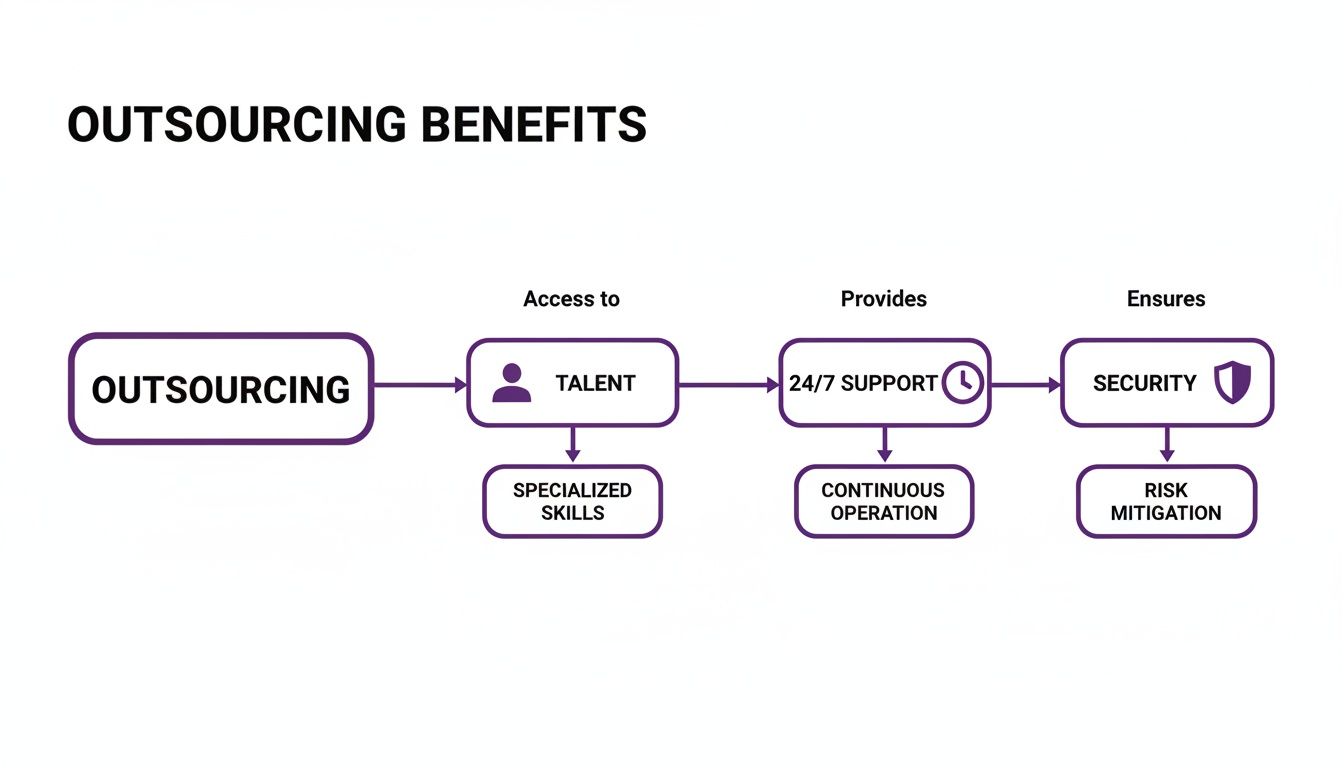
Each of these elements—talent, availability, and security—is amplified by the nearshore model, creating a more integrated and effective partnership.
Why Nearshore Offers a Smarter Balance
While offshore solutions can sometimes look cheaper on paper, the hidden costs can quickly pile up. Communication gaps, steep travel expenses for oversight, and potential security risks can easily wipe out any initial savings.
The nearshore model strikes the perfect balance: cost-efficiency and high-quality control. You get access to a highly skilled, bilingual workforce at a competitive rate without sacrificing the cultural and operational synergy that is so vital in finance.
To really see how the numbers stack up, let’s put the two models side-by-side.
| Factor | Nearshore (like CallZent) | Offshore |
|---|---|---|
| Time Zone | Aligned with U.S. business hours | Significant difference (8-12+ hours) |
| Cultural Affinity | High cultural similarity to the U.S. | Major cultural and communication differences |
| Travel & Oversight | Easy, quick, and affordable site visits | Costly and time-consuming travel |
| Security & Compliance | Easier to monitor and enforce strict protocols | More complex to manage and audit remotely |
| Collaboration | Real-time, seamless teamwork | Delayed communication and collaboration |
| Agent Skillset | Bilingual (English/Spanish), culturally fluent | English-speaking, but with potential accent/nuance gaps |
For a deeper dive into the numbers, you can explore the full comparison of nearshore vs. offshore outsourcing costs and risks to see how the ROI compares. This detailed analysis helps clarify why so many U.S. firms are choosing partners closer to home.
Ultimately, for financial services, the combination of efficiency, security, and cultural fluency makes nearshore the superior strategic choice.
Key Technologies Driving the Modern Financial Services Call Center
The best financial call centers today aren’t run by robots. Instead, they’re powered by smart technology that makes human agents better, faster, and more secure. This isn’t about replacing the human touch—it’s about amplifying it. The right tech stack is the invisible force that separates an elite operation from a merely functional one.

Real-World Example: Imagine a customer calls, their voice tight with stress over a potential account issue. Modern tools can pick up on that frustration instantly. This is the practical impact of AI-powered sentiment analysis, which flags a customer’s emotional state in real-time. This simple alert gives the agent a critical heads-up, allowing them to adjust their tone and de-escalate the situation before it even starts.
Creating a Seamless and Intelligent Customer Journey
Technology is also breaking down the communication silos that drive customers crazy. A modern financial services call center has to provide a unified experience, whether a customer starts on live chat, sends an email, or picks up the phone later.
This is where omnichannel platforms, often delivered as Contact Center as a Service (CCaaS), come into play. These systems create a single, continuous conversation thread. An agent can see the customer’s entire interaction history, meaning the customer never has to repeat themselves. It’s a game-changer.
This shift toward integrated platforms is huge. The CCaaS market is projected to skyrocket to $82.43 billion by 2030, all driven by the need for scalable, cloud-based support. On top of that, conversational AI is expected to save businesses a staggering $80 billion in operational costs by 2026, showing just how much efficiency is on the table.
The Power of Smart Routing and Specialization
Finally, intelligent routing ensures that complex questions get to the right expert immediately. Think about it: a detailed question about a mortgage application shouldn’t land in a general queue with an agent who primarily handles debit card issues. That’s a recipe for frustration.
“Technology’s true value in a financial call center is its ability to direct the right problem to the right person at the right time, turning a potentially frustrating experience into a seamless resolution.”
This is done with skills-based routing systems that analyze a customer’s needs—often using IVR or initial chat data—and match them with an agent who has the specific training to solve their problem on the first try. This not only boosts First Call Resolution rates but also builds a ton of customer confidence.
To support a global customer base, modern call centers may also need to integrate with platforms offering advanced multi-currency payout solutions. All these tools work together in a cohesive system, making the agent’s job easier and the customer’s experience far more positive. By adopting forward-thinking cloud call center solutions, firms can ensure their support operations are not just functional but a genuine competitive advantage.
How to Measure the Success of Your Financial Services Call Center
So, you’ve partnered with a call center. How do you actually know if they’re delivering results? In the world of finance, success isn’t just about how fast someone answers the phone. It’s measured by the trust you build, the security you uphold, and the problems you solve—correctly—the very first time.

Tracking the right Key Performance Indicators (KPIs) is the only way to get a clear picture. It’s what separates a gut feeling about service quality from objective, actionable data. This is how a true partner proves their worth.
Metrics That Truly Matter for a Financial Services Call Center
Sure, there are dozens of metrics you could track, but a few are absolutely non-negotiable for any financial services call center. These KPIs cut through the noise to measure the things that define success in this industry: trust, resolution, and rock-solid compliance.
- First Call Resolution (FCR): This might just be the most important metric of them all. When a customer calls about a lost credit card or a transaction they don’t recognize, they’re stressed and need an immediate fix. FCR tells you what percentage of issues are completely solved in a single contact, preventing frustrated customers and unnecessary follow-up calls.
- Compliance Adherence Rate: In finance, compliance is everything. This KPI tracks how consistently agents follow required security protocols and regulatory scripts, like properly verifying a caller’s identity. A high adherence rate isn’t just a “nice-to-have”—it directly protects your firm from massive fines and data breaches.
- Customer Satisfaction (CSAT): Think of this as a direct pulse on how your customers are feeling. CSAT is usually measured with a simple post-call survey asking something like, “How satisfied were you with this interaction?” It gives you instant, unfiltered feedback on agent performance and the overall experience.
These three metrics alone provide a powerful snapshot of your call center’s health. You can dive deeper into setting up and monitoring these numbers in our guide to call center reporting and metrics dashboards.
Setting Realistic Benchmarks for Financial Call Centers
Knowing what to measure is only half the battle. You also need to know what “good” actually looks like. The financial services industry sets a high bar here. One standout statistic for financial services call centers is the sector’s leading 79% customer satisfaction rate, which blows many other industries out of the water. This is often paired with strong FCR rates, which typically hover around 75% for similar service models.
These benchmarks are critical because the stakes are incredibly high. With 40% of consumers ready to walk away after just one bad experience, every single interaction counts.
“In financial services, excellent metrics aren’t just a sign of efficiency—they are a direct reflection of customer trust and regulatory integrity. Every percentage point in FCR or CSAT represents a stronger, more secure customer relationship.”
By zeroing in on these specific, high-impact KPIs, you can ensure your outsourcing partner isn’t just handling calls. You can confirm they are actively strengthening your brand and protecting your business.
Why Choose CallZent for Your Financial Services Call Center?
Picking a partner to handle your customer interactions is a high-stakes decision. Let’s be real—for a growing financial firm, the right financial services call center does a whole lot more than just answer phones. It builds trust, locks down security, and becomes a direct extension of your brand. The wrong choice? That can lead to frustrated customers, scary compliance risks, and a reputation that’s hard to rebuild.
You need a partner who just gets it. They need the chops to handle sensitive data, the cultural fluency to actually connect with your customers, and the flexibility to scale right alongside you. This isn’t about finding the cheapest option; it’s about finding a solution that’s both smart with your budget and completely uncompromising on quality.
The CallZent Advantage: Your Nearshore Solution
At CallZent, we didn’t just stumble into this. We built our entire model for U.S. businesses that need top-tier customer support without the astronomical price tag. We bring three powerful elements together to deliver results that speak for themselves:
- A Strategic Nearshore Location: Our headquarters in Tijuana gives you the perfect blend of cost-efficiency and close proximity. You get real-time collaboration and easy oversight without the communication headaches and time-zone nightmares of traditional offshore models.
- A Bilingual, Culturally-Aligned Workforce: Our agents aren’t just fluent in English and Spanish; they’re immersed in U.S. consumer culture. This is huge. It means they can build genuine rapport and navigate sensitive financial conversations with the empathy and professionalism your customers deserve.
- A Commitment to Security and Technology: We don’t mess around here. We invest heavily in robust security protocols and modern contact center technology to protect your data and make every single interaction smooth, ensuring both compliance and efficiency.
“A true partnership is about more than just service level agreements; it’s about finding a team that is as invested in your customers’ trust and your long-term growth as you are.”
We believe that scaling your operations should never mean sacrificing the quality of your service. Our custom-fit solutions are designed to help you manage costs, expand your reach, and build the kind of unshakable customer loyalty that fuels real, sustainable growth.
Ready to build a dedicated financial support team that truly works for you? Connect with our experts today for a personalized consultation.
Frequently Asked Questions About Financial Services Call Centers
When you’re thinking about bringing on a partner for your financial firm’s support, questions are a good thing. They show you’re serious about getting it right. Here are some of the most common ones we hear—answered straight up.
How do you handle data security and financial compliance in your call center?
We don’t just “meet” standards—we live by them. For us, security isn’t just a department; it’s woven into everything we do. Our financial services call center is built on a foundation of multi-layered security protocols, starting with strict PCI DSS compliance and backed by regular, tough-as-nails third-party audits.
But technology is only half the battle. Every single one of our agents goes through intensive, ongoing training on the latest data privacy laws and security practices. It’s about building a culture where protecting sensitive customer information is second nature, not just an item on a checklist.
What is the onboarding process like when we partner with you?
We treat onboarding like the start of a true partnership. It kicks off with what we call a “deep dive session.” No PowerPoints, just a real conversation where we roll up our sleeves to understand your business, your brand’s unique voice, and exactly what you need to accomplish.
From there, we map out a strategy together and build a custom training program for the agents who will become a dedicated extension of your team. The final step is a smooth, carefully planned launch with open lines of communication the entire way. We make sure there are no surprises, just a seamless transition.
Can your financial services call center scale with my business?
Absolutely. This is where our nearshore model really shines. We built our entire operation around flexibility. Whether you’re dealing with a seasonal rush, launching a new product, or just flat-out growing faster than expected, we can scale your dedicated team up or down in a heartbeat.
This gives you the kind of agility and capacity that big enterprise firms enjoy, but without the crippling fixed costs or HR headaches that come with managing a large in-house team. It’s scalability on your terms.
Build a Secure Financial Services Call Center
Let CallZent design a compliant, nearshore call center solution tailored to your financial institution.
Ready to build a secure, scalable, and expert team for your financial firm? CallZent provides the nearshore solutions you need to enhance customer trust and drive growth. Connect with our experts today for a personalized consultation.