Skip to content
IT Outsourcing & BPO
Technology Support Companies: How to Choose the Right Partner
A complete guide to choosing technology support companies. Compare onshore, offshore, and nearshore models to find the right IT partner for growth.
TL;DR — Quick Takeaways
- Technology support companies act as strategic IT partners, not just problem-solvers.
- Services range from help desk support to advanced technical teams and full BPO operations.
- Nearshore outsourcing balances cost savings, cultural alignment, and real-time collaboration.
- Success should be measured through KPIs like FCR, CSAT, uptime, and ROI.
Having trouble juggling overwhelming IT issues while trying to actually grow your business? You’re not the only one. Technology support companies are essentially strategic partners that step in to manage all that technical complexity, prevent expensive downtime, and keep your operations running smoothly so you can get back to what you do best. In today’s world, they’re not just a nice-to-have; they’re vital for survival.
 What Are Technology Support Companies?
Think of a technology support company as the pit crew for your business. While you’re focused on driving forward and winning the race, they’re behind the scenes making sure everything runs perfectly—handling routine maintenance, emergency repairs, and everything in between. Their entire goal is to keep your business running smoothly, securely, and without any interruptions.
These partners do far more than just fix broken computers. They’re the architects of your company’s efficiency, managing the complex web of software, hardware, and networks that power everything you do. Their real mission is to proactively stop problems before they can disrupt your business, saving you from lost revenue and frustrated customers.
For many companies, especially small and mid-sized ones, building an in-house IT department with this level of expertise just isn’t practical. The cost of salaries, continuous training, and specialized tools adds up fast. This is exactly where outsourcing to a dedicated technology support company becomes a game-changing strategic move.
 The Strategic Role of a Tech Support Partner
A true tech support partner doesn’t just work for you; they become an extension of your own team. They take the time to really get what you’re trying to achieve, what your biggest challenges are, and what your customers expect. This deeper understanding lets them offer solutions that not only fix today’s problems but also pave the way for long-term growth.
This partnership model is a cornerstone of Business Process Outsourcing (BPO), a strategy where companies hand off specific functions to third-party experts. By doing this, you gain access to specialized skills and advanced technology without all the overhead. You can get a better handle on the basics by checking out our guide on what Business Process Outsourcing is.
The best technology support companies don’t just solve problems—they anticipate them. They provide the strategic oversight and technical execution needed to keep your business competitive, secure, and ready for whatever comes next.
For instance, a growing e-commerce business might partner with a firm like CallZent to manage its customer-facing technical support. Instead of hiring and training a full-time team just to troubleshoot login issues or payment errors, the business can lean on our nearshore experts. This ensures their customers get quick, professional help 24/7, while the company’s core team stays focused on developing new products and marketing. That’s how a simple vendor relationship transforms into a true partnership that drives growth.
What Exactly Do Technology Support Companies Do?
Once you see technology support companies as true partners, not just vendors, the next logical question is: what do they actually do? The services they offer aren’t just a menu of technical terms. They’re specific solutions designed to fix real-world business problems, from a customer’s minor login issue to a complete operational overhaul.
Let’s break down the core services you’ll encounter and see how they play out in day-to-day business.
Help Desk Support: Your First Line of Defense
Think of the help desk as the friendly and fast first responders for your customers and employees. Their entire job is to handle common, everyday issues quickly and efficiently, stopping small problems from turning into big headaches. In the industry, these are often called “Level 1” or “Tier 1” support tickets.
Here’s a classic example: an e-commerce store is in the middle of a massive holiday sale. A customer can’t complete their purchase because of a vague payment error message. Instead of abandoning their cart and costing you a sale, they connect with a help desk agent. Within minutes, the agent walks them through clearing their browser cache and reprocessing the payment successfully.
The customer is happy, the sale is saved, and your internal team never got pulled away from their work. It’s frontline problem-solving at its best. To see how we handle these make-or-break moments, check out our guide to IT help desk support services.
Technical Support Teams: The Specialists
But what happens when an issue is too complex for the help desk? That’s when it gets escalated to technical support. These are the specialists—the “Level 2/3” engineers—who tackle the deep, intricate problems that require specialized knowledge of your software, hardware, or network infrastructure.
Imagine a busy healthcare clinic where the electronic health record (EHR) software suddenly crashes, locking doctors out of patient files. This isn’t just an inconvenience; it’s a critical failure that needs immediate, expert intervention. A technical support specialist would remotely access the clinic’s system, diagnose the software glitch, and deploy a patch to get it running again, ensuring patient care continues with minimal disruption.
Back Office and BPO Services: Streamlining Your Operations
Beyond direct troubleshooting, many technology support companies offer services that manage entire business functions from behind the scenes. These fall under the umbrella of back-office support and Business Process Outsourcing (BPO), and they’re all about improving operational efficiency.
This isn’t a small niche; it’s a massive and growing field. The Information Technology Service Management (ITSM) market, which is the engine that drives efficient tech support delivery, is projected to explode from $13.49 billion in 2024 to $51.93 billion by 2034. That explosive growth is all thanks to businesses needing smarter, more efficient IT operations in a world of remote work and digital-first commerce. You can explore the full research on ITSM growth to see the trends driving this shift.
Here’s how these services work in the real world:
- Data Entry and Management: A logistics company might outsource the tedious but critical task of entering thousands of shipping manifests into its tracking system. This ensures data is accurate and up-to-date without tying up its own staff.
- Customer Onboarding: A fintech startup that’s growing like a weed could partner with a BPO provider to handle its entire new customer onboarding process. This includes everything from identity verification and account setup to initial welcome calls, creating a smooth and professional experience for every new user.
- Billing and Invoicing: Instead of wrestling with billing cycles internally, a subscription-based software company can outsource this function. This guarantees timely and accurate invoices go out, which directly improves cash flow.
To bring these concepts together, the following table breaks down how each service directly impacts your business.
Key Technology Support Services and Their Business Impact
| Service Type | Core Function | Primary Business Benefit |
|---|---|---|
| Help Desk Support | Resolving common, everyday user issues quickly. | Improves customer satisfaction, prevents lost sales, and frees up internal teams. |
| Technical Support | Solving complex software, hardware, or network problems. | Minimizes critical downtime, protects revenue, and ensures business continuity. |
| Back-Office & BPO | Managing entire non-core business processes. | Increases operational efficiency, reduces overhead costs, and allows for better scalability. |
Each service layer builds on the last, creating a comprehensive support system that keeps your business running smoothly.
The Big Picture: Help desk solves immediate user issues, technical support tackles complex system failures, and BPO services handle entire operational workflows. Together, they create a complete support system that allows your business to run smoothly and scale effectively.
Choosing Your IT Outsourcing Model
Once you know what kind of support you need, the next big question is where that support will come from. Picking an IT outsourcing model is a bit like choosing a supplier for a physical product. You’re constantly weighing cost against quality, communication, and how close they are to your home base to find that perfect fit.
The decision really comes down to three main flavors: onshore, offshore, and nearshore. Each has its own set of trade-offs, and the best choice hinges entirely on your company’s priorities, budget, and what your customers expect.
Onshore Support: The Premium Local Option
Onshore outsourcing means you’re partnering with a company right here in your own country. Think of it as sourcing from a local, high-end workshop. The biggest win here is the seamless cultural and language alignment. You won’t be fighting with time zones, and collaboration just feels easier because your partner operates in the exact same business environment you do.
But, that premium service comes with a premium price tag. With higher labor costs in North America, onshore support is easily the most expensive route. For a lot of small or growing businesses, that cost can be a deal-breaker, making it tough to scale up support without blowing the budget.
Offshore Support: The Cost-Saving Powerhouse
At the other end of the spectrum is offshore outsourcing. This is when you partner with a company in a faraway country, often in Asia or Eastern Europe. The main attraction is the huge cost savings—sometimes up to 60-70% less than onshore rates. It can be a fantastic way to tap into a massive talent pool without the massive price.
However, this model can bring its own headaches. Major time zone differences can make real-time collaboration a nightmare, leading to communication delays that frustrate your internal team and your customers. On top of that, cultural and language barriers can sometimes get in the way of top-notch service, leading to misunderstandings and a rocky customer experience.
Nearshore Support: The Strategic Sweet Spot
That brings us to nearshore outsourcing, which has quickly become the strategic sweet spot for many North American companies. This model is all about partnering with a provider in a neighboring country, like CallZent in Tijuana, Mexico. It’s designed to give you the best of both worlds: the cost savings of going abroad with the close alignment of a local partner.
This isn’t just a fleeting trend; it’s a reflection of a massive shift in the market. The global IT support services market was valued at $10.06 billion in 2025 and is set to grow steadily, all because businesses need flexible, high-quality remote support. For companies in North America, this growth underscores the huge value of partners who can deliver fantastic technical help without the communication gaps of traditional offshore setups.
The Balanced Approach: Nearshore outsourcing strikes a compelling balance between lower costs, cultural alignment, and geographic proximity. It sidesteps the biggest pain points of offshore models without the hefty price tag of onshore solutions.
For a US-based company, having a nearshore partner in Tijuana means time zones are a non-issue, making it simple to hop on a call or collaborate in real time. There’s a strong cultural affinity, and the bilingual talent pool ensures agents can communicate clearly and effectively with your customers. We break this down in much more detail in our guide to nearshore vs. offshore outsourcing costs and risks.
A popular way to leverage IT outsourcing is through staff augmentation, where you bring external experts directly into your team. This is a super flexible approach that lets you scale your tech muscle up or down as needed, filling skill gaps without the long-term commitment of a full-time hire. Nearshore providers are a perfect match for this, offering skilled pros who can sync up with your team’s daily rhythm without missing a beat.
How to Select the Best Technology Support Partner
Choosing a technology support company feels like a high-stakes decision, because it is. You’re not just buying a service; you’re bringing on a partner who will directly impact your operations, your customer happiness, and your ability to grow. It’s a classic mistake to rush this and just pick the cheapest option—a move that almost always leads to mismatched expectations and a lot of headaches down the road.
To get this right, you need a solid framework for vetting potential partners. It’s all about looking past the slick sales pitch and digging into the details that actually matter. This process ensures you find a true strategic ally who gets your business, not just a vendor who’s there to fix things when they break.
First, Define What You Actually Need
Before you even glance at a provider’s website, the most important step is to look inward. You need to paint a crystal-clear picture of what success means for your company. Without this roadmap, it’s impossible to tell if a potential partner is heading in the same direction.
Start by asking some fundamental questions:
- What specific problems are we trying to solve? Are you buried under a mountain of support tickets? Is IT downtime killing your team’s productivity? Or do you need to scale back-office tasks like data entry? Get specific.
- What technical skills are non-negotiable? Do you live and breathe a specific CRM? Do your operations depend on a proprietary software platform or cloud infrastructure like AWS or Azure? Make a list.
- What are our security and compliance burdens? If you’re in healthcare, HIPAA compliance is the law of the land. For finance, it might be PCI DSS or SOC 2. List every single standard you have to meet.
This internal audit is the foundation of your entire search. It turns a fuzzy goal like “get better IT support” into a concrete checklist you can use to measure every potential partner. This is a core principle of strategic “smart sourcing,” where the objective is to find a partner who aligns perfectly with your goals.
The Vendor Evaluation Checklist
Once you have your needs dialed in, you can start sizing up potential technology support companies. Don’t just go with your gut; use a structured checklist to compare them side-by-side. This disciplined approach ensures you make a decision based on facts, not just a good first impression.
A detailed comparison is essential. For instance, if you’re looking for help with customer-facing roles, checking out lists of the top customer support outsourcing companies can give you valuable context and a benchmark for what the industry leaders offer.
Here’s a practical checklist to guide your evaluation.
Vendor Evaluation Checklist for Technology Support Companies
A checklist to compare potential technology support companies across key criteria to ensure you select the right partner.
| Evaluation Criteria | What to Look For | Red Flags to Avoid |
|---|---|---|
| Technical Expertise | Proven experience with your specific software, hardware, and systems. Certifications and case studies that match your industry. | Vague promises without concrete proof. A “one-size-fits-all” approach to complex technical needs. |
| Scalability & Flexibility | The ability to easily scale services up or down as your business needs change. Flexible contract terms without long-term lock-ins. | Rigid pricing tiers that force you to pay for services you don’t need. Inability to handle sudden growth. |
| Security & Compliance | Documented proof of relevant certifications (HIPAA, SOC 2, PCI). Clear data protection, disaster recovery, and security protocols. | Reluctance to share security documentation. Lack of specific experience with your industry’s compliance standards. |
| Cultural & Brand Fit | A collaborative approach. Evidence they train agents to embody your brand’s voice and values. Positive agent-centric culture. | A purely transactional relationship. High employee turnover, suggesting a poor internal culture that will impact service. |
Your partner’s success is your success. Look for a company like CallZent that invests heavily in its agents’ well-being and professional growth. A happy, empowered team is far more likely to provide the excellent service your customers deserve.
This structured review makes it much easier to spot the genuine contenders and filter out the ones that just aren’t the right fit.
Critical Questions to Ask Potential Technology Support Companies
Once you’ve narrowed your list down to a few top contenders, it’s time to go deeper with some pointed questions. How they answer will tell you everything you need to know about their operational maturity, their partnership style, and whether they truly get what you’re trying to achieve.
Don’t be shy about pushing for specifics. Here are five essential questions to get you started:
- How do you train your agents to represent our specific brand? A great partner will want to immerse their team in your company culture, not just hand them a script and a headset.
- Can you walk me through your disaster recovery and business continuity plan? You need to know exactly what happens if their facility loses power or faces a natural disaster. Surprises are not your friend here.
- What is your step-by-step process for handling a major security incident? Their response should be detailed, immediate, and transparent. Anything less is a major red flag.
- How do you measure agent performance and ensure quality? Look for a serious commitment to key metrics like First Call Resolution (FCR) and Customer Satisfaction (CSAT), backed by regular quality checks.
- Can we speak with a few of your current clients? A provider who is confident in their service will have no problem connecting you with happy customers.
By following this disciplined process, you’ll cut through the noise and the sales fluff. You’re not just picking a vendor; you’re choosing a technology support partner who will solve today’s problems and help you build a stronger business for tomorrow.
 Measuring the Success of Your Tech Support Partner
Once you’ve signed the contract, the real work begins. Choosing a partner is just step one; the next phase is all about accountability and making sure the partnership delivers real, measurable value. How do you actually know if your investment is paying off?
You have to move past gut feelings and focus on the cold, hard data. Tracking the right metrics is the only way to objectively measure how your tech support partner is performing. It turns vague conversations like “I think things are better” into concrete statements like “We know our customer satisfaction has jumped by 15%.” This is how you hold your partner accountable.
Core Metrics That Actually Matter
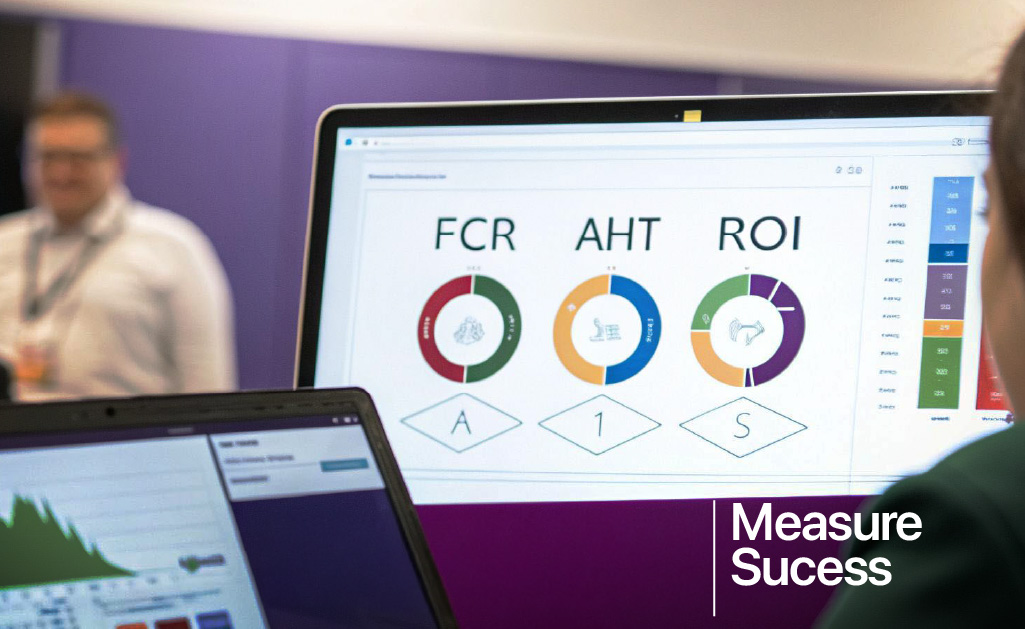
It’s easy to drown in data. That’s why you need to zero in on the key performance indicators (KPIs) that directly impact your customer experience and your bottom line. While there are dozens of metrics you could track, a few are absolutely non-negotiable.
Here are the essentials to keep on your dashboard:
- First Call Resolution (FCR): This is the holy grail of support metrics. It tracks the percentage of issues solved on the very first contact, no follow-up needed. A high FCR means your partner is efficient, knowledgeable, and saving your customers a ton of frustration.
- Customer Satisfaction (CSAT): Usually measured with a quick post-interaction survey, CSAT gives you a direct pulse on how customers feel about the support they just received. It’s the clearest window you have into service quality.
- Agent Utilization Rate: This metric shows how much time agents spend on support-related work versus sitting idle. It’s a great way to see if you’re paying for productive time and if staffing levels are right for your ticket volume.
The Nuance of Average Handle Time
One of the most common—and most misused—metrics is Average Handle Time (AHT). This KPI measures the average length of a support interaction from start to finish. Too many businesses fall into the trap of thinking a lower AHT is always better, pushing their partners to close tickets as fast as humanly possible.
But speed without quality is a recipe for disaster. An agent might rush a customer off the phone just to keep their AHT low, only for that same customer to call back an hour later with the same unresolved problem. That creates a terrible experience and actually drives your support costs up.
The real goal isn’t just speed; it’s efficiency. The best technology support companies know how to balance AHT with FCR and CSAT. They focus on resolving issues both quickly and correctly the first time around.
Calculating Your Return on Investment
At the end of the day, the one metric that rules them all is your Return on Investment (ROI). You have to know if the money you’re spending on a support partner is generating more value than it costs. And calculating ROI means looking beyond the monthly invoice.
The IT services market is a powerhouse. In fact, North America is on track to command over 35% of the global market revenue by 2025. This massive spending shows just how much value businesses place on effective tech support. As the market grows, being able to prove a clear ROI isn’t just a good idea—it’s essential. You can read more about the growing IT services market to see why smart partnerships are so critical.
To get a real picture of your ROI, you need to factor in:
- Cost Savings: Add up the direct savings from lower salaries, benefits, and training costs you would have spent on an in-house team.
- Productivity Gains: Put a dollar value on the time your internal team gets back by not having to troubleshoot IT issues. What could they accomplish instead?
- Increased Customer Loyalty: Even a small bump in customer retention can have a massive impact on your revenue over the long haul.
By tracking these KPIs and calculating a clear ROI, you can confidently measure your partner’s success. The right partner doesn’t just cut costs—they create undeniable value that strengthens your entire business.
Wrapping It Up: Your Strategic Advantage with a Nearshore Partner
Choosing the right technology support company isn’t just about ticking an operational box—it’s one of the most important strategic decisions you’ll make. We’ve walked through the different types of services, compared the pros and cons of various outsourcing models, and laid out a clear path for vetting potential partners.
Now, let’s put it all together and talk about the real competitive edge a nearshore partner can give you.
The whole game comes down to balancing three things: cost, quality, and collaboration. Onshore gives you perfect alignment but at a premium price. Offshore promises big savings but often comes with communication headaches and cultural disconnects.
This is where the nearshore model really shines. It’s built for businesses that refuse to sacrifice service quality just to hit a certain price point.
The CallZent Difference
A nearshore partner like CallZent, operating right from Tijuana, delivers a unique mix of benefits perfectly suited for North American companies. We combine geographic proximity with a huge pool of bilingual, bicultural talent, which lets us smooth over the friction points that plague so many outsourcing relationships.
Here’s what that looks like in practice:
- Cost-Savings Without Compromise: You get significant labor cost savings compared to US-based teams, but you never have to worry about the quality of service dropping.
- Cultural and Time Zone Harmony: Our teams work the same hours you do and operate in the same cultural context. This means communication is seamless, and collaboration feels natural, not forced.
- Expert Bilingual Support: With fluent English and Spanish support on tap, you can serve a much wider customer base clearly and professionally.
This powerful blend is what we call the nearshore advantage. It’s a model that delivers wins for your bottom line and your daily operations.
Your Final Takeaway: The goal isn’t just to offload tasks; it’s to forge a partnership that actively fuels your company’s growth. A smart nearshore partner helps you scale efficiently, delight your customers, and frees you up to chase your biggest goals.
Take a hard look at your current support setup. By exploring a partnership built on shared success, you can turn a simple cost center into a powerful engine for growth.
Got Questions? We’ve Got Answers
When you’re thinking about bringing on a technology support partner, a few key questions always come to the surface. Getting solid answers is the first step to making a smart decision that fits your budget, protects your data, and gets you up and running without a hitch. Here are the big ones we hear all the time.
What’s the Real Cost of a Tech Support Partner?
The honest answer? It varies—a lot. The final number on the invoice is shaped by a few major factors. The pricing model is a big one; you might see anything from per-user or per-hour rates to tiered packages. The delivery model you choose also moves the needle significantly.
Onshore providers based in your home country will almost always be the priciest option. Offshore will be the cheapest. But for most North American companies, the sweet spot—the best bang for your buck—is usually a nearshore solution. A great nearshore partner delivers major cost savings without the communication hurdles and cultural disconnects that can sometimes derail offshore projects. It’s the ideal blend of performance and affordability.
How Can I Be Sure My Data Is Safe with an Outsourced Team?
This is non-negotiable, and it should be at the top of your list when you’re vetting potential partners. Your first move is to check their credentials. Look for certifications that matter to your business, like SOC 2 for general data security or HIPAA compliance if you’re in the healthcare space.
But don’t just take a certificate at face value. Dig deeper. Ask them to walk you through their data protection protocols, their process for employee background checks, and the physical security measures at their facilities. A partner who takes security seriously will have no problem opening the books and showing you exactly how they keep your information locked down.
Here’s a rule of thumb: If a potential partner gets cagey or vague when you ask about their security protocols, that’s a massive red flag. Transparency is everything when your data is on the line.
How Long Does It Take to Get Started with a New Partner?
The onboarding timeline can be anywhere from a few weeks to a couple of months. What really dictates the schedule is complexity. Setting up a straightforward help desk is a much quicker lift than launching a full-scale back-office operation that needs to be deeply woven into your existing systems.
A smooth launch always comes down to teamwork. It requires clear and detailed documentation from both you and your partner, a dedicated implementation team on their side, and constant communication to keep everything on track. This kind of hands-on, collaborative approach is what ensures that on day one, your new support team is ready to go, no excuses.
🚀 Ready to Strengthen Your IT Support Strategy?
Partner with CallZent’s nearshore experts to reduce downtime, improve service quality, and scale efficiently.
Talk to an ExpertReady to gain a strategic advantage with a partner who understands your needs? At CallZent, we provide custom-fit nearshore solutions that blend cost-effectiveness with exceptional, bilingual service. Let’s build a support strategy that fuels your growth.