Skip to content

FINTECH & BPO STRATEGY
A Guide to Fintech App Development in 2026
Learn how to build, scale, and support fintech apps with modern strategies, security frameworks, and nearshore BPO solutions for sustainable growth.
TL;DR — Quick Takeaways
- Fintech app development is a trillion-dollar opportunity driven by digital-first users and demand for seamless financial tools.
- Security, compliance, and user trust are the foundation of any successful fintech product.
- A modern tech stack with APIs accelerates development while maintaining scalability and compliance.
- Nearshore BPO support is critical for scaling customer service and maintaining trust as user demand grows.
Ever wondered what it really takes to get the next big financial app off the ground? At its core, fintech app development is the whole journey—from the back-of-a-napkin idea to designing, building, and launching a mobile app that delivers financial services. This could be anything from a simple payment tool to a sophisticated investment platform.
It’s all about blending deep financial know-how with smart technology to build something seamless, secure, and incredibly user-friendly.
 The Trillion-Dollar Opportunity in Fintech
So, is now the right time to jump into fintech app development? The short answer is yes. The data isn’t just compelling; it’s overwhelming.
We’ve moved past the point of fintech being a “trend.” This is a fundamental rewiring of how people and businesses handle their money. Building a fintech app is no longer a fringe idea—it’s becoming a competitive must-have in finance, e-commerce, and even healthcare.
The market is riding a massive wave of growth, powered by a generation of digital-first users who want their bank to be as intuitive as their Instagram feed. This isn’t just about convenience. It’s about giving people the access, personalization, and control that traditional banking has struggled to provide.
A Market Driven by Massive Growth
The global fintech market is on an absolute tear, with a projected compound annual growth rate (CAGR) of 16.2%. This rocket ship is on track to hit $460.76 billion in 2026 and then soar to an incredible $1.13 trillion by 2032.
This isn’t just empty hype. It’s driven by real demand from digital-first consumers, especially in emerging markets like Asia-Pacific and Latin America, which now make up 29% of all new revenue growth. Meanwhile, North America still leads the pack with over 12,000 fintech companies and a market share of $112.91 billion.
To get a better handle on this shift, a solid guide on Fintech & Blockchain: Building Future Finance can give you the full context.
But for a quick look, the numbers speak for themselves.
Fintech Market Growth at a Glance
The projections below offer a snapshot of the sheer momentum in the fintech space. These figures highlight why now is such a pivotal time for new and established players to invest in app development.
| Metric | Projected Value/Figure | Key Driver |
|---|---|---|
| Global Market Size (2032) | $1.13 Trillion | Widespread adoption of smartphones and digital payments. |
| Annual Growth Rate (CAGR) | 16.2% | Increasing demand for personalized, accessible financial services. |
| Emerging Market Revenue | 29% of new growth | Expansion of internet access and a rising middle class. |
| N. America Fintech Companies | 12,000+ | Strong venture capital investment and a mature tech ecosystem. |
These metrics aren’t just abstract figures; they represent millions of users actively seeking better financial solutions, creating a clear runway for innovative apps.
The Unseen Challenge of Scaling in Fintech App Development
While the market opportunity is enormous, explosive growth brings its own set of headaches. As your user base balloons, so does the demand for fast, reliable, and empathetic customer support.
In fintech, trust is everything. A single bad support experience can shatter that trust for good. For example, if a user’s payment fails and they can’t get a clear answer from support within minutes, they won’t blame a “glitch”—they’ll blame your app.
The biggest risk in the current fintech landscape is not failing—it’s failing to act. However, a close second is failing to support the customers you’ve worked so hard to acquire.
This is where you need to think beyond the tech and get your operational plan straight. What happens when you have thousands of users simultaneously asking about transactions, security alerts, or locked accounts?
A strategic BPO partnership can be a game-changer here, giving you the power to manage user trust and security at scale. For North American growth, integrating bilingual customer support is a no-brainer. It turns a potential bottleneck into a powerful competitive edge, letting you serve a much broader customer base from day one.
Designing Features That Build User Trust
A great fintech app isn’t just about what it does—it’s about how it makes users feel. When you’re dealing with someone’s money, trust is the only currency that matters. The most successful apps build this trust from the very first tap, using features that prove their reliability and security.
Your features are the handshake, the eye contact, the proof that you’ve got your user’s back. Every interaction is a chance to earn—or lose—their confidence.
The First Handshake: Seamless Onboarding and KYC
The first few minutes are everything. A clunky, confusing signup process is a surefire way to get your app deleted. The goal is to make essential Know Your Customer (KYC) and Anti-Money Laundering (AML) checks feel like a secure welcome, not a bureaucratic nightmare.
Don’t bury them in paperwork. Modern fintech apps nail this by using tech to smooth out the bumps. Instead of asking for a dozen documents, let users scan their ID with their phone’s camera. The app can use optical character recognition (OCR) to fill out the forms automatically. It’s a simple touch that shows you value their time.
Core Fintech App Features Users Expect
Once they’re in, your users have a baseline of expectations. These aren’t flashy extras; they’re the non-negotiables for any serious player in the game. If you’re missing any of these, your app will feel dated and, frankly, untrustworthy.
- Secure Payment Gateways: This is the heart of your operation. You absolutely must partner with established, compliant processors like Stripe or Dwollla. Users need to know their transactions are locked down with industry-standard security.
- Instant Transaction History: People want to see their money move. Immediately. A real-time, easily searchable history provides transparency and peace of mind. A two-day delay to see a payment doesn’t read as “processing”—it reads as “broken.”
- Personalized Financial Dashboards: A dashboard should be more than a balance. It needs to offer a clean, visual snapshot of spending, savings, and investments. Think simple charts and progress bars that make complex data dead simple to understand.
Advanced Features That Create a Competitive Edge
To really stand out, you have to go beyond the basics. The next wave of fintech is all about adding intelligence and convenience—features that make an app feel like an indispensable partner.
“Functionality gets a user to download your app. A frictionless, trustworthy experience is what gets them to stay.”
Take AI-powered chatbots, for instance. They’re no longer just for basic FAQs. A modern chatbot can handle common queries like “Where is my transfer?” or “What are my spending limits?” 24/7. This frees up your human agents for the really sensitive issues, creating a perfect human-in-the-loop system. When a user has a complex fraud concern, the bot can seamlessly escalate it to a live agent who already has the full context.
Biometric security—like facial or fingerprint recognition—is another must. It’s not a novelty anymore; it’s an expectation. Studies show that adding biometric login can boost sign-ups by nearly 30% because it eliminates forgotten passwords while making the app feel more secure.
A truly great app even anticipates what its users need. Think automated savings tools that round up purchases and stash the change, or AI-driven advisors that offer personalized tips. These features show your app is actively working for the user’s financial well-being, and that’s the ultimate way to build lasting trust. Of course, technology can’t solve every problem. Learn more about how to humanize your brand to create powerful connections with your customers.
 Navigating Security and Compliance in Fintech App Development
When you’re building a fintech app, you’re not just coding features—you’re building a digital vault. People are trusting you with their money, and in this world, security and compliance aren’t just part of the checklist. They are the foundation.
One mistake isn’t just a bug. It’s a potential disaster that can trigger devastating financial losses, attract hefty legal penalties, and instantly shatter the trust you’ve worked so hard to build. From day one, your security architecture needs to be your top priority.
The Big Three of Fintech Compliance
The regulatory landscape can feel like a maze, but for any fintech founder, it all comes down to mastering three core areas. Getting these right isn’t optional.
- PCI DSS (Payment Card Industry Data Security Standard): If your app touches credit card information in any way—processing, storing, or even just passing it through—this is your bible. It’s a set of strict rules for protecting cardholder data through things like encryption and network security.
- AML/KYC (Anti-Money Laundering/Know Your Customer): These rules are all about preventing financial crime. KYC is the process of confirming your users are who they claim to be. AML is the ongoing work of monitoring their transactions for any red flags.
- Data Privacy Laws (GDPR/CCPA): Depending on where your users live, laws like Europe’s GDPR or California’s CCPA control how you collect, use, and protect their personal information. They give users rights over their data and demand complete transparency from you.
Turning Rules into Real-World Security
So, how do you translate that dense legal jargon into actual features that keep your app and your users safe? It’s not about ticking boxes; it’s about creating an environment that’s genuinely secure.
In fintech, security isn’t a department; it’s a culture. A proactive security posture is the most valuable asset you can build.
Here are the non-negotiable security measures every fintech app must have:
- End-to-End Encryption (E2EE): Think of this as a secret code. Data is scrambled the instant it leaves a user’s phone and isn’t unscrambled until it reaches your secure server. Anyone who tries to intercept it just sees gibberish.
- Multi-Factor Authentication (MFA): A password alone just doesn’t cut it anymore. MFA adds a critical second layer of defense, requiring users to prove their identity with something else, like a code sent to their phone or a fingerprint scan.
- Recurring Security Audits: Don’t wait for a breach to find your weak spots. You need to hire outside experts to perform “pen tests”—essentially, ethical hacking—to find and fix vulnerabilities before the bad guys do.
Outsourcing for Secure and Compliant Operations
The demand for airtight fintech is exploding. The fraud monitoring and KYC market is projected to grow at a staggering 32.8% CAGR between 2025 and 2030, hitting USD 1,029.16 billion. With over 90% of Millennials already on fintech apps, the user base is massive and expects top-tier security. You can find more insights on the financial app market to see just how big the opportunity is.
While your dev team is busy building your core product, managing these critical back-office functions can quickly become overwhelming. This is where a specialized BPO partner makes all the difference. An experienced partner can handle sensitive tasks like identity verification and real-time fraud monitoring. For example, a trained agent can manually review a flagged transaction that an automated system couldn’t resolve, preventing both fraud and false positives that frustrate legitimate customers. You can dig deeper into how to ensure data security and compliance when working with a partner.
By outsourcing these duties to a nearshore team in a hub like Tijuana, you get access to highly trained, bilingual agents who can manage these workflows securely and affordably. It lets you scale with confidence, knowing the “vault” is locked tight and your compliance obligations are covered.
How to Choose Your Fintech Tech Stack
Picking the right technology to power your fintech app—your tech stack—can feel like a high-stakes decision, especially for non-technical founders. But it doesn’t have to be complicated.
Think of it like building a bank vault. The frontend is the polished, heavy-duty door the customer sees. The backend is the intricate series of locks, gears, and security systems that actually protect the money inside.
Your job is to build a vault door (frontend) that looks and feels impenetrable yet is simple to operate, backed by an internal mechanism (backend) that’s bulletproof, secure, and can handle anything thrown at it. Getting this combination right from day one is non-negotiable in fintech.
Understanding the Core Components of a Fintech Tech Stack
Every fintech application is built from a few fundamental layers. The technologies you select for each layer will define your app’s speed, security, and ability to scale down the road.
-
Frontend (The Vault Door): This is everything your user sees and interacts with—the buttons, charts, and navigation menus. It has to be dead simple and lightning-fast.
-
Backend (The Locking Mechanism): This is the app’s engine room. It handles transaction processing, authenticates users, and manages the database. It must be powerful, secure, and unfailingly reliable.
-
Database (The Contents of the Vault): This is where all your critical data lives, from user credentials to transaction ledgers. Security here has to be airtight.
-
API Integrations (The Armored Trucks): These are trusted third-party services that deliver specialized functions, like connecting to bank accounts (Plaid), processing payments (Stripe), or verifying identity.
Selecting the Right Technologies
When it comes to the backend—the secure core where money actually moves—Python and Node.js are industry favorites. They’re built for speed and can process thousands of concurrent transactions, which is critical for handling peak usage without a hiccup. For the absolute core ledger systems where there is zero room for error, battle-tested languages like Java and .NET are still the gold standard.
On the frontend, frameworks like React Native and Flutter are a massive accelerator. They let you build your app for both iOS and Android from a single codebase, effectively cutting your development time and costs. This is a huge win when you need to push updates or security patches to all users simultaneously.
Remember, keeping your app running flawlessly is just as crucial as the initial build. For a strategic framework on this, check out our guide on application maintenance and support.
Finally, your infrastructure—the physical building the vault sits in—is almost always a major cloud platform like Amazon Web Services (AWS) or Microsoft Azure. They provide the on-demand scalability and security tooling required to meet stringent fintech compliance mandates.
The Power of Third-Party API Integrations
You don’t have to—and shouldn’t—build every single component of your fintech app from the ground up. In fact, attempting to do so is one of the most common and expensive mistakes a startup can make. Smart fintech development is built on third-party API integrations.
Using battle-tested APIs isn’t a shortcut; it’s a strategic accelerator. It frees you up to focus on what makes your app unique instead of reinventing secure, regulated infrastructure.
Take services like Yodlee or Plaid. They provide the incredibly complex and secure technology needed to link a user’s bank account to your app. Building that yourself would take years and millions in R&D and regulatory hurdles. By plugging in their API, you get that functionality in a fraction of the time. The same goes for payment gateways like Stripe, which handle the messy, highly regulated world of moving money.
When mapping out your tech stack, look at how modern integrations like Open Banking can expand your app’s features. This excellent Open Banking API Guide for UK Businesses is a great resource. These APIs are pre-built, secure, and already familiar to regulators, which dramatically simplifies your path to compliance.
The table below breaks down some of the most popular technology choices to help you weigh the trade-offs.
Comparing Popular Fintech Tech Stack Components
This table compares common technology choices for different parts of a fintech app, helping you understand the pros and cons of popular options.
| Component | Technology Option | Best For | Considerations |
|---|---|---|---|
| Backend | Python / Node.js | High-volume transaction processing and rapid development. | Requires strict security protocols for handling sensitive financial data. |
| Frontend | React Native / Flutter | Building for both iOS and Android with a single codebase, saving time and money. | Can have minor performance differences compared to fully native apps. |
| Cloud | AWS / Azure | Scalable infrastructure with robust, built-in security and compliance tools. | Configuration can be complex and requires specialized expertise to get right. |
| API | Plaid / Stripe | Accelerating development for core functions like bank linking and payment processing. | Adds a dependency on a third party and their associated transaction fees. |
Ultimately, choosing your tech stack is about balancing speed, security, and cost. By making smart choices and integrating proven third-party tools, you can build a powerful, compliant fintech product without starting from scratch.
The Fintech App Development Roadmap
Turning a great fintech idea into a real, market-ready product can feel like a monumental task. The secret? Breaking the journey down into clear, manageable stages. This roadmap will walk you through the entire process, making sure you build a secure, compliant, and user-friendly app without getting lost in the weeds.
Think of it like building a house. You don’t just start throwing up walls. You need a solid blueprint, a strong foundation, and a logical construction sequence. Each phase we’ll cover builds on the last, moving you from a rough sketch to a fully-functioning digital product.
Stage 1: Discovery and Strategy
This is your blueprint phase. It’s where you pressure-test your idea and map out your business goals before a single dollar is spent on development. Rushing this step is the fastest way to build something nobody wants. Your main job here is to confirm there’s a real-world problem that your app can solve better than anyone else.
Here’s what you need to nail down:
- Market Research: Who are your ideal users? What are their biggest financial frustrations? For example, are they small business owners struggling with invoicing, or millennials who find traditional investment apps too intimidating?
- Defining Your Value Proposition: Get crystal clear on what makes your app special. Why would someone choose you over their bank’s app or another established player?
- Compliance Planning: Figure out exactly which regulations apply to you—think PCI DSS, AML, and KYC. This isn’t something to worry about “later”; it shapes your entire development path from day one.
- Monetization Strategy: How will you make money? Will it be through subscription fees, a small cut of transactions, or a freemium model?
Stage 2: Prototyping and UX Design
With a solid strategy, you can start sketching out what the app will actually look and feel like. This stage is all about user experience (UX). In fintech, trust is everything, and a confusing or clumsy interface immediately feels insecure to a user.
You’ll start with low-fidelity wireframes—the basic architectural blueprints of your app’s screens. From there, you’ll move to high-fidelity prototypes that look and function just like the final product. The goal is to get these prototypes in front of real users, gather honest feedback, and make changes before any code is written. This iterative loop will save you a fortune in time and money down the road.
Stage 3: MVP Development
The Minimum Viable Product (MVP) is the most important concept you’ll encounter in modern app development. An MVP isn’t a half-finished app; it’s a lean, focused version that includes only the essential features needed to solve your user’s primary problem.
The goal of an MVP is to launch faster, validate your core assumptions with real market data, and gather crucial user feedback to guide future development.
For example, an MVP for a new budgeting app might only include secure bank account linking, automatic transaction categorization, and a simple spending dashboard. It would leave out advanced features like investment tracking or AI-powered savings goals. You add those later, based on what your first users tell you they actually want.
This diagram shows a simplified view of how your app’s core technology fits together.
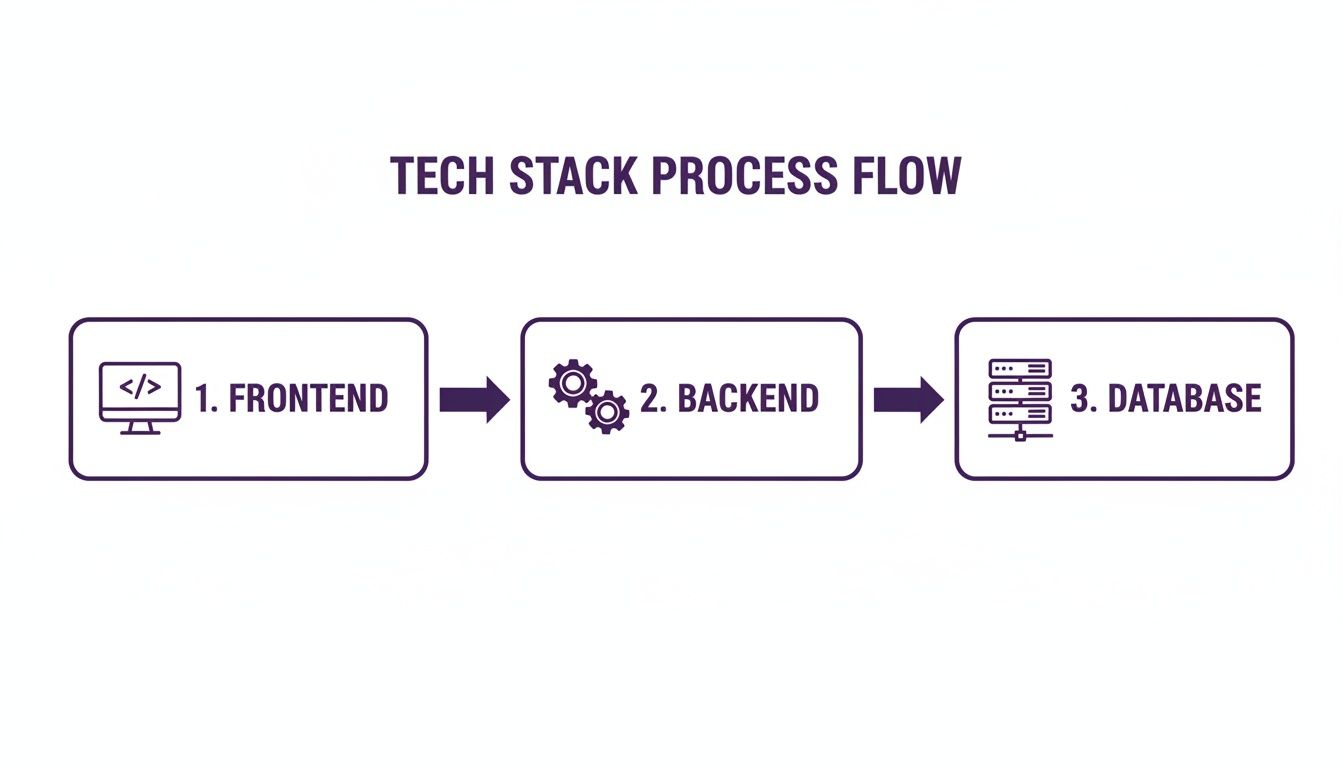
The frontend is what your users see and interact with. It sends requests to the backend—the “brain” of the operation—which then securely processes information and manages data in the database.
Stage 4: Rigorous Testing and QA
Before your app sees the light of day, it needs to be put through the wringer. Quality Assurance (QA) in fintech is absolutely non-negotiable and covers several critical areas:
- Functional Testing: Does every single button, menu, and feature work exactly as it should?
- Security Testing: How easy is it to break? You’ll need professional penetration testing and vulnerability scans to find weaknesses before hackers do.
- Performance Testing: What happens if 10,000 users try to log in at the same time? The app can’t buckle under pressure.
- Compliance Audits: Does the final product meet every single regulatory standard you identified back in Stage 1?
Stage 5: Strategic Launch and Post-Launch Support
Getting your app on the store is just the starting line. Now the real work begins: acquiring users, collecting feedback, and delivering world-class customer support. A smooth launch needs a smart marketing plan and, crucially, a support team that’s ready to go from day one.
This is where a nearshore partner can be a game-changer. A team in Tijuana, for instance, can provide scalable, bilingual customer service and manage critical back-office functions right from the get-go. By having them handle vital operations, you get a direct line to user feedback while your core team stays focused on refining the product and scaling the business. To see how this works, you can explore the benefits of outsourcing back-office services for a growing fintech. This ensures your users are supported every step of the way, building the trust you need to succeed.
How to Budget for Fintech App Development
Let’s get straight to the point. The first question every fintech founder asks is, “How much is this going to cost?” The honest answer? It’s not a single number. Think of it as a range, one that shifts based on your ambition, strategy, and the path you take to build your app.
Budgeting for a fintech app is a lot like planning a construction project. A simple payment tool is like a small outbuilding, but a full-blown investment platform is a skyscraper. The materials, team size, and regulatory permits all scale with complexity, and so does your budget.
Key Factors That Influence Your Fintech App Budget
To get a real handle on your final cost, you have to understand the main drivers. A simple payment app with just the basics will sit on the lower end of the spectrum. But a complex platform packed with AI-driven analytics, advanced security, and multiple third-party integrations? That will command a much higher investment.
Here are the primary factors to think about:
- Feature Complexity: The more you add—like biometric logins, real-time analytics, or AI chatbots—the more development hours you’ll need. It’s simple math.
- Regulatory Hurdles: Meeting compliance standards like PCI DSS and KYC isn’t just a legal checkbox. It requires serious development work to handle data securely and implement verification processes, adding to your costs.
- Team Size and Structure: The number of developers, designers, and project managers on your team will be a major line item in your budget.
The good news? Fintech investment is bouncing back in a big way. Global funding hit $97.8 billion in just the first three quarters of 2025. Median deal sizes have also climbed 33% year-over-year to $4 million. This renewed confidence, especially in hot sectors like payments ($6.7 billion) and digital lending ($4.9 billion), proves that well-funded, high-quality apps are attracting serious capital. You can explore more fintech statistics to see where the market is headed.
Comparing Development Models: In-House vs. Outsourcing
Your choice of a development team will have the single biggest impact on your budget. Building an in-house team gives you total control, but it comes with the sky-high costs of salaries, benefits, and overhead—especially if you’re in a major tech hub.
This is where outsourcing models offer a strategic way forward:
- Onshore: Hiring a team in your own country is great for communication, but it’s by far the most expensive option.
- Offshore: Partnering with a team in a distant location (like Asia) can cut costs dramatically, but you often run into headaches with time zones, communication gaps, and cultural differences.
- Nearshore: Working with a partner in a nearby country, like our teams in Tijuana, gives you the best of both worlds. You get major cost savings compared to onshore teams without the communication barriers of offshoring. And since the time zones align, collaboration is seamless.
A critical mistake is treating security and support as cost-cutting areas. Compromising on customer support is a false economy that ultimately costs you far more in lost user trust, negative reviews, and customer churn.
Choosing a nearshore model frees up your budget to be spent where it matters most: building a high-quality, secure product while ensuring you have expert support ready from day one. You can learn more by understanding the costs of outsourced app support and how that fits into your overall plan. A smart outsourcing strategy isn’t just about saving money—it’s about investing in a scalable, resilient foundation for your fintech app.
Fintech App Development FAQs
When you’re diving into the world of fintech app development, the same questions tend to pop up again and again. Let’s tackle some of the most common ones head-on to give you the clarity you need to move forward.
How Long Does It Take to Build a Fintech App?
Honestly, the timeline is all about complexity. There’s no one-size-fits-all answer.
If you’re aiming for a streamlined Minimum Viable Product (MVP) with just the core essentials—think account creation and basic money transfers—you’re looking at a development window of about 4 to 6 months.
But if your vision is bigger, with features like lending algorithms, investment tools, or advanced AI for fraud detection, you’ll need a more patient approach. A full-featured, secure platform like that typically takes 9 to 12 months (or even longer) to build, rigorously test, and launch.
What Are the Biggest Security Risks in Fintech?
The two heavy hitters are data breaches and compliance failures. Fintech apps are a goldmine for cybercriminals, and a single breach can vaporize user trust and cost millions overnight.
One of the sneakiest threats we’re seeing now is Shadow AI. This is when your own team uses unapproved AI tools that get their hands on sensitive customer data, creating huge security holes that nobody is even tracking.
Beyond that, you have to worry about internal fraud, vulnerabilities from third-party APIs you integrate with, and falling short of strict regulations like PCI DSS. A failure there could get your payment processing privileges revoked completely.
Can I Launch a Fintech App Without Being a Bank?
Yes, you absolutely can. In fact, most startups go this route. Getting your own banking charter is an incredibly long, expensive, and complicated process.
The smart move is to partner with a Banking-as-a-Service (BaaS) provider.
These partners essentially let you rent their banking license and infrastructure. They handle all the regulatory headaches and core banking systems, allowing you to offer services like accounts and payments much faster and for a fraction of the cost.
🚀 Scale Your Fintech Support with Confidence
Partner with CallZent to deliver secure, bilingual, and scalable customer support for your fintech platform.
Talk to an ExpertReady to scale your fintech operations with expert customer support? CallZent provides secure, bilingual, and cost-effective BPO solutions that build trust and keep your users happy. Learn more about our nearshore call center services.