Skip to content
Healthcare Outsourcing Guide
What Is Health Care BPO? A Practical Guide to Efficiency, Compliance, and Better Patient Care
TL;DR: What Is Health Care BPO?
Health Care BPO (Business Process Outsourcing) means outsourcing non-clinical administrative tasks—such as medical billing, claims processing, scheduling, and patient calls—to a specialized third-party provider.
The result: lower operational costs, stronger compliance (including HIPAA), faster revenue cycles, and more time for your clinical staff to focus on patient care.
Is your medical practice drowning in paperwork and administrative headaches? You’re not alone.
As healthcare operations grow more complex, back-office work often pulls attention away from what matters most: patients.
This is where Health Care BPO comes in—not as a cost-cutting shortcut, but as a strategic partnership that strengthens efficiency, compliance, and long-term scalability.
Is your medical practice drowning in paperwork and administrative headaches? It’s a common story. When back-office tasks start pulling focus away from patient care, something has to give. This is where Health Care BPO (Business Process Outsourcing) comes in. It’s a strategic partnership where you hand off non-clinical administrative jobs—think billing, scheduling, and claims processing—to a specialized expert, freeing up your clinical staff to do what they do best: provide outstanding care.
Understanding Health Care BPO Beyond the Buzzwords
Think of a health care BPO partner as a highly efficient, specialized administrative team that just happens to work remotely. Instead of hiring, training, and managing an in-house team for every single back-office function, you partner with a company that already has the expertise, technology, and trained staff ready to hit the ground running. This isn’t just about offloading tasks; it’s about embedding a specialist team that becomes a true extension of your own.
The core idea is simple: let medical professionals handle medicine, and let administrative professionals handle administration. As the healthcare world grapples with rising operational costs and dizzyingly complex regulations, this model has become a lifeline for maintaining both financial health and high standards of patient care. A great BPO partner does more than just fill operational gaps—it actively drives efficiency and bolsters your bottom line.sWhat Does a Health Care BPO Actually Do?
A health care BPO handles the critical non-clinical functions that keep a practice, clinic, or hospital running. These are the essential business operations that don’t require a medical degree but are absolutely vital for survival. Common responsibilities they take on include:
- Revenue Cycle Management (RCM): This is the big one. They manage the entire financial journey of a patisssssnt’s visit, from the moment an appointment is scheduled to the final payment collection.
- Medical Billing and Coding: They accurately translate diagnoses, treatments, and procedures into the standardized codes required for insurance claims. Get this wrong, and you don’t get paid.
- Patient Engagement: This includes handling inbound calls for appointments, answering billing questions, and making outbound reminder calls to reduce no-shows.
- Claims Processing: They submit insurance claims, chase down denials, and manage appeals to make sursss you get reimbursed on time.
To really get past the surface-level talk about Health Care BPO, it’s vital to dig into foundational pieces like understanding what Revenue Cycle Management is and why it matters. This financial backbone is often the very first area providers look to optimize.
“The true value of a health care BPO isn’t just cost savings—it’s gaining an operational partner dedicated to maximizing your administrative efficiency so you can focus entirely on patient outcomes.”
Ultimately, the goal is to create a seamless operational flow where administrative burdens are expertly managed off-site. This frees up your organization to scale more effectively, adapt to changing patient volumes, and pour more resources into its core mission: caring for people. To get a broader view of this strategy, you can explore our guide on what business process outsourcing entails and how it applies across different industries.
The Core Services of a Health Care BPO Partner
So, what can you actually hand off to a health care BPO? The range of services is often much wider than people think, touching nearly every administrative and financial process that keeps a medical practice running. It’s less about offloading single tasks and more about outsourcing interconnected systems that directly impact your cash flow, patient happiness, and operational stability.
When you bring in a specialized provider, you’re giving complex, rule-heavy work to a team that does this all day, every day. This frees up your clinical staff to stop wrestling with paperwork and get back to what they do best: caring for patients.
The diagram below gives you a clear picture of how this partnership simplifies your workflow.
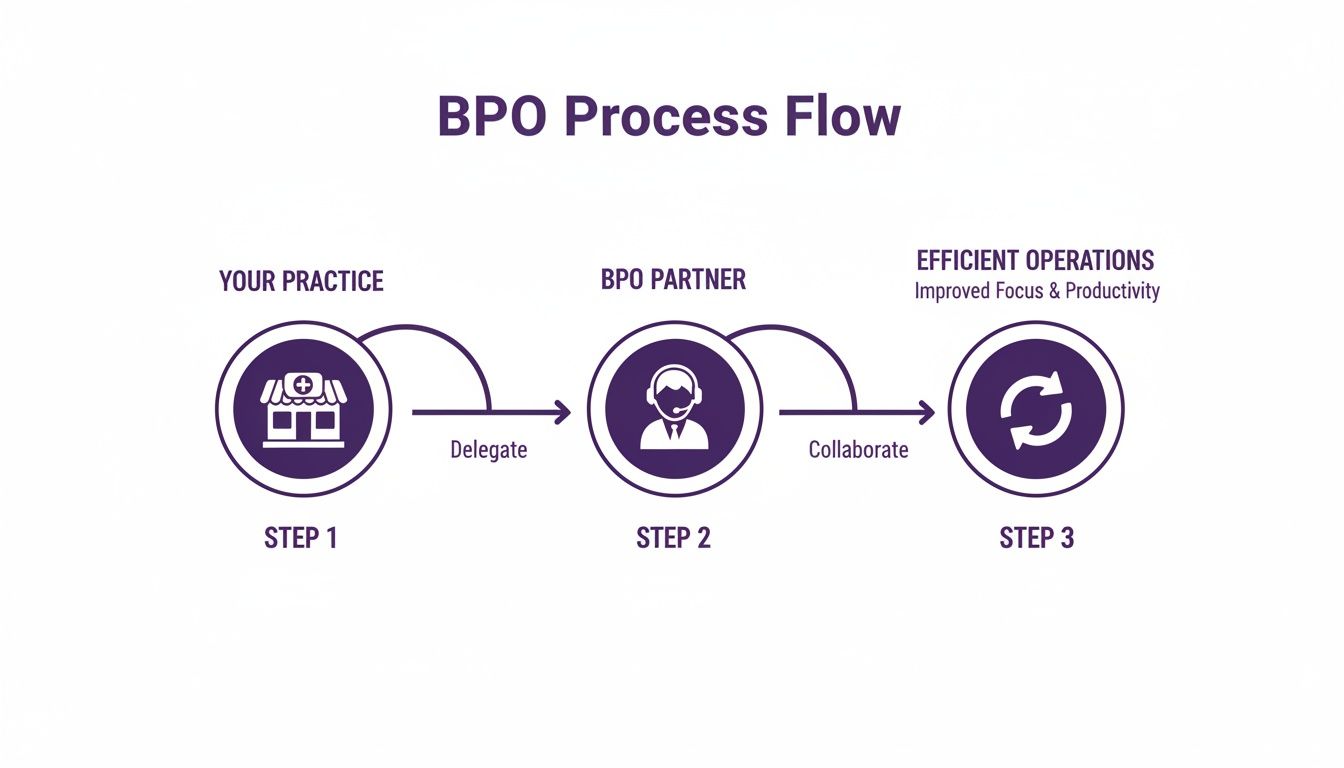
As you can see, it creates a direct and efficient channel from your practice to the BPO team, lifting the administrative weight off your shoulders.
Revenue Cycle Management (RCM)
Think of Revenue Cycle Management as the complete financial journey a patient takes with your practice. It starts the moment they book an appointment and doesn’t end until their balance is fully paid. A health care BPO manages every single step along this path to make sure no money gets lost along the way.
This is so much more than just sending out bills. It’s about optimizing the entire process to plug revenue leaks. That includes front-end tasks like checking insurance eligibility before a visit and back-end work like fighting claim denials and handling collections.
For instance, imagine a simple typo in a patient’s insurance ID at check-in. Without a sharp RCM process, that tiny mistake could cause a claim to be denied weeks later. Your staff would then have to hunt down the patient, fix the error, and resubmit—a huge waste of time. A BPO partner catches these issues from the get-go.
Medical Billing and Coding
In healthcare, there is zero room for error in medical billing and coding. This is the critical process of turning every service, diagnosis, and procedure into a universal code that insurance companies can understand. Payers use these codes to decide how much to reimburse, so getting them right is everything.
An expert health care BPO has certified coders who are fluent in CPT, ICD-10, and HCPCS Level II code sets. They’re constantly updated on changing regulations to make sure every claim you submit is clean, compliant, and structured for the highest possible reimbursement.
“Mistakes in medical coding are one of the fastest ways to lose revenue. A specialized BPO partner acts as your first line of defense against costly errors and claim denials.”
Claims Processing and Denial Management
Submitting claims is only the first step. The real challenge lies in managing them afterward. A BPO partner takes on the massive job of submitting claims to hundreds, sometimes thousands, of different insurance payers, each with its own quirky rules.
Even more importantly, they are relentless when it comes to managing denials. The moment a claim gets kicked back, their team digs in to find out why, fixes the problem, and files an appeal. This proactive mindset turns potential losses into recovered revenue.
Patient Engagement Services
The patient’s experience doesn’t end when they leave the clinic. BPO partners handle critical communications with the professionalism and empathy your patients deserve. These services typically include:
- Appointment Scheduling and Reminders: Keeping your calendar full and dramatically cutting down on no-shows.
- Answering Billing Inquiries: Freeing your team from fielding confusing questions about payments and insurance.
- Patient Follow-Up Calls: Making sure patients understand their care instructions or have a clear payment plan.
These touchpoints are key to building lasting patient loyalty. At CallZent, our teams specialize in making these interactions positive and helpful. You can find out more about how our medical call center services transform patient care and boost satisfaction.
Telehealth and Back-Office Support
With virtual care becoming a staple, the administrative work behind it has exploded. A BPO can step in to manage telehealth scheduling, provide tech support to patients struggling with virtual platforms, and even run virtual waiting rooms.
They also tackle a whole host of other essential back-office jobs that keep your practice moving:
- Data Entry and Management: Entering patient information into EHR/EMR systems with precision.
- Medical Records Indexing: Organizing digital files so they can be found in seconds.
- Payment Posting: Matching payments to patient accounts to keep the books clean.
This behind-the-scenes work is the engine of a modern medical practice. The growing need for these services is why the global healthcare BPO market is projected to jump from an estimated USD 417.7 billion in 2025 to a staggering USD 694.3 billion by 2030. That growth says it all—these services are no longer a nice-to-have; they’re essential.
In-House vs. Outsourced Healthcare Administrative Tasks
Deciding whether to keep administrative functions in-house or to outsource them is a major strategic choice. While maintaining an in-house team offers direct control, it often comes with significant overhead, training burdens, and challenges in keeping up with regulatory changes. Outsourcing, on the other hand, provides access to specialized expertise and technology without the upfront investment.
The table below breaks down the common challenges of in-house management versus the solutions offered by a dedicated health care BPO partner.
| Service Area | In-House Management Challenges | Health Care BPO Solution |
|---|---|---|
| Medical Billing & Coding | High cost of hiring/training certified coders; constant need for regulatory updates; risk of costly errors. | Access to a team of certified coding specialists who are always current on compliance and best practices. |
| Claims Processing | Manual, time-intensive submission process; difficulty tracking thousands of claims; slow denial follow-up. | Automated, high-volume claims submission and a proactive denial management team dedicated to recovering revenue. |
| Revenue Cycle Management | Disjointed processes leading to revenue leaks; staff stretched thin between clinical and admin duties. | An end-to-end, optimized financial workflow that minimizes errors and maximizes collections from start to finish. |
| Patient Call Support | In-house staff pulled from patient care to answer phones; inconsistent service quality during peak hours. | Professional, 24/7 call handling for appointments, billing questions, and follow-ups, ensuring a great patient experience. |
Ultimately, partnering with a health care BPO allows your practice to convert fixed operational headaches into a variable, scalable service. It’s about redirecting your internal resources toward what truly matters: delivering exceptional patient care.
Navigating the Complex World of Healthcare Compliance
In healthcare, data security isn’t just a good idea—it’s the law. Handing over sensitive patient information to a third-party BPO can feel like a massive leap of faith. But with the right health care bpo partner, it’s one of the safest decisions you can make.
For a true BPO partner, compliance is non-negotiable. They must show an absolute, ironclad commitment to protecting your data, no ifs, ands, or buts.

This responsibility is about far more than just promises. It demands a tough, multi-layered security framework built to handle constant threats while sticking to a strict set of government rules. Think of a top-tier BPO as a secure vault for your patient data—every process, piece of tech, and team member is just another lock on the door.
HIPAA: The Cornerstone of Healthcare Data Security
At the very heart of healthcare compliance is the Health Insurance Portability and Accountability Act (HIPAA). This federal law is the national standard for protecting sensitive patient health information (PHI) from being shared without a patient’s consent.
For a health care BPO, being HIPAA compliant isn’t just a feature; it’s the absolute foundation of their entire service.
So, what does that actually look like in the real world? It’s not just about signing a form. It means building a culture of security that runs through every part of the operation.
- Secure Data Encryption: All patient data, whether it’s sitting in a database or flying across a network, must be encrypted. This scrambles the information, making it completely useless to anyone who isn’t authorized to see it.
- Rigorous Agent Training: Every single agent who might come into contact with PHI has to go through extensive, ongoing training on HIPAA’s privacy and security rules. They need to know what a data breach is and exactly how to prevent one.
- Audited Security Protocols: A truly compliant BPO will have regular, independent audits of its security systems. These checks are designed to find and fix weak spots before they can ever be exploited.
When you’re looking at potential partners, making sure they use systems that meet these strict standards is critical. Ensuring your partners utilize HIPAA-compliant platforms is essential for both data security and staying on the right side of the regulations.
Beyond HIPAA: HITECH, SOC 2, and Other Key Standards
While everyone knows HIPAA, the compliance landscape is much bigger than just one regulation. The HITECH Act (Health Information Technology for Economic and Clinical Health) came along to encourage the use of health information technology. More importantly, it put some serious teeth into HIPAA’s enforcement, dramatically raising the stakes for data breaches.
This means a BPO partner must have a clear, well-rehearsed breach notification plan, ready to spring into action the moment an incident occurs.
A truly compliant partner doesn’t just perform tasks; they absorb the responsibility of safeguarding your most sensitive information, mitigating your risk and protecting your reputation.
On top of that, certifications like SOC 2 (Service Organization Control 2) give you another layer of confidence. A SOC 2 report is an independent verification that a service provider securely manages data to protect their clients’ interests and their customers’ privacy. It’s proof that their systems and controls are as solid as they claim.
Choosing the right partner means you don’t have to become a cybersecurity expert yourself. Instead, you gain a dedicated ally whose entire business depends on being your shield against regulatory fines and data breaches. If you’re exploring how to put these safeguards in place, learning more about a HIPAA compliant call center can give you a clear roadmap of what to look for. This lets you get back to focusing on patient care, knowing your data is in expert hands.
The Real-World Benefits of Outsourcing Healthcare Tasks
Let’s get past the theory and talk about what really happens when you outsource. Bringing on a health care bpo partner isn’t just about handing off tasks; it’s a strategic move that can deliver tangible, measurable improvements across your entire practice. These aren’t just abstract ideas—they’re real-world wins that directly impact your bottom line, staff morale, and the quality of patient care.
When the weight of administrative work gets lifted, your whole practice can finally breathe and start operating on another level. Let’s break down the five core benefits that make outsourcing such a compelling business decision.
Significant Cost Reduction
One of the first and most powerful benefits you’ll see is a major drop in operational costs. A specialized BPO partner works at a scale that a single practice or hospital just can’t match. Instead of carrying the full financial weight of salaries, benefits, training, and technology for an in-house admin team, you’re plugging into a shared, expert resource.
This flips your fixed overhead into a predictable, variable expense, meaning you only pay for what you actually use. It’s particularly effective for functions like medical billing, where keeping a team of certified, up-to-date coders on staff can be incredibly expensive.
For example, a mid-sized clinic might need two full-time billing specialists. By outsourcing, they get access to the expertise of a much larger team for a fraction of the cost—and they completely sidestep expenses like recruitment, paid time off, and ongoing professional development.
Greater Efficiency and Scalability
Healthcare demand is anything but static. You have to deal with seasonal rushes, like flu season, or sudden growth spurts that can completely swamp an in-house team. A BPO partner gives you instant scalability, letting you ramp up or dial down your administrative support whenever you need to.
This kind of operational flexibility is a total game-changer. Imagine needing to double your appointment scheduling capacity for a few months. Instead of going through a long and costly hiring process, you just let your BPO partner know, and they can assign more agents to your account almost overnight.
This agility means the quality of your patient service never has to suffer, even when you’re at your busiest. You can adapt to changes in the market quickly, without the usual HR headaches.
A Renewed Focus on Patient Care
This might be the most important benefit of all: the freedom for your clinical staff to focus purely on patient outcomes. When your nurses and medical assistants aren’t stuck chasing down insurance claims or scheduling follow-ups, they can put all their energy and attention into caring for patients.
This isn’t just good for morale; it directly elevates the patient experience. A happier, less-stressed team provides more empathetic and attentive care, which is exactly what drives patient satisfaction and loyalty. By outsourcing the non-clinical work, you’re empowering your most valuable people—your medical professionals—to do the job they were actually trained to do.
When your team is unburdened from administrative tasks, every minute saved is a minute that can be reinvested into patient well-being, leading to better health outcomes and stronger patient-provider relationships.
Access to Specialized Expertise
The world of medical regulations is a beast—it’s incredibly complex and always changing. A top-tier health care bpo isn’t just a team of generalists; it’s a deep bench of specialists. You instantly get a partner with certified experts in key areas like:
- Complex Medical Coding: Professionals who live and breathe ICD-10, CPT, and HCPCS codes.
- Payer-Specific Regulations: Teams who know the unique submission rules for hundreds of different insurance companies.
- Denial Management: Experts who specialize in figuring out why a claim was denied and successfully appealing it.
This kind of specialized knowledge is invaluable. It helps you maximize reimbursements and stay compliant without forcing your practice to become an expert in every little corner of healthcare administration.
Improved Revenue Cycle Management
Ultimately, all these benefits feed into one thing: a healthier, more predictable revenue cycle. Efficient and accurate claims processing is the engine that keeps your practice financially sound. Claims management is the powerhouse segment in healthcare BPO, commanding the lion’s share of the market. For healthcare providers, outsourcing this function can slash processing times by 40%, cut errors by 25%, and give a massive boost to cash flow predictability. You can find more details in these healthcare BPO market findings on fortunebusinessinsights.com.
Faster, cleaner claims mean fewer denials, quicker payments, and a stronger bottom line. That’s the fuel you need to reinvest in your practice and focus on growth.
How to Choose the Right Health Care BPO Partner
Picking a partner for your health care BPO needs is the most critical decision you’ll make in this entire process. Get it right, and you’ll see a dramatic boost in efficiency and profitability. But get it wrong, and you’re staring down the barrel of massive compliance headaches and operational chaos. This isn’t just about finding a vendor; it’s about finding a genuine partner who gets the unique pressures of the healthcare world.
You need to look past the sales pitch and really dig into the capabilities that matter. Think of it like hiring a key member of your leadership team—you’d vet their experience, check their credentials, and make sure they’re a perfect fit for your culture and operations.
Build a Vetting Checklist
Don’t just wing it. A formal checklist is your best friend here, letting you compare potential partners apples-to-apples on the stuff that will actually impact your success. A systematic approach means every candidate is measured against the same high standards, making your final call clear and easy to defend.
Here are the absolute must-haves for your checklist:
- Proven Healthcare Specialization: Don’t even consider a generalist BPO that just dabbles in healthcare. You need a partner with deep, provable experience in the medical field, ideally with practices or organizations just like yours.
- Verifiable Compliance and Security: This is a deal-breaker. Ask for hard proof of their HIPAA compliance training and any relevant certifications like SOC 2. They must be able to walk you through their security protocols for protecting patient health information (PHI) in detail.
- Modern Technology Stack: Outdated systems are a recipe for inefficiency and errors. Your partner should be using modern tools, including AI-driven automation for tasks like data entry and claims scrubbing. Crucially, they have to show how they’ll integrate seamlessly with your existing EHR/EMR and CRM systems.
- Flexibility and Scalability: Your needs are going to change. A great partner can easily scale their services up or down to match patient volume or your practice’s growth, all without trapping you in a rigid contract that no longer makes sense.
- Rigorous Agent Training: How do they actually prepare their agents? Dig into their quality assurance (QA) programs, find out about their ongoing training schedules, and ask how they measure agent performance on critical skills like empathy, accuracy, and efficiency.
Having a solid framework is the only way to make the right choice. For a much deeper look into the selection process, our comprehensive guide to find and vet the best call center outsourcing companies offers more detailed strategies.
Focus on Cultural and Linguistic Alignment
Never, ever underestimate the power of cultural and linguistic alignment, especially for any role that interacts with patients. When agents can communicate clearly and with genuine empathy, it directly builds patient satisfaction and trust.
This is a huge advantage of the nearshore model. Partners in places like Tijuana have a talent pool that is not only bilingual but also culturally in sync with U.S. patients. An agent who understands cultural nuances can navigate a sensitive conversation about billing far more skillfully, reducing friction and improving the entire patient experience.
“Choosing a BPO partner is less about outsourcing tasks and more about insourcing expertise. The right partner becomes an extension of your own team, fully invested in your compliance, efficiency, and patient care goals.”
Define and Monitor Key Performance Indicators
Okay, you’ve picked a partner. Your job isn’t done. Now you have to establish the right Key Performance Indicators (KPIs) and monitor them religiously to make sure they’re delivering on their promises. These metrics are the objective proof of their performance and keep them accountable.
Your service level agreement (SLA) should spell these KPIs out clearly. For a health care BPO focused on your revenue cycle, these are the metrics that count:
- Denial Rate: This shows the percentage of claims getting kicked back by payers. A low and consistently falling denial rate is a clear sign of high-quality work.
- Days in Accounts Receivable (A/R): This KPI tracks how long it takes, on average, to get paid. A lower number means a faster collections process and much healthier cash flow for you.
- First Call Resolution (FCR): For any patient support roles, this metric tracks the percentage of issues solved on the very first contact. It’s a powerful indicator of agent knowledge and efficiency.
By sticking to this structured evaluation, you can cut through the noise and find a healthcare BPO partner who will truly become an asset to your practice’s long-term success.
Why Nearshore Is the Smart Choice for Health Care BPO
When it comes to outsourcing, where your partner is located can make or break your success. Many healthcare providers get tempted by the rock-bottom prices of overseas vendors, but the smartest move often lies just across the border. Nearshore outsourcing delivers a powerful mix of cost-savings, quality control, and easy collaboration that offshore alternatives just can’t touch.
The decision really comes down to three models: onshore (in the U.S.), offshore (think India or the Philippines), and nearshore (nearby countries like Mexico). Onshore is usually too expensive, and offshore introduces huge communication gaps. That leaves nearshore sitting in the sweet spot.

The Time Zone and Proximity Advantage
Imagine you need to sort out a critical billing issue right now. With an offshore partner, you could be stuck waiting 12 hours for a response because of the massive time zone difference. That kind of delay stalls your revenue cycle and creates frustrating bottlenecks for everyone.
A nearshore partner, especially one in Tijuana, works in the same time zones as the U.S. This simple alignment changes everything. Your BPO team is online when you are, which means problems get solved in real-time. Plus, the close proximity makes site visits easy and affordable. You can actually meet your team, run training sessions, and build a genuine partnership.
Cultural Affinity and Bilingual Talent
In healthcare, clear and empathetic communication is non-negotiable. A nearshore health care bpo in Mexico brings a deep cultural understanding of the U.S. population. Agents get the nuances, which leads to better patient interactions—especially when talking about sensitive financial details.
“The true advantage of nearshore isn’t just about location; it’s about alignment. When your BPO partner shares your time zone, culture, and work ethic, they stop feeling like a vendor and start becoming a true extension of your practice.”
On top of that, cities like Tijuana are home to a massive pool of highly skilled, bilingual talent. Having agents who are fluent in both English and Spanish is a game-changer for any U.S. provider, letting you serve a diverse patient base without missing a beat. For a closer look at the benefits, check out our guide on nearshore outsourcing to Mexico.
A Case Study in Nearshore Success
Let’s look at a real-world example. A multi-location dental clinic in California was drowning in administrative overhead and dealing with a 20% patient no-show rate. Their in-house team was completely overwhelmed, and patient satisfaction was tanking.
They decided to partner with a nearshore BPO in Tijuana, and the results were dramatic.
- Operational Costs: The clinic slashed its administrative costs by 40% in just the first six months.
- Patient Engagement: The bilingual BPO team set up a solid appointment confirmation system, cutting the no-show rate all the way down to 5%.
- Focus on Care: With the administrative weight lifted, the clinic’s staff could finally focus on what they do best—patient care. Satisfaction scores went up, and retention improved.
This is what a strategic nearshore partnership can do. By blending major cost savings with high-quality, culturally aligned service, the nearshore model is hands-down the smartest choice for U.S. healthcare providers.
Your Top Questions About Healthcare BPO, Answered
Thinking about bringing on a healthcare BPO partner is a big step, and it’s smart to have questions. We hear a lot of the same ones from practice managers and providers, so we’ve answered the most common ones right here to give you the clarity you need.
Is This Really an Option for a Small Practice?
Absolutely. One of the biggest myths we hear is that outsourcing is only for massive hospital networks. The truth is, modern BPO providers have moved far beyond the one-size-fits-all model. Today, it’s all about scalable solutions that fit the budgets of smaller, independent practices.
You aren’t locked into a massive fixed cost. Instead, you pay for the services you actually use, whether that’s handling after-hours calls or chasing down denied claims. For a small practice, this isn’t an overhead expense; it’s a direct investment in plugging revenue leaks, reducing administrative headaches, and giving your team more time to focus on patients.
How Can I Be Sure My Patient Data Is Secure?
This is non-negotiable, and any BPO partner worth their salt treats it that way. Patient data security is paramount. The absolute baseline is ensuring they are 100% HIPAA compliant, but you should dig deeper.
A trustworthy partner will back this up with:
- Ironclad Contracts: Your agreement should spell out their security protocols and responsibilities in black and white. No gray areas.
- Third-Party Audits: Ask to see their certifications, like SOC 2 reports. This is proof that an independent party has verified their security controls.
- Constant Agent Training: Protecting Protected Health Information (PHI) isn’t a one-and-done training session. Agents should be undergoing continuous, rigorous education on security best practices.
What’s the Real Difference Between Nearshore and Offshore?
It really boils down to three things: geography, communication, and culture.
- Offshore BPO (think India or the Philippines) often looks cheapest on paper. But that usually comes with huge time zone gaps, potential language barriers, and cultural disconnects that can leave patients feeling frustrated or misunderstood.
- Nearshore BPO (in places like Tijuana, Mexico) strikes a powerful balance. You still get significant cost savings, but you gain time zone alignment for real-time problem-solving, a huge pool of bilingual talent, and a much closer cultural understanding of the U.S. market.
For most healthcare providers in the U.S., the nearshore model just makes sense. It delivers that ideal mix of cost-efficiency and a high-quality, seamless experience for your patients and your team.
Your Top Health Care BPO Questions, Answered
1. What is Health Care BPO?
Health Care BPO (Business Process Outsourcing) involves outsourcing non-clinical healthcare tasks such as medical billing, claims processing, scheduling, and patient support to a specialized third-party provider.
2. Which healthcare tasks can be outsourced?
Commonly outsourced tasks include revenue cycle management (RCM), medical billing and coding, insurance claims processing, patient call handling, appointment scheduling, and data entry.
3. Is Health Care BPO HIPAA compliant?
Yes—reputable Health Care BPO providers operate under strict HIPAA guidelines, including secure data encryption, access controls, agent training, and regular compliance audits.
4. Is healthcare outsourcing safe for patient data?
When handled by a certified provider, outsourcing is often safer than in-house operations due to dedicated security infrastructure, standardized processes, and third-party audits such as SOC 2.
5. Can small medical practices use Health Care BPO?
Absolutely. Health Care BPO services are scalable, making them ideal for small and mid-sized practices looking to reduce administrative burden without increasing overhead.
6. How does Health Care BPO improve revenue cycle management?
BPO partners reduce billing errors, accelerate claims processing, manage denials efficiently, and shorten days in accounts receivable—leading to stronger, more predictable cash flow.
7. What are the cost benefits of Health Care BPO?
Outsourcing lowers operational costs by eliminating hiring, training, benefits, and software expenses while converting fixed overhead into flexible, usage-based pricing.
8. What’s the difference between nearshore and offshore healthcare BPO?
Nearshore BPO (e.g., Mexico) offers time-zone alignment, cultural compatibility, and bilingual agents, while offshore BPO may introduce communication delays and patient experience challenges.
9. How quickly can a Health Care BPO partner be onboarded?
Most experienced BPO providers can onboard within weeks, integrating seamlessly with your EHR, billing systems, and workflows without disrupting patient care.
10. How do I choose the right Health Care BPO provider?
Look for healthcare specialization, HIPAA compliance, proven RCM expertise, scalable staffing, modern technology, and transparent performance metrics.
Ready to Eliminate Administrative Overload?
CallZent delivers secure, scalable, nearshore Health Care BPO solutions from our state-of-the-art center in Tijuana—helping healthcare providers reduce costs, improve revenue cycles, and refocus on patient care.
Ready to see how a nearshore partnership can transform your practice’s efficiency and patient care? At CallZent, we specialize in providing secure, scalable, and culturally aligned BPO solutions from our state-of-the-art center in Tijuana. Let our team become an extension of yours.