Skip to content

Healthcare Outsourcing
Healthcare BPO : How Outsourcing Administrative
Work Improves Patient Care
Discover how Business Process Outsourcing (BPO) helps healthcare organizations reduce administrative overload, control costs, maintain compliance, and refocus staff on delivering better patient care.
TL;DR: What You Need to Know About Healthcare BPO
- What it is: Healthcare BPO delegates non-clinical work like medical billing, scheduling, and data entry to specialized partners.
- Why it’s used: Cuts costs, boosts efficiency, improves compliance, and frees clinical teams to focus on patients.
- Key services: Revenue Cycle Management (RCM), medical coding, telehealth support, and patient-facing customer service.
- Primary benefit: Solves capacity problems without the overhead of hiring and training more internal staff.
Is your healthcare team drowning in administrative tasks when they should be focused on patient care? For a growing number of North American healthcare organizations, the answer is Business Process Outsourcing (BPO)—a strategic move that cleans up operations, gets costs under control, and frees up your medical staff to do what they do best: care for patients.
Demystifying Healthcare BPO
Think of any successful hospital or clinic as running on two parallel engines. You have the clinical engine, which delivers patient care, and the administrative engine, which manages everything behind the scenes. When that administrative engine starts to sputter—bogged down by endless paperwork, convoluted insurance claims, and a constant flood of phone calls—the whole organization slows to a crawl. Healthcare BPO is the specialized tune-up that gets that engine humming again.
This isn’t just about offloading tasks you don’t want to do. It’s about entrusting specific business functions to a partner who has the expertise, technology, and trained personnel to get them done better and faster. For a deeper dive into the fundamentals, check out our guide on what Business Process Outsourcing is and how it works across different industries. In a healthcare context, this simply means your team is freed from the critical-but-non-clinical work that doesn’t require a medical degree to perform.
The Core Problem BPO Solves
At its heart, the problem is capacity. As your practice or hospital grows, so does the mountain of administrative work. Your front desk staff, billers, and office managers get stretched thin trying to juggle a rising tide of claims, appointments, and patient questions. This overload quickly leads to burnout, expensive errors like claim denials, and a noticeable dip in the quality of patient service.
“When administrative work grows faster than your team can manage, small delays compound into lost revenue and staff burnout. BPO provides the specialized support needed to fix this capacity gap permanently.”
By partnering with a BPO provider, you gain a dedicated team focused exclusively on these admin processes. They bring a level of specialized knowledge that’s hard to build in-house, especially when it comes to navigating the constantly shifting landscape of insurance rules and medical coding standards. For example, a mid-sized clinic might struggle to keep one in-house biller up-to-date on the latest ICD-10 coding changes from dozens of different insurance payers. A BPO partner has entire teams of certified coders who live and breathe these updates, preventing costly errors before they happen.
Why Is BPO Gaining Momentum Now?
It’s no accident that BPO adoption is accelerating across North American healthcare. Several key drivers have turned outsourcing from a simple cost-cutting trick into a core strategic advantage.
Here are the main reasons:
- Rising Operational Costs: The expenses tied to hiring, training, and retaining skilled administrative staff are climbing. Add the cost of keeping technology up-to-date, and the numbers get big, fast.
- Complex Regulatory Environment: Just staying compliant with regulations like HIPAA is a full-time job. Specialized BPO partners build their entire operation around these standards, which dramatically reduces your compliance risk.
- The Push for Value-Based Care: The industry is moving away from fee-for-service and toward a value-based model where patient outcomes and satisfaction are everything. Outsourcing admin work lets your clinical staff dedicate more time and energy to delivering that high-quality care.
- The Need for Scalability: Patient volume is never static. BPO gives you the flexibility to scale services up or down as needed, without the headaches of hiring or layoffs.
Core Services in Healthcare BPO
So, what does healthcare BPO actually do? Forget the abstract definitions. Let’s talk about the real-world problems these services solve for clinics, hospitals, and healthcare networks every single day.
Think of these services not as a random list, but as targeted solutions for the most persistent operational headaches in healthcare. Each one is designed to lift a specific administrative weight off your team’s shoulders, freeing them up to concentrate entirely on patient care. A BPO partner essentially becomes a specialized extension of your own practice, handling the crucial but draining tasks that keep the lights on.
This isn’t just about saving a few dollars; it’s about bringing in focused, expert teams to handle functions that are frankly better off managed by specialists.
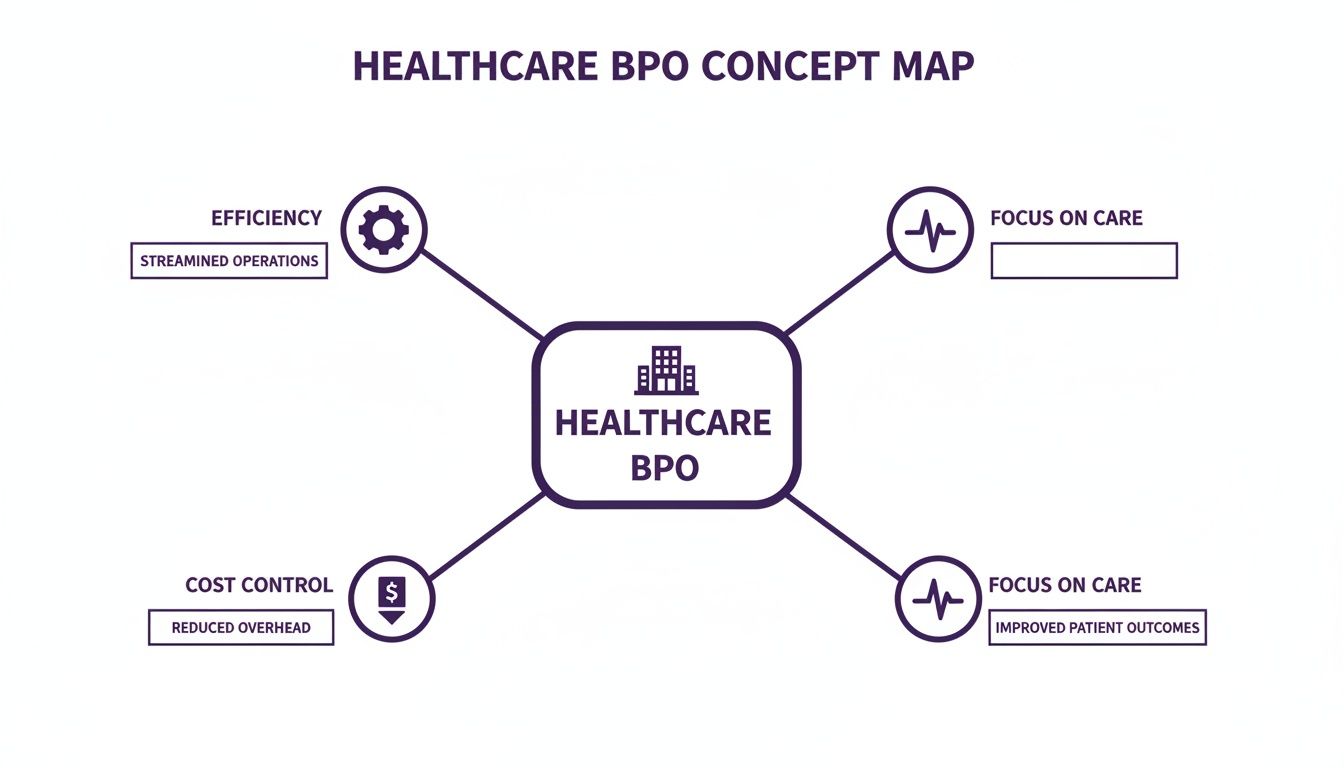
As you can see, it all boils down to three key outcomes: running a tighter ship operationally, getting costs under control, and—most importantly—shifting your team’s focus back to the patient.
Revenue Cycle Management and Medical Billing
If there’s one function that’s the lifeblood of any practice, it’s Revenue Cycle Management (RCM). Picture it as the financial circulatory system of your organization. RCM covers every single touchpoint, from the moment a patient books an appointment until their final payment clears.
One tiny mistake anywhere in that cycle—a wrong code, a missed follow-up—can trigger claim denials, stall payments, and punch a hole in your revenue. A BPO partner takes complete ownership of this cycle, making sure every step is handled with absolute precision.
- Medical Coding and Billing: This is where it all starts. Certified coders translate every diagnosis and procedure into the correct billing codes (think CPT and ICD-10). Getting this right is non-negotiable, especially when you consider that simple coding errors are behind a staggering number of claim denials. To get a better sense of how this works, take a look at our specialized outsourced medical billing services.
- Claims Submission and Follow-Up: The BPO team doesn’t just submit claims; they become bulldogs. They relentlessly track every submission and chase down every denial or rejection, saving your staff from the black hole of insurance company hold music.
- Payment Posting and Reconciliation: They meticulously post every payment and reconcile all accounts. This gives you a crystal-clear, real-time snapshot of your practice’s financial health, without any of the manual legwork.
Patient Engagement and Telehealth Support
Good BPO support goes way beyond the back office. It can also transform your front-office operations and directly shape the patient experience. We’ve all seen it: a front desk staff member juggling three ringing phones, a line of patients waiting to check in, and a mountain of paperwork.
Outsourcing key patient communication tasks gives them the breathing room they desperately need. Imagine a patient calling to reschedule an appointment. Instead of being put on hold, they are instantly connected to a friendly, professional agent from your BPO partner who efficiently finds a new time slot, updates the calendar, and sends a confirmation email—all while your in-house staff focuses on the patient standing in front of them.
“A BPO partner isn’t just a back-office support system; they are a frontline extension of your patient care team, ensuring every interaction is professional, timely, and helpful.”
This kind of support typically includes:
- Appointment Scheduling and Reminders: A dedicated team can handle all inbound scheduling calls, confirm appointments, and send out reminders. This simple service alone can significantly slash no-show rates.
- Insurance Verification: They do the critical work of pre-verifying a patient’s insurance eligibility before the visit. This prevents awkward billing surprises for the patient and ensures claims sail through processing without a hitch.
- Telehealth Technical Support: With virtual care now a permanent fixture, BPO partners can offer non-clinical tech support for patients. They help troubleshoot platform issues, ensuring appointments start on time and run smoothly.
Essential Back-Office Administrative Functions
Finally, there are the dozens of administrative tasks that are absolutely essential but also highly repetitive and time-consuming. Handing these off to a BPO partner is often the fastest path to boosting your internal team’s efficiency and morale.
- Data Entry and Management: This covers everything from updating patient demographics in your EHR to transcribing medical notes. A dedicated BPO team guarantees data is entered accurately and consistently, which is fundamental for maintaining the integrity of your patient records.
- Credentialing Support: The painfully slow process of getting physicians credentialed with insurance payers can be managed by a BPO partner. This ensures your providers can start seeing patients—and you can start billing for their services—without frustrating delays.
Before we move on, let’s quickly summarize the core differences between keeping these functions in-house versus outsourcing them.
In-House vs Outsourced Healthcare Services: A Quick Comparison
The table below breaks down the key trade-offs when deciding whether to manage administrative tasks internally or bring in a BPO partner.
| Function | In-House Management | Outsourced to BPO Partner |
|---|---|---|
| Staffing & Training | Direct hiring, onboarding, and continuous training costs. | Access to pre-trained, certified specialists. |
| Technology & Tools | Requires investment in billing software, EHR, and other platforms. | Partner brings their own best-in-class technology stack. |
| Operational Costs | Salaries, benefits, office space, and equipment overhead. | Predictable, contract-based pricing model; often lower total cost. |
| Scalability | Difficult to scale up or down quickly with patient volume changes. | Highly flexible; can easily scale services based on demand. |
| Core Focus | Administrative staff are pulled in many directions. | Allows your internal team to focus solely on patient care. |
| Compliance Risk | Internal team must stay updated on all coding and privacy rules. | BPO partner assumes responsibility for regulatory compliance. |
Ultimately, the choice depends on your organization’s specific needs, but outsourcing often provides a level of specialization and cost-efficiency that’s tough to replicate with an in-house team alone.
Why North America Is the Healthcare BPO Powerhouse
It’s no accident that North America dominates the global conversation around BPO in healthcare. The region isn’t just playing the game; it’s setting the rules, driving both adoption and innovation. This leadership is born from a perfect storm of high operational costs, sophisticated infrastructure, and intense pressure to improve patient care.
For hospitals, clinics, and health systems across the U.S. and Canada, outsourcing administrative work is no longer just a cost-cutting tactic—it’s a core strategic move. The mix of an aging population, rising rates of chronic disease, and ridiculously complex insurance systems creates an operational tornado that most in-house teams can’t handle alone. BPO partners have become essential for navigating this environment.
The numbers really drive this home.
North America holds a commanding share of the global healthcare BPO market. The worldwide market is projected to grow substantially, and the region is expected to claim a massive piece of that pie. This is all fueled by a booming pharmaceutical sector, widespread adoption of healthcare IT, and the never-ending need to get costs under control.
This data paints a clear picture: in a region where the operational stakes are this high, efficiency isn’t just a goal. It’s about survival.
The Perfect Storm of High Costs and Complex Systems
The number one reason for North America’s BPO leadership is the eye-watering cost of delivering healthcare. The U.S. and Canadian systems are a tangled mess of public and private payers, each with its own dictionary of billing codes, submission rules, and compliance demands. Trying to manage this internally is not only expensive but a recipe for mistakes.
Think about it: one tiny coding error on a claim can trigger a denial, pushing back reimbursement by weeks, if not months. Now, multiply that across thousands of patient interactions, and you’ve got a serious cash flow problem. BPO providers solve this by deploying specialized, certified teams whose entire job is to master these complexities, ensuring claims are right the first time and accelerating the revenue cycle.
This relentless focus on cost containment is where strategic partnerships really shine, especially with nearshore providers. If you’re exploring your options, understanding the benefits of nearshore outsourcing is a great way to see how geographic proximity and cultural familiarity can lead to a much stronger ROI.
Technology and Infrastructure Pouring Fuel on the Fire
North America’s advanced tech infrastructure has been a massive accelerator for BPO adoption. The wide-scale rollout of Electronic Health Record (EHR) systems and the explosion of telehealth have created both headaches and opportunities. While these innovations improve patient care, they also produce an avalanche of digital data that needs to be managed securely and efficiently.
This is where specialized BPO in healthcare truly comes into its own. BPO partners offer services that are perfectly tuned for this digital reality:
- EHR Data Management: Outsourced teams can take over data entry, records updates, and digital transcription. This keeps patient information accurate without pulling clinical staff away from their real jobs.
- Telehealth Support: With virtual care now a standard offering, BPO providers deliver the non-clinical support that makes it all work—handling appointment scheduling, patient tech support, and post-visit communications.
The COVID-19 pandemic threw these needs into the spotlight. As health systems were stretched to their absolute limits, the ability to quickly bring on administrative support through BPO became a lifeline. The crisis cemented the role of outsourcing not just for day-to-day efficiency, but for building operational resilience. It made partnering with outside experts a no-brainer.
Navigating Compliance and Security in Outsourcing
In healthcare, data security isn’t just a best practice—it’s the law. When you’re thinking about BPO in healthcare, the first question that comes to mind is always about protecting sensitive patient information. Handing over critical functions requires absolute trust, and that trust has to be built on a rock-solid foundation of compliance and security.
Partnering with an external provider doesn’t mean you lose control. It means you gain a specialist ally who knows how to navigate the complex web of regulations governing patient data. A top-tier BPO partner doesn’t just meet the standards; they build their entire operation around them, turning a potential risk into a core strength for your organization.

HIPAA: The Cornerstone of BPO in Healthcare
The Health Insurance Portability and Accountability Act (HIPAA) is the non-negotiable gold standard for protecting patient health information (PHI). Any BPO provider that even touches patient data—from billing records to appointment reminders—must operate as a HIPAA-compliant Business Associate. This isn’t a suggestion; it’s a legal requirement sealed with a signed Business Associate Agreement (BAA).
This agreement legally holds your BPO partner to the exact same data protection standards you follow. It clearly outlines their responsibility to safeguard PHI from any unauthorized access, use, or slip-ups. When you’re vetting a partner, their deep, practical understanding of HIPAA is the very first thing you need to confirm. To get a better handle on this, exploring what goes into a HIPAA-compliant call center can give you a clearer picture of the necessary safeguards.
A truly compliant partner will have multiple layers of protection baked into their process:
- Rigorous Employee Training: Every single agent and staff member must go through regular, documented training on HIPAA’s privacy and security rules.
- Secure Infrastructure: This means encrypted data storage, secure network configurations, and tightly controlled access to all systems that handle PHI.
- Strict Access Controls: Only authorized personnel should ever have access to patient data, with roles and permissions clearly defined and strictly enforced.
Mitigating Common Risks with a Proactive Strategy
While checking the compliance boxes is essential, a proactive approach to risk management is what separates an average vendor from a true strategic partner. The biggest fears in outsourcing are almost always data breaches and a feeling that you’ve lost oversight. A quality BPO provider tackles these worries head-on.
For example, a hospital might be concerned that outsourcing its billing department could expose thousands of patient records to a breach. A premier BPO partner neutralizes this risk by using end-to-end encryption for all data transfers and storing PHI on secure, access-controlled servers. They also run regular security audits and penetration tests to find and fix vulnerabilities before they can ever be exploited.
“True security in healthcare BPO isn’t just about firewalls and compliance certificates. It’s about building a culture of vigilance where every team member understands their role in protecting patient privacy.”
Building Trust Through Transparency and Accountability
Ultimately, the best way to manage risk is through a transparent partnership built on clear expectations and constant monitoring. This is where a Service Level Agreement (SLA) becomes invaluable. An ironclad SLA should spell out security protocols, data handling procedures, and exactly what happens if there’s a breach.
Look for a partner that offers:
- Transparent Reporting: You should get regular reports on key security metrics and their compliance status.
- Auditing Rights: Your organization should have the right to audit their processes and infrastructure.
- Clear Communication Channels: You need a dedicated point of contact for any security or compliance questions.
It’s critical to understand how healthcare organizations handle sensitive patient data; reviewing examples of robust privacy policies can show the kind of stringent data protection standards that BPO providers must also meet. By choosing a partner who makes these safeguards a priority, you can confidently hand off administrative functions, knowing your patients’ data is secure and your organization is compliant.
How to Choose the Right BPO Provider
Picking a BPO provider is easily the most critical decision you’ll make on your outsourcing journey. This isn’t just about handing off tasks to a vendor; it’s about choosing a long-term strategic partner who will become a genuine extension of your healthcare organization. A careful, deliberate selection process is the only way to find a partner who truly aligns with your goals, your culture, and your unwavering commitment to patient care.
The right partner brings so much more to the table than just lower labor costs. They deliver deep expertise, proven technology, and a dedicated team that strengthens your operations from the inside out. The wrong choice? Well, that can lead to compliance nightmares, frustrated patients, and a return on investment that never materializes.
Step 1: Define Your Objectives and Scope
Before you even start looking at providers, you have to look inward. What specific problems are you actually trying to solve? Vague goals like “improve efficiency” are useless. You need to get granular with your objectives.
- Reduce claim denial rate: Are you trying to slash claim denials from 15% down to 5% within the next six months?
- Decrease patient call wait times: Is the goal to get every single patient call answered within 60 seconds?
- Accelerate revenue cycle: Do you need to shrink your average accounts receivable cycle from 45 days to under 30?
Once your goals are crystal clear, define the scope of work. Are you outsourcing your entire revenue cycle, or just the initial medical coding and billing? Do you need front-office support for appointment scheduling, or just back-office data entry? A detailed scope prevents confusion down the road and ensures the proposals you get are accurate.
Step 2: Vet for Healthcare-Specific Expertise and Compliance
This is an absolute deal-breaker. A generalist BPO provider just won’t survive in the highly regulated world of healthcare. You need a partner with a proven track record in the industry and deep, demonstrable knowledge of its complexities.
When you start talking to BPO providers, applying robust IT vendor management best practices is critical for success and for covering your bases. Start by verifying their compliance credentials. Ask to see proof of HIPAA training programs, recent security audit results, and their official Business Associate Agreement (BAA). A confident, experienced provider will have this documentation ready to go and will welcome your questions.
“Choosing a BPO partner is less like hiring a contractor and more like choosing a co-pilot. Their expertise in navigation—through complex regulations and technology—is just as important as your own.”
Step 3: Assess Technology and Scalability
Your BPO partner’s tech stack should complement and enhance what you’re already using. Ask potential providers about the software platforms they run, their experience integrating with common EHR systems (like Epic, Cerner, or Allscripts), and how they use automation and AI to boost accuracy and speed. A partner worth their salt will be able to show you exactly how their technology drives measurable results, not just how it processes tasks.
Scalability is just as important. Your patient volume is going to go up and down. Can the BPO provider easily scale their team to meet your needs without service quality taking a nosedive? This flexibility is one of the core benefits of outsourcing and a key sign of a strong partnership.
Step 4: Consider the Nearshore Advantage for North American Providers
For healthcare organizations in the U.S. and Canada, a nearshore partner in a location like Tijuana offers a distinct strategic advantage. This model gives you the cost-effectiveness of outsourcing combined with the massive benefits of being geographically and culturally close.
Here’s why it’s such a powerful option for BPO in healthcare:
- Time-Zone Alignment: Working in the same or similar time zones means your partner is on your schedule. This eliminates frustrating communication delays and makes real-time collaboration feel effortless.
- Cultural Affinity: A shared cultural understanding, especially around communication styles and patient service expectations, leads to a much better experience for your patients.
- Bilingual Talent Pool: Having access to a highly skilled, bilingual workforce is a game-changer for serving diverse patient populations across North America.
Finding the right outsourcing company can feel overwhelming, but breaking it down into a structured process makes it manageable. For more guidance on evaluating potential partners, our detailed guide on how to find and vet the best call center outsourcing companies provides a helpful framework. At the end of the day, your goal is to find a partner who feels like a natural part of your team.
The Future of BPO in Healthcare
So, what’s on the horizon for Business Process Outsourcing in healthcare? The industry is gearing up for a major shift, powered by a one-two punch of explosive market growth and the integration of artificial intelligence. The push for operational efficiency is no longer just a conversation about saving a few dollars; it’s about building smarter, more resilient healthcare systems from the ground up.
This isn’t just talk—the numbers back it up. The global healthcare BPO market is expanding at an incredible rate, which tells us that hospitals and insurers everywhere are relying more and more on outsourcing to manage their crushing administrative workloads. Projections show the market is expected to grow at a compound annual growth rate of over 10% in the coming years. This boom is driven by a simple need: structured, reliable processes in a field where a small mistake can have big consequences. You can dive deeper into these market trends over at MarketsandMarkets.com.

How AI and Automation Are Game Changers for BPO in Healthcare
Artificial intelligence is already changing the rules of the game for BPO in healthcare. This isn’t some far-off concept; AI-powered tools are actively revolutionizing core administrative jobs, delivering a level of speed and accuracy we’ve never seen before.
Think about how this plays out in the real world:
- AI-Powered Medical Coding: Instead of a human manually poring over clinical notes, AI algorithms can analyze the text and suggest the right billing codes. This cuts down on human error and means fewer claim denials.
- Automated Claims Processing: All those repetitive checks—verifying claim details, making sure nothing is missing—can be handed off to automation. This frees up your team to handle the tricky, high-value exceptions that actually require a human touch.
- Intelligent Patient Scheduling: AI systems can look at appointment calendars, predict which patients might be no-shows, and send out automated reminders. The result is a more efficient clinic and a smoother flow for patients.
“The future of healthcare BPO isn’t about replacing people; it’s about augmenting their capabilities. AI handles the repetitive work, freeing human experts to solve complex problems and deliver better patient outcomes.”
This shift does more than just make things run faster. Some reports have found that health centers using AI in their BPO operations have seen a measurable reduction in staff burnout. That’s a huge win.
The Strategic Role of Nearshore Solutions
As technology makes geography less of a barrier, the right location becomes more important than ever. For North American healthcare providers, nearshore partners in places like Mexico or Central America strike the perfect balance between innovation, cost, and control.
A nearshore team operates in a similar time zone, which eliminates those late-night calls and communication lags. They share a closer cultural context and offer a highly skilled, bilingual workforce that’s ready to manage sophisticated, AI-driven workflows. This model lets you adopt new tech seamlessly while keeping the quality of patient interaction high—exactly what North American standards demand. It’s the smart way to stay ahead in an industry that’s constantly changing.
Your Top Questions About Healthcare BPO, Answered
Stepping into a partnership for BPO in healthcare always brings up a few key questions. Let’s walk through the most common ones to give you the clarity and confidence you need to move forward.
What Are the Typical Cost Savings with Healthcare BPO?
While every organization is different, most healthcare providers see significant savings, often in the range of 30% to 50% on specific administrative functions.
But this isn’t just about paying less for labor. The real savings come from a blend of powerful efficiencies:
- You’re no longer sinking capital into office space, new tech, and other infrastructure.
- The high costs of recruiting, hiring, and training administrative teams are completely off your plate.
- Processes like medical billing get a major efficiency boost, which means you get paid faster, improving your entire revenue cycle and cash flow.
How Long Does It Take to Implement a BPO Solution?
The timeline really depends on what you need. A straightforward, single-function service—like outsourcing your patient appointment scheduling—can be up and running surprisingly fast, sometimes in as little as 4 to 6 weeks.
On the other hand, a more comprehensive partnership, like transitioning your entire Revenue Cycle Management, is a much deeper undertaking. That kind of project usually takes somewhere between 3 to 6 months. It involves a careful, deep integration with your EHR system, rigorous training for the BPO team on your specific protocols, and a phased rollout designed to prevent any disruption to patient care or your bottom line.
Is Nearshore BPO Better Than Offshore for Healthcare?
For most North American healthcare organizations, the answer is a resounding yes. A nearshore partner almost always delivers a better long-term return. While some offshore options might look cheaper on paper, the real value of nearshore goes far beyond that initial price tag.
The biggest wins are time-zone alignment for seamless daily collaboration, cultural similarities that make patient communication smoother and more natural, and simpler logistics for oversight and building a strong partnership.
These factors add up to higher-quality work, tighter security, and much greater operational harmony over the long haul.
Can a BPO Partner Handle Sensitive Patient Data Securely?
Absolutely—as long as you choose a reputable, compliance-focused partner. The best healthcare BPO providers build their entire operation on a foundation of strict regulatory frameworks like HIPAA. They make huge investments in secure infrastructure, end-to-end data encryption, multi-factor authentication, and constant staff training on data privacy.
A critical part of your vetting process must be verifying their compliance certifications, digging into their security measures, and ensuring a comprehensive Business Associate Agreement (BAA) is in place. A partner you can trust won’t just meet the standards; they’ll be proud to show you how they go above and beyond to protect your patients’ data.
Ready to Reduce Admin Burden and Refocus on Patient Care?
CallZent delivers HIPAA-compliant healthcare BPO solutions designed for North American providers.
Let’s streamline your operations and protect your revenue.
Ready to streamline your operations and get your team back to focusing on what matters most—patient care? At CallZent, we provide specialized, HIPAA-compliant BPO solutions built specifically for North American healthcare providers. Let’s build a plan to solve your administrative challenges.