Skip to content

Healthcare BPO Services: The Ultimate Guide to Efficiency & Growth
Is your clinical staff drowning in paperwork instead of focusing on patients? If administrative burdens are slowing you down and squeezing your budget, it’s time to rethink your operations. The solution might be simpler than you think: a strategic partnership with a provider of healthcare BPO services.
This isn’t just about handing off tasks; it’s about integrating a specialized team that handles the complex, non-core work so your medical experts can get back to what they do best—caring for people. This guide offers actionable insights to help you understand how this partnership model can transform your practice.
TL;DR — Your Quick Guide to Healthcare BPO
- What is it? Healthcare BPO (Business Process Outsourcing) is a strategic partnership where a medical provider delegates non-clinical administrative tasks like medical billing, patient scheduling, and claims processing to a specialized third-party company.
- Why does it matter? It allows your clinical staff to focus exclusively on patient care, reduces operational costs, improves billing accuracy, and enhances the overall patient experience.
- Key Services: Core services include medical billing and coding, claims management, prior authorization, and patient support.
- Core Benefits: Partnering with a BPO provider leads to significant cost savings, effortless scalability to match patient demand, and improved revenue through increased accuracy.
- Getting Started: Choosing the right partner involves verifying their HIPAA compliance, assessing agent expertise, and evaluating their technology and quality assurance processes.
meta title: Healthcare BPO Services: The Ultimate Guide to Efficiency & Growth
meta description: Explore the key benefits of healthcare BPO services. Learn how outsourcing medical billing, patient support, and claims can cut costs and boost efficiency.
Is your clinical staff drowning in paperwork instead of focusing on patients? If administrative burdens are slowing you down and squeezing your budget, it’s time to rethink your operations. The solution might be simpler than you think: a strategic partnership with a provider of healthcare BPO services.
This isn’t just about handing off tasks; it’s about integrating a specialized team that handles the complex, non-core work so your medical experts can get back to what they do best—caring for people. This guide offers actionable insights to help you understand how this partnership model can transform your practice.
TL;DR: Your Quick Guide to Healthcare BPO
- What is it? Healthcare BPO (Business Process Outsourcing) is a strategic partnership where a medical provider delegates non-clinical administrative tasks like medical billing, patient scheduling, and claims processing to a specialized third-party company.
- Why does it matter? It allows your clinical staff to focus exclusively on patient care, reduces operational costs, improves billing accuracy, and enhances the overall patient experience.
- Key Services: Core services include medical billing and coding, claims management, prior authorization, and patient support.
- Core Benefits: Partnering with a BPO provider leads to significant cost savings, effortless scalability to match patient demand, and improved revenue through increased accuracy.
- Getting Started: Choosing the right partner involves verifying their HIPAA compliance, assessing agent expertise, and evaluating their technology and quality assurance processes.
 Why Healthcare BPO Is More Than Just Outsourcing
Imagine a clinic where doctors are 100% focused on patients, not paperwork. How do you get there when administrative pressures and operational costs keep piling up? The answer is to embrace healthcare BPO services as a core part of your strategy.
This isn’t just about offloading a few tasks. It’s about building a true partnership with a provider who acts as an extension of your own team. Think of them as your dedicated administrative wing, expertly handling everything from patient scheduling and insurance verification to the complexities of medical billing and claims processing.
Building a More Resilient Practice
The real goal of a BPO partnership is to free your highly skilled medical staff from the administrative grind that pulls them away from their mission. When nurses and doctors aren’t tied up with paperwork or stuck on the phone with insurance companies, they can deliver better, more attentive patient care. Period.
This shift empowers your clinical team to do what they do best, which naturally leads to improved patient outcomes and higher satisfaction. If you want to explore the basics further, our guide on what business process outsourcing is breaks down how this model works across different industries.
A smart partnership can reshape your operations in a few key ways:
- Enhanced Patient Focus: It gets your clinical team back to diagnosing, treating, and caring for patients.
- Streamlined Operational Efficiency: It brings in specialized processes and tech that smooth out workflows and cut down on administrative headaches.
- Improved Financial Stability: It helps stop revenue leaks caused by common problems like billing errors or slow claims management.
By strategically delegating non-clinical functions, healthcare organizations can build a more resilient, efficient, and patient-centric operation.
A Strategic Move for Growth
Ultimately, bringing on a healthcare BPO partner is a forward-thinking decision that strengthens the very foundation of your practice. Today’s healthcare world demands both clinical excellence and sharp business sense. As clinics and hospitals deal with rising costs and greater patient demands, outsourcing administrative work becomes a powerful way to stay competitive and financially sound.
It gives you instant access to a team of experts in niche areas like medical coding and compliance—all without the overhead of hiring, training, and managing them yourself. This move frees up your internal resources, both people and money, which you can then reinvest into core medical services, technology upgrades, or facility improvements. The result is a practice that not only runs more smoothly but is also perfectly positioned for sustainable growth.
The Core Services That Transform Healthcare Operations
So, what exactly can you hand off to a healthcare BPO partner? The real value clicks into place when you look at the core functions they manage. These aren’t just minor back-office tasks; they’re the complicated, time-consuming processes that make or break your practice’s financial health and daily flow.
Imagine your team no longer having to chase down insurance companies or spend hours deciphering cryptic billing codes. A specialized partner steps in to handle these essential, non-clinical jobs with the precision of a surgeon. This move frees up your medical staff to focus entirely on patient care—where they truly shine.
The industry is catching on, and fast. The global healthcare BPO market is projected to grow significantly, a clear sign that more practices are recognizing the need for operational backup.
The Role of Healthcare BPO Services in Medical Billing and Coding
Medical billing is so much more than sending out an invoice. It’s a minefield of ICD-10 and CPT codes, insurer-specific rules, and rigid compliance standards. One tiny coding mistake can trigger a costly claim denial, wrecking your cash flow and creating hours of administrative cleanup.
This is where a BPO partner proves its worth. They bring in a team of certified coders and billing specialists who live and breathe this stuff.
- Real-world Example: A busy orthopedic clinic was losing revenue due to a 15% claim denial rate, mostly from incorrect modifiers on surgical codes. After partnering with a BPO, certified coders began reviewing every claim. In just three months, their denial rate dropped to 4%, significantly boosting their revenue.
Outsourcing this function is one of the quickest ways to improve accuracy and get your staff off the phone with insurance companies. Dig deeper with our comprehensive guide on outsourcing medical billing for better revenue.
How Healthcare BPO Improves Claims Processing and Management
Getting a claim submitted is just the first step. The real work is in the follow-up—tracking its status, chasing down payments, and fighting denials or appeals. An in-house team can easily get swamped by the volume, leading to delayed payments and revenue that simply slips through the cracks.
A healthcare BPO puts a system in place for all of it. They use specialized software to monitor every single claim, pounce on rejections right away, and navigate the appeals process without missing a beat. The result is a steady, predictable revenue stream you can count on.
To better understand how these services directly help providers, here’s a quick breakdown of common outsourced tasks and the problems they solve.
Common Healthcare BPO Services and Their Impact
| Service | Core Function | Primary Benefit to Provider |
|---|---|---|
| Medical Billing & Coding | Translating procedures into billable codes (ICD-10, CPT) and submitting claims to insurers. | Reduces claim denials, accelerates payment cycles, and maximizes revenue. |
| Claims Management | Tracking submitted claims, following up on unpaid invoices, and managing appeals for denied claims. | Frees up administrative staff, improves cash flow, and recovers lost revenue. |
| Prior Authorization | Obtaining pre-approval from insurance companies for procedures, tests, and medications. | Prevents treatment delays, avoids claim rejections, and improves patient satisfaction. |
| Patient Support | Handling appointment scheduling, reminders, billing inquiries, and general patient questions via phone or chat. | Reduces no-show rates, enhances the patient experience, and lightens the front-desk workload. |
| Revenue Cycle Management | Overseeing the entire financial process from patient registration to final payment collection. | Provides a holistic view of financial health, identifies bottlenecks, and optimizes profitability. |
These services work together to create a seamless operational backbone, ensuring the financial side of your practice runs as smoothly as the clinical side.
Prior Authorization and Insurance Verification
There are few things more frustrating than spending an hour on hold with an insurance company just to get a procedure authorized or to verify a new patient’s coverage. These delays don’t just eat up staff time; they can postpone critical patient care.
A BPO partner takes this headache away completely. Their agents are pros at navigating insurer phone trees and getting answers quickly.
Think of your BPO partner as a dedicated liaison. They cut through the red tape with insurance companies to get approvals and verify benefits fast, so you can prevent treatment delays and your patients can avoid billing surprises.
Patient Scheduling and Support
A patient’s experience starts long before they walk in the door. The way their initial call is handled—whether for scheduling, asking a question, or getting a reminder—sets the entire tone. A BPO provides professional, empathetic agents who can manage these crucial first impressions, often 24/7.
Take a nearshore partner like CallZent, for example. Located in Tijuana, we offer fully bilingual support, making sure both English and Spanish-speaking patients get clear, compassionate help. This does more than just boost satisfaction; it actively reduces no-show rates with proactive reminder calls and messages.
Ultimately, these core services aren’t just about offloading work. They’re about building a more efficient, financially stable, and patient-focused healthcare operation from the ground up.
Navigating HIPAA Compliance and Data Security in Healthcare BPO Services
Handing over patient data is a huge deal. At the end of the day, it all boils down to trust. In the world of healthcare BPO services, the Health Insurance Portability and Accountability Act (HIPAA) isn’t just a suggestion—it’s the absolute bedrock of any reliable partnership. Protecting Patient Health Information (PHI) is completely non-negotiable.
This isn’t about just checking a box or hanging a certificate on the wall. Real compliance is woven into every single part of a BPO provider’s operations, from the tech they use to the people they hire. It demands an active, vigilant approach to data security that goes way beyond basic password rules.
The Anatomy of a Secure BPO Partner
So, what does genuine HIPAA compliance actually look like in practice? It’s a multi-layered defense system built to protect sensitive data at every touchpoint. A partner you can trust doesn’t just promise security; they show it through concrete actions and solid infrastructure.
Here are the essential safeguards you should expect from any BPO provider handling your patient data:
- Secure Physical and Digital Infrastructure: This means access-controlled data centers, end-to-end encrypted communication channels, and secure networks designed to keep unauthorized eyes out.
- Rigorous and Continuous Agent Training: Agents need initial and ongoing training on HIPAA privacy rules, data handling protocols, and how to spot and report potential security threats.
- Strict Access Controls: Not everyone needs to see all patient information. A secure BPO ensures agents can only view the specific data required to do their job—and nothing more.
A BPO’s commitment to data security should be evident in its culture, not just its compliance documents. It’s about instilling a ‘security-first’ mindset in every agent and every process, making data protection an instinctual part of the job.
More Than Just a Legal Requirement
Let’s be clear: compliance isn’t just about avoiding hefty fines. It’s about protecting your patients’ trust and your practice’s reputation, both of which can be shattered by a single data breach. This is why a top-tier BPO partner integrates security into its very DNA, from the background checks they run on new hires to the technology stack that powers their services.
This chart shows how different BPO services fall under the wider umbrella of Revenue Cycle Management, each demanding its own strict data security measures.
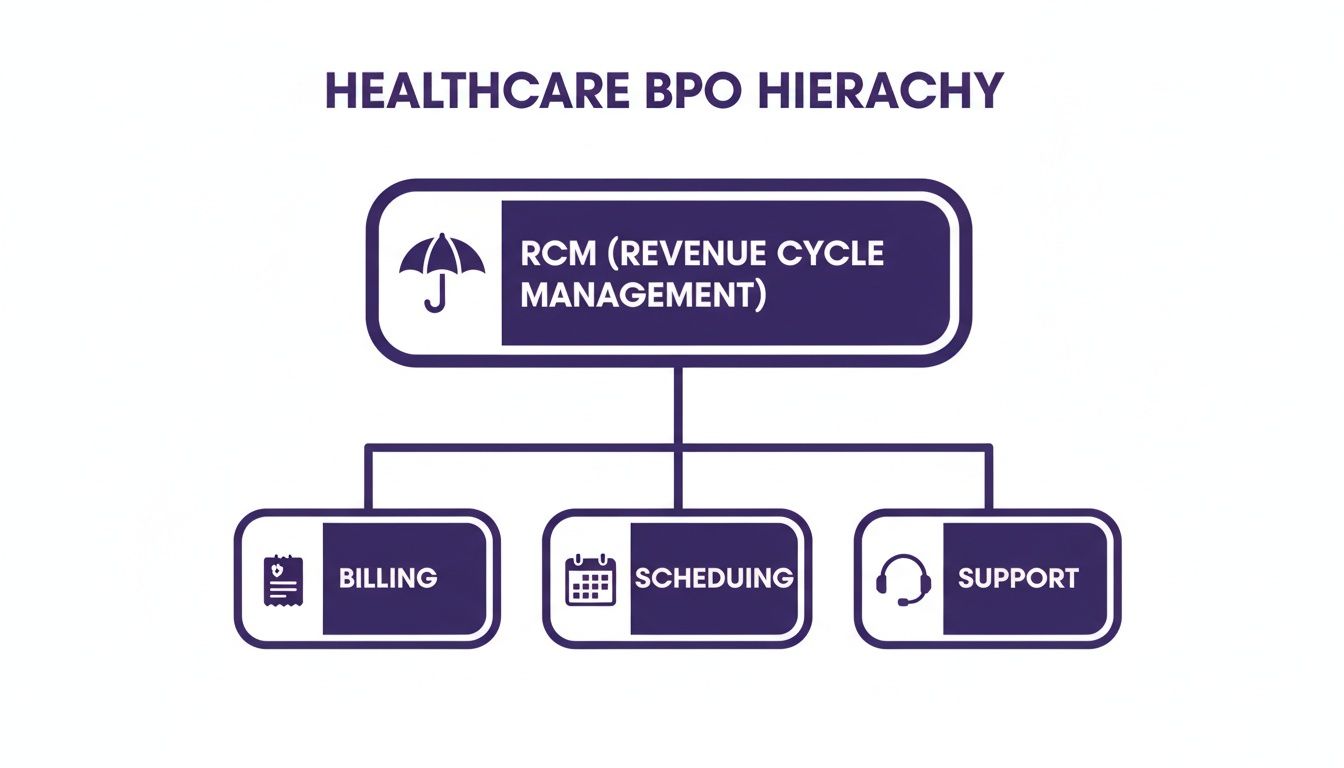
As you can see, core functions like billing and patient support are all connected. A security slip-up in one area can easily put another at risk.
For BPO providers that serve diverse patient populations, offering robust medical document translation solutions is often a critical service. These offerings also fall under strict data privacy rules, requiring the secure handling of sensitive medical records across different languages. You can learn more about how a dedicated partner becomes a fully HIPAA-compliant call center in our detailed guide.
Ultimately, choosing a BPO is an investment in a secure extension of your own practice. Their commitment to protecting patient data must be just as unwavering as yours.
 The Strategic Benefits of a Healthcare BPO Partnership
Now that we’ve walked through the core services, let’s get to the real question: why should you partner with a healthcare BPO services provider? The answer goes way beyond just getting tasks off your plate. It’s about making a strategic move that fundamentally changes how you manage resources, grow your practice, and care for patients.
This isn’t just a niche strategy anymore; it’s becoming a pillar of modern healthcare operations. The market for these services is growing at an incredible rate, a clear signal that healthcare leaders see BPO as an essential tool for thriving in a complex industry.
Significant Cost Reduction
Let’s start with the most immediate win: a major drop in your operational costs. Hiring an in-house administrative team brings a mountain of expenses that go far beyond what you see on a paycheck.
Think about all the hidden costs tied to just one employee:
- Recruiting and Hiring: The time and money poured into job ads, interviews, and onboarding.
- Training: The resources needed to get someone up to speed on complex medical codes and your specific software.
- Salaries and Benefits: Competitive pay, health insurance, retirement plans, and paid time off all add up.
- Infrastructure: The ongoing cost of office space, computers, phones, and software licenses.
A BPO partner wipes these overheads off your books. You get a fully trained, equipped, and managed team for one predictable fee, turning a hefty capital expense into a simple, manageable operational cost.
Effortless Scalability and Flexibility
Patient demand is anything but predictable. Your volume can swing wildly depending on the season, local health trends, or even the time of day. Trying to scale an in-house team to match these ups and downs is an HR headache, often leaving you overstaffed in slow times or with a burned-out team during busy periods.
A BPO partnership gives you an elastic workforce. You can instantly scale your support up or down to meet real-time demand, ensuring you’re always staffed perfectly without the administrative friction of hiring or layoffs.
Real-world Example: Imagine it’s flu season and your call volume doubles overnight. With a BPO, you simply adjust your service level agreement to add more agents. When things quiet down, you scale it right back. This agility means you only pay for the support you actually need, exactly when you need it.
Improved Revenue Through Accuracy
Mistakes in medical billing and coding don’t just create headaches—they directly hit your revenue. A single coding error can trigger a denied claim, which then requires hours of administrative work to fix and resubmit, assuming it even gets caught. Over time, these small leaks become a major financial drain.
Specialized BPO teams are obsessed with accuracy. Their agents are rigorously trained on the latest coding standards and payer rules, and their work is typically double-checked through multi-layered quality assurance. By getting it right the first time, they directly boost your bottom line.
- Fewer Claim Denials: Clean claims get approved faster, accelerating your cash flow.
- Maximized Reimbursements: Proper coding ensures you get paid the full amount you’re owed.
- Reduced Administrative Rework: Your staff spends less time chasing payments and more time on patient-facing activities.
A skilled partner also delivers the back-office support for your nearshore BPO operations, making sure every administrative gear turns smoothly.
The Nearshore Bilingual Advantage
For any provider serving a diverse community, clear communication is non-negotiable. This is where a nearshore partner in a location like Tijuana offers a powerful, unique edge: a culturally aligned, bilingual talent pool.
This isn’t just about speaking Spanish. It’s about understanding the cultural nuances that build trust and lead to better patient outcomes. When a patient can discuss a confusing bill or schedule a sensitive appointment in their native language with an agent who understands the context, their entire experience is transformed. This turns patient support from a basic function into a true competitive advantage, fostering loyalty and ensuring everyone is on the same page.
How to Choose the Right Healthcare BPO Partner
Choosing a partner to handle critical administrative functions—and your sensitive patient data—is one of the most important decisions you’ll make. The right provider feels like a seamless extension of your team. The wrong one can create a nightmare of compliance risks and operational headaches.
This isn’t a decision you can rush or base on a simple price comparison. To find a true partner, you need a framework to see past the sales pitch and really understand their capabilities. It’s all about digging into their compliance, agent training, and tech stack to find a BPO that truly aligns with your practice’s goals.
Verifying Compliance and Certifications
Before you even think about services or pricing, your very first step is to confirm a potential partner’s commitment to data security. HIPAA compliance is the absolute bare minimum. A truly reliable provider will go much further, holding certifications that prove their dedication to rock-solid security protocols.
When you’re vetting a provider, ask for proof of their credentials.
- HIPAA Certification: Don’t just take their word for it. Request documentation of their HIPAA audits and risk assessments. Ask them to walk you through how they train agents on protecting Patient Health Information (PHI).
- SOC 2 Certification: This audit is a big deal. It reports on how an organization handles sensitive information, covering security, availability, processing integrity, confidentiality, and privacy.
- ISO 27001 Certification: This is a leading international standard for information security management, showing they have a formal, risk-based approach to keeping data safe.
A hesitant or vague answer to these questions is a massive red flag. A partner you can trust will be proud to share their credentials and explain their security measures. If you need more guidance on due diligence, our article on how to find and vet the best call center outsourcing companies offers some great tips.
Assessing Agent Training and Expertise
The quality of any healthcare BPO service ultimately comes down to the people doing the work. A partner’s agents can’t just be generic call handlers; they need to be fluent in the specific language and complexities of the healthcare world. This is where you need to scrutinize their training program.
Don’t just ask if they train their agents. Ask how they train them. A great partner invests in continuous education on medical terminology, insurance payer rules, and empathy for patient interactions.
Look for a provider that can show you a structured, ongoing training curriculum. A one-and-done onboarding session just doesn’t cut it. The best partners provide regular coaching on changing regulations, new medical codes, and best practices for patient communication. This ensures the agents handling your accounts are always sharp, accurate, and professional.
Evaluating Technology and Quality Assurance
A BPO’s technology stack and quality assurance (QA) processes are the engine and the safety net of their entire operation. Their systems have to integrate smoothly with yours, and their QA program must be designed to catch errors before they ever impact your revenue or your patients.
Get specific with your questions. How do they monitor agent performance? What’s their process for auditing medical coding or claim submissions? A solid partner will have a multi-layered QA system that includes both automated checks and human review to guarantee the highest level of accuracy. They should be able to hand you clear metrics on their performance and error rates, proving their commitment to transparency and constant improvement. That level of detail is what separates the top-tier providers from everyone else.
A structured checklist can make this evaluation process much smoother. It ensures you cover all the critical areas and can compare potential partners apples-to-apples.
Vendor Evaluation Checklist for Healthcare BPO Services
| Evaluation Criteria | Key Questions to Ask | Red Flags to Watch For |
|---|---|---|
| Compliance & Security | Can you provide documentation for your HIPAA, SOC 2, and ISO 27001 certifications? How do you conduct risk assessments and train staff on PHI? | Hesitation to share certifications. Vague answers on training protocols. Lack of a dedicated compliance officer. |
| Industry Expertise | What is your experience with our specific medical specialty? Can you provide case studies or references from similar healthcare providers? | Generic experience across many industries with no healthcare focus. Inability to discuss specific payer rules or coding challenges. |
| Agent Training | What does your agent onboarding and continuous training curriculum look like? How do you ensure agents are up-to-date on regulatory changes? | A one-time training program. No ongoing education or performance coaching. High agent turnover rates. |
| Technology & Integration | What platforms do you use? How will your systems integrate with our EMR/EHR and billing software? What is your disaster recovery plan? | Outdated technology. Inability to demonstrate successful integration with common healthcare systems. No clear business continuity plan. |
| Quality Assurance | What is your QA process for tasks like coding and claims? What are your current accuracy and error rates? How is feedback provided to agents? | No documented QA process. Unwillingness to share performance metrics. Reliance on self-auditing only. |
| Communication & Reporting | Who will be our main point of contact? What kind of performance reports will we receive, and how often? How are escalations handled? | No dedicated account manager. Generic, infrequent reporting. A confusing or slow escalation path. |
| Scalability & Flexibility | How do you handle fluctuations in volume? What is the process for scaling services up or down as our needs change? | Rigid contract terms. Long lead times for adding or removing staff. Difficulty handling seasonal peaks. |
Using a checklist like this helps you move beyond the marketing materials and get a clear picture of a vendor’s true capabilities. It’s the best way to ensure you’re choosing a partner that will protect your practice and help it thrive.
Frequently Asked Questions About Healthcare BPO Services
Making the leap to a healthcare BPO services provider is a big decision. It’s totally normal to have questions about how it all works, what you should expect, and how the partnership will really affect your practice. We’ve pulled together some of the most common questions we hear from healthcare leaders to give you clear, straight-up answers.
The goal here is to pull back the curtain on the process. This is all about making sure you have the confidence and understanding to choose a partner that clicks with your operational needs and patient care philosophy.
What Does the Implementation Process Look Like?
Jumping in with a new BPO partner can sound like a huge undertaking, but a good provider makes the transition smooth and predictable. It’s never about just flipping a switch; it’s a collaborative, step-by-step process designed to cause as little disruption as possible.
The whole thing usually kicks off with a deep-dive discovery phase to get everything right from the start.
- Discovery and Scoping: First, we sit down with your team to map out your current workflows. We want to know what’s working, what isn’t, and what your ultimate goals are. This isn’t a cookie-cutter exercise—it’s about tailoring a solution that fits your practice perfectly.
- Customization and Training: With that info, we customize our training playbooks and hand-pick the right agents for you. They don’t just get generic training; they learn your specific protocols, your software, and your unique style of patient communication.
- Systems Integration: Our tech crew works hand-in-hand with yours to make sure our platforms talk to your EMR/EHR and billing systems without a hitch. The goal is a secure, seamless flow of information.
- Pilot Program: We almost always start with a small, controlled pilot program. This lets us monitor performance, get your feedback, and tweak anything that needs it in a low-risk setting before we go big.
This careful approach means that by the time we’re fully live, the system is already humming along, and your team feels great about the new partnership.
How Do You Guarantee Quality and Accuracy?
When it comes to things like medical billing and coding, “close enough” doesn’t cut it. Accuracy is everything. One little mistake can trigger a claim denial, hold up payments, and create a headache for patients. That’s why quality assurance (QA) isn’t just a final check—it’s woven into everything we do, every single day.
Quality isn’t an accident. It’s the result of a multi-layered system built on rigorous training, smart technology, and constant human oversight. It’s designed to catch and fix issues long before they ever affect your practice.
Our approach to QA stands on a few key pillars:
- Initial and Ongoing Training: It all starts with intensive training on medical terminology, your specific rules, and all the compliance standards. But it doesn’t stop there. We provide continuous education to keep our team sharp and up-to-date on any regulatory changes.
- Technology-Assisted Review: We use automated tools to flag potential slip-ups, like a wrong code or missing info. These get sent straight to a human for review, adding an extra layer of protection.
- Dedicated QA Audits: We have a specialized QA team that constantly audits work samples from every agent. They provide one-on-one coaching and feedback to help everyone keep getting better.
- Performance Tracking: We’re obsessed with the numbers. We track Key Performance Indicators (KPIs) like First Pass Resolution Rate and Claim Denial Rate to see exactly where we’re knocking it out of the park and where we can improve.
Are There Hidden Costs I Should Know About?
Let’s be honest, a big reason to outsource is to save money, so nobody wants surprise fees. A trustworthy BPO partner will be completely upfront about costs. The real value is in cutting the overhead you’d normally spend on salaries, benefits, office space, and tech for a full in-house team.
When you’re looking at providers, always ask for a simple breakdown of their pricing model—it’s usually either per-agent-per-hour or per-transaction. A good partner will give you a detailed service agreement spelling everything out. Make sure you ask about one-time setup fees, software licensing, or any charges for going over certain volumes. Clear, predictable pricing is the sign of a partner who’s in it for the long haul.
How Does a Nearshore Partner Improve Patient Communication?
Going with a nearshore partner brings some powerful advantages that you can feel directly in the patient experience, especially if you serve diverse communities in North America. The perks go way beyond cost and get right to the heart of cultural and geographical alignment.
For starters, being in a similar time zone means no communication lag. When your team needs to sync up with ours, it happens in real-time. It feels less like an outsourced service and more like an extension of your own office down the hall.
Even more important is the cultural connection. It leads to more natural, empathetic conversations with patients. Our agents get the nuances of North American communication, which helps build genuine rapport and trust.
And finally, our bilingual capability is a total game-changer. Offering fluent, culturally-aware support in both English and Spanish means every single patient feels heard and respected. It breaks down language barriers, cuts down on confusion, and ultimately leads to happier, more loyal patients.
More FAQs Healthcare Leaders Ask Before Outsourcing
1. What types of healthcare providers use BPO services?
Healthcare BPO services are used by hospitals, private practices, urgent care centers, specialty clinics, medical billing companies, and multi-location healthcare groups. Any organization with heavy administrative load or revenue cycle complexity can benefit.
2. Are healthcare BPO services HIPAA compliant?
Yes—reputable providers are fully HIPAA compliant and implement strict safeguards such as encrypted systems, controlled access, agent training, and regular audits to protect patient health information (PHI).
3. Can a healthcare BPO integrate with my EHR or billing system?
A qualified BPO partner should integrate with your existing EHR/EMR and billing platforms through secure workflows, access controls, and process mapping during onboarding.
4. Will outsourcing negatively impact the patient experience?
When done correctly, it improves it. Patients get faster response times, clearer billing communication, proactive scheduling, and more consistent support—especially with bilingual coverage.
5. How quickly can we implement healthcare BPO services?
Most programs go live in 2–6 weeks depending on scope, integrations, training, and compliance requirements. Many teams start with a pilot to validate quality before scaling.
6. Is healthcare BPO only for large organizations?
No. Small and mid-sized practices often see major results because BPO services provide specialized expertise without the overhead of hiring and retaining a full admin team.
7. How does BPO reduce costs if we still pay for service?
BPO replaces multiple cost centers—recruiting, salaries, benefits, training, office space, and software—while also improving billing accuracy and speeding up collections.
8. Can a BPO team support bilingual patient communication?
Yes. Nearshore teams like CallZent can provide bilingual English–Spanish support that is culturally aligned, empathetic, and easier for patients to understand—especially for billing or scheduling.
9. How is quality monitored in a healthcare BPO partnership?
Quality is typically managed through a layered QA program: call monitoring, workflow audits, billing accuracy checks, performance scorecards, coaching, and KPI reporting.
10. What should I look for when choosing a healthcare BPO partner?
Prioritize HIPAA compliance, healthcare-specific experience, bilingual capabilities, strong QA processes, scalable staffing, transparent pricing, and documented proof of results.
Ready to Strengthen Your Practice with Healthcare BPO Services?
If administrative work is pulling focus away from patient care, it’s time for a smarter model. CallZent delivers HIPAA-compliant, bilingual nearshore healthcare support from Tijuana—built to reduce costs, improve efficiency, and elevate the patient experience.
Schedule a Call with CallZent →
Discover our healthcare BPO services today.
Ready to see how a strategic BPO partnership can strengthen your practice? CallZent provides custom-fit, bilingual healthcare support solutions from our nearshore location in Tijuana, helping you reduce costs while enhancing patient care.