Skip to content
Customer Support Technology
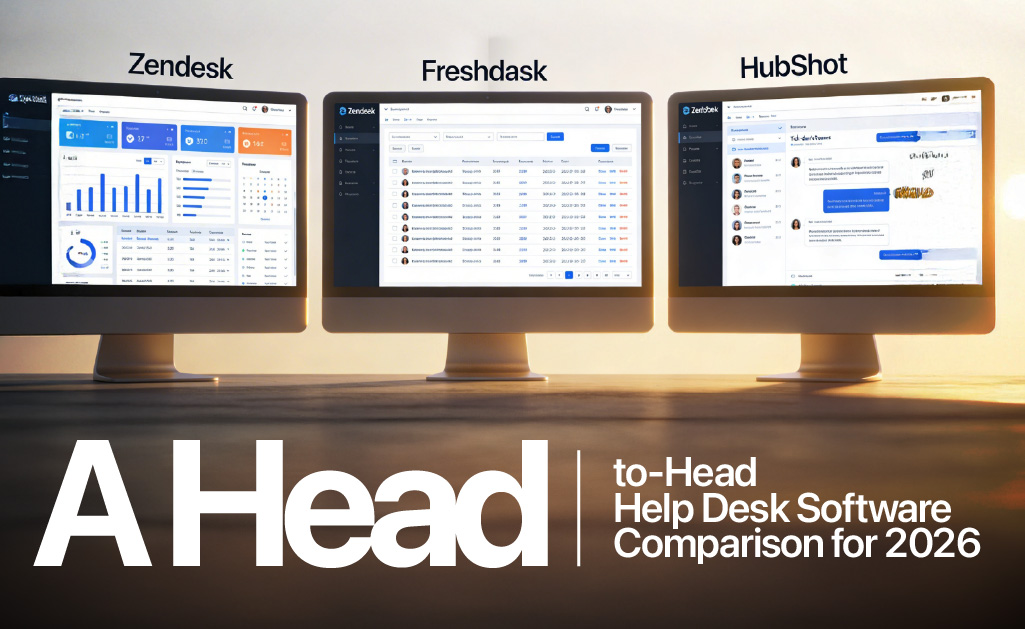
Help Desk Software Comparison: Zendesk vs Freshdesk vs HubSpot
A detailed help desk software comparison of Zendesk, Freshdesk, HubSpot, Zoho Desk, and Gorgias to help you choose the best platform for your business.
TL;DR — Quick Takeaways
- Zendesk: Best for enterprises needing advanced customization and scalability.
- Freshdesk: Ideal for SMBs seeking simplicity and fast deployment.
- HubSpot Service Hub: Perfect for companies aligning support with CRM, sales, and marketing.
- Zoho Desk & Gorgias: Strong niche solutions for Zoho users and e-commerce brands.
Is your current customer support software actually keeping up with modern demands? The real challenge in any help desk software comparison is cutting through the marketing fluff to find a platform that truly empowers your agents, plays nice with your existing tools, and scales as you grow. This single decision has a massive impact on customer satisfaction and operational efficiency, especially when you pair it with the right BPO partner.
Why Your Help Desk Software Comparison Matters
Let’s be clear: selecting help desk software is far more than an IT decision—it’s a cornerstone of your business strategy. With customer expectations higher than ever, the platform you choose directly defines your ability to deliver fast, effective, and personalized support.
A modern help desk should be the central nervous system for all customer interactions. It organizes tickets, automates repetitive tasks, and gives your team the context they need to solve problems on the first try. For example, without the right tool, your agents are stuck toggling between disconnected systems to check a customer’s order history and their previous support tickets, inevitably leading to slower response times and frustrated customers.
Your help desk software isn’t just for logging tickets—it’s the engine that powers your entire customer service operation.
Core Goals of This Help Desk Software Comparison Guide
This guide is designed to give you a clear path forward. Our detailed help desk software comparison zeroes in on what actually matters for growing businesses. We’re moving beyond simple feature lists to give you actionable insights based on criteria that drive real-world results.
Here are the key questions we’ll be asking:
- Improving Agent Efficiency: How does the software help agents resolve tickets faster and with less grunt work?
- Enhancing Customer Experience: Does the platform offer seamless, omnichannel communication that meets customers where they already are?
- Providing Actionable Insights: What kind of analytics and reporting are available to help you understand performance and spot trends before they become problems?
- Ensuring Scalability: Will the software grow with your business, or will you be facing a costly and disruptive migration in a year or two?
For a closer look at the day-to-day headaches a great platform can solve, check out our guide on common IT help desk problems and their solutions.
Your Framework for an Effective Help Desk Software Comparison
To make a smart help desk software comparison, you first need a solid evaluation framework. Just looking at feature lists won’t tell you which platform will actually solve your business problems. Instead, the real trick is to focus on the core capabilities that directly impact your team’s performance and your customers’ happiness.
Think of this as building a scorecard. Every platform you review should be measured against the same critical criteria—criteria that are tailored to your specific operational needs. This is how you ensure your final decision is based on a clear, apples-to-apples assessment rather than flashy but irrelevant features.
Start with the Essentials: Core Features to Compare
Before you get wowed by advanced functionalities, make sure any potential software nails the fundamentals. These are the non-negotiable pillars of any effective help desk.
- Ticketing Management: How does the system capture, organize, and prioritize customer requests? Look for intuitive workflows that make it easy for agents to track, assign, and resolve tickets without getting lost in a confusing interface.
- Omnichannel Capabilities: Can you manage communications from email, live chat, phone, and social media in one unified dashboard? Customers expect to connect on their preferred channel, and your software has to support this without creating frustrating data silos.
- Knowledge Base Management: Does the platform offer a user-friendly way to create, organize, and update self-service articles? A practical example is a software company creating a self-help guide for a common error, deflecting hundreds of tickets and freeing up agents for more complex issues.
Evaluate Scalability and Integrations
Your help desk software has to fit your business today, but it also needs to support your growth tomorrow. A platform that feels perfect for a team of five can quickly become a bottleneck for a team of twenty.
Scalability isn’t just about handling more tickets; it’s about maintaining performance and adding functionality as your needs evolve. Be sure to ask vendors how their pricing and feature tiers accommodate growth.
A help desk that doesn’t integrate with your CRM is a recipe for inefficiency. Agents waste time switching tabs and manually transferring data, creating a disjointed experience for everyone.
Seamless integration is another deal-breaker. The software must connect effortlessly with your Customer Relationship Management (CRM) system, e-commerce platform, and other business-critical tools. This creates a single source of truth and gives agents the full context they need to deliver truly personalized support.
Assess Analytics and Future-Proofing
The modern help desk is a goldmine of business intelligence. A key part of your help desk software comparison is evaluating the depth of its reporting. You need dashboards that help you track crucial metrics and improve operations. To dive deeper, check out our guide on the most important KPIs in customer service.
The industry is also shifting rapidly. Today, 86% of service units are facing unprecedentedly high customer demands, forcing 63% of IT leaders to prioritize modernization. AI-powered tools are now capable of deflecting 35% of support tickets on average, and self-service portals are the fastest-growing segment. Your chosen software must have a clear roadmap that includes AI-driven automation and advanced self-service options. You can discover more insights about these help desk industry trends on wifitalents.com.
An In-Depth Help Desk Software Comparison: Zendesk vs Freshdesk vs HubSpot
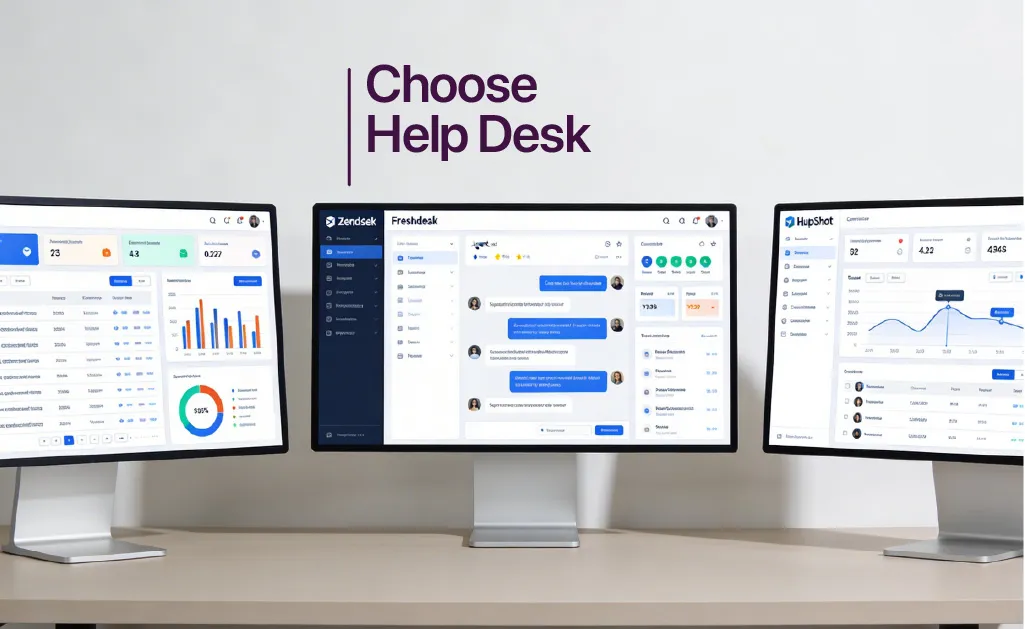
Choosing a help desk solution goes way beyond a simple feature checklist. The real decision comes down to understanding the core philosophy behind each platform and figuring out which one actually clicks with your business model. Here, we’ll get past the marketing fluff and give you a real-world, side-by-side breakdown of three industry heavyweights: Zendesk, Freshdesk, and HubSpot Service Hub.
We’re going to dissect each one based on its sweet spot, what it’s like for your agents to use day-in and day-out, and where it fits strategically. This isn’t about finding a single “best” platform—it’s about helping you find the one that’s best for you.
Zendesk: The Enterprise Powerhouse
Zendesk has been a dominant name in customer service for ages, and for good reason. It’s a seriously powerful and flexible platform built for organizations with complex, high-volume support needs that demand deep customization. Think of Zendesk as a professional-grade workshop for a master craftsman—it can do just about anything, as long as you have the expertise to set it all up.
The platform’s biggest flex is its scalability and its gigantic app marketplace, which has over 1,000 integrations. This lets large teams build a completely custom support system that fits their unique workflows like a glove.
For example, a global retail brand could integrate Zendesk with its inventory management system, logistics providers, and local payment gateways. When a customer ticket comes in, the agent sees a full, unified picture of that customer’s order history and shipping status—all without ever leaving the Zendesk dashboard. This is where Zendesk’s enterprise muscle really shines.
Zendesk is made for complexity. It thrives in environments where custom workflows, tons of integrations, and tight control over the support process are absolute must-haves.
But all that power comes with a steeper learning curve and a higher price tag. Smaller teams or businesses without a dedicated IT person might find the setup and ongoing management to be overkill.
Freshdesk: The SMB Champion
Freshdesk jumps into the help desk software comparison as the approachable, user-friendly champion. Its entire philosophy revolves around simplicity and delivering solid value right out of the box. While Zendesk gives you a sprawling set of tools, Freshdesk provides a curated feature set that’s intuitive and easy for agents to pick up fast.
This makes it a fantastic pick for small to medium-sized businesses (SMBs) and startups that need a capable help desk without the enterprise-level headaches. The interface is clean, modern, and requires almost no training, letting teams get up and running in a matter of hours, not weeks.
Imagine a growing SaaS company with a ten-person support team. They need reliable ticketing, a good knowledge base, and some basic automation to handle common questions. Freshdesk gives them all of that in an affordable package, complete with its popular “Freddy AI” to help automate ticket routing and suggest relevant articles. The team can spend their time actually helping customers, not fighting with the software.
HubSpot Service Hub: The All-In-One Growth Engine
HubSpot Service Hub plays a completely different game. It’s not just a help desk; it’s a fully integrated piece of a much larger ecosystem that includes marketing, sales, and a world-class CRM. This makes it the clear winner for businesses that want a single source of truth for the entire customer journey.
HubSpot’s main advantage is the effortless flow of data between departments. A support agent working on a ticket can instantly see if the customer just downloaded a marketing guide, talked to a sales rep last week, or is a high-value client. This 360-degree view of the customer is incredibly powerful for delivering support that’s personal and context-aware.
For instance, an e-commerce store using the full HubSpot platform can create automated workflows from customer actions. If a VIP customer submits a negative feedback survey in Service Hub, it can automatically create a task for their account manager in Sales Hub and enroll them in a special re-engagement email sequence in Marketing Hub. This kind of cross-team automation is where HubSpot truly stands apart. For those looking at different ways to set up their support, our guide on SaaS help desk solutions provides a look into the future of smarter support.
The catch? If you’re not already bought into the HubSpot ecosystem, Service Hub might feel a bit less powerful as a standalone tool compared to specialists like Zendesk or Freshdesk. Its real strength is unlocked when it works together with the rest of the HubSpot platform.
Feature and Use Case Comparison: Zendesk vs Freshdesk vs HubSpot
To make the choice clearer, let’s put these three platforms head-to-head. The right tool often depends less on a single feature and more on how the entire package aligns with your team’s size, goals, and existing software stack.
| Criterion | Zendesk | Freshdesk | HubSpot Service Hub |
|---|---|---|---|
| Ideal Business Size | Enterprise & Large SMBs | Startups & SMBs | Businesses of all sizes using the HubSpot CRM |
| Core Strength | Unmatched customization and scalability | Intuitive UI and fast time-to-value | Seamless integration with marketing and sales |
| Agent Experience | Powerful but can be complex | Simple, clean, and easy to learn | Unified within the HubSpot CRM interface |
| Best Use Case | A financial firm needing advanced security and audit logs. | A tech startup needing a quick, effective tool. | A B2B company aligning support with sales and marketing. |
| Pricing Model | Higher-tier, per-agent pricing | Freemium and affordable per-agent plans | Freemium tier; priciest in higher-tier bundles |
Ultimately, Zendesk is for those who need to build a support fortress, Freshdesk is for those who need to get a great help desk running today, and HubSpot is for those who want their support team to be an integral part of their growth engine.
Comparing Emerging Contenders: A Help Desk Software Comparison of Niche Players
While the industry giants usually grab the headlines, some of the most interesting action in the help desk world is happening in specialized corners of the market. This section of our help desk software comparison dives into two of those players: Zoho Desk and Gorgias. Each has built a powerful identity by solving very specific business problems, often better than a general-purpose tool ever could.
Zoho Desk: The All-In-One Value Player
For any business that’s already using Zoho’s wide array of applications—like Zoho CRM, Books, or Projects—Zoho Desk is a no-brainer. Its biggest advantage is the deep, native integration it shares with the rest of the ecosystem. This creates a single, unified command center where customer data flows seamlessly between your support, sales, and finance teams.
Think about it. A B2B client opens a ticket about a billing issue. With Zoho Desk, your agent instantly sees the client’s entire history pulled from Zoho CRM—their contract value, recent sales calls, and more. They can also pull up the exact invoice from Zoho Books and tag someone from the finance team, all without ever leaving the help desk screen.
Zoho Desk’s real power isn’t just a list of features—it’s the deep, contextual intelligence it gets from being part of a larger, interconnected business operating system.
The demand for these kinds of tools has skyrocketed. The global help desk software market has seen huge growth, with cloud solutions now making up over 65% of the market. SMEs are a driving force, with an expected adoption increase of 18% CAGR. Since 2020, overall adoption has jumped by 103%, and 54% of companies are now investing more in ticket automation to build smarter, more efficient support teams. For a deeper look, you can find more on the growth of the help desk market on skyquestt.com.
Gorgias: The E-commerce Specialist
Where Zoho Desk casts a wide net, Gorgias is hyper-focused on one vertical: e-commerce. It was built from the ground up to be the ultimate customer service hub for brands on Shopify, BigCommerce, and Magento (now Adobe Commerce). That specialization is its secret weapon.
Gorgias doesn’t just integrate with these platforms; it practically becomes part of them. When an agent opens a ticket, they see a full customer profile with their entire order history, shipping status, and even loyalty points right inside the help desk.
Here’s a practical example of Gorgias in action:
- A customer emails, “Where is my order?”
- In Gorgias, the agent sees the ticket appear next to the customer’s recent Shopify order details.
- Without switching tabs, the agent can check the tracking number, see the delivery status, and even issue a partial refund or generate a discount code for their next purchase.
This tight integration allows agents to handle dozens of e-commerce-specific tasks directly from the ticket view. The efficiency gains are massive, dramatically cutting down response times and letting agents solve problems in one touch.

Who Should Choose Which Platform
Picking the right tool between these two really comes down to your core business model and the tech you already use.
-
Choose Zoho Desk if: You’re already bought into the Zoho ecosystem (or plan to be). Your main goal is getting a 360-degree customer view that connects sales, marketing, and support, all while keeping costs down.
-
Choose Gorgias if: You run an e-commerce business on Shopify, BigCommerce, or Magento. Your number one priority is speed, and you need to empower your agents to resolve shipping, order, and refund questions as fast as humanly possible.
Ultimately, this help desk software comparison shines a light on a major trend: the best tool is often the one that was built with a specific user in mind. Zoho Desk wins on unified business intelligence, while Gorgias dominates with its laser focus on e-commerce efficiency.
How to Find the Best Help Desk for Your Industry
The perfect help desk software isn’t a one-size-fits-all solution. It’s a specialized tool that has to fit your industry’s specific rules, customer habits, and day-to-day realities. A generic help desk software comparison often glosses over the fine print that makes a platform a perfect fit for one business but a total headache for another. The real secret is matching features directly to your unique challenges.
Healthcare: HIPAA Compliance and Patient Data Security
For anyone in healthcare, the top priority is—and always will be—security. Any help desk software that touches patient information must be fully HIPAA compliant. Failing here leads to catastrophic legal and financial penalties.
When comparing platforms, you need to see proof of:
- End-to-end encryption for every communication and all stored data.
- Business Associate Agreements (BAAs), which are legal contracts confirming the vendor will protect patient health information.
- Strict access controls to guarantee only authorized staff can view sensitive data.
Here’s a practical example: a hospital uses its help desk to manage IT tickets. A nurse submits a ticket about a problem with the EMR software, which happens to contain patient data. A HIPAA-compliant system ensures that ticket is encrypted, logged, and only visible to the specific IT agent cleared to handle that information.
Financial Services: Security and Detailed Audit Trails
The financial services industry plays by a different but equally strict set of rules, from PCI DSS for payment card data to various SEC regulations. Your help desk needs to be a digital fortress.
Key features you can’t compromise on include:
- Granular audit trails that log every single action taken within the system for compliance checks.
- Robust security protocols like multi-factor authentication (MFA) and IP whitelisting.
- Data residency options that let you control the geographic location where your data is stored.
E-commerce and Retail: Seamless Omnichannel Support
In e-commerce and retail, the name of the game is speed, context, and handling massive seasonal spikes in ticket volume. Customers expect to reach you on any channel—email, chat, social media, phone—and get the same great service every time.
An effective retail help desk has to master omnichannel support, merging all those different conversations into a single, unified view of the customer. When someone who was just using your website’s live chat sends a follow-up email an hour later, your agent needs to see that entire history instantly. If you’re in this space, our guide on improving customer support in e-commerce offers more strategies built for your needs.
For retail and e-commerce, the difference between a good and great help desk is its ability to turn a support interaction into a sales opportunity by providing fast, contextual service.
Maximizing Your ROI with a Strategic BPO Partner
Going through a detailed help desk software comparison is a great start, but picking the right platform is only half the battle. The real return on your investment comes from how that software is used day-in and day-out, and that’s where a strategic partner can completely change the game.
This is exactly where a nearshore BPO partner like CallZent turns your technology spend into a serious operational advantage. We don’t just use your help desk software; we amplify it. Our empowered, bilingual agents in Tijuana take these tools and deliver a superior customer experience, often at a lower cost than keeping it all in-house.

From Software to Strategy: The BPO Advantage
Think of your help desk platform as a high-performance car. You can own the fastest one on the market, but its potential is only reached with a skilled driver behind the wheel. A BPO partner gives you those expert drivers—people trained not just in customer service, but in mastering the specific workflows of your chosen software.
For instance, a skilled BPO team can:
- Manage complex ticket queues with precision: We handle triage, prioritization, and routing to ensure urgent issues get escalated immediately.
- Build out and maintain your knowledge base: Our agents spot common customer questions and turn them into self-service articles, cutting down ticket volume.
- Handle multilingual support seamlessly: With a bilingual team on deck, you can provide consistent, high-quality support to both English and Spanish-speaking customers.
Your help desk software provides the tools. A strategic BPO partner provides the expertise, manpower, and process optimization to turn those tools into measurable results.
This strategic partnership frees your core team to focus on what they do best—driving product innovation and high-level growth. Instead of getting bogged down in the daily grind of support management, your team can count on us to keep the operational engine running smoothly. Our guide on finding technology support companies offers more valuable insights.
Frequently Asked Questions About Help Desk Software
Even after a detailed help desk software comparison, you might still have a few practical questions. This FAQ section provides clear, straight-to-the-point answers.
How Do I Migrate Data From An Old System?
The thought of moving all your data can be intimidating, but most modern help desk platforms have made this process surprisingly smooth. It usually starts with exporting your existing data—like tickets, customer contacts, and knowledge base articles—from your old system into a standard format, most often CSV files.
From there, the new platform provides an import tool to map everything. To make sure it goes off without a hitch, follow these best practices:
- Clean your data first: Before you export, remove duplicate contacts, close ancient tickets, and archive old articles.
- Run a test migration: Always migrate a small, non-essential batch of data first to catch any mapping errors.
- Plan for downtime: Schedule the final migration during a slow period, like overnight or over a weekend, to minimize disruption.
What Is The Difference Between Help Desk and ITSM?
People often use these terms interchangeably, but they are built for different jobs. A help desk is all about incident management—fixing problems as they arise. Think of it as the reactive, break-fix crew for issues like password resets. In contrast, IT Service Management (ITSM) is a broader, strategic approach to managing the entire lifecycle of IT services, including proactively solving problems before they happen.
A help desk puts out fires. An ITSM platform designs the fire-resistant building.
How Can I Measure The ROI Of My New Help Desk Software?
Measuring the Return on Investment (ROI) is a mix of tracking hard numbers and looking at qualitative improvements. Your Key Performance Indicators (KPIs) are your best friends here.
-
- Quantitative ROI: Track metrics like a drop in average ticket resolution time, a higher first-contact resolution rate, and a lower cost-per-ticket. These directly reflect efficiency gains.
- Qualitative ROI: Track metrics like Customer Satisfaction (CSAT) scores and Net Promoter Score (NPS). An increase in these scores is a clear sign your new tool is helping agents deliver a better experience.
🚀 Ready to Elevate Your Customer Support?
CallZent’s nearshore experts help you maximize your help desk investment with bilingual agents and performance-driven support operations.
Talk to an ExpertUnderstanding how robust maintenance and support services contribute to business growth is crucial for maximizing your investment. To learn more, consider exploring the impact of comprehensive Maintenance and Support Services.
Choosing the right software is just the beginning. To truly get the most out of it, you need a team of experts who know how to use it to its full potential. At CallZent, our skilled bilingual agents master your chosen platform to deliver exceptional customer service, turning your technology investment into a powerful driver of customer loyalty and operational excellence. Discover how our nearshore BPO solutions can amplify your support strategy at https://callzent.com.