Skip to content
Customer Service Technology
Help Desk Software Solutions: The Backbone of Modern Customer Support
Discover how help desk software solutions streamline communication, boost agent productivity, and enhance customer loyalty through smarter, centralized support systems.
TL;DR: Your Quick Guide to Help Desk Software Solutions
- What is it? A centralized platform that gathers all customer inquiries (email, chat, social) into one ticketing system.
- Why does it matter? It automates repetitive tasks, organizes communication, and provides data to improve customer service.
- Key Features: Centralized ticketing, automation workflows, a self-service knowledge base, and robust analytics.
- Business Impact: Boosts team efficiency, increases customer retention, and enables data-driven decisions.
- How to Choose: Assess team needs, prioritize features, ensure scalability, and test-drive the platform.
Are you drowning in a sea of customer questions coming from every direction—email, social media, phone calls, and live chat? If your support team is struggling to keep up, you’re not just losing track of conversations; you’re risking customer loyalty. Help desk software solutions are designed to pull you back to shore by centralizing all those customer conversations into one, easy-to-manage platform. It’s the command center that turns customer service chaos into a smooth, orderly process.

What Are Help Desk Software Solutions?
Simply put, help desk software is a specialized tool built to centralize, manage, and report on your entire customer support operation. It grabs interactions from all your different channels and pulls them into a single, unified dashboard. From there, it uses automation to handle the busywork and gives you the data you need to see what’s working and what isn’t. The goal is to make your team more efficient, slash response times, and ultimately make your customers happier.
Think of it like an air traffic control system for your customer inquiries. Instead of customer questions (the planes) circling aimlessly, each one is given a clear flight path. It’s tracked from start to finish and guided to a safe landing (a resolution) by your support team. This organized system stops messages from falling through the cracks and gives your agents the full backstory on a customer’s previous issues. No more asking, “Can you explain the problem again?” It creates a single source of truth, empowering your team to deliver support that’s both consistent and genuinely helpful.
Core Functions of Help Desk Software Solutions
The main job of help desk software solutions is to bring order to the natural chaos of customer service. Without a proper system, support teams are stuck juggling multiple inboxes, spreadsheets, and sticky notes. It’s a recipe for missed tickets and frustrated customers. A good help desk platform fixes this with a whole suite of tools that do way more than just log tickets.
Here’s a quick look at the core functions that make these systems indispensable for any call center or support team.
| Function | What It Does | Primary Call Center Benefit |
|---|---|---|
| Centralized Ticketing | Gathers all customer requests from email, chat, social media, etc., into one shared queue. | Provides a complete, unified view of all customer interactions so nothing gets lost. |
| Automation Workflows | Automatically assigns tickets, sends status updates, and escalates urgent issues based on rules. | Frees up agents from repetitive tasks so they can focus on solving complex customer problems. |
| Knowledge Base | Lets you build a self-service FAQ or help center for customers to find their own answers. | Reduces ticket volume for common questions, lowering support costs and empowering customers. |
| Performance Analytics | Tracks key metrics like response time, resolution rates, and customer satisfaction scores. | Provides clear data to measure team performance, identify training opportunities, and improve service. |
The market data backs this up. The global help desk software market is projected to grow significantly, showing just how seriously modern businesses are taking customer support as a key to long-term success.
Exceptional customer service isn’t about working harder; it’s about working smarter with the right tools.
At the end of the day, these platforms are about more than just managing questions. They’re essential for building and keeping strong customer relationships. To get a better sense of the technologies powering modern support, explore the different types of call center software.
Exploring Must-Have Help Desk Software Features
Not all help desk platforms are created equal. While some solutions offer a dizzying array of features, a handful of core capabilities truly separates a functional tool from an essential one. These are the features that actually drive efficiency, empower your agents, and create the kind of seamless experience that modern customers expect.
Let’s look at how these must-have features solve real-world problems for your call center team.
Centralized Ticketing in Help Desk Software Solutions
Picture this: your support agent is trying to piece together a customer’s history by flipping between an email inbox, a social media feed, and a separate live chat window. It’s a recipe for disaster—inefficient for your team, and incredibly frustrating for the customer. Centralized ticketing cuts through that chaos by acting as a single command center for every customer request.
This system converts every single incoming query—whether from email, a web form, or a social media DM—into a numbered ticket within a shared queue.
- For the Agent: No more channel-hopping. They see the entire history of a customer’s interactions in one clean view, leading to faster, more informed responses.
- For the Customer: They get a consistent experience no matter how they reach out. Their issue is logged and tracked, giving them confidence it won’t get lost.
Automation Workflows: The Efficiency Engine
Repetitive, manual tasks are the enemy of a productive support team. Think about the time your agents spend manually assigning new tickets or sending out confirmation emails. Automation workflows take over these routine jobs, freeing up your team to focus on what they do best: solving complex problems for your customers.
Real-World Example: A B2B tech company sets up an automation rule in their help desk. Any ticket containing the words “urgent” or “outage” is automatically tagged as high-priority and assigned to a Tier 2 support specialist, while an SMS alert is sent to the on-call manager. This ensures critical issues are addressed in minutes, not hours.
The goal of automation isn’t to replace your agents; it’s to empower them by removing the friction that slows them down.
This kind of intelligent routing is foundational to a support model that can actually scale. For a deeper look at how this fits into a bigger picture, check out our guide on what makes Contact Center as a Service (CCaaS) so revolutionary.
Knowledge Base Portals for Self-Service
What if you could solve a customer’s problem before they even create a ticket? That’s the power of a well-maintained knowledge base. This feature lets you build a public-facing portal packed with FAQs, how-to guides, and troubleshooting articles.
Studies show that a majority of customers prefer to find answers on their own before contacting support. A self-service portal meets this demand head-on.
- Reduces Ticket Volume: By providing ready-made answers to common questions, you deflect routine inquiries, freeing up your agents for more complex issues.
- Provides 24/7 Support: Your knowledge base works around the clock, offering help even when your team is offline.
- Improves Agent Efficiency: Instead of typing out the same detailed explanation over and over, agents can simply link to a relevant article.
Reporting and Analytics for Data-Driven Decisions
You can’t improve what you don’t measure. The best help desk software comes with powerful reporting and analytics dashboards that turn raw support data into actionable insights. This is how you shift from putting out fires to preventing them in the first place.
These tools track essential metrics that tell you how your team is performing and how your customers are feeling.
- First Response Time: How quickly does your team acknowledge a new ticket?
- Average Resolution Time: How long does it take to completely resolve an issue?
- Customer Satisfaction (CSAT) Scores: Are customers happy with the help they received?
- Ticket Volume Trends: Are you seeing spikes related to a specific product or feature?
By digging into this data, you can spot opportunities for agent training, identify product flaws, and make smarter decisions to improve your entire customer service operation.
How Help Desk Software Solutions Drive Business Growth
Don’t think of help desk software solutions as just another operational expense. In reality, they’re a strategic investment that drives real, measurable growth. While the core function is managing customer inquiries, the ripple effects touch every part of your business—from customer retention to your bottom line.
This technology is what connects the dots between a single customer chat and your company’s long-term health. Let’s break down exactly how these platforms turn features into tangible business gains.
Boosting Operational Efficiency with Help Desk Software
The first thing you’ll notice after implementing a help desk platform is a massive boost in your team’s efficiency. Automation workflows are the heroes here, taking repetitive tasks off your agents’ plates so they can focus their brainpower on solving tough problems.
Real-World Example: An e-commerce company, “GlowGadgets,” was burning nearly two hours every single day just sorting and assigning emails. After implementing a help desk solution, all order-related questions were instantly tagged and routed to the right person. That simple tweak freed up 10 hours of agent time per week—time they reinvested into proactive customer outreach. Within a month, their ticket resolution time dropped by 40%. This isn’t just about working faster; it’s about reallocating your team’s expertise to work that actually moves the needle.
Enhanced Customer Loyalty and Retention
Quick, consistent, and personalized support builds trust. When customers feel heard and valued, they don’t just buy from you again—they become your biggest fans. Help desk software solutions lay the groundwork for creating these standout customer experiences.
With a unified view of every customer’s history, agents can step in with real context. No more asking a frustrated customer to repeat their problem for the third time. That seamless experience is everything, because one positive service interaction can be the very thing that makes a customer decide to stick with you for the long haul.
Loyalty isn’t built on flashy marketing; it’s forged in the moments when you solve a customer’s problem with speed and empathy.
A huge driver behind this is the digital shift happening everywhere. A majority of organizations are moving their customer service over to automated help desk platforms to deliver this exact kind of top-tier experience.
Data-Driven Decisions for Smarter Strategy
Guesswork is the most expensive strategy in business. Help desk analytics give you the hard data you need to stop guessing and start making informed decisions that prevent problems before they happen. By tracking ticket trends, you can spot recurring product issues or find gaps in your knowledge base.
Let’s go back to GlowGadgets. Their analytics dashboard flagged a sudden spike in tickets about a specific product’s battery life. Armed with that data, they gave the product team a heads-up, who quickly found a manufacturing flaw. They proactively emailed every customer who bought the product with a replacement offer before most people even noticed there was an issue. This didn’t just stop a tidal wave of angry support tickets; it turned a potential PR nightmare into a masterclass in customer care. The financial upside is obvious, and digging into the ROI of outsourcing call centers can give you even more ideas on how to maximize these gains.
Choosing The Right Help Desk Software for Your Call Center
With a flood of help desk software solutions on the market, picking the one that truly fits your business can feel overwhelming. The secret? Start with a clear picture of what you actually need, not what a flashy sales page tells you is important. This is about matching features to your real-world operational headaches.
Assess Your Team’s Needs and Pain Points
Before you even look at a single demo, you need to do an internal audit. What are the biggest friction points for your support team right now?
- Are agents wasting time manually assigning tickets?
- Is finding a customer’s conversation history a chaotic scavenger hunt?
- What is your average daily ticket volume?
A small team handling 50 tickets a day has vastly different needs than an enterprise call center managing thousands. Be honest about your scale and complexity to narrow down the options.
Define Your Must-Have Features
Once you’ve pinpointed your pain points, you can create a checklist of non-negotiable features. This isn’t about finding the software with the most features; it’s about finding the one with the right ones for you.
- Struggling with manual routing? Automation workflows are a must-have.
- Customers asking the same questions repeatedly? A self-service knowledge base is essential.
- No visibility into team performance? Robust reporting and analytics are non-negotiable.
This decision tree infographic can help you visualize how factors like team size and feature needs might guide your search.
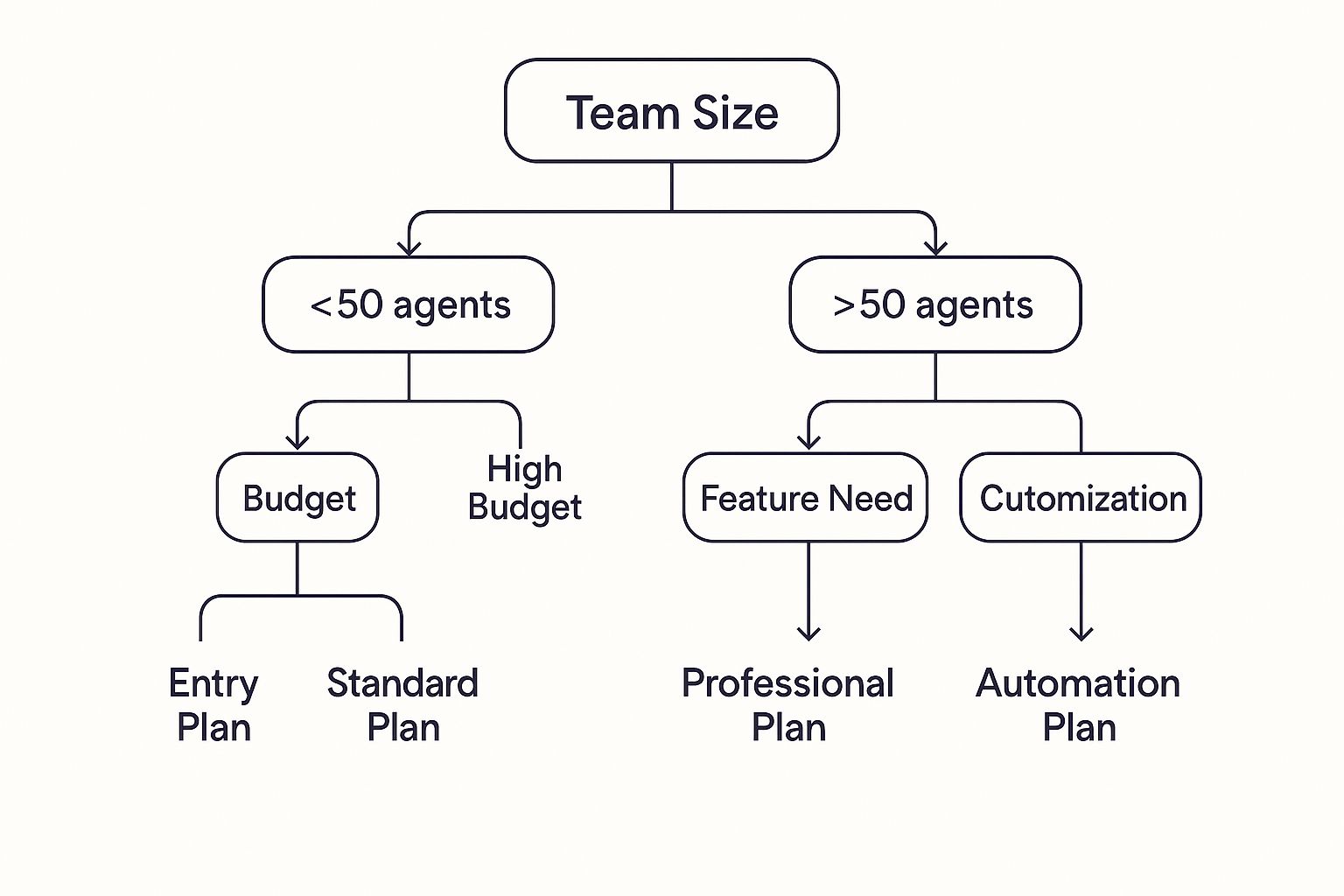
As you can see, smaller teams often prioritize budget and core functionality. On the other hand, larger organizations tend to focus on advanced customization and enterprise-grade automation.
Evaluate Integration and Scalability
Your help desk software doesn’t operate in a vacuum. It must connect to your other essential business tools—your CRM, e-commerce platform, or internal chat apps. Always check for pre-built integrations to ensure a smooth flow of data across your entire tech stack.
Scalability is just as important. The platform that works for you today must also support you in two years. Ask potential vendors how their pricing and feature tiers accommodate growth. You don’t want to be forced into a costly migration down the line because you outgrew your first choice.
The right software is an investment in your future. Choose a partner that can scale with your ambition, not a tool that just solves today’s headaches.
When looking at different customer support tools, it’s smart to check out guides on the best call center software for small business to see what else is out there.
Compare Pricing and Test Drive Everything
Help desk software pricing can be tricky. You’ll see models like per-agent-per-month, tiered plans, or usage-based fees. Look beyond the sticker price and watch out for hidden costs related to implementation or premium support.
Finally, never buy without trying. Almost every reputable provider offers a free trial or a guided demo. This is your chance to get your hands on the software. Involve your support agents in this process—they’re the ones who will use it every day, and their feedback is invaluable. Tracking key customer service performance indicators during the trial is a great way to measure its real-world effectiveness.
 Integrating Help Desk Software with Call Center Services
Powerful help desk software is just one half of the equation. The real magic happens when you pair that great technology with skilled professionals who know how to maximize its potential. This is where partnering with a call center services provider like CallZent transforms a simple software investment into a customer experience powerhouse.
Think of your software as a high-performance race car. It has incredible potential, but it needs an expert driver behind the wheel to win. A BPO partner is that expert driver, turning all those features into service that’s not just faster, but smarter.
Why Call Center Services Maximize Your Help Desk Software
Just buying the software won’t automatically deliver results. You need people to run it effectively. Integrating your platform with expert call center services creates an unbeatable combination that boosts your bottom line and builds lasting customer loyalty.
Here’s how a BPO partner unlocks the full potential of your help desk platform:
- 24/7 Omnichannel Coverage: Your software pulls every channel into one place, and our agents are there to staff them around the clock. That means a customer sending a late-night email or an early-morning chat gets a fast, consistent response every time.
- Day-One Expertise: Forget a steep learning curve. Our agents are already trained on industry-leading platforms and know how to use automation and knowledge bases effectively from their very first day.
- On-Demand Scalability: Got a seasonal rush or a big product launch? Instead of scrambling to hire and train temporary staff, you can instantly add trained agents to your team. We handle the staffing so you can focus on managing the peak without missing a beat.
Technology provides the tools for great service, but empowered people deliver it. The right partner ensures you get the best of both worlds.
From Raw Data to Strategic Action
One of the best features of help desk software is the mountain of data it collects. But data is just noise until someone turns it into action. A good BPO partner doesn’t just answer tickets; we analyze trends and turn those performance metrics into strategic recommendations you can use.
We dive into your analytics to find recurring problems and spot opportunities for improvement. For example, our teams can pinpoint common customer pain points, giving you the insights to refine your products or improve your self-service articles. Our expertise in automation and artificial intelligence in call centers takes this even further, helping us build smarter, more efficient workflows right inside your software. To make this all work together, it’s crucial to evaluate solutions based on their third-party integration features with other essential tools. By connecting technology with strategy, we help you get the absolute most out of your investment.
Common Questions About Help Desk Software Solutions
Thinking about making the switch to a modern help desk software solution? You’re not alone. Let’s tackle some of the most common questions we hear from businesses before they take the leap.
How long does it take to implement help desk software?
It depends. Simple, cloud-based tools for smaller teams can often be ready to go in just a few days. For larger companies needing to migrate data and set up custom integrations, you’re likely looking at a few weeks. Good planning is key—mapping out your channels, importing customer data, and configuring automation rules beforehand will make the entire process much smoother.
What pricing models are common for help desk software solutions?
Most help desk software solutions use a subscription model, usually priced per agent, per month. This allows you to scale costs up or down as your team changes. You’ll typically see a few different tiers:
- Basic/Starter: Perfect for small teams needing essentials like ticketing and a simple knowledge base.
- Professional/Growth: Adds automation, better reporting, and more integrations for scaling businesses.
- Enterprise: Designed for large operations, offering the highest level of security, dedicated support, and deep customization.
Always ask what’s included and watch for add-on costs for advanced features.
How do I get my team on board with a new system?
Getting your team to actually use the new platform is key to a successful rollout. Start with great training that shows them how the new software makes their jobs easier, not just different. Focus on time-saving features like canned responses and automated workflows.
Pro-tip: The best way to guarantee adoption is to involve your agents in the selection process from the start. When they have a say in the tool they’ll be using every day, they become invested in its success.
🚀 Empower Your Support with CallZent
Pair powerful help desk software with expert bilingual agents. CallZent’s nearshore teams turn your technology into a true customer experience advantage.