Skip to content
Customer Experience & Analytics
A Guide to Customer Service KPIs
That Actually Drive Growth
Discover the Customer Service KPIs that truly move the needle on growth. Learn how FCR, CSAT, NPS, AHT, FRT, and advanced metrics create a high-performing support operation.
TL;DR — Quick Takeaways
- Customer Service KPIs provide the clarity needed to turn support teams into growth engines.
- FCR, CSAT, NPS, AHT, and FRT form the core metrics every service leader should monitor.
- AI-powered analytics reveal trends that basic KPIs alone cannot uncover.
- Choosing the right KPIs depends heavily on your industry, goals, and customer expectations.
Are you steering your customer service ship without a compass? Think of Customer Service KPIs (Key Performance Indicators) as that essential tool. They’re the measurable values that guide your team’s performance, making sure every action aligns with your business goals and transforming abstract objectives into tangible, trackable metrics.
Why Your Business Needs a KPI Compass, Not Just a Map
Running a customer service operation without KPIs is like trying to cross an ocean with an old map but no compass. You might know your general destination—happier customers, better efficiency—but you have no real way to measure progress, correct your course, or react when the weather changes. A map shows you the landscape; a compass gives you real-time direction.
The old saying, “what gets measured gets managed,” has never been more true. Without clear metrics, your support team is just guessing. Are agents resolving issues on the first try? Are customers actually happy, or are they quietly looking for an exit? You can’t answer these critical questions without a solid framework of customer service KPIs.
From Cost Center to Growth Engine
For years, many companies saw their call centers as a necessary cost. But with the right performance indicators, that entire perspective shifts. When you start tracking metrics that tie directly to customer loyalty and revenue, your support team stops being a cost center and becomes a powerful engine for growth.
Take First Contact Resolution (FCR), for example. Tracking it isn’t just about efficiency; it’s directly linked to customer happiness. Studies have shown that for every 1% improvement in FCR, there’s a corresponding 1% jump in CSAT. Suddenly, a simple operational metric becomes a strategic tool for building stronger customer relationships.
Your KPIs should be a flashlight, not a hammer. Use them to illuminate the path forward, not just to measure past performance.
This mindset is at the heart of effective customer experience management. Instead of just counting closed tickets, you start digging into the quality of those resolutions and their long-term impact on your business.
The Essential Customer Service KPIs Every Leader Should Track
Alright, you understand why tracking performance is critical. Now, let’s get into the nitty-gritty and talk about the actual metrics that every top-tier customer service team lives and breathes by.
These are the non-negotiables. Think of them as the foundational pillars that give you a complete picture of your operation, balancing pure efficiency with genuine customer happiness. Get these right, and you’re not just running a support team; you’re building a strategic advantage.
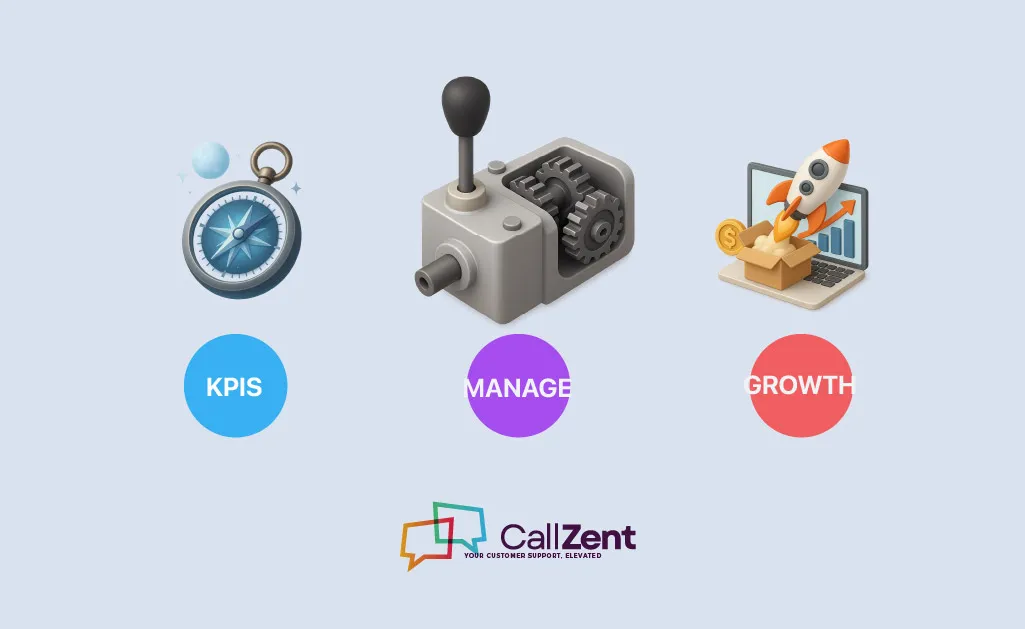
This journey is simple but powerful: you start by measuring what matters (your compass), then you manage your operations based on that data (the gears), and finally, you drive real business growth (the upward arrow). It’s all about turning insights into action.
First Contact Resolution (FCR)
Ever been to a perfect pit stop in a race? The car pulls in, the crew swarms it, and it’s back on the track in a flash without needing a second stop. That’s First Contact Resolution (FCR) for your customers. It’s about solving their problem on the very first try—no follow-up calls, no repeat chats, just a clean, one-and-done solution.
A high FCR is a direct reflection of your team’s expertise and the efficiency of your internal processes. Let’s be honest, nobody enjoys having to re-explain their issue to three different people. When you nail the solution on the first attempt, you’re sending a clear message: “We respect your time.” That’s a huge loyalty builder. For a deeper dive, check out our guide on why First Call Resolution matters.
- How to Calculate It:
(Total Issues Resolved on First Contact / Total Number of Issues) x 100 - A Good Target: Most industries see an FCR between 70% and 75%. But elite teams—the ones with smart routing and rock-solid knowledge bases—can push that number north of 85%.
Customer Satisfaction (CSAT)
If you need a real-time pulse check on how your customers are feeling, look no further than Customer Satisfaction (CSAT). It’s that simple, direct question you ask right after an interaction: “How satisfied were you with our service today?” This immediate feedback is gold for understanding the quality of individual moments with your brand.
CSAT cuts straight to the heart of the customer’s experience, helping you pinpoint which agents are knocking it out of the park and where you might need some coaching. It’s the story behind the numbers, giving you the human context that metrics like handle time just can’t provide.
- How to Calculate It:
(Number of "Satisfied" or "Very Satisfied" Responses / Total Number of Responses) x 100 - A Good Target: While it can vary, a CSAT score of 80% or higher is a solid goal. If you’re hitting above 90%, you’re delivering exceptional service that creates devoted fans.
Net Promoter Score (NPS)
While CSAT measures in-the-moment happiness, Net Promoter Score (NPS) is all about long-term loyalty. It gets to the core of your brand’s relationship with its customers by asking the ultimate question: “On a scale of 0-10, how likely are you to recommend us to a friend or colleague?”
This single question sorts your customers into three distinct groups: Promoters (9-10), who are your brand champions; Passives (7-8), who are satisfied but not enthusiastic; and Detractors (0-6), who are unhappy and could damage your reputation. NPS is a powerful leading indicator of business growth because it tells you if you’re creating more fans or critics.
- How to Calculate It:
Percentage of Promoters - Percentage of Detractors - A Good Target: Any NPS score above 50 is considered excellent. If you’re pushing past 70, you’re in world-class territory with a fiercely loyal customer base.
Average Handle Time (AHT)
Think of Average Handle Time (AHT) as the stopwatch for your support interactions. It measures the entire lifecycle of a customer contact, from the moment an agent picks up the phone or starts a chat until all the follow-up work (or “wrap-up time”) is complete.
AHT is a cornerstone of operational efficiency. It’s essential for figuring out staffing levels, planning resources, and identifying agents who might need a bit more training. But here’s the catch: it’s a metric that demands balance. Chasing a low AHT at the expense of quality is a recipe for unhappy customers.
- How to Calculate It:
(Total Talk Time + Total Hold Time + Total Wrap-Up Time) / Total Number of Contacts - A Good Target: This one varies wildly. A complex tech support call will naturally take longer than a simple billing question. A general benchmark for a contact center might be around 6 minutes, but the real key is to track your own data and set internal goals that make sense for your business.
First Response Time (FRT)
In a world of instant everything, how long a customer has to wait for that initial “hello” matters. A lot. First Response Time (FRT) measures the delay between a customer reaching out and your team’s first reply. It’s your first and best chance to make a great impression.
A snappy FRT shows customers you’re attentive and you value their time. Long waits, on the other hand, breed frustration and can lead to customers giving up entirely. It can sour the entire experience before it even begins. According to Salesmate.io, 95% of customer interactions are expected to be AI-powered by 2025, which will only raise the bar for response times even higher.
- How to Calculate It:
Total Time to Respond for All Inquiries / Total Number of Inquiries - A Good Target: This is completely channel-dependent. For live chat, people expect an answer in under one minute. For email, under an hour is great, though 24 hours is often the baseline.
The real secret to building a world-class service operation isn’t just tracking these metrics—it’s balancing them. Obsessing over efficiency KPIs like AHT without keeping an eye on quality KPIs like CSAT and FCR will always backfire. The goal isn’t just to close tickets quickly; it’s to build positive, lasting relationships, one great interaction at a time.
Key Customer Service KPIs At A Glance
To make things even clearer, here’s a quick cheat sheet summarizing the essential KPIs we’ve covered. Use this table as a handy reference to keep your team focused on the metrics that truly drive success.
| KPI (Key Performance Indicator) | What It Measures | Calculation Formula | Good Industry Benchmark |
|---|---|---|---|
| First Contact Resolution (FCR) | The percentage of issues solved on the first try. | (Resolved on First Contact / Total Issues) x 100 | 70-75% (85%+ is excellent) |
| Customer Satisfaction (CSAT) | Short-term happiness with a specific interaction. | (# of Satisfied Responses / Total Responses) x 100 | 80% or higher |
| Net Promoter Score (NPS) | Long-term customer loyalty and referral likelihood. | % Promoters - % Detractors | 50+ is excellent, 70+ is world-class |
| Average Handle Time (AHT) | The average duration of a customer interaction. | (Talk + Hold + Wrap) / Total Calls | ~6 minutes (varies by industry) |
| First Response Time (FRT) | The time a customer waits for an initial reply. | Total Response Time / # of Inquiries | Chat: <1 min; Email: <1 hour |
Remember, these benchmarks are just a starting point. The most important thing is to establish your own baseline and strive for continuous improvement that aligns with your specific business goals and customer expectations.
Using Technology to Unlock Deeper KPI Insights
Once you’ve got a handle on the foundational metrics, the real fun begins. It’s time to uncover the deeper story your data is trying to tell you. This is where technology, particularly Artificial Intelligence (AI), acts like a powerful magnifying glass, revealing insights you’d otherwise completely miss. Moving beyond basic tracking lets you explore advanced customer service KPIs that tie your support performance directly to business growth.

Think of it this way: your basic KPIs are like checking your car’s speed and fuel gauge. They’re essential, but they don’t tell the whole story. Advanced, tech-driven KPIs are the onboard diagnostics that tell you why the engine is running smoothly—or isn’t—and exactly what you need to do about it. This is where a strategic BPO partner uses a sophisticated tech stack to turn raw numbers into decisive action.
Going Beyond the Basics with Advanced KPIs
While metrics like AHT and CSAT give you a valuable snapshot, advanced KPIs help you understand the long-term health of your customer relationships. They often require more sophisticated data collection and analysis, which is precisely where modern technology shines.
Two of the most powerful examples are:
- Customer Effort Score (CES): This KPI is all about measuring how easy it was for a customer to get their issue resolved. A simple post-interaction survey asking, “How easy was it to handle your request?” gives you a score that is a direct predictor of loyalty. Low-effort experiences are a massive driver of customer retention.
- Customer Lifetime Value (CLV): This is the ultimate metric for connecting your service department to your revenue. CLV predicts the total profit your company can expect from a customer over their entire relationship with you. When you start segmenting CLV, you can clearly see how positive (or negative) service experiences impact your long-term profitability.
Technology doesn’t just help you track KPIs; it helps you understand the cause-and-effect relationships between them. You can finally see how a 10-second reduction in hold time impacts a customer’s lifetime value.
The Role of AI in Modern KPI Management
AI-powered analytics are absolute game-changers for any support operation. They automate the tedious work of data collection, deliver performance insights in real-time, and can even start predicting customer behavior before it happens. This allows managers to shift from constantly putting out fires to building a proactive, forward-thinking strategy.
AI-driven automation and analytics have become the cornerstone for optimizing customer service KPIs, directly impacting metrics like Average Handle Time (AHT) and First Response Time (FRT). As companies grow, they’re aiming for CSAT scores above 80% and SLA compliance over 90%. Analytics tools make real-time tracking possible, letting teams spot trends and tackle issues before they escalate. This operational shift is turning customer service from a cost center into a measurable competitive advantage.
How CallZent Puts Technology to Work
At CallZent, we don’t just use technology; we integrate it into the very fabric of our operations. Our platforms don’t just spit data onto a dashboard. They provide actionable intelligence that our agents and your team can use to make smarter, faster decisions.
Here’s what that looks like in practice:
- AI-Powered Sentiment Analysis: Our systems analyze call transcripts and chat logs in real-time to gauge customer sentiment. If a customer’s frustration starts to rise, the system can flag the interaction for a supervisor to jump in, preventing a poor CSAT score before it even happens.
- Predictive Analytics: By analyzing historical data, our tools can forecast future call volumes with surprising accuracy. This allows for much smarter staffing, ensuring we always have the right number of agents ready to go, which keeps wait times low and Service Level Agreements (SLAs) high.
- Automated Quality Assurance: Instead of manually reviewing a tiny, random sample of calls, AI can analyze 100% of interactions. It automatically scores calls against your specific criteria, pinpoints coaching opportunities for agents, and ensures consistent quality across the board.
For a clear-cut example of this in action, the article on measuring success with AI voice agents and KPIs in healthcare shows how these principles are applied to modern service solutions. This tech-forward approach is how we turn your customer service operation into a competitive advantage, using data to not only meet your goals but blow past them.
Choosing the Right KPIs for Your Industry
Applying a generic set of customer service KPIs to every business is like giving a chef, a mechanic, and a doctor the exact same set of tools. Sure, a wrench is essential for the mechanic, but it’s not going to help the surgeon. A one-size-fits-all dashboard is a recipe for measuring the wrong things and missing the insights that truly matter.
The KPIs that drive success for a fast-paced e-commerce brand are fundamentally different from those that a healthcare provider must prioritize. The real trick is to tailor your metrics to reflect your unique operational realities, customer expectations, and business goals. When you focus on the right 2-3 indicators for your sector, your data transforms from noise into a clear signal for growth.
KPIs for E-commerce and Retail
In the world of online shopping, speed and resolution are everything. When a customer has an issue with an order, a payment, or a return, their patience is thin. Every single moment of friction increases the risk of a lost sale or a negative review that could scare off hundreds of other potential buyers.
This is exactly why e-commerce and retail businesses live and die by these core customer service KPIs:
- First Contact Resolution (FCR): When a customer asks, “Where is my order?” they want an answer now—not a ticket number and a vague promise of a follow-up. A high FCR means your agents have the tools and authority to solve problems, like tracking a package or processing a refund, on the very first try. Think of this KPI as a direct measure of your ability to eliminate customer effort and restore confidence on the spot.
- Customer Effort Score (CES): How easy was it for the customer to get help? For retail, a low-effort experience is non-negotiable. A high CES score is a red flag, often pointing to convoluted return processes, hard-to-find contact info, or getting bounced between agents. These are the little frustrations that kill customer loyalty for good.
KPIs for Healthcare
Healthcare is one industry where accuracy, empathy, and compliance simply can’t be compromised. While speed is always nice, it can never come at the expense of patient privacy or the quality of care information. A rushed interaction that leads to incorrect medical advice isn’t just a mistake; it’s a catastrophic failure.
Because of this, healthcare providers have to focus their KPI strategy on quality and strict adherence:
- Quality Assurance (QA) Scores: This is arguably the most critical KPI here. QA reviews make sure that agents are not only following HIPAA guidelines for patient privacy but are also delivering information with clarity and genuine empathy. These scores measure adherence to strict protocols, the accuracy of the information provided, and the agent’s ability to handle incredibly sensitive situations with care.
- Customer Satisfaction (CSAT): In a healthcare context, CSAT often measures a patient’s feeling of being heard and respected. A patient might still be unwell after a call, but a high CSAT score shows the interaction itself was reassuring, clear, and supportive. It’s all about building trust in the provider.
KPIs for Finance and SaaS
For industries like finance, insurance, and Software-as-a-Service (SaaS), the customer relationship is a long-term journey, not a one-and-done transaction. The value isn’t just in the initial sale but in the ongoing subscription, the renewal, and the potential for upselling down the line. Customer issues are often complex, requiring deep product knowledge to solve.
The most impactful customer service KPIs for these sectors are tied directly to long-term value and retention:
- Customer Churn Rate: This metric tracks the percentage of customers who cancel their service over a specific period. It is the ultimate, unfiltered indicator of customer dissatisfaction. A rising churn rate is a massive red flag that your support experience, your product, or your pricing is failing to meet expectations.
- Net Promoter Score (NPS): NPS is crucial here because it measures long-term loyalty. A customer who is a “Promoter” isn’t just satisfied; they are the ones who are likely to stick around for years and recommend your service to others, directly fueling your growth. It’s a powerful leading indicator of the overall health of your customer base.
Common KPI Traps and How to Sidestep Them
Collecting data is the easy part. Knowing what to do with it is where the real work begins. Even with a dashboard full of perfectly calculated customer service KPIs, it’s shockingly easy to fall into traps that can derail your entire strategy. These mistakes can quickly turn good-intentioned metrics into a source of team anxiety and bad decisions.
The good news? Once you know what to look for, you can build a healthier, more effective data culture. The goal is to create a system where KPIs empower your team, not punish them.
Your KPIs should be a flashlight, not a hammer. Use them to illuminate the path forward, not just to measure what went wrong.
This mindset shifts the focus from just hitting numbers to understanding the story behind them. It’s about using data to guide better coaching, fix broken processes, and ultimately, make customers happier.
Trap 1: The Efficiency Obsession
This is the classic mistake, and it’s everywhere. A manager sees a high Average Handle Time (AHT) and immediately tells agents to get off the phone faster. What happens next? AHT might tick down, but First Call Resolution tanks and CSAT scores plummet. Why? Because agents are now rushing customers off the line instead of actually solving their problems.
- How to Sidestep It: Never look at an efficiency metric in isolation. Always pair it with a quality metric. On your dashboard, put AHT right next to CSAT and FCR. This creates a balanced view, making it obvious that a slightly longer call that leaves a customer happy and their issue resolved is infinitely more valuable than a quick, useless one.
Trap 2: Setting Arbitrary Targets
“Our NPS is 40. Let’s get it to 60 by next quarter!” Okay… but why 60? What specific actions will get you there? A target without a plan is just a wish. Setting goals without a clear, data-backed strategy is a recipe for frustration. It completely demoralizes your team when they feel like the goalposts are just being moved at random.
- How to Sidestep It: Anchor your targets in reality. Look at your historical performance and credible industry benchmarks. Set smaller, achievable goals and tie them to specific actions. For example, instead of a vague NPS goal, aim to improve FCR by 5% through a new agent training module. You know that better FCR will have a positive ripple effect on your NPS score.
Trap 3: Letting Data Gather Dust
You’ve got beautiful dashboards. Weekly reports are automatically sent out. But nothing ever changes. Data that doesn’t inspire action is just noise. This usually happens when there’s no formal process for reviewing KPIs and turning insights into a to-do list. The information is all there, but it’s not being put to work.
- How to Sidestep It: Block out time for regular KPI review meetings and give them a non-negotiable agenda. Every meeting should answer three questions: What is the data telling us? Why is it telling us that? And what are we going to do about it? This simple framework builds accountability and ensures your data becomes the engine for real progress. Focusing on improving call center quality demands this kind of disciplined, action-first approach to analytics.
By sidestepping these common traps, you can transform your KPIs from a simple report card into a strategic playbook for success.
How a BPO Partnership Can Supercharge Your KPIs
Knowing your customer service KPIs is one thing. Actually moving the needle on them is a whole different ball game. This is where partnering with a specialized Business Process Outsourcing (BPO) provider stops being about just monitoring numbers and starts being about actively driving results. An expert partner doesn’t just track your metrics—they own them.

When you choose the right BPO, you’re not just hiring agents. You’re getting immediate access to a highly-trained workforce, proven operational frameworks, and the right technology—all pointed at one goal: hitting your targets.
Turning KPI Theory Into Reality
Think of a nearshore BPO like CallZent as a true extension of your team. We bring specialized skills to the table that have a direct, measurable impact on the metrics you care about most. Our bilingual agents are fluent in both English and Spanish, which immediately broadens your market reach and ensures clear, effective communication that boosts both Customer Satisfaction (CSAT) and First Contact Resolution (FCR).
We draw a straight line from our services to your success:
- Lower Average Handle Time (AHT): Our agents go through rigorous, industry-specific training and come armed with robust knowledge bases. This prep work means they find answers and solve problems faster, which naturally drives down AHT without ever cutting corners on quality.
- Higher CSAT and NPS: Cultural alignment is everything. Our proximity to the U.S. market means our agents get the cultural nuances that lead to more positive, empathetic conversations. Happy customers don’t just stay—they become loyal promoters.
- Improved Scalability and Efficiency: Gearing up for a product launch or a seasonal rush? A BPO gives you the flexibility to scale your team up or down on demand, so you always meet your service levels without the massive overhead of direct hiring.
A BPO partnership transforms your KPIs from passive indicators into active levers for growth. It’s about having a dedicated team whose success is measured by your success.
By integrating our team with yours, we help you build the kind of operational excellence that makes you stand out. Find out more about how our tailored customer service outsourcing solutions can help you not just meet, but completely blow past your performance goals.
Frequently Asked Questions About Customer Service KPIs
Let’s be honest, once you start digging into customer service KPIs, a lot of questions bubble up. We get them all the time from managers working to build a more data-driven team. Here are a few of the most common ones we hear, with straight-to-the-point answers from our experience.
How Often Should We Review KPIs?
There’s no single magic number here—the right rhythm depends on the metric. Think of it as having different check-ins for different goals.
- Daily Huddles: A quick, 15-minute look at real-time numbers like incoming call volume and First Response Time (FRT) is perfect. It helps the team get a feel for the day’s flow and make adjustments on the fly.
- Weekly Reviews: This is where you can dig a little deeper. Look at metrics like CSAT, FCR, and individual agent performance. You’ll start to see trends emerge and find great coaching opportunities.
- Quarterly Strategy Sessions: Pull back and look at the big picture. This is the time to review major KPIs like NPS and Customer Churn Rate to see if your efforts are moving the needle on your long-term business goals.
What Is the Most Important KPI for a New Business?
When you’re just starting out, your main job is to create a solid base of happy customers who will stick around. That means quality and problem-solving should trump pure speed and efficiency.
For that reason, I always recommend focusing on either Customer Satisfaction (CSAT) or First Contact Resolution (FCR). A high score in either of these tells you one simple thing: you’re solving people’s problems and leaving them with a good feeling. Nailing this early on is how you build trust and earn the word-of-mouth that every new business desperately needs.
How Can I Motivate My Team with KPIs Without Creating Anxiety?
This is a big one. The key is to position KPIs as a tool for getting better, not a stick to beat people with. The goal is to coach, not to criticize. You have to celebrate the wins and use the data to have supportive, constructive chats about performance.
For example, instead of just flagging a low FCR score, pull up a few call recordings and listen with the agent. Together, you can pinpoint where a process might have gotten confusing or where they needed a bit more information.
This collaborative approach shows your team that KPIs are there to help them win, which is a total game-changer for building confidence and a positive, growth-focused culture.
Ready to turn your KPIs from just numbers on a dashboard into real, tangible business growth? CallZent provides the dedicated teams and strategic guidance to help you not just meet, but exceed your customer service goals. Discover how our solutions can help you today.