Skip to content
Call Center Performance
How to Improve Call Center Agent Performance | Actionable Guide
Unlock peak call center agent performance with this expert guide. Discover actionable strategies for training, technology, coaching, and motivation.
TL;DR — Quick Takeaways
- Shift from Quantity to Quality: Focus on FCR and CSAT instead of AHT.
- Invest in Continuous Training: Emphasize real-world learning and mentoring.
- Empower with Technology: Use AI as an agent co-pilot, not a replacement.
- Build a Coaching Culture: Prioritize regular, constructive one-on-ones.
- Recognize and Motivate: Celebrate achievements and create clear career paths.
Is your call center’s success still measured by how many calls an agent can churn through in an hour? If so, you might be chasing a metric that’s actively damaging your customer relationships and burning out your best people. To truly improve call center agent performance, it’s time to shift from a stopwatch mentality to a strategy built on quality, empowerment, and intelligent support.
This guide provides actionable insights for call center managers and BPO leaders looking to build a high-performing, resilient team. We’ll move beyond outdated metrics and dive into the practical steps that foster genuine skill, motivation, and outstanding customer experiences.
Why Old Performance Metrics No Longer Work
Are you still measuring your team’s success by how quickly they can get a customer off the phone? If that’s your main KPI, you might be unintentionally torching customer loyalty and sending your agent turnover through the roof.
The call center world has evolved past simply counting calls and obsessing over Average Handle Time (AHT). These traditional metrics are deceptive; they only tell a fraction of the story and completely miss the bigger picture.
The Pitfall of “Calls Answered per Hour”
Let’s face it—tracking how many calls an agent answers per hour sounds productive. On the surface, it’s a general measurement of efficiency and workload. But if it’s not balanced against customer satisfaction and resolution quality, it becomes a shallow victory. High call volume might look impressive on a spreadsheet, but if each call is rushed, unresolved, or leaves the customer frustrated, you’re just spinning your wheels.
Chasing speed above all else cultivates a high-pressure environment. Agents feel rushed, forced to cut corners, and unable to truly solve problems. This inevitably leads to frustrated customers calling back, incomplete resolutions, and disengaged employees who feel more like robots than problem-solvers. It’s a textbook recipe for burnout.
Instead of fixating on how many calls your agents can blaze through, it’s time to ask: Are those interactions actually effective? Are your agents empowered to deliver real solutions—or just trained to move on to the next call as fast as possible?
Shifting Focus From Speed to Substance
The truth is, a single five-minute call that completely solves a customer’s issue is infinitely more valuable than a two-minute call that just kicks the can down the road. Top-performing BPOs get this. They’ve shifted their focus to metrics that actually reflect the quality of an interaction.
Instead of fixating on AHT, today’s successful teams prioritize metrics like:
- First Call Resolution (FCR): Did the agent nail it on the first try? This is the gold standard for improving call center agent performance.
- Customer Satisfaction (CSAT): Simple and direct—how did the customer feel about the experience?
- Agent Engagement: Are your team members motivated, supported, and invested in their roles?
This infographic perfectly illustrates the critical shift away from outdated, quantity-based metrics toward the modern, quality-focused ones that actually drive results.
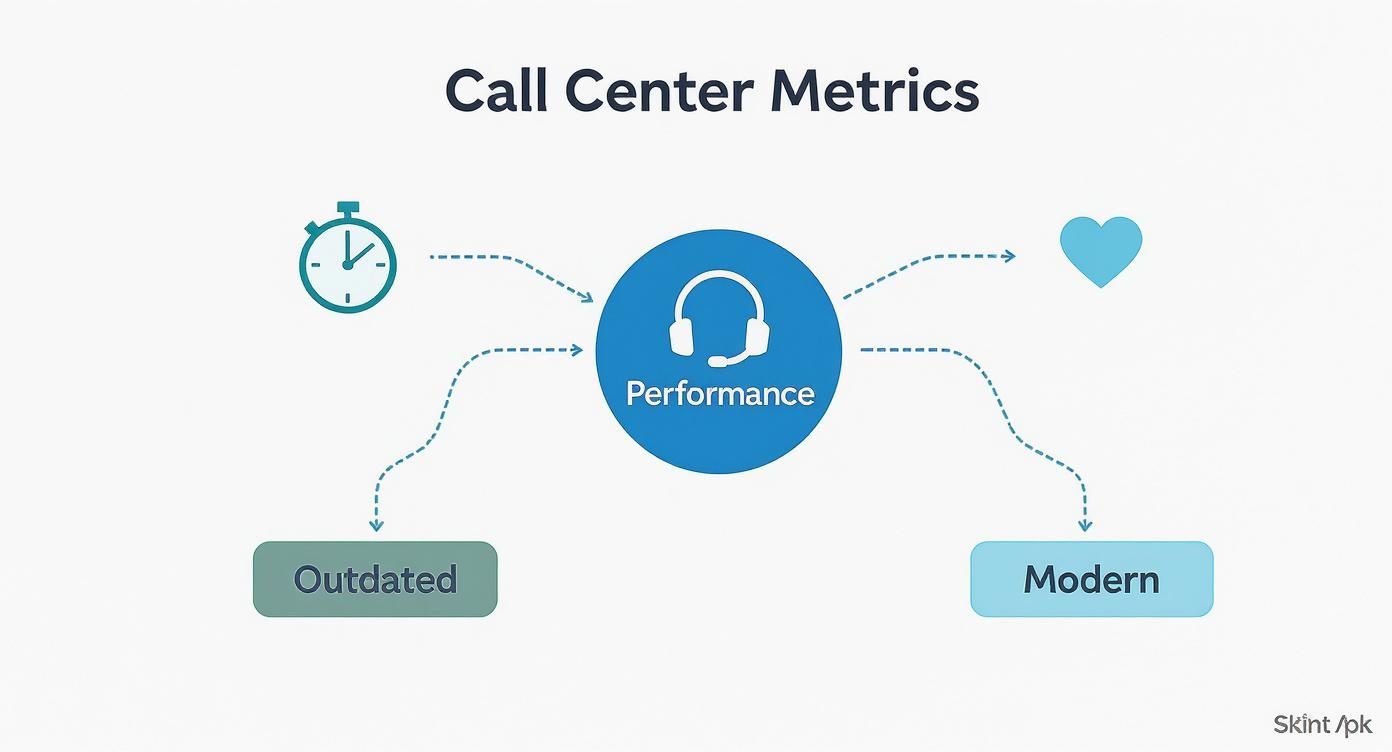
As you can see, the modern approach is all about customer-centric outcomes and agent well-being, not just operational speed. It’s a fundamental change in philosophy.
To make this shift crystal clear, it helps to compare the old way of thinking with the new. We’ve moved from a factory mindset to a value-driven one.
Outdated vs. Modern Agent Performance Metrics
| Outdated Metric (Focus on Quantity) | Modern Metric (Focus on Quality & Impact) |
|---|---|
| Average Handle Time (AHT) | First Call Resolution (FCR) |
| Calls Per Hour | Customer Satisfaction (CSAT) / Net Promoter Score (NPS) |
| Adherence to Scripts | Agent Engagement & Satisfaction |
| Occupancy Rate | Customer Effort Score (CES) |
| After-Call Work (ACW) Time | Quality Assurance (QA) Score (focused on empathy & resolution) |
This table isn’t just a list of KPIs; it represents a complete change in how we define success in the contact center. It’s about empowering agents to deliver real value, not just process calls.
The Impact of Agent Utilization Rate on Performance and Well-Being
Let’s dig into a key metric that doesn’t get nearly enough airtime: the Agent Utilization Rate. Think of it as the ratio of time your agents are “on”—actively speaking with customers or handling their requests—versus the time they’re prepping, learning, or simply taking a breather.
When utilization is dialed in just right, it’s like a well-tuned engine. Agents are productive, engaged, and their energy goes exactly where it counts: great customer service. But crank that utilization rate too high and you’re in the red zone. Agents have no time to recharge between interactions, stress mounts, and—just like a phone stuck on 1% battery—they burn out. Quality takes a nosedive, mistakes happen, and before you know it, top talent heads for the exits.
Here’s how to strike the balance:
- Monitor utilization trends: Look for patterns where productivity peaks and where strain shows up.
- Build in breathing room: Schedule small buffers between calls so agents can reset and return ready to help.
- Recognize the warning signs: High utilization might sound efficient, but in reality, it signals a risk of turnover and diminishing service quality.
The takeaway? Sustainable productivity is never about wringing every second of labor from your agents. It’s about creating an environment where performance and well-being work hand in hand. That’s when your team thrives—and your customers feel the difference.
What Total Resolution Time Tells Us About Complex Customer Issues
Total Resolution Time isn’t just another stop on the metrics merry-go-round—it’s a window into how effectively your team handles the thorny, multi-layered problems that can make or break customer loyalty.
Rather than focusing on how quickly an agent can end a call, Total Resolution Time tracks the entire journey from the customer’s first contact all the way through to a final solution. This provides an honest look at two critical things:
- Problem-Solving Depth: Are your processes and support systems robust enough to handle issues that require more than a quick fix? A reasonable Total Resolution Time signals your agents have the space and skill to solve what really matters, not just patch it up.
- Customer Experience for Complex Cases: Long, unresolved issues can turn even the most patient customer into a critic. By keeping an eye on this metric, you’ll see whether your escalation paths, knowledge bases, or cross-team collaboration efforts are actually working—or if slowdowns are eroding trust.
Ultimately, Total Resolution Time helps you spot where complexity is bogging things down, letting you invest in smarter tools, training, and workflows that keep both customers and agents happy. It’s a crucial gauge for leaders who want to level up their team’s problem-solving game, not just their speed.
The Critical Role of Service Level
Let’s not overlook one of the foundational metrics in any high-functioning call center: service level. At its core, this measures how quickly you’re responding to incoming calls—typically calculated as the percentage picked up within a set number of seconds.
Why is this so critical? Meeting your service level targets doesn’t just check an operational box; it’s a direct line to customer satisfaction and brand reputation. Imagine being the customer: a prompt answer sets the tone for the entire interaction. Miss the mark consistently, and customers start associating your brand with endless hold music—never a good look.
Service level also impacts overall efficiency. When wait times spike, you’re not just risking frustrated customers. Agents field callers who are already annoyed or impatient, making the conversation harder and reducing the chance of a positive outcome. It’s a lose-lose for both sides.
Forward-thinking organizations—like Zappos and American Express—put a premium on keeping service levels high. They know that every second shaved off the wait is one step closer to a loyal customer. That’s not just good service; it’s smart business.
Maintaining a healthy service level keeps the pipeline flowing smoothly, supports your agents, and leaves your customers feeling heard right from the start.
Adherence to Schedule: The Unsung Hero of Call Center Stability
Let’s talk about a metric that often lurks in the shadows but quietly keeps your operation running smoothly: adherence to schedule. At its core, adherence measures how closely agents are sticking to their assigned shifts and breaks—not just showing up on time, but also being available when customers need them most.
Why does this matter? Because when agents follow their schedules, you maintain optimal staffing levels throughout the day. This means shorter wait times for customers, fewer missed calls, and hitting those all-important service level agreements (SLAs). It’s not just about clock-watching—it’s about creating a reliable rhythm for your team and ensuring customers aren’t left hanging when call volumes spike.
Poor adherence leads to chaos: lines back up, SLAs slip, and even your all-stars end up frazzled from the fallout. On the flip side, consistently strong adherence sets the stage for everything else—efficiency, happy customers, and agents who aren’t constantly scrambling to catch up.
The Case for Monitoring Transfer Rate
Let’s talk about Transfer Rate—that often-overlooked metric with a big impact on both customer experience and team efficiency.
Why keep an eye on it? Because high transfer rates usually signal trouble lurking beneath the surface. If your customers keep getting shuffled from agent to agent, it can mean your routing system is off, your agents aren’t equipped with the right information, or there are knowledge gaps that training hasn’t covered. Every unnecessary transfer is another touchpoint where frustration builds, resolution time stretches out, and loyalty takes a hit.
By tracking Transfer Rate, you can spot patterns—say, a spike in one department versus another—and take targeted action. Maybe it’s smarter routing logic, better cross-training, or more robust knowledge bases like those at Zappos or American Express. The bottom line: minimizing transfers means customers feel heard and agents feel empowered to actually solve problems on the first try.
What the Call Abandonment Rate Is Really Telling You
Now, let’s talk about a metric that often lurks in the background—Call Abandonment Rate. Instead of simply tracking how many callers hang up before reaching an agent, think of this number as a canary in the coal mine for deeper operational headaches.
When your abandonment rate is climbing, it’s usually less about impatient customers and more about system bottlenecks. Here’s what a spike often reveals:
- Staffing shortfalls: Too few agents on the floor means longer wait times, so customers give up before ever getting help.
- Broken processes: Clunky IVRs, confusing menus, or unclear hold queues create a frustrating experience—even before your team can step in.
- Overloaded teams: If agents are stretched too thin handling complex calls, the queue balloons behind them.
Instead of brushing off abandoned calls, treat them as red flags. A persistent issue here may cost you not just calls, but customers—who might head straight to a competitor with a smoother system. By addressing the root causes behind rising abandonment, you protect both your agents’ sanity and your reputation.
The Real Cost of Outdated Metrics
Clinging to the wrong numbers has very real, very expensive consequences. Agent attrition is one of the biggest bleeders, averaging a staggering 52% annually in 2023. When agents are judged solely on speed, they burn out. Fast.
To fight this, smart companies are investing in agent career progression, a strategy proven to increase the achievement of strategic goals by 23%. Happy, supported agents stick around.
The takeaway is simple: A supported agent who is measured by the quality of their work will always outperform a rushed agent who is measured by a stopwatch.
This shift in perspective is the cornerstone of building a high-performing team. It directly impacts your bottom line by improving service consistency, boosting customer loyalty, and creating a more stable, skilled workforce. Recognizing why call centers are important in 2025 starts with seeing them as relationship-building hubs, not just transaction-processing factories.
Balancing Workloads: The Secret Weapon Against Burnout
Let’s face it—nothing tanks morale (and performance) faster than an overwhelmed team frantically fielding back-to-back calls, day after day. Think of your call center like a busy NYC restaurant: if every table is filled and your staff doesn’t have time to breathe, something’s about to go up in flames (and not in a good, tableside flambé way).
So, how do today’s most successful operations keep their teams energized and productive without pushing them to the brink? It all comes down to balancing workloads—with a smart, data-driven approach.
How Proactive Scheduling Makes All the Difference
Rather than reacting to chaos, top teams tap into historical data, seasonal patterns, and even weather forecasts (yes, really—just ask any insurance provider during hurricane season!). Here’s how this plays out:
- Forecast with Precision: By using tools and analytics to predict call volume, you can anticipate busy stretches and schedule more hands on deck when it matters most.
- Prevent Overload: Well-balanced schedules mean agents aren’t slammed during the lunch rush and left twiddling their thumbs at 4pm. Instead, workload is distributed fairly, keeping stress (and idle time) to a minimum.
- Boost Agent Well-Being: When agents know their day isn’t a constant sprint, they show up more energized and ready to solve real problems—leading directly to better customer experiences.
The bottom line? Balancing workloads is more than just good math. It’s the foundation for happy agents, lower turnover, and higher productivity. If you want your contact center humming like a well-oiled machine (instead of blazing out like a broken espresso maker during Monday morning rush), workforce management has to be a strategic priority.
Now, let’s get into the actionable strategies that truly drive success.
Build Your Foundation with Smarter Agent Training
Let’s be honest: generic, one-size-fits-all onboarding is a fast track to disengaged agents and lackluster performance. If you’re serious about improving call center agent performance, you have to build a dynamic, continuous learning program that gives agents real skills, not just scripts to read.
The goal isn’t to create agents who can memorize a manual. It’s to cultivate confident problem-solvers who can actually resolve issues on the first call. An agent who feels well-trained isn’t just more effective—they’re more invested, which directly boosts First Call Resolution (FCR) rates and creates a much better customer experience.

Move Beyond Onboarding to Continuous Learning
Training can’t just be a box you check during an agent’s first week. The best call centers I’ve seen treat learning as an ongoing cycle woven right into an agent’s career path. This means getting past the initial product knowledge dumps and creating a rhythm of reinforcement, upskilling, and coaching.
For instance, instead of one massive, mind-numbing session on a new software update, break it into smaller bites. Kick it off with a quick e-learning module, follow up with a team huddle to talk about how it works in the real world, and then use call recordings to showcase agents who are already nailing the new features. This micro-learning approach makes new information much easier to digest and apply immediately.
Focus on Real-World Scenarios and Soft Skills
Technical know-how is only half the battle. Your agents need the emotional intelligence to handle tricky human interactions. This is where scenario-based training is worth its weight in gold.
Your best training material is your own call history. Use recordings of your top performers to demonstrate exactly how to de-escalate a frustrated customer or turn a complaint into a positive experience.
Role-playing is also non-negotiable. Don’t just talk about empathy—practice it. Set up realistic situations where agents have to deal with difficult personalities or answer complex product questions. This builds the muscle memory they need to handle tough calls with grace and confidence.
Key soft skills to bake into your program include:
- Active Listening: Training agents to truly hear what the customer is saying, instead of just waiting for their turn to talk.
- Empathy and Rapport Building: Teaching simple techniques to connect with customers, making them feel heard and respected.
- Problem-Solving and Critical Thinking: Empowering agents to think on their feet and find creative solutions, rather than just passing the buck.
- De-escalation Techniques: Giving them a clear playbook for calming upset customers and taking control of a tense conversation.
Developing these skills is what turns script-readers into genuine brand ambassadors. You can explore a bunch of modern call center training techniques that build these essential skills outside of a traditional classroom.
How to Structure Training for Better Agent Performance
How you teach matters just as much as what you teach. An agent who feels overwhelmed isn’t going to retain much. To make sure your training actually sticks and improves performance, consider approaches like competency-based training. This shifts the focus from just “completing the module” to actually mastering a specific, measurable skill.
A solid training framework needs a few key components working together to make sure learning sticks.
The Power of a Centralized Knowledge Base
An easy-to-search, well-organized knowledge base is an agent’s best friend. Think of it as the “single source of truth” for all product info, company policies, and troubleshooting guides. This resource empowers agents to find answers on their own, which builds their confidence and drastically improves FCR.
Picture this: an agent gets a call about a rare billing error. Instead of putting the customer on a long hold while they hunt down a supervisor, they can do a quick search, find the exact procedure, and solve the problem in minutes. That’s how you build an efficient, empowered team.
Peer Mentoring and Collaborative Learning
Pairing your new hires with experienced, high-performing agents is one of the most powerful training tools you have. Mentors provide real-time guidance, share practical tips, and offer encouragement in a way that formal training simply can’t.
This isn’t just good for the new agent—it also reinforces the mentor’s own knowledge and expertise. Plus, it fosters a supportive team culture where everyone feels invested in each other’s success. That right there is a huge driver of both performance and retention. When you build this solid foundation, you’re setting your agents up to thrive.
Leverage Technology to Empower, Not Replace Agents
There’s a lot of chatter about technology making call center agents obsolete. Honestly, that’s the wrong way to look at it. The smartest BPOs I’ve worked with see technology for what it truly is: a powerful tool to empower their best people, not replace them.
Think of it as giving your top agents an intelligent co-pilot. This co-pilot handles all the tedious, repetitive stuff, freeing up your human agents to focus on what they do best—connecting with customers, showing empathy, and solving those tricky problems that a machine just can’t handle.
When you nail this balance, you unlock a whole new level of agent performance. They’re less stressed, more confident, and ready to deliver fantastic service on every single call.

Making Technology an Agent’s Co-Pilot
The real goal here is to reduce an agent’s cognitive load—that’s the mental gymnastics they have to do just to handle a call. When an agent is frantically digging for a customer’s history, juggling five different windows, and trying to recall a brand-new policy, their ability to actually listen and solve problems tanks.
This is where empowering tech comes in to clear the mental clutter.
For instance, an AI tool can feed an agent real-time suggestions and script prompts right when they need them. A customer mentions a specific error code? Bam. The system instantly pops up the right troubleshooting guide in the agent’s sidebar. What could have been a stressful five-minute hunt becomes a confident, two-second solution.
It’s the same with customer history. Having a complete interaction timeline appear the moment a call connects is a total game-changer. The agent immediately has context and doesn’t have to ask the dreaded, “So, can you remind me why you called last week?” That small tech advantage makes the agent look sharper and the customer feel heard.
Real-Time Data: The Secret Sauce for Smarter Goal Setting
Here’s where things get interesting: real-time data is your secret weapon for keeping agent performance goals fresh, relevant, and actually achievable.
Gone are the days of setting rigid monthly targets and hoping for the best. With the help of AI and real-time dashboards—think along the lines of what Salesforce or Zendesk offers—managers can spot emerging trends as they happen, not weeks after the fact. Maybe customer wait times spike on Mondays, or a new product rollout is generating a surge in tricky support tickets. With live data at your fingertips, you can instantly recalibrate goals to meet the moment—whether that means adjusting call resolutions, focusing on a specific skill gap, or prioritizing customer sentiment.
This isn’t just helpful for managers; it makes a world of difference for agents, too. When goals are clearly tied to up-to-the-minute realities, your team feels supported, not blindsided. They know exactly what success looks like today, not just what it looked like last quarter. That’s the kind of dynamic, transparent coaching that keeps everyone on track and motivated to grow.
Give Agents the Power of Self-Insight
Another underrated way to boost agent engagement (and results) is by handing them the keys to their own performance data. Imagine giving each agent access to a super-clear, easy-to-use dashboard—think Google Analytics, but for their calls and KPIs. No digging through crusty spreadsheets, no waiting for a monthly manager rundown—just live, visual stats that actually make sense.
When agents can see their own numbers in real time—daily FCR rates, average handle times, customer satisfaction—it’s like flipping on a spotlight. They instantly spot their strengths and pinpoint where they can improve, all without having to play data detective. This transparency fosters true ownership; suddenly, improving performance isn’t just a quarterly goal from the top, but a personal mission they can track every single shift.
These dashboards aren’t just about individual growth, either. When everyone can see their own progress laid out plainly, it builds a culture where coaching conversations happen naturally, and wins (big or small) are easy to celebrate. Managers are freed from being glorified scorekeepers and can focus on real development. With the guesswork gone, everyone spends less time calculating and more time connecting—with each other and with your customers.
Self-Service: Your 24/7 Sidekick
Here’s a little secret: not every customer wants (or needs) to talk to a live agent. When you roll out robust self-service channels—think user-friendly IVR menus, well-stocked FAQ pages, or a smart AI chatbot like you’d find with Google’s Dialogflow—you’re actually serving two masters.
First, customers with quick questions (like “How do I reset my password?” or “What’s my account balance?”) can solve problems instantly, any time of day. They skip the wait, find answers fast, and leave happy. That means those straightforward, repetitive calls simply never hit your agents’ desks.
Second, this frees up your human team’s bandwidth for the stuff that truly requires their expertise—those unique, complex, or emotionally charged issues that no automated script can handle. With fewer basic inquiries clogging up the queue, agents spend less time multitasking and more time showing empathy, creativity, and deep problem-solving on the calls that matter most.
The result? Call volumes drop, agent focus rises, and customers get a faster, more personalized experience—no matter which path they choose.
Automate the Repetitive, Not the Relational
One of the biggest morale killers for agents is after-call work (ACW). Manually logging call notes, summarizing conversations, and categorizing tickets is essential but incredibly draining. This is the perfect job for automation.
Modern platforms can automate call logging and even use generative AI to draft surprisingly accurate summaries of conversations. This frees up a massive amount of mental energy for your team.
When you automate routine tasks, you’re not just saving time; you’re preserving your agents’ focus for the high-value, human-centric parts of their job—building rapport and finding solutions.
The impact here is huge. Gartner predicts that by 2026, automation in agent interactions will increase fivefold. Tools that create generative summaries can slash after-call work time by up to 35%. That’s a massive efficiency gain that lets agents get to the next customer faster and with way less burnout.
Using Tech for Proactive Support and Quality Assurance
Technology also acts as a fantastic safety net for both agents and customers. A sentiment analysis tool, for example, can monitor the emotional tone of a call in real time.
If a customer’s frustration starts climbing, the system can automatically flag the call for a supervisor. This allows a manager to discreetly listen in, ping the agent a helpful tip via private chat, or get ready to jump in if things escalate. It’s a proactive way to cool situations down before they boil over.
This fosters a supportive environment where agents feel like they have backup, not like they’re being micromanaged. Here are a few practical examples of tech that truly empowers:
- Unified Agent Desktops: Pulling every tool an agent needs—CRM, knowledge base, chat—into a single, clean interface. No more frantic app-switching.
- AI-Powered Knowledge Bases: Instead of static FAQ pages, agents can ask natural language questions like, “What’s our refund policy for VIP customers?” and get an immediate, precise answer.
- Predictive Routing: Smart systems that route calls based on more than just who’s available. They can factor in agent skill sets, the customer’s history, and even personality matches to set up every interaction for success.
But proactive tech support doesn’t stop there. Automated quality management tools now make it possible to evaluate 100% of interactions across all channels—not just a random sampling. With AI and machine learning, every single conversation can be analyzed for key performance indicators. The result? Agents get unbiased, targeted, and personalized insights delivered far faster than old-school manual reviews ever could.
By accelerating feedback and eliminating subjectivity, you enable agents to make immediate course corrections and drive continuous improvement. That’s a huge leap from the days of waiting weeks for a supervisor to comb through a few calls. Now, supervisors can scan more data points, spot trends in real time, and focus their coaching where it matters most. Automation here doesn’t just remove tedious manual review—it supercharges the entire coaching loop, making team-wide growth more achievable.
By thoughtfully choosing and implementing these tools, you turn technology from a threat into your agent’s most valuable ally. Finding that sweet spot between automation and people is the core mission, a topic we dive into deeper in our guide to Balancing Technology and Human Touch in Call Centers. This human-focused approach is the key to sustainably boosting your call center’s performance.
How Automation Supercharges Supervisor Feedback
Here’s an often-overlooked win: Automation isn’t just about helping agents—it’s a boon for supervisors, too. When manual review is taken off their plates, supervisors aren’t burning hours poring over endless call logs or patching together performance notes from scattered tools.
Instead, automation pulls together all those juicy data points—call transcripts, sentiment scores, resolution stats—into a tidy, ready-to-review dashboard. That means supervisors can spot patterns faster, zoom in on areas that need attention, and spend more time on what actually moves the needle: giving agents targeted, actionable feedback.
In short, less time on mind-numbing admin equals more meaningful coaching moments and, ultimately, a stronger, more resilient team culture.
Here’s where AI truly shines: feedback. Traditionally, evaluating agent performance relied on a handful of spot-checked calls—a process riddled with human bias and more “gut feeling” than hard fact. Enter AI-driven quality management, and suddenly you’re playing with an entirely different set of cards.
Instead of sampling a small percentage, intelligent platforms like Five9 and NICE CXone can review 100% of interactions—across calls, chat, and email—without breaking a sweat. This isn’t just about speed. Machine learning pinpoints specific performance markers, from tone and scripting adherence to how well agents de-escalate tense moments. Each review is measured by the same standards, so there’s no room for “Well, I just had a feeling this wasn’t their best day.” Biased opinions? Out the window.
The real-world result: agents get timely, objective, and actionable insights, not vague advice or inconsistent coaching. Everyone knows exactly what’s expected, gaps are crystal clear, and the feedback loop becomes a powerful agent development tool. In short, it’s not just about faster feedback—it’s about fair feedback, giving every agent the same runway to improve and shine.
Unifying Feedback: Seeing the Whole Customer Picture
Let’s face it—today’s customers don’t just call you. They ping support on chat, shoot off emails, vent on Twitter, leave Facebook reviews, and maybe even slide into your DMs (hey, it happens). If you’re only monitoring one channel, you’re basically watching a movie with half the screen blacked out.
Bringing everything together with a unified monitoring solution changes the game. Instead of hopping between fragmented systems or spreadsheets, you get a 360-degree view of every customer interaction—voice, email, chat, and even those spicy social comments—collected in one easy dashboard.
Why does this matter for your agents? Because patterns and pain points don’t hide in silos. By analyzing feedback and sentiment across all channels, you can:
- Spot trends early. Is a new product tripping folks up on both voice calls and live chat? A unified view uncovers the issue before it snowballs.
- Get richer, fairer agent evaluations. You see not just how agents perform on calls, but how they handle tricky emails or multitask across live channels.
- Promote consistency. It’s much easier to coach for a signature, branded support experience when you have a composite look at how agents interact everywhere, not just on the phone.
- Resolve issues faster. The right tech lets you connect the dots between, say, a frustrated tweet and a follow-up phone call—leading to speedier, smarter resolutions.
In short, consolidating feedback and interactions into a single hub transforms monitoring from a chore into an insight-driven tool for growth. Instead of chasing down data, you’re using it to fuel smarter agent coaching and deliver a support experience that feels seamless for every customer—no matter how they reach out.
By thoughtfully choosing and implementing these tools, you turn technology from a threat into your agent’s most valuable ally. Finding that sweet spot between automation and people is the core mission, a topic we dive into deeper in our guide to balancing technology and human touch in call centers. This human-focused approach is the key to sustainably boosting your call center’s performance.
Master the Art of Coaching and Constructive Feedback
There’s a massive difference between managing metrics and genuinely coaching people. If you really want to boost call center agent performance, you have to graduate from being a supervisor who just stares at numbers to a leader who actively develops your team. Real growth happens in the conversations between the calls, not just during them.
This means leaving behind awkward, outdated techniques like the “feedback sandwich” and learning to have real, productive conversations about performance. The heart of effective coaching is knowing how to give constructive feedback that inspires growth, turning every chat into a chance to build skills.

From Performance Review to Ongoing Conversation
Let’s be honest: the annual performance review is a dinosaur. Meaningful improvement doesn’t happen in a single meeting once a year; it’s the sum of consistent, informal coaching. Regular one-on-ones are your foundation here, building the trust and psychological safety agents need to actually hear and act on feedback.
Instead of waiting for a quarterly review, try brief, weekly check-ins. These aren’t for grilling agents on their KPIs. They’re your chance to ask open-ended questions like, “What was your toughest call this week, and what made it so tricky?” or “Which part of the new script feels the most natural to you?”
This simple shift changes the entire dynamic. Feedback stops feeling like a top-down critique and starts feeling like a collaborative partnership focused on getting better every day.
Supercharge Coaching with Automated Quality Management
But don’t just rely on memory or random call samples. Modern contact centers are leveling up by implementing automated quality management tools—think AI and machine learning that evaluate 100% of interactions across every channel, not just a cherry-picked handful.
Here’s why that matters: Automated analysis highlights key performance indicators and surfaces personalized insights for each agent, all at lightning speed. No more waiting weeks for a supervisor to review a few calls; agents get unbiased, targeted feedback while the experience is still fresh. This consistency eliminates guesswork, removes the “my manager just doesn’t like me” factor, and empowers agents to make immediate improvements.
With this real-time feedback loop, coaching becomes proactive and personalized. Supervisors can spot patterns, deliver relevant tips, and focus on actual development instead of just box-ticking. And since the process is automated, you’re not bogged down by the time-consuming burden of manual reviews—freeing up energy for more meaningful, skill-building conversations.
Combine this technology with frequent, human check-ins, and you’ve created an environment where agents know exactly how they’re doing and feel supported in their growth—all without waiting for the next dreaded performance review.
A Real-World Coaching Scenario
Let’s see how this plays out on the floor. Imagine an agent, Maria, just handled a tough call with a frustrated customer. Her Average Handle Time (AHT) was high, and the customer’s post-call survey score was pretty low.
- The Old Way: A manager pulls Maria aside and says, “Your AHT on that last call was way too high, and the customer wasn’t happy. You need to follow the script and resolve issues faster.” This approach is demoralizing and, frankly, not very helpful.
- The Coaching Way: Maria’s coach, David, listens to the call recording first. Then he invites her for a quick chat. He starts with empathy: “I listened to that last call. It sounded really tough. Let’s walk through it together. What was your main goal when the customer first explained their problem?”
David and Maria listen to key parts of the call together, but he doesn’t point fingers. Instead, he asks questions that guide her to her own conclusions:
- “At this point, where the customer got upset, what do you think they were feeling?”
- “Looking back, is there another question we could have asked here to get to the real issue sooner?”
- “You did a great job staying calm. What tool or piece of information would have made you feel more confident in that moment?”
Through this back-and-forth, they discover Maria wasn’t sure about a specific warranty policy. The fix isn’t to “be faster”—it’s to add a quick reference guide for that policy to the knowledge base. Maria leaves the session feeling supported and equipped, not criticized.
Great coaching isn’t about pointing out what an agent did wrong. It’s about collaboratively discovering a better path forward for the next call.
Building a Culture That Improves Agent Performance Through Coaching
This approach requires a mindset shift across your leadership team. It’s about developing people, not just managing outputs. To get this culture humming, you need a few key pillars. Digging into performance management best practices can give you a solid framework for a system that puts growth ahead of simple monitoring.
Key Elements of a Coaching Culture:
- Regular One-on-Ones: Schedule consistent, informal meetings focused on development, not just a readout of metrics.
- Peer-to-Peer Learning: Encourage your top performers to mentor newer agents. Let them share what works and build a more supportive team environment.
- Focus on Behaviors, Not Just Outcomes: Don’t just look at the CSAT score. Analyze the specific agent behaviors—like active listening or empathy statements—that led to it.
- Celebrate Incremental Progress: Acknowledge and praise small improvements. When an agent successfully uses a new de-escalation technique for the first time, that’s a win worth recognizing.
At the end of the day, personalized, ongoing coaching is the single most powerful lever you can pull to turn good agents into truly great ones. It’s the continuous conversation that fuels resilience, builds skills, and drives lasting success.
Measure What Matters for True Performance
If you want to get a real handle on agent performance, you have to stop obsessing over Average Handle Time (AHT). Sure, speed is nice, but it’s a hollow victory if the customer hangs up frustrated and likely to call back. The best call centers I’ve seen have made a critical shift in thinking: from “how fast” to “how well.”
This isn’t just about picking a few new KPIs from a list. It’s about using them as diagnostic tools. Think of metrics like First Call Resolution (FCR), Customer Satisfaction (CSAT), and Net Promoter Score (NPS) as your roadmap to genuine improvement. They don’t just tell you what happened; they whisper clues about why it happened, letting you fine-tune your coaching with surgical precision.
First Call Resolution as Your North Star
Honestly, if I could only track one metric, it would probably be First Call Resolution (FCR). A high FCR rate tells you your agents know their stuff, feel empowered to act, and are shutting down problems on the first try. It’s the ultimate sign of both operational health and a happy customer base. When people don’t have to call you back, everybody wins.
On the flip side, a stubbornly low FCR score is a massive red flag. It’s not just a bad number; it’s a symptom of a deeper issue. Maybe your initial training is too rushed. Maybe your knowledge base is a mess. Or maybe your agents simply don’t have the authority to make the decisions needed to solve the problem right then and there.
Let’s say you notice your FCR rate for billing questions is dragging the whole team’s average down. That’s your signal. Don’t just tell the team to “try harder.” Dive into those call recordings. You might find out agents are constantly escalating calls because they’re confused about a new refund policy. The fix isn’t a lecture on efficiency; it’s a quick, targeted training session on that exact policy.
Your FCR rate is the ultimate test of your training, tools, and processes. A low score isn’t an agent failure; it’s a system failure waiting to be diagnosed and fixed.
Why First Response Time Matters
But FCR isn’t the only hero here—don’t sleep on First Response Time (FRT) if you care about happy customers. Think of FRT as that crucial first handshake: how quickly do you say “I see you” when someone reaches out? The faster you acknowledge an issue, the faster you start building trust.
When customers get a prompt reply, even if it’s just “Hey, we’ve got your message and we’re on it,” anxiety goes down and patience goes up. It signals you respect their time and genuinely want to help—not just eventually, but right now. And let’s be honest, nobody likes staring at an empty inbox, wondering if they’re yelling into the void.
If wait times drag, frustration creeps in—satisfaction tanks, and suddenly your support team just feels like another black hole (looking at you, cable company chatbots). Prioritizing quick acknowledgments isn’t about rushing the fix; it’s about letting people know they matter, right from the jump.
Using CSAT and NPS as Real-Time Feedback
While FCR tells you if the problem got solved, CSAT and NPS tell you how the customer felt about it. These metrics get to the human element of the interaction, which is where loyalty is built or broken.
- CSAT: This is your immediate pulse check, usually from a simple post-call survey (“How satisfied were you with your interaction today?”). If an agent’s CSAT scores suddenly tank, it could be a sign of burnout or that they’re struggling with a new product line.
- NPS: This one asks the “ultimate question” (“How likely are you to recommend our company to a friend?”) and gives you a bird’s-eye view of customer loyalty.
Imagine you just rolled out a stricter return policy. The following week, your overall CSAT score drops by 10%. That’s not a coincidence. It’s direct, invaluable feedback that the new policy is creating friction. Now you have the data to go back to the drawing board, maybe tweaking the wording or giving agents better scripts to handle pushback. This is how metrics become a tool for collaboration, not punishment.
For a deeper dive into these crucial numbers, explore our detailed guide on customer service performance indicators.
Balancing Quality with Quantity
Switching to quality-focused metrics doesn’t mean you throw efficiency out the window. It’s all about finding the right balance.
The industry benchmark for FCR, for example, is generally between 70% to 79%, with top-performing centers hitting 90%. By setting realistic goals and using data to target training—whether it’s on active listening or conflict resolution—you can lift your agents’ skills and create dramatically better customer experiences. You can find more about industry benchmarks by discovering more insights on call center statistics at Xima Software.
At the end of the day, measuring what matters means looking beyond the stopwatch. When you put FCR, CSAT, and NPS at the heart of your performance strategy, you build a system that rewards agents for actually solving problems and making customers happy—the very things that secure long-term success.
Create a Culture of Motivation and Recognition
Let’s be real. You can have the most optimized metrics, slickest training modules, and smartest tech in the world, but it all falls apart if your agents are just going through the motions. An agent who feels like a number on a spreadsheet will never, ever deliver the kind of service that builds loyalty.
This is where building a genuine culture of support and recognition stops being a “nice-to-have” and becomes your most powerful performance lever. It’s about creating an environment where your people feel seen, valued, and believe they have a future with you. A motivated team is a stable team, and stability is gold in this business.
Go Beyond the Paycheck with Meaningful Recognition
A fair wage is the entry fee, not the grand prize. Money pays the bills, but it rarely inspires someone to go the extra mile on a tough call. People crave acknowledgment for their hard work. The great news? Some of the most powerful ways to give it cost next to nothing.
The trick is to make recognition specific, timely, and public. A generic “good job, team” in a weekly email is wallpaper. It’s forgotten in seconds. But a specific shout-out during a team huddle for an agent who masterfully turned a furious customer into a happy one? That lands. That sticks.
Here are a few simple, low-cost ideas you can roll out tomorrow:
- Peer-to-Peer Shout-Outs: Kick off every team meeting by dedicating five minutes for agents to thank a colleague who helped them out. This builds incredible camaraderie and reinforces the collaborative behaviors you want to see.
- A “Wall of Fame”: Set up a dedicated space—a physical whiteboard or a special Slack channel—to showcase top performers. Feature the agent with the week’s highest CSAT score or someone who received a glowing customer review. Make a big deal out of it.
- Gamified Leaderboards: Use your call center software to spin up some friendly competition around positive metrics like First Call Resolution (FCR) or glowing customer feedback. Just be sure to avoid metrics like AHT that can encourage agents to rush customers off the phone.
Build Clear Paths for Career Advancement
Want to know one of the biggest reasons good agents quit? They feel stuck. When people can’t see a future for themselves at your company, they’ll eventually start looking for one somewhere else.
This is why mapping out clear, achievable career paths is one of the most effective retention tools you have. It shows agents you’re invested in their long-term growth, not just their daily call stats. Seeing a clear progression from Agent to Senior Agent, to a subject matter expert, QA Analyst, or Team Lead gives people a tangible goal to shoot for.
When an agent sees a clear ladder to climb, they stop viewing their role as just a job and start seeing it as the first step in a career. This mindset shift is transformative for both performance and loyalty.
Don’t just talk about it—map it out. Show an agent exactly what they need to do to become a Team Lead. Define the performance metrics, the soft skills they need to demonstrate (like mentoring new hires), and the training they need to complete. This transparency turns a vague dream into a concrete plan, giving your best people a powerful reason to stick around and grow with you.
Connect Motivation Directly to Business Outcomes
Investing in a positive, supportive culture isn’t just about warm feelings; it delivers cold, hard business results. When your agents are motivated and engaged, you will see a direct and immediate impact on your bottom line.
A supported team leads to:
- Lower Agent Turnover: Happy agents stay. This absolutely crushes your recruitment and training costs and, more importantly, keeps valuable institutional knowledge from walking out the door.
- Higher Customer Satisfaction: An engaged agent is far more likely to find creative solutions and show real empathy, which sends CSAT and NPS scores soaring.
- Improved Consistency: A stable, experienced team delivers a more reliable and polished service experience for your clients, which is foundational to strengthening your brand’s reputation.
But the ripple effects go even further:
- Enhanced Customer Loyalty: Agents who feel valued and empowered are naturally more invested in each customer interaction. That genuine care turns first-time callers into repeat customers and can transform a routine support call into a memorable brand experience.
- Better Operational Efficiency: Motivated teams are more likely to hit (and exceed) targets like First Call Resolution (FCR) and reduced Average Handle Time (AHT), without sacrificing quality. This means your operation runs smoother, customers get answers faster, and your metrics look a whole lot healthier.
- Real Business Growth: When your team is firing on all cylinders, you’re not just solving problems—you’re building advocates. Satisfied customers spread the word, referrals go up, and your business grows organically as a result.
In short, investing in agent motivation isn’t just a “nice-to-have”—it’s the secret sauce behind customer satisfaction, operational excellence, and long-term business success.
Ultimately, a culture of motivation is the glue that holds all your other performance strategies together. It’s what transforms your call center from a place where people simply work into a place where they genuinely want to win.
Frequently Asked Questions About How to Improve Call Center Agent Performance
Here are a few common questions we hear about boosting call center agent performance. We’re cutting through the noise to give you direct insights for refining your BPO strategy.
What Is The Single Most Important Metric For Agent Performance?
This is a tough one, because it really depends on your specific goals. But if I had to pick just one, it would be First Call Resolution (FCR). Hands down, it’s one of the most impactful metrics you can track.
Why? Because a high FCR rate tells you a powerful story. It means your agents are sharp, well-trained, and have the authority they need to solve problems right then and there. This single KPI is directly tied to higher Customer Satisfaction (CSAT) scores and incredible operational efficiency, slashing those costly and frustrating follow-up calls.
How Can I Motivate Agents Without A Large Budget?
Don’t fall into the trap of thinking motivation is all about money. Some of the most powerful morale boosters I’ve seen are low-cost or even completely free.
It’s all about recognition and opportunity. Try these:
- Launch a peer-to-peer recognition program. Let agents give shout-outs to their colleagues during team huddles. It builds camaraderie and highlights teamwork.
- Use scheduling as a reward. Offer flexible hours or first dibs on preferred shifts for your top performers. Control over their time is a huge perk.
- Give genuine, public praise. When you see an agent handle a tough call perfectly, call it out. Be specific about what they did well.
- Show them a future. Create clear, achievable career paths. When agents see a road ahead with your company, they’re far more likely to stick around and give it their all.
These kinds of initiatives show your team that they’re valued as people, not just numbers on a dashboard. That’s a motivator no bonus can buy.
What Is The Biggest Mistake Managers Make When Improving Performance?
The most common pitfall I see is managers focusing almost exclusively on the negative. They only schedule coaching sessions after a bad call or when a metric dips. This creates a culture of fear, where agents dread seeing their manager approach.
Great managers are coaches, not critics. They see a difficult call not as a failure, but as a learning opportunity to sit down and solve the problem together.
The real goal is to strike a balance between constructive feedback and positive reinforcement. You want to build an agent’s confidence and skills simultaneously. A coaching-first culture builds a tough, resilient team; a punitive one just leads to burnout.
Watch for Agent Burnout
Let’s be honest—burnout is a real threat. Years of high turnover rates have shown that traditional approaches just don’t cut it anymore. If you want your team to thrive, you need to proactively watch for the signs: increased absenteeism, a dip in productivity, or agents who start dreading customer interactions.
Don’t wait for someone to crash and burn. Make regular check-ins part of your routine, not just when there’s a problem. Offer stress management resources, encourage breaks (yes, actual breaks!), and remind your team that work-life balance isn’t just a buzzword.
With a little intention, you can replace the cycle of fear and burnout with one of growth and resilience—one coaching conversation at a time.
🚀 Build a High-Performing Agent Team with CallZent
Ready to see how a culture of empowerment and strategic coaching can transform your customer support? CallZent designs nearshore BPO solutions that unlock agent excellence and drive measurable performance.
Ready to see how a culture of empowerment and strategic coaching can transform your customer support? CallZent builds high-performing teams that deliver exceptional results. Discover our custom-fit BPO solutions by visiting us at CallZent.com.