Skip to content

Home ›
Blog › Customer Experience
How to Improve Your Net Promoter Score (NPS): A BPO Insider’s Playbook
Want to know how to improve your Net Promoter Score? The short answer: get systematic. Build a reliable loop to collect feedback, follow up with every customer (especially unhappy ones), and fix root causes across your customer journey.
BPO Operations
Nearshore CX
Updated:
TL;DR: Your Blueprint for a Higher NPS
A great NPS doesn’t happen by accident. It’s the result of a closed-loop feedback system: listen, act, and improve—over and over.
- Listen & Diagnose: Collect and segment NPS feedback. Dig into the “why” behind scores to find root causes.
- Act & Engage: Close the loop with every respondent. Prioritize detractors fast to reduce churn and convert passives.
- Improve & Systemize: Turn themes into operational/product fixes. Coach agents using real feedback to prevent repeats.
Want to know how to improve your Net Promoter Score? The short answer: get systematic. You need a reliable process to gather customer feedback, follow up with everyone (especially unhappy customers), and use those insights to fix the root problems. Think of it as a constant loop: listen, act, and improve. Get that right, and you’ll turn detractors into your biggest fans.
This guide breaks down the battle-tested strategies you need to elevate your customer experience. A great score never happens by accident; it’s the result of building a customer-first culture from the ground up.
Understanding the NPS Landscape: Detractors, Passives, and Promoters
Before you can improve your score, you must know what you’re working with. The NPS system is brilliant in its simplicity, sorting your customers into three groups based on their answer to one crucial question: “On a scale of 0-10, how likely are you to recommend our company to a friend or colleague?”
- Detractors (Score 0-6): These are your unhappy customers. They’re at risk of churning and can actively harm your brand with negative word-of-mouth. They need immediate attention. For example, a customer who gives a ‘2’ after a frustrating 45-minute support call is a detractor.
- Passives (Score 7-8): These folks are satisfied but not enthusiastic, making them prime targets for competitors. They won’t go out of their way to recommend you. Think of a client who rates your software an ‘8’—it works, but nothing about the experience wowed them.
- Promoters (Score 9-10): These are your champions—loyal, repeat customers who act as your volunteer marketing team. A customer who leaves a ’10’ and mentions their agent by name is a clear promoter.
The real goal isn’t just chasing a number; it’s systematically improving the entire customer journey to move people up this loyalty ladder.
“A high Net Promoter Score is a byproduct of an exceptional customer experience. Focus on creating value at every touchpoint, and the score will follow.”
Ultimately, your blueprint for a higher Net Promoter Score is deeply intertwined with understanding how to improve customer satisfaction through proven strategies that build loyalty. It’s about creating relationships, not just processing transactions. This whole process is far more than just sending a survey; it’s about building a closed-loop feedback system where every comment is valued and acted upon. By exploring various customer satisfaction measurement methods, you can get a complete picture of your performance. At CallZent, our nearshore teams in Tijuana provide the operational backbone for this strategy, helping businesses turn raw customer feedback into their most powerful asset for growth.
Mastering NPS Data Collection and Analysis
A top-tier Net Promoter Score program is built on clean, reliable data. It’s not enough to just ask the NPS question; the real magic comes from a collection process that delivers actionable intelligence. To really move the needle on your NPS, you have to master both the art and the science of data collection.
This means looking past the score itself and digging into the why behind it. It’s about asking the right questions at the right moments to the right customer segments. Without a thoughtful approach, you’re just collecting numbers.
Designing a Survey That Delivers Intelligence
The mechanics of your survey design directly impact the quality of feedback. While the standard NPS question is the start, the open-ended follow-up is where you find gold. A generic “Why did you give that score?” is fine, but you can get far more specific.
- For Detractors: Try asking, “What was the single biggest reason for your score?” This forces them to pinpoint the most critical issue.
- For Promoters: A question like, “What do you love most about our service?” helps you uncover the strengths you need to double down on.
When you send the survey is just as crucial. The most successful strategies blend two approaches:
- Post-Interaction Surveys: Sent immediately after a specific touchpoint, like a support call or a new purchase, to capture raw, in-the-moment feedback.
- Periodic Surveys: Sent on a regular schedule (e.g., quarterly) to get a broader view of overall customer loyalty and brand perception.
Using both gives you a complete picture of the customer journey.
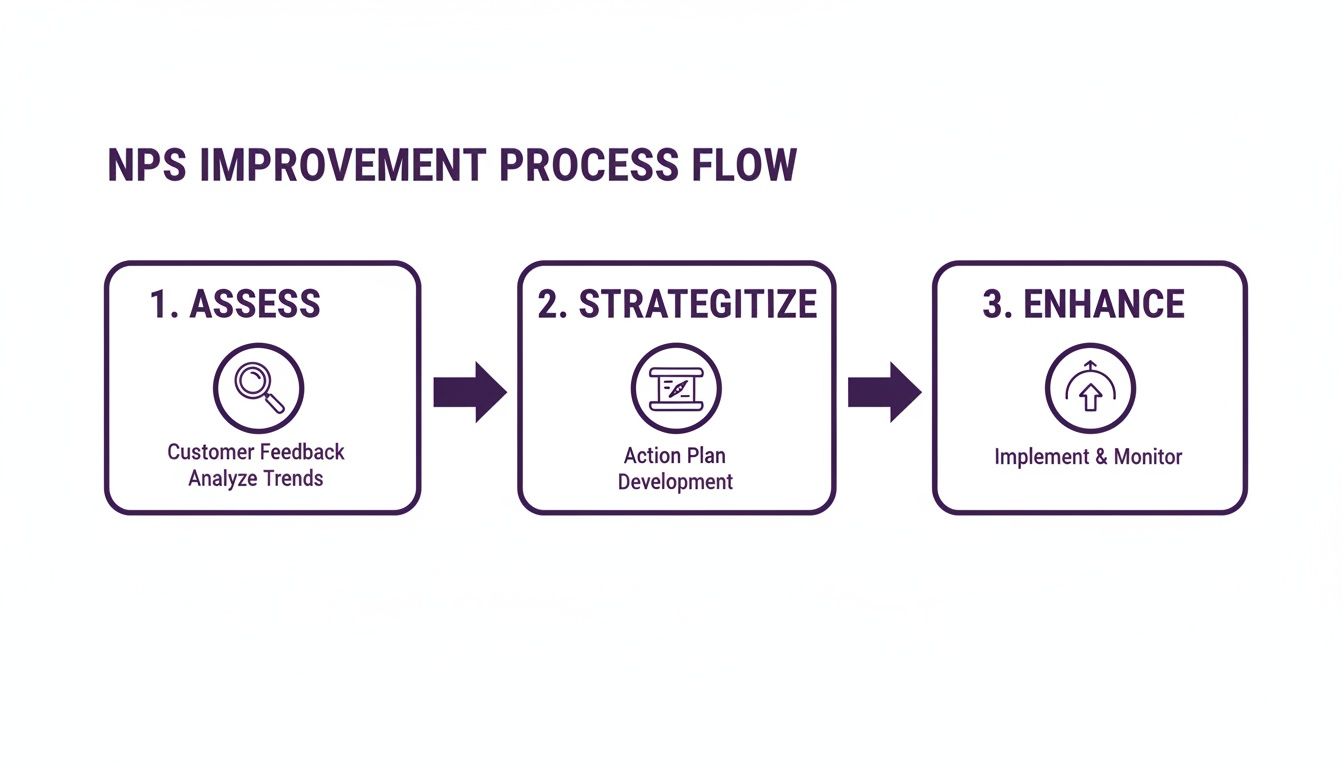
This visual drives home the point that improving NPS isn’t a one-and-done project. It’s a continuous cycle of assessing feedback, building a strategy, and enhancing the customer experience.
How to Improve Net Promoter Score with Data Segmentation
A raw, company-wide NPS score is a good start, but segmented data is where the real power lies. Grouping customers by shared characteristics reveals patterns a single score would hide. This is how you pinpoint service gaps with surgical precision.
Imagine a financial services firm discovers that while its wealth management clients are Promoters, its new mortgage applicants are almost all Detractors. That insight immediately points to a problem with the mortgage onboarding process, not the entire company.
Here are a few practical ways to segment your NPS data:
- By Customer Lifecycle Stage: Are new customers happier than long-term clients?
- By Product or Service Used: How does feedback for Product A compare to Product B?
- By Support Channel: What’s the experience for customers using phone support versus live chat?
- By Geography: Are there regional differences in customer satisfaction?
“Segmentation turns a vanity metric into a diagnostic tool. It shows you not just what your score is, but where your customer experience is breaking down.”
This level of detail is essential for creating targeted improvement plans and is a core function of any effective call center reporting and metrics dashboards. A nearshore partner like CallZent, operating in the same time zones as North American markets, can manage bilingual data collection and follow-up around the clock, ensuring you act on insights with integrity and speed.
Closing the Loop: How to Turn Detractors into Promoters
Gathering feedback is just the start. The real transformation—the kind that moves your Net Promoter Score—happens when you do something with it. This is where “closing the loop” comes in. It’s the critical process of following up with customers after they’ve given you their honest opinion. Without it, your NPS survey is just data collection, not a tool for growth.
When you act on feedback, you show customers you’re listening. It’s the most direct way to prove you have a customer-first culture and gives you a golden opportunity to resolve issues and even turn a terrible experience into a loyalty-building moment.

A Rapid-Response Protocol for Detractors
Detractors (scores 0-6) are your biggest risk and your greatest opportunity. They’ve had a bad experience, but they also gave you a gift: they told you about it. A swift, empathetic response can completely flip their perception of your brand. Your absolute first priority should be to reach out, listen, apologize, and solve the problem. A follow-up within 24 hours is the gold standard.
Here’s a simple, real-world protocol for engaging Detractors:
- Acknowledge and Apologize: Start by thanking them for their feedback and offering a sincere apology. “I’m so sorry we let you down” works wonders.
- Listen to Understand: Ask open-ended questions to get to the root of their frustration. Let them talk without interrupting.
- Resolve the Issue: Empower your team to fix the problem on the spot. If it’s complex, give the customer a clear timeline and a single point of contact.
- Document and Escalate: Log the feedback and send it to the right department—product, operations, or billing—to fix the underlying systemic issue.
Proactive Tactics to Engage Passives
Passives (scores 7-8) are your biggest untapped resource. They don’t hate you, but they aren’t loyal, either. The key is to figure out what’s holding them back. Reaching out shows you’re committed to being great, not just “good enough.”
For instance, ask a passive customer, “We’re glad your experience was okay, but we’re always aiming for great. What’s one thing we could have done to make it a 10?” This question often uncovers incredibly valuable insights—a missing feature, a confusing checkout process—that can elevate your entire service. Our guide on using customer feedback for continuous improvement dives deeper into turning these conversations into real strategies.
Activating Your Promoters for Growth
Promoters (scores 9-10) are your biggest fans, and closing the loop with them is just as vital. Don’t take their loyalty for granted. A follow-up here isn’t about fixing a problem; it’s about reinforcing their positive feelings and channeling their enthusiasm.
First, thank them genuinely for their support. Then, you can put their loyalty into action:
- Ask for a Testimonial: “We’re thrilled you had a great experience! Would you share a brief testimonial for our website?”
- Request a Review: “Positive reviews help others find us. If you have a minute, would you mind leaving a review on [Platform]?”
- Launch a Referral Program: Offer them a small incentive for sending new customers your way.
By engaging each segment with a tailored approach, you build a powerful engine for growth. At CallZent, our bilingual agents in Tijuana are trained in empathetic problem-solving, turning these critical customer interactions from risks into loyalty-building opportunities.
Using Feedback to Drive Real Operational Change
Closing the loop with individual customers is a must, but it’s fundamentally reactive. For sustainable, long-term growth in your Net Promoter Score, you must leap from fixing one-off problems to fixing the systemic issues that create them. This is where you connect raw customer feedback to real internal improvements.
True operational change happens when you stop seeing Detractor comments as complaints and start treating them as a free diagnostic tool. Every piece of negative feedback is a breadcrumb trail leading to a deeper issue—a confusing product feature, a process bottleneck, or a gap in agent training.
How to Turn Individual Comments into Systemic Fixes
First, categorize your feedback. Don’t just obsess over scores; dive into the open-ended comments and tag them with themes. You’ll see patterns emerge almost immediately.
- Tech Gaps: Are agents struggling with clunky systems? Multiple transfers and long holds are often symptoms of a technology problem, not a people problem.
- Process Bottlenecks: Do Detractors mention repeating their story to three different people? That’s a classic sign of a broken internal handoff process.
- Product Flaws: If one specific feature generates a massive chunk of complaints, that feedback needs to be sent directly to your product team.
- Policy Issues: Feedback will shine a light on company policies that feel unfair or rigid to customers.
“Your most unhappy customers are your greatest source of learning. Their feedback isn’t just a complaint to be resolved; it’s a free consultation on how to build a better business.”
By analyzing these patterns, you can prioritize changes that will actually move the needle. Fixing a single product bug that frustrates 20% of your Detractors is a far more powerful way to boost your NPS than just apologizing to each of them.
How to Improve Net Promoter Score with Agent Coaching
Your frontline agents are the face of your company, and their performance is directly tied to your NPS. Detractor feedback is a goldmine for targeted, effective coaching that goes beyond generic “customer service 101.”
Imagine a trend where Detractors say agents sound robotic. You can use those exact comments to build a coaching session on active listening and personalization. Role-playing scenarios based on actual complaints is incredibly effective.
Here’s how to translate feedback into powerful coaching:
- First-Contact Resolution (FCR) Training: Use cases where a customer had to call back multiple times as case studies for training agents on taking ownership.
- De-escalation Techniques: Pull comments from highly emotional Detractor interactions to train agents on acknowledging frustration and steering conversations toward a resolution.
- Empathy and Tone Workshops: Use call recordings from high-NPS and low-NPS interactions. Let agents hear the difference in tone and language.
This approach empowers your team to become champions of your NPS strategy. For a deeper look, our guide on quality assurance in call center operations lays out a complete framework.
How a Nearshore BPO Can Supercharge Your NPS
Let’s be honest: maintaining a high Net Promoter Score demands a dedicated team, the right tech, and an expertise that’s tough and expensive to build in-house. This is where a strategic partnership with a nearshore BPO like CallZent can completely change the game, turning your NPS from a passive metric into an engine for growth.
When you partner with a nearshore call center, you’re not just outsourcing calls. You’re bringing in a specialized force that lives and breathes customer loyalty, freeing your internal teams to focus on innovation.

Unlocking Cost-Efficiency and Cultural Alignment
One of the biggest wins with a nearshore model is the perfect mix of cost savings and cultural fluency. Unlike distant offshore locations, nearshore hubs like Tijuana, Mexico, are in the same time zones and deeply in sync with U.S. markets. This means agents understand the cultural nuances and conversational flow, making every interaction feel natural and effective.
This cultural synergy is a direct pipeline to a better NPS. When customers feel truly understood, their satisfaction shoots up. A good nearshore BPO partner delivers this high-touch support for a fraction of the cost of an in-house team.
Accessing a Deep Bilingual Talent Pool
In today’s market, speaking both English and Spanish is essential. A nearshore partner in Tijuana instantly plugs you into a huge pool of highly skilled bilingual talent, a massive advantage for boosting your NPS across all customer demographics.
For example, a healthcare provider using a nearshore BPO for 24/7 patient support can provide a Spanish-speaking patient with clear, empathetic help at any time. What could have been a stressful experience becomes a positive one that builds loyalty.
“Strategic outsourcing isn’t just about cutting costs. It’s about gaining capabilities. A nearshore BPO provides the specialized talent and infrastructure to turn your customer support from a cost center into a powerful driver of customer loyalty and NPS growth.”
Real-World Scenarios: The Nearshore BPO Advantage
The impact of a nearshore BPO on NPS becomes clear in real-world situations. Consider an e-commerce brand hit with a massive wave of inquiries during the holiday season. Without proper support, long wait times can tank an otherwise stellar NPS. A nearshore partner provides the scalability to handle those spikes seamlessly, ensuring every customer gets fast, professional service and protecting the brand’s score during its most critical season. For BPOs looking to sharpen their edge, integrating tools like SupportGPT’s AI-powered platform can help agents handle these interactions even more effectively.
How to Drive NPS with Specialized Call Center Services
Every service a BPO offers can be tied directly to a healthier NPS:
- 24/7 Inbound Support: Customers get help on their schedule, not just during business hours.
- Technical Support: Complex problems get solved quickly, turning frustration into relief.
- Lead Generation: The right expectations are set from the very first conversation.
- Virtual Assistance: Flawless handling of administrative tasks creates a seamless background experience.
In the call center world, an NPS above 50 is excellent. Studies show that call centers reducing detractors by just 10% can see their NPS jump by 15-20 points in a few quarters. That’s the kind of result you get by leveraging the 24/7 English-Spanish support and quick response times of a nearshore model, which can slash resolution times by up to 40% (call center statistics and reports).
Common Questions on How to Improve Net Promoter Score
Jumping into an NPS program can bring up a lot of questions. As a BPO leader, we’ve heard them all. Here are straight answers to the most common ones.
How often should we send NPS surveys?
There’s no single “right” answer—the perfect timing depends on your business model.
- For transactional businesses (e.g., e-commerce), the best moment is immediately after a key event, like a purchase or a resolved support ticket. This captures fresh feedback.
- For relationship-driven businesses (e.g., SaaS, finance), it’s often better to send a relational survey quarterly or semi-annually. This gives a big-picture view of overall loyalty.
The key is to gather consistent data without fatiguing your customers.
What is a good Net Promoter Score to aim for?
A “good” NPS is relative. While any score above 0 is positive and anything over 50 is excellent, the most important benchmark is your own score from last quarter. Your goal should always be steady improvement. It’s also smart to see how you stack up against your industry average. The real goal isn’t to hit a magic number but to become a leader in your competitive space.
The best benchmark for your NPS is your score from last quarter. Consistent internal improvement is more valuable than constantly chasing a competitor’s number.
Can a small business realistically implement an NPS program?
Absolutely. The beauty of NPS is that its core principles work for any size business. You don’t need a huge budget to get started. A small business can use free or low-cost survey tools. The most important first step is closing the feedback loop with every Detractor. Those initial conversations will give you invaluable insights. Partnering with a flexible BPO like CallZent makes it surprisingly affordable to manage customer feedback professionally right from the start.
Which departments should be involved in our NPS strategy?
A successful NPS program is a company-wide mission, not just a customer service project.
- Product Team: Needs to hear from Detractors to squash bugs and fix clunky features.
- Marketing Team: Can turn Promoter feedback into powerful testimonials and case studies.
- Sales Team: Can learn if expectations weren’t met during the sales process.
- Operations Team: Can spot process bottlenecks creating friction for customers.
When everyone feels ownership over the customer experience, your NPS will naturally climb.
Ready to Turn Customer Feedback into Higher NPS?
CallZent helps brands operationalize a closed-loop NPS system—fast follow-ups, bilingual coverage, QA-backed coaching, and reporting that drives real change from our nearshore center in Tijuana.
Ready to turn your customer feedback into a powerful engine for growth? CallZent provides the specialized teams and proven strategies to elevate your Net Promoter Score from our nearshore center in Tijuana. Discover how our solutions can help you build lasting customer loyalty. Learn more at CallZent.com.