Skip to content
Lead Generation Outsourcing
How to Outsource Lead
Generation: Best Vendors, Pricing & Metrics
Learn how to outsource lead generation the smart way. Explore costs, KPIs, vendor types, and why nearshore outsourcing drives better pipeline efficiency.
TL;DR — Quick Takeaways
- Outsourcing lead generation frees your sales team to focus on closing deals.
- Nearshore partners offer ideal balance of cost, quality, and time-zone alignment.
- Top KPIs include MQLs, Appointment Setting Rate, CPA, and Lead-to-Close Ratio.
- Expect $6k–$15k/month for nearshore outsourcing vs. $20k+ in-house costs.
Is your sales team drowning in prospecting tasks instead of actually closing deals? If that sounds familiar, it’s a big, flashing sign that it might be time to outsource lead generation. This isn’t just about trimming the budget; it’s a strategic move to fast-track growth. By partnering with specialists who live and breathe pipeline-building, you let your team get back to what they do best—winning new business.
Is It Time to How to Outsource Lead Generation?
Most companies hit a point where the decision to outsource becomes unavoidable. It usually happens when they hit a growth ceiling. Your in-house sales team, the pros at building relationships and closing, suddenly find themselves spending up to 40% of their time digging for leads and doing cold outreach.
That’s not just inefficient; it’s a massive bottleneck holding back your revenue. When your closers are stuck doing top-of-funnel work, the whole sales engine starts to sputter. This is the classic scenario where bringing in an outside partner is less of a nice-to-have and more of a strategic necessity.
Gaining a Strategic Advantage When You
Outsource Lead Generation
When you outsource lead generation, you’re essentially plugging into a high-performance system that’s already built and humming along. A professional BPO partner gives you instant access to:
- Specialized Expertise: You get a team of trained agents whose entire job is prospecting, qualifying leads, and setting solid appointments. They do this all day, every day.
- Advanced Technology: These partners come with a full tech stack—CRMs, data platforms, automation software—saving you a small fortune in licensing and setup fees.
- Scalability on Demand: Need to ramp up for a big campaign or scale back during a slow season? You can do it almost overnight without the headache of hiring or laying people off.
This completely transforms the top of your funnel from a time-suck into a predictable, well-oiled machine. It’s one of the main reasons why so many companies choose to outsource their work—it just makes good business sense.
The data doesn’t lie, either. Outsourced lead gen campaigns can deliver results that are roughly 43% better than programs run in-house. That boost comes from the focused, data-driven approach that dedicated agencies bring to the table. In a world where it can take nearly six touchpoints to even get a buyer’s attention, that expertise is everything.
The bottom line is simple: Outsourcing lead generation isn’t about losing control. It’s about gaining a serious strategic advantage in a noisy market.
By handing off the heavy lifting of finding and qualifying leads to a nearshore BPO like CallZent, you empower your internal team to focus exclusively on high-value, revenue-generating activities. This smart division of labor doesn’t just improve morale; it directly shortens your sales cycle and fuels sustainable growth.
Comparing Nearshore, Offshore,
and Domestic Partners
So, you’ve decided outsourcing your lead gen is the right move. Smart. Now comes the real question: where do you find your partner? This isn’t just about picking a spot on a map; it’s a strategic decision that will shape everything from your budget and communication flow to the actual results you get.
Each model—domestic, offshore, and nearshore—comes with its own unique flavor of pros and cons. The right fit for you hinges entirely on what you’re trying to achieve, how complex your sales process is, and of course, how much you’re looking to spend.
This quick decision tree gives you a visual on that initial thought process. If your sales team is already swamped, you’re looking at a huge green flag for outsourcing.
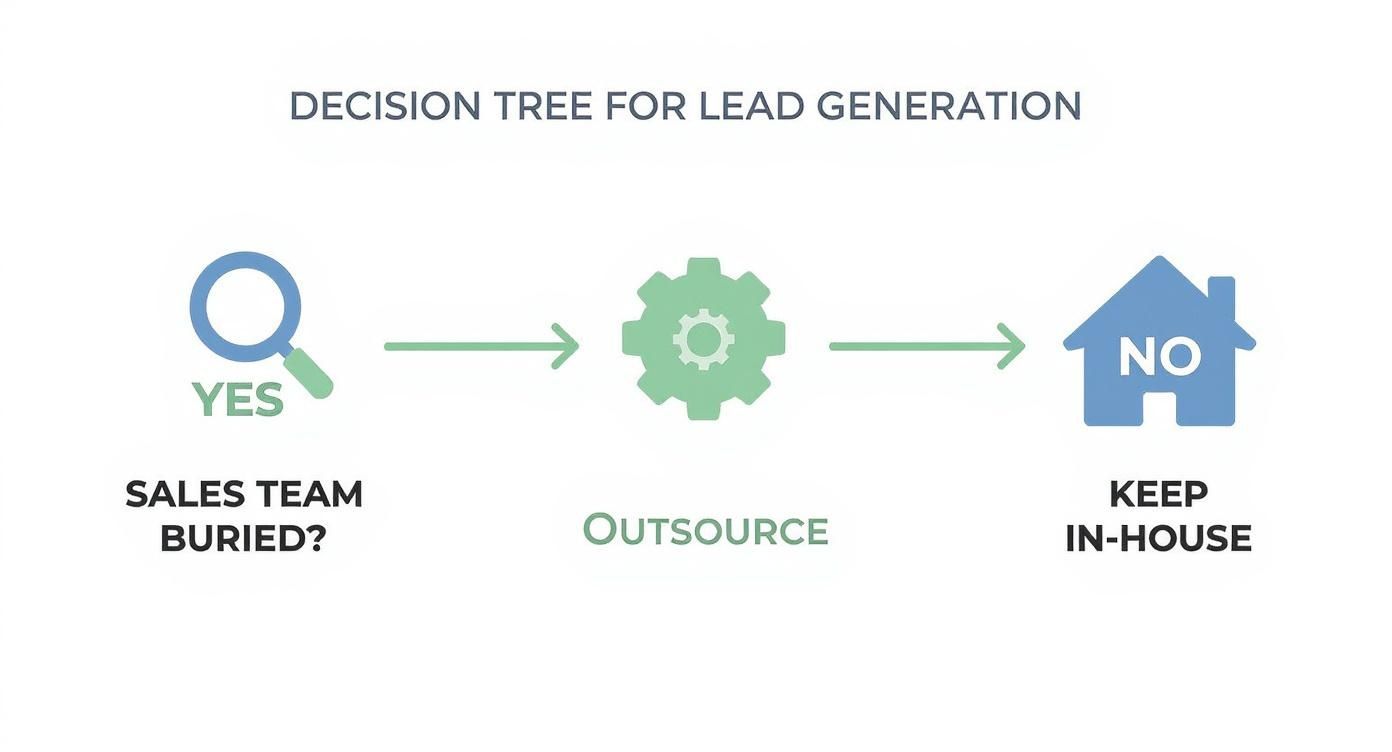
As you can see, an overburdened sales team is often the first sign that it’s time to bring in a partner to handle the top of the funnel.
The Domestic Outsourcing Model
Keeping your lead generation partner in your own backyard offers the path of least resistance. Culturally, you’re on the same page. Linguistically, there are zero barriers. And forget about wrestling with time zones; everyone’s working on the same clock.
This is the go-to for companies with a really complex product or a hyper-niche market. For example, a U.S.-based medical device company selling a new surgical robot to American hospitals. A domestic team will instantly get the nuances of the U.S. healthcare system, the regulatory minefields, and how to talk to hospital administrators without sounding like an outsider.
But that seamless communication comes with a hefty price tag. Domestic outsourcing is, by a long shot, the most expensive option. For a lot of businesses, especially those trying to scale without breaking the bank, the cost is a non-starter.
The Offshore Outsourcing Model
Fly to the other end of the cost spectrum and you’ll find the offshore model, partnering with a BPO in a country like India or the Philippines. The number one reason companies go this route? Cost. The savings on labor can be massive.
It’s an incredibly compelling option for high-volume, low-complexity campaigns where the budget is tight. Imagine an e-commerce brand that wants to call thousands of people who abandoned their shopping carts. An offshore team can run through a simple script and do that work for a fraction of what it would cost anywhere else.
The trade-offs can be pretty stark, though. A 10-12 hour time difference can make real-time collaboration a nightmare. And while many agents speak excellent English, subtle cultural and linguistic gaps can sometimes lead to awkward conversations with prospects, which might impact lead quality if you’re not careful.
The Nearshore Advantage for how to outsource Lead Generation
This is where things get interesting. Nearshore outsourcing, like partnering with us at CallZent in Tijuana, Mexico, strikes a killer balance between the domestic and offshore worlds.
You get the serious cost savings of outsourcing without the headaches that come with being halfway around the globe. It’s the best of both worlds, really.
- Time Zone Alignment: Our teams work in the same time zones as the U.S. Need to hop on a quick call to tweak the messaging? It’s as easy as calling a colleague down the hall. No waiting overnight for an answer.
- Cultural Affinity: Being neighbors means we share a deep understanding of North American culture, business etiquette, and humor. Conversations feel natural, not forced, which makes a huge difference in building rapport.
- Cost-Effectiveness: You get significant savings on labor and operational costs, but without sacrificing the quality that comes from seamless, real-time collaboration.
Imagine you’re a B2B software company running a campaign that needs daily check-ins and quick adjustments based on prospect feedback. A nearshore partner is perfect for that. The constant communication keeps the campaign agile and sharp. If you want to go deeper on this, check out our breakdown of nearshore vs offshore call centers.
Comparing Outsourcing Models:
Nearshore vs. Offshore vs. Domestic
To make this even clearer, I’ve put together a simple table that lays out the core differences. It’s a quick way to see how the three models stack up against each other based on what matters most to your business.
| Factor | Nearshore (e.g., Tijuana) | Offshore (e.g., India) | Domestic (e.g., USA) |
|---|---|---|---|
| Cost Savings | High | Highest | Low |
| Time Zone Alignment | Excellent (Overlapping hours) | Poor (Significant difference) | Perfect (Same time zones) |
| Cultural Affinity | High (Shared cultural context) | Moderate to Low | Excellent (Native culture) |
| Real-Time Collaboration | Easy and seamless | Difficult and requires planning | Easy and immediate |
| Talent Pool | Large, bilingual workforce | Very large, English-speaking | Large, but competitive |
| Best For | Complex campaigns needing collaboration and cost-efficiency. | High-volume, simple tasks where cost is the priority. | Highly nuanced campaigns where budget is not a constraint. |
Ultimately, the best choice depends on your priorities. If budget is your only concern, offshore is hard to beat. If money is no object and cultural alignment is everything, domestic is your play. But for that sweet spot of cost, culture, and collaboration, nearshore is tough to top.
 How to Vet Your Potential
Lead Generation Partner
Alright, you’ve got a shortlist. Now comes the hard part: vetting. This is where you cut through the slick sales pitches and separate the real partners from the pretenders. A flashy website means nothing if they can’t back it up with process, technology, and a solid track record.
Your mission here is to dig deep. You need to be absolutely sure they’re the right fit to represent your brand.
Making the wrong choice isn’t just a financial hit—it’s wasted time, lost opportunities, and potential damage to your reputation. A thorough, no-stone-unturned evaluation is your only real defense against a bad partnership.
Gauging True Industry Expertise
Every single agency will tell you they’re an expert. Your job is to make them prove it. Generic experience is table stakes; you need a partner who gets the nuances of your industry and has the wins to show for it.
Don’t be shy. Ask the tough questions that force them off-script. This is how you find out if they’ve actually been in the trenches or are just feeding you lines.
Here are the questions I always lead with:
- “Can you show me a case study from a client with a customer profile just like ours?” This weeds out the generalists fast.
- “What’s the biggest challenge you’ve faced targeting our specific industry, and how did you solve it?” This reveals their problem-solving chops and, just as importantly, their honesty.
- “Who on your team is actually running my account, and what’s their background in my vertical?” The person selling you the dream is rarely the one doing the work. You need to know the day-to-day team has real experience.
A confident partner will have these answers ready to go. Any hesitation or vague hand-waving is a massive red flag. For some good benchmarks on what top-tier providers look like, check out a curated list of lead generation outsourcing companies.
Key Takeaway: Past performance is the best predictor of future success. Don’t settle for a partner who can’t prove they’ve successfully navigated your market before.
Scrutinizing the Technology Stack
The tools an agency uses have a direct line to their efficiency and the quality of leads you get. In this day and age, a modern partner needs a robust tech stack that covers everything from prospecting to reporting.
Just having a CRM isn’t enough. You need to know how their systems talk to each other and, more importantly, how they talk to yours. An outdated or disjointed tech stack is a recipe for bad data, missed follow-ups, and a total lack of transparency.
Get granular with their tech:
- CRM and Integration: Are they on a major platform like Salesforce or HubSpot? Great. But the real question is, how painlessly can it integrate with your own system? A smooth data flow is non-negotiable.
- Prospecting and Data Tools: What are they using for data acquisition? Think ZoomInfo or LinkedIn Sales Navigator. And how do they keep that data fresh and accurate?
- AI and Automation: How is AI actually being used? Is it just a buzzword on their website, or can they give you specific examples, like using it for script optimization, predictive lead scoring, or personalizing outreach at scale?
A forward-thinking BPO will be excited to pop the hood and show you their tech stack. They’ll be able to explain how every tool plays a part in getting you better results.
Evaluating Agent Training and Quality Assurance
This might be the most critical piece of the puzzle. The agents on the phone are your brand to a potential customer. If their training is weak or their QA process is a joke, you’re setting yourself up for disaster. Think off-brand messaging, botched calls, and leads that are anything but qualified.
This is a dealbreaker. The best partners invest heavily in their people because they know that well-trained, supported agents are the ones who deliver.
Here’s what to zero in on:
- Onboarding and Brand Immersion: What’s their process for turning a new agent into an expert on your company, your product, and your unique brand voice?
- Ongoing Training: How do they keep their agents sharp? Look for signs of continuous coaching and skill development, not just a one-and-done onboarding.
- Quality Assurance Loop: Ask them to walk you through their QA process. Do they do regular call monitoring? How is feedback given to agents? A closed-loop system where feedback leads directly to coaching and improvement is the gold standard.
A structured, transparent process for training and QA is a clear signal that they’re committed to excellence. It’s the only way to ensure the team representing you is always on their A-game.
Understanding Pricing Models
and Contract Terms
Navigating pricing structures and contracts can feel like walking through a minefield. Get it wrong, and you could end up paying a fortune for dismal results. But when you get it right, you build a partnership where everyone is motivated to win.
The key is figuring out which common models align with your actual business goals. There’s no single “best” option—the right choice depends entirely on what success looks like for your specific campaign.
Demystifying Common Pricing Models for Lead Generation
When you start talking to potential partners, you’ll run into three main pricing structures. Each has its own rhythm, and it’s on you to match the model to what you’re trying to achieve.
- Pay-Per-Lead (PPL): This one is pretty straightforward. You pay a fixed price for every lead that meets a pre-agreed set of criteria—think correct industry, company size, or job title. The model is predictable, but you absolutely have to nail down the definition of a “qualified lead” to avoid paying for junk.
- Pay-Per-Appointment (PPA): This takes it a step further. You only pay when your partner successfully books a meeting or demo with a qualified prospect. This model tightly aligns incentives, as the BPO only gets paid for tangible results that actually move the needle for your sales team.
- Monthly Retainer: Here, you’re paying a fixed monthly fee for a dedicated team, a certain number of hours, or a specific scope of work. This is the go-to for complex, long-term campaigns that need multi-touch nurturing and real relationship-building. It gives the partnership stability and lets your vendor invest deeply in your success.
No matter which model you lean toward, you have to get a handle on your numbers. A crucial first step is mastering your Cost Per Lead (CPL) calculation. This metric is the bedrock for measuring ROI and knowing if your campaign is actually profitable.
For example, a B2B SaaS company launching a new product whose main goal is to book as many demos as possible would find a pay-per-appointment model to be a perfect fit. It guarantees they’re only paying for scheduled meetings, directly linking their investment to their core objective.
Scrutinizing the Fine Print of Your Contract
A great pricing model means very little without a solid contract to back it up. Think of the contract as your safety net—it defines the rules of engagement and protects your interests. Don’t just skim it; read every single clause.
Let’s be honest, cost is a huge driver here. Building an in-house lead gen team can easily take 3-6 months and cost $20,000 to $30,000 a month. In contrast, you can get an outsourced team up and running in just 2-4 weeks for $6,000 to $15,000 a month. That’s a massive reduction in both setup time and overhead.
Here are the non-negotiables you need to look for in any agreement:
- Service Level Agreements (SLAs): This is the heart of your contract. It needs to spell out, in no uncertain terms, what a “qualified lead” is, the expected volume of leads or appointments per month, and what happens if those targets aren’t met.
- Data Security and Confidentiality: Your customer data is gold. The contract must detail exactly how your partner will protect this information, comply with regulations like GDPR or CCPA, and handle data securely.
- Exit Clause and Termination Terms: What happens if the partnership just isn’t working out? A clear exit clause should outline the notice period and the process for ending the contract. The last thing you want is to be locked into a long-term, underperforming relationship.
Your contract should be a blueprint for a successful partnership, not a trap. A transparent and fair agreement protects both parties and sets the stage for mutual growth.
Knowing these details gives you the power to negotiate a contract that truly works for your business. For a deeper dive into the numbers, check out our call center outsourcing cost breakdown.
 Kicking Off and Managing
Your Outsourced Campaign
A great partnership doesn’t just happen. It’s built on a rock-solid, collaborative foundation right from the start. Launching your campaign is the first real test of this relationship, where you move from contracts and promises to actual, tangible results.
The whole point is to create a seamless transition where your outsourced team feels less like a vendor and more like an extension of your in-house crew.
This all kicks off with a deep-dive onboarding process. This is where both sides roll up their sleeves and get completely aligned. It’s where you build the playbook that will guide every single conversation your new team has with potential customers. Rushing the launch is a recipe for missed targets and muddled messaging.
Building the Campaign Blueprint Together
The best campaigns always start with a detailed campaign brief. This isn’t just some form your partner fills out; it’s a hands-on, collaborative workshop. You bring your deep knowledge of the product and market, and they bring their expertise in outreach and execution.
First up, you’ll meticulously define your Ideal Customer Profile (ICP). This goes way beyond basic stats like industry and company size. You need to get into the nitty-gritty of their pain points, the common objections they throw up, and the specific triggers that make them a perfect fit.
From there, it’s all about scripting and messaging. A top-tier partner won’t just take your existing sales collateral and run with it. They’ll work with you to craft and sharpen scripts that sound natural, hit prospect needs head-on, and are built to convert. This back-and-forth ensures your brand’s voice comes through loud and clear. For some fresh ideas on messaging, check out our guide on powerful outbound lead generation strategies.
Defining Lead Generation KPIs That Actually Matter
Success in lead gen is about so much more than just call volume. You have to look past the vanity metrics and zero in on the numbers that directly fatten your pipeline. Setting and tracking the right Lead Generation Key Performance Indicators (KPIs) is non-negotiable if you want predictable growth.
Here are the core metrics you should have on your dashboard:
- Marketing Qualified Leads (MQLs): The total number of leads that hit your pre-defined criteria. This is your main gauge of top-of-funnel quality.
- Appointment Setting Rate: The percentage of good conversations that turn into a booked demo or meeting for your sales reps. It shows how good the agents are at turning interest into action.
- Cost Per Acquisition (CPA): Your total campaign cost divided by the number of new customers you landed. This is the ultimate measure of ROI and financial efficiency.
- Lead-to-Close Ratio: What percentage of leads from your partner actually end up signing on the dotted line? This metric shows the true bottom-line impact of the whole operation.
“Your KPIs are your campaign’s North Star. If you’re not tracking metrics that tie directly to revenue, you’re flying blind.”
It’s also smart to know the industry benchmarks when you set these goals. For instance, tech and financial services often have a higher cost per lead because of longer sales cycles. A tech lead might average $208, while a financial services lead can climb past $160. An experienced agency knows this and will fine-tune the campaign, aiming for an industry-average conversion rate of about 2.9% by using a mix of targeted channels.
Establishing a Rhythm of Communication and Optimization
Once the campaign goes live, the real work begins. The secret to continuous improvement is a steady, predictable communication rhythm. Vague, infrequent updates are a massive red flag. A partner worth their salt will insist on a structured review process.
The best practice here is a weekly performance review meeting. This keeps everyone accountable and ensures the campaign is nimble enough to pivot based on real-time feedback and results.
A productive weekly review should look something like this:
- Performance Check-In: A quick rundown of the week’s core KPIs against the targets you both agreed on.
- Quality Deep-Dive: Listen to a few sample call recordings together—the good, the bad, and the ugly. This is where you discuss agent performance, script effectiveness, and brand voice.
- Sales Feedback Loop: Your sales team gives direct, unfiltered feedback on the quality of the appointments and leads they received. Is the info accurate? Are the prospects truly qualified?
- Action Plan: Together, you decide on specific, actionable tweaks for the next week. This could be anything from refining a script, adjusting the target list, or giving an agent some extra coaching.
This constant loop of data, feedback, and adjustment is what separates a flat, underperforming campaign from one that learns, adapts, and consistently drives incredible results for your business.
Putting It All Together:
Building a Stronger Sales Pipeline
When it comes down to it, the decision to outsource lead generation isn’t just about offloading tasks—it’s a strategic move toward building predictable, sustainable growth. It’s about finally transforming your sales pipeline from a hit-or-miss stream into a well-oiled machine that consistently fuels your business.
We’ve covered a lot of ground in this guide, from doing that critical internal gut-check to picking the right kind of partner—whether they’re nearshore, offshore, or right here at home. A solid contract with clear SLAs becomes your playbook for a healthy, transparent relationship. From there, it’s all about a collaborative launch and smart, ongoing management to make sure your campaign not only works but gets better over time.
By bringing in a dedicated team, you free up your in-house closers to do what they do best: close deals. That synergy creates a powerful momentum that strengthens your entire sales operation from top to bottom.
A robust sales pipeline isn’t just about having more names on a list; it’s about the quality and predictability of your opportunities. Outsourcing is the most direct path to getting both right.
This shift does more than just fill calendars with appointments. It builds a stronger, more resilient sales engine—one that can handle market shifts and drive real, long-term success.
Ready to build a more powerful and predictable sales pipeline? It all starts with a simple conversation. Contact CallZent today to talk through your lead generation goals with an expert.
Answering Your Outsourcing
Lead Generation Questions
Deciding to outsource lead generation is a big move, and it’s natural to have a few questions swirling around. Let’s be honest, it’s a major strategic shift. Before you jump in, you need to feel confident about the process. Here are some of the most common questions we hear from companies weighing their options.
How Can an Outsourced Team Really Sound Like Us?
This is probably the biggest concern we hear, and it’s a valid one. You’ve spent years building your brand voice, and the last thing you want is a team that sounds scripted or disconnected.
Any partner worth their salt gets this. Making an outsourced team an extension of your own comes down to a seriously deep onboarding process. We’re not just talking about handing over a call script. It involves digging into your company’s values, personality, and unique place in the market.
Think collaborative workshops to hammer out messaging, intensive training on your products, and a constant feedback loop with call monitoring. A quality BPO will have a transparent quality assurance program to make sure every single conversation feels like it’s coming straight from your headquarters.
Realistically, How Long Does it Take to Launch an
Outsourced Lead Generation Campaign?
This is where outsourcing really shines. While every campaign is different, a good BPO partner can get a new lead generation campaign fully launched in just 2 to 4 weeks.
That timeframe packs in all the essentials:
- Initial discovery calls and strategy sessions
- Building out scripts and messaging together
- Getting agents trained on your systems and offers
- Running final tests to make sure everything is perfect
Compare that to the 3-6 months it typically takes to recruit, hire, train, and get an in-house team firing on all cylinders. You’re getting to market and seeing results much faster.
One of the biggest wins with outsourcing is skipping the long internal ramp-up. You can start generating qualified leads and seeing a return on your investment in weeks, not months.
How Do I Keep Tabs on Performance and ROI?
You should never feel like you’re in the dark. A solid partnership is built on total transparency, which means you need access to a real-time reporting dashboard tracking all the KPIs that you care about.
At a minimum, you should expect regular, easy-to-read reports covering the core metrics: dials, contact rates, Marketing Qualified Leads (MQLs), appointments set, and, of course, your cost per lead. This steady stream of data is what allows you to measure ROI accurately and work with your partner to tweak and optimize the campaign as you go.
What if the Lead Quality Isn’t What We Expected?
This is the true test of a partner. A great BPO doesn’t make excuses—they have a plan. If lead quality ever dips, they should be the ones scheduling a call to dive into the data with you.
The process involves analyzing call recordings, tightening up the targeting criteria, refining the scripts, and providing specific coaching to the agents. A proactive partner will see the dip and come to you with a solution already in mind.
The best way to sidestep this issue from the start is to get crystal clear on what a “qualified lead” looks like in your initial service level agreement (SLA). When everyone is aligned on the definition of success from day one, you have a clear benchmark to measure against.
🚀 Ready to Scale Your Pipeline with Predictable Results?
Partner with CallZent’s nearshore lead generation experts and unlock faster, smarter, cost-efficient growth.
Ready to stop wondering and start building a stronger sales pipeline? The team at CallZent has the answers and the results you’re looking for.
Schedule a consultation with our lead generation experts today!