Skip to content
Home ›
Blog › Customer Experience
What Does It Mean to Humanize Your Brand?
Humanizing your brand isn’t a buzzword—it’s a shift from transactional interactions to genuine, trust-based relationships that create lasting loyalty. For customer-facing teams, especially in BPO and call centers, it’s now essential for growth.
By CallZent Editorial Team Updated
TL;DR: The Core Meaning of a Humanized Brand
- What it is: Humanizing your brand means showing the real, relatable people and values behind your company. It’s about communicating with authenticity, empathy, and transparency.
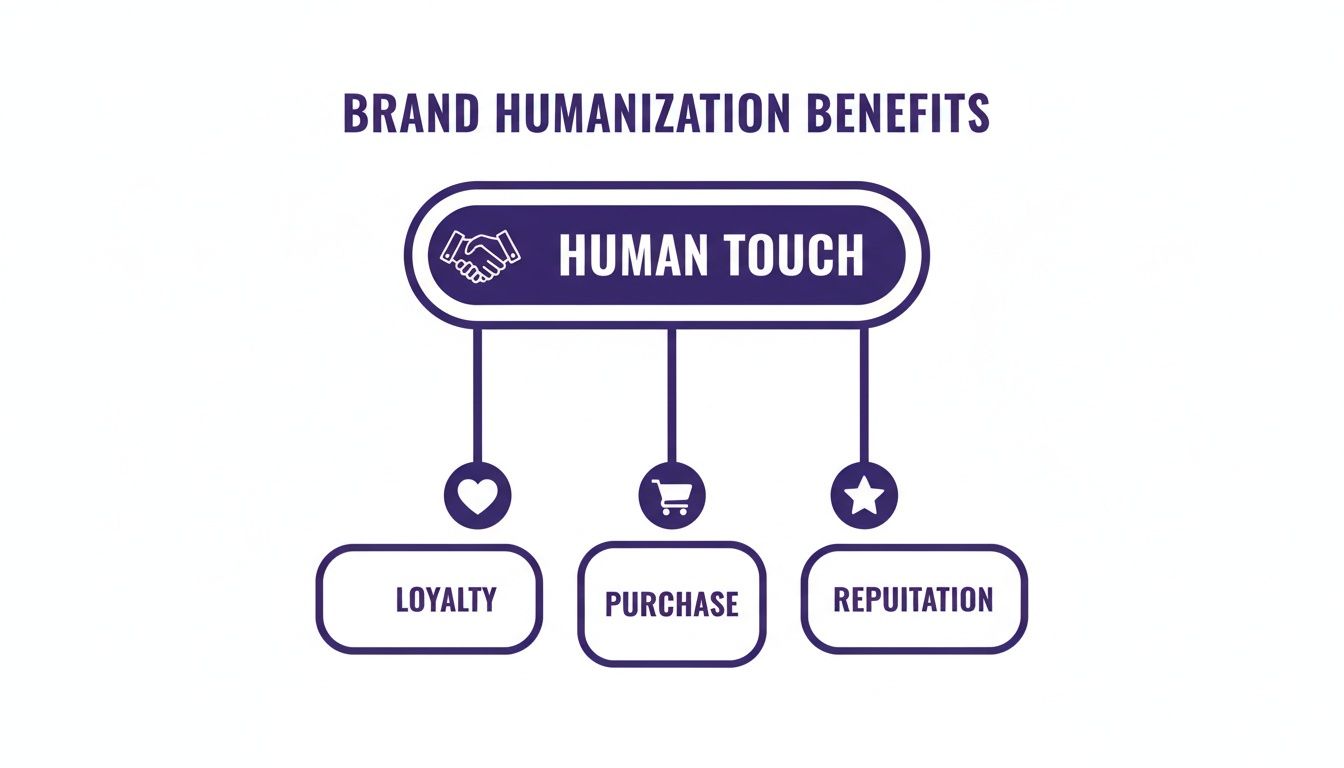
- Why it matters: It builds trust, increases customer loyalty, and differentiates you from competitors who rely solely on automation. A human touch turns one-time buyers into lifelong advocates.
- How to do it: Develop an authentic brand voice, empower your teams to lead with empathy, and commit to transparency in all interactions, especially in customer service.
the single greatest advantage you have is your ability to connect on a human level. Humanizing your brand isn’t just a marketing buzzword;
it’s a fundamental shift from transactional interactions to building genuine, trust-based relationships that create lasting loyalty.It means swapping rigid scripts for real conversations, corporate jargon for clear and empathetic language, and seeing customers as people,
not just data points. For any business with a customer-facing team, especially in the BPO and call center space, mastering this is no longer
optional—it’s essential for survival and growth.
The True Meaning of a Humanized Brand: Moving Beyond the Corporate Mask
At its core, to humanize a brand means ditching the corporate mask and showing the real, relatable people behind the logo.
It’s about moving past robotic, transactional conversations and building genuine connections. Think of it as transforming your company from a
faceless entity into a personality customers actually want to engage with.
Gone are the days when a slick logo and a catchy slogan were enough. Today’s customers demand more; they want to know the “who” and “why”
behind the products and services they choose. Humanizing your brand isn’t about faking a personality—it’s about letting your company’s true
character, values, and culture shine through in a way that clicks with people on an emotional level.
This shift requires dropping stiff, formal jargon and embracing a more authentic voice. A critical piece of this puzzle is
developing a distinct brand voice
that feels consistent and real, whether on social media or during a customer service call. For a BPO, this translates directly to how agents connect with callers.
Instead of just closing a ticket, a humanized interaction feels different. It includes:
- Active listening: Genuinely hearing a customer’s problem instead of just waiting for a keyword to trigger a scripted response.
- Empathetic responses: Using simple phrases that show you understand, like, “I can absolutely see why that would be so frustrating.”
- Authentic personality: Giving agents the freedom to be themselves within a professional framework, rather than chaining them to a rigid, soulless script.

Humanized vs. Corporate Brand Interactions
When you put the two approaches side-by-side, the difference is night and day. One builds lasting relationships, while the other just completes a task.
This distinction is precisely why
human connection remains key in 2025
for any business that wants to thrive.
| Characteristic | Traditional Brand Approach | Humanized Brand Approach |
|---|---|---|
| Communication Style | Formal, scripted, and one-way. | Conversational, empathetic, and two-way. |
| Primary Focus | Transactions and efficiency. | Relationships and customer experience. |
| Customer Perception | Seen as a faceless corporation. | Viewed as a relatable, trustworthy partner. |
| Problem Solving | Follows a rigid process. | Flexible, solution-oriented, and personal. |
A humanized approach isn’t just about being friendly—it’s a strategic shift in focus from process to people. Ultimately, humanizing your brand boils down to one thing:
building trust. It’s about showing your customers you see them as individuals, not just as numbers on a spreadsheet.
Why a Human Touch Is Your Greatest Business Advantage
Let’s be clear: shifting to a more human approach isn’t a fluffy marketing tactic—it’s a powerful business strategy that drives measurable results.
In a world drowning in chatbots and automated emails, a real human connection is what makes you stand out and fuels sustainable growth.
The Real-World ROI of a Human-First Approach
The data supports this strategy. People are actively seeking—and rewarding—brands that feel more human.
Personalized experiences get customers to spend up to 38% more, and a simple, tailored call-to-action can outperform a generic one by over 200%.
Even more telling? A massive 87% of consumers say they’ll buy from a company that supports an issue they care about. Shared values literally translate into sales.
In a world run by automation, a genuine human connection is the ultimate ace up your sleeve.
Of course, to see these benefits, you have to know how to
measure customer engagement
and track what’s working. Keeping an eye on metrics like customer satisfaction scores (CSAT) and customer retention gives you solid proof that your strategy is paying off.
This doesn’t mean abandoning technology. Not at all. It just proves
why AI can’t replace human connection
when interactions become complex or emotional. The smartest companies use automation for repetitive tasks. This frees up their people to handle the complex problem-solving and
provide the empathy that bots can’t fake, creating a brand that’s both efficient and unforgettable.
The Three Pillars That Define a Humanized Brand
Knowing what a humanized brand means is one thing, but actually building one requires a clear framework.
To make it happen, we need to break the concept down into three core pillars.
1. Developing an Authentic Voice
First, a humanized brand needs an authentic voice. This is your brand’s unique personality—how it speaks, the language it uses, and the character it projects.
2. Leading with Empathy
The second pillar is leading with empathy. This is where you move beyond just solving a problem to actively understanding the customer’s emotional state.
Building this into your operations is a core part of strong
customer experience management.
“Authenticity isn’t a persona you put on for marketing. It’s the honest, consistent expression of your company’s core values in every single action.”
3. Committing to Transparency
Finally, a truly humanized brand commits to transparency. This pillar is all about honesty and openness, even when things get tough.
How to Humanize Every Call Center Interaction
The true meaning of a humanized brand comes to life in every customer call, email, or chat. The key is empowering your agents to be more than script-readers.

From Scripted Responses to Real Conversations
A truly humanized call center culture encourages agents to listen—really listen. This is where understanding
the power of active listening in call centers
can turn tough interactions into moments of connection.
Here are actionable steps your team can take today:
- Use the customer’s name naturally. This simple touch reminds them they’re a person, not just another case number.
- Mirror their language (when appropriate). If a customer uses a specific word to describe their issue, repeating it shows you’re on the same page.
- Celebrate small wins. Acknowledging a customer’s long-term loyalty or a recent positive experience makes them feel seen and valued.
- End with a personal touch. Instead of a generic closing, try something like, “I hope you have a great rest of your afternoon, Sarah.”
Every interaction is a chance to prove your brand’s humanity. Even a difficult complaint can become a loyalty-building moment when handled with genuine care and respect.
Building Unbreakable Customer Trust with Authenticity
Authenticity is the bedrock of a humanized brand. It’s not a marketing switch you can flip on and off; it’s about proving your company lives its values through genuine, consistent actions.
Consistency Is Your Greatest Asset
This isn’t just a feel-good idea; the numbers back it up. A whopping 90% of consumers are more likely to buy from brands they trust.
On the flip side, 37% have ditched brands they previously loved within a single year because that trust was broken.
To see how other brands are maintaining loyalty, you can
discover insights on the state of global branding.
“The meaning of a humanized brand isn’t about perfection; it’s about being reliably and genuinely yourself, building a foundation of trust that can withstand the occasional mistake.”
We dive deep into this principle in our guide on
how to personalize customer interactions.
Frequently Asked Questions About Brand Humanization
Does a humanized brand have to be informal?
Not at all. The goal is authenticity, not forced casualness. A financial services firm can be incredibly human by being reassuring,
professional, and deeply empathetic—not by trying to use slang it doesn’t understand.
Can we still be human while using automation?
Absolutely. The best strategies use technology to amplify the human touch, not replace it. Automation should handle repetitive tasks,
freeing people for complex or emotional conversations.
How do we measure the ROI of humanizing our brand?
You’re likely already tracking the right numbers. Keep an eye on positive movement in:
- Customer Satisfaction (CSAT): Are customers happier with interactions?
- Net Promoter Score (NPS): Are people more likely to recommend you?
- Customer Lifetime Value (CLV): Are customers sticking around and spending more?
- Customer Retention: Are you seeing less churn?
Ready to Bring a Human Touch to Every Conversation?
At CallZent, we build nearshore teams that lead with empathy, clarity, and consistency—so your customer experience becomes your strongest competitive advantage.
Learn More About Our Customer-Centric Support
Prefer to talk now? Book a 30-minute call.